The Notable Noble – Nicknames and Their Power

Let’s begin by defining nobles. Any character with a crown and a fief or kingdom can be a noble, but we’re looking at them as antagonists or support staff for the player characters, and putting them in the “monster” or NPC category.

The toughest nobles are the border nobles – the guys and dolls on the fringe of the wilderness fighting against humanoids / barbarians / neighbors day in and day out. We’re going to give these folks 9 Hit Dice, making them roughly equal to the name-level characters who might live next door. These folks probably have titles like baron or margrave / markgraf / marquis.

The next toughest are the lesser nobles dwelling within the kingdom’s borders – far enough from the barbarians to not be fighting every day, but close enough that they have to muster maybe once or twice a year to fight a war for their liege. Because they aren’t the upper nobility, they’re more expendable, and might very well have to form up in ranks and charge into battle. We’ll give them 5 HD to reflect their combat training and experience. These folks can be barons, viscounts, counts and maybe dukes.

Dukes, however, are usually part of the greater nobility, along with grand dukes, archdukes (yeah, all the various varieties of duke) and the royals – princes, kings, etc. The greater nobility are politicians more than anything else. They’re trained to fight, but they don’t have to do much fighting. We’ll give the greater nobility 2 HD to show off their training and better living.

This makes nobles pretty plain, really – just men and women with 2, 5 or 9 HD. What makes them noble? Well, power, of course. Some hold more treasure than somebody with their hit dice should hold. We’ll say the greater nobility have treasure as though they were CL 20 monsters, lesser nobility as CL 15 and borderers as CL 9. They also specialize in retinues. Nobles always get twice the number of followers that their charisma (we’ll assume a charisma of 10, but those nicknames we’re going to roll up can change that) would normally allow. Greater nobles have triple the normal number of followers.

Who follows a noble? Roll on the table below for each follower …

Noble Followers (Roll 3d6)
3. Court jester (thief or bard level 1d4+2; re-roll if a second jester comes up)
4. Court musician (bard level 1d4+2; additional musicians are level 1 associates of the first)
5. Rake (5% chance of being a level 1d4+2 assassin; additional rakes are just plain rakes)
6-7. Lesser noble
8-10. Scribe (1% chance of being a level 1d4+2 assassin spy)
11-13. Man-at-arms (platemail, pole arm, sword, maybe crossbow)
14-15. Sergeant-at-arms (platemail, shield, longsword, maybe crossbow)
16. Champion (fighter level 1d4+2; additional champions are level 1 comrades of the first)
17. Court magician (magic-user level 1d4+2; additional court magicians are level 1 apprentices to the first)
18. Chaplain (cleric level 1d4+2; addition chaplains are level 1 assistants to the first)

So, here are our basic noble stat lines:

BORDERER: HD 9; AC 2 [17]; Atk 1 weapon (1d8); Move 9 (12 out of armor); Save 5; CL/XP 9/1100; Special: Double normal number of followers.

LESSER NOBLE: HD 5; AC 2 [17]; Atk 1 weapon (1d8); Move 9 (12 out of armor); Save 12; CL/XP 5/240; Special: Double normal number of followers, treasure as CL 15.

GREATER NOBLE: HD 2; AC 2 [17]; Atk 1 weapon (1d8); Move 9 (12 out of armor); Save 16; CL/XP 2/60; Special: Triple normal number of followers, treasure as CL 20.

Now, about those nicknames.

We’ve all heard them. Charles the Bold, Richard the Lionheart, Pepin the Small. They can describe the person’s appearance, faults, foibles, personality and deeds. So, why not let them make nobles something more than cookie-cutter monsters or NPCs.

What follows are 600 possible nicknames, 99% of them drawn from history. Yeah – the weirdest ones are all real – I added about 5 to give me a solid 600. Most nobles have a single nickname, a few have more than one (see below).

Number of Noble Nicknames (Roll 1d10)
1-8. Roll for one nickname
9. Roll for two nicknames
10. Roll for three nicknames

Roll 1d6 to determine which list to use and then 1d100 to determine the nickname. This post has the first list – the other five will follow (hey, this took a while – I need to get more than one blog post out of it).

Since I don’t know which set of rules you’re using, I tried to keep things basic. If your rules don’t give a bonus for high dexterity, then nicknames that give high dexterity should just be treated as descriptive. If a noble gets two nicknames that give him character class levels, then either treat he or she as dual-classed, or re-roll if that doesn’t make sense. Of course, anything that doesn’t make sense, ignore.

Where a title is mentioned (in ALL CAPS), insert the title appropriate to your noble. If your noble is a baron and you roll “Iron DUKE”, just change it to Iron Baron. For REGION, insert the name of a region or kingdom in your campaign world. For BARBARIAN insert the name of a human barbarian tribe or a group of humanoids – i.e. Hammer of the Orcs, Judge of the Scots. References to “virtuous spells” and “sinful” spells we’ll be dealt with later, though most of you can probably figure it out.

If a rolled nickname doesn’t make sense to you, re-roll.

Click the Table to make it full sized.

TABLE I (Roll 1d100)

Sample Nobles (using nicknames from Table I)

Baron Usted the Bald
Being bald doesn’t get Usted much, but as a noble he does get double the normal followers, giving him 8. We roll and find he has the following people in his retinue: For men-at-arms, three scribes (one is a 6th level assassin) and Marcus, the son of the Countess Genevieve, Usted’s liege lady.

USTED: HD 9 (41 hp); AC 2 [17]; Atk 1 battle axe (1d8); Move 9 (12 out of armor); Save 5; CL/XP 9/1100; Special: Eight followers.

Countess Genevieve Hairyfoot
The countess has some halfling blood in her; after all, her mother adored pastries and that halfling gourmand who worked at the castle was often called to visit at odd hours. She now rules a prosperous county in the middle of the kingdom. Her eight followers are Wodwick, a sergeant -at-arms, four men-at-arms, a scribe, the Baroness Salamandra, a childhood friend and Sister Sarah, a 5th level cleric.

GENEVIEVE: HD 5; AC 2 [17]; Atk 1 weapon (1d8); Move 9 (12 out of armor); Save 12; CL/XP 5/240; Special: Halfling racial abilities, eight followers, treasure as CL 15.

King Humphrey the Antichrist
King Humphrey was birthed on a moonless night, the midwife a witch and his mother a sacrifice. A bastard, he was presented to the court by his uncle and, within a decade, had seized the throne and instituted a reign of terror. His followers include five scribes, five men-at-arms and their sergeant-at-arms, Zabbo, and the wicked Viscomte de Gris.

HUMPHREY: HD 2; AC 2 [17]; Atk 1 weapon (1d8); Move 9 (12 out of armor); Save 16; CL/XP 2/60; Special: Twelve followers, treasure as CL 20, spells (1/day – bestow curse, inflict light wounds, protection from good).

FIND PART TWO HERE

You Know What I’d Like?

In no particular order …

To play some games. Not run them – play them. Particularly, I’d like to finally get to play Talislanta (one of the older versions) or give Dungeon Crawl Classics a whirl. Hell, I’d actually love to play Pars Fortuna or Mystery Men!


And I’d like to wargame. Nothing overly grand or complex – something fun and simple. Jason Sholtis has shared some spaceship combat rules with me and they look like a blast. There’s also Swords & Shields from ckutalik at Hill Cantons, and I just got wind of a game called The Green and the Tan by Nathan Russell from Peril Planet. Even some old Warhammer would be fun. Best of all, though, would be Wells’ Little Wars.

I’d like to sit back on a couch and read comic books for the better part of a day – Silver and Bronze Age stuff – classic stuff – and classic weird stuff like Weird War Tales and Superman’s Girlfriend Lois Lane. Just me and some comic books and a cold beer.

I’d like to take a road trip – maybe walk London Bridge in Lake Havasu and then cruise down to the Grand Canyon – or go to Zion. Throw some drinks and food into a cooler and take a road trip.

And I’d like to learn to draw. I used to mess with drawing, and I know that I’m never going to be an artist in that regard, but sometimes when I’m writing, I’d like to just be able to sketch something out, point to it and say, “Here – that’s what’s in my mind’s eye.”

That’s what I want at the moment – which, when you get down to it, indicates that I have a pretty damn good life if those are my major desires.

Shields Again and Knights of the Round Table

So, I’m watching Knights of the Round Table on TCM right now and thought – I need to blog this. I don’t think I’ve ever seen it before, and I rather like the way the aforementioned knights are not treated as super-heroes, but rather men in armor with weapons trying to kill each other – some heroically, some villainously. The fight scenes are nice as well – a good antidote to modern movie fights, which I must admit tend to leave me cold.

Anyhow – Armor vs. Weapons – A little notion popped into my head earlier today about armor and weapons, so I figured I’d throw it into this post as well. Armor at one point was sometimes classified as “proof” against a weapon – usually firearms. This made me think that, assuming you use variable weapon damage, you could classify armor as proof against a damage dice, such that weapons using that dice or smaller would suffer a penalty to hit someone in that armor. So, for example:

Platemail is proof against 1d6
Chainmail is proof against 1d4
Leather is proof against nothing

Thus, attacking a platemail armored knight with a short sword or hand axe or dagger is done at a -1 penalty. Likewise, attacking a man in chainmail with a dagger or club. Obviously, you could alter the specifics as you like. Or perhaps in place of a penalty, you allow those weapons to do but minimum damage (i.e. 1 point plus strength bonus). This could also allow you to reduce the armor modifier for plate, chain and leather and boost the bonus for using a shield. Maybe change the modifier for leather/chain/plate to +1/+2/+3, while shields grants a +3 bonus to AC.

The Whole Shields Thing

The Problem: Shields only give a +1 bonus to Armor Class

The Solution: ???

So, here’s the deal. Shields are super important in combat, but not very important in the D and the D. My first thought is — is this really that big a deal. Let’s assume it is. So, what do we do about it? The most obvious choice is to bump the armor bonus from a shield. If you’re going to do this, though, you should probably discount the armor bonus from everything else. Thus:

Leather armor: -1/+1 to AC
Chainmail armor: -3/+3 to AC
Platemail armor: -5/+5 to AC

Shield: -2/+2 to AC

Since that solution is simple, reasonable and easy to implement, I feel as though I’m ripping people off with this blog post. As a penance, please enjoy some unarmored, two-weapon wielding cheesecake by RGUS.

Side Note – Is anyone out there running a play-by-post with the DCC RPG beta rules? If so, let me know. I’d be interested in trying it out.

Side Note II: The Quickening – I should post a Megacrawl 3000 update later today, more Yun-Bai-Du (with a map) tomorrow.

A Notion on Alignment

Every good blog / magazine / forum devoted to fantasy gaming needs to address alignment eventually, especially if it can find a way to annoy its readers in doing so. Today is the day for The Land of Nod …

And before I go any further, this entire blog post is declared Open Game Content.

Law Means Sacrifice
Let’s assume, for the moment, that human beings, and therefore characters in an RPG, have free will. They can choose to kill the goblin children or leave them alive, steal the sacred goblet or leave it alone, etc. Adhering to a code – call it Law or Good or Lawful Good or whatever – means choosing to sacrifice your freedom to do things that might seem tactically or strategically wise, or just emotionally satisfying, in deference to a higher authority. In AD&D there was a hint of this in terms of which alignments were allowed to use poison and flaming oil. Clearly, poisoning a weapon (especially when poison usually meant save or die) was tactically a smart thing to do for adventurers. Kill your opponents more quickly, save your hit points for later battles, collect more treasure and thus collect more XP. The paladin, however, chooses not to do such a thing – just isn’t cricket you know! So, the notion here is that characters who choose to obtain their XP the hard way receive “compensation” from the higher powers.

Assumptions
Besides the assumption of free will above, an alignment system like this one makes a couple other assumptions that probably make it anathema to many campaign worlds and play styles. Understand – I’m only proposing this as a notion of how an alignment system could be modeled, not how an alignment system should be modeled. Therefore, if you feel the need to comment something like “No, this system is wrong, alignment shouldn’t be handled this way at all”, save yourself the trouble – I already know.

Assumption #1 – The God/Goddess/Deities of Law created the universe. This isn’t too far afield for a fantasy game – many mythologies work on this concept. First their was chaos, then there were titans/giants who gave birth to the gods who destroyed their parents and used them for spare parts while creating the universe and setting up its laws physical and spiritual. If you’re working on a more temporal universe or a Lovecraftian universe, this alignment system is almost certainly not for you.

Assumption #2 – The good gods are doing their best to hold back or defeat the bad gods/demons and they reward mortals for toeing the line. This alignment system operates on the idea of XP rewards for good behavior, which means experience points don’t just represent training and skill, but also the blessings of higher powers. It also means there is a universal establishment of right and wrong in the campaign, and those who submit themselves to it gain a palpable benefit. If this does not fit with your or your player’s sensibilities about life or how things should operate in a campaign, then this system is probably not for you.

Virtue and Vice
Now that we have the assumptions out of the way, we get to the system. Since this is a blog for rules light, old school gaming, the system is simple and draws on an existing system in the game – XP bonuses. You can use this system alongside XP bonuses for high ability scores or have it replace the existing system as you like.

Before we get into the rewards, let’s discuss virtue. This article will present virtue on quasi-Abrahamic grounds, since the Abrahamic religions were kind enough to put down things like Commandments and Cardinal Virtues and Seven Deadly Sins in writing. The point here isn’t to promote one faith over another. Feel free to rewrite the commandments.

Using the medieval concept of the chain of being, I’m going to put down a few commandments for adventurers in an order based on how difficult these rules would make dungeon delving. Commandment 1 is the most difficult to keep, Commandment 10 the easiest. I am then going to write down three systems of rewarding player characters with XP bonuses based on how they interact with these commandments.

Ten Commandments for Adventurers
1. You shall not murder/kill
2. You shall not steal (even from evil temples, though feel free to destroy their idols)
3. You shall defend the innocent and helpless with your life
4. You shall donate a minimum of 10% of your acquired wealth to the poor / the temple / etc.
5. You shall not use wicked tactics in combat (i.e. poison, flaming oil)
6. You shall not lie
7. You shall share treasure equally with other adventurers
8. You shall obey legal authority anointed with legitimacy by Law
9. You do not have improper relations with tavern wenches / stable grooms / etc.
10. You shall only worship (i.e. tithe, sacrifice to, call on) Law

Note that you can interpret “Law” in the above commandments as The God of Law, Creator of the Universe or The Deities of Law, Creators of the Universe or however it makes sense in your campaign.

Reward System One – Humans are Basically Evil
System one establishes that human beings are basically wicked and incapable of following any of these rules, and therefore rewards adventurers for adhering to any of these commandments. After an adventure, the Referee should award a +3% bonus to earned XP for each commandment an adventurer obeyed, working up from #10. As soon as you come to a broken commandment, the accrual of bonus XP stops.

For example, Sir Rodd of Todd gets back to town after delving in the Caves of Chaos. During that foray, he never called on Neutral or Chaotic gods, had no improper relations with men or women, obeyed the castellan and paid his taxes, shared treasure equally with the other adventurers, but did tell a lie to an orc sentry. So, he managed to obey the first four commandments, and thus earns a +12% bonus to earned experience points on the adventure.

Reward System Two – Setting Saintly Standards
In system two, we divide the commandments into the Greater Commandments (1-5) and Lesser Commandments (6-10). This scheme works much as the first, except one starts with an XP penalty and gradually lessens the penalty before it becomes an XP bonus. So, the commandments now look like this …

1. You shall not murder/kill [+15%]
2. You shall not steal (even from evil temples, though feel free to destroy their idols) [+12%]
3. You shall defend the innocent and helpless with your life [+9%]
4. You shall donate a minimum of 10% of your acquired wealth to the poor / the temple / etc. [+6%]
5. You shall not use wicked tactics in combat (i.e. poison, flaming oil) [+3%]
6. You shall not lie [-3%]
7. You shall share treasure equally with other adventurers [-6%]
8. You shall obey legal authority anointed with legitimacy by Law [-9%]
9. You do not have improper relations with tavern wenches / stable grooms / etc. [-12%]
10. You shall only worship (i.e. tithe, sacrifice to, call on) Law [-15%]

With this scheme, you again look for the highest level of “goodness” you manage to achieve, and are rewarded accordingly. Using the above example of Sir Rodd, the best he manages to do is share treasure equally, so he suffers a 6% penalty to earned experience points.

Obviously, this represents a much more severe attitude by Law to vice and virtue, and chaotic types had better make sure they score lots of experience points with their evil, because the universe is going to be acting against them at every step of the way.

System Three – Karma
Our last system is a modification of system one. In this case, you receive a +3% bonus for each commandment you obey and a 3% penalty for each commandment you break. All commandments are considered equal in this scheme – there is no chain of commandments from low to high – every one kept is a bonus, every one broken is a penalty.

Let’s again look at Sir Rodd. In our first example, we know that he kept the first four commandments and then broke the fifth. Perhaps he also abstained from wicked tactics, gave 10% of his treasure to the poor and defended the innocent with his life. That would give him 7 commandments kept (+21% XP) and 3 broken (-9%), giving him a total XP bonus of +12%.

Conclusion
Obviously, this is not a system for everyone. Take it as nothing more as a notion that struck me one day about how one might design an alignment system based on deeds (i.e. what you do) rather than words (i.e. what alignment you profess). If you find something of value in it, feel free to play with it, modify it and use it. If you think it sucks, feel free to ignore it.

Random Musings on RPG Clones vs. Frankensteins

In the world of modern old school gaming, you have your originals (D&D, AD&D, etc), your clones (OSRIC, LL) and your simulacra (LotFP, S&W, BFRPG, C&C, etc). Personally, I love ’em all – for the nostalgia, for the rules lite approach and for the fact that I find something that I like in every one that I read. Which brings to mind something that Jeff Rients once blogged about – wouldn’t it be cool if you could go to a website, go through a list of D&D rules, mark check boxes of your preferred version of that rule and then click a button and have your customized D&D rules spit out as a PDF. Of course, the answer is – yes, that would be quite cool. But it also got me thinking about what my customized game might look like. Here goes …

COVER – Tough choice, but it would either be Erol Otus or Wayne Reynolds. I know, I know …

ABILITY SCORES – Molvay D&D

RACES – 3rd Edition – I like the way they handle the stats – probably the most rules lite portion of those rules

CLASSES – Either Swords & Wizardry – simple, to the point, very little need to check out the rules during play – or Castles & Crusades – more choices, but still pretty streamlined – love that single saving throw though

EQUIPMENT – Moldvay D&D, including those encumbrance rules (or maybe my own from Pars Fortuna)

COMBAT – BFRPG – really, my answer is Moldvay but with ascending AC and attack bonuses instead of charts, but I think BFRPG gets the closest to that

SPELLS – Moldvay rules with 3rd edition’s breadth

MONSTERS – AD&D

So, what would your customized D&D look like?

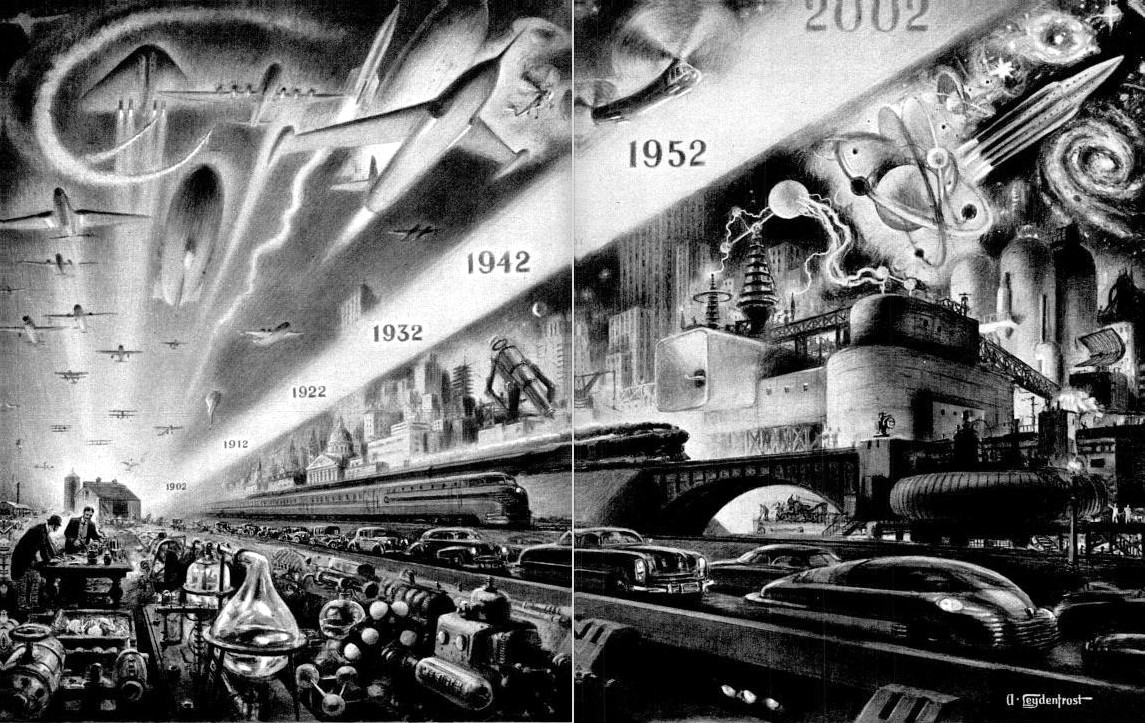
Random Musing – The March of Progress in a Campaign World

This notion just struck me a few moments ago, so I figured I’d put it down on pixel while it was fresh in my mind. I was thinking about the transition of a medieval-style fantasy campaign world, my own in fact, to a Renaissance level of technology and society – nation states, masses of firearm-armed men-at-arms, printing presses – and then to higher levels of advancement – the Victorian Age, etc. Invention in most fantasy game rules, at least in terms of invention by PCs,  is relegated to the creation of new spells. Naturally, a Referee’s NPCs can invent anything they want, but if we assume that everybody in the world uses the same spell creation rules, the more high level magic-users there are, the more spells will be invented. In my own world, I have the Scientist class, so the same concept would hold in NOD for pseudo-scientific inventions.

Therefore, while invention in our world has generally relied on the strength of civilizations and their ability to share information and amass resources, the march of progress in a fantasy world would rely on the existence of powerful monsters and hidden treasures – the very things that provide experience points for adventuring magic-users and scientists. Now, again, I know that NPCs aren’t shackled by the same rules as PCs in most old school fantasy, but bear with me – this is just a matter of a guy following an idea around to see where it goes. So, if we take the necessity of powerful monsters as the basis for invention, as a campaign world’s PCs gradually whittle down the powerful adversaries, the pace of new inventions should slow down. As civilization expands in a campaign world, invention slows down – an interesting concept.

It also occurs to me that as all those high level and mid-level monsters – the more unique sorts that don’t multiply like rabbits (or goblins) – are killed off and as large treasures are discovered, the ability of any PC to advance in level becomes restricted. Once you get past the lower levels, not being able to take out mid-level monsters means getting through those mid-levels becomes much harder, and it makes those few powerful monsters that avoided the old high-level PCs more secure. Maybe the natural evolution of a fantasy world would be:

1. Small civilizations, lots of wilderness, many monsters, high potential for high level advancement.

2. Mid-sized civilizations, less wilderness, fewer powerful monsters, less potential for high level advancement.

3. Large civilizations, very little wilderness, very few powerful monsters, almost no potential for high level advancement.

Once you enter stage 3, the likelihood of powerful monsters laying waste to civilization might be pretty high, sending the fantasy world back to stage one and setting the scene for all these old school campaigns where low-tech civilizations always seem to be built on the ruins of ancient high-tech civilizations.

Illustration by Alexander Leydenfrost

Random Musings of the Day

Item One
This …

… is cool. Eric Canete – check him out, won’t you. He’ll show up on Deviant Friday sooner or later. Never watched much of the old Gargoyles cartoon, but I can certainly get behind Demona.

Item Two
Are pen and paper games ahead of the curve? Consider – in the case of rules-lite games, you have a slim set of rules to which you can add modules/house rules (i.e. apps) to build the experience you want, as opposed to something like Warcraft, which offers some pretty cool features, but forces everyone into the same experience. Want the ability to fly around on dragons and joust – no problem in Rules-Lite Pen and Paper – heck, somebody probably already wrote some rules for that. Want to do it in Warcraft (and honestly, maybe you already can – I have no idea) – you’ll need to ask and they’ll need to put it in a list of things to do and then debate on whether this is an idea that will be popular with everyone – oh, and you’ll need to have a subscription of some sort. Most rules-lite and rules-lite supplements are either free or very cheap. Maybe pen and paper has a brighter future than we all thought in a world of program-it-yourself entertainment?

Item Three

Random Thoughts Table (Roll D4)

1. Did I remember to extinguish the hearth before I left on this quest?
2. You know, I really like pretzels.
3. Is that idiot seriously going to tap that damn 10-ft pole on every floor tile in this hallway?
4. I should totally stab the thief in the back – he’d never see it coming.

My best friend drew up a random table for one of his characters (Rygar the Last), which included things like accidentally discharging his crossbow. Good times.

Item Four
Anyone want to trade a black and white illo for NOD #6 for a full page ad of their choice in the magazine. I’m writing up the next level of Izrigul’s Pleasure Palace (the best – and only – multi-level dungeon ever published in NOD). The whole level was designed as a theater by the demon Izrigul and features two factions at eternal (and pointless) war with one another. The troops on one side are tieflings in the style of Spanish soldiers from the 17th century armed with staffs that shoot rockets/sparks and sabers. The other side is composed of bugbears with snow white hair in the style of the powdered wigs of the time, wielding halberds and hand axes and dressed like 18th century French soldiers. I’d love a pic of one facing off against the other. Think opera/ballet meets D&D. Email me if you’re willing and able.

That’s all for today – much writing to do …

Random Thought – Character Survivability & Game Design

Okay – it seems that one of the things modern game designers like is characters that last more than 5 or 10 minutes. The (almost) latest iteration of D&D, for example, seems to start characters out at a much higher power level than the old games. Part of this desire for survivability comes, I assume, from a desire to get young folks into the game. After all, kids don’t enjoy losing and if their first experience with a game is to spend time making an awesome character only to have them slain by the first kobold they see, they might shy away from the game and spend their allowance on penny candy and baseball cards (or whatever kids these days favor) instead of dozens of splat books. So, the thinking goes, the rules need to be changed to make the game more survivable at low levels. Wrong.

I started playing D&D when I was 12. My friends and I would spend lots of time trying to roll up awesome characters. This was AD&D, so I’m talking paladins and rangers here. The scores needed to get these characters were pretty hard to achieve, but we managed to do it more often than not using the age old trick of … cheating! We fudged our rolls to get the characters we wanted, and then we fudged them some more to keep them alive. Scandalous, I know – but there it is. Designing a game to appeal to children (or, God forbid, adults) by making it easier is silly, because children can easily solve the problem of survivability and awesome characters by cheating their little heads off. You don’t need to corrupt your rules and throw the system off by making the cheats official – just make your game and let the chips fall where they may. Heck – the only reason paladins and rangers were ever worth cheating to play was because they were so dang hard to roll up fairly.

Something to think about …

Thinking About Experience and Levels

First, I’ll declare right off that I’m okay with Experience Points and Levels just as they are. However, I got to thinking about how BRP advances skills that you use during an adventure by having you roll percentage dice at the end of the adventure and advancing the skill if you roll over it – thus, as you get better at something it becomes harder for you to get better still.

So, what if you had a rating for, say, Fighting and Magic, beginning at 10. Levels in fighting-man and magic-user and other classes are then pegged to ratings for Fighting and Magic (and/or other categories, whatever makes sense in a particular game). So, to become a 2nd level fighting-man, you might need a Fighting rating of 20. At the end of a session of play, you roll your percentile dice, and if you roll above your current rating, you increase your rating by 1 or 2 or 5 points – whatever the Referee is comfortable with. I think 2 would be a good number. When your Fighting rating hits 20, you become a 2nd level fighter. Likewise, magic-users rely on their magic rating. Clerics, on the other hand, might need ratings in both Fighting and Magic, say a 18 in Fighting and a 16 in Magic to advance to 2nd level.

Just a random thought inspired by the idea of “roll to advance”.

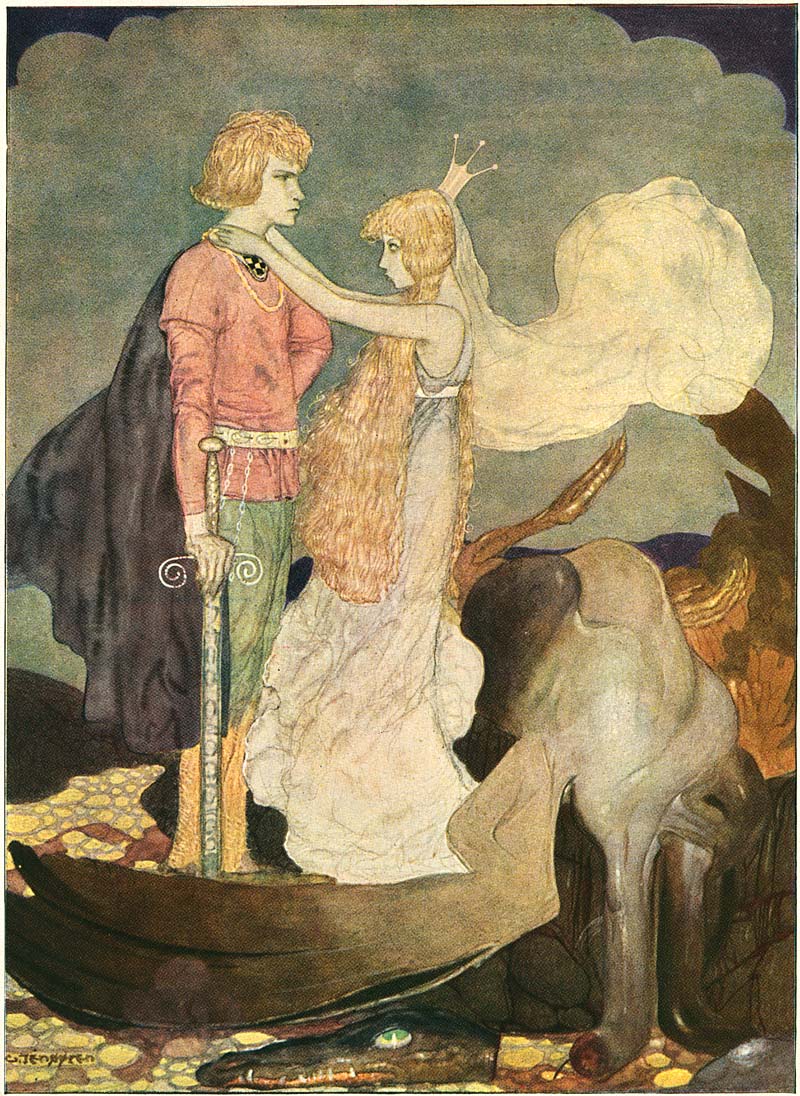
Art by Gustaf Tenggren, illustration for Grimm’s Fairy Tales in 1923