Thoughts on the City of Dis [Hellcrawl]

Dis presents a unique challenge for the Hellcrawl, as it is a city that dwarfs anything mankind has ever known. Mapping it would be impossible, and producing enough unique encounters to fill its streets would take more time than I can possibly devote to the task.

For that reason, Dis is going to lean more heavily on randomization than the other cities I’ve presented in NOD.

For geography, Dis will rely on a deck of playing cards. As players enter Dis, the Refeee will lay down a card in such a way that everyone can see it. The card’s suit determines the general activity of that “block” of the city, while the number will determine the level of that activity and thus the likelihood of adventurers being caught up in it. The common cards in the deck represent something akin to suburbs, while the “face” cards represent city cores, each governed by a different arch-devil or demon lord of Hell.

Clubs = Magic – illusions, alchemical experiments, magic storms, wizard wars

Diamonds = Commerce – con-men, slavers, thieves, doxies, hucksters, beggars, merchants selling indulgences and buying souls

Hearts = Religious Fervor – unholy preachers, sacrifices, religious processions, gruesome holidays and festivals

Spades = Violence – duelists, gladiators, angry mobs, gang wars, armies fighting street to street or besieging a small castle, etc.

Each hex of Dis is taken up by four cards, placed thus:

Dis is generally three hexes thick, so winning through the other side of Dis will involve, at a minimum, navigating through six cards. Naturally, this isn’t as easy as it sounds.

The streets of Hell are mazelike, so finding one’s way through is difficult. Unlocking each maze depends on the wisdom of the party members. The wisdom totals are added together and divided by two. This is the percentage chance that the party members can navigate through the maze. If they fail, they can remain where they are and try again tomorrow – though that means finding lodging and dealing with the possibility of frightening urban encounters. They can also go back the way they came.

Becoming lost in Dis is not just a matter of physically finding one’s way through the city – it also represents becoming spiritually lost. When a group becomes lost, the member with the current highest wisdom score loses 1d4 points of wisdom. If their wisdom score is reduced to a 9 or lower, they begin to question the value of virtue and become more attracted to vice. If their wisdom is reduced to 3 or lower, they become enmeshed in sin and take on the chaotic alignment. If their wisdom is reduced to 0, they become one of the undead citizens of Dis (those citizens will be given more detail in the actual article) and they cease attempting to escape.

If a group’s wisdom roll is successful, they find 1d3 exits from the current block they are in, allowing them to move in one of three directions to another card.

1 Exit – you can move right or left (50% chance of either)
2 Exits – you can move right or left
3 Exits – you can move right, left or forward

The higher the value of the card, the more difficult it is to find one’s way.

To finally escape Dis, one must win their way to the other side and hire transport to the next circle. In Dante’s Inferno, this transport is provided by Geryon. In Stater’s Inferno, it is provided by any number of contrivances, but whatever the method, one must show a silver key. These keys might rarely be found on random encounters (and there are many counterfeit keys), but they are most often won by providing services to one of the arch-devils or demon lords of the city. The only way to escape Dis is to become involved in the politics of the place – a tricky thing indeed, and sure to wear on one’s soul.

Among the lords of Dis (most are courtiers and bureaucrats) are Medusa, Titivilus, Adramalech, Astaroth, Behemoth, Buer, Leonard, Glasya-Labolas and, of course, Dispater, the grim king and final authority of the city (or so he thinks). Dis also holds the parliament of Hell, Pandaemonium.

The look of Dis will differ from block to block, from heaping ruins to the cobblestone streets of Dickensian London to Hell’s Kitchen to Babylon to the soulless blocks of buildings of Soviet-era Russia. There are streets of embers, canals of magma and more than enough horrors to keep a party of adventurers busy for a session or two.

Stygian Depths – Dark Diplomats, a Fierce Tomb and Macrosian of the Long Shadow!

Illustration by Sidney Sime, because you never need a reason to post a Sime piece!

A few more from Stygia! NOD 14 is pretty much on schedule. I’m 95% finished writing the Stygia hellcrawl, and am ready to tackle the city of Dis. I’ll post my thoughts on Dis tomorrow.

43.69 Diplomats: There is a vast expanse of mud flats here. The mud is fairly solid, though strange, burrowing worms sometimes push up from the mud, “stare” vacantly at passers-by and then disappear once again. Ten rusty, iron pylons form a gathering in the mud flats, each one a bit tilted. They are, at the moment, occupied by a ten bat monsters, envoys of Bael who are hearing the pleas of a diplomat of Adamantia, one of the Queens of Elemental Earth. The diplomat, if anyone so brusque can be called a diplomat, is an elder xorn called Xaanon. He has been accompanied by six normal xorn, and they are demanding that the soul of a wicked elementalist who did much harm to their people be turned over to Adamantia for proper punishment. Bael is not inclined to agree, though he is willing to make a deal that Queen Diamond will probably find repugnant.

48.31 Macrosian: A tower made of nightmares – surging and writhing like a tower of crimsons, ambers, golds and bilious greens, screaming or weeping faces appearing and then dis-appearing on the surface – stands here, overlooking a dismal landscape of frothy water and black claws that might once have been trees. The tower seems solid enough, despite its moving surface, and it has a wide door composed of black oak embossed with a golden eye.

To enter, one must simply push through the door, saving as they do against a nightmare spell. Inside, they find themselves in a throne room with walls lined with books (most are false, containing only the screaming faces of damned souls that attempt to steal levels per a wraith). In the middle of the room there is a throne of built of metal cubes, shimmering with peacock brilliance. One’s footsteps echo in the chamber and the air is so still it almost strangles a person’s words before they can utter them. Spiral stairs of hepatizon rise from the four corners of the throne room to other chambers and halls.

When a person enters the tower, a shadow version of them emerges from the wall. These shadow clones (the effect is similar to greater shadow conjuration or greater shadow monsters) act very much like their doubles, but one of them, randomly, is possessed by the spirit of Macrosian – He of the Long Shadow – a powerful sorcerer (Mage 17; 44 hp) consigned to Hell. Macrosian seeks to conjure the Typhon from its slumber in the abyssal depths.

The tower is inhabited by hundreds of shadow people, the clones of people who have passed through, and any one of them could be Macrosian. He speaks with a thunderous whisper, and it is through his speech that one can identify him. He can move from body to body at will, and is canny enough to take on the mannerisms of the person he is, at that moment, possessing.

53.80 Athachs: A pair of athachs are clumsily working their way through a village of mostly ruined brick hovels in search of a very special child. The inhabitants of the hovels are twisted, little grey men and women in dirty smocks who seem to make a living raising cabbages. The child was found by them in the swamp. He is a frail lad of about 7 years with opalescent skin that gives off a coiling green mist and completely black eyes that mirror one’s soul.

56.30 Bronze Tomb: On a high, flat mound of earth, surrounded by a picket of bronze spears, there is a tomb of bronze in the shape of a demon with a distended belly. The demon sits in a squatting position and its clawed arms drag the ground at its sides. The demon’s belly is made of glass – in fact, it is actually a sphere of glass about 3 inches thick and mingled with silver dust. This sphere is filled with a pale, grey ichor and floating in it is the preserved corpse of a murderess. The corpse is in a fetal position, clinging to an iron chest, her black hair fanning out in the weird liquid.

A flight of harpies protect the tomb, swooping down on any who would disturb it within 3d6 rounds of their first approaching the tomb. The tomb is also capable of defending itself, for the wicked soul within it can animate the monstrosity, making it arise and flail at tomb robbers with its claws.

Stygian Depths – Hellcrawl Preview III

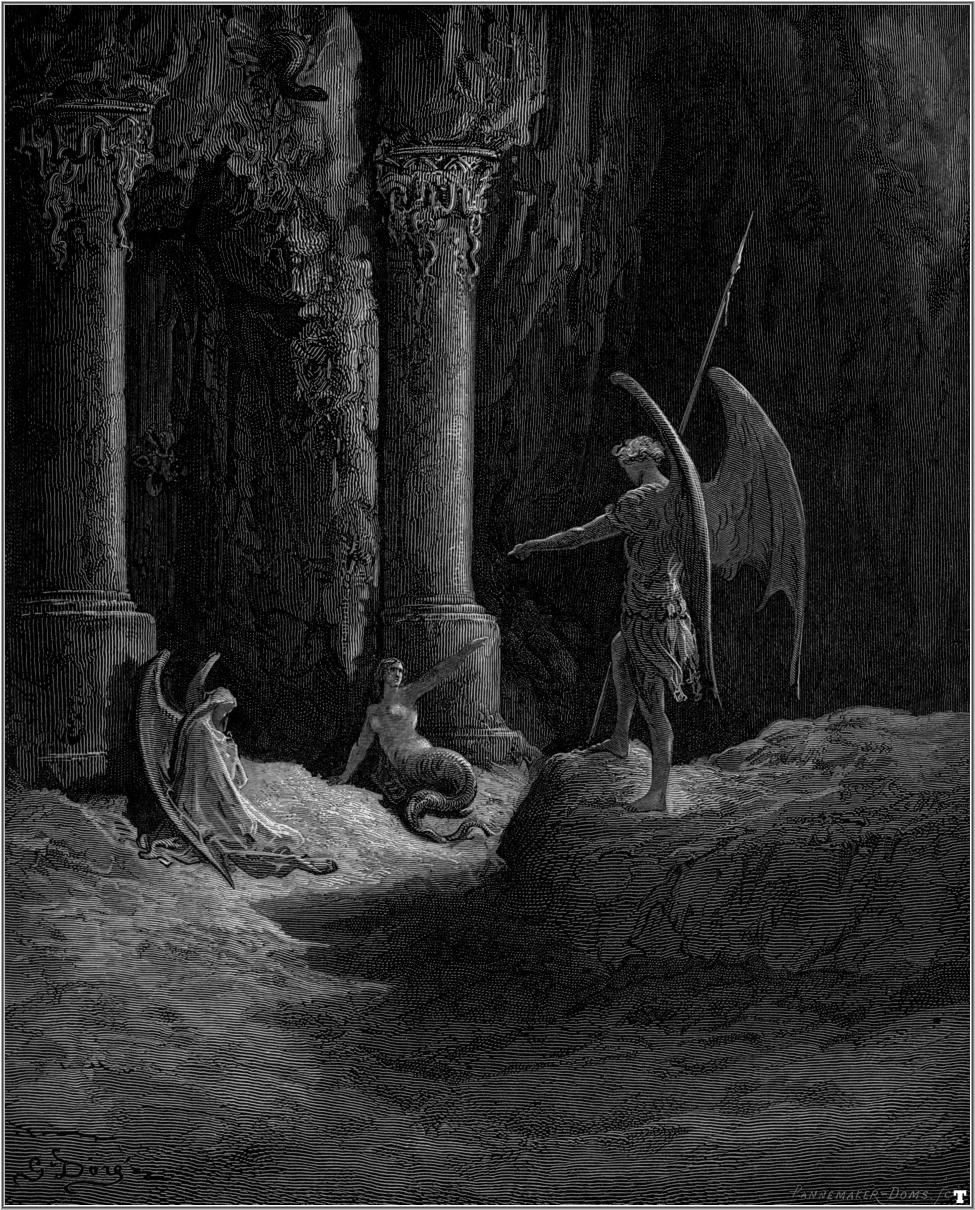
Gustave Dore – Satan talks to his children, Sin and Death

37.41 Ossuary: A muddy little island here is topped by a stone building about 30 feet wide and 100 feet long, with a peaked roof that is also made of stone. The building is sealed by double doors of polished oak that bear four brass medallions, each one depicting a grinning skull. The door opens easily.

The building within is composed of a single large chamber wracked with thunder and lightning. As soon as the doors are opened, the storm spills out from the building, with almost hurricane force winds that make closing the doors very difficult. The winds swirl around the building, forming clouds in the sky overhead. After one minute, the clouds erupt in lightning (per the call lightning spell cast by a 20th level druid). The storm soon covers the entire hex, and an hour later expands into all of the surrounding hexes. If the doors are closed, the storm soon ceases.

Inside the building, there are stored hundreds of skulls engraved with glyphs and runes that emit a phosphorescent glow. Each round, there is a 1 in 6 chance that the skulls, which are blown around the room by the violent winds, swarm around the adventurers and attack.

If a skull is removed from the ossuary, its animation ceases and it gives its bearer the power to cast control weather and call lightning once per day.

SKULL SWARM: HD 12; AC 1 [18]; Atk 3 vicious bites (1d8); Move F15; Save 3; CL/XP 15/2900; Special: +1 or better weapon to hit, immune to electricity, half damage from bludgeoning weapons, 1 point of damage from slashing and piercing weapons.

38.70 Temple of Sin: There is a temple here, standing above the swamp waters on vaulted granite legs. Will-o-the-wisps swarm beneath the temple and around these legs, tracing out glyphs of warding (no magical power) to frighten away travelers.

One enters the massive structure by catching hold of a barbed chain (holding it inflicts 1d4 points of damage per round) and climbing 20 feet up to an alcove in the wall that holds an iron door. There are a dozen such doors, each looking like the monumental brass of a warrior king.

The temple proper is a tall stone building covered with patches of purple moss; it is about 40 feet wide and 200 feet long with a ceiling 30 feet high. The temple holds an idol to Lucifer’s daughter, Sin. From this sanctum, there are six portcullis-barred tunnels (three per side) leading back into the living quarters of the thirty hobgoblin priests of the temple and their mistress, the so-called Woman of Many Faces.

The Woman of Many Faces is just that, a humanoid woman with coppery skin and wearing heavy black robes. She has no face, the front of her head being perfectly smooth and flat. She has five artificial faces that she can hold up to her face, as one holds up a mask, and animate. These are her porcelain face of beauty (cast charm monster and suggestion), emerald face of envy (cast mage’s lucubration and transformation), her ruby face of rage (cast flame strike and rage), her iron face of war (cast ironskin and spiritual weapon) and her wooden face of contemplation (cast augury and divination).

42.38 Bodikar, High Inquisitor: The necromancer Bodikar (Mage 16; 43 hp) occupies a tower of granite faced with sheets of beaten bronze. He serves as the chief inquisitor of Bael, seeking out high-ranking demons who may be disloyal to Bael and putting them through trials and eventual imprisonment and torture. Torturing a demon is, of course, a tricky thing to do.

The offenders have strange metal boxes strapped to their heads. The surfaces of these boxes look into the Empyrean Heaven (per a crystal ball), showing them a world they may never visit again. All the while, lumpy green energy leeches draw their vitality from them, making them as weak as humans. When the leeches grow fat, they are removed from the demons and polymorphed by Bodikar into amber globes that hold the devils’ ichor and a portion of their power.

Bodikar uses these globes to create clones of some of the devils and demons that are loyal to him above all else. Other globes are retained as ingredients for potions or to be used as splash weapons, the ichor acting as flaming oil that causes double damage to lawful creatures.

Stygian Depths – Hellcrawl Preview II

Writing has begun in earnest on the Stygia portion of the Hellcrawl. Here are some samples of what I’ve written so far.

33.50 Tree Temple: The mangroves here grow to a truly enormous size. A city of 500 frog men is built in the tree tops, centered around an abbey dedicated to Tsathogga. Their matriarch is an engorged female frog man, bedecked in amber beads and holding in her hands two crystal balls, each one colored bright green with a white, star shape in the center that spins and waxes and wanes. Though they appear identical, one seems to promise security and safety, while the other promises unending struggle and chaos. As soon as people enter the temple their gaze must be drawn to one or the other.

Those who choose safety and security gain the ability to commune with Tsathogga once per day, but whatever advice he gives, they must obey. Those who choose unending struggle have chosen life, and suffer no ill effects other than the ire of the frog men, who attempt to sacrifice those who reject the fatherhood of Tsathogga in his name, hosting a grand feast of them for those who have chosen Tsathogga’s blessings.

34.59 Love Shack: A red, serpentine dragon courses through the mud, battering down trees as it does so. When it spots travelers, it slinks close and opens its great mouth, revealing a door of ruby crystal. It waits patiently for 1 turn to allow people to enter the door, and then moves on.

Beyond the door there is a grand hall of red velvet and marble floors. The spirits of jealous, bitter lovers slink by the walls, hissing at travelers. The twisting hall leads to a shrine in which there is a throne of green stone. Sitting on the throne there is a handsome youth who looks much like Cupid, but has glowing green eyes and pincers in place of hands. This is Phthonus, a daimon of jealousy who stirs the fires of love and unleashes it in violent passions.

36.48 Flooded Temple: A sinkhole here might send unlucky travelers into a series of flooded caverns. The largest of them holds an ancient, partially ruined temple. The temple is composed of blocks of lapis lazuli. The temple is dedicated to Omoo, a sahuagin goddess regarded as the mother of the species. The idol holds a statue depicting the demon lord Dagon simultaneously copulating with and tearing apart Omoo, whose blood, according to the myths of the sahuagin, turned into the first sahuagin, who then fed on her flesh and drew on her powers. A reliquary hidden in a dungeon beneath the temple holds her dismembered hand, which gives the bearer command over sahuagins, sharks and rays and denies creatures struck by it the ability to regenerate for 24 hours. If the hand is planted, it grows into five fiendish sahuagin warrior-maids who persist for as long as they are fed the blood of their summoner. They obey their summoner loyally.

A Fantasy Cosmos

While writing (or, to some degree, copy/pasting from the SRD) Blood & Treasure the other day, I finally came to the section on the planes. I decided, for a sample cosmos (and I do mean sample – there is no official cosmology for Blood & Treasure), to present something like the one I use for NOD. I thought folks might like to see it, but note – it lacks a mention of Hell or the Firmament at the moment.

ONE POSSIBLE COSMOLOGY

This cosmology of planes is inspired by the old Ptolomaic view of the universe, i.e. The Earth at the center of the universe surrounded by “crystalline spheres” containing the different planets and beyond them the Empyrean Heaven of God and the angels. At the center of Earth lies Hell, essentially a plane within a plane.

In this conception, the Ethereal Plane extends beyond Earth to the Moon, but no further. The Astral Plane extends throughout the entire universe, to the borders of the Empyrean Heaven.
All of the planes (i.e. planets) in this cosmology other than the Empyrean Heaven are self-contained spheres. Heaven is infinite.

EARTH AND THE MOON (MATERIAL PLANE)
Earth and the Moon are the Material Plane, the center of the universe. The Moon differs from Earth only in that it is mildly-chaotic. They define what is considered normal. The Material Plane has the following traits:

• Normal gravity.

• Normal Time

• Alterable morphic.

• No Elemental or Energy Traits (specific locations may have these traits, however)

• Mildly neutral-aligned (mildly chaos-aligned for the Moon).

• Normal magic.

THE ETHEREAL PLANE
The Ethereal Plane is coexistent with the Material Plane and the plane of Luna. The Material Plane itself is visible from the Ethereal Plane, but it appears muted and indistinct, its colors blurring into each other and its edges turning fuzzy.

While it is possible to see into the Material Plane from the Ethereal Plane, the Ethereal Plane is usually invisible to those on the Material Plane. Normally, creatures on the Ethereal Plane cannot attack creatures on the Material Plane, and vice versa. A traveler on the Ethereal Plane is invisible, incorporeal, and silent to someone on the Material Plane.

The Ethereal Plane is mostly empty of structures and impediments. However, the plane has its own inhabitants. Some of these are other ethereal travelers, but the ghosts found here pose a particular peril to those who walk the fog.
It has the following traits.

• No gravity.

• Alterable morphic. The plane contains little to alter, however.

• Mildly neutral-aligned.

• Normal magic. Spells function normally on the Ethereal Plane, though they do not cross into the Material Plane. The only exceptions are spells and spell-like abilities that have the force descriptor and abjuration spells that affect ethereal beings. Spellcasters on the Material Plane must have some way to detect foes on the Ethereal Plane before targeting them with force-based spells, of course. While it’s possible to hit ethereal enemies with a force spell cast on the Material Plane, the reverse isn’t possible. No magical attacks cross from the Ethereal Plane to the Material Plane, including force attacks.

PLANE OF SHADOW
The Plane of Shadow is a dimly lit dimension that is both coterminous to and coexistent with the Material Plane. It overlaps the Material Plane much as the Ethereal Plane does, so a planar traveler can use the Plane of Shadow to cover great distances quickly.

The Plane of Shadow is also coterminous to other planes. With the right spell, a character can use the Plane of Shadow to visit other realities.

The Plane of Shadow is a world of black and white; color itself has been bleached from the environment. It is otherwise appears similar to the Material Plane.

Despite the lack of light sources, various plants, animals, and humanoids call the Plane of Shadow home.

The Plane of Shadow is magically morphic, and parts continually flow onto other planes. As a result, creating a precise map of the plane is next to impossible, despite the presence of landmarks.

The Plane of Shadow has the following traits.

• Magically morphic. Certain spells modify the base material of the Plane of Shadow. The utility and power of these spells within the Plane of Shadow make them particularly useful for explorers and natives alike.

• Mildly neutral-aligned.

• Enhanced magic. Spells of shadow are enhanced on the Plane of Shadow. Such spells are cast as though they were prepared with the Maximize Spell feat. Shadow conjuration and shadow evocation spells are 30% as powerful as the conjurations and evocations they mimic (as opposed to 20%). Greater shadow conjuration and greater shadow evocation are 70% as powerful (not 60%), and a shades spell conjures at 90% of the power of the original (not 80%).

• Impeded magic. Spells that use or generate light or fire may fizzle when cast on the Plane of Shadow. Spells that produce light are less effective in general, because all light sources have their ranges halved here. Despite the dark nature of the Plane of Shadow, spells that produce, use, or manipulate darkness are unaffected by the plane.

THE ASTRAL PLANE
The Astral Plane is the space between the planes. When a character moves through an interplanar portal or projects her spirit to a different plane of existence, she travels through the Astral Plane. Spells that allow instantaneous movement across a plane briefly touch the Astral Plane.

The Astral Plane is a great, endless sphere of clear silvery sky, both above and below. Occasional bits of solid matter can be found here, but most of the Astral Plane is an endless, open domain. Both planar travelers and refugees from other planes call the Astral Plane home.

The Astral Plane has the following traits.

• Subjective directional gravity.

• Timeless. Age, hunger, thirst, poison, and natural healing don’t function in the Astral Plane, though they resume functioning when the traveler leaves the Astral Plane.

• Mildly neutral-aligned.

• Enhanced magic. All spells and spell-like abilities used within the Astral Plane may be employed as if they were improved by the Quicken Spell feat. Already quickened spells and spell-like abilities are unaffected, as are spells from magic items. Spells so quickened are still prepared and cast at their unmodified level. As with the Quicken Spell feat, only one quickened spell can be cast per round.

MERCURY (ELEMENTAL PLANE OF EARTH)
Mercury is a solid sphere of rock and metal burrowed through by a multitude if tunnels and caverns. An unwary and unprepared traveler to Mercury may find himself entombed within this vast solidity of material and have his life crushed into nothingness, his powdered remains a warning to any foolish enough to follow.

Despite its solid, unyielding nature, Mercury is varied in its consistency, ranging from soft soil to veins of heavier and more valuable metal.

Mercury has the following traits.

• Earth-dominant.

• Enhanced magic. Spells and spell-like abilities that use, manipulate, or create earth or stone are both empowered and extended (as if the Empower Spell and Extend Spell metamagic feats had been used on them). Spells and spell-like abilities that are already empowered or extended are unaffected by this benefit.

• Impeded magic. Spells and spell-like abilities that use or create air (including spells that summon air elementals or outsiders with the air subtype) are impeded.

VENUS (POSITIVE ENERGY PLANE)
Venus is a lush world of brilliant, almost blinding color and overgrown vegetation and animals. Some area of the plane are so fertile that entering them can actually cause a person to explode with life.

Venus has the following traits.

• Normal gravity.

• Minor positive-dominant. Some regions of the plane have the major positive-dominant trait instead, and those islands may be inhabited by various divinities of fertility and life.

• Enhanced magic. Spells and spell-like abilities that use positive energy, including cure spells, are maximized (as if the Maximize Spell metamagic feat had been used on them). Spells and spell-like abilities that are already maximized are unaffected by this benefit. Class abilities that use positive energy, such as turning and destroying undead, gain a +10 bonus on the roll to determine Hit Dice affected.

• Impeded magic. Spells and spell-like abilities that use negative energy (including inflict spells) are impeded.

MARS (PLANE OF NEUTRALITY)
Mars is an earth-like plane dedicated to neutrality in the war between Law and Chaos. It is a small sphere and taken up by red, sandstone hills, shallow, salty seas, lowlands of red, tuberous plants watered by vast canals and gleaming, ancient cities slowly falling into ruin. The various people of Mars are warriors who glory in combat.

Mars has the following traits.

• Light gravity.

• Strongly neutral-aligned. Lawfuls and chaotic suffer a -2 penalty to reaction checks and to intelligence- and wisdom-based checks.

• Limited magic. The following spells operate normally on Mars: Detect thoughts (ESP), xxx. All other spells fail to operate here.

• Flowing time. Time passes more quickly on Mars than the Material Plane. A year spent on Mars corresponds to a day on the Material Plane.

SUN (ELEMENTAL PLANE OF FIRE)
Everything is alight on the Sun. The ground is nothing more than great, evershifting plates of compressed flame. The air ripples with the heat of continual firestorms, and the most common liquid is magma, not water. The oceans are made of liquid flame, and the mountains ooze with molten lava. Fire survives here without need for fuel or air, but flammables brought onto the plane are consumed readily.

The Sun has the following traits.

• Fire-dominant.

• Enhanced magic. Spells and spell-like abilities with the fire descriptor are both maximized and enlarged (as if the Maximize Spell and Enlarge Spell had been used on them). Spells and spell-like abilities that are already maximized or enlarged are unaffected by this benefit.

• Impeded magic. Spells and spell-like abilities that use or create water (including spells that summon water elementals or outsiders with the water subtype) are impeded.

JUPITER (ELEMENTAL PLANE OF AIR)
Jupiter is a giant spheric plane of air. At the heart of Jupiter there is a core of iron and adamantine, and there are other bits of solid ground and water vapor floating amid the endless, roiling skies of Jupiter.

Jupiter is the home of all manner of airborne creatures. Indeed, flying creatures find themselves at a great advantage on this plane. While travelers without flight can survive easily here, they are at a disadvantage.

Jupiter has the following traits.

• Subjective directional gravity. Inhabitants of the plane determine their own “down” direction. Objects not under the motive force of others do not move.

• Air-dominant.

• Enhanced magic. Spells and spell-like abilities that use, manipulate, or create air are both empowered and enlarged (as if the Empower Spell and Enlarge Spell metamagic feats had been used on them).

• Impeded magic. Spells and spell-like abilities that use or create earth (including spells that summon earth elementals or earth-based outsiders) are impeded.

SATURN (PLANE OF CHAOS)
Saturn is a plane infused with chaos, and therefore quite alien to most folk of the Material Plane. It is covered by all manner of fascinating land-scapes, including ashen plains cut by streams of mercury, swamps of sentient ooze, thickets of mineral plants like sheaves of swords and towering mountains of vapor, all under a greenish-black sky illuminated by the plane’s wondrous rings from which ioun stones are plucked.

Saturn has the following traits:

• Strongly chaos-aligned. Lawfuls suffer a -2 penalty to reaction checks and to intelligence- and wisdom-based checks.

• Wild magic.

NEPTUNE (ELEMENTAL PLANE OF WATER)
Neptune is a sea without a floor or a surface; an entirely fluid sphere lit by a diffuse glow. It is one of the more hospitable of the Inner Planes once a traveler gets past the problem of breathing.

The eternal oceans of this plane vary between ice cold and boiling hot, between saline and fresh. They are perpetually in motion, wracked by currents and tides. The plane’s permanent settlements form around bits of flotsam and jetsam suspended within this endless liquid. These settlements drift on the tides of the plane of Neptune.

Neptune has the following traits.

• Subjective directional gravity. The gravity here works similar to that of the Elemental Plane of Air. But sinking or rising on the Elemental Plane of Water is slower (and less dangerous) than on the Elemental Plane of Air.

• Water-dominant.

• Enhanced magic. Spells and spell-like abilities that use or create water are both extended and enlarged (as if the Extend Spell and Enlarge Spell metamagic feats had been used on them). Spells and spell-like abilities that are already extended or enlarged are unaffected by this benefit.

• Impeded magic. Spells and spell-like abilities with the fire descriptor are impeded.

URANUS (PLANE OF LAW)
Uranus is the opposite of Saturn, a plane of law and perfection. Uranus has the same landscapes as the Material Plane, but they are each perfect and slightly angular, often repetitious, as though made by the will of a single artist. The skies and landscapes of Uranus all carry a metallic hue – warm coppers, brilliant silvers and dazzling golds.
Uranus has the following traits:

• Strongly law-aligned. Chaotics suffer a -2 penalty to reaction checks and to intelligence- and wisdom-based checks.

• Static. Uranus cannot be altered by visitors.

• Timeless. Time does not flow on Uranus.

PLUTO (NEGATIVE ENERGY PLANE)
To an observer, there’s little to see on Pluto. It is a dark, empty place, an eternal pit where a traveler can fall until the plane itself steals away all light and life. Pluto is the most hostile of the planets, and the most uncaring and intolerant of life. Only creatures immune to its life-draining energies can survive there.

Pluto has the following traits.

• Subjective directional gravity.

• Major negative-dominant. Some areas within the plane have only the minor negative-dominant trait, and these islands tend to be inhabited.

• Enhanced magic. Spells and spell-like abilities that use negative energy are maximized. Spells and spell-like abilities that are already maximized are unaffected by this benefit. Class abilities that use negative energy, such as rebuking and controlling undead, gain a +10 bonus on the roll.

• Impeded magic. Spells and spell-like abilities that use positive energy, including cure spells, are impeded. Characters on this plane take a –10 penalty on Fortitude saving throws made to regain lost levels from a life drain attack.

Into Stygia … Preview 1 Again!

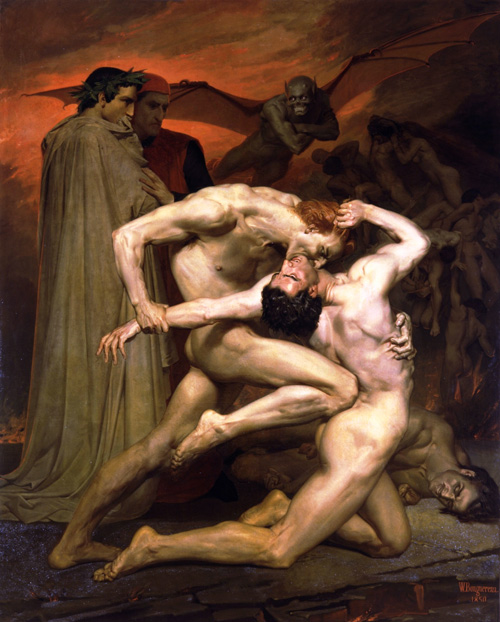
Is it me, or is that demon photo-bombing those fighting naked dudes?

Well, you’ve seen the sketch of Stygia a bit earlier … now the finished product.

STYGIA
As one passes from hot, dry Gehenna into cool, damp Stygia, the metallic sands beneath their feet harden and become a plain of swirling metals. This plain abruptly ends in a metal cliff, perfectly smooth and angular, as though cut by a die. One mile below the top of this cliff lies the murky swamp of Stygia, a land of mangrove swamps (though such mangrove trees one has never seen on the surface, with trees so twisted and black that even a druid would be compelled to grab and axe and fell the lot of them) mud flats, rocky, vine-choked promontories and always the thick, reddish water, so much like blood, that sucks and laps at the swampy shores. Eventually, the islands in the swamp become less and less, and finally one enters the sluggish, crimson River Styx. Beyond the Styx, of course, lie the battered walls of Dis, the great metropolis of Hell in which lies Pandaemonium, their parliament, and the manors and manses of the lords of Hell.

Stygia is the fifth circle of Hell, given over to the souls of the wrathful and forlorn. It is swathed in darkness both physical and spiritual, and sits upon a base of black mud. Wallowing in this mud, incapable of escape, are the souls of the wrathful, who look much as they did in life, but with faces twisted with unending ire. Beneath their feet are trampled the souls of the sullen and forlorn, who choke eternally on the mud and seek to pull others into it.

Stygia is an eternal battleground between two great princes of Hell, Bael and Dagon. Ancient enemies, they launch their forces against one another in an unending farce, for Bael rules the land and has no use for the waters of the Styx, while Dagon rules the Styx and has no use for the land above. One cannot use what the other possesses, but desires it just the same.

Dangers of Stygia

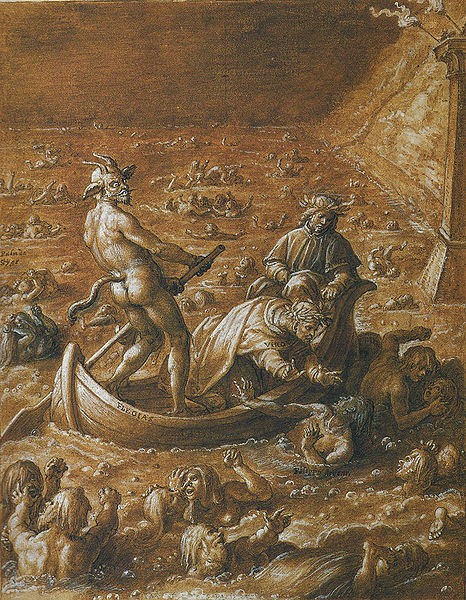
Crossing Stygia: Stygia is a difficult terrain to move through, for it requires a boat, skiff or raft of some sort, and such an item is not readily available when one first enters the swamp. One might wait for Phlegyas, the boatman of the Styx, to arrive, but his price is a heavy one – a portion of one’s soul (and impossible gift for those of lawful alignment) and a service to be granted at some point in the future. We’ll discuss Phlegyas more below.

Wrathful and Sullen: Assuming one is not ferried across Stygia, one must pole themselves across the landscape. The channels of Stygia are treacherous and ever-shifting. When one seeks passage from one hex into another, one must roll a die to see what passage they find:

ROLL PASSAGE
1-2 No passage by water – one must walk and leave their craft behind
3-5 A narrow channel (see below)
6 A wide channel (see below)

Wide channels are also deep and the safest routes for travel (though random encounters may occur there as well as anywhere else). Narrow, shallow channels, on the other hand, are clogged with the souls of the wrathful and sullen.

Those who travel a narrow channel have a 1 in 6 chance per mile (roll 1d4 to determine the length of the channel) of being beset by these creatures. Each person so attacked must pass a saving throw or be grappled by 1d4 wrathful. They are incredible powerful, making grapple attacks with a bonus of +3. If they get a hold, they then attempt (also with grapple attacks) to pull a person into the water. Each successful attack deals 1d4 points of damage. A successful grapple attack on a person already grappled drags them into the water and muck.

Each round, 1d4 more wrathful will attempt to grab a person not already dragged into the water (and each of their companions, so delayed, must make another saving throw to avoid the same fate). No more than six wrathful can grapple a person at one time.
If a person is dragged into the water and mud, they are then grappled by 1d6 of the sullen, who lie beneath the mud (and who also attack with a +3 bonus), with the purpose of drowning them.

Waters of the Styx: A dip in the Styx has the same effect as oil of invulnerability (i.e. per the spell stoneskin). This effect lasts for 24 hours. The invulnerable is also affected as per the spell rage whenever they are challenged in any way.

Finding Phlegyas
Phlegyas dwells in a stone tower bathed in blinding light. This tower’s position in Stygia is quite variable, moving every 1d6 days. Its position can be rolled as follows:

ROLL POSITION
1-2 Opposite side of Stygia from the adventurers
3-4 Quarter of the way around Stygia from the adventurers
5 2d4 hexes away from the adventurers
6 In the same hex as the adventurers

Races of Stygia
Stygia, like most of the other circles of Hell, is not only inhabited by pitchfork-carrying devils and their victims. Five races known to people of the surface world dwell in Stygia, though these races have been changed in many ways by their habitation in Hell.

In particular, the race of Stygia, living so long near or in the River Styx, are nearly invulnerable to normal weapons (i.e. those of less than adamant construction), taking only half damage from such weapons. They are also all berserkers, gaining double their normal attacks in combat, but suffering a -2 penalty to their Armor Class.

Frog Men: The frog men have long, thin legs and great, wide mouths filled with needle thin teeth. They have glossy black skin and warm, amber eyes that produce a dim glow. Their tongues are long and barbed, and those struck by them must pass a saving throw or be infected by disease (lose 1d3 points of wisdom per day). Just as frogs straddle land and water, the frog men straddle the lines between Bael and Dagon, attempting to play one side off the other for their own benefit.

Hobgoblins: Hobgoblins, as mentioned in NOD 11, are “the wrathful”, so it is only right that they dwell in Stygia as the foot soldiers of Bael. Stygian hobgoblins have crimson skin so dark it is almost black, with beady eyes of a sulfurous yellow. They dress in light or medium armors, like ring armor or lamellar, for the danger of being sucked into the mud is ever present in Stygia. Stygian hobgoblins arm themselves with sabres and scimitars, hacking falchions, barbed spears, throwing axes, brazen muskets and pistols. Some protect stone fortresses hidden in the swamp, while others patrol the swamps in shallow draft, iron-clad galleys armed with rows of ornate bronze cannon.

Mermaids: The mermaids of Stygia have pallid skin and overly large, deep green eyes that can allow them to charm person. Their lower bodies are those of eels and their hands are tipped with deep, green claws. They are utterly without mercy and quite carnivorous.

Ogres: The ogres of Stygia are the armorers of Bael, forging the weapons, armor and ordnance of his armies. They have greenish-black skin and lank, green hair that grows to their ankles. This hair is matted, sometimes braided, and the ogres weave iron knobs into the ends so that their hair becomes a weapon while they are fighting. Any creature in melee contact with them must save each round or suffer 1d4 points of damage from these knobs. The ogres of Stygia are berserkers (two attacks per round).

Sahuagin: The sahuagin of Hell are not terribly different from the sahuagin of any other world – a testament of sorts to their innate wickedness and ferocity. The Stygian sahuagin have dull black scales that aid them in surprising their prey in the black waters of the swamp and river.

Lords of Stygia
Stygia is divided between two princes, Bael and Dagon.

Prince Bael is a fallen solar, and one of the principal kings of Hell. He is one of Lucifer’s lieutenants, and thus also one of his greatest rivals. Bael can take the form of a crimson-skinned man with a face twisted with rage (even when he is calm is appears this way) and bull’s horns jutting from his head, as a brazen bull with a man’s face, or as a strange creature with the body of a spider and three heads, those of a crowned man, a cat and a toad. This last form is his true form since his fall from grace.

Dagon is the prince of the waters of Stygia, i.e. the River Styx. Also known as Lotan, the patron deity of Ophir, he dwells in a grand palace beneath the Styx with his wife, Ishara, a demi-goddess of the oaths and magical bindings, who inflicts bodily penalties on oath breakers. Both appear as demonic merfolk. Ishara is known for her milky white skin. She can also take the form of a white scorpion.

Vepar is the lieutenant of Dagon and a great duke of Hell in his own right. He governs the waters and on Nod is invoked to guide armed vessels to safety or to sink such vessels beneath the waves. He takes the form of a fetching mermaid clad in armor of coral and gold.

Furfur, a great earl of Hell, is the chief of the perytons, and he commands 29 companies of demons and devils. He appears as either a winged deer or an angel and is the patron of furcifers (i.e. scoundrels). Furfur believes the skies of Stygia to be his domain, and he counts himself neutral between Bael and Dagon, though the raids of his servants on the land forces of Bael have disposed the former quite badly toward him.

Aguares, who was covered in NOD 9, is a duke of Hell and an unsteady servant of Bael. He appears as a pale, old man mounted on a crocodile, with a hawk on his fist. He is served by 31 companies.

Scox is a marquis of Hell and the chief of the eblis, and he attempts to take no part in the battles between Bael and Dagon. He is faithful to Lucifer, and acts as his chief factor in Stygia, despite the fact that Bael is supposedly Lucifer’s right-hand-man.

Nickar, chief of the kelpies and pirates, is a servant (unwilling to some extent) of Dagon. He commands the shallower channels and appears as a demonic nixie playing a harp and attended by kelpies and nixies who comb his hair and whisper sweet nothings in his ears.

Finally, we come to Styx herself, daughter of Oceanus and Tethys, a titan and nereid who bore to the titan Pallas the children Zelus, Nike, Kratos and Bia. She remains above the fray, but lends some support to both sides to keep them locked eternally in battle and thus out of her hair. Styx is fairly neutral in alignment, and the most approachable of the lords of Stygia, though she is rarely inclined to lend aid.

Into Stygia … Preview 1

I’m just beginning the process of writing the Stygia portion of my Hellcrawl – the fifth circle of Hell, to be precise, wherein dwell the wrathful and the sullen. What follows is my initial sketch of the overview. Some parts are in a finished state, most are just bits and pieces of notes. I thought it might be interesting to people – like an illustrator showing a sketch before the finished drawing.

WHAT – swamp, mangroves, weird plants, amphibians, deeper lakes, river

WHO (WRATHFUL)

Stygian darkness

Wrathful souls in the mud, biting and attacking

Berserkers

Souls of the sullen beneath the waters, grasping and pulling people down

Inability to control anger and rage

Tower wreathed in flame and boatman Phlegyas taking people across the Styx proper

Blue bayou pirates

Terrains – mud flats, rocky islands, wooded islands, clumps of mangrove, Spanish forts, Spanish moss, vines

“Shooting the Rapids”
You have to do a check to find a channel to the hex you want to enter – if successful, you find a deep channel. If not, you find a shallow channel filled with the souls of the wrathful, who are stuck in the mud but no less dangerous for it.

Reflex saving throws – once per mile

If failed, you are grappled by first one wrathful, then 1d4 more per round, all trying to damage you and pull you into the mud, where then the sullen grab from below and suck you in to drown

Dipping in the Styx can make people invulnerable for a time (1d8 days) (bonus to armor and saves), but also makes them intemperate (save or go berserk)

Races of Stygia
Stygia, like most of the other circles of Hell, is not only inhabited by pitchfork-carrying devils and their victims. ??? races known to people of the surface world dwell in Stygia, though these races have been changed in many ways by their habitation in Hell.

Sahuagin: The sahuagin of Hell are not terribly different from the sahuagin of any other world – a testament of sorts to their innate wickedness and ferocity. The Stygian sahuagin have dull black scales that aid them in surprising their prey in the black waters of the swamp and river.

Frog Men: The frog men have long, thin legs and great, wide mouths filled with needle thin teeth. They have glossy black skin and warm, amber eyes that produce a dim glow. Their tongues are long and barbed, and those struck by them must pass a saving throw or be infected by disease (lose 1d3 points of wisdom per day).

Ogres: The ogres of Stygia are the devoted servants of Bael. They have greenish-black skin and lank, green hair that grows to their ankles. This hair is matted, sometimes braided, and the ogres weave iron knobs into the ends so that their hair becomes a weapon while they are fighting. Any creature in melee contact with them must save each round or suffer 1d4 points of damage from these knobs. The ogres of Stygia are berserkers (two attacks per round).

Mermaids: The mermaids of Stygia have pallid skin and overly large, deep green eyes that can allow them to charm person. Their lower bodies are those of eels and their hands are tipped with deep, green claws. They are utterly without mercy and quite carnivorous.

Lords of Stygia

Prince Baal of the Land – sometimes Bael, Baell – associated with Ashtaroth – principal king of Hell – 66 legions of demons, main assistant of Satan – can make people invisible or wise, speaks hoarsely, carries ashes in his pocket, appear in forms of man, cat and toad or as a man or bull

Prince Dagon of the Water – also called Lotan, patron of Ophir – has a chain gang of drowned kings – Anat is his sister, cooked kings on a fisherman’s spit – wife is Ishara or Shala – patron of Hammurabi – weapon of the god was used to slay Arman and Ibla by Naram-Sin – Joppa (Jaffa, famous for Jonah) is the land of Dagon – possesses the head of Saul – also called Marnas – Saint Porphyry destroyed his temples

Ishara – goddess of the oath, “binding promise”, “magical charming”, “white ghost” – inflicts bodily penalties to oathbreakers, in particular breakers of military oaths and a goddess of medicine, mother of the seven stars, associated with Scorpio, also love goddess and associated with underworld

Vepar – strong Great Duke of Hell, 29 legions of demons, governs waters and guides armored ships laden with ammunition and weapons; can bring storms and rough seas, can make men die in three days by putrefying sores and wounds, causing worms to breed in them, depicted as a mermaid

Furfur- great earl, chief of perytons – 29 legions of demons, liar unless compelled to enter magic triangle – causes love between man and woman, creates storms and tempests, thunder, lightning and blasts, teaches on secret and divine things, can appear as winged deer or angel – corruption of Furcifer, Latin for scoundrel

Aguares – duke of the eastern zone of upper Hells – duke served by 31 legions – see NOD 9 – can make runaways come back, and those who run stand still, cause earthquakes and teaches languages, finds pleasure in teaching immoral expressions, destroy dignities (temporal and supernatural) – pale old man riding crocodile with hawk on his fist

Scox – chief of the eblis – Marquis – also Shax, Chax, Shass, Shaz – 1000 legions of demons on evil horses, takes away the sight, hearing and understanding, steals money from kings’ houses, steals anything, discover hidden things, faithful and obedient, but a great liar, stork who speaks with a subtle and hoarse voice, but voice becomes beautiful when forced into magical triangle and made to speak the truth

Nickar – chief of the kelpies and pirates – green hair and plays harp – mermaid creature

Styx – daughter of Oceanus and Tethys – a titan/neried, wife to Pallas, bore him Zelus, Nike, Kratos and Bia (Eos) – supported Zeus in the titanomachy

Phlegyas – the boatman of the Styx (according to Dante)

Random Encounters
Demons – Lemures, Dretches, Imps, Achaierai, Rutterkin, Vrock, Chasme, Hydrodaemon, Greruor, Shrroth

Dhezik
Wight
Eblis
Kelpie
Spriggan
Peryton
Devil Wasp
Brykolakas
Ghoul Stirge
Ogre Mage
Grey Nisp
Undead Raven Swarm
Aberrant
Witch Tree
Bog Mummy
Cerebral Stalker
Fen Witch
Entropic Ooze
Tenebrous Worm
Groaning Spirit
Demiurge
Hydra
Widowshark
Giant frog
Giant crocodile
Froghemoth
Death head moths

Gehenna – Besieged Towns and Ruby Cities

Probably the last Gehenna preview until NOD 13 hits the virtual shelves – having an extra day this February is going to help. Other articles slated for lucky number 13 include Shades of Red (the variant red dragons), Hero vs. Villain (stats for Zanzibar the magician and the speed demon Greymalkin – and an adventure seed as well), a crop of Demon Lords, Epic Journeys (a series that will lay out the concept of a 1st level to 20th level campaign centered around an epic level monster, in this case the Anaxim), the rules to my card game Greatsword, the Evolutionary PC class (with some sweet art) and a few new magic helms.

On to the preview …

Fly Man of Abaddon by Ndege Diamond – not in this preview

80.28 Nathox: Nathox was once a splendid town of 1,000 Xshayathian ophidians under the command of the glabrezu Keirzer the Dreadful. It is now besieged by an army of demonic centaurs and erinyes that marched into Gehenna from Stygia. Powerful magics from the centaurs and their leader, Erichtho (Mage 17; 43 hp), the Stygian witch and a servant of mighty Dagon, Prince of Stygia, who seeks the soul of the damsel Beatrice, stolen by rebel erinyes.

Erichtho wields the horn of an ancient white wyrm, using it to freeze the once blazing city, encasing the walls in ice and causing all of the fires in the city to sputter and die – they now produce nothing but thick, acrid smoke.

87.76 Black Dogs: This hex is patrolled by packs of gaunt, black dogs. The dogs are about the size of terriers and are capable of emitting a terrible shriek before attacking (save vs. fear or flee for you drop). The strange beasts are only harmed by holy symbols (which are pretty pathetic weapons) and divine magic. They have 90% resistance to arcane magic and even magic weapons only harm them 90% of the time. The dogs were summoned by an unfortunate wizard using a small book bound in black leather. The book was stolen from the camp of Paymon, and may contain other weird summonings.

88.73 Monastery of Madness: There is a monastery here that looks like it might have been dreamed up by Salvadore Dali – all abstract shapes and weird lines. The monastery is dedicated to Azathoth, the Slaad Lord of Madness, and is staffed by a priesthood of walking slimes and overseen by a balor demon called Karum, Bringer of Madness. Karum looks as though his flesh is melting from his body, and he leaves a trail of slime that, if it puddles, has a 1 in 6 chance per turn of animating as yet another walking slime.

At the heart of the monastery, if one can find it through the shifting corridors and many pit falls, there is an idol in the form of a black sphere that gives off a strange humming noise (like a theramin) and great arcs of electricity (1 in 6 chance per round of striking a random person within 30 feet with a 3 dice lightning bolt that also steals their soul unless they pass a saving throw). Rumors speak of a vault beneath the idol holding all manner of relics and riches.

The idol is surrounded, at a distance of 35 feet, by six hepatizon pedestals. A thief can work out that they are triggers that must be weighted down with 100 lb. each to be triggered. If this is done, the would-be tomb robbers get a nasty surprise. Instead of discovering a treasure vault, they instead are drained of 1d4 levels, their life energy passing into the black sphere, which shatters and is sucked inward into a umbral blot that has been summoned to wreak havoc in Hell in service to mighty Azathoth.

92.42 Calepp: Calepp is a grand city of ruby spires inhabited by the 1,000 Lamuresti elves. The city is constructed of ruby-colored crystal and blocks of brass, each one a bas-relief of a beauteous elf. From the walls of Calepp, the elves sing terrible chants that echo across the metallic sands, mourning the kidnap of the Princess Ninsab, daughter of King Barimu (Fighter/Mage 10; 36 hp).

The elves are especially enraged that Barimu has launched no counter attack against the gnolls [90.76] who took her. He is currently enchanted by Eshkit (Duelist 11; 35 hp), a rakish woman who is actually a doppelganger in service to Mammon, sent to spy on these elves who worship Mulciber above all other demons. She has carried a magical garnet into the city and has secreted it in Barimu’s treasure chamber. The accursed garnet has not only stolen Barimu’s heart and will, but is spreading a wasting curse (per mummy rot) through the elves of the city.

Hellcrawl Preview – White Towers and Black Volcanoes

I’ve come to the monumentous decision to push the portion of the Hellcrawl covering Stygia, the 5th circle of Hell, back to the next issue of NOD. Honestly, I don’t think I could write it quickly enough to get NOD 13 out in February if I don’t. So, Stygia and Dis will be covered in NOD 14, and NOD 13 will contain Abaddon and Gehenna.

And speaking of Gehenna … a few more previews of that bleak landscape:

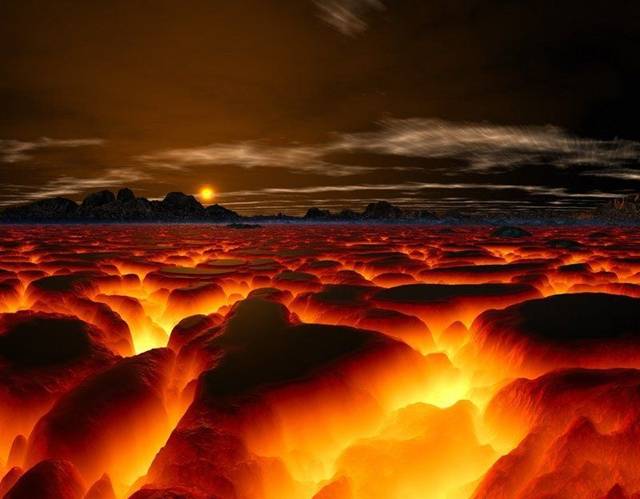
Image found at the Happy Whisk

25.58 Aurika’s Tower: The dwarven adventurer Aurika (Elementalist 11; 32 hp) has established herself in a tower of cracked, creamy white stone. The tower is a spiral cone, in the fashion of an alicorn, and appears to have been raised from the ground by the way the metallic sands are piled around it.

The tower can be entered through a single large portal that is blocked by a massive block of stone that weighs about 3 tons. Aurika simply uses passwall to move through the stone, though she rarely ventures out into Gehenna. She sought the gates of Hell as an adventurer long ago, and the dwarves still speak of her legendary career. After finding the bleak wasteland of Gehenna, she became intrigued by the metal sand and what challenges they might hold to an Elementalist. She was also changed by her travels through Hell, her natural dwarven avarice heightened and excited.

Aurika is a heavy woman with brown skin and a thin nose (for a dwarf). Her hair is brown and worn very short, and her grey-green eyes show a fickle side to her personality.

The bottom of her tower contains pure lead sands, which she has sifted with the help of various elementals. Aurika is using this lead sand to create a lead golem, which she believes will be able to challenge the demon lords. The lead golem is about 50% complete.

27.57 House of Lead: A monastery of lead blocks has been constructed here. The monastery consists of an outer building and an inner building. The courtyard between them is a weird garden of burning coals and slim, crystalline growths reminiscent of branch coral. Igniguanas skitter around the coral. The only way from the outer building into the inner building is across the 12-ft. wide garden, the rectangular portals from one building to another being offset and located about 10 to 20 feet above the ground – a difficult jump indeed.

The outer building is home to the lesser demonic monks, a collection of peoples from Gehenna and a few tieflings as well, all dedicated to attaining physical and mental perfection that they might better serve their ultimate liege, Lucifer. They number 20 in all.

The inner building is the home of their master, Amus (Monk 15; 68 hp), a muscular man, heavily scarred, with reddish skin and a face encased in a brass lion mask that covers his entire head. A sapphire embedded in the mask permits him to communicate telepathically with all sentient beings within 100 feet. His home is a great cube of lead, 40 feet to a side, and cluttered with ledges and poles jutting from the floor, ceiling and walls at every conceivable angle. Amus’ meditation platform is a stout column in the center of the building, about 10 feet tall and topped by a bed of nails.

Besides Amus, the inner building is guarded by four chain demons, that lurk in the shadows. Their true purpose is to guard the treasure within the lead pillar, a vial of Lucifer’s own ichor, which appears as a black, viscous fluid.

28.61 Volcano: A volcano of black rock rises from the sands here, eternally spewing streams of magma that solidify on the extremes of the hex into promontories of porphyry, serpentine, hornblende and magnetite. Rivers of molten metal flow through these promontories from a molten lake into the rest of Gehenna, and sleek crystalline sea serpents can sometimes be seen surfacing in the lake.

There are dozens of monastic cells carved into the rock within the rim of the volcano. Naked hermits, their hair singed and their skin like leather, dwell in these places, contemplating the fall of Lucifer and the end of the cosmos. They are all powerful clerics (Cleric 9), and capable of answering many and varied questions about Gehenna and Hell as a whole (i.e. they’re a good source of adventure hooks).

30.48 Xarcho: Xarcho is a magnificent citadel of 2,000 Xulites who serve Mulciber. Their citadel has 60-ft. tall walls laid out in a circle set with nine great towers, each 100-ft tall and studded with arrow slits from which 4d6 heavy crossbow-armed Xulites can shower bolts down from any given angle.

Within the walls, the citadel is divided into raised streets lined with cheerless basalt buildings housing the people and their shops, and between them 200-ft. wide canyons of basalt where the smithwork of the people is performed. The furnaces are natural vents of burning gasses that send a crimson radiance into the sky – a radiance that can be seen from one hex away in otherwise black Gehenna.

At the center of the citadel there is a palace-temple of black marble where sits the balor Vugencothi, the Herald of Insanity and ruler of Xarcho. The balor is entertained by the sufferings of slaves drawn from all over Hell, including the form of the succubus Neveh, flayed alive and bound with leather thongs crafted from her own hide. She is forced to dance by a gang of sabre-toothed tigermen armed with pitchforks and wearing leather battle harness.

Rising from the black temple there is a scarlet spire around which curls a writhing flame. Once per day, at the direction of Vugencothi, this flame can be send blasting through the citadel, this holocaust of flame inflicting 6d6 points of damage on all who are not immune to fire (no save).

The temple is surrounded by a marketplace of shrewd traders and moneychangers from around Gehenna. At one end of the plaza there stands the infamous inn known as the Sign of the Smoking Serpent, where fire nymphs in mithral collars that send shocks of electricity through them serve platters of smoked meats (very well done, of course) and fiery wine that forces normal folk who drink it to pass a saving throw or suffer 1d4 points of damage and the loss of their voice for 1d8 days.

Xarcho is currently suffering a rash of banditry from a warband of Uccenite warriors. Encounters with the sahitim occur on a roll of 1-3 on 1d6 in this hex. Encounters are with 2d6 sahitim, and there is a 25% chance that they are battling with 2d6 bronze men.

Gehenna – Introduction

Mammon by George Frederick Watts (1885)

Time for my first preview of Gehenna, with an overview of this rather warm circle of Hell.

Although Gehenna is a dry, inhospitable wasteland of black, burning metallic sand, it almost looks like paradise to travelers who have just slogged their way through many leagues of sewage and decay in Abaddon.

Getting into Gehenna is dangerous. When one is one the very edge of Abaddon they cannot see into Gehenna. Instead, they see nothing but miles of sewage and junk as far as the horizon. When they place one over the border, though, they suddenly find themselves in the midst of a howling, raging storm of burning metallic sand and fire (per the fire storm spell). This persists for 1d6 rounds, and when it ends, one sees nothing but Gehenna, with no trace or sign of Abaddon.

Gehenna, as mentioned above, consists of mile after mile of rolling dunes of metallic sand. The sand is mostly black, but there are lines of coppery red, golden brown and silvery white worked into the landscape, making it almost pretty for a circle of Hell. Rivers of molten metal flow through the landscape aimlessly, ending in bubbling lakes. There are also great mesas of basalt to be found in Gehenna, and it usually on these that the landforms that the various tribes and lords of Gehenna dwell.

No plants exist in Gehenna, but the landscape is often broken up by growths of metallic crystals, some tall and branched like trees, others in spiked clumps.

All of the animals of Gehenna are immune to fire. Most are reptilian or insect in nature.

Gehenna is the ring of Hell allotted to the souls of the avaricious and prodigal. Avarice (also known as greed or covetousness) is the rapacious pursuit of wealth, status and power. While all people have ambitions, the covetous take this to an extreme, casting aside the eternal (and Lawful) for the temporal. In time, these things they sought fall through their hands as dust and escape them.

In Gehenna, the shades of the avaricious are turned into “misers”. Misers take the form of slaves in Gehenna, being driven by the Gehennites to push around great stones for their pointless monuments to the glory of Mammon, Amon or one of the other lords of the circle. The misers have lost their humanity and their individuality, and are now little more than beasts of burden.

The shades of the prodigals, on the other hand, become small in stature – nimble little thieves who try their best to steal from travelers and others, but find their bodies become immaterial whenever they attempt to hold onto anything, their newly acquired wealth quickly slipping through their hands. They are naked and hunched, and would be pitiable if not for their rapacious faces.

Races of Gehenna
Gehenna, as lifeless as it might seem, has its own inhabitants. These are the seven tribes of Gehenna, all of them races known to people of the surface world but altered by their habitation in Hell.

Arkusites: The Arkusites are hairless gnolls with pallid skin and icy blue eyes. The Arkusites build strongholds of gold and ride out from them on feral centaurs to raid and plunder. Arkusite warriors wear glistening scale armor, amply decorated with gold and tall, golden conical helms and wield long horseman’s axes and shortbows. Warriors are extensively tattooed.

Arkusites worship various demon lords, and change their allegiance often. Their priests use drugged wine to bring on prophetic dreams and practice ritual cannibalism.

The Harrites: The Harrites are kobolds that look like pteradactyls with golden scales and eyes like multi-faceted garnets. They roam Gehenna in great swarms, swooping down on victims from above with their cruelly barbed and hooked spears, snatching people up into the sky to be roasted alive in their towers. The Harrites dwell in great fluted towers of blue metal (cobalt, in fact). In the base of these towers, which rise in clumps from the landscape, they keep great fires burning at all times. The towers are open from base to ceiling and ringed with platforms and shelves on which the kobolds dwell. They hang their captives over these fires from chains and allow their screams and moans of torment to echo up through the tower. On the ceiling of the tower they keep strange ooze, which feeds on these screams and produces weird, sticky nodules that the kobolds collect and sell. The nodules are eaten by the inhabitants of Hell like candy. The Harrites usually worship Pazuzu.

The kobolds can exhale plumes of burning ash. Alone, a kobold can spew this into the face of an opponent once every 1d4 rounds, the victim having to pass a save or be blinded for 1d4 rounds. In groups of 30 or more, the kobolds can swoop down and exhale in unison, creating the equivalent of an incendiary cloud that lasts for 1 round.

Lamuresti: The Lamuresti are the elves of Gehenna, with warm, copper skin and entirely black eyes. They are graceful in appearance, with sharp, severe features. The Lamuresti are completely loyal to Mammon, whom they call their divine king. Each lamuresti village is governed by a priestly steward (an anti-cleric of level 1d4+2). They construct two-towered bronze ziggurats to Mammon and decorate their walls with bas-reliefs and metallic tiles depicting woodlands and marshes they may never visit. They are particularly known for their bronze lions.

The villages of Lamuresti contain eternal flames fed by the bodies of the shades punished in Gehenna (or any other captive they can get their well-manicured hands on). The Lamuresti are known for their harsh punishments and cruelty (pyramids of skulls, flaying captives alive, walling people into their city walls, etc.). The males wear flowing robes of cloth-of-gold and conical caps, with tighter dresses and feathered head-dresses on the females.

Lamuresti warriors wear scale armor and carry short swords, spears and longbows.

Sarrimites: The Sarrimites are changeling goblinoids. When first encountered, they look like hunched and muscular goblins, with short, bandy legs and bearded faces with over-large teeth jutting from their grim, low-set mouths. They wear iron masks that depict noble-looking men with dead eyes and long beards. When joined in battle, they shout their war-cries and become large hobgoblins. If reduced to half their normal hit dice, they grow into ogres (their equipment growing with them), gaining 2 extra hit dice and doing +2 points of damage with their attacks. The Sarrimites wear iron scales and horned helms. They attack with axe, spear and hand cannon (per heavy crossbow).

The Sarrimites are usually loyal to Mulciber, but worship his wife, the sensuous demoness Tyrana, a winged lilin only marginally loyal to Lilith of Erebus. Her temples grace the citadels of the Sarrimites and are attended by the female goblins. The citadels are ruled by the high priestess of Tyrana, the goblin king being subservient (and married) to her – a situation no goblin king cares for.

The goblins are expert engineers and smiths. Their villages are joined by iron-shod roads that rise above the burning sands of Gehenna, and they have canals that channel the molten rivers of metal to their foundries where most of the weaponry, armor and ordnance of Hell is manufactured.

Uccenites: The Uccenites, or “wolves of Gehenna” are sahitim, demonic humanoids who dwell in some of the deserts of Nod. Like their surface kin, the Uccenites are lean and lank, with golden-orange skin, with black horns like those of an antelope rising up to 3 feet tall. They swathe themselves in black robes, the men veiling their faces, the women adorning theirs with black tattoes.

The Uccenites are nomads, setting up temporary camps around large sepulchral tomb mounds in which they store their mummified dead. These mummies are animated, of course, and appear as naked, hunched sahitim (they are interred in a fetal position that bends their spines) covered in red ochre paint and in a state of decay. These mounds look like conical pyramids, wider than they are high, made of various metal blocks. The Uccenites also raise megalithic monuments to Amon, whom they worship exclusively. In honor of their demon lord, they sacrifice captives by slowing carving up their bodies while alive – first the ears, nose and lips, then the fingers and toes, etc.

Uccenite warriors wear mail tunics and carry bronze shields, scimitars and jezzails (as crossbows). They ride beasts that look like a cross between wolves and camels.

Xshayathiyans: The most grandiose and powerful of the peoples of Gehenna are the Xshayathiyans, also known as ophidians. They were worshipping demons before it was cool – perhaps before there actually was a Hell. Here they preside over stately cities of silver and gold, encrusted with gems and inlaid with serpentine and lapis lazuli. They wear kilts and loose tunics of cloth-of-gold and –silver and tall crowns (even the lowliest wear crowns). Warriors wear bulbous helms with golden face masks depicting demons, gorgons, medusas and other monstrous creatures. They are armed with iridescent scale coats, oblong shields, spears, axes, short swords and longbows.

The Xshayathiyans are ruled by their magic-users, who preside in palatial temples that are home to powerful glabrezu demons, the ruling class of the ophidians, who serve as the various satraps under their emperor, Mammon from his capitol, the Burnt City. These temples also hold ritual vats in which the priests bathe in oil or in the blood of sacrifices. The temples are guarded by winged gorgons and serpoleopards.

Xshayathiyan magi possess the most useful objects in Gehenna – at least for adventurers. These are stones that look like pure, white quartz spheres that, when buried one foot beneath any soil, cause a spout of pure, fresh water to erupt into a fountain for 1d4 minutes. One waterskin can be filled from the fountain per minute. The stones, called stones of necessity, function once per day, and there is a 5% chance per use of them crumbling into dust.

Xulites: The Xulites are bronze men – humans with skin not only the color of bronze, but the consistency as well. The Xulites build citadels of brass, decorated with gynosphinxes with golden bodies and ivory faces. Within these citadel they keep gorgons who feed on the metallic sands (they are immune to their petrifying breath) and grow crystalline trees of emerald and ruby.

The Xulites are slavers, capturing the zombie-like prisoners of Gehenna and using them as beasts of burden. They wear pointed helms and scale hauberks and wield longswords, spears, daggers and crossbows that throw metal darts. The elite Xulite warriors ride scaled lions (like miniature dragonnes) into battle, their roars driving their foes in fear before them.

Lords of Gehenna
Mammon, the Grand Prince of Avarice, rules the Circle of Gehenna with subterfuge and double dealing. There are those who say he commands a power greater than himself, and uses it to get his opponents out of the way. Four demon lords have proven too powerful for Mammon to unseat, they being Amon, Maphistal, Paymon (king of the glabrezu demons) and Pazuzu. The smith of Hell, Mulciber, also dwells in Gehenna, though he shows no interest in the politics of Hell and is not seen as a rival by any of the other lords.