Monsters of the Virgin Woode

I’ve spent a few hours finalizing the new monster stats that will appear in NOD 19 (coming soon – I swear – just give me time). Thought I’d share a few of the beasts from mythic North America. The cultural origin of the monsters appears in parentheses after the monster’s name. Keep in mind, most of these monsters have been fantasy-ized, as is typical for the grand old game (i.e. I already know it isn’t accurate in terms of folklore).`

ALTAMAHA-HA (Georgians)
Large Animal, Neutral (N), Animal Intelligence; School (1d4)
HD 8
AC 14
ATK 1 bite (1d6) and 1 slam (1d8)
MV Swim 50
SV F8 R8 W14
XP 400 (CL 8)

The Altamaha-ha is a giant river creature that looks vaguely like a giant sturgeon with a bony ridge on its back and a snout like a crocodile. The monster is grey in color, with a belly the color of parchment. Mostly harmless, they are curious creatures who are attracted to humanoid activity, and those ridges on their backs have a nasty habit of damaging or capsizing river craft. Boats under which the animal scrapes must pass an item saving throw or spring a leak.

BOO HAG (Gullah)
Medium Monstrous Humanoid, Chaotic (CE), Average Intelligence; Solitary
HD 6
AC 15
ATK 2 claws (1d4) and bite (1d6)
MV 30 (Swim 50)
SV F12 R10 W10
XP 1500 (CL 8)

Boo hags are monstrous women of the swamp. Similar to vampires, they drain the life of their foes by riding them at night while they sleep and stealing their breath. A hag squatting atop a person drains one hit dice or level from them every 10 minutes.

Those victims they kill, they skin, as they have no skin of their own. They use this skin as a disguise when they wish to hunt at night in settled areas. Boo hags are amphibious, and look like skinless, gaunt women with blazing eyes and gnashing, yellow teeth. They can be distracted for 1d10 minutes by brooms, the straws of which they are compelled to stop and count. If attacked while counting straws, the hags flee with their brooms, that they may count the straws at their leisure in a safe place.

Spells: 3/day—gaseous form

FASTACHEE (Seminole)
Small Humanoid, Lawful (NG), Average Intelligence; Clan (1d20)
HD 1
AC 12
ATK 1 weapon
MV 20
SV F14 R15 W15
XP 50 (CL 1)

The fastachee are the dwarves of the hilly portions of the Virgin Woode, exiles from the Bleeding Mountains who settled here long ago. They have reddish-brown skin and black hair, which they wear long, braiding both the hair on their heads and their chins. The fastachee have long since given up on mining, save for the working of flint and granite. They are now mostly farmers, growing corn and raiding medicinal gardens. They enjoy a +2 bonus to save vs. poison and magic. They usually wear buckskin armor and wield tomahawks.

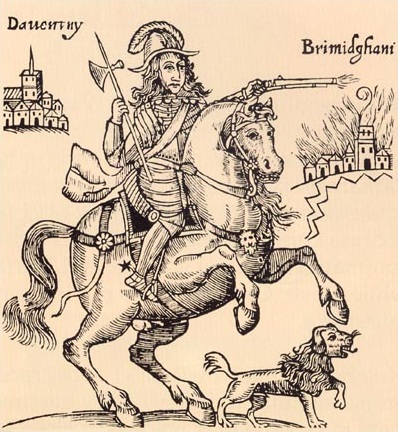
HEADLESS HORSEMAN (Washington Irving)
Large Undead, Chaotic (CE), Average Intelligence; Patrol (1d6)
HD 7
AC 18
ATK 1 sword (1d8 + special) and 2 hooves (1d6) and bite (1d4)
MV 30 (Mounted 50)
SV F12 R12 W10
XP 1750 (CL 9)

Headless horsemen may be encountered alone or in small patrols. The souls of horsemen who have perished in battle and now seek vengeance on the living. They appear as soldiers of various types, always mounted on black horses and always lacking a head. Most carry lanterns, perhaps even jack-o-lanterns, and slashing swords.

Headless horsemen are dangerous opponents. The whinny of their spectral horses and their own shrieks, screams and maniacal laughter cause fear (as the spell) in those with 3 HD or less. They prefer to get their victims running away, that they might swoop in and attempt to decapitate them. Attacks with their swords that roll a natural ‘20’ have a chance at decapitation; the target must pass a Reflex save to avoid this terrible fate. Mounted warriors who are decapitated will rise as headless horsemen themselves in 24 hours, while all others who are decapitated rise as wraiths, none of them under the control of their creator.

Headless horsemen have but a single weakness. They cannot cross running water, like streams or rivers. Make it across a bridge, and they cannot follow, though they may throw their lanterns in a fit of pique.

Note that the headless horsemen’s stats represent the horseman upon his horse – the two are rarely separated. That being said, it is possible to remove a headless horsemen from his steed, though he always gets a Fortitude saving throw to resist, and can, the next round, “teleport” back onto his mount. The two creatures live and die as a team.

Spells: 3/day—ethereal jaunt

Special Qualities: Immune to fear and all mind effects

KANONTSISTÓNTIE (Mohawk)
Large Aberration, Neutral (N), High Intelligence; Solitary
HD 7
AC 18 [+1]
ATK Slam (1d10) or breath weapon
MV Fly 40
SV F11 R12 W9
XP 1750 (CL 9)

Kanontsistóntie are giant, flying heads that appear to be constructed of bronze. They have unmoving faces and apparently sightless eyes, though they see all. Their mouths are agape and one can discern powerful energies within. The ultimate purpose of these entities is unknown and often seems contradictory from day to day. They primarily seek sustenance in the form of grain, lording it over lesser peoples and threatening them with destruction if they fail to pay tribute.

Kanontsistóntie have a breath weapon they can use once every three rounds, and no more than three times per day. The breath weapon is a 60-ft. cone of pure energy that deals 6d6 points of damage. Objects deposited in their mouths linger for a moment, and then disappear in a cascade of colored motes of light. Living creatures so transported into the “belly of the beast” suffer 6d6 points of damage, and, if they live, find themselves suffering 1d6 points of energy damage per day as they are slowly processed and digested by the head.

Special Qualities: Magic resistance 15%, regenerate

SPLINTERCAT (Lumberjack)
Medium Magical Beast, Neutral (N), Animal Intelligence; Solitary
HD 4
AC 14
ATK Bite (1d6) or slam (2d6)
MV 40
SV F11 R10 W17
XP 400 (CL 5)

Splintercats are odd creatures that look like stout mountain lions with broad, flat heads. They so love honey that they charge at trees hosting beehives, smashing into them so hard that the trees are killed; they lose their branches and leaves and are utterly blighted. This rather odd method of feeding leaves them with a terrible headache and in an eternally foul mood.

YEHASURI (Catawba)
Tiny Humanoid, Chaotic (CE), Average Intelligence; Band (2d8)
HD 0
AC 13
ATK By weapon
MV 20
SV F16 R16 W16
XP 25 (CL 0)

Yehasuri are the goblins of the Virgin Woode. They appear as tiny, hairy wildmen armed with spears and darts. They dwell in burrows beneath tree stumps (they enjoy fermented stump water) and issue out at night to hunt for animals and any unfortunate humanoids they might come upon. The smell of tobacco, either tobacco smoke or the juice, drives them away in a panic.

Virgin Woode – Scrolls, Icy Corpses, Rievers and Tombs

1328. Soul Scrolls | Treasure
A stone totem pole stands in a clearing within a grove of trees. Within the mouth of the dragon atop the pole there is hidden a thick sheaf of scrolls. Each scroll holds a powerful spell (6th to 8th level) as well as the soul of an ancient elf wizard. Thirteen zombies are buried beneath the totem, and wait for somebody to climb it that they may erupt from the ground and climb the pole to attack them. Removing the sheaf of scrolls without first dispelling a magic rune on the dragon’s forehead causes the pole and anyone on it or within 60 feet to shift into a demi-plane of acid.

1528. Ice-Bound Corpse | Dungeon
A small cave in the side of a rocky hill issues forth an icy breeze. Inspecting the cave, one finds about 60 feet back a steep drop off and signs of former exploration – iron spikes hammered into the stone and a bit of dry rope.

At the bottom of the drop off, there is a second tunnel that extends back 100 feet, ending in a block of ice. Encased in the ice is the body of a drow warrior, encased in black armor, face twisted in a rictus of rage. Golden runes of power have been beaten into the surrounding tunnel, forming not only a wall of force effect, but also each acting a glyph of warding (cold). Three humanoid skeletons lie before these runes, tomb robbers killed by the traps.

Behind the block of ice there is a cavern filled with the funerary treasures of the drow, Cairithuic of the Canny Eye. The treasures are guarded by a chlorine elemental. If the body is removed from the ice, it revives in 1d4 hours as a dire wight!

1923. Hazard Station | Village
Two hundred rievers, mostly ex-henchmen who have turned to a life of freedom and larceny on the frontier, dwell here in a small gathering of cabins. The log cabins are scattered in a valley surrounded by wooded hills, each village having its own pigpen and cabin garden. The men and women of the village are surly and unwelcoming to those they do not know. On approach, the village women can be seen working in the gardens or tending the pigs or children, while the men hunt in the woods or relax in front of the cabins, tending their muskets or bows.

2027. Tomb of Sera | Dungeon
The wooded hills are dotted by remnants of the ancient elves, and this hex holds the tomb of a very noble elf, Sera, the father of Partholón, who crossed Mother Ocean in elder days and founded the city-state of Nomo. The tomb is stately and untouched, with walls of moonstone. It is situated on a large platform of moss quartz. The tomb has no discernable entrance. The only entrance is located on the platform, under the earth. One must figure a way to either raise the platform or lower the earth to reach it.

Behind this secret door there is a steep slope covered by a permanent grease spell. The back of the door is studded with spikes. At the top of the ramp there is a simple stone bier, beautifully carved, atop of which rests the body of Sera in state. It shows little decay. The body and tomb are attended by three spirits who served the elf in life – a squire, a courtesan and a jester. The spirits are bound willingly to the lord, and they do their best to protect the body from looters and defilers. They are not evil, and they are not ill-disposed to visitors, so long as they are honorable and well-behaved. The tomb can serve as a safe-haven for adventurers, for the wild elves will not approach it.

The only problem is the pack of ghoul wolves that patrol the woods. They can sense the flesh of a noble elf within the tomb, and are hungry for it.

A Stroll Through the Virgin Woode – Sun Gods, Fort Adventure, Giant City and the White Tower

A few more previews of the Virgin Woode

0848. Ancient Idol | Dungeon
An ancient idol of Asur, the sun god of the ancient elves, stands here, half-toppled and overgrown with creepers that bear large, violet blooms. The statue has been damaged and defaced, the gold leaf stripped from it, the small, bench-like altar that stood before it cracked in half.

The blooms that grow around the idol put off a sweet-smelling odor, and in the presence of warm bodies release a pollen that intoxicated (Fortitude save vs. poison or fatigued).

The base of the idol, if one can get to it through the underbrush and creepers, holds a secret compartment accessed by speaking the high holy words (Klaatu Barada Nikto) or with a prying device, holds a large garnet that provides proof against illusions. If a person holds the stone in his or her mouth (don’t swallow it), they are immune to illusions, including invisibility. Fighting or doing other rough work while holding the stone in one’s mouth carries with it a chance of accidentally swallowing it (Reflex save, attempted once per minute). If swallowed, the stone causes nausea for 1d4 hours, and piercing pains in the gut as it is passed over the course of a few days.

Image found HERE

1118. Fort Adventure | Stronghold
A fighting-woman of Salem colony, Hepzibah Stanis, has established a fort in this hex as an early defense of the colony and as a base of operation for pilgrim adventurers. The fort consists of a wooden palisade around several log buildings, barracks for the fort’s 20 pikemen, 16 longbowmen, 10 cuirassiers and 10 rangers, a home for Hepzibah and a small shrine to Diana tended by Elder Druthy Avanulf. A second druid, Elder Wandla Narlis once served here, but he was dishonest and greedy, and now dwells with brigands in the woods, consorting with demons. Hepzibah is gathering soldiers to route the brigands and bring the surrounding skraeling clans to heel.

1142. Skagarak | City-State
Skagarak is a large city of cyclopean architecture nestled in the wooded hills and surrounded by fields plowed by mammoth and mines dug by enslaved kobolds. The city is inhabited by 2,000 stone giants with shocking red hair and prominent jaws. The stone giants of Skagarak are rooted in the paleolithic, and claim to have dwelled in these hills since before the arrival of the ancient elves. Their city consists of great stone lodges inhabited by up to a dozen families bound together as a clan, walls 70 feet in height and buttressed by five great towers, a temple dedicated to mighty Atlas, and a splendid palace inhabited by their king, Tsul’kalu, and his royal clan. The streets are narrow and twisty, and the walls are surrounded by a a dry moat 20 feet deep.

The stone giants claim this hex as well as the hexes around it, using them to grow their crops and quarrying various stones (mostly granite and flint) and precious stones. They are not hostile to the wild elves, but care nor for their company, nor the company of the newly arrives humans.

1204. White Tower | Dungeon
The white tower is an example of an ancient elven ruin that the player’s might discover. It is a tall structure of white marble rising out of the woods. Inside the tower there is a golden stair leading to a chamber at the top of the tower. An antipathy spell has been cast on this chamber. The floor is littered with several uncut green garnets (5 gp each).

Each garnet confers on its possessor a single druid spell of 1st to 3rd level (roll randomly) that can be cast at the cost of 1d4 hit points. A creature must concentrate to cast this spell, and will only notice the hit point loss with a successful Will save.
Creatures killed by casting spells with these garnets will rise one day later as spectres that appear as glowing white skeletons with green garnets for eyes. The newly risen spectre will seek out the tower and reside in its walls.

Each garnet a creature steals from the tower will be pursued by a spectre. The spectres will appear each night in the thief’s dreams, chasing them through the dark woods toward the tower.

The dreamer will always awaken just as they reach the tower door and just as the glowing spectre is about to place its hand on their shoulder. Each night that they have this dream, they must pass a Will saving throw. If ever they fail, the spectre will be waiting for them in the waking world and it will immediately attack them. If killed, the unlucky thief will be found with all the color drained from their bodies and their eyes missing. The unfortunate will rise as a spectre as detailed above.

Humans in the Virgin Woode

Today, I thought I’d throw out some of my notions on the colonists who are settling in the Virgin Woode. I like, if possible, to relate things back to classic D&D tropes and concepts – in the vein of “D&D is always right” – and thus pair a bit of historic fact or fancy with the reality suggested by the rules. Recently, I’ve been reading Albion’s Seed: Four British Folkways in America to get some ideas, and it’s certainly been a great help. Currently, the three main groups of colonists are the Pilgrims, Cavaliers and Traders, with a sub-group of Agitators.

The Traders: You’ll recall “trader” as a monster type in Basic D&D (or Expert – one of them). Here, it refers to venturers (a’ la the class I worked up in an early issue of NOD), rangers and their ilk who settled the Dweomer Bay seeking riches in the Virgin Woode. The “traders” are made up of folks from Antigoon (i.e. Holland), Tremayne (i.e. Elizabethan England), Lyonesse (medieval France), Blackpoort (Dickensian London) and, well, just about anywhere there are men and women who want it all and want it now. The patron deity of Dweomer Bay is Atlas, the “god of exploration”, who has a pretty level-headed and casual cult in the city. The other gods and goddesses of the Motherlands pantheon are here as well, of course. I want Dweomer Bay to be a sort of melting pot of alignments, nationalities, classes, races, etc – like a D&D tavern writ large. Ultimately, an easy place to start a band of adventurers out. A peg-legged old fighting-man will probably serve as the city-state’s elected prince.

The Pilgrims: Inspired by the “monster” in the AD&D Monster Manual, the pilgrims in this case refer to religious exiles from Tremayne. Tremayne is ruled by the Faerie Queen, Gloriana, and has as its patron deity Diana. I wanted Tremayne to have a druidic religion that was very formal and, well, “Church of England”, I suppose. The pilgrims are the religious folks who want a return to the more “primitive church”, and they’ve settled to the north of Dweomer Bay in a town called Trinity after the notion of the triple goddess. For all intents and purposes, these folks are pagan puritans, witches who hunt clerics (and demons and such – hey, even if you’re neutral, you know that Chaotic Evil represents more of a threat than Lawful Good). They dress like the puritans in russets, browns and other “sadd” colors, wear steeple hats, venerate their elders – the big change being that these pilgrims are ruled by their women rather than men.

The Cavaliers: Inspired by the name of the class from Unearthed Arcana and by the identity of the Anglican settlers of Virginia and the Chesapeake, the cavaliers are dandies and monarchists loyal to Gloriana that are seeking to recreate Camelot in the Virgin Woode. Their names are based on the knights of Arthurian romance and the Faerie Queen and they adhere pretty closely to the feudal concept so common in fantasy games. Like the real cavalier settlers of North America, they speak with a drawl (which originates in SW England – the Southerners of America didn’t make it up) and are all about gallantry, nobility, power, lust and a love of gambling.

The Agitators: The agitators are the Son of Liberty in Dweomer Bay, determined to found a true republic and cast off the chains of monarchy. They’re devout worshipers of William Blake’s pantheon, especially of the Sons of Los, the gods of revolution. They’ve founded their own version of Penn’s Philadelphia, called Golgonooza. They’re recruiting an army and plan to cause trouble!

A Stroll Through the Virgin Woode – Oil Slicks, Swamp Apes, Burial Mounds and Fountains

0418. Oil Slick | Trap
A portion of the woods here is covered in an oil slick. The slick covers about three acres; only thick, rugged grasses grow from beneath the slick, making the area it has blighted look like some sort of a unwholesome meadow. Those who touch the oil with their bare skin must pass a Fortitude save or be affected by a random magic oil.

0527. Skunk Ape | Monster Lair
The remains of a walled city can be found in the swamp here. The ruins consist of nothing but crumbled walls and a few towers covered with slimes, verdigris or other forms of corruption. The ruins are haunted by an especially fierce skunk ape, who brooks no intrusions on his domain, and who is clever enough to pick off intruders one at a time. A flooded vault in the ruins holds a +2 scimitar that can slice through air. This has the effect of dealing double damage on gaseous and air elemental creatures, as well as allowing one to create small sonic booms by making a special attack against an Armor Class of 20.

0624. Burial Mound | Monster Lair
An ancient skraeling burial mound can be found here. The mound is about 200 feet in diameter and 22 feet tall. One side of the hill hides an entance veiled in illusion. Beyond this entrance there is a 80-ft. long passage lined by megaliths. At the end of this passage there is a teardrop-shaped shield painted a brilliant sapphire blue. This +1 shield is Lawful (CG) in alignment, and if touched by a member of any other alignment, sparks and causes 1d6 points of electricity damage (per round, if one keeps ahold of it).

The shield is actually a door of sorts, a small passage being hidden behind it. The shield is wizard locked to the wall (by a 10th level magic-user). Beyond the shield and the small hole in the wall, there is a narrow set of stairs that lead downward through a brackish, powerful wind. At the bottom of the stairs (about 400 feet long, and sensitive folk might get the feeling they’re “not in Kansas anymore”) there is a crimson sea stretching out into a black expanse. Beyond the sea (how one crosses it is up to the players – perhaps canoes would work) there is a grey shore, a long strand of beach behind which there is a noisome jungle of scarlet foliage. A treasure has been buried on this beach by pirates of this strange dimension, a treasure of two golden tablets containing the location of the tomb of the Thief of Dreams.

What monsters might dwell in this dimension, other than the pirates, is up to the TK – have fun and use it as a chance to surprise the players and introduce some new menaces.

0716. Empty Fountain | Curiosity
A clearing in the woods here holds an empty fountain made of red granite and topped with a coiled dragon made of tarnished copper. The dragon’s head is held aloft, such that one would assume that the water of the fountain would emerge from its snout. The pipe in the snout from which the water would emerge is currently blocked by the handle of a +1 light mace.

The fountain is guarded by an astral deva called Morviel, placed here at the behest of a wizard of the ancient elves to keep the curious or wicked away from this Fountain of Holocausts. Should the magic mace be removed, the fountain would explode in a gout of blazing flame, one that would send white hot cinders flying through the air to land in the woods beyond.

Anyone within 30 feet of the fountain, if active, would suffer 3d6 points of fire damage per round. Beyond 30 feet, and up to 1 mile, one suffers 1d6 points of damage per round. Naturally, within a short time the woods will be burning, causing other problems.

A Stroll Through the Virgin Woode – Magic Cloaks, Malevolent Maidens and Dimension X

Yes, ladies and germs, it’s the first preview of the Virgin Woode hexcrawl. Since we always begin in the west of the map, these next few previews will be set in the hinterlands. Let’s see what I have in store …

0105. Forgotten Urns | Treasure
Several ceramic urns, glazed bright red, have been buried here in a shallow hole; a glint of the sun might reveal them as folk pass by (1 in 6 chance). Most of the urns hold nothing but ashes, likely the remains of living creatures. One contains eleven agates of various hues (worth 1d4 x 10 gp each) wrapped in an ocherous cloak. The cloak is magical and cursed, steeped in the blood of a pyrohydra and spat upon by a woman scorned. When worn too near a large fire (campfire size or larger, and yeah, fireballs count), it bursts into flames, burning for one minute and dealing 1d6 points of damage per round. Only after a person has burned in it can they attempt to remove it, the effort still requiring a Will saving throw.

0223. Dimension X | Monster Lair
A cavern in the mountains here is serving as the temporary base of operations for a band of scouts from the shadowy Dimension X. The scouts are humanoid, but their features are obscured by their protective suits, which are formed of a silvery cloth. These jump-suits are loose fitting, and cover the entire body. Over their heads, they wear globes of silvery metal with dark visors. These helms and suits cannot be removed save by the most dire force. If removed, they reveal the humanoids within look like normal humans, save for their eyes, which are entirely black.

The ten scouts are usually found hovering around a column of black metal decorated with dials, knobs and blinking lights of many colors. This device not only opens a portal into their home dimension, it also collects information about the surrounding lands and can project a wall of force for up to 10 minutes.

The scouts carry ray guns (6 charges each; they can be recharged by placing them on the column for 1 hour) that fire beams of negative energy that deal 1d6+1 points of damage per hit.

The presence of the scouts and their weird device are causing the weather in this hex to behave oddly; each hour, there is a 1 in 6 chance of severe weather (lightning storm, hail, high winds).

0321. Cathron’s Hold | Stronghold
Cathron is an ancient elf, a victim of Asur’s curse who was turned into a drow. She did not leave her stronghold, but rather enmeshed it in demonic energies. The stronghold appears as a 200-ft. tall tower of smooth, scarlet stone that writhes with black, choking smoke and drips with demonic ichor. One only enters the place by teleportation.

Cathron is a lithe, athletic drow with silvery hair and tempting eyes. She is a born deceiver, and is quite incapable of love, though that has not disuaded Finnard [0231] or Lowellon [0246] from attempting it.

Within the tower, Cathron is served by a company of fiendish lizard men with glistening black scales and blazing eyes. Her treasure trove is guarded by a young red dragon, Thartwalla, who also serves as her mount when she leaves her tower.

The Virgin Woode – The Next Nod Hexcrawl

My original map of the region*

The Virgin Woode is a narrow coastal plain backed by a wide swathe of wooded hills. The woodland is composed of such trees as oak, hawthorn, elm, birch and magnolia. It runs along the eastern coast of Antilia, from the Bloody Mountains in the south to the Trow Hills in the north. To the west it is bordered by the Purple Mountains.

Upon the disappearance of the Emperor of Nomo and the subsequent decline and fall of that empire, the tributary city-states of the Motherlands sought to claim a portion of their old master’s power. This was first attempted in a series of ineffective wars, as no one city-state was powerful enough that it could best its rivals, separated as they were by vast tracts of wilderness.

Begrudgingly, the aristocracy was forced to turn to “vulgar commerce” to rake in the gold, chartering adventurers to delve into the underworld and merchants to ply the seas or take caravans through the wilderness. The city-state of Guelph really got the ball rolling by their establishment of Port Janus at the midway point in Mother Ocean between the eastern landmass and western landmass. From there, they skirted the Blustering Main and founded the colony of Argentum in Hybrasil, discovering rich veins of silver, gold and electrum.

As the Guelphlings moved this metal back home, the filibusters of Tremayne began sallying forth from their normal haunt, the Tepid Sea, and conducting piracy on the high seas. With the galleons of Guelph so harried on Mother Ocean, the merchants of Antigoon were able to move through Mother Ocean and through the stormwracked Blustering Main to found their own trading post in what came to be called Dweomer Bay, after the strange magical radiations of that landscape.

Eventually, Port Janus fell to the pirates of Tremayne, cutting Argentum off from its metropolis (confusing, I know, but I’m actually using the word “metropolis” properly here). Dweomer Bay continued to thrive, though, as the Virgin Woode beyond produced cargo ships more often than treasure ships, and because the Antigooners and their ilk proved a seafaring match for pirates, where the landlubber Guelphings did not. The wars between the colonists and the pirates continue to this day, of course, but Dweomer Bay’s libertine attitudes and focus on commerce has been an attractive lure to adventurers in search of lucre, merchants desperate to escape overbearing nobles and every weirdo in the world yearning to let his or her freak flag fly has kept brave, hearty souls traversing the pirate haunted waters of the Blustering Main to Dweomer Bay or one of the many village and towns that now dot the shore of the Virgin Woode.

These colonists, scalawags, adventurers, roustabouts and ne’er-do-wells have much to fear, though. By land, the fey and the wild elves harry them at every turn; many a trapper has survived a bear attack only to perish under the gnarled foot of a treant, who marks the occasion with no more than a casual shrug of its woody shoulders and a scrape of the foot on a handy boulder. By sea, an ancient empire has arisen “from the silt” – the aquatic elves of Atlantis desire to expand their empire on land, and seek to choke off the commerce that is Dweomer Bay’s lifeblood.

Wild elves, cunning fey, avaricious Atlanteans, dangerous elven ruins … there’s plenty to see and do in the Virgin Woode.

* I just recently resurrected an external hard drive that had a ton of my original work on the Land of Nod! So excited!

Cush and Pwenet – Ophidian Ruins, Angry Books and Sleeping Kings

NOD 18 (wow, 3 years of NOD!) is written, 90% laid out, and just about ready to hit the presses (so to speak). I think I’ll have it ready to go after Christmas, because right now I’m all about getting my holly and mistletoe on and having some Christmas fun!

Guess which one of these guys writes RPGs in his spare time …

Anyhow – since I need an easy post today, I’m going to the Cush and Pwenet well one more time! Have fun, lads and lasses!

62.04 Ophidian Ruin: A portion of the savannah here is marked with strange hemispheres of marble. The marble is ancient and cracked, and the hemispheres are actually domes – parts of an ancient ruin that now lurks beneath the savannah. The ruin belonged to the ophidians, and was long ago destroyed by the forces of the Nabu, assisted by the cosmic beings who helped found that empire.

The domes connect to palaces, temples and other buildings of what must have once been an astounding ancient city. Many of the rooms of these buildings are now collapsed and filled with soil, but many remain intact. Buildings are connected by tunnels or catacombs, while others have been connected by tunnels dug out of the earth by large, reptilian brutes bred by the ophidians as slaves and warriors. The ophidians of the ruins also breed vicious attack lizards. They have retained a small portion of their ancient technology, but most has been lost.

The lost city is ruled by a bloated queen, Sheshuur, the mother of all the ophidians in the complex. The complex is rife with traps – green slime-filled pits, pits of vipers, gouts of poisonous fumes and flaming jets.

64.37 Fortress of the Twin Tomes: Long ago, two rival princes, Trentar and Epham, mages of wondrous ken, were trapped inside magical grimoires by their former patron, Muola. Their mother, the hag queen Gwrga, interred each tome in a tower. The partisans of each prince gathered in these towers, and have for centuries been locked in sporadic battle with one another, each seeking to free their prince and destroy the other while still trapped within his grimoire. Travelers passing through this hex have a 4 in 6 chance to be pressed into service by a roving band of 3d6 miscreant mages intent on using them to destroy their enemies. The mages are loathe to expose themselves to danger, and prefer to use outsiders to settle their scores.

Miscreant Mages, Human Magic-Users: LVL 3; AC 10; ATK 1 staff +1 (1d6); MV 30; F14 R14 W12; AL Neutral; XP 300; Special—Spells (4/2/1); Gear—Spellbooks, quarterstaffs, darts (3).

65.19 Empire of the Sleeping King: This hex of windswept hills and hibiscus trees is eerily quiet. A deep well in the hex, so deep that it reaches into the Underworld, produces a sweet perfume that causes people and animals to fall into a drowsy langour. The outskirts of the hex are marked with small villages filled with laconic villagers and their herds of sleeping cattle. A road of adobe bricks overgrown with weeds winds through the villages to a small town in the center of the hex, from which rules the sleeping king, Kulala. The people of the town walk about as though asleep, and their baskets of food are bare. The people are severely undernourished, as they can barely stay awake long enough to feed themselves. In the center of the town sits the well, with a sort of wavering haze about it.

Just entering the hex forces people to pass a Fortitude save or become fatigued. Those who travel 2 miles into the hex must pass a Fortitude save (once per day) or fall dead asleep for 1d6 hours. Those who travel 4 miles into the hex must pass a Fortitude save (once per day) or fall asleep for 2d6 hours. Those who enter the town at the center of the hex must pass a Fortitude save (once per day) or fall asleep for 3d6 hours. An unlimited number of potions of sleep can be drawn from the well, but the liquid is so powerful that those in possession of it must pass a Fortitude save once per day or become fatigued.

Cush and Pwenet – A Hospice, a Mindmaster and the Krakoo

57.08 Nabu Castle: Rising above the savannah is a concentric castle in the style of Old Nabu. From the outside, the castle looks perfectly normal. The outer wall is 20’ tall and constructed of white limestone (quite dazzling under the blazing sun). It has a single gate house with a bronze portcullis that has been rended apart like tin foil. The gate house is guarded by a blazing bones (43 hp) who holds a chain connected to a cauldron of boiling palm oil.

Beyond the outer wall there are the burnt remains of many huts and a well that still supplies sweet water. At some point, a desperate woman cast a golden ring (100 gp) into the well.

The inner wall is 30’ tall and shows signs of damage (broken ramparts, piles of rubble) on its eastern side. The inner gatehouse, located away from the outer gatehouse, consists of 40’ tall towers bristling with arrow slits. Inside each tower are five skeleton archers (HP 7, 6, 6, 5, 2, 2 in each). The iron portcullis between the towers is rusted shut, and would take a combined strength of 100 to force it open.

Once one has breached the inner walls, they will discover that the castle’s donjon is nothing but a pile of rubble. Nevertheless, a cavernous opening does give access to a small entry chamber guarded by three zombies (HP 10, 2, 1) wearing a number of cow bells. Any fight with them will produce a racket, warning the lord of the castle that dinner is served.

From the entry chamber one will pass through a wide tunnel that winds below the castle. The tunnel eventually splits into three passages. The easternmost passage leads to a veritable ossuary of humanoid and animal bones as well as dozens of bell jars containing rare herbs and fungi worth 10 gp each to a herbalist or sage.

The central passage leads further down until the slope becomes quick slippery (permanent grease spell), sending intruders into a deep pool (10’) of fresh water. A submerged tunnel leads to the bottom of the well.

The westernmost passage leads down a bit before ending in a large burrow supported by pillars of limestone. This burrow holds a pool of black water and a large pile of treasure. It is the home of a middle-aged dragon who calls himself Mindmaster the Controller.

Mindmaster sacked this fortress a millenia ago and has been sleeping for the past two centuries. He has copper scales, a sinewy body with bat-like wings, and hypnotic eyes (gaze attack). He is capable of casting the following spells: Grease, detect thoughts (ESP), summon monster I, wall of fire and animate dead. Mindmaster’s breath weapon is a cloud of hallucinogenic gas (save or suffer frightening hallucinations for 1d4 rounds).

Mindmaster’s hoard consists of 1,000 gp and a wand of wonder.

57.44 Hospice of the Blazing Sun: A band of Lawful clerics and knights has established here a hospice and road house for folk bound from the west and south for points north. The hopsice was established on a sacred field of battle, where warriors of the Order of the Blazing Sun, crusaders in service to Mithras, did battle with a coalition of gnolls and the servants of Chaos.

The hospice is a small fort of adobe brick. There is an outer wall, about 16 feet high and 4 feet thick, which is patrolled by crossbow-armed warriors of the order, with a two gates consisting of an iron grate. A 10-ft. deep pit, 8-ft. wide and 16-ft. long, has been secreted beyond the gate, and can be set to open when trod upon by releasing a lever near the inner gate. Above the gate, there is a gold plate (worth about 160 gp) depicting the face of Mithras.

Within the wall, there is a stable (can hold 30 horses), a small smithy manned by the armorer Kanu (who worships Ogun, but keeps it quiet around the religious knight), a cookhouse where game and cattle are barbequed by a cook called Amah, and the main keep, a 20-ft. tall building, square in foundation with sides 40-ft. long, with crenelations on the roof. The keep has a single, sturdy oak door bounnd in iron. Within, there is a great hall, chapel of Mithras, hospice, kitchen, apothecary, armory, a cellar (storage, including several barrels of sweet wine) small rooms for travelers and even smaller cells for the warrior of the hospice.

The hospice is manned by 20 men-at-arms (ring mail, heavy mace, light crossbow (fires bullets rather than bolts), 10 bullets), ten 1st level fighters (light horse, chainmail, shield, lance, light mace) and six 1st level clerics (light horse, chainmail, light mace, three throwing hammers). They are led by a chanter called Bonse and the master of the hospice is the vidame Arkhun, who hails from Ibis.

The hospice is famous for its wine (the valley it is situated in produces a decent grape, which the brothers turn into a sweet wine) and the cattle they graze on the savannah. Recently, a constrictor has stolen its way into the cellar, and awaits its prey.

60.06 Krakoo: This hex was long dominated by a powerful band of gnolls. Over time, their numbers fell and another group of crow-headed warriors called the krakoo invaded. The last band of gnoll warriors, their chieftain Zharl and his eight bodyguards, are now chained to several thorny acacias, slowly bleeding to death. The krakoo have set up their new stronghold on a rocky promontory, studding the upper portions with the spears (and bones) of the gnolls. If aided, the gnolls will happily lead adventurers to the promontory, and will even fight with them, but they ultimately cannot be trusted.

Cush and Pwenet – Pillars, Mists and Spires

Note: No ostriches appear in this preview!

53.15 Fortress of Pillars: There is a very strange fortress in this hex. The structure is built of bluish-grey stone and is raised above the ground on pillars encusted with sea shells. It has a grand front gate of oak and iron, but no apparent way to enter it without walking on air (and this is, in fact, the way the fortress is entered by visitors – the inhabitants use the hippogriffs kept in the stable to come and go).

It is a large keep with nine towers (one is central) topped by glass bubbles aquamarine in color that, from afar, appear to be filled with water. This is a trick of the eye – each in fact holds a small garden of exotic, fragrant flowers from the jungles of Cush. The walls of the fortress are 30 feet tall, the eight outer towers about 40 feet tall and the central tower about 50 feet tall. Atop the walls, one sees 1d4 crossbow-armed goblins on watch at any given time. The walls are exceptionally slick, and one suffers a -2 penalty to climb them.

The fortress actually holds 40 goblins (ring mail, spear, light or heavy crossbow) and other monstrous guards. They work for His Most Illustrious Eminence, the Palatine Baron Devald the Daring, a displaced Tremanni warrior who made his fortune as a trader, raider and plunderer in Ende and Cush. As mentioned above, he has a stable of 10 hippogriffs, and he also has an old goblin witch-woman called Zaxa who serves as his major domo and court wizard.

54.27 Mists: This hex is thronged by enchanted mists. The hex looks clear during the day, but if adventurers spend the night here, they awake to a thick fog that makes navigation all but impossible. A ranger or druid can attempt to roll 1d12 under their level to escape the hex – others have a 1 in 20 chance per day to escape. The mists are inhabited by a company of people who lingered too long here. They now appear as misty shades. When encountered (2 in 6 chance per day; 2d8 shades) they attempt to drag people deeper into the mists. After one week in the mists, adventurers must pass a Will save each day or lose one level; any person who has all their levels drained (either by the mists or by the shades), becomes one of the people-of-the-mist and is trapped in this weird pseudo-dimension for all time.

55.35 Spires: The landscape of the savannah here is broken by large limestone spires and arches. The ground here is uneven and difficult to travel across. The soil is sandy around the spires and in the many shallow canyons, and thick with brambles and poisonous snakes. A keen-eyed elf might notice a vast murder of ravens wheeling and keening about a particularly tall spire in the distance. At the base of this spire, a female fighter called Ambang lies dying, two arrows piercing her breast. She was ambushed by seven gnolls – their bodies lie about her and already bare signs of feasting by the carrion birds. Ambang will be dead 1d10 minutes after she is found by adventurers.