Yun-Bai-Du: City of the Clouds Part III

Another edition of Yun-Bai-Du, finally with a complete (well, 90% complete) map – I still need to put some numbers on it.

Spice Merchant: Sari is a graying Meng merchant who runs caravans between Yun-Bai-Du and Tetsukado, the southern colony famous for its pepper plantations. Very short and thin (outlanders sometimes mistake him for a tall halfling), the plucky merchant has made numerous journeys himself, but now leaves the adventures to his three sons, Toli, Qai and Mayn. Sari’s wife died many years ago, and he now entertains himself with a number of pleasant concubines. Sari is an immaculate man, and his 4-story, 20 room manse is no different. Much of the furniture is teak, with velvet cushions in a variety of vibrant colors. Callous and avaricious, Sari is a devotee to the lords of chaos, and his cellar contains a shrine to Mung, the Lord of All Deaths.

| Sari: HD 6 (22 hp); AC 9 [10]; Atk 1 weapon (1d6); Move 12; Save 11; CL/XP 6/400; Special: None.

Opera House: This large, beautifully decorated opera house is one of three in Yun-Bai-Du. The building is two stories tall and has a footprint measuring 100 ft x 100 ft. The interior consists of the stage/performance area (which measure 60 ft x 60 ft) in the center of the building and around it two stories of storage rooms, dressing rooms, lounges and offices. The performance area consists of a number of sunken boxes in which spectators stand surrounding a square stage. Balconies ringing the room are provided for noble and royal visitors, along with chairs and a steady stream of servants carrying trays of viands and goblets of wine. The house is administered on behalf of the king by Inasar, a fat mandarin of Yun extraction with heavy eyes and a sibilant lisp. Inasar is an unforgiving taskmaster with the staff of the opera house, but he fawns upon the talent, all the while entertaining less than moral thoughts about his star performer, the lovely Madame Ijing, a graduate of the Imperial Music Bureau and a favorite of the deposed Tiger Empress.

Hanging Garden: The street here goes through an ancient hollow. One either side there are embankments covered with flowering vines that hang over the lane, filling it with sweet perfume. Several wooden pegs at the lowest point allow one to cross a trickling stream that runs beneath the embankments. The hollow is inhabited by a tribe of fairy dragons. The dragons dwell in the clumps of flowers, but always descend to investigate intruders and maybe play pranks on them.

| Fairy Dragon: HD 2; AC 4 [15]; Atk 1 bite (1d4); Move 9 (F36); Save 16; CL/XP 5/240; Special: Breath weapon (5-ft cone of confusion), spells (4th level shugenja), invisibility, magic resistance (10%), telepathy (2 miles).

Yun-Bai-Du: City of the Clouds Part II

Now with 100% more map!

The map is still in the rough stages. Here are a couple more locales to go with it.

2. Fortress of the Splendiferous Tiger King: The fortress monastery at the base of the Mountain of the Splendiferous Tiger King is 60 feet tall and composed of sloped walls topped by twenty towers. Each tower rises 20 feet above the top of the crenelated wall and has two levels of sloping red tile roofs. The fortress has an outer gate that is inlaid with red marble and massive iron doors featuring a bas-relief of the Splendiferous Tiger King riding a tiger and dueling a trio of swamp hags to rescue his future wife, the maiden Qorian of the Amber Eyes. The inner gate leads from the mountain to the meadows, and resembles the outer gate in every detail save the gates are smaller and made of thick wood fortified with iron bands.

As with all the priests of Yun-Bai-Du, the sohei of the Splendiferous Tiger King are women. Called the Tiger’s Daughters, they wear red robes embroidered with golden tigers on the sleeves over their armor and are known for the black paint they use to decorate their faces in the manner of a tigress. The Tiger’s Daughters wield long-handled iron claws (deal 1d6 damage) and tachi. Atop their walls they wield repeating crossbows and baskets of stones and iron balls that they can pour down on their enemies. Their fortress is connected to the fortresses of the sohei of Darting Sparrow King Mountain and Crashing Thunder Emperor Mountain (with whom they share a profound enmity). These long walls are 40 feet tall and every 50 feet have a 60 foot tower marble studded with small iron spikes, many of which are electrified. These walls and towers are manned by the royal guard of the White Sage King (which includes many low level shugenja) and the elite archers of the Chiwa Brotherhood.

The inner gatehouse is connected to the nunnery of the Tiger’s Daughers. Since the sohei (as with all the gatehouse sohei of Yun-Bai-Du) keep 25% of the tolls collected at their gatehouses, their nunnery is quite luxurious, with extensive use of marble and oiled teak and many statues of ivory, gold, brass and marble. Their dining hall is lined with long, low tables of polished oak, with velvet cushions and silver bowls and goblets. The exercise chambers of the sohei are floored with supple bamboo and have padded walls. Most spectacular is the inner sanctum of their temple, where they keep a gold statue of the Splendiferous Tiger King mounted on his war-tiger. The tiger is decorated with orange sapphires and inlaid with black jade, while the King is garbed in rich silks.

The roof of the nunnery is planted with lush grasses. Here, the nuns rear sacred red deer for sacrifices at the altar of the immortal king. The beasts are slain by the abbess Sarighin using bagh nakh to tear out its throat. The blood is collected in a terracotta jar and boiled over a sacred flame. The jar with the dried blood is then filled with wine and drank by all the sohei, while the deer’s carcass is prepared with rice noodles and served to the folk who enter the outer gate and give an offering and prayer to the Splendiferous Tiger King. The antlers are ground into a powder that is sold as a medicine.

5. Temple of Agrodaur: Boldashar is the high priestess of Agrodaur, the implacable, unresponsive god of law and defense. Her temple is a six-story pagoda constructed of cut stone blocks, polished white oak and steel roof tiles traced with silver. The heart pillar is made from blessed granite. This pillar also serves as the idol of Agrodaun. The pagoda is approached via four paths paved with red stone and lined with guardian statues (bronze) of famed soldiers of the empire. Between the paths there are rock gardens tended by halfling slaves taken from the Golden Steppe by the Ulu-Than nomads. Surgeries performed by the priests keep the slaves docile and obedient. The priests of the temple dress in robes of white silk and tall silk hats bearing numerous black tassels.

Beneath the pagoda of Agrodaur (or beneath its rock gardens, to be precise) there is a subterranean ossuary containing the bones of sohei who died in battle. In these halls, the bones are placed on shelves and given every reverence by the priests of the pagoda. The ossuary halls are circular and formed like a labyrinth. At the center of this labyrinth is the exposed heart pillar, here carved in the shape of a coiled dragon and bedecked with jewels worth 17,000 gp. The entire chamber is riddled with razor-sharp, invisible blades. To get to the central pillar and then exit back into the labyrinth, one must know the proper combination of steps and do them precisely. Otherwise, each step taken into the inner sanctum inflicts 1d8 points of damage and forces the person to step back. A person has a 1 in 6 chance of taking a safe step even if they do not know the proper combination.

Once one has reached the dragon sculpture, they might notice that the dragon’s taloned hands are actually manacles and that the altar is stained with blood. Further investigation reveals channels and holes in the floor around the bottom of the idol. One of the dragon’s fangs pivots. If turned right, the fang causes the blades in the room to animate (per the blade barrier spell). Turning it left causes the floor around the idol to turn into a polished chute. The chute delivers people to a secret chamber 40 feet below the temple onto a small island in the middle of a subterranean lake.

This lake is cold and black and sits in a large volcanic cavern 1 mile in radius. The walls of the cavern are riddled with caves that extend another two to three miles into the underworld. The lake and caves are home to all manner of aquatic horrors, from albino electric eels to a rare breed of blind aquatic hobgoblins with translucent skin and long, black horns placed in their foreheads. The island in the middle of the lake is of particular interest. It is formed of basalt and carved by human hands into a platform with a well in the center. Examination by dwarves or engineers will reveal that the blood holes in the inner sanctum above would send that blood dripping into the well. In the bottom of the well there is a pulsating cyst that looks as though it is encrusted with thousands of bloodstones. This cyst contains the slumbering form of the demon Daldis. Daldis hungers for halfling blood and needs approximately three more sacrifices (made at the new moon) before she will awaken on the material plane as the herald of Chaos. In her complete form, she appears as a tall woman with a curvaceous body, glistening black skin, a sharply pointed chin and skeletal hands that end in long talons. She has shining green eyes that can open gates in walls three times per day, allowing up to 10 HD of demons (or a single demon prince) to enter the material plane before the gate collapses. Around her neck she wears a necklace of halfling skulls lacquered with green paint. Boldashar is her high priestess and the sohei of the pagoda are her devout cultists. The birthing well is tended by mogura-jin (mole men) who travel to it from their subterranean lair via boats made from the dried remains of purple worms.

Yun-Bai-Du: City of the Clouds Part I

I’ve been holding off posting any previews of Yun-Bai-Du, the Mu-Panese city-state that will appear in NOD 9 later this month (well, hopefully this month). I haven’t actually drawn the map – though I do have it stored in my brain and hope to finally put the thing down on paper (or pixel) soon. In the meantime, enjoy a few sample locations.

The Bronze Rooster: This restaurant is so named for the fierce bronze roosters that decorate the corners of the roof. The restaurant is a two-story structure set atop a brick platform with a comfortable patio. The patio has wicker chairs that are usually occupied by the old men of the neighborhood smoking long clay pipes. The patio is decorated with terracotta pots overflowing with chrysanthemums and jasmine.

Beyond the door one enters a generously sized room with four large tables, each table capable of sitting ten people. The restaurant is run by Banaikht, a neat young man with saffron skin, dull black hair and striking blue eyes. Aloof and artistic, he regularly glides through the room overseeing the waiters and ensuring they are showing their customers every courtesy and then moseys through the kitchen sampling the cooking and giving brief, terse instructions to his chefs. Banaikht is married and has three young children, though wife and children never appear at the restaurant save for when she has them in tow on one of her shopping excursions. Banaikht is both chaotic and deeply impressed with fortune tellers and magicians.
The restaurant specializes in duck, serving it in several elegant and tasty ways, and is also well known for its excellent stock of wine (some imported from as far away as Lyon) and dragon fruit imported from the margins of Terra Obscura to the southwest.

Court of the Golden Rabbit: This brick courtyard is usually filled with a bazaar with booths selling exotic fruits and spices from the south. The bazaar is noisy and wonderfully fragrant, and is usually patrolled by two yari ashigaru. A brick shrine dedicated to the rabbit god Hu Tianbo is set in the middle of the bazaar and tended by a hoary old priest called Dawa. The shrine contains a brass idol of the Rabbit God, to which petitioners, always homosexual men, make offerings of chowed pork intestine and wafers of sugar. Dawa writes charms on pieces of paper and supplies them to worshipers for 1 sp each. The charms may be placed under one’s bed to bring luck in love.

One booth in the corner of the bazaar might be of especial interest to adventurers. Qan, an alchemist’s apprentice, sells small rockets and firecrackers there on behalf of his master, Temubo, who dwells elsewhere in the city. Qan is a mousy man with bad hair and severe acne, but he is quite knowledgeable about his stock and fancies himself dangerous with the ladies.

The court is surrounded by several spice exchanges run by Meng merchants. While shoppers purchase fruit and spices in the bazaar below, the spice merchants shout trade with one another up above using trained monkeys and pigeons to carry their orders and rolled up notes of exchange.

Temple of Genbu: Genbu is a folk deity. Also called Invincible Warrior of the North, he is represented as a giant black tortoise of terrible demeanor – spikes on tail and neck, tusks jutting from mouth. The temple is made of black bricks and has terrifically sloping roofs coated in tiles of bronze stamped with glyphs of warding. The building has but a single story and consists of an inner sanctum surrounded by apartments for the priests and storage and an antechamber where worshipers can leave offerings of cabbages and river stones and make prayers to the deity. The floors of the temple are all bare earth. The inner sanctum holds a hepatizon idol of Genbu and is mostly given over to a large pit in which resides the living idol of the temple, a massive tortoise that, though not black, corresponds in most other respects to the idol of Genbu. A wooden ramp allows access into the pit, and though the tortoise is rather fierce with outsiders, he is used to the priests. At night, he is taken from his pit, which is then covered by an iron grate, and permitted to roam the inner sanctum. Tunnels leading from the pit go to three burrows in which dwell females of the same species – Genbu’s harem, one might say. Once per year, a sacred red cow raised on a monastery outside the city is brought into the temple as a sacrifice to Genbu.

The cult of Genbu has about 250 avid followers in Yun-Bai-Du. The temple is under the command of Alasuja, a priestess of Kirikersan extraction, and home to 12 lesser priests. Alasuja has reddish-brown skin, dark brown hair that is always kept covered by a red scarf and blue eyes. Her appearance is always immaculate, and usually overbearing.

Image from HERE.

NOD 8 On Sale Now!

Finally finally finally!

Enter the land of the Dragon Chans! This issue presents a sandbox hex crawl inspired by the folklore and literature of Asia, as well as a new class, the wushen, options for warriors, many new monsters and a pantheon based on Lord Dunsany’s Gods of Pegana. 104 pages.

Articles are:

A Bevy of Bujin – options for customizing the bujin class

The Wushen – a sohei sub-class for Ruins & Ronin
 
Land of the Dragon Chans – the hex crawl, Asia-style

Monsters of Mu-Pan – 42 new monsters for your favorite old school game

Gods of Mu-Pan – a pantheon based on Lord Dunsany’s Gods of Pegana.

Print version is $10 (apparently Lulu failed its save vs. inflation)

E-Book is $3.50

I haven’t received my print version yet, so buyer beware.

Mu-Pan – Encounter XXV

Ah – the final encounter preview! Enjoy …

3718. An ancient town stands by the side of the river. It once held a fine market, but the arrival of a ghostly leopard has driven most of the population away, as it devoured the hearts of their animals without leaving a mark on them. The town is surrounded by a thick stone wall with a most impressive carved gate that looks like the open maw of a celestial tiger. The village now houses 100 woodsmen and their elder, Hengoutoq and her daughter, the healer Sukouay. Hengoutoq is a tall, elderly woman in lavender robes. She has haunted gray eyes and frizzy silver hair that falls to her waist. She acts as though quite meek, but in fact has called the ghost leopard (a totem of her ancestors) to punish the townspeople for their decadent, corrupt ways. Her daughter is curvaceous and terribly beautiful, and knows not of her mother’s actions.

| Ghost Leopard: HD 9 (38 hp); AC 0 [19]; Atk 1 bite (2d6 + level drain); Move 18; Save 7; CL/XP 11/1700; Special: Drains one level with successful bite attack, no save.

Image from Wikimedia Commons via Creative Commons 3.0 license – taken by Rolf Müller

Mu-Pan – Encounter XXIV

Well, just one more sample after this – 10 more encounters to write and then lots of work on finishing up NOD 8.

3634. A band of wild men with bushy hair and the legs and horns of goats dwells in these wooded hills, harrassing travelers. The men collect ribbons or the hems of robes and tie them in their hair. The folk have a thorough knowledge of the area and, if given gifts of saki and ribbons, are happy to become guides (though their mercurial personalities keep them dangerous). At least twelve of them can summon a great earth tortoise whose shell, composed of hexagonal slabs of granite marked with runes, measures approximately 30 feet in diameter. The tortoise can swim through earth and stone, with passengers crawling down its tunnel of a throat into its gem encrusted belly. Should anyone be foolish enough to try to steal a gem, the tortoise will never allow them to leave, coughing up their shriveled corpses a few years after they have died.

| Wild Man: HD 6; AC 4 [15]; Atk 1 slam (1d4) or cudgel (1d6); Move 9; Save 11; CL/XP 8/800; Special: Summon earth tortoise, spells (confusion 1/day, transform 1/day), magic resistance (30%).

| Earth Tortoise: HD 12; AC 0 [19]; Atk 2 claws (2d6), bite (4d6); Move 9 (S12); Save 3; CL/XP 12/2000; Special: Immune to sleep and paralysis.

Mu-Pan – Encounter XXIII

Mu-Pan is proceeding nicely – about thirty more encounters to write up. I got some great material from the Weird Asia post, and Theodoric the Obscure, JD Jarvis and the wondrous Mr. Huth definitely have a free PDF coming their way.

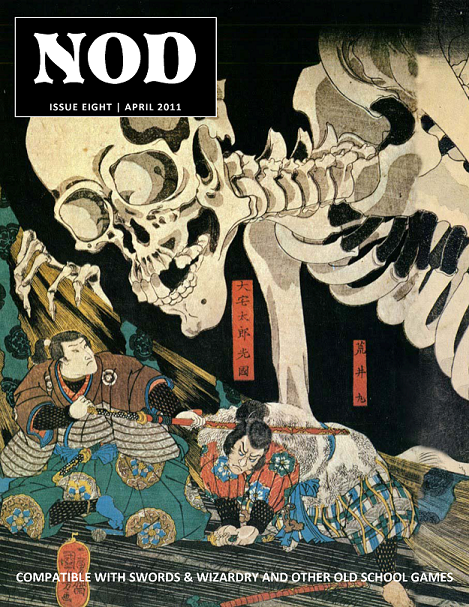
The image in the corner is the cover of the next issue of NOD – coming soon. Now, a quick encounter and then back to work.

3018. The wooded hills here hide a coal mine worked by a gang of slave labor – convicted felons – under the tender mercies of a half-ogre called Suke. Suke is especially savage-looking for his breed, and he paints red radiations on his face to make himself look more fierce. He is assisted in his duties by five shashu no ashigaru.

The slaves of the mine are fifty men, ashen skinned and bleary eyed. They look like living dead, dragging leather sacks full of coal to ox-drawn carts or chipping away at the walls of the mine with picks, slim amber-colored lanterns hanging from their iron slave collars. In the evening, one can find them lying on the ground outside the mine, coughing and wheezing, praying for death but lacking the strength to even pretend to escape.

Of late, the place has attracted a gang of seven fire mephits. The mephits have made the mines too dangerous to work, enraging Suke. The mephits “arrived” when a bronze mask was uncovered embedded in a wall of the mine. The mask depicts a demonic face with a pointed chin and two pointed horns, and gives one complete immunity to fire as well as the ability to polymorph into a fire elemental once per month for a total of one hour.

| Fire Mephit: HD 3; AC 3 [16]; Atk 2 claws (1d6); Move 12 (F21); Save 14; CL/XP 5/240; Special: Immunity to fire, +1 or better weapon to hit, regenerate 2 hp/round when touching flame, double damage from cold, breath fire 1/day (3d6 damage, 15-ft cone).

| Suke, Half-Ogre Bujin Lvl 4: HP 4d6+1; AC 4 [15]; Save 13 (12 vs death, 9 vs. poison & disease); CL/XP 4/120; Special: Follow through, ogre’s ferociousness, open door on 1-4 on 1d6. Do-maru, suneate, kote, jingasa, tetsubo (1d6+2).

Mu-Pan – Encounter XXII

Back from the Magic Kingdom. Much work to catch up on, but the weather was beautiful, the park not too crowded and the Candy Cane Inn (yes, I say it with pride) was excellent as usual. Two encounters today – a bit of a fight brewing between them.

2842. The deforested hills around a sprawling castle of cream-colored stone are alive with the activity of two companies of shashu no ashigaru, three companies of yari ashigaru and a squadron of samurai in training. Further afield there are meadows of grazing sheep and fields of pulses and barley worked by busy, nervous farmers. The villagers dwell in simple huts located about half a mile from the castle. The village boasts a small tavern run by Myshulai, a raven-haired beauty with a wicked jaw and purple burn scar decorating the right side of her face. A former paramour of the lord, she is the only person known to have defied him and survived, though none know the details of their romance or parting.

The lord of the castle is Chinegan, a thin, malevolent sprite of a man with a long mustache and thinning hair pasted over a spotted scalp. Chinegan always appears swathed in silks, a poisoned dagger grasped in one hand and hidden in a long sleeve. Chinegan covets 2942 more highly than the lives of his wives and daughters, and has long been preparing his forces for an assault. His little army has been funded by a fabulous mine of peach-colored agates discovered many summers ago underneath the castle behind a dungeon wall. Dozens of peasants now labor in the dark, day and night, digging out the stones.

When not plotting the destruction of his neighbors, Chinegan amuses himself hunting outlaws in the woods surrounding his castle using a pack of three shocker lizards. The lizards are wrangled by Anq, a half-ogre who raised them from the egg and keeps them under control with nothing but his commanding voice and a series of hand movements.

Chinegan owns a treasure of 1,630 sp, 1,645 gp, a terracottage aquamanile (painted with a code that means nothing) worth 1 gp, a lapis lazuli water buffalo worth 50 gp, an amber vase worth 70 gp, a sack of agates worth 115 gp, a granite statuette of a five legged gryph worth 80 gp and twenty pounds of red (iron) dye worth 5 sp per pound, and meant for the manufacture of battle flags.

| Shocker Lizards (3): HD 1-1 hp; AC 6 [13]; Atk 1 bite (1d3); Move 6; Save 18; CL/XP 2/30; Special: Electric shock.

| Anq, Half-Ogre Bujin Lvl 6: 34 [45]; AC 4 [15]; Save 11 (10 vs death, 7 vs. poison & disease); CL/XP 6/400; Special: Follow through, ogre’s ferociousness, open door on 1-4 on 1d6. Hara-ate, jingasa, kote, suneate, tetsubo (1d6+1).

| Chinegan, Bujin Lvl 10: HP 36 [55]; AC 3 [16]; Save 7 (6 vs death & poison); CL/XP 10/1400; Special: Follow through, parry death blow. Do-maru, kote, suneate, kabuto, katana, wakizashi, tanto, daikyu, 10 arrows.

MON: Red field, white gryph

2942. The gaijin warlord known as the Lord of the Granite Chrysanthemum dwells here in an unyielding safehold (the aforementioned Granite Chrysanthemum). The Granite Chrysanthemum is a castle of concentric rings protected by tall towers that encircle an inner keep. The structure is constructed on the Motherlander model and is ruled by a dwarf warlord called Inthor, a former servant of the Tiger Empress who now rules as a freelord in brazen defiance of the Jade Empress and her court. The castle is constructed of yellowish stone with roofs of red tile and ample stonecarving, as is the wont of dwarves.

Within the inner court of the castle, surrounding the keep, there is a grove of gingko-biloba trees. The gingko is harvested by Inthor’s harem of maidens – all the eldest daughters of foes he has vanquished placed in Inthor’s protective custody to insure the loyalty and good will of their fathers. Despite their imprisonment, the maidens are treated well. The gingko’s essence is extracted by a half-mad wise woman called Gombe. Her elixirs are much sought after by shugenja, for whom they have a 1 in 6 chance of acting as a potion of mnemonic enhancement.

Inthor commands three companies of dwarf warriors armed with teppo or chu-ko-nu and masakiri. They wear Motherlander-style mail and carry shields, as does their lord.
Inthor rules over a tribe of cavemen who dwell in leather tents on the wooded grasslands surrounding the keep. The holding is rich in copper and malachite, and the cavemen are employed as able miners.

| Inthor: HP 31 [57]; AC 1 [18]; Save 4 (2 vs. magic); CL/XP 12/2000; Special: Note stonework. Platemail, shield, battle axe, dagger.

Weird Asia Contest

To be precise China, Korea and Japan. What’s the weirdest factoid about these geographies or cultures that you would like to see represented in Mu-Pan? I’m looking for the obscure here – something I probably haven’t already stumbled upon myself.

Submitters of my favorite three get a free PDF of NOD 8 and credit in the text.

Image from Alcatena’s blog

Seriously, if there was one artist I could impress into lifelong service on illustrating the Land of Nod, it’s him. Astounding creativity and attention to cultural quirks and details, all blended seamlessly into a unified style. Love it. I’ll stop raving now.

Monsters of Mu-Pan III

Taking a day trip to a date farm today, and next week I’m spending a couple days at Disneyland, so posting will probably be light. Getting closer to being finished with NOD 8 and Mystery Men! – excited about that. Hopefully some glimpses at the finished pages of Mystery Men! soon.

Gyuki – Ox-Ogre (Japanese)
Hit Dice: 8
Armor Class: 1 [18]
Attack: Gore (1d8), 2 pincers (1d8)
Saving Throw: 8
Special: Magic immunity, resistance to damage (10%)
Move: 12
Alignment: Neutrality
Challenge Level/XP: 9/1100

Ox ogres appear as massive crabs with the heads of oxen and the tusks of elephants. They dwell in coastal waters and only emerge to hunt.

Kasha (Japanese)
Hit Dice: 5
Armor Class: 3 [16]
Attack: 2 claws (1d4), bite (1d4)
Saving Throw: 12
Special: +1 or better weapon to hit, magic resistance (20%), stun, surprise on a roll of 1-2 on 1d6
Move: 15
Alignment: Chaos
Challenge Level/XP: 9/1100

Kasha are cat demons that prowl the fringes of civilization in search of funeral processions. When they find one, they leap from the underbrush and sieze the corpse, dragging it into the forest to devour it. The ferocity of the attack is such that, provided the kasha achieves surprise, all in attendance must succeed at a saving throw or be stunned and unable to act for 3 rounds. The kasha is exceptionally difficult to track. Kasha make their lairs in burrows beneath dead pine trees. They decorate their lairs with the jewelry and funeral shrouds of their meals. The soul of a devoured corpse cannot enter the afterlife and thus wanders the woods in which the kasha makes its home as a ghost until the kasha is destroyed.

Ninja (Japanese)
Hit Dice: 2
Armor Class: 4 [15]
Attack: Strike (1d4) or Weapon (1d6)
Saving Throw: 16
Special: Death attack, stun, spells
Move: 15
Alignment: Neutrality
Challenge Level/XP: 6/400

Ninjas are humans that have trained themselves in the arts of stealth, assassination and illusion. When encountered on the job they wear black clothing, hoods and masks. Ninjas have all the abilities of assassins, including the assassins’ death attack, the ability to make a stunning attack as a monk and the ability to cast phantasmal force and ventriloquism.

Ninjas are armed with shuriken and wakizashi. They might also carry hankyu. Ninjas also carry a collection of powders that they can blow into their enemy’s faces. These powders can be used to blind an opponent, cause itching and sneezing (-2 to AC and to hit) or sleep (as the spell) unless a saving throw is made.

Groups of four or more ninjas are led by a 3 HD genin. If a clan is encountered, there is one genin per 10 ninjas. The clan is led by an 5 HD jonin with the ability to cast invisibility and obscuring mist. He is assisted by a 4 HD chunin with the ability to cast obscuring mist. Both jonin and chunin are capable of flipping out once per day, gaining a +2 bonus to hit and damage.

Shamshir
Hit Dice: 3
Armor Class: 4 [15]
Attack: 4 weapons (1d6) or bite (1d3 plus poison)
Saving Throw: 14
Special: Poison
Move: 15/12 (climbing)
Alignment: Neutrality
Challenge Level/XP: 5/240

The shamshir are a strange humanoid people who combine mammalian and reptilian characteristics. They have four arms and pale scales speckled with electric blue and long hair that ranges from white to gray to aquamarine. Shamshir have humanoid faces with poison sacs in their checks.

Shamshir can replace one weapon attack with a poisonous bite that deals 1d3 damage plus an additional 1d6 damage if the victim fails a saving throw. Because they are so quick, they rarely wear armor. They arm themselves with longbows and katana.

Shamshir tribes are ruled by princes called shatyas. Shatyas usually have 4 to 8 levels in bujin. Shatyas are guarded by level 2 to 4 bodyguards.

Common Names: Aehvel, Aisfimies, Alshsis, Bishl, Bisihism, Clihih, Csisei, Dieshm, Flivsi, Gesisi, Gilih, Hilxishessi, Ilxeh, Ji-Ahh, Kisssi, Melesiees, Ofesh, Oszissie, Qeehvis, Rielesi, Rissi, Sphisei

Image of shamshir by Jason Sholtis of Underworld Ink. I cannot recommend him highly enough!