The Glooms – Caged Imps, Forlorn Golems and Shadowy Theatres

Three more from the Ante-Hell. Perdition awaits …

110.5. Imp-N-Cage: Somewhere in this hex of magma pools and basalt landforms, hanging from a chain beneath a natural land bridge that spans a flow of magma, there is an imp inside a cage constructed of logical fallacies. The cage is too convoluted for the imp, but perhaps a character with high intelligence could solve it. To simulate this, the Referee can prepare three riddles. If a player can answer all three of them, they succeed in freeing the imp, which will swear eternal loyalty (ha!) to its rescuer and even become their familiar if they are a magic-user. Each riddle that is answer incorrectly, however, costs the character one point of their intelligence score, permanently, as they find themselves trapped in logical fallacies. Of course, as difficult as answering the riddles is, the swarm of adamantine wasps that guards the bridge is even worse.

ADAMANTINE WASP SWARM: HD 15 (76 hp); AC 0 [19]; Atk 1 sting (3d6+poison); Move 5 (F14); Save 4; CL/XP; 16/3200; Special: Poison (harden into ice, 1d6 damage per round, shatter when dead), magic resistance (12%).

IMP: HD 2; AC 2 [17]; Atk 1 sting (1d4 + poison); Move 6 (F16); Save 16; CL/XP 6/400; Special: Poison tail, polymorph, regenerate, immune to fire.

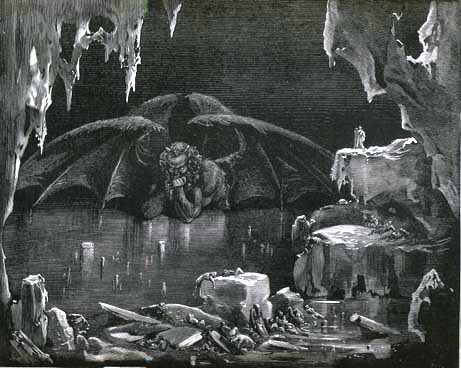
110.29. Forlorn Golem: A stone golem sits on the banks of the Acheron, its feet in the black waters, chin on hands, elbows resting on knees. The golem was created by a mad wizard to besiege Hell, the wizard miscalculating the width and depth of the Acheron. Abandoning the concept, the wizard moved on and left his creation by the river to await new orders. He sits there to this day.

STONE GOLEM: HD 15 (60hp); AC 5 [14]; Atk 1 fist (3d8); Move 6; Save 3; CL/XP 16/3200; Special: +1 or better magic weapon to hit, immune to most magic.

118.51. Natural Amphitheatre: There is a natural amphitheater located in this hex. The amphitheater has been accentuated with seating carved into the reddish-brown rock. Against the back of the amphitheater there is what appears to be a bas-relief (deep relief) of a warrior in Greek armor, spear and shield in hand. He appears to be fighting, with his back against the wall. The statue is actually a warrior who was turned to stone while fighting the guardians of this shrine, for the amphitheater is a shrine dedicated to the Tenebrae, the daughters of Nyx and Eerebus. It is guarded by eight sisters, medusas with black-bronze skin and cool, green eyes. Each of these medusas, as a priestess of the Tenebrae, can cast three cleric spells, one of first, second and third level, each.

The statue is still inhabited by the warrior’s spirit, now an ethereal shade. The shade appears when people walk on the “stage” and attempts to force a female adventurer touch his statue body. Doing this releases him from the curse, in which case the restored warrior can introduce himself as Damali, a crusader from ancient days. Damali is a 10th level paladin.

ETHEREAL SHADE: HD 8; AC 1 [18]; Atk Icy touch (2d6) or special ability; Move 9; Save 8; CL/XP 10/1400; Special: Hard to see, immune to non-magic weapons, befuddlement.

Image from HERE.

The Glooms – Landsharks!

Still working diligently on Hell. Almost finished with the north half of the first ring, and then I need to sprint in October to finish the north half of the next few rings. Should fill quite a few pages. I’m also working on a Demonologist class based on the Elementalist I published a few months back and a class that will present a few underground creatures as playable races, for those who want to run a campaign set entirely in the underworld. I’ve commissioned some art from Jon Kaufman, who did the race images for PARS FORTUNA and requested an old-style bugbear (a’la DCS), orc (pig-nosed of course), goblin (a’la DAT), kobold (scaled dog dude), hobgoblin (samurai armor wearing), svirfneblin (a’la Russ), drow (a’la Willingham), duergar (a’la Holloway) and a new critter. I can’t wait to see what he comes up with.

I should also mention – if these encounters sound tough, they’re meant to be. Most Land of Nod hex crawls are designed with characters in the fourth to eighth level in mind. These are meant to challenge characters who have gone past 12th level and want to invade Hell instead of settling down and playing the end game (stronghold, armies, etc). For example, Cocytus, the lowest plane of Hell, will be geared towards challenging a party of 30th level characters.

66.4. Fishing Trolls: A tribe of trolls (50 males, 50 females and 60 young) dwell here on the banks of the Acheron. The trolls are whalers. They sail a boat made from the ribs and hardened skin of abyssal whales. They head out into the Acheron each day seeking abyssal whales to harpoon and pull out of the water. The whales are then processed, producing black ambergris that is highly valued (1,000 gp per pound; the trolls usually have 2d10 pounds on hand).

The trolls dwell in a white mount that abuts the river, in caves chewed out of the chalky stone. These caves wind through the white stone like a maze, but the trolls always know their way, especially the secret doors and passages.

The trolls are led by a jarl called Svalmad and his five brothers, who serve as his huscarls. The tribe also includes a shaman called Bearlang, who prays to Hel and Angrboda and has been given a nidhund by those demons for his loyal worship. The trolls of White Mountain have oddly elongated arms, giving them a +1 bonus to hit in melee combat. They wear bits and pieces of leather and metal armor (equivalent of ring mail) and carry axes and harpoons. Svalmad is growing old for a troll, and his brothers know it. They plot against him with Bearlang.

Besides the aforementioned ambergris and a fair amount of scrimshaw art (maybe 1d4 x 100 gp worth), the trolls have a treasure of 3,500 ep, 45,400 gp, 520 pp, a silver idol of Hel (800 gp), an emerald (4,000 gp), an aventurine (1,250 gp) and eight casks of fine wine (12 gal./100 lb. each, worth 600 gp/gal.)

TROLLS: HD 6+3; AC 4 [15]; Atk 2 claws (1d4), 1 bite (1d8); Move 12; Save 11; CL/XP 8/800; Special: Regenerate 3hp/round, +1 to hit.

NIDHUND: HD 4; AC 5 [14]; Atk 1 bite (1d6) and 2 claws (1d6); Move 21; Save 13; CL/XP 7/600; Special: Immune to cold and poison, rake with claws, magic resistance (10%).

HUSCARLS: HD 7+3; AC 4 [15]; Atk 2 claws (1d4), 1 bite (1d8); Move 12; Save 9; CL/XP 9/1100; Special: Regenerate 3 hp/round, +1 to hit.

BEARLANG: HD 6+3 (38 hp); AC 4 [15]; Atk 2 claws (1d4), 1 bite (1d8); Move 12; Save 11; CL/XP 8/800; Special: Regenerate 3hp/round, cast spells as a 3rd level anti-cleric, +1 to hit due to elongated arms.

SVALMAD: HD 9+3 (33 hp); AC 4 [15]; Atk 2 claws (1d4), 1 bite (1d8); Move 12; Save 9; CL/XP 9/1100; Special: Regenerate 1 hp/round, +1 to hit due to elongated arms.

90.11. Igho-Kih: Igho-Kih is a dready city of 12,500 grimlocks and their thelidu masters. The city is hewn from the very stone of the underworld in a lopsided radial pattern – meaning circles off-set from one another in such a way that they intersect at weird angles. The city-state is surrounded by a tall karst wall that looks like a picket of giant stalactites. These walls have been carved into battlements and towers at places, and form a massive fortress. Each buttressed balcony is patrolled by 1d4 grimlocks who carry spears and wear chainmail. Within the city-state there are tall towers that rise above the canyon-like streets. These black, 3-story towers contain acid that can be released into the streets like a flood at the direction of the city’s masters, a council of thirteen thelidu, squid-headed humanoids with tremendous powers.

These thelidu dwell in a domed palace in the center of the city-state. The palace and city are ensorcelled to be completely dark. Even magical light can only penetrate about 5 feet into the darkness, and even then only with the brightness of twilight. Within the domed palace there is a series of pits and tower platforms. There is no way to move between them other than magic or difficult climbing. At the center of the dome there is a deep pit lined with mirrors that scry into the worlds beyond Nod (i.e. Mercurius, Veneris, Martis, etc).

The thelidu plot the downfall of all creation, though they are so plodding and intellectual they’ll probably never get around to actually doing anything grandiose and meaningful. In the meantime, the grimlocks raise worms and fungus. They live in warrior bands under violent chiefs and enslave their (and other races’) women to use as domestic servants and for mating. The council watches all and knows all, and rewards or punishes the chiefs as they see fit.

109.7. Rats & Sharks: There is an old stone fortress here, probably built by the drow ages ago. The fortress has a courtyard and three towers. The two smaller towers have tumble at some time in the past and now exist as a ruin. The larger tower, though shabby, is still strong and is inhabited by a gang of 20 ratling reavers. Ratlings are, of course, little threat to the denizens of Nifol, but these ratlings are smart and they control five landwalking sharks, which they use in the manner of war elephants. The sharks are kept chained in the courtyard. The ratlings must use extreme caution when mounting them, jumping on the large leather and wood harnesses affixed to their backs from above and then guiding them with gibbets of meat tied with sinew to long sticks or bones. Patrols of three of these war sharks are constantly active in these tunnels, and may be encountered randomly (see above).

The tower of the ratlings contains a shrine to their goddess, the Mouse Lord. Here, they keep a silver idol with ruby eyes and the living manifestation of their goddess (or so they think), a wererat named Tefnuin who wandered into Nifol as an adventurer and managed to hook up with the ratlings after her partners were killed. Tefnuin dwells in luxury, her every need catered to. She wears silk veils that accentuate her semi-humanoid curves, enticing perfume (well, enticing to a ratling) and carries a poisoned dagger. Her soldiers are armed with crossbows with poisoned bolts, short swords and, when on their landwalking sharks, harpoons that are used to reel in prey.

The ratlings have a treasure of 9,790 gp, 860 pp and a lapis lazuli charm worth 200 gp.

LANDWALKING SHARK: HD 13; AC 5 [14]; Atk 1 bite (1d10+8); Move 9 (S18); Save 4; CL/XP 13/2300; Special: Amphibious, feeding frenzy.

RATLING: HD 1; AC 9 [10]; Atk 1 bite (1d6+poison) or weapon; Save 17; Move 12; CL/XP 2/30; Special: Diseased bite.

TEFNUIN, WERERAT: HD 9; AC 6[13]; Atk 1 bite (1d3), 1 weapon (1d6); Move 12; Save 7; CL/XP 10/1400; Special: Lycanthropy, control rats, surprise (4 in 6).

Hell Preview 4 – Iron, Salt and Fire!

A few more glimpses into Nifol – the Darkness – the Ante-Hell.

12.30 Iron Maze: This hex holds a maze of iron. The maze has walls 50 feet tall and many twists and turns. To navigate the maze, you can use the following process:

The Referee rolls 6d6. Each dice represents one turn (10 minutes) of travel time. If players guess the number on the dice, they advance through the maze to the next dice. If they fail to guess the number, they must deal with an random event determined by the number on that dice:

Random Event
1. After an hour of wandering, you return back to where you started. Roll for a random encounter from the main Nifol Wandering Monster chart for this hour.

2. After 1d3 turns of wandering you come to a dead end. The walls here are cast in a bas-relief of Amazons slaying men, women and children. The Amazons are iron dergenue, who animate and attack unless a handsome man sings them a song (roll 3d6 under Charisma score to succeed).

3. After 1d3 turns of wandering you come to a Ploutonic shrine. The shrine has been bored into one of the iron walls, and contains an idol of a random Demon Lord holding a large gemstone. Touching the gemstone causes it to shatter, the pieces sprouting into xxx. A small pool of unholy water is left in the cupped hands of the idol.

4. Walls of iron spring up around you, trapping you unless you can climb over them. The tops of the maze’s walls come to a razor-sharp point, making escape tricky.

5. After 1d3 turns of wandering, you are discovered by the fiendish minotaur of the maze, a creature called Baalgor.

6. After 1d3 turns of wandering you discover a large, black hole in an iron wall. This hole transports you to a hex in Nifol of the Referee’s choice.

BAALGOR: HD 8+4; AC 6 [13]; Atk Head butt (2d4), bite (1d3) and flail (1d8); Move 12; Save 11; CL/XP 8/800; Special: Never gets lost in mazes.

IRON DERGENUE: HD 4; AC 2 [17]; Atk 1 strike (1d6); Move 12; Save 16; CL/XP 5/240; Special: Drag into iron, immunities.

16.19. Salt Mummies: A cavern that branches away from the main Salt Tunnel has been carved into a mausoleum. Sixteen goblin bodies wrapped in spider silk in the fashion of mummies are interred here. The touch of these mummies does not spread mummy rot, but rather drains the moisture from people (saving throw or lose 1d3 points of constitution; one point of constitution can be regained by drinking one gallon of water). Sewn into each mummy is a gold statuette worth 600 gp.

GOBLIN SALT MUMMY: HD 6+4; AC 3 [16]; Atk 1 fist (1d12); Move 6; Save 11; CL/XP 7/600; Special: Desiccate, hit only by magic weapons.

25.17. Tomb of Fire: The tomb of Sinmara, a queen among fire giants, has been placed here about seven miles from the Acheron. The tomb is a pyramidal tower of basalt with a locked bronze door. The door is trapped so that a layer of bronze melts over the thief’s hand (4d6 damage) and then hardens, trapping them there until a denizen of the under-world can finish the job. Once the thief’s hand is trapped the lock cannot be opened without removing the hardened bronze. The tower is surmounted by a everburning fire.

Within the tomb there is but a single chamber clad in red marble and lit with twenty everburning torches, each sized for a fire giant and set about 7 feet above the floor. In the center of the room there is a bronze idol of Sinmara that holds the queen’s bones. The idol can only be opened by the application of a cone of cold. If so opened, the bones suddenly light with hellfire and attack.

A secret chamber beneath the idol holds a burial treasure of 500 over-sized gold coins (five times normal size) stamped with Sinmara’s image in life.

SINMARA: HD 11+3; AC 1 [18]; Atk 2 claws (1d6 + 1d6 fire), bite (1d8 + 1d6 fire); Move 12; Save 4; CL/XP 13/2300; Special: Hurl boulders, immune to cold and fire, half damage from edged weapons, flaming aura (1d6 damage to all within 10 feet).

Hell Preview 3 – Tempests, Bakeries and Sad Ogres

6.40. Tempest: This hex is situated between an icy and steamy tunnel. These air currents create swirling, damp winds that smell of salts. The tempest prevents flying and increases the chance of surprise to 1-3 on 1d6. Near the center of the cavern there is a virtual forest of copper poles, some up to 1 foot in diameter and 50 feet in height, that crackle with static electricity.

Dwelling among these poles and feeding on whatever game enters the tempest – but mostly on slimy fungus that gathers on the posts – are hook beasts. These weird creatures look something like bipedal, hulking, wingless turkeys with large hooks – something like the claws of a sloth – in place of hands. Encounters with them occur on a roll of 1-4 on 1d6 in this hex. Inside their gizzards one might find thunderstones – small rocks that, when slammed against a hard surface erupt in a thunderous noise that causes deafness (save to avoid) and stuns people within 30 feet for 1 round.

HOOK BEAST: HD 6; AC 3 [16]; Atk 2 hooks (1d6); Move 12; Save 11; CL/XP 6/400; Special: None.

8.32. Bakery: A family of ten ubues dwells here in a deep cave. The smell of burning coal is in evidence as people approach, the smell coming from a large fire pit kept ever ablaze before the entrance to their cave. The ubue run their lair as a road-house. They provide a pallet of furs, a pungent blood wine and thick pasties made out of what-ever meat happens to turn up – usually dire corbies and bats. Any group that passes by is informed that the ubue claim the right to cull one of their animals or members for their pantry. The ubue have a treasure of 250 sp, 340 ep, 190 gp and a coral oil lamp (100 gp). A night’s stay in their cave costs 5 gp per person.

UBUE: HD 3; AC 2 [17]; Atk 3 clubs (1d8) or 3 strikes (1d6); Move 9; Save 14; CL/XP 3/60; Special: Multiple personalities.

11.26. Sorrowful Ogres: A band of thirty ogres has made camp here. Mercenaries, they were recently defeated by a large force of duergar and are now nursing their wounds. Their commander, a bull-necked lout called Dagum, has be driven round the bend by this defeat. He has become even more violent and erratic than normal for an ogre, and the others seek a cure – for they know he cannot easily be defeated by them.

DAGUM, DEMON OGRE: HD 10 (48 hp); AC 2 [17]; Atk 2 claws (1d10); Move 15; Save 6 (3 vs. mind effects); CL/XP xxx; Special: Resistance to acid, cold, fire and electricity (50%).

The Wages of Sin

About a copper a soul, actually.

In putting together a hex crawl of Hell, I decided to work off of a swords & planet model – rings of hell with weird-but-recognizable landscapes inhabited by strongholds, cities, dungeons, monster lairs, etc. Generally, I prefer to let D-n-D (or S-n-W) be what it is – a game about exploration with treasure as one of its primary objectives. Given that notion and the high power level one must find in Hell to make it a challenge for high level parties, it was a given that there was going to be a LOT of treasure in the Underworld.

In some ways, this makes sense. Gold, silver, gems, etc. are dug out of the ground, and the ancients sometimes combined their deities of the underworld and wealth for this reason. But on the other hand, it seems a bit silly. Why does Orcus need gold pieces? Or, more to the point, why does Orcus value gold pieces? Okay, maybe because money is power, but in the case of demon lords, hit dice and spell-like abilities are also power.

So, I wanted to set up an alternate economy for Hell based on souls and the value therein … but I also wanted a Hell that could be navigated and enjoyed by treasure-hungry PCs. What to do? Well, I decided to combine the concepts.

The demon lords want souls, and since Nod’s version of Hell is at least vaguely based on medieval notions of the architecture of Creation, I would assume that they would value different souls the way mortals value different autographs. In other words, the soul of Julius Caesar is worth more in Hell than the soul of Jack the Plowboy.

Inspired by the concept of souls paying a copper to Charon for passage into Hell, I decided that souls that pass into Nod’s Hell also bring a coin of commensurate value to their position in society at death. This coin eventually finds its way into the hands of the various demon lords and their minions and serves as a means of trade within Hell. To some degree, if you own the coin, you own the soul, and collecting golds and coppers would be a major pursuit of demon lords.

Each coin in Hell is impressed with the image its linked soul possessed in life – thus, if a PC comes across a coin in Hell with his mother’s portrait on it, he knows that her soul passed through this dark realm after death. In general, the coinage of Hell is linked to souls as follows:

Copper = Common souls like normal folk and men-at-arms
Silver = The most skilled, handsome or manipulative of common folk, including most chaotic PC’s who fall short of “the end game” of fiefs and strongholds
Electrum = Commoners raised into the lesser nobility or minor clergy
Gold = Nobles and high functionaries of the clergy
Platinum = Royals, Emperors, Patriarchs and High Priests

At one point I had thought about renaming the coins, but finally decided against it just in terms of the annoyance of record keeping. A gold piece is a gold piece, after all, to a merchant in Nomo. On the other hand, these coins did need be a little different from normal coinage to be interesting. Thus …

1. Hellcoins cannot be melted down by anything less than the breath of an ancient red dragon or the churning fires of a volcano. Once melted down, they are fit for forging into magic weapons, but always implant a secret curse in these items.

2. Hellcoins are unlucky to those who hold them. Quantity doesn’t matter – any Hellcoin in one’s pocket gives them a -1 penalty to saving throws and enhances by a small amount “wandering misfortunes” like having a commode emptied on them or having the target of one’s insults and jests turn out to be standing behind them, etc.

3. The holder of a Hellcoin can use it as a focus for speaking with its linked soul per the speak with dead spell.

4. Finally, a Hellcoin can be placed in the body of its’ soul’s previous owner and animate that body as a loyal, though sentient, zombie.

Image from Wikimedia Commons.

Hell Preview 2 – The City of Goblins

Here are a couple more encounters from Nifol – the Ante-Hell.

3.56. Celdrien’s Tomb: The wizard Celdrien was laid to rest here in a fire pit (20 feet deep), his ashes mingling with the ashes of his favorite courtesans and most hated enemy. Secret catches here hidden in the walls of the black bricks that line the pit, each one containing one of his treasures:

– A large tome covered in duergar skin holding three spells: teleport, dimension door and passwall as well as demonic chants that, if repeated, summon 2d6 vrock to attack the reader. Until these vrocks are fought and defeated, the book drives its owner (and anyone who has learned a spell from it) to kill honest men and women they meet.

– An oil lamp of yellow glass. It is non-magical, but was made with pitchblende, causing the owner of such a lamp to pass a saving throw each month or lose one point of constitution from radiation exposure.

– A round +1 shield lacquered bright orange and emblazoned with a black demon head. The shield is -2 against the attacks of demons until the bearer has slain three different breeds of demon and nailed their hands into the wooden frame of the shield. After that, the shield is +3 against the attacks of demons.

– Silk hose of yellow with ribbons of pale lavender and brilliant white. They act as a ring of feather fall, but until they are dyed in the ichor of a demon they make their wearer completely passive (i.e. must save each round to fight, though they can defend themselves).

– A copper locket set with tiny sapphires. The locket provides a +2 bonus to save vs. magic, but also prevents natural healing until hairs from a bearded devil are placed inside the locket.

The pit is guarded by the spirit of Celedrien, who manifests as a raging fire elemental with a vaguely humanoid shape.

FIRE ELEMENTAL: HD 16 (81 hp); AC 2 [17]; Atk 1 strike (3d6); Move 12; Save 3; CL/XP 17/3400; Special: Ignite materials.

5.45. Dal-Berith, City of Goblins: Dal-Berith is a terrible city of goblins located near xxx. The city is constructed of large, crude stone blocks, with narrow, dark lanes in between them. Throughout the city there winds a covered lane with no apparent entrance – one can only enter it via secret doors hidden in buildings. This covered lane houses the true masters of the city-state, the Sages Who Dwell in Shadow. The sages are a cabal of black sorcerers who died and should have gone to Hell but for powerful magics enacted before they died. This gave them the power to resist the pull of Hell, but still left them trapped as shadows. They now lurk in this corridor, lit by ghostly candles, seeking new magic to free them from their curse.

Dal-Berith has a population of 5,000 goblins, hobgoblins, bugbears and orcs living in tense, angry clans always at one another’s throats. One might compare the city-state to Hell’s Kitchen. The presence of a powerful artifact in the hidden corridors of the shadow sages spreads contrariness and dissension, and each night a thousand petty arguments spreads into the streets as all-out war. The artifact looks like a simple necklace of chicken bones.

The walls of Dal-Berith are slimy and irregular. There are no gates – one can only enter through one of a dozen hidden silver mines in the hex. The walls are topped by about 100 gargoyles who guard the city. It is surrounded by foul-smelling streams and fields of mushrooms.

SHADOW SAGE: HD 6+6; AC 7 [12]; Atk 1 touch (1d4 + strength drain); Move 12; Save 14; CL/XP 9/1100; Special: Drain 1 point Str with hit, hit only by magic weapons, spells as 8th level magic-user.

Visit the Bazaar / Preview of Hell

Are you in need of late ’80s or very early ’90s comic books in readable condition? Maybe some 3rd edition books from WOTC or some spell decks from 2nd edition AD-n-D? Then by golly, you are in luck. I just opened a Bazaar to get rid of this crap these wonderful artifacts from another time.

CLICK HERE and name your price or trade, folks. If I can’t shift it here, I’ll probably just give them away to a charity shop here in town.

And now that my crass advertising is finished, enjoy a preview of Hell’s doorstep (i.e. Ante-Hell), which I’m tentatively calling Nifol (“Darkness”) …

1.91. Temple of Amfelyn: A trail of phosphorescent flagstones leads to a plaza of similar construction in the middle of this tunnel. The plaza measures about 100 feet on each side and has a crypt in its center and four round towers at each corner. These towers and the crypt are carved from polished obsidian. The crypt is square and about eight feet tall, with no obvious entrance. The towers have circular bases and measure about four feet in diameter. They are also eight feet tall. Each tower is really just a stairwell for a narrow, spiral staircase that leads about twenty feet below the tunnel floor to a large cavern littered with the dead bodies of drow. Each drow has had its heart removed with surgical precision, the organ being replaced by an iron sphere.

The crypt has channels carved into the top in an “X” shape with a slight depression at the intersection. These channels extend down the sides and onto the plaza floor. Should a male touch the crypt, the sides become transparent, revealing a female drow interred inside. The woman has the dull, charcoal gray skin of a dead drow, though her form remains lovely. Her eyes are a brilliant violet and their look can dominate any male humanoid (saving throw to negate). When the walls of her crypt become clear, she stirs and attempts to use her gaze, commanding any person so dominated to deliver her the heart of a comrade. The heart must be placed atop the crypt, allowing blood to flow into the tiny channels and down the sides. When filled with blood, these side channels form the sides of a portal, which opens to allow access to the crypt. The female drow, Amfelyn, is a vampire of sorts. She will emerge from crypt and attempt to slay the dominated man, feasting on his heart. If the man is a priest, as the ones below the crypt were, the iron heart grows in their wound and animates them as a huecuva. Otherwise, their body is simply cast into the darkness to feed the oozes. Amfelyn can remain out of her crypt for one year and one day when she feasts on a heart, and then must return to her supernatural slumber.

As mentioned above, the eight bodies below the crypt are all huecuvas. They animate when the crypt is touched, but only interfere if it looks as though the dominated man will fail to slay a victim and open the crypt. The crypt, which measures about 12 feet on either side, contains Amfelyn’s treasure of 1,500 gp, a horn fashioned of white gold (1,000 gp), a Morningstar, a container of salve that grants a +1 bonus to save vs. poisons, a large bottle of green liquid (potion of heroism), a bone wand (10 charges, lightning bolt) and a single agate worth 250 gp.

HUECUVA: HD 2; AC 2 [17]; Atk 1 claws (1d4+1 + disease); Move 12; Save 16; CL/XP 5/240; Special: Change self, disease, silver or +1 weapon to hit.

AMFELYN, VAMPIRE: HD 9 (49 hp); AC 2 [17]; Atk 1 bite (1d10 + level drain); Move 12 (F18); Save 6; CL/XP 12/2000; Special: +1 weapon to hit, gaseous form, regenerate 3 hp/rd, change into giant bat, summon bat swarm, charm gaze (-2 to save), drain levels (bite, 2 levels).

Ruminations on the Netherworld

Rebellion seemed like a good idea at the time …

So – a hex crawl through Hell. What to expect.

The basic architecture of the Netherworld here will be from Dante’s Inferno, with some touches drawn from Milton’s Paradise Lost. The rest will be pulled out of my imagination, which is fueled by any of a thousand images I’ve seen or read over the years. One thing it will not do is sync well with the old Gygaxian cosmology of the alignment-planes. Hell here is about Chaos, and the idea that demons, devils, daemons and demodands are all something fundamentally different will be ignored.

Dante can only be used up to a point though. While some aspects of his cosmology are appropriate for NOD, given the fact that it uses a Medieval Christian architecture for the basis of its cosmology. Some aspects are not as appropriate. A “Limbo of virtuous pagans”, for example, doesn’t make much since in a world with a profusion of deific identities, even if they may not actually be “gods” in the sense that ancient peoples imagined them to be. So, the first circle has to be changed. I’m taking inspiration from Hades’ Fields of Asphodel and making it a ring of grasslands – long, gray-green blades of grass and a profusion of asphodels and deadly trees. Under an eternal twilight the grasses are grazed by stench kows, hellephants and other demonic beasts who are in turn hunted by various terrible things. Essentially, it’s Hell’s savannah, with caravans of shades on their way to the Palace of Minos to be judged and sentenced. Many lesser demonic lords have their fiefs in Asphodel, marshalling their hellish hosts in service to more powerful lords below.

A goodly portion of Dante’s Inferno is also designed to portray his political enemies in the bowels of Hell getting their just rewards – since 14th century Italian politics plays no major role in NOD, that stuff doesn’t quite work either.

From Dante we get the architecture, but the meat of NOD’s Hell will be owed more to Burroughs. Essentially, I’m taking a Sword & Planet tack with depicting Hell since, in my opinion, everything in a fantasy role-playing game should be geared towards running adventures for players. In other words – there will be “people” living in hell – tribes and nations among the demon lords – like the drow, duergar, sahitim and other “evil humanoid” communities from fantasy gaming. There will be dungeons to delve and treasures to find in this weird little pocket dimension locked in the center of NOD.

Light in Hell
One of the hallmarks of Hell in the Christian cosmology, and similarly in other beliefs about the Underworld, is the absence of light. In Christian cosmology, light represents more than just physical illumination – it is also about spiritual enlightenment and reason.

The uppermost layer of Hell is given illumination in Dante, since it isn’t so much a place of punishment as it is a place of no reward. As mentioned above, I’m giving it an eternal twilight. Lower rings of Hell, however, are without light. The regions of upper Hell are simply dark. Fire provides no illumination – it is as black as night – so adventurers must rely on magic (spells, magic swords) and their own inner light. This manifests as a dim, gray glow for chaotic characters, a warm twilight for neutrals and a brilliant daylight for lawful characters to a range determined by their wisdom score. This radius grows smaller as people go deeper.

The deeper portions of Hell are swathed in spiritual as well as physical darkness. Here, one’s faith and reason (i.e. intelligence and wisdom) are ever assaulted and chipped away at, and even magical light ceases to function without supreme effort (i.e. magic resistance toward light, divination and healing spells).

A Brief Tour

Limbo: Before one enters Hell, they enter Limbo, a sort of ante-Hell. These caverns lead to the rocky vault through which flows the Acheron, plied by Charon and his assistants. They can give one access to the gates of Hell, which are not easily penetrated. Hell is surrounded by a massive wall guarded by demons and the gates are guarded by Sin and Death. Shades can simply pass through the gates, but living petitioners have a harder time. The shore of Acheron is beset by stinging vapor wasps that torment the souls waiting for passage across the river. The walls of Hell can be seen beyond – massive, basalt walls with insets holding tormented angels that remained neutral in the War of Heaven, forced to hold up the battlements of Hell eternally.

Asphodel: Mentioned above, this is a hellish savannah plied by caravans of the damned. Easily the most dangerous safari you’ll ever go on. Perhaps this is Persephone’s garden – a gesture of growth and beauty twisted by the entropic energies of the Underworld. Designed for 10th level parties.

Eerebus: A bleak, stony plain constantly ravaged by hurricane-force winds and freezing rains. There are gullies and canyons and flash floods and mist-shrouded moors and worn, stone castles. Eerebus is a place of shadows and dreams. Its constant rain is the source of the lower rivers of Hell – they form streams that flow into the bog that is the third circle of Hell. I imagine it populated by frogs, water weirds, tempting undead (vampires, baobhan sith) and, of course, succubi and incubi. The transition between Erebus and Abbadon is the easiest to make, for one circle simply flows into the other. Designed for 11th level parties.

Abbadon: Abbadon is just miles and miles of bog (and I mean that in both the sense of a swamp and the slang term for a toilet). A drizzle of human waste falls from the sky, landing on the souls of gluttons too fat to move, and the circle of Abbadon is absolutely crawling with otyughs. Mushrooms of every shape and size (and some ambulatory) grow in the bog. Few demon lords dwell in Abbadon, Jubilex being one of the few. Cerberus guards the entrance to Gehenna.

Gehenna: Gehenna is a desert of gray sands and swirling winds. Gangs of tethered slaves drag massive blocks of stone about the desert, but never finish dragging them – there is no destination – nothing here is every completed. The remnants of great cathedrals and pyramids rise from the sands, staffed by corrupt clerics that have been turned into huecuvas.

Stygia: Beyond Gehenna there is a muddy swamp that is, in fact, the flood plain of the River Styx. This swamp is filled with the souls of the wrathful, biting and rending one another and anything else they can get their hands upon. Islands in the swamp hold the citadels of demon lords, their followers fishing for souls and other critters in the swamp. Phlegyas ferries souls across the river to the quays of Dis.

At this point, NOD 11 should contain the first half of these upper circles of Hell – the northern half, so to speak. NOD 12 will finish it with the second half. NOD 14 will cover the lower hells.

Dis: Dis is the great metropolis of Hell. It covers an entire circle of hell, and does for the souls imprisoned within what modern cities do to their inhabitants – the torture of a thousand daily frustrations. The city is a maze of dark alleys, burning plazas, tombs, sepulchers, catacombs, brazen towers and the great parliament of Hell, the Pandaemonium. I’m picturing Dis with a Persian/Byzantine feel. Many demon lords have “townhouses” within Dis.

Dis will probably occupy NOD 13 – an appropriate issue for it, I suppose.

Avernus: Avernus is the first of the lower Hells, and here Dante started regretting the whole nine circles of Hell thing, because he starts packing different geographies into each circle. The seventh circle has three geographies, which Dante presents as rings (and I do this on my initial map), but I’m now thinking of doing as bands instead. The first is a badland of jagged, maze-like canyons inhabited by minotaurs. The burning river of Phlegethon flows through these canyons. This boiling river is home to tyrants and warlords. As they attempt to escape the river, they are set upon by the centaurs that patrol the banks.

The Phlegethon then flows into a woodland of black, gnarled trees that are actually the souls of wastrels. The woods are haunted by hell hounds and harpies. Beyond the woodland is a desert of burning, black sands, where charred blasphemers are staked out on the sands to writhe and burn. Mulciber’s forge is located here, and sparks from this hammer fall from the sky like a rain of fire. The center of the ring is a great ravine of dark water – the River Eridanos – which flows over the side as a roaring waterfall. Here dwells Geryon, the only creature capable of carrying folk to Malebolge beyond.

Malebolge: Malebolge is a land of tall mountains and deep valleys, each valley being given over the a different punishment. The valleys are inhabited by the Malebranche devils, who do not permit folk to pass through unchallenged. Looking over the edge of Malebolge one sees the imprisoned titans chained to the miles high cliffs that lead down to the deepest hell, Cocytus.

Cocytus: Cocytus is a frozen land of icy mountains surrounding a great lake covered in ice of varying thickness. Great, gray afancs swim beneath the ice, sometimes breaking through to feast on intruders. At the center of Cocytus lies Lucifer, ruling his dark realm from chains.

Going to Hell!!

Here’s a first glimpse at my Hell hex crawl. Came out a little lopsided, but hey – nobody is perfect. The uppermost layer is Ante-Hell – essentially a 9th level dungeon level writ large. It is divided from Asphodel – a twilight land of rolling meadows grazed on by stench kows and populated by shades – by the river Acheron. The hexes on this one are 12-mile rather than 6-mile. It is designed to force adventurers to circumnavigate each layer to go from “entrance” to “exit”. So, roll up some paladins and clerics and you can send them on the ultimate hex crawl, beginning in a couple months!