The Monsters of Henry Justice Ford – Part I

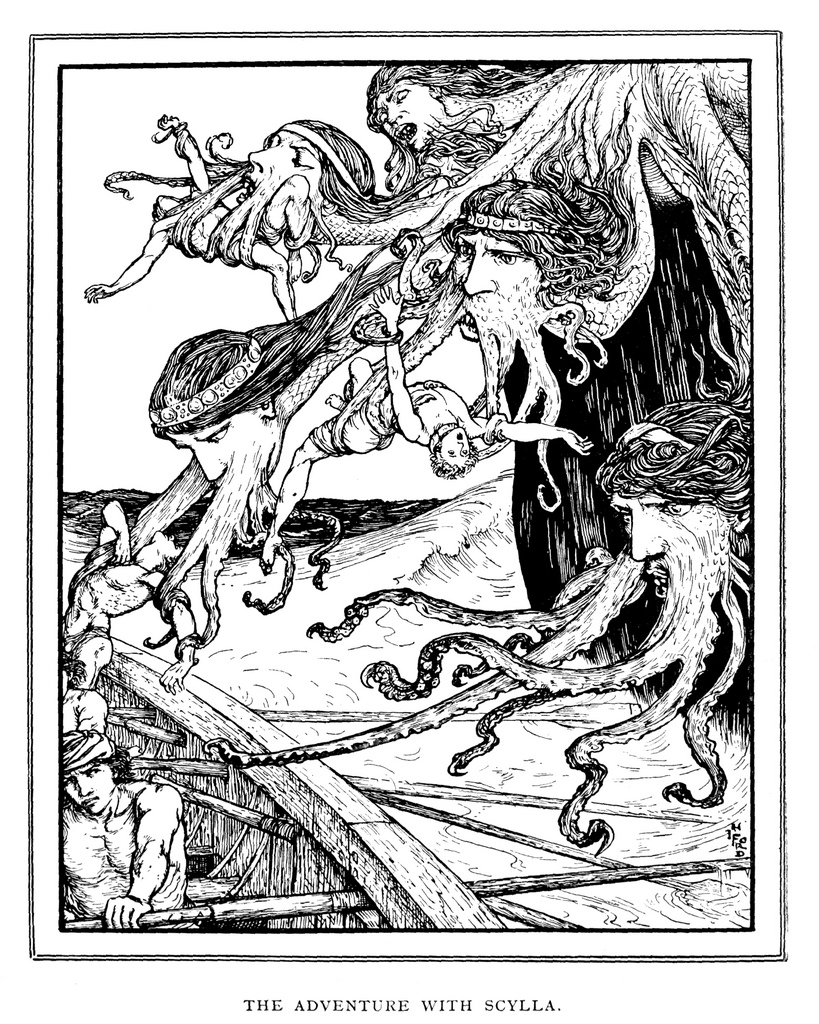
Henry Justice Ford, in case you, the reader, haven’t heard the name, is one of the finest illustrators of fantasy and folklore to have ever come around the bend. Recently, Monster Brains did a very long post showcasing a ton of his work – I highly suggest taking a tour of the post and the site (one of my favorites).

Many of the works depict monsters that were new to me, either in the sense that I was unaware of the fairy tale in which they originated, or they were drawn in a way that sparked my imagination. I decided it might be fun to stat a few up for Blood & Treasure, and, if you continue reading, you will find that that is precisely what I’ve done.

By the by – I think the idea of a monster book divided up by great artists (in the public domain, of course) in the manner the old Deities & Demigods book was divided up by mythos, would be pretty cool, in case anyone wants to collaborate.

Three-Headed Draken
Medium Monstrous Humanoid, Chaotic (CE), Average Intelligence; Band (1d10)

HD: 2
AC:  14
ATK: 2 claws (1d6 + rend) and bite (1d4)
MV: 30
SV: F12 R15 W12
XP 200 (CL 3)

The three-headed draken are goblinoids with skin as black and as shiny as coal. They have feet tipped with cruel talons, mouths full of fangs, and generally lurk in ruins planted with fruit trees. They regard this fruit as a dragon regards its treasure, for the trees to which they are bound are the only ones from which they can draw sustenance.

Special Qualities: Regenerate

Black Master of the Beasts
Large Fey, Neutral (N), High Intelligence; Solitary

HD: 9
AC: 16
ATK: 1 club (2d8) or slam (1d6)
MV: 20
SV: F10 R9 W8
XP: 900 (CL 10)

A black master of beasts is a fey guardian of a particular woodland, having the animals of that woodland under his protection. Black masters appear as black-skinned giants with single eyes in their heads and single legs to support them. They wield massive iron clubs and are capable of summoning 30 HD worth of animals, dragons and magical beasts common to their woodland (i.e. they show up on a random encounter chart) to their service once per day. These animals arrive in 1d4 rounds.

Special Qualities – magic resistance, immune to fear

Spells – 3/day—augury, calm animals, hold animal; 1/day—divination, magic fang, quest

Scylla
Huge Aberration, Chaotic (CE), Average Intelligence; Solitary

HD: 16
AC: 18
ATK: 5 heads (1d8 + constrict)
MV: 10 (Swim 30)
SV: F4 R7 W5
XP: 4000 (CL 18)

Scyllas are primordial sea monsters, terrible abominations that haunt narrow straits, lying in wait for prey. They have bodies shaped something like hydras, with scaled skin and five thick necks that end in massive humanoid heads. These heads have beards of tentacles, six tentacles each. Scyllas communicate telepathically, and they can induce fear (as the spell) once per day per head in creatures with 5 or fewer hit dice. If one head of the scylla is casting a spell, the others are still capable of attacking.

Special Qualities – Immune to fear, immune to cold, regeneration, magic resistance 40%, resistance to electricity

Spells – 3/day—control water; 1/day—control weather

Seasonal Beasties – Ladies in Grey

In the fall, the earth begins to fall asleep, and sleep was the inspiration for this next seasonal beastie …

LADIES IN GREY

Women in gray are fey spirits who appear as elegant elven women. The are clad in ruffled silks of teal and dun and dappled bodices of velvet, their collars and wrists ringed in lace. Their skin is as white as bleached bone, their thin, enticing lips are champagne, their hair platinum and their eyes xanadu. They are, no doubt, lovely, but they do not inspire love.

Ladies in grey appear when the wind turns chill and the leaves begin to fall. One might think of them as the harbingers of winter. They walk through the streets of villages and down woodland paths, a chill following them wherever they go. It is said they speak of deep secrets in the hush, honeyed voices, and their raison d’etre is to lay low the powerful to make room for new blood.

In any situation, the ladies in grey will focus their attentions on the most powerful (by levels or possible hit dice) person in their presence. They move swiftly, their bodies and clothes blurring as they do so, and those who enter melee with them must pass a Will save each round or be affected as per the slow spell from the hypnotic quality of their blurred movements. If engaged in hand-to-hand combat, they can produce a slim, silver sickle, but prefer to use their own chilling touch.

Those touched by a lady in grey must pass a Fortitude saving throw or be cast into a deep slumber from which they cannot easily be awakened. The amount one fails the save indicates the amount of time they slumber:

MISSED BY … DURATION
1 … 1d4 rounds
2-3 … 1d4 minutes
4-5 … 1d4 turns
6-7 … 1d4 hours
8-9 … 1d4 days
10-11 … 1d4 weeks
12-13 … 1d4 months
14-15 … 1d4 years
16+ … 1d4 decades

While slumbering, a victim is placed in stasis – they do not age, nor are the affected by any beneficial or deleterious effects currently on their person, such as spells like bless or poison or disease. They can be harmed and healed while sleeping. While sleeping, half of their life force (i.e. half their levels or hit dice, rounding up) are drained from them and into the surrounding landscape, making plants within 10 feet grow lush and bloom. When they awaken, they must pass one Fortitude saving throw per level or hit dice lost, or lose that level or hit dice permanently.

A person can awaken a sleeping creature with a kiss, but doing so imparts one of their one levels or hit dice to the slumberer. This means that the slumberer need not roll a Fortitude saving throw for one of their lost levels or hit dice.

Lady in Grey, Medium Fey, Average Intelligence: HD 5; AC 14; ATK 1 sickle (1d4) or touch (sleep – see above); MV 30; F13 R11 W11; AL Neutral (N); XP 1250; Special – Sleep touch, blur effect, slow effect – see above.

Happy Thanksgiving, One and All!

From We Heart Vintage

Just a quick note today to wish everyone (American or not) a happy day. It’s always a good idea to stop and take an inventory of the blessings in your life, and among mine is the audience of folks who read my blog and buy my stuff. You folks have given me, through your attention and your cold hard cash, an opportunity to pretend to be a real grown up writer, and I appreciate it more than you know.

As a way to show my appreciation, I’m put all of my books at Lulu are now 10% off between now and the end of the year (not the PDF’s though – they’re cheap enough already). At the moment, Lulu is doing a 30% sale as well (code is DELIRITAS), so if you’ve been waiting to buy NOD or Blood & Treasure or anything else, now’s the time! Remember, with Blood & Treasure, I’ll send you a link for a free download of a PDF when you buy a hard cover book – just email me the receipt.

In other news, I’ve commissioned the first bits of character class art for the Nod Companion, which will gather together classes, races and other useful character bits from the NOD magazines, revising and updating them for Blood & Treasure. It will also include a brief run-down of the Land of Nod’s history and major city-states and peoples, for those who want to know more and can’t wait for me to hex crawl the entire planet (yeah, that’s just about what I’m aiming for – I might skip a bit of open ocean, but I do want to hex crawl the entire landmass).

And finally, to keep this post useful …

HELL-PUNKINS

Hell-punkins are orange gourds that are grown in the swamps of Hell. They are steeped in hatred and misery and, when the air turns cold, heaved out of the depths to spread fear on the Material Plane.

Hell-Punkins look like large pumpkins (usually about 3-ft in diameter) with burning red eyes and jagged mouths that look as though they were ripped into the flesh of the plant by the plant’s own burning desire to nibble on the flesh of innocents. A single long tendril (8 feet) rises from the top of the plant.

Hell-Punkins can breathe cones (10 ft.) of molten gunk and seed from their mouths once per day. The gunk initially does 2d6 points of damage, and if the target fails their Reflex save to cut the damage in half, sticks to people’s skin and deals another 1d6 points of damage the next round. More importantly, the seeds in the gunk begin to sprout the second round, digging roots into the person’s blood (1d4 points of damage) and then sprouting forth in tendrils that grow quickly, entangling the victim (per the spell entangle). Victims killed by this burning gunk eventually become the fodder for a new crop of hell-punkins.

The creatures move by bouncing and utter a wheezy cackle of delight when they discover new victims.

Demons and devils enjoy a spicy pie made from hell-punkins, a pie that deals 3d6 points of internal damage to most humanoids.

Hell-Punkin, Small Plant, Low Intelligence: HD 3; AC 16; ATK 1 bite (1d4) and 1 tendril whip (1d4/10′ range) or breathe burning gunk; MV 20; F13 R14 W15; AL Chaotic (CE); XP 300; Special – Breathe gunk, immune to fire and poison, magic resistance 15%

Seasonal Beasties – The Applejack

In the days of questionable water safety, man developed alcoholic beverages as a way to hydrate without also succumbing to any of a number of horrible diseases and parasites. In colonial America, for example, far more apples were turned into cider and applejack than were baked into pies or eaten raw. Unfortunately, in a fantasy world magic often enters the picture.

Some halfling witch of antiquity, miffed at not being invited to the moot, concocted a devilish plan. She invented a magical parasite that could withstand the fermentation process and introduced it to an apple orchard. While only a very few of these parasites managed to actually survive fermentation, the result was devastating. The parasites survived past the witch’s curse, and now appear seemingly at random in apples all over the fantasy realms. The parasites enter the body through the digestive system when an alcoholic apple-based beverage is consumed, and then go to work on body and brain. After ingesting a parasite, a person (non-humanoids are unaffected by the parasites) must pass a Fortitude saving throw or begin a startling transformation.

The victim, usually nicknamed applejacks, gets a wild look in his or her eye and falls to the ground, writhing about while they are transformed into a monstrous version of themselves. Their skin becomes a deep crimson, their eyes bloodshot, their lisp curl back to reveal their teeth and the hair all over their bodies grows thicker. The applejack then springs from the ground and begins attacking everyone in sight. The transformation and violent behavior last about 1 hour.

The applejack has the same number of hit dice of its host, plus five. The applejack stats below assume the base creature is a 0 HD human being.

An applejack primarily attacks with fists and feet. The victim of the creature’s attack must pass a Fortitude saving throw or be knocked backwards 1d4+4 feet and stunned for 1d4 rounds. After the stunning wears off, the victim must make an additional Will save or be confused – in essence, they act as thought inebriated.

The applejack does not appear to be interested in killing, only knocking people about and committing as much property destruction as possible. Non-magical wooden weapons that strike an applejack must pass an item saving throw or break on contact, and non-magical shields employed against an applejack must pass an item saving throw every other round or likewise be destroyed.

When a person finally comes out from under the influence of the parasite, they fall into a deep sleep and transform back to normal, though they retain a ruddy hue to their faces and their additional hair remains for a few days before finally falling out. They rarely remember the experience, but about 1 in 20 do remember, and gain the ability to go into a berserk rage (per the barbarian class) once per day for about 30 days.

Applejack, Large Monstrous Humanoid, Low Intelligence: HD 5; AC 17; Atk 2 fists (1d6 + knock back and stun and confusion); Move 40; F12 R11 W12; AL Chaotic (CE); XP 500; Special – Knock back, stun, confusion, break wooden weapons and shields, insensitive to pain, weapon resistance, immune to mind-affecting spells.

Image found HERE

Seasonal Beasties – Leaf Golem

Everyone enjoys jumping in a fresh pile of fallen leaves (okay, actually I don’t know anybody who does that, but just play along, okay), but some piles are better left alone (what a weird phrase to write!)

Leaf golems are constructed by druids in the autumnal months, when leaves have turned yellow, gold and red and fallen from the trees and vines are beginning their retreat before the coming of winter. A vast quantity of this plant material is gathered by the druid and sprinkled with various holy compounds and then left in a clearing under a new moon. When the first hint of moonlight touches the mouldering pile, it stirs and rises as a leaf golem.

Leaf golems look something like shambling mounds – they are vaguely humanoid, stout and thick, and smell of rotting vegetation. Unlike shambling mounds, they are a bit taller than they are wide. They have no faces, but appear to be able to see and hear. They make no sound other than a persistent rustling, even when standing still, but quieted when imitating a leaf pile and ready to attack.

Leaf golems contain dozens of thick, woody tendrils and their interiors are suffused with brown mold. Up to four of these tendrils can be projected from the creature’s body to attack creatures. A creature constricted by a tendril must pass a Fortitude saving throw each round or be dragged 5 feet closer to the monster. When they are right next to the monster, the next dragging pulls them inside the monster. A leaf golem can hold one medium-sized creature at a time, two small creatures or four tiny creatures. Creatures inside the leaf golem begin to suffocate, and are affected per brown mold, suffering 1d6 points of cold damage per round until dead. When dead, they are ejected in a random direction, flying 5 feet and possibly striking another creature for damage (1d3 for tiny creatures, 1d6 for small creatures, 2d6 for medium creatures).

The presence of the brown mold and the dampness of its leafy body give a leaf golem resistance to fire. The monsters are immune to cold and suffer only half damage from piercing weapons like spears and arrows.

Leaf golems are immune to most spells, and those spells that do affect it do so in weird ways (with no save):

– A blight spell drives the golem back 120 feet and deals 3d12 points of damage to it.

– A command plants spell slows a leaf golem for 1d6 rounds and suppresses its magic immunity during that time.

Leaf Golem, Large Construct, Non-Intelligent: HD 9 (45 hp); AC 19; ATK 2 slams (2d8 + constrict) and 4 tendrils (1d4 + constrict); Move 20; F10 R11 W11; AL Neutral; XP 2250; Special – Resistance to fire, magic immunity (see above), suffocate (see above), immune to cold, brown mold, surprise (3 in 6 in leafy areas), weapon resistance (piercing).

Image found at Pixabay

Seasonal Beasties: The Forlorn Grey

Forgot to mention that my last post was number 1000. If that means anything to anyone.

Now then …

FORLORN GREY

Image from 7art

Sometimes that grey mist in the corridor or tunnel is just a bit of water vapor. Sometimes, though, it’s a monster that has been nicknamed “the forlorn grey”.

The forlorn grey appears as a grey fog, usually about 20 feet long and 10 feet wide. To the touch, it is clammy and chilly, and an astute observer might notice that it does not leave a damp residue on people who walk through it.

A forlorn grey usually allows a group to get within it, and then moves along with them. It obscures vision, so most folks think that they are just moving through a very long patch of fog. Each round a person spends in the fog, their minds are attacked by the strange monster.  The adventurer must pass a Will save, or lose a bit of their zest for living, not to mention suffer 1 level of energy damage. The TK should prepare several strips of paper outlining the apathy that has befallen a character who fails a saving throw. Some examples might be:

“You realize you don’t really want to be in this stupid dungeon.”

“Treasure isn’t everything.”

“That serving wench really wasn’t all that attractive.”

“It occurs to you that you don’t really have any friends.”

Once a creature within the forlorn grey reaches effectively 0-level, they take on a dull appearance, their eyes turning grey and losing their spark of life. They remain 0-level monsters at this point, normal humanoids of their type who are apt to wander aimlessly for the rest of their lives, begging for scraps and generally avoiding the company of others. They can again be restored to vigor through the use of a wish or restoration spell, and can otherwise be used as torchbearers by their former friends – they don’t care one way or the other about it.

Fighting the mist is difficult. It can only be struck for full damage by magical edged weapons, and silver edged weapons deal half damage to the creature. Bludgeoning and piercing weapons deal no damage to a forlorn grey, magical or otherwise. If actively fought, the forlorn grey can manifest tendrils of super-chilled mist, with which it can make feeble physical attacks that, on a natural attack roll of ’20’, snake down people’s throats (or through their noses), dealing double damage and forcing the victim to pass a Fortitude save or be stunned for 1d3 rounds. The creature can manifest three such tendrils.

Forlorn Grey, Large Elemental (Air), Average Intelligence: HD 7; AC 16 [+1]; Atk 3 tendrils (1d3 + see above); Move Fly 30; F11 R10 W12; AL Chaotic (NE); XP 1750; Special – Only damaged by edged weapons, silver weapons deal half damage, energy damage, stunning attack, immune to cold and acid.

Seasonal Beasties: The Gorger

October is all about horror, and obviously horror-inspired monsters (i.e. undead). November, to me, is all about fall (or autumn, if you prefer), and I figured I would try to work up a few fall-themed monsters. The reapers last week was one of them, but they also meshed pretty well with Halloween – consider them a transition monster. Today I’m presenting the Gorger!

GORGER

Gorgers are akin to trolls and giants. They have a strange life cycle, hibernating (so to speak) most of the year and then emerging from their slumber in the fall to consume mass quantities and prepare for their next hibernation. They are not terribly bright, and seem to exist solely to produce offspring.

Most gorgers live in small bands, burying themselves in loose earth while hibernating, and then emerging when the air becomes crisp and the crops are in. They are omnivorous, and even a small group is capable of eating a small village out of house and home.

Gorgers looks like warty, grey trolls with over-sized mouths and ponderous bellies. Their feet and hands are tipped by massive claws (useful for burrowing as well as killing) and their legs are stubby and a bit bandy. They always attack as a group, and though not terribly bright, they are cunning and capable of tactical planning. Most uproot a small tree to use as a double-handed weapon, relying on their claws only if they are unarmed or forced to fight in tight quarters or when they are bent on swallowing an opponent whole.

When a gorger swallows a victim whole, they begin to take on that victim’s intellect (though not personality) and skills after 1 round of digestion. Each round thereafter, a gorger gains one level’s worth of their victim’s skills and special abilities (regardless of alignment restrictions) until they have the same level as their victim. For example, if a gorger swallows a 4th level thief, they would, one round after swallowing them, gain the abilities of a 1st level thief. The next round, they would have the abilities of a 2nd level thief, and then a 3rd level thief in the round after that, until finally capping off as a 4th level thief. These special abilities are retained by the gorger for 1 hour, at which point they fade at the same rate (one level per round) that they were gained. If a gorger swallows a monster, it gains the monster’s special abilities after a number of rounds equal to half the monster’s hit dice total.

Gorgers regenerate as do normal trolls.

Gorger, Large Giant, Low Intelligence: HD 8; AC 16; ATK 1 weapon (3d4) or 2 claws (1d6) and bite (1d6 + swallow whole); Move 30 (Burrow 15); F8 R11 W12; XP 800; Special – Absorb skills and special abilities, regenerate.

One Last Trick

Here’s a monster that popped into my mind yesterday …

REAPER

Reapers look like long-armed goblins with glossy black skin and magnesium green eyes that have a slight phosphorescence. Some wear carved pumpkins over the heads, like masks. They travel in small packs and are armed with very sharp cutting blades, each one carrying a mild enchantment that makes it especially dangerous.

A creature hit by a reaper’s blade and suffering 5 or more points of damage must pass a Fortitude saving throw (or save vs. petrification) or have one of their arms lopped off. The severed arm instantly comes to life and begins grabbing at its former owner or performing any other task the reaper sets it to. Arms have the same armor class as their former owner, and 1d4 hit points. If an arm is “killed” it is destroyed. Otherwise, the arm can be reattached (remember, there’s magic involved) to its original owner once the reaper has been killed.

Some especially lucky (or talented) reapers ride strange mounts composed of severed arms. These mounts look something like centipedes.

Reaper, Small Humanoid, Average Intelligence: HD 3; AC 16; ATK 2 blades (1d6 + sever limb); Move 30; F13 R14 W14; AL Chaotic (CE); XP 300; Special – Sever and control limbs.

Manopede, Large Aberration, Non-Intelligent: HD 4; AC 14; ATK 2 slams (1d4+1 + grapple); Move 50; F13 R13 W11; AL Neutral (N); XP 400; Special – Grapple.

Severed Arm, Tiny or Small Aberration, Non-Intelligent: HD 1; AC varies; ATK 1 slam (1d3 + grapple); Move 10; F16 R16 W13; Special – Grapple.

Six Lovable Lycanthropes

We round out the “6 Monsters” series with six lycanthropes that might be lurking about the next city or dark wood your PCs visit.

Emma Scholt

Emma Scholt is a fierce woman, with a grave countenance and nary a sign of joy or lightness in her. A librarian, she is a pinnacle of order and reason, relied upon by the traveling sages and professors of Hogyth College for their research. Her staff fear more than respect her, for they have had occasion to see the mask slip every so slightly, to see the blood rise to her face and the rage within bubble to the surface even momentarily when something was found out of place or improperly handled. She keeps her office in the sub-level of the old church-come-library at the college, within the confines of the forbidden section, where heretical and valuable texts are locked away behind an iron door. Here, she prowls when the moon is full and she has taken on the aspect of the wolf (after making sure the volumes here are safely locked behind iron bars and away from her more destructive impulses.) It was two summers ago that one of her staff, a dashing fellow from the north, crept into the forbidden section in a bid to woo the librarian, for he had seen her flush with anger and was captivated by the beauty that anger revealed. Of course, he never left the forbidden section, and what remained of him the next day was hidden away to be a nagging worry in the back of Emma’s mind that, one day, he will be discovered and she will have to flee.

Emma Scholt: HD 4; HP 10; AC 16 [silver]; ATK 2 claws (1d4) and bite (1d6); MV 30; F14 R11 W11; AL C (NE); XP 400; Special – Lycanthrope.

Hemix

The docks of Sampthr are a wild place, sitting as they do at “the end of the world”, where the northern lights adle the brain and the bitter cold drives men and women to all manner of extremes to survive. The docks will be an even wilder place soon, for a werewolf has been introduced to the mix. Hemix was a sailor from a far away land who was traveling north, to the empty, snowy quarters there that he might quit humanity and live out his curse in relative peace. Alas, an accident aboard the ship that was carrying him left him unconscious and with amnesia. Recovering on the icy streets of Sampthr, he spent a week regaining his strength under the ministrations of a tavern girl named Muirion, who liked the look of him. A strong lad, he soon found work on the docks and has taken up with the girl, blissfully unaware that in just two days, when the moon is full, his true nature will reveal itself.

Hemix: HD 4; HP 11; AC 16 [silver]; ATK 2 claws (1d4) and bite (1d6); MV 30; F14 R11 W11; AL N currently, but normally C (CE); XP 400; Special – Lycanthrope.

Talyn

Talyn was a soldier of Rurit who was captured during a fierce battle with the Duwoldi Empire. He and his fellows were gathered up, bound in chains, and sold off to Rolla the Slave Trader, who in turn sold Talyn and a few others to work on the villa of Chazadar, a spice merchant who had made a name for himself in Duwoldi politics. A mercenary, his fellow soldiers knew little about him, and they have learned little since. Talyn is a werewolf, and though he was at first loathe to be a slave, he has since found it excellent cover for his disease. Hunting his fellow slaves is like shooting fish in a barrel, and he has set his eyes on Chazadar’s wife. At the next full moon, he will creep into his “master’s” villa, slaughter the household and bite the beautiful Latzme, infecting her and making her his mate.

Talyn: HD 4; HP 14; AC 16 [silver]; ATK 2 claws (1d4) and bite (1d6); MV 30; F14 R11 W11; AL C (CE); XP 400; Special – Lycanthrope.

Minri
Minri is a girl of about 12 years who lives on the rough and tumble streets of Tricardis. One of many street urchins, she makes her way as a beggar and thief, leading (from behind) a large gang of urchins. They dwell in a number of abandoned buildings or beneath bridges or in the sewers, picking pockets during the day and sometimes carrying off more ambitious heists at night. When the moon is full, Minri takes on her rat nature and infects the new members of the gang with lycanthropy. Those who survive become full fledged “street rats”, and are brought to the gang’s sanctum sanctorum in an abandoned and forgotten dungeon beneath one of the city’s old watch towers, where they feast and dance and dream of conquest.

Minri: HD 2; HP 7; AC 16 [silver]; ATK 1 bite (1d6) and 1 dagger (1d4); MV 30; F15 R12 W12; AL C (CE); XP 200; Special – Lycanthrope, pick pockets as 6th level thief.

Samera

Samera is a princess, regal and cruel, who rules over a small principality on the shores of a great, inland sea. Her land of rugged hills and tangled woods is known for its horses and its blue-furred tigers. Samera is a strong ruler who has had many consorts, but has not yet been wed. Her family is tight-knit, and the house servants fear them, for they are casually cruel and seem not to have a drop of human kindness in them. When the moon is full, the servants are dismissed from the house and the family perform rituals and sacrifices to the moon goddess to ensure their country remains fertile and strong – or so they say. It is also during these revels that the blue tigers of the hills become exceptionally aggressive, attacking not only livestock, but people (usually hapless travelers) who wander out of doors at night.

Samera: HD 7; HP 34; AC 16 [silver]; ATK 2 claws (1d8) and bite (2d6); MV 30; F11 R10 W10; AL C (LE); XP 700; Special – Lycanthrope.

Yao the Peddler

Yao is a wandering peddler of boar bristle brushes and other odds-and-ends he scavenges on his travels. He travels on foot, visiting the villages and towns between the eastern hills and the tranquil sea, his fat, red face well known in the region. Most folk are suspicious of the man, who never sleeps a night in a civilized village, always preferring to camp a mile or so away. His products are good enough, and he doesn’t cheat folks, but he tends to stare with his piggish little eyes, and one gets the feeling he is sizing them up for a meal. He is, of course, a wereboar. An intelligent man, he makes sure to get himself far away from civilization when the moon is nearing full, only rarely allowing himself the luxury of killing a human being, and only then when that person has cheated or offended him in some way. Travelers might encounter him in the wilderness, where they will find him evasive and hostile if they are kind to him, and uncomfortably pleasant if they are unkind.

Yao: HD 4; HP 18; AC 16 [silver]; ATK 1 gore (1d6) or light mace (1d4+1); MV 30; F14 R11 W11; AL N; XP 400; Special – Lycanthrope.

Image found at Brian’s Drive-In Theatre

Six Delightful Demons

Who doesn’t like a good demon (well, not good – you know what I mean). Today, I present six delightful demons that have fallen prey to the bindings of earthbound conjurers.

Izalph

Izaph is a type I demon that once stalked the woodlands around an ancient castle that was inhabited by a coven of diabolists. The villages that bordered the woods were beset for many years by the temptations and depredations of Izalph, and many a knight and maiden were cast into ruin by the demon’s actions. Finally, a trio of spellcasters, a cleric, druid and magic-user, joined forces to deal with the infamous ‘Demon of the Wood’. The trio found a grove of ancient oak trees and carved runes of power into them. They then drew lots. The cleric lost and served as bait for the demon, fleeing from it and drawing it into an especially large, ancient oak tree. As the demon followed the cleric into the tree, the magic-user and druid completed their spellwork and activated their magic circle, binding the demon into the tree. The cleric, alas, lost his life. Izalph is still trapped in the great oak, brooding and cursing his fate. Seven dryads dwell in the smaller oaks that serve as the anchors of the magic circle, and they delight in tormenting the captive demon.

Izalph: HD 8; HP 28; AC 20 [+1]; ATK 2 claws (2d8) and bite (1d8); Move 30 (Fly 50); F8 R9 W8; AL C (CE); XP 2000; Special: See B&T.

Phimzael

Phimzael is a type II demon that looks like an especially large, warty, frog with bilious green flesh streaked with gold. For many long years, the wizard Yurk researched Phimzael, learning his true name and the symbols required to conjure and hold him. Yurk desired a very ancient spell involving transportation to and from the gem-like worlds that dot the Firmament, and his inquiries convinced him that the Celestial Circle, a band of magic-users known in ancient Irem, had been the last to perfect this spell, and that they had had contact with Phimzael. Yurk also knew that Phimzael was not to be trifled with. He constructed a long shaft, like a well, with a circular room at the bottom. Here, he drew his magic circle and, accompanied by his apprentices, conjured the demon. Phimzael was a cunning opponent, and time and time again he fed Yurk false information about the spell he sought. Eventually, he corrupted Yurk’s most promising apprentice and, during an especially long and frustrating audience with the demon, the apprentice stabbed Yurk in the back (literally) and released Phimzael from the magic circle. It was then that Phimzael learned just how canny Yurk was, for the rim of the shaft also formed a magic circle, more powerful than the first and obscured by illusions. Phimzael was again trapped in a magic circle, and this time there was nobody capable of releasing him. In a fit of anger he slew the apprentices and consumed their souls. He still sits at the bottom of the shaft, which is now filled with water, in the ruins of Yurk’s manse.

Phimzael: HD 9; HP 35; AC 21 [+1]; ATK 2 claws (1d8) and bite (4d6); Move 30; F8 R9 W8; AL C (CE); XP 2250; Special: See B&T.

Zuron

Zuron was a type III demon that specialized in providing engineering knowledge to those who conjured and commanded him. It was in this capacity that was conjured by the archimage Thebea to advise the gnomish engineer Walprict in the crafting of an especially large and impressive iron golem. Unfortunately, dealings with demons are never easy, and Zuron proved to be more than Thebea could handle. She arrived in her laboratory one morning to find that Walprict had killed himself in an especially macabre fashion, and that Zuron was free of his magic circle. Thebea had prepared for this, though, and grabbing the only item handy, a bronze cog, pronounced a powerful spell that trapped Zuron within the cog. She hid the cog away and, in the course of many years, was killed on an adventure. Her manse fell into disuse and ruin, and one day became the target of locals, who scavenged the ruins for building materials. It was in this way that a scrounger came across the cog and other mechanical items, and traded them to a clockmaker in a far away city, who used the parts to fashion a wondrous clock tower, in which each day a parade of automatons would act out various acts of knightly valor when the clock struck noon. The demon cog, however, corrupted this machine. If it can spill the blood of three innocents, Thebea’s ancient spell can be broken and Zuron released. The demon clock has already claimed one victim, a workman who was cleaning the mechanism when he was struck by the sword of one of the clockwork automatons.

Zuron: HD 10; HP 35; AC 23 [+1]; ATK 2 pincers (2d10), 2 claws (1d6) and bite (1d8); Move 40; F5 R8 W7; AL C (CE); XP 2500; Special: See B&T.

Rahorezs

Rahorezs was a rather grandiose and gluttonous pig of a type IV demon who was brought into the fabric of the material plane by the renowned demonologist Praction as a wedding gift for his beloved, Halia Rathsdottir, scion of a family that claimed descent from the rebel angels. The demon was conjured into a tapestry, his depiction fixed there with a magical golden thread. The demon could still communicate from the tapestry, but was otherwise powerless. Still, communication was enough, as Praction and Halia found themselves slowly giving way to gluttony themselves. In time, their inexhaustible appetites drove their subjects to revolt, and the two, despite Praction’s power, were destroyed. Rahorezs had hoped a revolt would result in the tapestry being burned or otherwise destroyed, thus releasing him. Unfortunately, it was merely looted and has been handed down through several owners, always bringing upon them the same curse that finally destroyed the demonologist and his bride.

Rahorezs: HD 11; HP 37; AC 23 [+1]; ATK 2 claws (1d8) and bite (2d8); Move 30 (Fly 40); F5 R8 W5; AL C (CE); XP 2750; Special: See B&T.

Saherael

The demoness Saherael, a type V demon, fought in the epic Battle of Borok’s Grave, where 20,000 demons and devils, manipulated by the demodands, destroyed themselves in a quest to claim an artifact that did not exist. Neither side tells of the incident today, of course, but the damage was done. Saherael was not killed in the battle, but she was gravely wounded and weakened, and in this state was captured by a coven of witches loyal to Baalzebul. The witches held and tormented the demon for nine long months before finally tearing her, body and soul, apart. Her body they threw to their devil swine, but her soul they captured in six small rubies, each a piece of a larger gemstone. These rubies they set in the hilts of six magic swords that now thirst to be united so that Saherael can reform in the Underworld and seek vengeance on the souls of those who wronged her.  The Six Swords of Saherael are as follows:

+1 Bastard Sword, makes bearer immune to electricity

+1 Broadsword, bearer can cast project image and detect invisibility 1/day

+1 Greatsword, bearer can summon one marilith 1/day with a 20% chance of success

+1 Longsword, grants bearer a +4 bonus to save vs. spells

+1 Scimitar, bearer can cast project image and telekinesis 1/day

+1 Short Sword, bearer can cast blade barrier and teleport without error 1/day

Each of the swords is intelligent and chaotic (CE), and yearns to be re-united with its siblings. All six will fill the heads of their owners with the notion that all six swords united will grant a single wish (which is actually true, as they will allow Saherael’s fondest wish to come true). Assume each sword has an Ego of 6 and can speak and communicate telepathically. They all have 120-ft darkvision.

Currently, the longsword is in the possession of Sir Galt, a formerly shining knight in the process of becoming a chaotic warlord. The scimitar and bastard sword are in the vault of a king, and cry out constantly for their sisters. The other three are scattered about in various dungeons, seeking new pawns to carry them to their ultimate desire.

Saherael: HD 8; HP 25; AC 24 [+1]; ATK 6 swords (2d10) and tail (4d6 + constrict); Move 40; F8 R9 W8; AL C (CE); XP 2000; Special: See B&T.

Dosoharh

Dosoharh is a type VI demon that has tired of immortality. He seeks ultimate release from existence, and can only achieve this by being slain in the depths of Hell. Dramatic to the end, he has concocted a grandiose quest involving three (three!) virginal maidens, a silver chalice that holds the preserved eyes of six of the world’s greatest diviners, a down-on-its-luck red dragon called Jorvax the Bloody, the comedy stylings of Thobad (a renowned jester of Yex) and a cast of thousands. Powerful adventurers encountering any of these people or things might take up a thread of this plot and follow it into Hell, where Dosaharh awaits his fate impatiently. What those adventurers will not know is that Dosoharh is a manic depressive, and he’s just about ready to go from the blackest sadness to joy unrestrained (and joy in a demon is a terrible, terrible thing).

Dosoharh: HD 20; HP 66; AC 26 [+3]; ATK +1 vorpal longsword (1d10+7) and +1 flaming whip (1d6+1 + 1d6 fire); Move 40 (Fly 90); F3 R3 W3; AL C (CE); XP 5000; Special: See B&T.