Time to revise the No. Appearing line in the Monster Manual.
Monsters
Medieval Bestiary – Part Six

European folklore holds a candle to none in the breadth and depth of its imagination. Europeans populated not only their own countries with all manner of strange beasts and monsters, but extended their imaginations over the entire globe. While a good many of these creatures have been given game statistics, several have not. Some of these creatures are, to be sure, simple variations on existing monsters – ogres, giants, fairies, spirits, etc. Others are just not threatening or interesting enough to demand statistics. Those monsters of the folklore of France, Germany and the Low Countries, and those of medieval bestiaries and heraldry, that I thought both unique and challenging are presented below.
Part One, Part Two, Part Three, Part Four, Part Five
This post is declared Open Game Content.
Pegasus, Ethiopian
Medieval bestiaries told of a breed of pegasus from Ethiopia that had two horns. These creatures can be treated as normal pegasi with the addition of a gore attack that deals 1d6 points of damage.
Revenant
The revenant is an animated corpse that has returned from the grave to terrorize the living. The name comes from the French and means “returning”. Revenants are always wicked in life. Creatures struck by a revenant in combat must make a saving throw or be infected with a disease that resembles mummy rot. Revenants regenerate damage in the manner of a troll at the rate of 1 hit point per round. A revenant can only be destroyed completely by cutting off the head, removing the heart, and burning them and the body separately.
Revenant: HD 4; AC 3 [16]; Atk 1 slam (1d6); Move 9; Save 13; CL/XP 6/400; Special: Regeneration, disease.
Snakes
The writers of medieval bestiaries imagined many interesting serpents, many that were probably based on fourth-hand accounts of real animals. The hydros was a viper whose poison caused a person to swell up. In game terms, his poison causes the person to have their movement and dexterity scores cut in half. The hydros’ poison could only be cured with the application of ox dung. There’s a fun quest! The hydrus, on the other hand, was a water serpent of the Nile River. It would swim into the mouth of a crocodile and then down its throat. Once in the stomached, it would eat the poor beast from the inside out. In game terms, it is probably immune, or at least resistant, to acid. The hypnalis was an asp that killed its victims in their sleep. In game terms, perhaps it can cast a sleep spell one or several time per day. The scytale was a snake with such brilliant markings that those gazing on the creature are hypnotized and lulled into inaction. The scytale’s body is so hot that those touching it or touched by it suffer 1d4 points of burning damage. The seps, on the other hand, has venom so acidic that it liquefied its prey; assume normal viper poison plus an additional 2d6 points of acid damage.
Waldgeist (Woodwose)
The German “woodland spirit” is the custodian of the forest. It dwells in woodlands and protects it as well as lawful creatures within the woodland. Waldgeists resemble gnarled old dwarfs with skin like the bark of a tree and hair like a tangle of leaves and twigs. They dwell in the branches of trees and, though mischievous, are not by any means evil. Waldgeists can use the spells bless and bestow curse. They blend in with the foliage, and thus surprise foes on a roll of 1-4 on 1d6. Despite their small size, they are exceptionally strong and dangerous to provoke.
Waldgeist: HD 5; AC 2 [17]; Atk 1 slam (2d4); Move 15; Save 12; CL/XP 6/400; Special: Bless, curse, surprise.
White Ladies (Wise Ladies)
The white ladies of the woods are elven amazons of the ancient and powerful blood. They are tall and beautiful, with white skin and hair like gleaming platinum. They dress in white cloaks and gleaming armor and wield spears tipped with silver and bows with silver-tipped arrows. White women are capable of casting spells as 3rd level clerics, druids or magic-users. They are capable of using the spell Light at will and always radiate an aura of Protection from Evil in a 10 ft radius. They usually appear in bands of 5 to 10 individuals and might be encountered in the company of unicorns. White women have the same immunities as normal elves. They are skilled in herb craft and healing, and under their care a person’s natural healing rate is doubled and he enjoys a +2 bonus to save vs. poison or disease.
White Woman: HD 3; AC 4 [15]; Atk 1 spear (1d8) or 2 arrows (1d6); Move 15; Save 14; CL/XP 4/120; Special: Spells, immunities.
White Worm
The white worm, or Indus worm, was a giant, pale worm that dwelled in the Indus River. It was carnivorous and capable of swallowing a man whole when it scores a natural ‘20’ on a bite attack.
White Worm: HD 7; AC 6 [13]; Atk 1 bite (2d6); Move 9 (Swim 12); Save 9; CL/XP 8/800; Special: Swallow whole.
Wild Man
Wild men are hairy humanoids that dwell in deep woodlands. They are called wilder mann by the Germans and homme sauvage by the French and wodewose by the English. They are associated with gods and goddesses of the wild such as Silvanus and Fauna and with the death god Orcus. In fact, they are known as orkes or lorkes in some parts of Italy.
Wild men run in bands of 20 to 30 individuals. Their entire bodies are covered in a tangled coat of brown hair and the men wear long, unkempt beards. They behave as though mad and fight as savagely as berserkers, gaining a +2 bonus to hit and damage. Despite their savage appearance, wild men are strict vegetarians, eating nuts, berries, roots and leaves.
Wild Man: HD 1+1; AC 7 [12]; Atk 1 weapon or fists (1d4); Move 12; Save 17; CL/XP 1/15; Special: Berserk.
Wraiths
The erlking, or “alder king”, was a pale, gaunt humanoid who rode a black horse and preyed on women. In game terms, it can be treated as a wraith. In truth, the name “erlking” was a mistranslation from the Danish for “elf-king”.
Yale (Centicore, Eale)
The yale is a black, horse-sized goat with the feet of an elephant and the tusks of a boar. It has large horns that it can swivel in any direction, thus allowing it two attack two different targets each round. Yales are immune to paralyzation and poison, thus making them a natural enemy of the catoblepas and basilisk.
Yale: HD 5; AC 6 [13]; Atk 2 gores (1d6); Move 15; Save 12; CL/XP 5/240; Special: Immunities.
Medieval Bestiary – Part Five
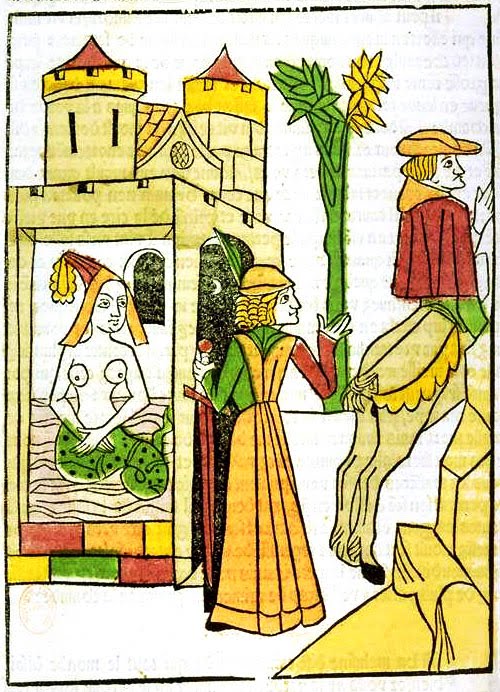
European folklore holds a candle to none in the breadth and depth of its imagination. Europeans populated not only their own countries with all manner of strange beasts and monsters, but extended their imaginations over the entire globe. While a good many of these creatures have been given game statistics, several have not. Some of these creatures are, to be sure, simple variations on existing monsters – ogres, giants, fairies, spirits, etc. Others are just not threatening or interesting enough to demand statistics. Those monsters of the folklore of France, Germany and the Low Countries, and those of medieval bestiaries and heraldry, that I thought both unique and challenging are presented below.
Part One, Part Two, Part Three, Part Four
This post is declared Open Game Content.
Melusine
Melusines appear to be exceptionally beautiful young women that, in place of legs, possess two mermaid-like tails. Melusines live in rivers and lakes. They crave the companionship of men, but are easily insulted if not given proper respect. The offspring of unions between humans and melusine are always melusines if female, or future magic-users if male. Melusines are fierce protectors of their children. Melusines can polymorph themselves at will into human females or small bronze dragons. One day per week they must assume their natural form and must submerge themselves in water.
Melusine: HD 2; AC 7 [12]; Atk 1 weapon (1d4); Move 6 (Swim 12); Save 16; CL/XP 4/120; Special: Polymorph.
Monocerus
The monoceros is an animal of the savanna often mistaken for a unicorn. It has the face of a sheep, the body of a stag, the rear feet of a goose, the tail of a dog and a long horn growing from its head. They are expert at spearing fish from rivers with their long horns. Although a monoceros horn has no efficacy against poison, it is worth approximately 20 gp on the open market.
Monoceros: HD 3; AC 5 [14]; Atk 1 gore (1d10); Move 15; Save 14; CL/XP 3/60; Special: None.
Monopod (Sciapod)
The monopodes are dwarves with one leg and a massive foot. They live in sunny highlands and use their foot as an umbrella when they take their afternoon naps. Monopodes are extremely strong (+2 to hit and damage) and they can control animals (as charm monster, but up to 6 animals). Monopods are as skilled at blacksmithing as other dwarves. They wear chainmail hauberks in combat and wield heavy maces and spears. Monopod tribes are led by 3 HD chieftains wearing platemail. The chieftain’s bride is always a druid. The chieftain will be guarded by four 3 HD bodyguards.
Monopod: HD 1; AC 4 [15]; Atk 1 kick (1d8) or 1 weapon (1d6); Move 9; Save 17; CL/XP 1/15; Special: None.
Muscaliet
This odd creature from medieval bestiaries has the body of a hair, the tail of a squirrel and a boar’s tusks. The muscaliet is about the size of a large dog. It’s body gives off a blistering heat that eventually kills the tree in which it builds its nest. Muscaliets are not terribly aggressive, but they do respond violently to threats and attacks. The muscaliet is surrounded by a 10 ft radius of intense heat. Creatures within the heat aura of a muscaliet suffer 1d3 points of damage each round. People in metal armor or wielding metal weapons suffer an additional point of damage each round.
Muscaliet: HD 1; AC 7 [12]; Atk 1 gore (1d4); Move 15; Save 17; CL/XP 2/30; Special: Heat.
Musimon (Tytron)
The musimon is a cross between a goat and sheep, having the feet and body of a goat and the head and wool of a ram. The creature has four horns on its head, two curved like a ram and two straight like a goat. Musimons are incredibly strong and will quickly charge creatures that approach their herd. Their gaze acts as a hold person spell on a single creature or a cause fear spell on up to 10 creatures. In any case, a saving throw is allowed to avoid the effect.
Musimon: HD 4; AC 7 [12]; Atk 1 butt/gore (2d6); Move 12; Save 13; CL/XP 5/240; Special: Gaze attack.
Myrmecoleon
The myrmecoleon has the body of a giant ant and the head of a lion. Because the lion head is only attracted to eating meat and the ant body is designed for digesting grain, the creature is usually in a foul mood. Like giant ants, they inject a poison with their bite attack. The poison does 2d6 points of damage if a saving throw is failed, 1d4 points of damage if the saving throw succeeds.
Myrmecoleon: HD 5; AC 4 [15]; Atk 1 bite (1d8 + poison); Move 18; Save 12; CL/XP 6/400; Special: Poison.
Panthera (Pantere, Love Cervere)
Pantheras are intelligent, supernatural felines with iridescent coats and sweet-smelling breath. Pantheras are roughly the size and shape of a leopard. They spend most of their time sleeping in their caves, but emerge once or twice a week to hunt. Pantheras are lawful creatures that will not attack non-chaotic creatures unless seriously provoked. Panthera females are capable of breeding only once, so the breed is quite rare.
Pantheras have a breath weapon that can be used three times each day. The panthera’s breath is a cloud of perfume that fills a 20 ft radius centered on the panthera. Any creature except dragons that breathes this perfume must make a saving throw or be affected as by a charm monster spell. Dragon, on the other hand, are affected as though by a fear spell. Spells like stinking cloud or a troglodytes maliferous odor are neutralized in a 30 foot radius around a panthera. A panthera’s hide, if reasonably intact, retains this property and thus is quite vauable. If a panthera successfully bites a victim, it gains two additional attacks with its rear claws.
Panthera: HD 7; AC 3 [16]; Atk 2 claw (1d4) and 1 bite (1d6); Move 12; Save 9; CL/XP 8/800; Special: Breath weapon, rear claws.
Parandrus
The parandrus resembled a shaggy ox with cloven hooves and a large rack of antlers. Although unintelligent, the parandrus is capable of changing its color and shape. A parandrus will change its color as a means of camouflage, surprising on a roll of 1-4 on 1d6. In general, a parandrus that surprises will choose to flee, rather than attack. If forced to fight, the creature is capable of changing itself into any natural and supernatural beast. The parandrus can change shape each round and still attack.
Parandrus: HD 4; AC 3 [16]; Atk 1 gore (1d6); Move 12; Save 13; CL/XP 6/400; Special: Change shape.
Peluda
A peluda is a river beast that resembled a giant, green porcupine. Its body is covered by stinger-tipped tentacles that can be made erect like quills. It also has the neck, head and tail of a serpent and the legs and feet of a tortoise. The peluda is capable of attacking with its poisonous stingers. Any creature in melee combat with the beast is subject to 1d3 stinger attacks each round. Each stinger inflicts 1d4 points of damage, or half that if the victim succeeds on a saving throw. The creature can also fire off one stinger each round as a missile attack with a range of 60 feet. A peluda has one of three possible breath weapons. The first is poisonous gas, like that of a green dragon. The second is a fiery breath, like that of a red dragon. The third is a gout of acid, like a black dragon. Each peluda will have one of these breath weapons, which it can use three times per day, inflicting 6d6 points of damage.
Peluda: HD 8; AC 2 [17]; Atk 1 bite (2d6), tentacles (see above); Move 9 (Swim 15); Save 8; CL/XP 11/1700; Special: Breath weapon, poison tentacles, only harmed by magic weapons, magic resistance 15%.
Medieval Bestiary IV

European folklore holds a candle to none in the breadth and depth of its imagination. Europeans populated not only their own countries with all manner of strange beasts and monsters, but extended their imaginations over the entire globe. While a good many of these creatures have been given game statistics, several have not. Some of these creatures are, to be sure, simple variations on existing monsters – ogres, giants, fairies, spirits, etc. Others are just not threatening or interesting enough to demand statistics. Those monsters of the folklore of France, Germany and the Low Countries, and those of medieval bestiaries and heraldry, that I thought both unique and challenging are presented below.
Part One, Part Two, Part Three
This post is declared Open Game Content.
Ghouls
The nachzehrer, or “afterwords devourer”, is a foul undead creature from German folklore. Usually the risen corpse of a victim of suicide or disease, the nachzehrer consumes dead bodies in the manner of a ghoul. The creature assumes the shape of a large pig after leaving its grave, and initially targets its own family for consumption.
Gnolls
Through one means or another, the gnoll of modern fantasy games has come to be represented as a humanoid with the head of a hyena. In medieval bestiaries, two creatures can be used as variant gnolls. The first is the chromandi, a hairy, savage humanoid with the teeth of dogs. The second is the cynocephalus, Latin for “dog-head”. These dog-headed creatures were long claimed to have hailed from the mountains India. The dog-heads were hunters who communicated with barking and wore animal skins. Although of ancient Greek origin, they persisted into the Middle Ages. Saint Christoper was often depicted as being a cynocephalus, for he was a member of the tribe of Marmaritae, who were believed to be large and to have the heads of dogs. In game terms, Christopher would be a very rare high level lawful gnoll cleric! In the late Middle Ages, there were stories of such people living in Central Asia. King Arthur had a band in his retinue, inhabitants of the mountains of Eidyn, or Edinburgh. The Chinese admiral Hui-Sheng described an island of dog-heads, a “dog kingdom”, to the east of Fusang. Clearly, the gnolls got around in the days when giants still walked the earth.
Gorgad
Gorgades are hairy demi-humans believed to inhabit islands off the Atlantic coast of Africa. First described by Pliny the Elder, they feature in many medieval bestiaries. In Pliny’s description, it seems likely that what he was really describing was an encounter with apes. There is no reason, of course, that the gorgad cannot be portrayed in a fantasy game as a new race of hairy, primitive humanoids. After all, one can only encounter orcs and hobgoblins so many times before they yearn for something new.
Gorgades are primitive humanoids that are covered in shaggy fur. They dwell in large, extended families of 20 to 50 individuals and are usually led by one or several powerful males (2-5 Hit Dice each). Gorgades use primitive weapons, usually clubs and stones. They are known to be fleet of foot.
Gorgad: HD 1+1; AC 7 [12]; Atk 1 weapon (1d8+1); Move 15; Save 17; CL/XP 1/15; Special: None.
Gulon (Jerff, Vielfras)
The gulon appears to be a large, brown, shaggy wolf with the head of a wild cat and the tail of a fox. The gulon kills quickly and then gorges itself on its prey, eating rapidly and until swollen. A frenzied gulon can devour most of a man-sized corpse in three rounds. Once gorged, its movement is reduced to 6, it suffers a -2 penalty to hit, and its Armor Class is reduced by 2 points. A creature devoured by a gulon cannot be raised from the dead or resurrected, but can be brought back to life with a wish.
Gulon: HD 3; AC 3 [16]; Atk 1 bite (2d4); Move 15; Save 14; CL/XP 3/60; Special: Devour corpse.
Humans & Demi-Humans
Pliny the Elder described many strange humanoids who can statistically be represented as bandits or men-at-arms. The hippopodes, or “horse-feet”, were a tribe of humans with equine feet that lived on an island with two other strange tribes. The panotti were humans with ears so large and long that they could cover the creature’s entire body. The other tribe was the oeonae, humans who only ate oats and marsh bird eggs (but not the eggs of the barnacle goose, for that creature does not lay eggs!) The struthopodes are a tribe of humans in which the male has very large feet and the female very tiny feet. The machlyes are a race of hermaphroditic humanoids that look generally like human beings with male and female halves.
Ichneumon (Echinomon)
The ichneumon was believed to be the enemy of dragons. When the creature spotted a dragon, it would cover itself with mud and close its nostrils with its tail in order to surprise the dragon and pounce upon it and swiftly kill it. The name was later used to designate the mongoose, legendary enemy of poisonous snakes. For our purposes, we’ll consider the ichneumon to be a giant mongoose that is incredibly swift (per the haste spell) and immune to dragon breath and poison. Against dragons and other reptiles, the ichneumon enjoys a +2 bonus to hit and damage.
Ichneumon: HD 6; AC 3 [16]; Atk 2 bites (2d4); Move 18; Save 11; CL/XP 8/800; Special: Haste, immune to dragon breath and poison.
Klabautermann
Klabautermann are aquatic gnomes of a kindly disposition who aid fishermen and sailors at sea. These gnomes are expert sailors and musicians. They appear to be small, gnomish sailors in yellow clothes, woollen caps and gripping a sailor’s pipe in its mouth. Unfortunately, a klabautermann is naturally invisible, and will only appear to sailors if their ship is doomed to sink. A klabautermann is skilled at the hornpipe, and can play a tune that grants the sailors of a ship a +2 bonus to hit, damage and on all saving throws.
Klabautermann: HD 1d6; AC 3 [16]; Atk 1 weapon (1d4); Move 9; Save 18; CL/XP 3/60; Special: Invisibility, rousing music, only harmed by silver or magic weapons.
Mandragora
A mandragora is a little doll or figurine in the shape of a beardless man. They are given to magic-users by the nether powers to act as familiars. In terms of game statistics, the mandragora can be considered a homunculus. Its possession allows a magic-user to Contact Other Plane once per week. The mandragora must be fed the blood of an innocent to keep it alive. They are immune to fire, and can actually travel back to their hellish plane of origin by entering a fire.
Matagot (Mandagot)
The matagot is an evil spirit that takes the form of a black cat, rat or fox. Matagots can bring wealth to a person, but in turn condemn their soul to torment after death. If the owner of a matagot gives it the first bite of food and drink at every meal, it is rewarded the next morning with a single gold coin. Each gold coin the person collects condemns his soul to torment for 1 year, thus making it impossible to resurrect or raise that person from the dead until his soul is freed. Moreover, the owner of a matagot suffers a -1 penalty to Armor Class and 1 extra point of damage per damage dice in combat – all the better to hasten his soul’s arrival in Hell.
Matagot: HD 1; AC 6 [13]; Atk 1 bite (1d3); Move 15; Save 17; CL/XP 2/30; Special: Only harmed by silver or magic weapons, misfortune.
Medieval Bestiary – Part Three

European folklore holds a candle to none in the breadth and depth of its imagination. Europeans populated not only their own countries with all manner of strange beasts and monsters, but extended their imaginations over the entire globe. While a good many of these creatures have been given game statistics, several have not. Some of these creatures are, to be sure, simple variations on existing monsters – ogres, giants, fairies, spirits, etc. Others are just not threatening or interesting enough to demand statistics. Those monsters of the folklore of France, Germany and the Low Countries, and those of medieval bestiaries and heraldry, that I thought both unique and challenging are presented below.
This post is declared Open Game Content.
Caleygreyhound
This odd beast of medieval heraldry had the body of an antelope, the head of a wild cat with the antlers of a deer, the forelegs of an eagle and the hind legs and tail of either a lion or ox. The caleygreyhound is a predator with amazing speed; in effect, it is always under the effects of the haste spell. A similar creature is the enfield, with the head of a fox, chest of a greyhound, body of a lion, hindquarters and tail of a wolf and forelegs of an eagle.
Caleygreyhound: HD 3; AC 1 [18]; Atk 2 bite (1d4) and 4 claws (1d3); Move 18; Save 14; CL/XP 5/240; Special: Haste.
Carcolh
The carcolh is one of the folkloric beasts that makes you half-wonder if our medieval ancestors did play fantasy roleplaying games, because it is simply made for them! The carcolh is a giant serpent with a mollusk shell on its back. It is covered in sticky slime. Around its gaping mouth, the creature has dozens of long tentacles – some as long as a mile. The beast dwells in a cave and unfurls its tentacles, extending them well into the countryside. When something approaches too close to a tentacle, it is grabbed and squeezed and pulled back to the creature’s waiting mouth. In game terms, these tentacles might be found anywhere in a dungeon, and in fact 90% of random carcolh encounters are actually with a tentacle. The tentacles surprise creatures on a roll of 1-4 on 1d6. If a tentacle successfully attacks, it wraps around its victim quickly, squeezing for 1d4 points of damage each round and dragging it back 10 feet per round to the creature’s mouth. The tentacles have an Armor Class of 6 [13] and can be severed by inflicting 8 points of damage on them. The bite of the carcolh is +5 to hit a grappled creature, and if the bite attack beats the victim’s Armor Class by more than 4 points, the creature is swallowed whole.
Carcolh: HD 9; AC 4 [15]; Atk 1 or more tentacles (1d4 + grappled) or 1 bite (2d6); Move 9; Save 6; CL/XP 11/1700; Special: Tentacles, swallow whole.
Chichevache
This odd creature began as an unkind joke of Geoffrey Chaucer. The creature is said to resemble an emaciated cow with a human face. Its diet consists entirely of obedient and faithful wives, and the scarcity of such women, according to Chaucer, explains why it is so thin. The word may be a play on the French chichifache (“thin face”). In game terms, the creature can be turned into a fairly disturbing creature. Imagine an emaciated grey cow with a human face (a good start, in terms of being disturbing). Now imagine that this creature is an undead spirit, roaming the countryside looking for lawful females that it might devour their souls. In essence, it becomes a wraith wrapped in a new form.
Chichevache: HD 4; AC 3 [16]; Atk 1 touch (1d6 + level drain); Move 12; Save 13; CL/XP 5/240; Special: Drain 1 level with hit.
Dipsa
The dipsa is a tiny serpent or worm, covered in a mucus membrane and so poisonous that its victims die before they are aware that they were bitten. The dipsa is a perfect creature to have lurking in swamps or dank dungeons, often buried in the soft mud or living in a puddle of water. It gets a single attack that forces its victim to save or die. The creature is so small that it can be killed with a single hit.
Dipsa: HD 1 hp; AC 9 [10]; Atk 1 bite (poison); Move 3; Save 18; CL/XP B/10; Special: Deadly poison.
Dragons
Dragons feature prominently in French folklore. Gargouille was a river dragon that spouted water. It was tamed by Saint Romain and then slaughtered and burned. Gargouille’s head and neck, however, would not burn, and were instead affixed to the cathedral, thus beginning the use of carved gargoyles as water spouts. The Tarasque was a legendary dragon from Provence. It was a dragon with six short legs, like those of a bear, an ox-like body covered by a turtle’s shell, a lion’s head and a tail that ended in a scorpion’s sting. The Tarasque was the offspring of the Biblical Leviathan and the Onachus, a scaly, bison-like beast from Galatia that burned everything it touched. The beast was impervious to the armies thrown against it, but was finally charmed by Saint Martha and led back to a city where it was killed by the people, offering them no resistance. The city was then renamed Tarascon. La Fertre’-Bernard, France, was terrorized by a dragon called Peluda, or “Shaggy Beast”. Peluda is unique enough to deserve its own entry below.
Note: Some fantasy games include rules for subduing dragons. Using these legends as a guide, a Referee might allow lawful or good clerics in his campaign the ability to charm dragons as though attempting to turn undead. If successful, treat the dragon as though it has been subdued.
Drude
The drude is a strange spirit from German folklore. It appears as a hag, and is in fact the evil portion of a virginal or holy woman’s soul. Sometimes, these women voluntarily undergo the Drudenfluch, or drude‘s curse to split their soul in two, and other times it is forced upon them by a demon or witch. The drude is very heavy and is as powerful as an ogre. It has a foot print that looks like a pentacle, and this symbol, called the Drudenfuss, can ward them away as a protection from evil spell. Drudes are capable of assuming gaseous form and seeping into a house through the tiniest cracks. Once inside, they attempt to suffocate their victim by sitting on its chest; in essence, this is handled as a fist attack. If successful, the victim must succeed at a saving throw or be grappled and suffer 1d3 points of constitution damage each round. When the victim is reduced to 0 consitution, the drude possesses them, bringing them back to full health and gaining complete control over them until forced out, which can be done by a cleric’s turn undead attack or with other spells.
Drude: HD 4; AC 5 [14]; Atk 1 fist (1d6); Move 12; Save 13; CL/XP 7/600; Special: Grapple, possession, only harmed by silver or magic weapons.
Forest Cattle
Pliny the Elder placed these cattle in Ethiopia. Forest cattle are twice the size of normal cattle and bright red in color. They are capable of turning their horns in any direction, thus allowing them to make two separate horn attacks each round. Bulls inflict 1d6 points of damage with each horn, while cows inflict only 1d4 points of damage. The forest cattle may be related to the yale of English folklore.
Forest Cattle: HD 6; AC 5 [14]; Atk 2 gores (1d6); Move 18; Save 11; CL/XP 6/400; Special: Can gore two different creatures in the same round.
Ged
Ged was the original word used for the pike. It is derived from the Old Norse gaddr, or “spike”. For our purposes, the ged is a giant pike that lurks in lakes and rivers. Ged are quite sneaky, and surprise on a roll of 1-3 on 1d6.
Ged: HD 4; AC 5 [14]; Atk 1 bite (3d6); Move 0 (Swim 24); Save 13; CL/XP 4/120; Special: Surprise.
Medieval Bestiary – Part Two

European folklore holds a candle to none in the breadth and depth of its imagination. Europeans populated not only their own countries with all manner of strange beasts and monsters, but extended their imaginations over the entire globe. While a good many of these creatures have been given game statistics, several have not. Some of these creatures are, to be sure, simple variations on existing monsters – ogres, giants, fairies, spirits, etc. Others are just not threatening or interesting enough to demand statistics. Those monsters of the folklore of France, Germany and the Low Countries, and those of medieval bestiaries and heraldry, that I thought both unique and challenging are presented below.
This post is declared Open Game Content.
Barbegazi
A creature from the folklore of the Swiss, the barbegazi resembles a dwarf covered in white fur and sporting a long beard and two enormous feet. They dwell in large, extended families in the highest mountains, traveling through the snow cover using their feet as skis or snowshoes. In the summer months, they doze away in caves and tunnels, not awakening until the first snowfall. The barbegazi are generally kind, warning people of impending avalanches and helping shepherds find lost sheep. They are usually encountered in bands of 6 to 10 individuals traveling from one community to another. These parties are armed with clubs and darts made of ice. They are not slowed by the snow, and can reach high speeds when skiing down hill.
Barbegazi: HD 1; AC 7 [12]; Atk 1 weapon (1d4+1); Move 9; Save 17; CL/XP 1/15; Special: Immune to cold, weapons cause +1 point of cold damage.
Birds
Several strange species of birds are described in medieval bestiaries. Most of them are not fit for a combat encounter, but they make for interesting non-combat encounters, or the goal of quests for magical ingredients.
The avalerion was a bird without a beak and with stumpy, feathered legs. After two avalerion mate and lay a pair of eggs, they drown themselves.
The barnacle goose is another interesting creature of European folklore. It was a small marsh goose that was believed to be born from a piece of driftwood, in much the same way that it was believed that flies were born out of rotting flesh and mice out of grain.
The hercinia was a bird of the Hercynian Forest. Its feathers glowed brightly, illuminating the forest at night.
Bishop Fish
The bishop fish, or sea bishop, is a bipedal fish with a human face and a pointed head that resembles a bishop’s mitre. A couple specimens were said to have been captured in the 16th century. One, while being studied by a group of bishops, plead to be released through gesturing. When the bishops acquiesced, the bishop fish made the sign of the cross before disappearing into the waves.
In game terms, the bishop fish can be treated as a more lawful version of the locathah. Bishop fish communities are led by low- to mid-level clerics of lawful deities. The bishop of a community is served by a bodyguard of 3 to 6 monk-fish. Monk-fish have maximum hit points for a bishop fish and can cast spells as 2nd level clerics. Bishop fish cannot speak out of water, but are capable of making themselves understood to humanoids with hand gestures.
Blemmye (Acephali)
Blemmyes are a race of headless men and women who have their faces in their chests. Pliny the Elder, the champion monster creator of his day, placed them as inhabitants of Nubia, Kush or Ethiopia. Others placed them in India. Sir Walter Raleigh wrote about a tribe of the creatures living in the Caribbean.
The blemmyes are humanoids without heads. They have eyes, mouths and noses in their chests, but are without ears and thus deaf. They live in small bands of 20 to 40 individuals, living by hunting and gathering. They are known to eat sentient humanoids, so one must take care when interacting with them.
Blemmye: HD 1+1; AC 7 [12]; Atk 1 weapon (1d6) or 1 bite (1d4); Move 12; Save 17; CL/XP 1/15; Special: Surprised on 1-2 on 1d6, immune to affects that work through sound.
Bonnacon (Bonasus)
The bonnacon was believed to be a species of bison native to the steppes of Asia. The bonnacon had curled horns and a most unpleasant form of self-defense. When attacked, the creature flees and sprays behind it a cone of acidic dung. Pliny describes the creature as a bull with the mane of a horse and horns curled back in such a manner as to be useless for fighting. The bonnacon’s “cone of dung” is 120 feet long and 50 feet wide at the base. Creatures caught in the shower suffer 1d6 points of damage (or half with a successful saving throw). Creatures hit by the dung suffer an additional point of damage each round thereafter, as it adheres to the skin and can only be removed completely by washing with some form of liquid.
Bonnacon: HD 3; AC 6 [13]; Atk 1 bite (1d3) or 1 kick (1d4); Move 15; Save 14; CL/XP 4/120; Special: Cone of dung.
Bugul Noz
The Bugul Noz, or “Night Shepherd”, is a fairy of Brittany. The last of its kind, it lives a solitary life due to its incredible hideousness. Any creature that views the face of Bugul Noz must pass a saving throw or be affected by its frightening visage. Creatures who fail their saving throw by 10 or more are killed on the spot. Those who fail the saving throw by at least 5 points faint dead away, and remain unconscious for at least an hour. Upon waking, they will discover that their hair has turned snowy white and that their sanity has been ever so shaken. Those who fail the saving throw by less than 5 are merely panicked and flee at top speed in a random direction until they collapse from exhaustion. Should one manage to control themselves, they will discover that the Bugul Noz is a kind and generous creature, and very knowledgeable about its home forest. Attacking so pitiable a creature may draw the ire of the seelie (i.e. holy) fairy court.
Caladrius (Dhalion)
The caladrius was represented in medieval bestiaries as a white bird that would take sickness upon itself, thus curing the sick. The bird would then fly away, dispersing the sickness to others. In game terms, the caladrius seeks out strong individuals and attempts to divest it of whatever disease it is carrying by pecking at them, in the hopes that they are strong enough to withstand the disease that a weaker person could not. The bird will appear in the sky, dive at the humanoid with the highest constitution, and attack until making a hit. At that point, the victim must make a saving throw against the effects of a cause disease spell (the reverse of cure disease). Whether the victim saves or not, the caladrius will flee, looking for another victim. The caladrius’s high Armor Class is due to its speed and savvy.
Caladrius: HD 1d4; AC 3 [16]; Atk 1 beak (1 + disease); Move 9 (Fly 24); Save 18; CL/XP B/10; Special: Cause disease.
Medieval Bestiary – Part One

European folklore holds a candle to none in the breadth and depth of its imagination. Europeans populated not only their own countries with all manner of strange beasts and monsters, but extended their imaginations over the entire globe. While a good many of these creatures have been given game statistics, several have not. Some of these creatures are, to be sure, simple variations on existing monsters – ogres, giants, fairies, spirits, etc. Others are just not threatening or interesting enough to demand statistics. Those monsters of the folklore of France, Germany and the Low Countries, and those of medieval bestiaries and heraldry, that I thought both unique and challenging are presented below.
This post is declared Open Game Content! Enjoy.
Abarimon
First described by Pliny the Elder in his Natural History, the abarimon lived in a country, also called Abarimon, in a great valley of Mount Imaus (i.e. the Himalayas). Despite their feet being turned backwards, or perhaps because of it, they were incredibly swift runners. The abarimon were terribly savage, and lived alongside wild animals. The air in the valley of Abarimon is so pure, that once one has become accustomed to it, they cannot leave the valley again without dying.
In game terms, the abarimon are humanoids who have backwards pointing feet. They dwell in mountain valleys and live the life of hunter-gatherers. They are swift runners, and as cunning as any animal. The abarimon speak a simple dialect of grunts and gestures, and place no value on treasure other than weapons.
Abarimon: HD 1; AC 7 [12]; Atk 1 weapon (1d6) or 1 unarmed (1d3); Move 18; Save 17; CL/XP 1/15; Special: None.
Alce (Keythong)
The alce is a wingless griffon, the offspring of a true griffon and a lion. Although lacking the ability to fly, it makes up for this with a coat of spikes, not unlike that of a hedgehog. Because of these spikes and the beast’s vicious disposition, creatures engaged in melee combat with an alce must make a saving throw each round to avoid suffering 1d4 points of damage from the spikes. Alces usually live in highlands bordering mountains inhabited by griffons.
Alce: HD 6; AC 2 [17]; Atk 2 claws (1d4), 1 bite (2d6); Move 12; Save 9; CL/XP 7/600; Special: Spikes.
Allocamelus
The allocamelus is the offspring of an ass and a camel. The allocamelus has the head of an ass and the body of a camel. The creature is used as a pack animal throughout Venatia and the Golden Coast. It is not as tolerant of the desert heat as the camel, but can in most respects be treated as that creature.
Alp (Schrat, Walrider)
In German folklore, the alp is a creature that resembles the incubus (the male version of a succubus) and the vampire. The word “alp” is related to the word “elf”.
The alp is a minor demon that appears as a demonic satyr wearing a hat in a style common to the region. The female version is called a “mara”. In either case, the creature attacks sleeping people, controlling their dreams and trapping them in terrible nightmares. While the victim is unable to rouse himself, the alp sits upon his chest, making it difficult to draw breath. The alp might also attempt to suckle on its victim, male or female, drawing blood if no breast milk is forthcoming. Alps can change themselves into the form of a boar, cat, viper, wolf or a small, white butterfly, and it is in this last guise that it often infiltrates a home. The alp’s hat, or tarnkappe, acts as a cloak of invisibility, though the hat itself always remains visible. Besides being able to use the nightmare spell at will (but only at night), the alp’s gaze can either cause disease or bestow a curse. In either case, a saving throw is allowed to negate the effect.
Alp: HD 5; AC 4 [15]; Atk 1 horn (1d4) and 1 bite (1d3); Move 12; Save 12; CL/XP 7/600; Special: Nightmare, gaze attack, change shape, cap of invisibility, only harmed by silver or magic weapons.
Alphyn
The alphyn’s name means “chaser”. A heraldic creature, it resembles a large wolf with the forelegs of an eagle and the hind legs of a lion. It has a long tail that is invariably knotted in the middle, and a long, flicking tongue like that of a snake. The alphyn is a powerful predator of the forest and highlands. As large as a tiger, it has multiple, vicious attacks and the tracking abilities of a wolf. In combat, an alphyn that hits the same target with both foreclaws gets two additional attacks on that target with its rear claws. Alphyns often run in small packs of 2 to 5 monsters. Their baying can be heard for miles. Up close, it causes fear (saving throw to negate), but even from afar is makes ones hair stand on end. Some hold that the alphyn is the executioner of the fairy court.
Alphyn: HD 6; AC 6 [13]; Atk 2 claws (1d4), 1 bite (1d6); Move 15; Save 11; CL/XP 7/600; Special: Rear claws, immune to fear, can track creatures on a roll of 1-5 on 1d6.
Amphiptere
The amphiptere is a small, legless wyvern. The creature is faster and more flexible than the wyvern and it is also more clever. An amphipteres is capable of folding its wings close to body and hiding in small (for a large creature) spaces and then springing out. This gives it the ability to surprise on a roll of 1-2 on 1d6. The amphiptere retains the wyvern’s stinging tail.
Amphiptere: HD 6; AC 3 [16]; Atk 1 bite (2d6), 1 sting (1d6); Move 9 (Fly 24); Save 11; CL/XP 8/800; Special: Poison sting, flight.
Apes
The callitrix, or cericopithecus, was a monkey with a long beard and wide tail that always gave birth to twins, loving one and hating the other. While this does make it something of a jerk, it doesn’t make for an interesting encounter. If the need arises, use the gorilla’s statistics for a callitrix.
Aspidochelone (Fastitocalon, Jasconius, Pristis)
The aspidochelone, or “asp-turtle” is either a whale or sea turtle or an amalgam of the two, that has grown to such a massive size as to be, in essence, a living island. In game terms, the creature is a massive sea turtle with a craggy shell that can easily be mistaken for a small island. The shell is caked with soil from which grows trees and flow small streams. The aspidochelone is among the largest creatures in creation, its shell having a diameter of approximately 300 feet. Unfortunately, the aspidochelone is a cruel beast. It surfaces and allows desperate sailors to land on its back. After they have tied their ships down and made camp, it suddenly submerges again, plunging them into the ocean and then gobbling them up as they flail about helplessly. A victim of the creature’s bite attack must pass a saving throw or be swallowed whole. Creatures inside the aspidochelon’s stomach suffer 1d6 points of damage each round from the stomach acids and poisonous vapors. From the inside, the creature has an Armor Class of 6 [13]. Escaping into the esophagus requires an open doors roll.
Aspidochelone: HD 20; AC 1 [18]; Atk 1 bite (3d6); Move 3; Save 3; CL/XP 21/4700; Special: Swallow whole.
Wyvern Coast – Shameful Sons, Feeding Frenzies and Demonic Springs
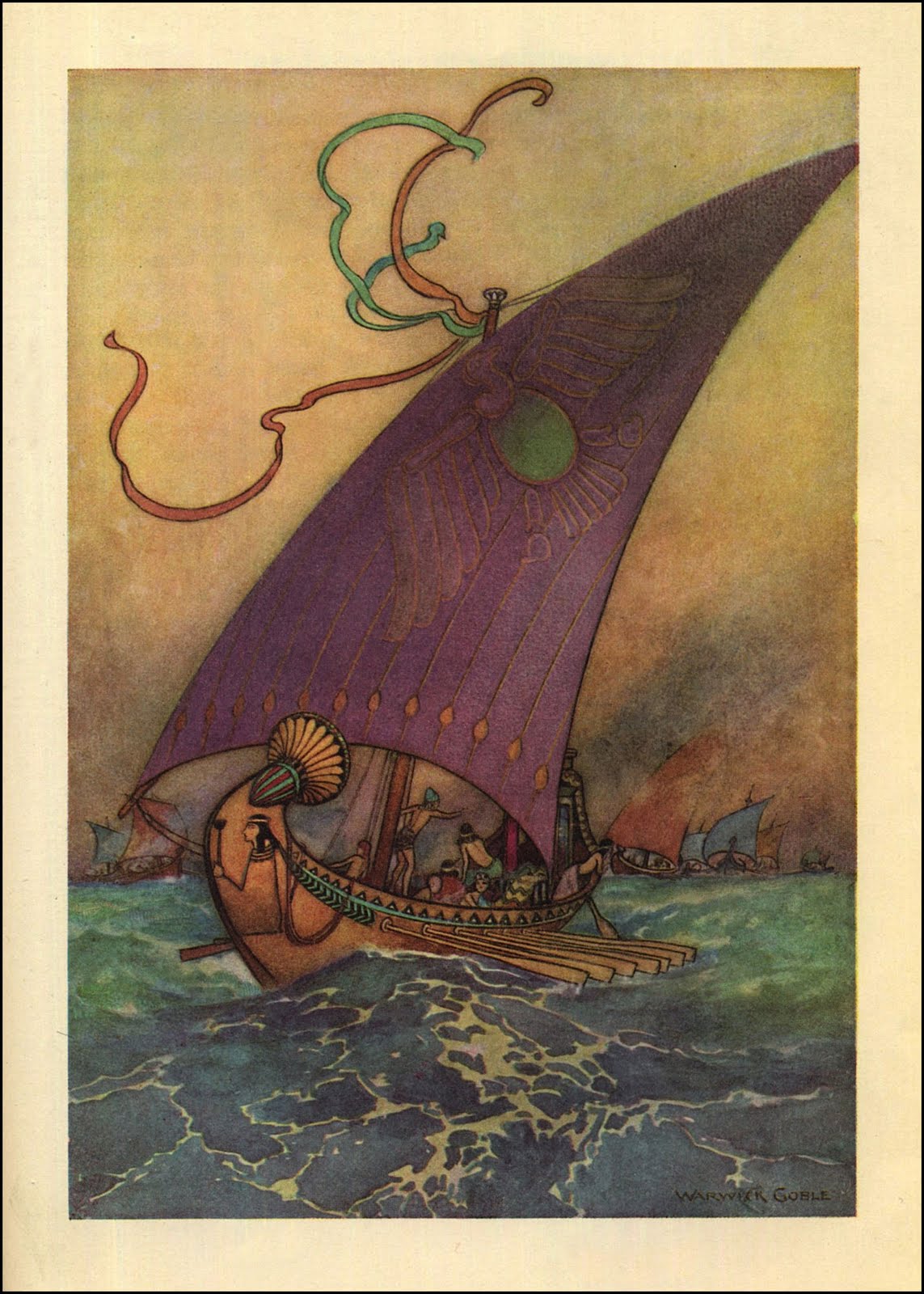 Twenty-seven more sites to explore in the southwest part of the Wyvern Coast map.
0132 Makronissos: Although King Philostos was a noble triton, his unruly sons were a shame to the entire kingdom. As each came of age, the king dutifully granted them leave to construct a fortress and attract whatever followers would have them. Naturally, Philostomes, the eldest, chose to stay by his father’s side, and it is he who now wisely rules Nimos in [0631]. His brother Mathian is the quarrelsome lord of Makronissos, while the youngest, Sthenelaus, lusty rascal that he is, rules Fleves in [0231]. The three rarely have anything to do with one another, though Mathian and Sthenelaus delight in outdoing their older brother and foiling the plans of the other.
Prince Mathian’s fortress is a three-story shell keep constructed from marble blocks on a trefoil pattern, the courtyards topped by onion-shaped domes of glassy-steel. The keep is surrounded by the homes of his fighting-men and women. These homes are constructed of marble blocks, resembling the courtyard homes of the ancient Romans. Makronissos is home to 99 triton warriors, 82 females and 110 young. Prince Mathian, in a fit of madness, constructed a basalt temple to Oceanus, Titan of the Sea. The temple is overseen by Marta with the help of four assistants. The household is overseen by Erigone, Mathian’s wife and a sorceress in her own right. Mathian’s nine household knights, who ride sea horses into battle, can be identified by the deep crimson kelp they wear as sashes. All of the howling warriors of Makronissos carry tridents and shields. They glory in battle. Prince Mathian himself rides in a bronze chariot pulled by seven sea cats. The treasury of Makronissos lies in a pit beneath a heavy stone slab that takes six tritons to lift. It contains 20,000 sp, 29,000 gp, 500 pp and five amphorae of fine wine.
- Prince Mathian, Triton Fighting-Man Lvl 9: HP 52; AC 4 [15]; Save 8; Special: Magic resistance 90%; Shield, trident.
- Marta, Triton Cleric Lvl 10: HP 40; AC 5 [14]; Save 5; Special: Cleric spells (5th), banish undead, magic resistance 90%; Shield, trident, holy symbol (gold conch).
- Assistant Clerics, Lvl 3: HD 3d6+3; AC 5 [14]; Save 12; Special: Cleric spells (1st), banish undead, magic resistance 90%; Shield, trident (silver conch).
- Erigone, Triton Magic-User Lvl 8: HP 19; AC 6 [13]; Save 8; Special: Magic-user spells (4th), magic resistance 90%; Silver dagger, grimoire.
- Household Knights: HD 6; AC 5 [14]; Atk 1 trident (1d8+1); Move 1 (Swim 18); Save 11; CL/XP 7/600; Special: Magic resistance 90%.
0134 Expensive Rubble: A large mound of marble blocks rests here, the remnants of construction by the tritons in [0233] and [0631].
0231 Fleves: Fleves is the stronghold of Sthenelaus, brother and rival of Mathian [0132] and Philostomes [0631]. Sthenelaus is wild and unruly, with a massive appetite for war, women and song. His cadre of retainers are nine devotees of Bacchus. Fleves itself is a coral feasting hall capable of holding Sthenelaus, his retainers, his court druid, Helle, and magician, Talthybios, and his 292 followers (93 males, 94 females and 105 young). The hall’s ceiling is covered in beaten bronze and hangs 40 feet above the floor. The tables, benches and chairs are the remnants of a century’s worth of shipwrecks. The walls are lined with trophies and weapons – the warriors of Fleves prefer barbed spears, bucklers and hoplite-style helms. The tables are always loaded down with the harvest of the sea, including stoppered stone crocks of wine. At one end of the hall is a massive marble idol of Bacchus. Heaped around the statue is the treasure of Fleves: 10,000 sp, 5,500 ep, 17,000 gp, 1,020 pp, an aquamarine (450 gp) and a jasper (6 gp). The idol is guarded by Helle’s four assistants at all time. The feast hall is surrounded by a thick forrest of kelp prowled by twelve sea cats trained to ignore the tritons of Fleves, but to attack anyone else on sight. Sthenelaus goes into battle in a chariot drawn by six hippocampi. His maenads ride hippocampi as well, their green hair tied into long braids, their arms bearing ritual scarification.
- Sthenelaus, Triton Fighting-Man (Barbarian) Lvl 9: HP 50; AC 4 [15]; Save 8; Special: Magic resistance 90%; Buckler, helm, barbed spear.
- Maenads, Triton Fighting-Women (Barbarians) Lvl 6: HD 6d6+12; AC 4 [15]; Save 11; Special: Magic resistance 90%; Barbed spear, net.
- Helles, Triton Cleric (Druid) Lvl 11: HP 41; AC 4 [15]; Save 4; Special: Cleric (Druid) spells (5th), magic resistance 90%; Barbed spear, shield, helm, holy symbol (gold vines, worn around neck).
- Helles’ Assistants (4), Triton Clerics (Druids) Lvl 3: HD 3d6+3; AC 4 [15]; Save 12; Special: Cleric (Druid) spells (1st), magic resistance 90%; Barbed spear, shield, helm, holy symbol (silver vines, worn around neck).
- Talthybios, Triton Magic-User Lvl 8: HP 18; AC 5 [14]; Save 8; Special: Magic-user spells (4th), magic resistance 90%; Silver dagger, grimoire.
0233 Tomb of King Philostos: As mentioned in [0132], King Philostos is dead, killed three centuries ago in battle with the sahuagin. In his honor, his sons, putting aside their rivalry, constructed a fabulous tomb for their father. The tomb is built of marble and stands 20-ft wide, 20-ft deep and 20-ft tall. Atop the tomb is a 20-ft tall bronze statue of Philostos. The tomb is surrounded by false columns carved onto 5-ft thick walls. The interior of the tomb is dry, and actually cannot be entered by water under any means. At the center of the tomb chamber is a gold-plated sarcophagus suspended from the ceiling by bronze chains over a pit of charcoal. The walls are covered in bright mosaics depicting the life, death, funeral and ascension of King Philostos.
A captive fire elemental called Horogule guards the tomb. He dwells in the fire pit, but copper piping allows him to move rapidly throughout the tomb chamber. His access to the chamber can be closed by depressing the right eye of the images of Philostos in the chamber murals. He is depicted four times, once on each wall. By depressing the right eyes on the images, the fire pit and pipes are sealed, trapping the fire elemental. There are two clues to this course of action; the first is a charred skeleton by one wall reaching toward the image of Philostos. The other is that the bas-relief of Philostos on his sarcophagus has his right hand over his right eye and his left hand grasping a trident that is impaling a fire-breathing dragon.
The tomb treasure is concealed in four floor spaces. Above each of these spaces there is a trap in the form of a crescent axe that falls from the ceiling, splitting would-be thieves in two (attacks as a 6 HD monster, 2d6 damage). The floor spaces contain 10,000 sp, 5,100 gp and a bronze figurine of Neptunus (500 gp).
- Horogule: HD 16 (43 hp); AC 2 [17]; Atk 1 strike (3d6); Move 12; Save 3; CL/XP 17/3400; Special: Ignite materials.
0631 Nimos: Nimos is the stronghold of Philostomes, the eldest and favored son of King Philostos. Nimos now rules Nimos and its 118 triton warriors, 93 females and 108 young. He is advised by his aged mother, Diomede, a priestess of Amphitrite. Philostomes is philosopher, poet and warrior. His army is well drilled and schooled in the concepts of chivalry. His personal guard consists of eight knightly warriors led by Aristonike, a chaste paladin and Philostomes’ ideal of beauty. Nimos is a marble citadel atop a sea mount. It is built in the ancient Greek style, and within its thick walls there is a fortified palace, a temple of Neptunus and Amphitrite and stables for the prince’s twenty hippocampi. Beneath the sea mount there is a dungeon protected by roving sea cats and cunning traps. The dungeon’s only resident is the undying eye of a wicked sea titan, killed a milennia ago by King Philostos. A vault in the citadel holds 21,000 sp, 5,500 ep, 27,500 gp, 500 pp, a spinel (7,000 gp), a zircon (10 gp)
- Philostomes, Triton Fighting-Man (Bard) Lvl 9: HP 45; AC 2 [17]; Save 8; Special: Magic resistance 90%; Helm, scale armor, shield, trident, silver dagger, golden horn, gauntlets of dexterity.
- Aristonike, Triton Fighting-Woman (Paladin) Lvl 8: HP 34; AC 2 [17]; Save 9; Special: Magic resistance 90%; Helm, scale armor, shield, trident, holy symbol (silver conch), potion of healing.
- Knights of Nimos, Triton Fighting-Men Lvl 6: HP 6d6+12; AC 3 [16]; Save 11; Special: Magic resistance 90%; Helm, scale armor, shield, trident.
- Diomede, Triton Cleric (Druid) Lvl 11: HP 44; AC 4 [15]; Save 4; Special: Cleric (Druid) spells (Lvl 5th), magic resistance 90%; Helm, shield, trident, holy symbol (gold image of Amphitrite).
- Diomede’s Priestesses, Triton Cleric (Druid) Lvl 4: HD 4d6+4; AC 4 [15]; Save 10; Special: Cleric (Druid) spells (2nd), magic resistance 90%; Helm, shield, trident, holy symbol (silver image of Amphitrite).
0640 Eador: Eador is a lair of 345 gnome artisans, 114 gnomewives and 64 gnomelings. They dwell in burrows beneath the roots of a large, gnarled oak tree. The gnomes of Eador produce delicate images in stained glass for trade, most of their contact coming via traders from Ophir or clerics interested in decorating their monasteries. Their work can be seen hanging from the branches of their tree and also lodged between gnarled roots, illuminating some of the burrows beneath. The gnome-king of Eador is Kermid. Kermid’s honor guard is composed of six level 3 fighting-gnomes. The community is also served by a cantankerous druid named Thumbar and his three level 2 assistants. The gnomes keep a flock of sixteen giant ravens as guard animals and messengers. Deep in their burrows, the gnomes keep 2,000 sp, 10,100 gp, 110 pp a matching pair of electrum clasps, each set with 11 tiny topazs (35 gp) and 1,000 gp worth of stained glass.
- Gnome: HD 1d6; AC 4 [15]; Atk 1 weapon (1d6); Move 9; Save 17; CL/XP 1/15; Special: Simple illusions, +4 AC vs. giant creatures.
- Kermid, Fighting-Gnome Lvl 5: HP 28; AC 2 [17]; Save 12; Light mace, platemail.
- Honor Guard, Fighting-Gnome Lvl 3: HD 3d6+6; AC 3 [16]; Save 14; Hand axe, chainmail, shield, crossbow.
- Thumbar, Gnome Cleric (Druid) Lvl 6: HP 30; AC 6 [13]; Save 9; Special: Cleric (druid) spells (3rd); Club, leather armor, shield, holy symbol (wreath of oak leaves).
- Thumbar’s Assistants, Lvl 2: HD 2d6+2; AC 6 [13]; Save 15; Special: Cleric (druid) spells (1st); Club, leather armor, shield.
- Giant Raven: HD 3; AC 5 [14]; Atk 1 bite (1d8); Move 2 (Fly 30); Save 14; CL/XP 4/240; Special: None.
0745 Morix: Morix is a relatively new dwarf stronghold built into the mountains. It is inhabited by 360 dwarfs with 135 females and 55 dwarflings. The dwarfs mine tin (about 20,000 gp worth a month), trading it to Ophir for iron and gold. Morix is ruled by King Okolast and Queen Maiu. Okolasts housecarls are six level 3 fighter/clerics. He is assisted in times of battle by two level 2 sergeants. The entrance to Morix is located 60 feet above the ground in the side of a mountain, with supplies being lowered and raised via pulleys and stout ropes. The dwarfs also maintain two escape tunnels that emerge well away from the entrance and can only be opened from the inside. The halls of Morix are patrolled by seven brown bears. Okolast’s main hall has a vaulted ceiling supported by massive pillars engrave with the name of every dwarf from his clan lost when they were forced to quit the Bleeding Mountains across the sea. His throne is cast from bronze and decorated with goblin skulls. The dwarfs of Morix maintain a dozen forges and a multiple shrines to Volcanus, whom they call Weyland. Their heavily trapped vaults contain 10,000 cp, 10,500 ep, 2,500 gp, 1,100 pp, a cymophane worth 40 gp and jewelry worth 30 gp. They generally have 60 tin ingots (5 lb each, worth 15 gp each) on hand and 15 barrels (60 gp each) of slightly sour wine (as dwarfs prefer it that way).
- Dwarf: HD 1; AC 4 [15]; Atk 1 weapon (1d8); Move 6; Save 17; CL/XP 1/15; Special: Detect attributes of stonework.
- Okolast, Dwarf Fighter/Cleric Lvl 5: HP 24; AC 1 [18]; Save 10; Special: Cleric spells (2nd); Platemail, shield, military pick, dagger.
- Housecarls, Dwarf Fighter/Clerics Lvl 3: HD 3d6+6; AC 1 [18]; Save 14; Platemail, shield, hand axe, dagger, crossbow.
- Sergeants, Dwarf Fighting-Men Lvl 2: HD 2d6+4; AC 3 [16]; Save 15; Chainmail, shield, hand axe, dagger, crossbow.
- Brown Bear: HD 4+1; AC 7 [12]; Atk 2 claws (1d3), 1 bite (1d6); Move 9; Save 13; CL/XP 4/120; Special: Hug (+1d8 damage if hits with both claws).
0833 Exiled Merrow: A band of ten exiled merrows have taken residence in a dilapidated keep choked with barnacles. The merrows have no mermaids in their harem and are taking their humiliation out on anything that passes by. They are lead by an especially large and stupid male called Kthuk. The merrows are armed with thick spears and nets. Their treasure consists of 500 ep, 400 gp, a rose quartz (165 gp) and a silver statuette of entwined mermaids (7,000 gp).
- Kthuk: HD 6 (26 hp); AC 4 [15]; Atk 1 weapon (1d10+3); Move 9 (Swim 9); Save 11; CL/XP 6/400; Special: None.
0930 Feeding Frenzy: A merchant galley recently slipped under the waves, victim of a tusked whale. It carried with it over 100 chained slave rowers, whose corpses are now at the center of a feeding frenzy of thirty lacedons and twenty sharks. The lacedons look like water-logged corpses with feral faces. From the tattered clothing they wear, it is obvious that most are former corsairs and sailors. At the center of the lacedons is a female with stringy, black hair, grey skin and wearing the remnants of a silk gown. Bards may be able to identify her as Ivada, Lady of Comiar in the territory of Ophir, lost at sea six months ago. Her return in a more civilized state could be worth a 200 gp reward from her father, as she was his last heir. Amidst the ship’s wreckage one could salvage 75 gp worth of cedar lumber, hides and skins worth 250 gp, an amphorae of spiced wine (40 gp), 60 gold ingots (1 lb each, 100 gp each) and a collection of marble statuary (2,500 gp) intended for the home of a wealthy merchant of Antigoon.
- Lacedon: HD 2; AC 6 [13]; Atk 2 claws (1d3), 1 bite (1d4); Move 9; Save 16; CL/XP 3/60; Special: Immunities, paralyzing touch.
- Shark: HD 5; AC 6 [13]; Atk 1 bite (1d6+2); Move 0 (Swim 24); Save 12; CL/XP 5/240; Special: Feeding frenzy.
0933 Zorix: Zorix is a small, rocky island with several sandy beaches. The center of the island is dominated by a craggy upland, from which flow two streams marked by many waterfalls. One flows to the northern shore of the island, the other to the western shore. The upland has many caves, and most show signs of visitation. One has seen more visitation than the others, and contains a crude, blood-stained stone altar and many black candle nubs. Just beyond the altar the cave floor drops away suddenly; thirty feet below is a grotto. The grotto is filled with icy, cold water. The ceiling is marked with dozens of reddish-orange stalagtites and the floor of the lagoon with similar stalagmites. Hidden among the stalagtites are a dozen piercers. The waters of the lagoon hide a submerged, 20-ft long tunnel that emerges in a large vault. This vault measures forty feet in circumference. The periphery is submerged in icy water, while the center rises above the water in a 20-ft tall black pillar. This pillar is actually Zorix, a massive, demonic roper, believed by cultists from Ophir to be the spawn of Baalzebul and one of his avatars on Nod. They are correct in this assumption, and any aggression committed on Zorix will be noted by the Lord of Flies. A century of offerings to Zorix now lie in the water around his dais and amount to 20,000 cp, 5,500 ep, 1,200 gp, 510 pp, a bronze kyton (100 gp) that once held blood wine.
- Piercers: HD 1; AC 3 [16]; Atk 1 slam (1d6); Move 3 (Climb 3); Save 17; CL/XP 2/30; Special: A piercer scores 2d6 damage on the roll of a natural 20 to hit, the piercer’s belly is coated with acid that deals 1d6 damage to exposed flesh.
- Zorix: HD 12 (51 hp); AC 0 [19]; Atk 1 tentacle (weakness), 1 bite (2d10); Move 3; Save 3; CL/XP 17/3500; Special: Tentacles grab and cause weakness (save or lose half strength points), smite good once per day (+12 damage to good creature), cleric spells (one per level, up to 9th), immune to poison, half damage from acid, fire and lightning, magic resistance 25%, only harmed by magic weapons.
[Because the 12-year-old in me still likes piercers and wants desperately for them to finally work!]
0936 Tomb of Clever Eksirossa: Eksirossa was, in her day, the greatest thief to have ever pilfered a vault in Ophir, a city-state noted for its thieves. Her tomb was constructed to her special design by a band of duergar who took her right hand and the jewels on her fingers as payment. The tomb is constructed in a cave overlooking the sea. The cave is filled with twenty feet of water at high tide and about 5 feet of water at low tide. The cave’s ceiling is 35 feet above the floor, thus 15 feet above the water surface at high tide and 30 feet above the water’s surface at low tide. Hanging from the ceiling by a thick, iron chain is a bronze sphere 13 feet in diameter. The sphere is hollow, the skin being 3’ thick. The ball has three obvious, circular portals. None of these portals are trapped, per se, but all are dangerous.
The first two portals are located on the upper surface of the globe. Either requires a master thief to overcome its locks. When one is opened, it reveals inky darkness within the globe. This is a portable hole that sends anyone entering into a cramped, empty space several miles away. This space contains a coffer corpse and a treasure of 500 silver-plated lead coins (worth about 1 gp, but weigh 1,000 lb).
- Coffer Corpse: HD 2+2 (16 hp); AC 7 [12]; Atk 1 fist (1d6); Move 9; Save 16; CL/XP 4/120; Special: Only harmed by magic weapons (though weapons appear to do damage), false death (if “killed” with normal weapons, will fall and then rise again, causing fear), choking (those hit by fist must save or be choked for 1d6 damage per round).
The second portal is much as the first, but leads to a slick tunnel-slide into a cavern filled almost entirely with bubbling magma. In the center of the cavern there is, atop a basalt dais, a pile of gold coins. Suspended from the ceiling of the magma cavern and leading from the entrance to the dais are nine rings suspended from chains. The second, fourth, sixth and ninth rings wil collapse if any weight is placed on them, the others will hold up to 200 pounds before collapsing. The pile of treasure on the dais is a treacherous treasure. The coinage on its surface amounts to 1,100 gp and 500 ep, all of its ancient and counterfeit and bearing very rude messages in a variety of languages.
- Treacherous Treasure: HD 7 (31 hp), AC 3 [16]; Atk 1 slam (3d6); Move 6; Save 9; CL/XP 7/600; Special: Surprise foes 40% of the time.
The final portal is located on the bottom of the sphere. It is also a portable hole leading into the center of the sphere. Moving up through the hole actually entails coming in from one side. The interior of the sphere is 10 feet in diameter. The center of the sphere is taken up by a circular cage with steel bars from top to bottom. Inside this space is the skeletal corpse of Eksirossa, identifiable by her missing hand and her broad grin, which reveals a mouth full of gold teeth (10 gp worth). The door of the cage has a very complex lock that requires two successful rolls to open. A failure on the first attempt results in the portable hole detaching and falling into the sea below and trapping the would-be thief inside the sphere. A failure on the second roll results in the sphere detaching from the ceiling and plunging into the water below, causing 5d6 points of damage to anyone inside (or beneath it). Eksirossa’s corpse is wearing a single glove of dexterity, a +1 dagger that glows when within 30 feet of precious metals or gems, and her personal burglar’s tools, crafted by masterful hands and giving thieves a +1 bonus to all thievery rolls.
1034 Delec: Delec is a village of 300 loutish copper miners living in adobe huts. The village has few females, for few women can be persuaded to live among the miners. Delec is surrounded by a stone wall, three stout watch towers and a moat filled by a stream. It is ruled by Lord Shemel, a pompous twit every bit as unpleasant as his subjects. The village knows no crime, primarily because Shemel and many of the miners are actually members of the Brotherhood of the Purple Hood, a clan of assassins that has existed since the times of the Purple Kings. Despite Shemel’s buffonish act, he is the shrewdest and most dangerous man on the Wyvern Coast after Zargo, whose rule he plans to usurp. Delec is defended by 60 men-at-arms in chainmail and toting pole axes, short swords and crossbows. The men-at-arms are commanded by seven sergeants, all assassins under Shemel’s ultimate command. Shemel’s treasure is 1,000 copper ingots (1 lb each, 1 gp each), 20,000 cp, 1,000 sp, 500 ep and 2,800 gp.
- Sergeants, Assassins Lvl 3: HD 3d6; AC 7 [12]; Save 13; Special: Death attack (save or die, otherwise double damage), surprise on 1-2 on 1d6; Leather tunic (backed with steel plates), short sword, dagger, crossbow.
- Lord Shemel, Assassin Lvl 7: HP 24; AC 6 [13]; Save 9; Special: Death attack (save or die, otherwise triple damage), surprise on 1-2 on 1d6; Leather tunic (backed with steel plates), spring-loaded cane (treat as javelin), silver dagger, poisoned dagger (save or die).
1036 Zonay: Zonay is a village of 100 pious goatherds living in timber huts surrounded by a thicket and moat. Zonay is governed by Difer, a reeve of Prince Zargo recently arrived from Ophir. Zonay is protected by ten men-at-arms (chainmail and shield, battle axe and crossbows) commanded by Sergeant Phaus. A stream rushes by the village and fills its moat. The goats of Zonay were known to produce the finest cheese on the Wyvern Coast, and thus were highly valued by Prince Zargo. Unfortunately, the arrival of Difer has changed this. For untold ages the people of Zonay paid heed to a kilmoulis named Kolong who tended their herds and produced their excellent cheese. In return, they were careful to ever speak his name reverently and leave nothing but dishes of perfume for his meals. Alas, Difer thought these the acts of fools, and has now brought the wrath of Kolong down on the village, for their milk is curdled and sour and their goats growing thin. A party of adventurers capable of rectifying this situation might attract the patronage of Prince Zargo.
1226 Noromina (West): Noromina island is ringed by reefs. It is dotted with a few small farmsteads that mostly raise sheep and garlic. A remote temple of Melkarth was constructed on the island by cultists several centuries ago. It has a caretaker named Grono and hosts athletic games every seven years in honor of Melkarth. At this time, dozens of adventurers, athletes, aristocrats and merchants crowd onto the island, pitching simple tents and grand pavilions and enjoying competitions that include races, swimming, javelin throws, archery and wrestling. Hidden behind a loose stone in the temple are 1,000 sp and an ivory idol of Melkarth worth 105 gp. The shephards have stout locks on their doors and have holy symbols painted on their doors and each wall of their home, for the other end of their island is plagued by vampires.
- Grono, Gnome Cleric Lvl 4: HP 20; AC 4 [15]; Save 11; Special: Cleric spells (2nd), banish undead, hear noise on 1-2 on 1d6, communicate with burrowing animals; Chainmail (rarely worn, slightly rusty), light hammer (1d4 damage), holy symbol of Melkarth.
1326 Noromina (East): This side of the Noromina island is mountainous and inhabited by bestial vampire spawn called kalikantzaros. The kalikantzaros look like smallish humans with bestial features (tusks, hairy bodies). They fear the sound of bells. They only come up from their subterranean abodes at night in the dead of winter.
- Kalikantzaros: HD 4; AC 4 [15]; Atk 1 bite (1d6 + level drain); Move 12; Save 13; CL/XP 7/600; Special: See this blog post.
1336 Vignos: Vignos is a sprawling village of timber huts overlooking the sea. The landward side is protected by an earthen rampart and several watch towers. Vignos is inhabited by 500 dour, xenophobic fishermen ruled by Lord Jerig, himself a paranoid with an intense hatred of elves. The villagers get their water from a large reservoir located in the hills beyond their village. Vignos is defended by 100 men-at-arms (leather armor, long bows, spears) and twelve sergeants under the command of Jerig himself. An old woman named Ronia has a vast knowledge of the Wyvern Coast, and will happily hire on to guide adventurers. Jerig’s coffers contain 20,000 cp, 1,000 ep, 2,500 gp, 20 pp, a garnet (70 gp), a silver ring decorated with scaled dolphins (80 gp) and a painted terracotta wine pitcher (115 gp). Vignos has over 100 fishing boats (worth 30 gp each)
- Jerig: HD 3 (19 hp); AC 2 [17]; Atk 1 weapon (1d8+1); Move 9; Save 14; CL/XP 3/60; Special: Gives soldiers a +1 boost to morale.
- Ronia: HD 2 (9 hp); AC 6 [13]; Atk 1 weapon (1d6); Move 12; Save 16; CL/XP 2/30; Special: While under her guidance, the chance of surprise and random monster encounters are rolled on 1d8.
1837 Sabre-Tooth Tribe: A tribe of 63 cavemen, 61 cavewomen and 37 cavechildren dwell in a deep, winding complex of limestone caves. The cavemen wield flint knives in combat. They are led by a prudish, tempermental chieftain called Yog along with four sub-chiefs. They worship sabre-tooth tigers under the guidance of a shaman called Jothag. Yog is always accompanied by his six bodyguards. The sabre-tooth people have persisted in these hills since the days when the Wyvern Coast was an archipelago of tiny islands. They are extraordinarily long-lived, with the elders of the tribe reaching well over 300 years of age.
- Caveman: HD 1; AC 8 [11]; Atk 1 weapon (1d6); Move 12; Save 17; CL/XP 1/15; Special: None.
- Bodyguards, Fighting-Man (Barbarians) Lvl 3: HD 3d6+9; AC 8 [11]; Save 14; Flint knife, tiger hide.
- Sub-Chiefs, Fighting-Man (Barbarian) Lvl 4: HD 4d6+12; AC 7 [12]; Save 13; Flint knife, wyvern hide.
- Yog, Fighting-Man (Barbarian) Lvl 5: HP 31; AC 7 [12]; Save 11; Flint knife, wyvern hide.
- Jothag, Cleric (Druid) Lvl 3: HP 9; AC 9 [10]; Save 12; Special: Cleric (druid) spells (1st); Gnarled acacia-wood staff, tiger tooth necklace holy symbol.
1946 Magnolia Grove: A large magnolia grove, a hold over from the days when the savanna was a swamp, covers several acres here. The grove offers shade, but the presence of dozens of castaway spears stuck in the ground suggests danger. This danger comes in two forms. The first are the nine dusky-skinned dryads that inhabit and protect the grove. They are particularly adoring of human hunters, and often lure them into their trees, only to cast them away centuries later. Moreover, living in the branches of the magnolias are a species of pseudo-dragon with white scales. The pseudo-dragons feed on the magnolia nectar with long, curled, pink tongues. At any given time, there will be 2d6 of these pseudo-dragons observing intruders and prepared to attack if they show any inclination to harm the trees.
- Dryads HD 2; AC 9 [10]; Atk 1 wooden dagger (1d4); Move 12; Save 16; CL/XP 3/60; Special: Charm person (-2 save).
- Pseudo-Dragon: HD 2; AC 2 [17]; Atk 1 bite (1d3), 1 tail sting (1d3 + poison); Move 6 (Fly 25); Save 16; CL/XP 5/240; Special: Magic resistance 25%, poison (25% lethal, otherwise catalepsy for 1d4 days), invisibility (80% effective).
2028 Absalon: Absalon is the name of an island ringed by high cliffs. The cliffs are dotted with dozens of sea caves, one such cave leading to the surface via steps carved into the stone. The walls of this cavern are decorated with images of bearded men dressed as fish. The surface of the island is green and lush. It is composed of verdant meadows with trickling streams and copses of tall pine trees. In the midst of this paradise there is a large granite upland covered by a sparkling town of white walls and tall, white buildings. A single gate permits access to the town, which is peopled entirely by children. The children of Absalon range in age from infancy to twelve years of age. The children perform the roles of adults – tending the miniature, dun cattle that graze in the meadows, making pottery, woodworking, etc. The recognized leader of the children is a boy named Lodeses. Lodeses is wise for his age, but still a child and in over his head trying to lead the 2,000 young citizens of Absalon. Nonetheless, he and his peers are expert slingers; they wear leather armor and carry slings, javelins and knotty pine clubs into battle. They are determined to defend their village, especially the domed church that sits in the center of town.
The domed church consists of a large, central chamber 30 feet in diameter surrounded by a dozen small rooms used for storage. Seven statues of fish-garbed men, like those in the sea cave, stand against the walls of the church, their hands extended in peace. In the center of the room there is a squat dais upon which rests a large vessel carved from malachite and used to burn incense and offerings of meat. A secret catch on the dais shifts this vessel and reveals a narrow set of stairs that leads to a grotto deep benath Absalon. It is here that the people of Absalon, upon reaching their thirteenth year, descend to undergo a monstrous transformation into a hybrid of fish and man. These bizarre creatures welcome these visitors. Young women are mated with, their children eventually being placed at night in the church to be found and raised by the children of Absalon. The fish people, who call themselves oannes, have pallid, scaled skin, lipless mouths and curled beards (on the men) and large, fishy eyes. They are exceptionally bright scholars and philosophers for many years. But they never stop growing, and eventually turn feral and are forced into the sea, where they complete their transformation into tusked whales.
- Child Soldiers of Absalon: HD 1d4; AC 8 [11]; Atk 1 weapon (1d4); Move 9; Save 18; CL/XP A/5; Special: None.
- Oannes: HD 6; AC 2 [17]; Atk 1 bite (1d4) or 1 weapon (1d8); Move 12; Save 11; CL/XP 7/600; Special: Spells (change self, dispel magic, ESP, levitate, magic missile, shield, all once per day each), create small, simple object once per day.
2247 Strange Statue: Half-buried in the soil is a bronze statue (60 gp) of a tall, bald woman with two hands at the end of each arm, each hand holding a dagger. The statues eyes are formed of bone chips and the woman’s face bears an inhumanly wide grin. The statue attracts weird parasites that dwell on the astral plane. These parasites will attach themselves to the astral body of any magic-user present and feed off his magical energies, creating a cumulative 1% chance per day of failure when he tries to cast spells. They can only be removed by casting remove curse while on the astral plane.
2429 Lionweres: A pride of seven lionweres, consisting of one male, four females and two cubs, dwells in a cave. The females hunt during the night, taking the form of beautiful, tawny-haired maidens to get close to their prey. If doing poorly in a fight, their yowls will draw the attention of the male, who will arrive in 1d4 rounds to either save them or take revenge. The lionweres have hidden in their caves a gold ring worth 100 gp, a platinum oil lamp worth 950 gp, trade (1,000 gp), 1,000 sp, 400 gp, 500 ep, 20 pp and a hematite worth 35 gp.
- Lionwere (females): HD 6 (24 hp); AC 2 [17]; Atk 1 bite (1d8) or weapon (1d8); Move 15; Save 11; CL/XP 7/600; Special: Weakness gaze, hit by silver or magic weapons only.
- Lionwere (males): HD 6 (36 hp); AC 2 [17]; Atk 1 bite (1d10) or weapon (1d10); Move 15; Save 11; CL/XP 7/600; Special: Weakness gaze, hit by silver or magic weapons only.
2839 Ivory Tower of Kinyoth: Rising above the highlands is a 75-ft tall tower of ivory and limestone. This is the tower of Kinyoth the tower hag. Kinyoth is the undisputed master of this hex and the hexes surrounding it. She stands 9-ft tall. She has steel grey skin, black claws and weathered, black teeth, pale yellow eyes and limp, black hair that falls beyond her shoulders.
The tower has five levels. The first level is approximately 20-ft in diameter. The walls of this level are slick, rippled ivory and seem to sweat a yellowish ichor. The first level is a dumping ground of the magical detritus of several centuries – ruined scrolls, broken vials, magical cabinets, scorched wands, etc. Lurking among the ruined items are ten barics. Winding stairs lead to level two.
- Baric: HD 5; AC 6 [13]; Atk 2 claw (1d4) and 1 bite (1d10); Move 15; Save 12; CL/XP 5/240; Special: None.
Level two looks much like level one. It is furnished with a multitude of torture devices and has seven sets of manacles attached to the walls and two iron cages hanging from the vaulted ceiling. Three prisoners currently occupy this chamber: An ogre called Tundrun that has been shrank to the size of a halfling, a young woman named Marya in an iron cage who appears to be suffering from leprosy, and a naked, scarred man named Lhumler with wild eyes who is chained to one wall. Lhumler was once a paladin, but successive bouts of torture and rape have reduced him to a mere fighting-man. The room is guarded by two headless screamers.
- Headless Screamer: HD 4; AC 3 [16]; Atk 1 claw (1d6) or 1 thrown head (1d8); Move 15; Save 13; CL/XP 7/600; Special: Throw and retrieve head, scream, immune to cold.
- Lhumler, Fighting-Man Lvl 6: HP 7 (39 normally); AC 9 [10]; Atk 1 fist (1d2); Move 9 (due to a limp); Save 11.
- Marya: HD 1d4 (1 hp); AC 9 [10]; Atk 1 fist (1d2); Move 12; Save 18; CL/XP A/5; Special: Leprosy (treat as mummy rot).
- Tundrun: HD 4+1 (21 hp); AC 5 [14]; Atk 1 fist (1d4); Move 6; Save 13; CL/XP 4/120; Special: None.
The third level is a dank library lit by candles made from the fat of virgins. A large, wooden chair sits in the middle of the room, and chained to the outer walls are six large tomes (30 lb each) containing magical lore (1d4 spells each). The books are guarded by six inaeds.
- Innaed: HD 3; AC 0 [20]; Atk none; Move 0 (Fly 18); Save 13; CL/XP 7/600; Special: Invisible, spells, immune to all weapons or normal weapons (depending on state).
Above the library is a laboratory of sorts, stocked with vessels containing preserved animals and body parts, a large wooden storage cabinet with a grisly harvest of human feet and shelves filled with all manner of humanoid bones, organized by type and size.
The top level contains Kinyoth’s personal lair and treasury. It is a round room without light and furnished with a greasy, straw mattress atop four large, wooden chests. The chests are locked and trapped with acid, poison or green slime. They contain 10,000 cp, 11,000 sp, 14,400 gp, 1,100 pp, five blocks of ambergris wrapped in waxed paper (100 gp), a rhodochrosite worth 950 gp and a cursed (-1) staff tipped with steel spheres grasped in demonic talons. Curled up along the wall is a 20-ft long gnasher lizard called Phac. Kinyoth is currently attempting to construct a gate deep beneath her tower that would allow the amphorons of Yothri easy access to Nod.
- Kinyoth: HD 16 (71 hp); AC 0 [19]; Atk 2 claws (2d6); Move 12; Save 3; CL/XP 26/5900; Special: Spit, claws, tower, spells, only harmed by silver or magic weapons, immune to mind effects, magic resistance 70%.
- Phac: HD 9 (47 hp); AC 4 [15]; Atk 1 bite (2d6); Move 12; Save 6; CL/XP 2000; Special: Behead, swallow.
3029 Dagul: Dagul is a village of 100 peasant farmers living in stone huts. The village is surrounded by an earthen rampart and there is a tall, stone watch tower in the center of the village. Lady Hunnsa, the village reeve live in a house connected to the watchtower. Dagul is defended by 10 stout men-at-arms under the command of Sergeant Foriz. The village is known for its sheep, who produce incredibly soft, white wool favored by weavers throughout the Tepid Sea region. Hunnsa keeps 1,000 sp, 1,200 gp and a rose quartz (125 gp) in a locked chest trapped with a poison needle.
- Hunnsa: HD 3; AC 5 [14]; Atk 1 long sword (1d8+1); Move 12; Save 14; CL/XP 3/60; Special: None.
- Men-at-Arms: HD 2; AC 6 [13]; Atk 1 pole-axe (1d10); Move 12; Save 16; CL/XP 2/30; Special: None.
- Foriz, Fighting-Man Lvl 4: HP 21; AC 3 [16]; Save 13; Chainmail, shield, pole-axe, short sword.
3247 High and Dry: Embedded in the ground and choked with savanna grasses, is the long and petrified skeleton of a basilosaurus, a primitive, toothy whale.
3538 Village of the Dead: Behind a thicket lies a small village of adobe huts with thatched roofs. From afar, one might see people in the village going about their business with a slow, deliberate manner. Closer examination will reveal the villagers to be brain-eating zombies. At the first sign of life, the twenty remaining villagers will swarm. Scattered about the village is 2,000 sp, 500 ep, 600 gp and a piece of polished coral worth 95 gp.
- Brain-Eating Zombie: HD 3; AC 8 [11]; Atk 1 strike (1d8); Move 6; Save 14; CL/XP 5/240; Special: Absorb spells.
3546 Demonic Springs: In the midst of the savanna you find boiling, bubbling springs. The springs form a deep pool, the banks of which are caked in rare earths and polychromatic mineral deposits. Within the springs lies a demon called Otstatho the Everburning. Otstatho’s skin gives off a tremendous amount of heat (the source of the pool’s boiling), so it commonly remains beneath the surface of the water. Should Otstatho emerge from the water, it would appear to be large, translucent grey amoeba. Otstatho is capable of telepathic communication, and will hammer into people’s heads the things it has heard other poor adventurers scream as it engulfed and roasted them alive. On an attack roll of a natural ‘20’, Otstatho will engulf its foe, inflicting 2d6 points of burning damage each round.
- Otstatho the Everburning: HD 10 (48 hp); AC 7 [12]; Atk 2 cilia (1d8); Move 9 (Swim 9); Save 5; CL/XP 13/2300; Special: Telepathy, drain magic from items (2d6 rounds), destroys wood by touch, engulf, immune to fire damage.
3927 Sabres Unsheathed: Two sabre-tooth tigers, brothers, hunt here in a pass through the highlands.
- Sabre-Tooth Tiger: HD 7 (33, 32 hp), AC 6 [13]; Atk 2 claws (1d4+1), 1 bite (2d6); Move 12 (Swim 6); Save 10; CL/XP 8/800; Special: Rear claws rake for 2 extra claw attacks if first two claw attacks hit.
New Monsters
The following monsters are open game content.
Baric
Barics are 6-legged, rat-like animals notable for their duck-like bills filled with needle-like teeth. They usually grow to be 3 feet long, but some males have grown as long as 7 feet. Barics run in packs in wild forests. Barics can be trained as guard animals or trackers, but it is very difficult and dangerous to do so.
- Baric: HD 5; AC 6 [13]; Atk 2 claw (1d4) and 1 bite (1d10); Move 15; Save 12; CL/XP 5/240; Special: None.
Gnasher Lizard
Gnasher lizards are 10 to 20-foot long reptiles with stone-colored scales and gaping mouths filled with a double row of dagger-like teeth. They are carnivorous and territorial, usually dwelling near sources of water in woodlands and highlands. They are solitary creatures, except during their mating season in spring and early summer. If a gnasher lizard rolls a natural ‘20’ for its bite attack, it will sever the head of its target. Bite victims who are not beheaded must make a saving throw to avoid being gulped down whole, where they will suffer 2d6 points of damage each round from the beasts digestive juices.
- Gnasher Lizard: HD 9; AC 4 [15]; Atk 1 bite (2d6); Move 12; Save 6; CL/XP 12/2000; Special: Behead, swallow whole.
Hag, Tower
Tower hags are 9’ tall crones with grey skin and black teeth and nails. They are usually allied to otherworldly creatures of chaos and evil, and work to help them enter our world. Every tower hag lives in a towering fortress made of ivory. To create such a tower, the hag must obtain the first adult tooth from a child. This tooth, wrenched from the mouth, is mixed with the hag’s stony saliva and planted into the ground. The tower immediately sprouts from where the tooth was planted, expanding to full size (50 feet in diameter) within one round. Any equipment or items in the tower are teleported from its old location to its new one. Most tower hags carry half a dozen teeth with them at all times. Each tower is similar in design, being fi ve storeys tall. The bottom two storeys are always prisons and traps; the middle two laboratories and libraries and the topmost storey the hag’s personal lair and treasury. Battlements ring the top of the tower, standing 75 feet off the ground.
A tower hag’s spittle is thick and congeals to form a substance as hard as stone. In combat, they can spit at an opponent as a ranged touch attack, inflicting 2d6 points of damage and sticking them to the ground until they make a successful strength roll. Tower hags can also extend their iron claws, increasing their damage to 2d10, but also exposing them to a sundering attack. Finally, they can summon a new tower by spitting a tooth at an opponent or group of opponents. Anyone within 50 feet of the tower suffer 4d6 damage as they are struck by it and must succeed at a saving throw. Those who fail are carried to the top. If the hag is within the area of the tower’s growth, she always ends up atop the tower.
Tower hags can cast the following spells: Animate dead, astral spell, cacodaemon, bestow curse, death spell, detect invisibility, gate, invisibility, monster summoning V, protection from good 10′ radius, (un)holy word and wizard eye.
- Tower Hag: HD 16; AC 0 [19]; Atk 2 claws (2d6); Move 12; Save 3; CL/XP 26/5900; Special: Spit, claws, tower, spells, only harmed by silver or magic weapons, immune to mind effects, magic resistance 70%.
Headless Screamer
Headless screamers arise from the corpses of the beheaded. They are cruel and chaotic beings who delight in tormenting the living. Headless screamers look something like zombies with a noticeable red slash across its neck. They can throw their heads with alarming accuracy, and in fact do not need to throw their own head, for the headless screamer’s intelligence and animating force are in the body. Many of these creatures keep four or five heads handy. Thrown heads have a range increment of 20’. The thrown head will snap its jaws, dealing 1d8 points of damage to anyone hit and then latching on if the target fails a saving throw. A latched head inflicts 1d4 points of bite damage each round until removed. Headless screamers can telekinetically retrieve these heads and still move or attack each round. Headless screamers can also emit a shrill shriek from the air hole in their necks. Anyone hearing this must succeed at a saving throw or suffer a -1 penalty to hit, damage and save for 1 hour.
- Headless Screamer: HD 4; AC 3 [16]; Atk 1 claw (1d6) or 1 thrown head (1d8); Move 15; Save 13; CL/XP 7/600; Special: Throw and retrieve head, scream, immune to cold.
On Being Chaotic, Shiny and Random
A few posts ago, I put together some creatures using the random generators at Seventh Sanctum. Today I’m doing the same with Chaotic Shiny, another favorite website of mine. The following critters are open game content.
Aeloll: The aeloll is a large, arachnoid horror that dwells in narrow mountain passes. The creature’s mottled, grey hide helps it hide among the stones, allowing it to surprise prey on the roll of 1-3 on 1d6. It waits for prey to move beneath it and then expels a gout of scorching gas from its abdomen. The gas inflicts 2d6 points of damage (saving throw for half) and forces creatures to make a saving throw or be blinded for 1d4 rounds. While its prey is confused and blind, the aeloll descends down the side of the pass. The spider has especially long legs that end in loops. Using four legs, it places these loops around the necks of its prey and lifts them just a few feet off the ground, choking them. It can release prey that put up too much of a fight.
- Aeloll: HD 5; AC 3 [16]; Atk 4 loops (strangle for 1d4 damage per round); Move 12 (Climb 12); Save 12; CL/XP 7/600; Special: Goat of scorching gas, choking, surprise on 1-3 on 1d6.
Byn: The byn, or siren lizard, is a dungeon predator. It is a 3-ft long lizard with horn-like protrusions above its eyes. The byn has slate colored scales and a speckled underbelly of green and blue. A clutch of four to eight byns will emit a low groan that acts as a hypnotic song. The song echoes through a large portion of a dungeon, attracting humanoid creatures who fail a saving throw. The humanoids walk, zombie-like, toward the song. When they are close enough, the byns make a grab for whatever obvious valuables are closest and then scurry away. The hypnotic trance lasts for 1d4 rounds after the byns stop singing.
- Byn: HD 1d6; AC 7 [12]; Atk 2 claws (1d4); Move 15 (Climb 15); Save 18; CL/XP 1/15; Special: Song.
Dreak: Dreaks look like pollywogs with the faces of human children and grey, pupil-less eyes. They live in deep lakes, swimming in large schools and attacking anything they come upon when hungry. They are quick in the extreme, and their limited, unconscious control over water forces their prey to make a saving throw each round in order to do anything other than attack at a -3 penalty. Their water control ability enables large schools to create waves large enough to sink small boats. The bite of a dreak is poisonous, causing extremities to swell up with water. This has the effect of reducing movement by half and dehydrating a creature, inflicting 1d6 points of damage per day.
- Dreak: HD 1d4; AC 7 [12]; Atk: 1 bite (1 + poison); Move (Swim 18); Save 18; CL/XP 1/15; Special: Poison, water control.
Frosseleth: A frosseleth is a smallish woodland creature, possibly a dinosaur, with dull, green scales and a mane of light green feathers. The creature is bipedal and has a long tail, forelimbs ending in claws and a narrow snout and mouth full of sharp teeth. Frosseleths travel in prides of 3 to 18 creatures. They are pack hunters and capable of taking down beasts much larger than themselves. Frosseleths are surrounded by an eldritch aura that randomly activates spells and magic items. Each creature within the aura that can cast spells must concentrate and make a saving throw each round to avoid one of their memorized spells from being cast (through no effort of their own). The target of such a spell is randomized, and could include a frosseleth. Magic items that can be activated (wands, scrolls, etc) have a 2 in 6 chance each round of activating. When a combat goes poorly for a pride of frosseleths, they can excrete an oil from their skin that gives off terrible, noxious fumes (saving throw or spend a round retching).
- Frosseleth: HD 2; AC 5 [14]; Atk 2 claw (1d3), 1 bite (1d4); Move 15; Save 16; CL/XP 3/60; Special: Eldritch aura, noxious fumes, magic resistance 25%.
Idekel: Idekels are bulky crosses between alligators and boa constrictors. It lives in bogs and can produce an effect similar to the spell hallucinatory terrain, making itself appear as an inviting stump on a dry piece of land. When someone sits on the stump, the coiled idekel quickly wraps itself around the poor victim, squeezing for 1d6 damage each round and heating its body to inflict another 1d4 points of damage. Moreover, the beast can attack others who come near with slashing claws and a gaze that turns people into driftwood (as a basilisk turns people into stone). Idekels fear holy symbols, and can warded away with them.
- Idekel: HD 4; AC 2 [17]; Atk 2 claws (1d4); Move 9 (Swim 12); Save 13; CL/XP 8/800; Special: Petrifying gaze, constriction, extreme heat, hallucinatory terrain, fears holy symbols.
Isaelen: The isaelen is a titanic beast that dwells in rain forests on isolated islands. The creature has only rarely been glimpsed, and is said to be a monstrous black beast with a conical body, one large red eye that can see into other dimensions and seven large, stubby protrusions around its base that look like a cross between clawed thumbs and tentacles. An isaelen can shift between the ethereal and material planes at will. It hunts by finding a well traveled location, nestling down on the ground and shifting into ethereal plane. When a creature passes through the isaelen, it shifts back into the material world, trapping the poor creature inside its stomach. The beast has no esophagus, and thus there is no escape from the creature other than by slaying it. The isaelen’s stats below represent its stomach, for none have ever encountered the beast from without.
- Isaelen: HD 9; AC 3 [16]; Atk see special; Move 0; Save 6; CL/XP 10/1400; Special: Stomach acid (1d6 damage each round, potential for drowning).
Jeyah: Jeyah are tiny, subterranean creatures that look like a cross between an opossum and gecko. Physically unimposing, they are surrounded by a field of psychic static that disrupts the synapses of other creatures, causing an effect like the confusion spell in an 8-ft radius. Jeyahs hunt in large family groups, spreading out and then converging on their prey.
- Jeyah: HD 1d4; AC 8 [11]; Atk 1 bite (1d3); Move 15 (Climb 15); Save 18; CL/XP B/10; Special: Confusion.
Nanc: Nancs look like a cross between a capybara and raccoon, having the general size and shape of the former and the nimble fingers of the latter. They dwell on jungle islands and are as intelligent as humans. Nancs are solitary creatures. They arm themselves with simple clubs and slings, but can also attack with their tails. A nanc’s tail is tipped with long, sharp spines that inject a mild poison. The poison is terribly painful, imposing a -2 penalty to all actions for 1 hour. Nancs are capable of casting phantasmal force once per day, and often do.
- Nanc: HD 3; AC 6 [13]; Atk 1 weapon (1d4) and 1 tail (1d6 + poison); Move 12; Save 14; CL/XP 5/240; Special: Phantasmal force, poison.
Vazin: Vazin are runty, fey reptilians that dwell in deep canyons. They are sensitive to light and dislike visitors. Vazin live in small bands of 1 to 4 creatures. Vazin look like sinuous lizards with long, curled claws, black scales and purple underbellies. Like some eels, they are capable of giving off an electric shock about once per hour. The drippings from a roasted vazin have hallucinogenic properties and the flesh keeps as well as iron rations, with one vazin capable of feeding one person for one week.
- Vazin: HD 1d6; AC 6 [13]; Atk: 4 claws (1d4); Move 12 (Climb 12); Save 18; CL/XP 1/15; Special: Electric shock (1d6 damage).
It Came from the SRD – Part Four
 This post is the fourth of four posts converting the unconverted monsters from the SRD to S&W. There is, naturally, a part one, part two and part three. This post is open game content.
Sahuagin Mutant
About one in two hundred sahuagin has four arms. Such creatures can make four claw attacks or use extra weapons, in addition to the claw and bite attacks. A Referee in possession of a game that utilizes random mutations may want to add other mutations to the sahuagin mutant (laser eyes, a winning personality, etc).
- Sahuagin Mutant: HD 2+1; AC 5 [14]; Atk 4 claws (1d4) or 2 weapons (1d8); Move 12 (Swim 18); Save 16; CL/XP 3/60; Special: None.
Scrag (Sea Troll)
These cousins of the troll dwell in any body of water in any climate. They regenerate only if mostly immersed in water.
- Scrag: HD 6+3; AC 4 [15]; Atk 2 claws (1d4), 1 bite (1d8); Move 12 (Swim 18); Save 11; CL/XP 8/800; Special: Regenerate 3 hp/round.
Shadow, Greater
Although no more intelligent than an average shadow, a greater shadow is more loathesome and dangerous because it can spawn. Creatures drained of all their strength by a greater shadow become shadows under the control of their killer.
- Greater Shadow: HD 9+3; AC 6 [13]; Atk 1 touch (1d6 + strength drain); Move 12; Save 6; CL/XP 10/1400; Special: Drain 1d4 points of strength with hit, hit only by magic weapons.
Shield Guardian
Shield guardians are magical constructs created to protect whoever wears a certain amulet. They obey verbal commands, but are fairly stupid. All attacks against the amulet wearer in the presence of a shield guardian suffer a –2 penalty to hit. A shield guardian can store one spell of level 4 or lower that is cast into it by another creature. It “casts” this spell when commanded to do so. If a shield guardian’s amulet is destroyed, the guardian ceases to function until a new one is created. If the wearer dies but the amulet is intact, the shield guardian carries out the last command it was given.
- Shield Guardian: HD 15; AC 0 [19]; Atk 2 slam (2d6); Move 12; Save 3; CL/XP 16/3200; Special: Shield other, spell storing.
Skum
Skum are humanoid algae that serve aboleths and other aquatic dark lords. They are amphibious and have raking claws.
- Skum: HD 2; AC 7 [12]; Atk 1 bite (2d6), 2 claws (1d4); Move 9 (Swim 15); Save 16; CL/XP 2/30; Special: None.
Spider Eater
A spider eater is 10 feet long and 4 feet high, and has a wingspan of about 20 feet. A spider eater attacks with its venomous sting and powerful mandibles. Female spider eaters lay their eggs inside large, paralyzed creatures. The young emerge about six weeks later, literally devouring the host from inside. Creatures stung by a spider eater must pass a saving throw or be paralyzed for 1d8+5 weeks. Spider eaters have a continuous freedom of movement ability as the spell. They can be trained as mounts.
- Spider Eater: HD 4+1; AC 5 [14]; Atk 1 sting (2d4) and 1 bite (1d8); Move 12 (Fly 24); Save 13; CL/XP 5/240; Special: Implant eggs, poison.
Thoqqua
The thoqqua is a 5’ long, reddish-silver worm-like creature that radiates intense heat. When it burrows through rock it leaves a 3-ft diameter tunnel glowing red with heat; anyone touching this tunnel within 1 minute of it being made will suffer 2d6 points of damage. It can charge 120’ in one round, dealing 5d6 damage to whomever it hits. Creatures struck must make a saving throw or lose a prominent item worn to the creature’s intense heat. A thoqqua is healed by fire damage. It suffers double damage from cold.
- Thoqqua: HD 3; AC 1 [18]; Atk 1 touch (2d6); Move 12 (Burrow 3); Save 14; CL/XP 4/120; Special: Healed by fire, double damage from cold.
Troll Hunter
Some trolls, more cunning than most, are not satisfied with merely eating civilized beings but train to hunt them relentlessly. These troll hunters are fearsome creatures who focus on slaying and devouring humanoid prey.
- Troll Hunter: HD 12+6; AC 1 [18]; Atk 2 claws (1d4), 1 bite (1d8) or battle axe (2d6) or javelin (1d8); Move 12; Save 3; CL/XP 15/2900; Special: Regenerate 3 hp/round, +2 bonus to hit humans and elfs, speak with animals at will, cast resist fire once per day.
Vampire Spawn
Vampire spawn are undead creatures that come into being when vampires slay mortals. Like their creators, spawn remain bound to their coffins and to the soil of their graves. Vampire spawn appear much as they did in life, although their features are often hardened, with a predatory look. Like vampires, vampire spawn have a variety of special abilities. They can only be harmed by magic or silver weapons, regenerate 1 hp per round, can turn into gaseous form at will and can drain one level with their bite. Looking into a vampire spawn’s eyes forces one to make a saving throw or be charmed (as the charm person spell). Vampire spawn have the same weaknesses and vulnerabilities as true vampires.
- Vampire Spawn: HD 4; AC 4 [15]; Atk 1 bite (1d6 + level drain); Move 12; Save 13; CL/XP 7/600; Special: See description.
Xill
Xill are four-armed, red-skinned hooligans. Xill are asexual. They reproduce by laying eggs in the stomachs of living humanoids. They can shift from the ethereal to the material plane instantly, or the reverse in 2 rounds during which it loses its magic resistance. Despite their magic resistance, xill can be warded with protection from evil. The xill’s claws can inject a paralyzing venom into grappled opponents (a saving throw applies). Once a victim is secured and subdued, the xill will take its victim to the ethereal plane for egg laying. If attacked in its lair, the xill will first save its eggs and any egg-bound victims. Xill eggs hatch in 1d4 days; over the next 2d4 days they will inflict 3d6 damage per day as they mature. Once they emerge they kill the victim instantly. The eggs will produce 2d8 small xill that mature to adulthood in only 1d4 hours.
- Xill: HD 5; AC 2 [17]; Atk 4 claws (1d4) weapons (1d8); Move 15; Save 12; CL/XP 12/2000; Special: Attack as 8 HD creatures, only harmed by magic weapons, magic resistance 70%, ethereal shift.
Yrthak
A yrthak is a large, blind avian. It senses sound and movement by means of a special organ on its long tongue. It emits powerfully focused beams of sound from the protrusion on its head. The creature is a yellowish-green color, with the wings and fin being more yellow and the head and body more green. The teeth are yellow. A yrthak is about 20 feet long, with a wingspan of 40 feet. Despite their intelligence, yrthaks do not speak. They can focus sonic energy into a ray every 2 rounds. The ray inflicts 6d6 damage. It can also focus the ray on stone, causing an explosion that deals 2d6 damage to all within 10 feet of the impact.
- Yrthak: HD 12; AC 3 [16]; Atk 2 claws (1d6), 1 bite (2d8); Move 9 (Fly 24); Save 3; CL/XP 13/2300; Special: Sonic attacks.
Templates
Templates are, in my opinion, a sound idea. Why have separate stats for skeletons and monster skeletons and dragon skeletons, when you can instead apply a simple template to any monster and turn it into a skeleton. Nice and simple. Unfortunately, here is where the idea runs smack-dab into one of my least favorite parts of the d20 experience – monster stats. When I used to run a d20 game, I would dutifully go about the business of template-ing a monster to throw a twist to my players. I would go down the list, make the changes, do the calculations, and in the end come up with a slightly new monster that would probably still bite the dust in the course of three or four rounds of combat. For me, not enough bang for the buck. Enter the Swords & Wizardry Core Rules and the sheer joy that is monsters with only SEVEN stats. Compare that to the 23 to 25 statistics for a d20 monster that is going to last just about as long and do just about the same things in combat. Of course, templates often are used to create fairly bizarre, tongue-in-cheek creatures, but I have room for a little comedy in my games. So, here is an attempt at converting some d20 templates into an old school format.
Celestial Creature
The celestial creature template can be applied to any kind of creature.
- Celestial creatures are subject to spells that repulse conjured creatures.
- Once per day a celestial creature can “smite evil”, dealing bonus damage equal to its own hit dice on a successful attack against a evil creature.
- Celestial creatures take half damage from acid, cold and lightning and have 10% magic resistance. A celestial creature with four or more hit dice can only be harmed by magic weapons.
- Celestial creaures have challenge levels 3 or 4 points higher than normal creatures of the same type.
Sample Celestial Creature
- Celestial Polar Bear: HD 7; AC 6 [13]; Atk 2 claws (1d6+1), 1 bite (1d10+1); Move 12; Save 9; CL/XP 7/600; Special: Hug, smite evil, half damage from acid, cold and lightning, magic resistance 10%, only harmed by magic weapons.
Fiendish Creature
The fiendish creature template can be applied to any kind of creature.
- Fiendish creatures are subject to spells that repulse conjured creatures.
- Once per day a fiendish creature can “smite good”, dealing bonus damage equal to its own hit dice on a successful attack against a good creature.
- Fiendish creatures take half damage from cold and fire and have 10% magic resistance. A fiendish creature with four or more hit dice can only be harmed by magic weapons.
- Fiendish creaures have challenge levels 3 or 4 points higher than normal creatures of the same type.
Sample Fiendish Creature
- Fiendish Giant Viper: HD 4; AC 5 [14]; Atk 1 bite (1d3 + poison); Move 12; Save 13; CL/XP 6/400; Special: Lethal poison, only harmed by magic weapons, half damage from fire and cold, magic resistance 10%, smite good.
Half-Celestial
The haf-celestial template can be applied to any humanoid creature. No matter the form, half-celestials are always comely and delightful to the senses, having golden skin, sparkling eyes, angelic wings, or some other sign of their higher nature.
- Half-celestials have feathered wings, giving them a fly speed equal to twice their land speed.
- A half-celestial’s armor class improves by one.
- Once per day a half-celestial can “smite evil”, dealing bonus damage equal to its own hit dice on a successful attack against an evil creature.
- Half-celestials can use the spell light at will, and can always counter magical darkness.
- Half-celestials can cast cleric spells. They can cast one spell of each cleric spell level, with the maximum level of cleric spells equal to their hit dice.
- Half-celestials are immune to disease, suffer only half damage from acid, cold and lightning, are only harmed by magic weapons, have 25% magic resistance and are +2 to save vs. poison.
- A half-celestial’s challenge level is 5 points higher than a normal creature of its type.
Sample Half-Celestial
- Half-Celestial Elf: HD 1+1; AC 4 [15]; Atk 1 sword (1d8) or 2 arrows (1d6); Move 12 (Fly 24); Save 17 (15 vs. poison); CL/XP 6/400; Special: Smite evil (+1 damage), bless once per day, light at will, immune to disease, half damage from acid, cold and lightning, only harmed by magic weapons, magic resistance 25%.
Half-Dragon
The haf-dragon template can be applied to any living creature. Half-dragon creatures are always more formidable than others of their kind that do not have dragon blood, and their appearance betrays their nature; scales, elongated features, reptilian eyes, and exaggerated teeth and claws. Sometimes half-dragons have wings.
- Half-dragons have +1 hit point per hit dice.
- A half-dragon that is larger than man-size gains leathery wings and a fly speed equal to twice its land speed.
- A half-dragon’s armor class improves by two.
- Half-dragons have one bite attack for 1d6 damage and two claw attacks for 1d4 damage. Damage can be increased for creatures larger than man-sized, or decreased for smaller creatures.
- Half-dragons gain one breath weapon of the breed of their dragon parent (i.e. frost if a half-white dragon, fire if a half-red dragon). A half-dragon’s breath weapon deals 5d6 points of damage and is usable once per day.
- Half-dragons are immune to sleep and paralysis.
- A half-dragon’s challenge level is 2 or 3 points higher than a normal creature of its type, depending on whether or not it can fly.
Sample Half-Dragon
- Half-White Dragon Mammoth: HD 12+12; AC 5 [14]; Atk 1 trunk (1d10), 2 gore (1d10+4), 2 trample (2d6+4) or 2 claw (1d8), 1 bite (1d10); Move 12 (Fly 24); Save 3; CL/XP 16/3200; Special: Breath cone of frost (5d6 damage) once per day, immune to sleep and paralysis.
Half-Fiend
The haf-fiend template can be applied to any humanoid creature. No matter its form, a half-fiend is always hideous to behold, having dark scales, horns, glowing red eyes, bat wings, a fetid odor, or some other obvious sign that it is tainted with evil.
- Half-fiends have bat-like wings, giving them a fly speed equal to their land speed.
- A half-fiend’s armor class improves by one.
- Half-fiends have one bite attack for 1d6 damage and two claw attacks for 1d4 damage. Damage can be increased for creatures larger than man-sized, or decreased for smaller creatures.
- Once per day a half-fiend can “smite good”, dealing bonus damage equal to its own hit dice on a successful attack against a good creature.
- Half-fiends can cast the reverse versions of cleric spells. They can cast one spell of each cleric spell level, with the maximum level of cleric spells equal to their hit dice.
- Half-fiends are immune to poison, suffer only half damage from acid, cold, fire and lightning, are only harmed by magic weapons, and have 25% magic resistance.
- A half-fiend’s challenge level is 5 points higher than a normal creature of its type.
Sample Half-Fiend
- Half-Fiend Berserker: HD 1; AC 7 [12]; Atk 1 weapon (1d8) or 2 claws (1d4), 1 bite (1d6); Move 12 (Fly 12); Save 17; CL/XP 7/600; Special: +2 to hit in berserk state, smite good (+1 damage), cast inflict light wound once per day, immune to poison, half damage from acid, cold, fire and lightning, only harmed by magic weapons, magic resistance 25%.
Lycanthrope
The lycanthrope creature template can combine any humanoid creature with any beast.
- A lycanthrope’s hit dice are equal to the hit dice of his humanoid form plus the hit dice of his animal form.
- Lycanthropes can shift between their humanoid form, their animal form, and a hybrid form.
- A lycanthrope’s armor class improves by two.
- Lycanthropes gain special movement types of their animal form while in hybrid form.
- A lycanthrope in hybrid form gains two claw attacks that deal 1d4 damage and one bite attack that deals 1d6 damage. Damage can be increased or decreased as the Referee deems appropriate.
- A lycanthrope spreads its curse to other creatures through its bite attack. Creatures bitten by the lycanthrope must pass a saving throw to avoid the curse.
- Lycanthropes can only be harmed by silver or magic weapons.
- Lycanthropes can communicate with animals of their kind in any form.
Sample Lycanthrope
- Hill Giant Were-Orca: HD 20+2; AC 2 [17]; Atk 1 weapon (2d6) or 2 claws (1d6), 1 bite (1d8); Move 12 (Swim 24); Save 3; CL/XP 9/1100; Special: Throw boulders, only harmed by silver or magic weapons, communicate with orcas, curse of lycanthropy.
Vampire
The vampire template can be applied to any humanoid creature.
- If the creature has fewer than seven hit dice, increase their hit dice to seven.
- Improve the creatures armor class by two.
- The creature gains a bite attack that deals 1d10 points of damage and drains one level.
- As a vampire, the creature gains the following special abilities: Can only be hit by magic weapons, regenerate 3 hp each round, turn into gaseous form or giant bat at will, summon a swarm of bats or 3d6 wolves from the night, eyes that charm (as the charm person spell, save at -2 to negate), and the ability to turn humanoids into vampires by killing them.
- As a vampire, the creature gains the following vulnerabilities: They can be killed by immersion in running water (unless they are natural swimmers), exposure to sunlight, or having a stake driven through their hearts (which, to be honest, kills non-vampires as well); they retreat from the smell of garlic, the sight of a mirror and the sight of “good” holy symbols.
- Vampiric creatures have challenge levels 3 points higher than normal creatures of the same type, plus any additions due to extra hit dice.
Sample Vampire
- Vampiric Lizardman: HD 7+1; AC 6 [13]; Atk 2 claws (1d3), 1 bite (1d10 + level drain); Move 6 (Swim 12); Save 9; CL/XP 10/1400; Special: See description above.
Art by Theodor Kittelsen – Sjøtrollet 1887 (The Sea Troll)
 Land of Nod