The Queens of Elemental Air

Readers may remember my Queens of Elemental Earth from a while back. Today, I introduce their rivals (are they rivals? I have no idea), the Queens of Elemental Air. Enjoy …

Among the entities that fill the air, the sylphs and air elementals and minor godlings and disembodied spirits, there are five rarefied entities commonly referred to as the Queens of Elemental Air. There is no kinship between these queens, and though they are not actively at war with one another, they each regard the others as neither here nor there – not with contempt, but with royal disinterest.

The queens dwell in the more refined quarters of the Elemental Plane of Air, in “palaces” of colored gas and variegated temperatures that they regard much as a human would a building of many rooms, each lovely in its own way. They are typically surrounded by their followers, and while each is powerful in her own right, they are also well guarded by their adoring court and by petitioners to their court.

All of the queens are permanently in a gaseous form, and can make themselves any size from tiny to huge. They typically appear as medium-sized humanoids. For each size category smaller, they increase their effective Hit Dice total by 2 and reduce their effective Armor Class by 2 (as they are more solid and thus easier to hit). For each size category larger, they reduce their effective Hit Dice by 2 and increase their effective Armor Class by 2.

All of the queens are immune to acid, electricity and sonic energy and resistance to cold and fire.

HELIA
Medium Elemental, Lawful (NG), Super Intelligence; Unique

HD: 21
AC: 26 [+2]
ATK 2 wind buffets (2d6) or cosmic ray (120′ / 2d6 damage + mutation)
MV Fly 300
SV F 3, R 3, W 3
XP 10,500 (CL 24)

Helia appears as a radiant queen surrounded by a glowing aura (as bright as daylight) with a diameter of 200 feet. Creatures that enter this glowing aura must pass a saving throw each round to avoid a charm monster effect. Helia commands the respect of both air and fire elementals, and they mingle about her in rapid orbit like electrons around a nucleus. Helia is fearsome and arrogant, the “center of the universe” who regards all creatures of less than solar or arch-demon status as beneath her dignity. She employs a series of servants to communicate with her major domo, a deva called Atron.

Special Qualities: Immune to acid, electricity and sonic, resistance to cold and fire, gaseous form, magic resistance 65%

Spells: At will–daylight, minor creation, searing light, shield; 3/day–cone of cold, legend lore, lightning bolt, sunbeam; 1/day–major creation, summon monsters IX (air and fire elemental creatures only), sunburst

NEA
Medium Elemental, Neutral (N), Super Intelligence; Unique

HD: 21
AC: 26 [+2]
ATK 2 wind buffets (2d6) or cosmic ray (120′ / 2d6 damage + mutation)
MV Fly 300
SV F 3, R 3, W 3
XP 10,500 (CL 24)

Nea dwells in a swirl of glowing, colored gases. She appears as a glowing, red female humanoid, airy and slightly indistinct, and surrounded by a devoted and adoring air and lightning elementals (2d6 of each, variable sizes), who create a wondrous clangor and exciting din as they dance and weave about their queen. Nea is a queen who appreciates excitement, though she rarely participates in it. She enjoys fetes and musicians and allows bits of her own gaseous form to enter their lungs and be expelled through their instruments.

Special Qualities: Immune to acid, electricity and sonic, resistance to cold and fire, gaseous form, magic resistance 55%

Spells: At will–color spray, light, protection from normal missiles, shield; 3/day–confusion, crushing despair, daylight, globe of invulnerability, good hope, polymorph other; 1/day–summon monsters VIII (air elemental creatures only)

ARGA
Medium Elemental, Neutral (CN), Super Intelligence; Unique

HD: 21
AC: 26 [+2]
ATK 2 wind buffets (2d4)
MV Fly 300
SV F 3, R 3, W 3
XP 10,500 (CL 24)

Arga dwells on a great chunk of emerald (about 8 feet long and 4 feet wide) that rests upon a windswept plateau of stone that floats in the bustling winds of the Elemental Plane of Air. She lounges on this “fainting couch”, a woman of luminous green gas attended by sylphs wearing hazy perfumes and guarded by two djinn. An equally sonorous court reposes on the plateau.  Arga is unconcerned with anything but herself, but will lend her air to those who promise a great reward. She takes lovers, even mortal lovers, often, and many now make up her court, for though she often tires of them and forgets them, she never drives them away.

Special Qualities: Immune to acid, electricity and sonic, resistance to cold and fire, gaseous form, magic resistance 45%

Spells: At will–chill metal, color spray, light, searing light, shield; 3/day–confusion, prismatic sphere, prismatic spray; 1/day–fusion (self with other), summon monsters VIII (air elemental creatures only)

KRYPTA
Medium Elemental, Neutral (N), Super Intelligence; Unique

HD: 21
AC: 26 [+2]
ATK 2 wind buffets (2d6)
MV Fly 300
SV F 3, R 3, W 3
XP 10,500 (CL 24)

Krypta is the “hidden one”, a shy spirit who prefers solitude to the goings on of court. Her form is transparent and translucent, but surrounded by an aura of white gas that outlines her. She nonetheless travels with two aerial servants, one tinged red, the other blue, who act as her valets and bodyguards. She roams the elemental sky, and for this reason often attracts the attention of dragon horses. Krypta appreciates wit and intellect, but despises the boastful and arrogant, enjoying laying these folk low.

Special Qualities: Immune to acid, electricity and sonic, resistance to cold and fire, gaseous form, magic resistance 55%

Spells: At will–cause fear, light, searing light; 3/day–invisibility, ray of enfeeblement, fear, stoneskin (the stone skin envelops her form and appears as white crystal); 1/day–meteor swarm, summon monsters VII (air elemental creatures only)

XENA
Medium Elemental, Neutral (N), Super Intelligence; Unique

HD: 21
AC: 26 [+2]
ATK 2 wind buffets (2d6)
MV Fly 300
SV F 3, R 3, W 3
XP 10,500 (CL 24)

Xena is a stand-offish woman, slightly paranoid and well guarded by 10 large air elementals. She dwells within a crystal sphere that float  through the Elemental Plane of Air, a sphere that can open and close by her will alone. She appears as a female humanoid of luminous blue gas that sometimes flares with flashes of electricity, especially when she is angry.

Special Qualities: Immune to acid, electricity and sonic, resistance to cold and fire, gaseous form, magic resistance 65%

Spells: At will–sleep, suggestion; 3/day–globe of invulnerability, haste, iron skin (her form is enveloped by a sky blue suit of plate armor), lesser restoration, polymorph other; 1/day–fission, summon monsters VII (air elemental creatures only)

RADA
Medium Elemental, Chaotic (NE), Super Intelligence; Unique

HD: 21
AC: 26 [+2]
ATK 2 wind buffets (2d6)
MV Fly 300
SV F 3, R 3, W 3
XP 10,500 (CL 24)

Rada appears as a female humanoid of translucent air, with a black orb floating in the midst of her head. Her arms are long and her fingers and toes come to talon-like points. Rada’s court is composed of belkers and disgruntled aerial servants, not to mention a few incorporeal undead, like spectres. She is a dire queen who is said to be worshiped by subterranean peoples by sacrificing the weak in caverns filled with poisonous gas.

Special Qualities: Immune to acid, electricity and sonic, resistance to cold and fire, gaseous form, magic resistance 45%

Spells: At will–doom, faerie fire, inflict light wounds, silence; 3/day–cause disease, enervation, gaseous form (other), ray of enfeeblement, rusting grasp; 1/day–energy drain, improved invisibility, summon monsters VII (air elemental creatures only)

Monster of Monsters

Saw a neat illustration today at Super Punch by Kelly Tindal that I had to share …

Naturally, something this grand must have some stats:

PATCHWORK MONSTER

Medium Construct; Chaotic (CE); Average Intelligence; Solitary

HD: 10 (50 hp)
AC: 16
ATK: 2 claws (1d4), bite (1d6 + energy drain) and snakes (1d4 + poison III)
MV: 30
SV: F 10, R 10, W 10
XP: 2,500 (CL 12)

A patchwork monster is perhaps the highest expression of the golem maker’s art, as it is composed not of bits of humans, but of humanoid monsters. More importantly, the maker of a patchwork monster must preserve the special abilities of the creatures he uses. The traditional patchwork monster uses components from a medusa, werewolf and vampire

A patchwork monster’s gaze turns people to stone for 1d6+1 days. A Fortitude saving throw negates this power. If a patchwork monster uses a special grapple attack with its bite, it can sink its fangs into a victim and drain blood, dealing 1d4 points of constitution damage, and gaining 1d6 temporary hit points for itself.

Special Qualities: Weapon resistance (silver weapons), immune to energy damage and drain, ability damage and drain and fatigue

A Skeleton For Every Occasion (18 of them, in fact!)

Image from Wikipedia

The old fashioned skeleton is a great monster for low level parties – maybe even mid-level parties in large enough numbers – but I thought I’d put my mind to making a skeleton for every level. Enjoy …

SAWBONES
Medium Undead, Neutral (N), Non-Intelligent; Gang (1d6)

HD: 2
AC: 15
ATK: 1 cleaver (1d4+1) and 1 saw (1d4 + rend flesh)
MV: 30
SV: F15 R15 W12
XP: 100 (CL 2)

Sawbones are animated skeletons that have had cleavers grafted to the right arms and serrated blades attached to their left arms, in both cases replacing their hands. Victims of a saw-blade attack who suffer maximum damage must pass a Reflex saving throw or suffer an additional 1d4 points of damage from the blade sawing at their flesh and bone. If said victim is wearing armor, they instead make an item saving throw for their armor; failure indicates the armor has been damaged and loses one point of its armor bonus until repaired. No armor can lose more than half its armor value (rounding down) from this attack.

Special Qualities: Immune to illusions and all mind-affecting spells, weapon resistance (edged and piercing weapons)

DRY BONES
Medium Undead, Chaotic (CE), Low Intelligence; Gang (1d4)

HD: 3
AC: 15
ATK: 2 claws (1d4) or by weapon
MV: 30
SV: F14 R14 W13
XP: 300 (CL 4)

Dry bones are animated skeletons capable of drawing the moisture out of the surrounding environment, including creatures. The dry bones always generates a 10-ft. radius area of blight (per the spell). Once every 1d4 rounds it can generate a cone (10′) of desiccating wind that deals 3d6 points of damage to most living creatures and 3d8 points of damage to plant creatures and water elemental creatures (Fortitude save for half damage). Any liquids within the cone must pass an item saving throw or be destroyed (including magic potions, which save at +1). Other items might also be ruined, as determined by the Treasure Keeper.

Special Qualities: Immune to illusions and all mind-affecting spells, weapon resistance (edged and piercing weapons), resistance to fire

HURLER
Medium Undead, Chaotic (CE), Low Intelligence; Gang (1d6)

HD: 4
AC: 15
ATK: 2 claws (1d6) and skull (1d4 + poison III)
MV: 30
SV: F14 R14 W12
XP: 400 (CL 5)

Hurlers are skeletons that can remove their skulls and hurl them at targets. If these skulls hit, they bite the target for 1d4 points of damage and inject Poison III into them (Fortitude save to negate poison). The target must also make a Fortitude saving throw or the skull clamps down on them and continues to deal bite damage (but not inject more poison) each round thereafter until the target can make a successful grapple attack against it to remove it. A hurler can continue to fight without its head, and if it gets the chance can pick it back up and throw it again. A hurler skull can only be thrown by the hurler it belongs to.

Special Qualities: Immune to illusions and all mind-affecting spells, weapon resistance (edged and piercing weapons)

WINGED SKELETON
Medium Undead, Chaotic (CE), Average Intelligence; Gang (1d4)

HD: 5
AC: 16
ATK: 2 claws or talons (1d6) or by weapon
MV: 30 (Fly 40)
SV: F13 R13 W11
XP: 500 (CL 6)

These skeletons are covered in leathery flesh and have two large, bat-like wings sprouting from their backs. They are more intelligent than normal skeletons, and use their ability to fly to full effect.
Special Qualities: Immune to illusions and all mind-affecting spells, weapon resistance (edged and piercing weapons)

DRAGON BONES
Medium Undead, Chaotic (LE), Low Intelligence; Gang (1d6)

HD: 6
AC: 16
ATK: 2 claws (1d6) or by weapon (1d8)
MV: 30
SV: F12 R12 W11
XP: 600 (CL 7)

Dragon bones are skeletons that rise from chromatic dragon teeth that have been sewn into the ground. The skeletons rise fully armed and armored, with scale mail (the color approximates the color of the dragon to whom the teeth belonged), shield and longsword or battle axe. These skeletons are immune to either fire, electricity, acid or cold, depending on their dragon “parent”.

Black Dragon: Acid
Blue Dragon: Electricity
Green Dragon: Acid
Red Dragon: Fire
White Dragon: Cold

Special Qualities: Immune to illusions and all mind-affecting spells, weapon resistance (edged and piercing weapons), resistance to energy (see above), magic resistance 5%

BLOODY BONES
Medium Undead, Chaotic (CE), Average Intelligence; Gang (1d4)

HD: 6
AC: 16
ATK: 2 claws (1d4 + blood drain) or by weapon (1d6)
MV: 30
SV: F12 R12 W10
XP: 600 (CL 7)

Bloody bones are skeleton covered in a sheen of slimy, red blood. They are especially difficult to grapple (DC 20), though why one would want to is beyond me, and they are surrounded by a 5-ft. radius of blood that acts as a grease spell. Creatures struck by the bloody bone’s claws must pass a Fortitude save or those claws pierce the flesh for an additional 1d4 points of damage and then begin draining blood at the rate of 1 point of constitution damage per round until the bloody bone’s grasp is broken, either with a successful grapple attack, or with an attack from a weapon that deals at least 6 points of damage.

Special Qualities: Immune to illusions and all mind-affecting spells, weapon resistance (edged and piercing weapons)

LAZY BONES
Medium Undead, Chaotic (NE), Average Intelligence; Yawn (1d4)

HD: 7
AC: 15
ATK: 2 slams (1d4) or by weapon (1d6)
MV: 30
SV: F12 R12 W10
XP: 700 (CL 8)

A lazy bones looks like a normal skeleton, though it is always wrapped in a black cloak. The skeleton constantly emits a strange, piping noise that acts as a sleep spell (Will save to resist; sleep for 1 hour). It gives off a 10-ft. radius aura that drains strength. Each foot of distance one travels within this aura forces a character to pass a Will saving throw or suffer 1d3 points of strength damage. Strength returns at a rate of 1 point per hour after one leaves the lazy bone’s aura.

Special Qualities: Immune to illusions and all mind-affecting spells, weapon resistance (edged and piercing weapons)

SCREAMING MEANIE
Medium Undead, Chaotic (CE), Low Intelligence; Howl (1d4)

HD: 7
AC: 15
ATK: 2 claws (1d4) or by weapon (1d6) or scream (see below)
MV: 30
SV: F12 R12 W11
XP: 700 (CL 8)

A screaming meanie can emit a piercing scream, once per battle and lasting for 4 rounds. This scream does not prevent it from attacking with claws or weapon. All within a 30-ft. cone must pass a Fortitude saving throw or be struck deaf for 1d6 hours and must also pass a Will saving throw or flee from the screaming meanie for 1d6 rounds.

Special Qualities: Immune to illusions and all mind-affecting spells, weapon resistance (edged and piercing weapons)

BLACK BONES
Medium Undead, Chaotic (NE), Average Intelligence; Solitary

HD: 8
AC: 15
ATK: 2 claws (1d4) or by weapon (1d4 + poison IV)
MV: 30
SV: F11 R11 W9
XP: 800 (CL 9)

Black bones are the animated remains of skilled assassins. They generate a field of impenetrable darkness 20 feet in radius and are also under the permanent effect of a silence spell. Naturally, a black bones can see through its own darkness, though the darkvision of other creatures does not pierce it. They are always armed with poisoned daggers. A black bones can backstab as an assassin for triple damage.

Special Qualities: Immune to illusions and all mind-affecting spells, weapon resistance (edged and piercing weapons)

BONE-SPUR
Large Undead, Chaotic (CE), Low Intelligence; Gang (1d3)

HD: 8
AC: 16
ATK: 2 claws (1d6)
MV: 30
SV: F10 R11 W10
XP: 800 (CL 9)

Bone spurs are animated from the remains of ogres. They are covered with barb-like growths that slash and tear at the flesh of creatures engaged with them in hand-to-hand combat. All creatures engaged in melee combat with a bone-spur must pass a Reflex save each round or be slashed for 1d4 points of damage. If 4 points of damage are scored, the bone barb detaches from the bone-spur and becomes caught in the victim’s flesh or clothing. The next round, the barb grows into a full-sized skeleton (per the normal skeleton stats) that can make a free grapple attack on its victim. A bone-spur can produce a maximum of ten skeletons in this way.

Special Qualities: Immune to illusions and all mind-affecting spells, weapon resistance (edged and piercing weapons)

BLAZING BONES
Medium Undead, Chaotic (CE), Average Intelligence; Gang (1d3)

HD: 9
AC: 16
ATK: 2 claws (1d4 + 1d6 fire)
MV: 30
SV: F11 R11 W9
XP: 900 (CL 10)

A blazing bones appears as a skeleton wreathed in flame. All creatures within 10 feet of the monster are affected as though by a heat metal spell, and all in melee combat with the skeleton must pass a Fortitude save each round or suffer 1d4 points of fire damage. Once per day, a blazing bones can breath a cone (20′) of fire that deals 4d6 points of damage (Reflex save for half damage).

Special Qualities: Immune to illusions and all mind-affecting spells, weapon resistance (edged and piercing weapons), immune to fire, vulnerable to cold

BONE CHILLER
Medium Undead, Chaotic (CE), Average Intelligence; Gang (1d3)

HD: 9
AC: 16
ATK: 2 claws (1d4 + 1d6 cold)
MV: 30
SV: F11 R11 W9
XP: 900 (CL 10)

A bone chiller appears as a skeleton clad in a thick layer of ice. All creatures within 10 feet of the monster are affected as though by a chill metal spell, and the ground to a 20-ft. radius around the monster is covered in frost and ice (per a grease spell).

Special Qualities: Immune to illusions and all mind-affecting spells, weapon resistance (edged and piercing weapons), immune to cold, vulnerable to fire

BRONZE BONES
Medium Undead, Chaotic (CE), Average Intelligence; Gang (1d3)

HD: 10
AC: Variable
ATK: 2 claws (1d8)
MV: 30
SV: F10 R10 W8
XP: 1000 (CL 11)

Bronze bones are skeletons covered in a coating of metal. Despite the name, the metal varies, determining the monster’s Armor Class as well as special abilities:

Bronze: True bronze bones have an AC of 17 and can heat metal around them in a 5-ft. radius.

Steel: Steel bones have an AC of 18; wooden weapons that hit them (including metal weapons with wooden hafts) must make an item saving throw or be broken.

Lead: Lead bones have an AC of 16 and are surrounded by a 30 ft. radius aura of slow (per the spell) that permits no saving throw (though it is countered by a character under the effects of the haste spell).

Mithral: Mithral bones have an AC of 19; in the presence of light, all creatures within 10 feet of a mithral bones must pass a Fortitude save each round or be blinded for 1d6 minutes.

Adamantine: Adamantine bones have an AC of 20; non-adamantine weapons that hit them must make an item saving throw or be broken; weapons that break deal only half damage.

Special Qualities: Immune to illusions and all mind-affecting spells, weapon resistance (edged and piercing weapons), resistance to fire, immune to electricity

FUNNY BONES
Medium Undead, Chaotic (CE), Average Intelligence; Gang (1d4)

HD: 10
AC: 17
ATK: 2 claws (1d6)
MV: 30
SV: F10 R10 W8
XP: 1000 (CL 11)

Funny bones are capable of separating into their constituent parts and then re-assembling. When struck for 4 or more points of damage by a physical attack from a bludgeoning weapon (or force effect), the funny bones separates into two demi-skeletons, each with 5 hit dice, a single attack and a movement rate of 20. These demi-skeletons can also be divided into piles of bones with 2 hit dice, no attacks, and a movement rate of 10. Demi-skeletons and bone piles can reassemble by touching. If 3 demi-skeletons (or 6 bone piles) manage to come together, or a full funny bones and a single demi-skeleton or 2 bone piles comes together, they form a creature with 15 hit dice, four attacks and a movement rate of 40. These creatures can only be divided (into funny bones) by scoring at least 8 points of damage. Two of these super-skeletons can join together to form a 20 hit dice mega-skeleton with six attacks. Mega-skeletons can only be divided (into super-skeletons) by scoring at least 16 points of damage.

Special Qualities: Immune to illusions and all mind-affecting spells, weapon resistance (edged and piercing weapons), regenerate

HOLY BONES
Medium Undead, Lawful (LG, NG, CG), High Intelligence; Solitary

HD: 11
AC: 18
ATK: 2 slams (1d4+1) or heavy mace (1d6+1)
MV: 30
SV: F10 R10 W7
XP: 1100 (CL 12)

Holy bones are the animated remains of lawful high priests. In effect, they are living reliquaries, sealed into plate armor (15% chance of being +1 plate armor) and armed with a heavy mace (15% chance of being a +1 heavy mace). Holy bones function under a permanent protection from evil effect, and in each of their bony fingers they can score a single cleric spell (two spells each of levels 1 through 5) that can be cast once per day. They are typically left as guardians of the catacombs under monasteries.

Special Qualities: Immune to illusions and all mind-affecting spells, weapon resistance (edged and piercing weapons), magic resistance 25%

SKELEPEDE
Large Undead, Neutral (N), Non-Intelligent; Solitary

HD: 12
AC: 18 [+1]
ATK: 6 slashes (1d8) and bite (1d6 + poison -see below)
MV: 40
SV: F8 R9 W7
XP: 3000 (CL 14)

A skelepede is a massive centipede-shaped monster composed of hundreds of humanoid or animal bones. They are non-intelligent and usually left as brutish guardians by necromancers. The clicking sound of the monster’s myriad components forces attackers within 10 feet to pass a Will save each round or suffer from a confusion effect. Targets bitten by the monster must pass a Fortitude save or succumb to a bone-softening poison. Targets who fail this save suffer 1d4 points of constitution damage and lose 5 feet from their normal movement rate.

Special Qualities: Immune to illusions and all mind-affecting spells, weapon resistance (edged and piercing weapons), regenerate, magic resistance 30%

CRYSTAL SKULL
Medium Undead, Chaotic (CE), High Intelligence; Solitary

HD: 13
AC: 18 [+1]
ATK: 2 claws (1d6) or spell (see below)
MV: 30
SV: F9 R9 W6
XP: 3250 (CL 15)

A crystal skull looks like a skeleton composed of a crystalline substance as hard as steel. Their bones glow with a light as powerful as that produced by a lantern, and so long as this light is not suppressed by magic darkness (the monster has magic resistance 50% against magical darkness effects), it can use one of the following spells: At will-dancing lights, hypnotic pattern, searing light; 3/day-prismatic spray, sunbeam; 1/day-prismatic sphere, sunburst.

Special Qualities: Immune to illusions and all mind-affecting spells, weapon resistance (edged and piercing weapons), magic resistance 30%, immune to fire, acid and electricity, vulnerable to sonic damage

SKELETRIX
Medium Undead, Chaotic (CE), High Intelligence; Solitary

HD: 14
AC: 16 [+1]
ATK: 2 claws (1d6 + energy drain) or symbol (see below)
MV: 30
SV: F8 R8 W5
XP: 3500 (CL 16)

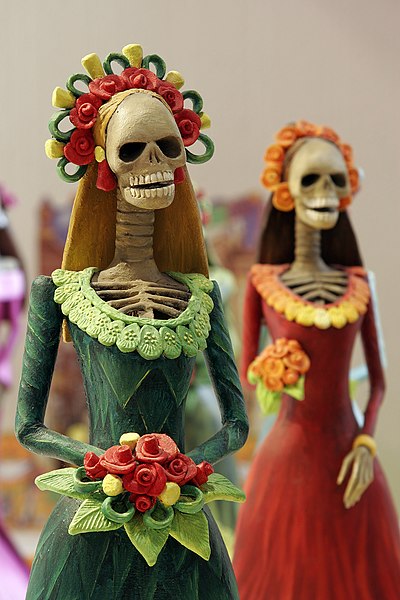
A skeletrix is a skeletal figure, usually garbed in women’s clothing and always painted in bright patterns that are actually glyphs of power. A skeletrix can use each of the symbol spells once per day, and can generate two symbols per round. The touch of a skeletrix drains 1 level (Will save to negate). Their presence causes fear (as the spell) in creatures with 5 or fewer Hit Dice.

Special Qualities: Immune to illusions and all mind-affecting spells, weapon resistance (edged and piercing weapons), magic resistance 45%

Dragon by Dragon – July 1978 (16)

Dragon #16 holds great promise based on the cover alone – a bad-ass barbarian and the word “ninja” …

To begin with, a gentle commentary from Kask regarding the amount of fiction in the magazine:

“Due to the length of the conclusion of THE GREEN MAGICIAN, we found it necessary to add an additional four pages this issue. Contrary to what some Philistines might think, this is not a fiction magazine. The Philistines I refer to are the ones that don’t want to see any fiction at all in these pages. To forestall the howls, the extra four pages were added to compensate, not that the story NEEDS compensating for.”

Gerald Guinn kicks this issue off with a rebuttal to a letter criticizing The Cthulhu Mythos Revisited. An entertaining exchange one would now expect to see … well, on every message board and blog frequented by geeks.

Jerome Arkenberg brings us the Near Eastern Mythos. Like the other articles in this series, it keeps it short and sweet and covers quite a bit of ground – everyone from An(s) to Ziusudra(s). The heroes in this article would be especially useful for swords and sandals campaigns – heck, this article, a map of the Near East and a few dungeon maps would be all you need to run a great campaign. The scorpion men are worth a look …

Scorpion Man: HP 240 (holy crap!), AC 1, MV 20″, Magic as 15th level wizard, fighter ability as 15th level lord and Class I psionic ability.

Okay, gonzo stats, but a sweet piece of art. I also love the fact that the “artifacts” presented would, in modern D&D circles, be considered fairly weak magic items.

After the Near Eastern mythos, we have the big article of the issue – The Ultimate NPC: Ninja – The DM’s Hit Man by Sheldon Price. I can hear the audible gasps of the “dick DM” crowd and the clicking of their teeth. To be honest, they have a point, but I think the article also needs to be seen in the context of the time. With characters bouncing around from game to game, there was the real danger of a ridiculously powerful character (probably played by a cheater) showing up to ruin everyone’s fun.

Here’s the rundown – Ninjas are limited to 16th level and must be neutral; they cannot use psionics. Their special abilities include seeing in the dark, tracking (as ranger with 20% penalty), simulate death, poison use (lots of rules here), far travel (2nd to 5th level 50 miles a day, 6th to 9th level 75 miles per day, 10th level or higher 100 miles per day – a unique ability), they prefer no armor but will wear leather or chainmail and they have a special shield called a neru-kuwa, they attack as a fighter, can attack open-handed as a monk and use judo as a samurai (originally in … uh, some other issue), they get a save vs. all damage, save as magic-users of one level higher against spells and can attack with any weapon at a -3 penalty, save ninja weapons they have mastered and weapons associated with a disguise class they have learned. Otherwise they save as a fighter. Their disguises are learned randomly. The article goes on a bit … go read it. It’s actually not too shabby in terms of being overpowered, especially since it’s assumed that one or two ninjas will be taking on an entire party and their retinues.

James Ward does another The Adventures of Monty Haul #3. This involves Freddie and his love of the weird. A sample:

“We appeared on a frosty plain of ice and snow with four Storm Giants swinging their weapons and Monty chuckling something about “minor guards”. We heard the sound of three clubs and a magic sword going smash, smash, smash, and chop. Mike’s gargoyle was a grease smear on one of the clubs, Tom’s Monk was down to one hit point, Dave’s cleric was really hurting, and Jake’s golem had one of its arms cut off by the vorpal sword. Robert clove one in two with his sword while Ernie’s and my cold rays took care of two more (and the sword, we found out a bit later). The last one was missed by the rest of the group, but it didn’t miss me for thirty-six points of bruises and nicks. With the next round, we were able to finish the giants off before the last one did any more damage. They didn’t have a copper coin’s worth of treasure on them, and we weren’t pleased. After a bunch of cure spells and a raise dead on the gargoyle, we still hadn’t figured out what to do about the golem’s arm. We just let it go and traveled on. Tim and Brian put on some of the dead guard’s clothes (which everyone thought was a good idea) and we were on our way towards a batch of caves.”

E. Gary Gygax covers a bit of ground in the Sorcerer’s Scroll with Role-Playing: Realism vs. Game Logic; Spell Points, Vanity Press and Rip-offs.  The essence is – some people are morons when they propose fixes to D&D, and they are an irritation to Gygax not because of vanity, but because they don’t understand game logic. Two quotes:

“The uniform element amongst these individuals is a complete failure to grasp the simple fact that D&D is a game. Its rules are designed and published so as to assure a balanced and cohesive whole.”

“D&D encourages inventiveness and originality within the framework of its rules. Those who insist on altering the framework should design their own game. Who can say that such an effort might not produce a product superior to D&D? Certainly not I.”

The bit about Weapon Expertise being stupid considering that any fighting-man worth his salt would practice with all arms all the time is funny, considering he had just published the AD&D Player’s Handbook with the weapon proficiency rules.

In a Design Variant article, Charles Sagui explains Why Magic Users & Clerics Cannot Use Swords. In essence: For balance in the game, and Tolkien didn’t write D&D, so I don’t care if Gandalf could use a sword. Sagui works out a system where clerics can use edged weapons, but whatever damage they score with those weapons must be paid with by losing spells or, if they’re out of spells, losing their own hit points. Weird, but kinda fun.

A. Mark Ratner presents Metamorphosis Alpha Modifications. This one covers the lack of mutants having a leadership potential, and thus being unable to use devices and weapons they find. I’m not sure that wasn’t the intention in the rules, but Ratner proposes a mechanical aptitude ability for mutants. More importantly, he presents a great big chart of mutated animals, including pigmy elephants, so you know it’s legit.

Next up is the second part of The Green Magician by L. Sprague deCamp.

“Shea’s intention was to jerk the blade loose with a twist to one side to avoid the downcoming slash. But the point stuck between his enemy’s ribs, and, in the instant it failed to yield, Nera’s blade, weakened and wavering, came down on Shea’s left shoulder. He felt the sting of steel and in the same moment the sword came loose as Nera folded up wordlessly.”

Hard not to fall in love with Belphebe.

Wormy involves Irving the imp selling dwarf burgers to a hungry crowd that includes a wereboar. Frank the tree troll takes him out with a club. Almost forgot Dudly and Frank – excellent characters. The gaming world really lost out when Wormy ceased.

Fineous Fingers, meanwhile, turns back to help his pals against the evil knight.

We finish up with a Design Forum article by James Ward on Game Balance. This involves the rate at which magic item treasure is given out – Gygax, Kask and Kuntz all want it restricted – Ward, on the other hand, loves it. He introduces the idea of Game Equilibrium. In this concept, the DM doesn’t care how much magic the players have. He uses plenty of it in his hordes … but he lets the defenders of those hordes use the magic items. In essence, Ward embraces the DM vs. players concept wholeheartedly, like a great big game of Spy vs. Spy. Not a bad style of play, in my opinion, if everybody involved is a good sport.

Well – I got steaks to grill. Have fun on the internet folks, and make sure you buy a copy of Blood & Treasure!

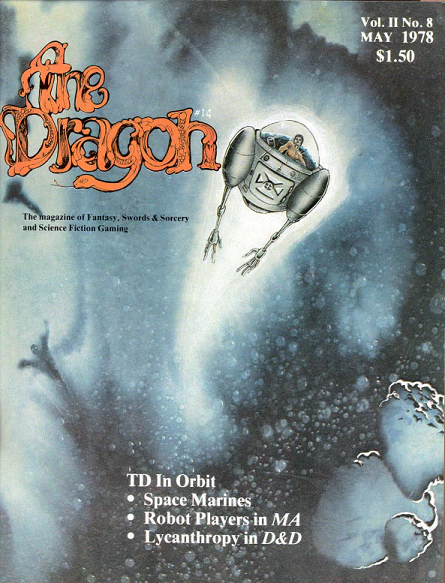
Dragon by Dragon – May 1978 (14)

I would have been 6 years old for this one, and 6 years away from discovery D&D. Let’s see what it has to offer …

First up, winners on that “Name the Monster” contest. Conrad Froelich of Wyoming, OH was the winner with “The Creature Some Call Jarnkung”. Runner’s up were Cursed Crimson Crawler by Thomas & Edward McCloud and The Ulik by Ann Corlon (who sez women didn’t play D&D back in the day). The winning stats were as follows:

Jarnkung, Large Magical Beast, Chaotic (NE), High Intelligent: HD 5; AC 3; Atk 1 tail (2d6) and 1 or 2 weapons; Move 20 (or 9 for S&W); Save F10 R11 W12 (or 12 for S&W); XP 500 (CL 6); Special: +1 or better weapon to hit, magic resistance 20%, detect thoughts (ESP) at will, may have psionic powers.

A. Mark Ratner now gives a review of Space Marines (not the later effort by Games Workshop), a game which he designed. Apparently it is a modified Tractics which owes something to Starguard. I wish that meant something to me. What did I learn about Space Marines from this article? Well, it has things like Nuclear Damper Fields, Mekpurrs (inspired by the killer herbivores from Satan’s World by Anderson), canineoid, rauwoofs, hissss*st (based on The Time Mercenaries by Philip High) and Klackons. The article has many rules ideas and additions for the game – mostly involving air combat and underwater combat. Makes it sound like a cool game.

J. Ward offers up a review of Nomad Gods. Unfortunately, this is another game I haven’t played or read, so I can’t comment much about it. Likewise with Tony Watson’s review of Cosmic Encounter.

Barton Stano and Jim Ward present Robots as Players in Metamorphosis Alpha. This one gets down into it, giving players structure points (115) and power points (100) to spend on propulsion, computer units, armor and various physical devices like quills, lead shielding and grasping claws. While this seems like a logical way to handle robots, it also stands as a preview of where RPG’s were going in terms of character building.

Michael McCrery now presents Excerpt From an Interview With a Rust Monster. Apparently this hinges on an NPC who was polymorphed into a rust monster, and now sometimes shows up as a wandering monster in McCrery’s dungeon.

Cool miniatures ad for spaceships …

Five sizes for each, which brings to my mind the ship sizes I used in Space Princess – starfighter, shuttle, corvette, star cruiser and dreadnaught. For their part, the ships are Galactic Dreadnaughts, Galactic Attack Carriers, Galactic Battlecruisers, Stellar Cruisers and Stellar Destroyers. OK – their names are better – I’ll give them that.

Gygax writes From the Sorcerer’s Scroll on D&D Relationships, the Parts and the Whole. This one gets into the edition mess that was forthcoming for TSR – i.e. what is the “Basic Set”, will the Original game be around much longer and what is Advanced D&D.

James Ward pops in now with Monty Haul and His Friends at Play. This appears to be a satirical piece about the folks at TSR. I dug the accompanying art:

And now, a peeved letter to the editor about the Cthulhu Mythos from the February issue. This is classic geek one-ups-manship at its finest, for example:

“First, the Elder Gods, after they defeated the Great Old Ones, stripped Azathoth of a lot of his power, so his hits should be lowered to 200 to 225.”

“If you’re wondering who is number one — YOG-SHOTHOTH his hits should be raised to 400. You can say that is rather powerful; you’re damn right. The Great Old Ones are so powerful, that the total power of the Elder Gods could not destroy them; only imprison them.”

“These may seem trivial, but if Howard Phillips Lovecraft, Augest Derleth, or Robert Howard saw your use, they’d roll over in their graves not once but at least ten times.”

Another one from James WardThe Total Person in Metamorphosis Alpha. This is a set of random tables for determining a character’s background. I always think these are most useful for Referees working out NPC’s.

Next we have an ogre fight in Wormy and Fineous Fingers being offered up as a sacrifice for a dark knight.

Gregory Rihn writes Lycanthropy – The Progress of the Disease. You can tell D&D is getting more advanced now and a little less free-wheeling for some folks in 1978. I dig this paragraph:

“A low-level werebear who takes six rounds to change fully would fight as follows: round one, normal level; round two, level minus two; round three, level minus four; round four, bear minus four; (claws and teeth have reached minimal offensive effectiveness) round five, bear minus two; round six, normal bear ability. Of course somewhere in here he has to shed his clothes.”

I like the idea of a lycanthrope changing during the course of a battle. The article includes a level table, which I would think was for adjudicating lycanthropes with class levels in the game – it has columns for “Changes Per Day”, “Chance of Involuntary Changes”, “Time Required for Change” and such – except it also has XP for each level. I guess it makes sense – XP determine one’s “lycanthrope level” separately from one’s normal class level.

And that’s it for #14. A few good bits in this one, but not my favorite issue. Even though I don’t always get much use for the articles in these issues, I still find the environment of gaming inspiration in these magazines. Well worth reading, especially for folks who have no grounding in the history of the game.

Truth > Fiction Files: Giant Scale Worms

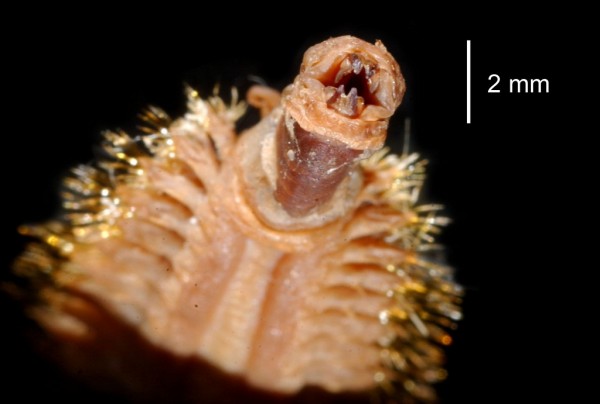
Saw this at Boing Boing today – a giant scale worm. 

Nasty little bugger, what? And is practically demands game stats. Of course, our version of giant is going to be GIANT!


GIANT SCALE WORM
Large Vermin, Neutral (N), Non-Intelligent; Bundle (1d6)

Hit Dice: 5
Armor Class: 14
Attacks: Bite (1d8)
Move: 20 (Climb 20)
Save: F 10, R 13, W 13
XP: 500 (CL 6)

Giant scale worms are aquatic monsters who sometimes crawl from the salty depths to harass ships traveling through shallow seas, or to attack people in fishing villages that have strayed too near the water’s edge at night. When a giant scale worm finds prey, it shoots its jaws out at the end of its reversible throat, allowing it an extra 5-ft. reach. For those not practiced in fighting scale worms, this attack gains a +5 bonus to hit. The jaws are quite powerful, and are capable of crushing weapons and armor. Any time a giant scale worm’s attack fails by no more than 2 points, the target must pass a Reflex save or the worm’s attack is treated as a sundering attack against their equipment, in the following order: Shield, weapon, armor.  In systems without rules for sundering attack, simply force the target’s equipment to pass an item saving throw, or the target to pass a save vs. paralyzation, or be destroyed.

Special Qualities: Blindsight, resistance to cold

Additional images found at Real Monstrosities

Eine Kleine Monster Art

One of my artists on Blood & Treasure, Jon Kaufman, has just posted a compilation shot of most of the monsters he illustrated for me on DeviantART. Check it ..

From left to right (vaguely – we’re all geeks here, so I’m sure you can suss it out): Behir, Centaur, Horned Devil, Wight, Mummy, Marilith, Nalfeshnee, Hengeyokai (Fox), Sahuagin, Ghaele, Bat Monster, Locathah, Succubus, Flail Snail, Cockatrice, Shedu and Gnoll.

You can also buy the illustration as a print, if you are so inclined.

In other news, I’ve finished editing the Player’s Tome for Blood & Treasure! I still need to tweak the layout a bit, but the Player’s Tome should be on sale pretty soon. Next step is the larger Treasure Keeper’s Tome. Still, I’m getting there little by little.

Thinking About Angels

We often talk about under-used (and over-used) monsters in D&D, but I rarely hear people bring up angels as an underused monsters. But think about it … aside from the railroady-save-the-world-from-elder-evil games, most D&D concerns a bunch of plunderers and tomb robbers. Even though some might be, technically, lawful, why wouldn’t some angelic vengeance show up once in a while when the party violates a consecrated tomb and carries away the burial goods or busts in on some humanoids who aren’t, at that moment, breaking God’s Law (or Whoever’s Law) and slaughter them wholesale, carting away their treasures. Angels in the game seem to just show up when a (technically) Lawful character summons them for help.

“Sure, mortal, I understand how hard it is to murder your way to riches. Let me help you out with some free healing because you’re technically on my team!”

I think there are a few reasons why this attitude predominates.

1) In a culture with Judeo-Christian roots (whether you believe or not, the roots are there), fighting angels seems wrong – i.e. not just non-lawful, but deeply chaotic. Fine for an “Evil Campaign” perhaps, but just weird otherwise.

2) The GM/Ref is “God”. You can fight berserkers, orcs, basilisks, balrogs, flail snails, etc. all day long, and it makes sense, because they’re just supposed to be there. But if an angel shows up and scolds the party with a fireball, it must be because the GM is trying to punish you for wrecking his dungeon/world.

3) History might be another problem. For generations, supposed believers in The Book wore their religion on their sleeve while engaging in plunder and slaughter. Angels didn’t punish them, so why should they punish us? We often posit – “What would a fantasy world be like if The Gods were real?”, but not  – “What would a fantasy world be like if Vengeful Enforcers of the Ten Commandments were real?”.

4) Finally, we tend to take a very soft, Michael Landon sort of view of angels in popular culture. You know, technically the adventurers are the good guys (or at least mostly focus their killing and robbing on evil folks), so, you know, the angels are kinda sorta on their side.

But how about a more unforgiving view of angels. Angels are relentless enforcers of the deity or deities of Law on the Material Plane. They take orders from an entity that is right, by definition, always right (maybe this entity is always right in your campaign, or maybe Lawful entities think he/she/it always is). “Thou shalt not kill” isn’t a suggestion, its a rule. You go around killing things, even wicked things, and eventually you’re going to run into some divine interference (maybe a cumulative 1% chance per killing, first you tangle with a lesser deva, and then work your way up to a Solar).

These are angels that encourage the concept of “martyrdom for one’s beliefs” (i.e. pacifism in the face of sure death, ’cause the point is to die with your alignment intact, not with the most XP or GP), not the “muscular Christianity” of the 19th century. Steal a pound of gold, lose a pound of flesh. It’s a different view of angels than we usually get, but isn’t that the point? Players won’t see it coming, and you can finally get some use out of the those solars, planetars, devas, archons, eladrin, etc. that are taking up space in your favorite monster book.

Anyhow – just a thought.

Dragon by Dragon – December 1977 (11)

Merry Christmas 1977! I would have been five, having my first Christmas in Las Vegas and opening, well, I have no memory of what I received for Christmas when I was five. I’m sure I was stoked. What were Dragon magazine subscriber’s opening?

First and foremost … best cover yet. A wagon of startled doxies pulled by God-knows-what is accosted by a red-robed dude and his captive troll while the triple-flail-armed driver looks on. Nice! Painted by Elrohir.

Second … an ad for newly released miniatures of the various demons plus Orcus and Demogorgon. The Type VI looks more like “naked guy with wings” than they are typically portrayed, which I think makes him creepier than the “OMG DEMON!” look.

Big announcement from Tim Kask … Dragon is going monthly! Oh, and they’re finally sending checks out to authors and artists! He also announces coming fiction in The Dragon from L. Sprague DeCamp and Andre Norton, as well as fiction from Fritz Leiber in this issue.

Gygax now chimes in with a defense of TSR defending its intellectual property from cheap and crappy imitations and outright theft in the form of reprints of D&D material. He has some nice words for GDW, but seems to be telling everyone else to piss off. He also mentions the coming release of the AD&D Monster Manual and future release of other AD&D material.

Enough announcements and editorials … let’s get to the gaming.

Rob Kuntz presents a system for Brawling (The Easy Way “Out” in D&D) which, at first glance, is way more system than I need. Brawling and grappling are always a problem, it seems, because they offer the chance of knocking someone out or disabling enough to make them an easy kill, thus tons of extra rules. This one compares ability scores of the fighters to get a modifier, and then a dice roll to score “damage” to one of the ability scores. Grappling, for example, involves averaging the dexterity and strength of both combatants and comparing them on a grapple table, then rolling 2d6 to discover how it works. Punching is similar, but determines the amount of damage.

Tony Watson then explains how to stop good old O.G.R.E. (not the monster, the mega-death machine) – basically tips and tricks for the game. I played it once, O.G.R.E. won, and my yen to play O.G.R.E. was satisfied.

In the Design Forum, Thomas Filmore, who opines on the value of role playing in D&D, as opposed to just wargaming. Pretty common blogpost material here, but perhaps a rather new concept back in the day, when many characters did seem to be more about puns and action than deeply invested backgrounds (i.e. the good old days).

Archive Miniatures has an ad for Star Rovers – 25mm miniatures. I dig the names of the figures, all of whom would be at home in a game of Space Princess: Planetary Scout, Funky Robot, Andromeda Annie, Bianca Snow, Doc Crock, Galactic Centaur, Alien Lizards, Walktapus (pre-Runequest?) and Sassanid War Elephant. Wait, Sassanid War Elephant? Why not.

MAR Barker continues answering reader questions in his Seal of the Imperium article.

Next up are some expansions to the Snits game that was featured last issue. Apparently the snits took the world by storm.

The Sorcerer’s Scroll is a new feature, and this first one is written by Rob Kuntz. Here, he mostly goes into the new Monster Manual (with “stupendous art by David Sutherland, David Trampier and Tom Wham”) and the eventual release of ADVANCED DUNGEONS & DRAGONS (I forgot that it was always written in all caps (“Fighters will now take 10-sided dice to determine their hit points and clerics 8-sided, etc.”). He also mentions Judge’s Guild, who continues to “saturate the D&D market with new variants” (and that TSR has undertaken to “make their new rule variant/additions … much more refined and interesting to the hard core D&D player” – I don’t like the sound of that). He has some kind words for Chivalry & Sorcery, but explains that it falls short due to its “smallish” print.

Fritz Leiber is next with Sea Magic. An excerpt:

“On the world of Nehwon and in the land of Simorgya, six days fast sailing south from Rime Isle, two handsome silvery personages conversed intimately yet tensely in a dimly and irregularly lit hall of pillars open overhead to the darkness. Very strange was that illumination — greenish and yellowish by turns, it seemed to come chiefly from grotesquely shaped rugs patching the Stygian floor and lapping the pillars’ bases and also from slowly moving globes and sinuosities that floated about at head height and wove amongst the pillars, softly dimming and brightening like lethargic and plague-stricken giant fireflies.”

Ral Partha’s new releases would make a nice random encounter list:

2. Gremlin War Party (3d6 winged goblins with spears)
3. Dwarf Lord (6th level dwarf fighter with chainmail and battle axe)
4. Satyr (Pan) (1% chance the encounter is with Pan, otherwise 1d6 satyrs)
5. Centaur Archer (1d8 centaurs armed with shortbows)
6. Land Dragon with Captain (treat land dragon as wyvern without wings, captain is 5th level fighter with splintmail, shield and lance)
7. Land Dragon with Lancer (lancer is 1st level fighter with breastplate, lance and shield)
8. Witch (female magic-user level 1d4+2; males must pass Will save or be fascinated with her breasts)
9. Monk (1d6 first level monks armed with staves)
10. Sprite War Band (3d6 sprites with swords led by 3rd level sprite fighter on fey mount)
11. Imp War Party (2d6 flying monkeys with sword or axe, shield and breastplate)
12. Were Bear (1d4)
13. Wing Lord (winged 3rd level fighter with spear and scale mail)
14. Paladin (dismounted) (5th level paladin with war harness (+2 AC), shield, pole axe and HUGE wings on his helmet)
15. Armored Knight (dismounted) (4th level fighter with platemail, shield and halberd)
16. Roomen War Party* (2d6 roomen with shield and spear)
17. Earth Demon (combo of stone giant and earth elemental)
18. Undead War Band (3d6 skeletons armed with swords, scythes and spears)
19. Woman Plunderer (1d6 levels of female barbarians with swords and chainmail)
20. Roll two times on table

* They’re freaking mutant kangaroo warriors!

Roomen (N Medium Humanoid): HD 1+1; AC 13; Atk 1 weapon (1d8) or kick (1d4+1); Move 40; Save F 13, R 15, W 15; XP 50; Special: Bound 60 ft. as charge attack.

James M. Ward now presents Quarterstaff Fighting Rules. This is like a mini-game that could be integrated into a normal game of D&D – somewhat like the jousting rules from Chainmail.

In Tramp’s Wormy, Wormy asks a bunch of dwarves “What wears chainmail and looks like black pudding?” – any guesses?

In Fineous Fingers, the adventurers discover that the evil wizard Kask has forced the local hobbits to try to conquer the city by capturing their princess.

The issue ends with a withering critique of NBC’s The Hobbit, by Rankin-Bass. I know, not the best adaptation, but I dig the design on the wood elves.

Overall, an issue that leaves me of two minds. I’m a big fan of Leiber, so the short story was cool. The EPT and O.G.R.E. stuff is not really aimed at me, so no complaints there. The brawling and quarterstaff fighting are nice mini-games/sub-systems, but probably not things I would include in my regular D&D game. Strangely enough, it’s often the ads that I’m enjoying the most – little snippets of creativity with no rules/stats attached. There’s the suggestion that in 1977, the creative energy of D&D is slipping away from TSR – they have some pretty good modules left in them, of course, but things are becoming more controlled and professional, and that carries with it a price to pay.

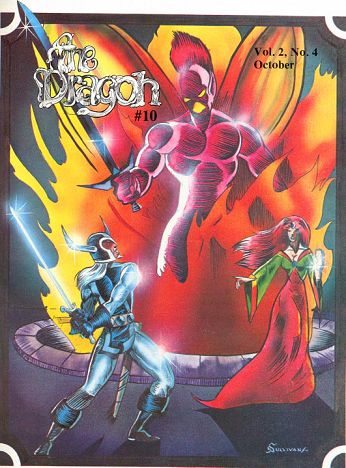
Dragon by Dragon – October 1977 (10)

Can you feel the chill in the air – that crisp chill of Autumn? Well, of course not. It’s July in the here and now, and just reading a magazine from October isn’t going to change that unless you have a rather powerful imagination or have been dipping into the pseudo-pharmaceuticals. Let’s see what Gygax & Co. had in store for us 35 years, when the leaves of Lake Geneva were beginning to change*

October 1977 starts off with a firecracker (mixing my seasons again), as Jon Pickens presents D&D Option: Orgies, Inc. The Mule Abides has already brought this article to prominence in the OSR, but I think it’s worth mulling over again.

The article posits the problem of too much wealth in the game. To this end, Pickens decided that treasure should only be translated into XP when it was spent. Since you can only have so many suits of platemail, 10-ft. poles and weeks of iron rations, players need something else for which to spend their gold. Pickens provides the following avenues of expenditure:

1. Sacrifices: Gold given directly to gods or demons; any character can do this
2. Philanthropy: Lawful’s can give gold to charity – but not to hirelings or fellow PC’s, of course
3. Research: This is for magic-users and alchemists.
4. Clan Hoards: Dwarves and other clannish folk can give their money to their clan.
5. Orgies: Fighters (not paladins or rangers), bards, thieves and all chaotics (except monks) can spend their money on wine, women and song

There are, of course, additional guidelines to these expenditures (i.e. how much can be spent in a night or week, etc.), but I love the idea and the restrictions. Even better, he has two appendices to the article – one on gambling and one on the effects of orgies on psionics (and in my opinion, the mere existence of this appendix should make you want to include both orgies and psionics in your next campaign).

Izzat what a female goblin looks like?

Daniel Clifton has the task of following up on Orgies, Inc., and does so with Designing for Unique Wilderness Encounters. It’s a nice little article, containing random tables for determining what the terrain looks like when a few pesky wandering monsters show up in the wilderness. The tables generate the vegetation, slope, etc., but don’t provide any guidance for how this terrain impacts the battle, which is probably a good thing.

Paul Montgomery Crabaugh presents Random Monsters – by which he means monsters generated randomly, not random wandering monsters. Naturally, I need to generate at least one (which I suppose I really should include in Blood & Treasure):

Intelligence: Highly intelligent (I have a budding genius on my hands here!)
Alignment: Chaos
Type: Mammal (which means it might be a ninja)
Speed: 12
Armor Class: 7 (would have been a 6 if it was a reptile; for B&T it’s a 12)
Hit Dice: Level -2 (level being the level of the dungeon … hmm let’s pretend we’re on the 9th level of our dungeon, so 7 HD)
Hit Dice Modifier: +0 (so, 7 HD … odd that I need to roll for the HD and then roll to modify it)
Damage: 1d8

Now I need to roll for special characteristics, which is an odd percentile table. For a 7 HD monster, I’m going to assume it works as follows:

01-39 – none
40-74 – one
75-89 – two
90-100 – three

I roll a “92” (no, really, I swear it) and thus my monster has three special characteristics. I need to roll d24 for these (if you don’t know how to roll d24, I just feel bad for you) and come up with the following:

1. Hostile to clerics
2. Has anti-magic shell
3. Hostile to magic-users

I have a very hostile monster, apparently. But he doesn’t hate cans … he hates spellcasters. This makes his anti-magic shell make pretty good sense (ah, the wisdom of dice!)

I now roll another D% to see if it has “other characteristics”, and a roll of “61” tells me it does not (otherwise, it could have some insect characteristics).

Last batch of rolls determine the physical description:

Size: Medium (6 feet)
Limbs: 2 legs, 3 arms
Exterior: Feathers
Coloring: Spotted white and grey

So, what do we end up with?

ALMESITH
Medium Magical Beast, Chaotic (CE), High Intelligence; Gang (1d4)

Hit Dice: 7
Armor Class: 12 [7 for Swords & Wizardry]
Attacks: 3 claws (1d8)
Move: 30 [12 for Swords & Wizardry]
Saves: F 10, R 10, W 11 [9 for Swords & Wizardry]
XP: 700 (CL 8)

Almesiths are strange beasts that are spawned from the residual energies of powerful spellcasting, living embodiments of nature’s abhorrence of magic. They are most often encountered in the deeper levels of dungeons, and seek out spellcasters for destruction. Almesiths look something like owlbears, and can be mistaken for those sorcerous creations. They differ in size, being no taller than a man, coloration, being covered in dark grey feathers on their arms, legs and backs and softer, white and grey spotted down on their bellies, and in two additional curiosities: They lack mouths, having instead a stirge-like tubular beak that juts 3 feet from their faces, and in that they have a third arm that juts from their chest. Almesiths attack with their large, hooked claws, and generate a natural anti-magic field (as a 7th level caster) in a 60-ft. radius. In combat, they always focus their attacks on spellcasters (clerics, druids, magic-users and sorcerers first, bards second, assassins, paladins and rangers third), ignoring attacks by non-spellcasters even when it threatens to kill them.

In the Design Forum, Richard Gilbert presents Let There Be Method To Your Madness. This is another in the series of “dungeons should usually make some rational sense” articles; the attempt to bring the retro-stupid branch of the RPG world to heel that persists to this day. I think these two camps can best be described as Phoebe vs. Rachel.

Next up is a mini-game … Snit Smashing, in which a Bolotomus waits to smash the Snits that run from the ocean so they can plant their snotch in a Snandergrab. If the Snit player manages to multiply more rapidly than the Bolotomus player can smash them, he or she wins. For the Bolotomus to win, he or she must destroy all of the Snits.

When you’re through smashing snits, you can proceed to P. M. Crabaugh‘s next article, entitled Weights & Measures, Physical Appearance and Why Males are Stronger than Females; in D&D (weird use of a semicolon). If the feminists in the audience are getting their hackles up, they might want to read the article first, they might want to read the article first. The article posits an additional 3d6 stat – Size – which can translate into bonus hit points and a modifier to carrying capacity. Yeah, males get some extra carrying capacity … and females get a +2 bonus to Con and a +1 bonus to Dex, and men get called “thick-fingered clods with facial hair”. The old “trash men to keep the feminists from calling you insensitive names” ploy. A classic.

Beyond the ability modifiers, the article has a mess of random tables for generating a random appearance (did you know males have a 30% chance of having facial hair). I don’t know that I’d use this for generating a PC, but it could be useful for generating general ethnic physical and cultural characteristics, if you want to get away from “these people look like Vikings, and these people look like East Asians and these people look like …” trend in campaigns.

The next article is Gaining a New Experience Level by Tom Holsinger. He explains that what D&D and EPT really need is some sort of dangerous ritual for characters to undertake when they have enough XP to advance in level. To which I reply, “Huh?” Favorite line in the article:

“The sacrifice of humans is generally forbidden in a populated area because too many people get upset.”

The article is actually pretty tongue-in-cheek, and would make for an interesting campaign. Essentially, it creates a sub-game that involves getting the gods’ attention with sacrifices or sacrilege, then assuming the “proper physical and psychic attitude, i.e. complete exhaustion”, which, Holsinger assures us, can only reliably be done by becoming thoroughly inebriated, during which the Emissaries of the Gods, the Great Pink Elephants, come to the character and imbue them with their new Hit Dice and special abilities. The level limits for elves, dwarves and halflings are, he tells us, because they have a harder time getting drunk. It is also why high level characters move out of town and build castles – with more hit points, they have to get super shit-faced to attract the attention of the gods, and that might mean burning things down and causing other massive disruptions to the lives of the common citizenry. This article actually dovetails nicely with Orgies, Inc. and together they could make for one hell of a fun campaign.

Next up, Edward C. Cooper‘s The Tactics of Diplomacy in Stellar Conquest. Honestly, I don’t know the game and so I’m not going to comment on the article.

In Wormy, the eponymous dragon is contemplating stumping some angry dwarves with a riddle. They’re angry because Wormy stole their bowling balls to use on his pool table. Meanwhile, Fineous Fingers is under attack by a whole guild of murderous hobbits.

And that’s it for October 1977. Good issue, I think. I have to run and set up an inflatable pool now, but I have a couple neat ideas in store for next week. Oh, and I finished writing Blood & Treasure yesterday …

Would they be changing in October? I’ve lived in Las Vegas my entire life – Summer temperatures only finally end around the last week of October, and the leaves may not change here until well into December. Basically, I have no idea how seasons are supposed to work.