Poker Made Easy [ACTION X]

I was just watching an episode of Mission: Impossible which hinged around a high stakes poker game. It occurred to me that such an occasion might arise in a modern role playing game, such as ACTION X (whenever I finish it), so it might be worthwhile to come up with a little in-game system to simulate a game of poker. Note – this is not a step-by-step simulation of poker, and it is completely untested and probably stupid.

Step one for the player (or players) involved is to roll on the following table to discover the strength of their hand. Essentially, this would be their final hand – there’s no drawing of new cards in this simulation. For our purposes, we just want to get a relative idea of what the player has to work with. Each hand carries with it a modifier that will be used later in the simulation.


D%
HAND
MOD.
01-44
High card
-2
45-86
One pair
+0
87-92
Two pair
+1
93-94
Three of a kind
+2
95
Straight
+3
96
Flush
+5
97
Full house
+7
98
Four-of-a-kind
+9
99
Straight flush
+11
100
Royal flush
+13

The player now nominates how much money he is risking on his hand. This will be matched or nearly matched by his opponents (see below)

Next, the player makes a Gambling task check against each opponent in the game. A gambling task check is a Charisma check in ACTION X, which uses the same task resolution system as Blood & Treasure. The player adds his hand modifier to the roll, and subtracts his opponent’s Wisdom modifier. If his opponent has a knack at gambling, the player suffers a -2 penalty to his roll. If his opponent is skilled at gambling, the player suffers a -4 penalty to his roll.

Each time the player makes a successful task check, that opponent folds and leaves the game. Each person who folds deposits half the amount of money the player chose to risk into the pot.

Each opponent that survives these Gambling checks now reveals his or her hand – roll randomly on the table above to find out what they have. Each of these participants will put risk as much money as the player. The participant in the game with the best hand takes the pot.

Sugarcane, Agent 99

You never know where inspiration will originate. A few days ago, my daughter and I were watching an old commercial on PubDHub, and the name of the product, Sugarcane99, struck me as a great name for a sexy ’60s spy. As we continued to watch the commercial, it revealed itself as a wonderful little preview for a spy movie …

First, we have the spy boss, in his thick-framed glasses …

Then we have Sugarcane, Agent 99, on the beach, awaiting instructions …

Then the villain of the piece, complete with obligatory white cat.

Finally, the villain’s accomplice, a wealthy femme fatale who uses her cover as a member of society to disguise her malevolent hobby, and the victim, a hapless diplomat drinking drugged coffee …

Hopefully, you’ll be able to catch the whole crew (and much more) in ACTION X, my take on modern role-playing. I’m about 75% finished with the game, and hopefully will start playtesting soon.

Action X – Still Ruminating on Classes

In a nutshell – With Action X, I’m trying to do with the Modern SRD what Blood & Treasure did with the fantasy SRD. The challenge – the SRD has a lot of history behind it – many editions of D&D with all the wonderful nonsense that goes along with it. The Modern SRD does not and, even worse, it’s just so damn boring and mechanical. Worse yet – it keeps making my writing boring and mechanical.

So – I bring an appeal to all of the geniuses that read this blog – what are the modern archetypes you’d like to see in a fun role-playing game not set in a fantasy milieu. By “modern”, I pretty much mean from Victorian times to today (or beyond into the near hard sci-fi future or even pulp sci-fi future).

I started with numerous classes, then boiled them way down and now I’m left feeling uninspired by them. Now I’m beginning to turn back to my original idea of a dozen classes that really hit the archetypes of modern action/adventure. I can’t hit every archetype of course, and new classes can always be added, but I’d like to get a strong core of fun classes that will spark people’s imaginations.

Some ideas (some of which are advanced classes in the Modern SRD, but which will need some TLC to make them anything more than collections of dry, boring bonuses to dice rolls) and some ideas for inspiration:

Brute (Mr. T) – hate the name; love Amazon, but that only applies to the ladies

Daredevil (Clyde Beatty, Howling Mad Murdock, Allan Quatermain)

Detective (Sherlock Holmes, Philip Marlowe, Jim Rockford, Thomas Magnum)

Gangster (Bonny & Clyde, Tony Montana)

Gunslinger (Lone Ranger, anyone from a John Woo flick)

Hacker (they abound in the news these days)

Martial Artist (Bruce Lee) – the name is so boring, though, but ninja and kung-fu master are too specific

Psion (Prof. X)

Scientist (Professor from Giligan’s Island, Spock) – maybe Brainiac would be a better name

Soldier (Sgt. Rock, Captain America, Hannibal Smith)

Sorcerer (Willow, Dr. Strange)

Spy (James Bond, Mata Hari)

I’ve thought about throwing in some odd balls as well – Cyborg, Mutant, Vampire – stuff like that. Almost a “race as class” concept for modern gaming.

So – any additional ideas out there? Let me know in the comments. Dangit – I want to make a fun modern RPG!

Action X Update

I’ve been sick the last week and had some extra time to devote to Action X. Even though the game is based, at least loosely, on the Modern SRD, it’s been tough going. Blood & Treasure was actually pretty easy, since it was essentially a tribute to various versions of D&D that have been published over the year. I wasn’t attempting to re-think the game – if D&D had rangers at some point, B&T was going to have rangers.

Action X, on the other hand, isn’t really based on a game with much history. d20 Modern wasn’t a terribly successful system, in part, I think, because it didn’t have much spirit. Charismatic Heroes and Strong Heroes might be a rational way to design character classes, but they aren’t exactly concepts to conjure with, and the special abilities read more like a technical read-out than something plucked from fiction or movies – lots of skill bonuses or spending action points. As such, most of my labor so far has gone into making Action X something that might spark a person’s imagination as well as being something easy to play and run.

In the past week, I’ve put most of my efforts into the Character Creation chapter, and in particular character classes. At this point, I’ve actually strained the character classes into only four classes, though a couple of those classes have what I call “sub-classes”. These aren’t sub-classes in the sense of 1st edition AD&D, but rather a choice of special abilities made by a member of the class. The current classes are as follows:

Adept – This is the spell casting class. The adept can use occult rituals (take some time and involve arcane tools) and psychic phenomena (only require some sort of focus and concentration). The adept starts with a few rituals or powers in their repertoire, and adds additional powers at every level. To use these rituals and powers, the adept has to make what is essentially a skill check, with various consequences for failure. In essence, I’ll be using a modified version of the system in Pars Fortuna for this. Vancian magic would have been easier, but I don’t think it fits well with how the supernatural is usually portrayed in modern films and books. Adepts roll d6 for hit points (with firearms in the game, it makes sense to allow for more hit points for characters), has one good save (Will), crappy attack rolls, two skills and four knacks and two starting weapon proficiencies.

Expert – The expert is the skill class. All experts have something called “skill mastery” – this allows them to pick one of their skills and, when rolling task checks, roll two d20, taking the better of the two rolls. There are three expert sub-classes – the daredevil can use adrenaline surges, the face can fascinate crowds (somewhat like a bard) and the infiltrator can make sneak attacks (i.e. back stab). The expert rolls d8 for hit points, has three good saves, mediocre attack rolls, six skills and four knacks and four starting weapon proficiencies.

Mastermind – Best described as a MacGyver or as the Professor from Gilligan’s Island, the mastermind is the go-to guy or gal for answering all sorts of questions, souping up devices and building machines, electronics or brewing up chemical formulas. The Game Master can decide how far out these devices and formula can be. Masterminds roll d6 for hit points, have one good saving throw (Will), crappy attack rolls, four skills and four knacks and two starting weapon proficiencies.

Warrior – These are the front line fighters of the game. They all gain multiple attacks as they rise in level (as the fighter in B&T). There are four warrior sub-classes in the game – the bruiser can go into a frenzy (like a B&T barbarian), the gunslinger can sacrifice attacks for extra damage, the martial artist gets some monk-style abilities and the soldier can improve the performance of other combatants (think Captain America barking out orders to his crew). The warriors rolls d10 for hit points, has one good saving throw (Fort), good attack rolls, two skills and four knacks and eight starting weapon proficiencies.

Characters can be further modified with feats, the kinds of weapons they become proficient with and, of course, by giving them personalities. Alignments at the moment are pretty simple – Hero, Anti-Hero and Villain – but do have an impact on the game. In place of experience points, characters advance by completing missions successfully. This made sense to me since Action X isn’t really an exploration-plunder sort of game like Blood & Treasure.  A hero is your typical white hat. Anti-heroes are like neutrals – they are focused on doing what’s best for themselves, but not to the point of robbing or committing murder. Most film noir protagonists would be considered anti-heroes. Villains are not typically appropriate as characters, though a villain-based game is not out of the question. Heroes have to watch their p’s and q’s, but the bonus they get is that they can consider a mission completed successfully if they manage to protect or save innocent people during the mission, even if their main goal in the mission is not accomplished.

Now that I have the classes more or less figured out, I can focus on the task checks, combat (especially gun combat) and then put some work into the adventure chapter, which will cover a few potential eras of game play – Victorian, Pulp, Cold War and Modern – adding little sub-rules where necessary, throwing in some fun random charts, talking about some “famous villains” of the era, and equipment available in the era.

It will still take a long while to get the game finished – maybe middle of 2013 if I’m lucky – but at least I’ve made some progress.

Action X Firearms Database

For those who have been interested in the gun posts, and my attempt to wrap my head around firearms, I’ve uploaded my database to Google Drive. It is still a work in progress, with many empty fields to be filled (I maintain a massive commercial real estate database at work, so believe me, empty fields are a hateful thing to me).

The database is not a collection of every firearm that has ever existed – I’ve mostly focused on firearms from the “great powers” with a few other interesting specimens thrown in for good measure. It also doesn’t attempt to categorize every variation on these firearms – I’m using it for a game, so I don’t need to be that thorough.

A few explanations:

Nation might refer to the nation or origin or the nation most associated with the weapon – it’s a mishmash at the moment

Era is broken down into Pre-Modern (i.e. before the main scope of the game), Victorian (1860-1901), Pulp (1910’s to 1950’s), Cold War (1960’s to 1980’s) and Modern (1990’s to present).

Type is the general classification of the weapon. At the moment, I’m classifying anti-materiel weapons as sniper rifles.

Caliber is in inches.

Muzzle velocity is in feet/second. When italicized, it is a value I found for the ammunition, not the weapon – beggars can’t be choosers.

Bullet weight is in grains; originally, I was using place holders here originally, so some of the values might be off for the type of ammunition indicated. I’ll clean this up later.

TKOF is a calculated field – The Knock Out Factor – a useful abstraction for coming up with damage ranges.

Rate of fire is in rounds per minute.

Range is in yards, and (hopefully) represents the weapon’s effective range, not maximum, though data sources are not always clear.

Ammo refers to the weapon’s ammunition loading mechanism (or whatever the heck you want to call it).

Damage is a calculated field (essentially dividing TKOF by 20). For now, the damage values I’m going to use, based on the Modern SRD and different from previous posts, are as follows:

0 = 2d4
1 = 2d6
2 = 2d8
3 = 2d10
4 = 2d12

5 and beyond, I’m not sure yet, but 0-4 should take in most of the personal firearms, which is what I’m primarily interested in at the moment.

Cost is in dollars at the time the weapon was introduced – and this column is about 99% blank at this point. Ultimately, costs in the game are going to relate to how effective the weapon is – I just wanted a little info here on which to base my later calculations.

Rate of Fire – a calculated field showing rounds per 10-second round.

Ammunition is the type of ammunition used in some of the other fields (bullet weight, etc.). Many of these are blank because I didn’t initially keep track of this data, so I’ll need to go back through and fill these in.

Notes are just what you would think – notes.

The second Year column was just a convenience for me, so I could organize the weapons either alphabetically or by year introduced.

Since this isn’t my only copy of the database, I’m going to open it to the public for editing. Be gentle with it. My one request – if you add or change data, please highlight the cell that you changed, as well as the cell containing the weapon’s name, in yellow. It will make it easier for me to track down new information and put it into my other copy of the database. Please only make changes if you have a reliable source of data to work with, and please make a note of that source of data in the Notes field.

You can access the file HERE

Enjoy!

More Guns – Victorian Pistols [Action X]

A week or so ago I wrote about gun in Action X. Here’s my first crack at taking the data and making it usable – a collection of “Victorian” revolvers and pistols. What I’m still playing with is the column headed “APR” – or attacks per round. When the machine guns show up, that’s going to get tricky. I’ll probably look to d20 Modern SRD for inspiration there.

For now, though, check out what I’ve got …

Of course, the main goal here, as with Blood & Treasure, is to keep it simple and playable and not get hung up on the intricacies. At the same time, though, you want gun fights to have a special flare, since they’ll be a big part of any modern game.

You’ll note that at the top, I have “generic revolver”. That’s for people who don’t want to bother with the individual firearms, or maybe for a Referee who wants to keep it simple with the NPCs. The generic version basically averages the data I have for all the weapons from the same time period and type, including weapons that do not appear in the table above.

The feed column: C stands for “Cylinder”, as in revolvers. M stands for “magazine” – a very generic term including clips, boxes, drums, etc. I’ll also use B for “belt” when the belt-fed machine guns show up. Reloading a magazine or belt should be fairly quick – maybe you can do it in place of an attack or move during a round. Cylinders would take maybe a full round, or one could take a 1/2 round to load 1d4 shots – something like that.

Anyhow – it’s a start, and I’m sure there will be many changes before I’m finished writing the game.

Murder, Most Random!

Halloween brings to mind ghost and goblins, yes, but also creepy or imposing Victorian mansions, and thus, MURDER!

The next time you need to generate a random murder for characters to solve, or perhaps explain the origin of the ghost they are busting, these random tables might come in handy …

WHERE? (d30)

1. Attic
2. Ballroom
3. Bathroom
4. Bedroom (upstairs)
5. Billiard Room
6. Buttery
7. Cellar / Undercroft
8. Dining Room / Eating Room
9. Drawing Room / Parlour
10. Dressing Room
11. Fainting Room (nudge nudge)
12. Gentleman’s Room
13. Great Chamber
14. Hall / Great Hall
15. Housekeeper’s Room
16. Kitchen
17. Larder
18. Library
19. Long Gallery
20. Lumber Room
21. Master Bedroom
22. Pantry / Butler’s Pantry
23. Picture Gallery
24. Scullery
25. Servant’s Quarters
26. Smoking Room
27. Solar / Solarium / Sunroom / Conservatory
28. Store Room
29. Study
30. Wine Cellar

WHO? (d30)

Note: This table can be used to generate the victim and the murderer, as well as the wrongly accused

1. Baronet / Lord
2. Lady of the House
3. Blustering Industrialist
4. Arrogant Playboy
5. Bold Explorer
6. Virile Sportsman
7. Member of Parliament
8. Spoiled Son/Daughter
9. Imperious Son/Daughter
10. Dowager Aunt
11. Doddering Uncle
12. Brainy Professor
13. Idiot Nephew
14. Sly Courtesan
15. Impassioned Suffragette
16. Intellectual Son/Daughter
17. Silly Son/Daughter
18. The Butler
19. Kitchen Maid / Scullery Maid
20. Cook
21. Valet
22. Driver / Chauffeur
23. Companion
24. Lady’s Maid
25. Nanny / Governess
26. Tutor
27. Chambermaid
28. Page / Houseman / Footman
29. Gamekeeper / Master of Hounds
30. Master of Horse

WHAT? (d8)

1. Poison (Arsenic, Curare)
2. Shot (revolver)
3. Stabbed or Slashed (knife, dagger, razor blade, something more archaic)
4. Bludgeoned (candlestick, wrench, statuette)
5. Strangled (rope, scarf, bare hands)
6. Electrocuted (where available)
7. Suffocated (or gassed)
8. Drowned

WHY? (d8)

1. Jealousy
2. Envy
3. Greed
4. Boredom
5. Ambition
6. Revenge
7. For the cause!
8. Because of the voices!

So, what is Chief Inspector Macintosh up against this week?

Doddering old Dr. Rolston has been found murdered in the fainting room! Egad! He appears to have been poisoned, and the most likely suspect is the very intellectual daughter of the family, Felicity, who had been conducting a bit of research into poisons. But why?

If Macintosh is smart, he’ll discover that the true murderer was the footman, Joseph, who did it out of jealousy – he envied those “hysteria treatments” the doctor had been giving to the scullery maid, Eliza, so he put a little extra kick in the old man’s brandy, and when next the two met in fainting room, the good doctor expired!

Guns! Guns! Guns!

Do you feel lucky punk? Well, then roll for initiative …

I’m not exactly a gun nut. I’ve fired a gun, once, at a Christmas outing, but other than that I’ve never had much of a fetish for the things. Yet, now I find myself working on Action X and needing to educate myself about the things.

The Modern SRD, on which I’m loosely basing Action X, has gun stats, of course, but I need a bit more. I plan on including in Action X a variety of “eras” in which to game – Victorian, Pulp, Atomic, etc. That means I need to chart guns from the 1860’s or so to the modern game, and therefore need a system, of sorts, to figure out what’s what with these things.

One way to go would be to simplify it – pistols, rifles, battle rifles, sub machine guns, light machine guns, medium machine guns, heavy machine guns, with damage following suit: Pistols do 1d6, rifles do 1d8, battle rifles 1d10, etc. I think, though, that many folks who are attracted to modern gaming like the idea of different guns – Bond’s Walther PPK, Dirty Harry’s S&W Model 29 .44 Magnum, etc. So, again, I need a system.

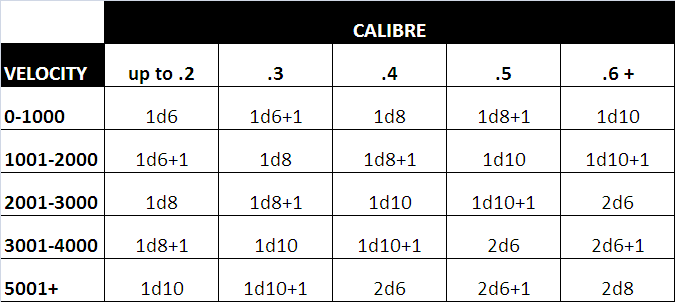
My solution (at the moment, anyhow) is to base damage on two factors – calibre and muzzle velocity. In other words, how much mass is hitting the target and at what speed. Rate of fire I think I’ll handle with an abstract “burst” mechanism – probably handled as a burst multiple that can either count as multiple damage on a single target or can spread among multiple targets, with the traditional penalty to hit multiple targets. So, a gun with a burst factor of “x3” could either be used to score triple damage on a single target, or used to score normal damage on up to 3 targets.

Anyhow – here’s my little matrix for gun damage. I’m beginning the damage at d6, and dropping damage by one dice size for balls vs. bullets.

Calibre is rounded off, and muzzle velocity is in feet per second. Using these numbers, Bond’s Walther PPK does 1d6+1 points of damage, while Dirty Harry’s .44 magnum (Smith & Wesson Model 29) does 1d8+1 points of damage.

Currently, I’ve been gathering data from Wikipedia on various guns – have a little database of 416 so far, with quite a few more to go and plenty of missing pieces of data – and should be able to put together some decent gun lists for each era of the game. And yes, I’ll be putting the database up on Google Docs for folks to download at some point.

Apocalypse 1898 – Introduction

Here’s a quick introduction to the Apocalypse 1898 setting …

It has been almost a decade since the civilizations of man were laid low by the invaders, and man’s dominion over much of the Earth was brought to a close. The invaders came not like a natural disaster, blind and deaf, to the planet, but with a cold, calculating intelligence. They knew what to destroy and how to destroy it. They knew how to win, and they did win.

But victory does not mean survival. Though they cast mankind’s progress back 500 years, the invaders did not survive to enjoy their victory. Now, the remnants of human civilization struggles to reclaim its former glory. This is no easy task though. Mankind’s factories were largely destroyed and their rail systems uprooted. Canals, rivers and seashores are clogged with the red weed of the invaders, making travel by boat exceedingly difficult and slow.

The 10 or 20 percent of humanity that survived the apocalypse from Mars operate with Medieval technology amid the ruins of a much more advanced civilization, one of steam, gas light and telegraph. Many people dwell in small, fortified villages, trembling in the night at the sound of the wolves at their door. A surprising number of people, however, still eke out an existence in the urban ruins.

In New York, once one of the world’s mightiest cities, the boroughs are now ruled as baronies by ruthless political machines and criminal gangs that hold power with fear and violence (well, maybe things haven’t changed much after all). In the rubble clogged streets and amid the crumbling edifices of the Gilded Age, men and women struggle for daily survival while plunging into subterranean vaults in search of their own lost marvels and technological wonders left behind by the invaders. With these tools, brave men and women can forge a new civilization on the ruins of the old.

Welcome to Apocalypse 1898.

Apocalypse 1898 attempts to combine two popular adventure tropes: the Victorian era and its wondrous scientific romances and the concept of the post-apocalyptic world, where man has lost his tools and must live again as an animal. The notion of a Victorian apocalypse is not new, the genre having been invented by the Victorians themselves. Apocalypse 1898 focuses in particular on the ruins of New York that were left behind after the infamous invasion by Mars written about in H.G. Wells’ War of the Worlds.

Apocalypse 1898 is a role playing game, in which a band of players take on the rolls of people attempting to survive and thrive in the post-apocalyptic New York of 1898. One player is the Referee, and he or she runs the adventures and adjudicates the rules when necessary. The game is primarily played with pencils, paper and a complete set of dice, including the traditional six-sided dice most often found in games as well as dice with four, eight, ten, twelve and twenty sides. A healthy dose of imagination is also required to bring the setting and the struggles of the characters to life.

This book explains the rules of play and describes the setting of New York in more detail. It also offers advice for the Referee in terms of running the game and writing adventures for the players.

After you have read the rules, gather your players, elect your Referee, grab some paper, pencils and dice and begin your exploration of Apocalypse 1898!

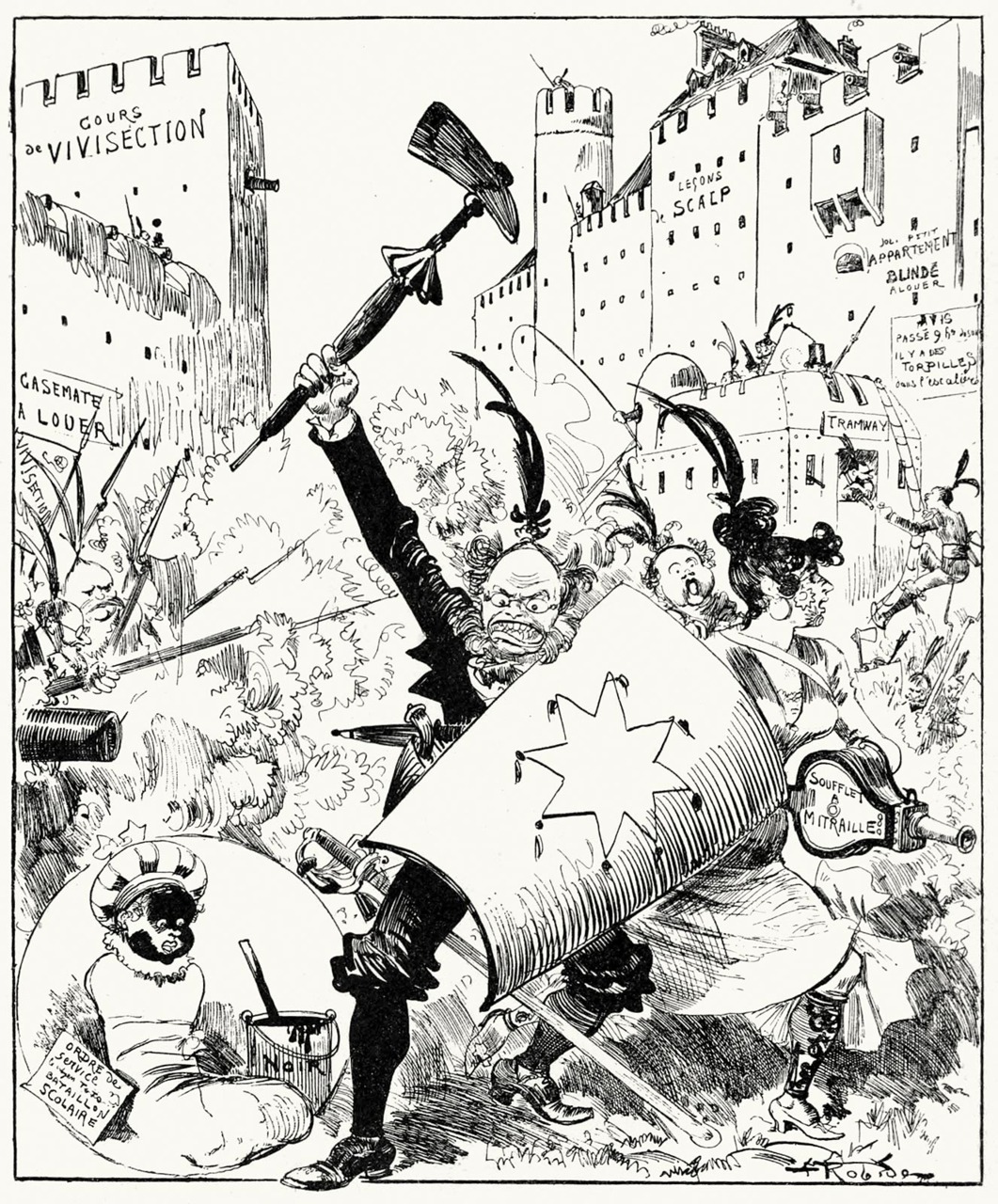
Image from OBI Scrapbook Blog – by Albert Robida, illustrating a European family going downtown to dine in a series of caricatures about war in the 20th century.

Apocalypse 1898 – I’m No Fool

Wow – within a day my last post becomes one of my most popular posts ever. I’m no fool, so it’s time to milk this a bit.

Apocalypse 1898 is the working title. Good / Bad / Whaddya think?

I’ll use a variation on Target 10 for the basic rules.

Here is my outline so far:

Ability Scores
Strength, Dexterity, Intelligence, Charisma; roll 3d6 for each to determine the score (will run from 1 to 9).

Each ability score is tied to several “skills”. For each ability, based on your score, you get to pick a number of these skills as “class skills” so to speak (i.e. you add your character’s skill bonus and ability score to them when your testing them, as opposed to just adding your ability score.

Score / No. of Skills
1-3 / choose one skill
4-5 / choose two skills
6-9 / choose three skills

In addition, you choose one additional skill from your highest ability category as your specialty (an additional +3 to tests)

Skills

Strength: Pugilism, swordplay, resist disease, resist poison, resist pain and exhaustion, wrestling, breaking and bending, leaping, climbing, swimming

Dexterity: Archery, throwing, gunplay, legerdemain, duck and cover, lock picking, riding, creep silently, lurk in shadows

Intelligence: Scholarship, decipher codes and languages, invent device, concoct formula, appraise value, discover clue, survival, pilot ship, occult knowledge

Charisma: Size up opposition, play instrument, sing and dance, command, charm, suggest, resist domination, trickery

Roll 1d20, add bonuses – penalties – try to meet or beat a 10 (i.e. Target 10)

Difficulties impose a -3 penalty (cumulative) on a roll – determined by Ref, but I’d give some examples

Other Stats /Abilities
Hit Points: 1d6 per point of Strength (+3 for specialization with any combat-oriented skill)
Equipment: One roll on random equipment chart per point of Charisma
Armor Class: 5 + Dex + armor bonus
Languages: One per point of Intelligence (or 2 slots to become literate in a language)

Levels
You can start at one of three “levels”

Novice: Has a skill bonus of +3 and 3 luck points
Veteran: Has a skill bonus of +6 and 1 luck point
Master: Has a skill bonus of +9 and 0 luck points

As always in Target 10, luck points are used to get automatic successes on rolls, or impose automatic failures on your opponents. You can also trade them for things like extra equipment

Species
This may change as I delve into the period literature, but for now …

Human: Gets 1 extra luck point
Freak: Get one mutation (see below)
Invader: Str -2, Int +2; gets “resist disease” as a bonus skill

Mutations
The mutations are going to be inspired more by PT Barnum’s freak show than by what you find in most mutant games. Things like bestial appearance, horrific appearance, gigantism, pinhead, etc. No death rays. All of them would have a boon and a drawback attached to them.

Occultism
You can work magic with this skill, but you must take it as a specialty.

There would be a list of magical operations with a Difficulty Class (DC) for each – like the psychic abilities in Space Princess. Maybe you would be required to have training in one to use it – perhaps you have as many “spells” as you have points of skill.

Character Packages
I’d probably include some sample character packages – if nothing else for use as quick NPCs. All of them would assume a “4” in three ability scores and a “6” in the fourth

Adventurer/Adventuress – explorers, doers of great deeds – Nellie Bly comes to mind

Gentleman/Lady – the gentry, educated and charming
Athlete – John L Sullivan comes to mind
Doctor
Soldier
Sailor
Gangster
Cowboy – Teddy Roosevelt, Buffalo Bill
Investigator
Magician – Madame Blavatsky
Priest
Inventor – Tesla, Edison

An example might be …

Cowboy (Veteran)
STR 4: Pugilism (10), Wrestling (10)
DEX 6: Duck & Cover (12), Gunplay (12), Riding* (15)
INT 4: Discover Clue (10), Survival (10)
CHA 4: Play Instrument (Guitar or Harmonica) (10), Resist Domination (10)

Gangster (Veteran)
STR 4: Climbing (10), Pugilism (10)
DEX 6: Creep Silently (12), Legerdemain (12), Lurk in Shadows* (15)
INT 4: Appraise Value (10), Survival (10)
CHA 4: Resist Domination (10), Trickery (10)

Monsters
This would probably be restricted to a few giant versions of animals – giant rats, giant spiders. Would replace Novice/Veteran/Master with Small/Medium/Large and otherwise use the same ability scores and a bunch of skills (common sense here, not using the same rules as character creation), with some special abilities added in where necessary.

Setting
The setting is New York. The game would describe the different boroughs and neighborhoods in the post-invasion setting. The main goal would be survival – food and water, not being beaten and robbed – as in “Warriors … Come hither and play!” type stuff. Of course, build up a reputation, a small army, some Invader weaponry and maybe you can knock down the doors of Tammany Hall and start running the joint.

To Verne or Not To Verne – That is the Question
The comments on the last post suggest people want some full scale Victorian Jules Verne sci-fi in this game. I’m not opposed to it, but it may occupy a separate chapter so people can either play a grim and gritty (though slightly tongue-in-cheek) romp through Victorian post-apocalyptic New York City, and others can include various sci-fi modules to make the game more in the steampunk vein.

Otherwise, the only “scientific romance” elements are going to be the surviving invaders and their weapons, and the supernatural abilities (which could be included as an add-on module as well, since some might prefer not to play Cabalists and Cowboys).