B is for Barbarian I

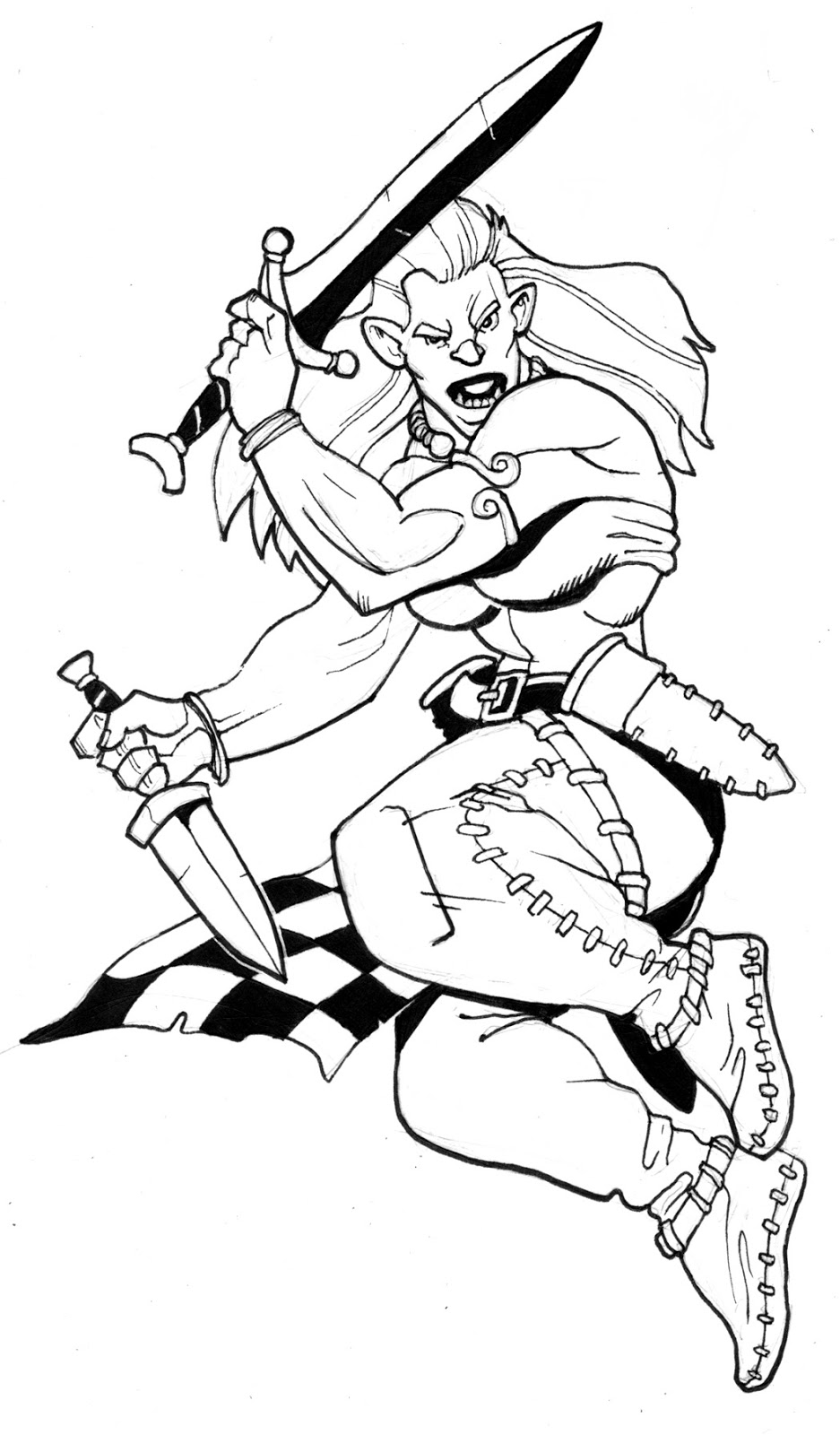
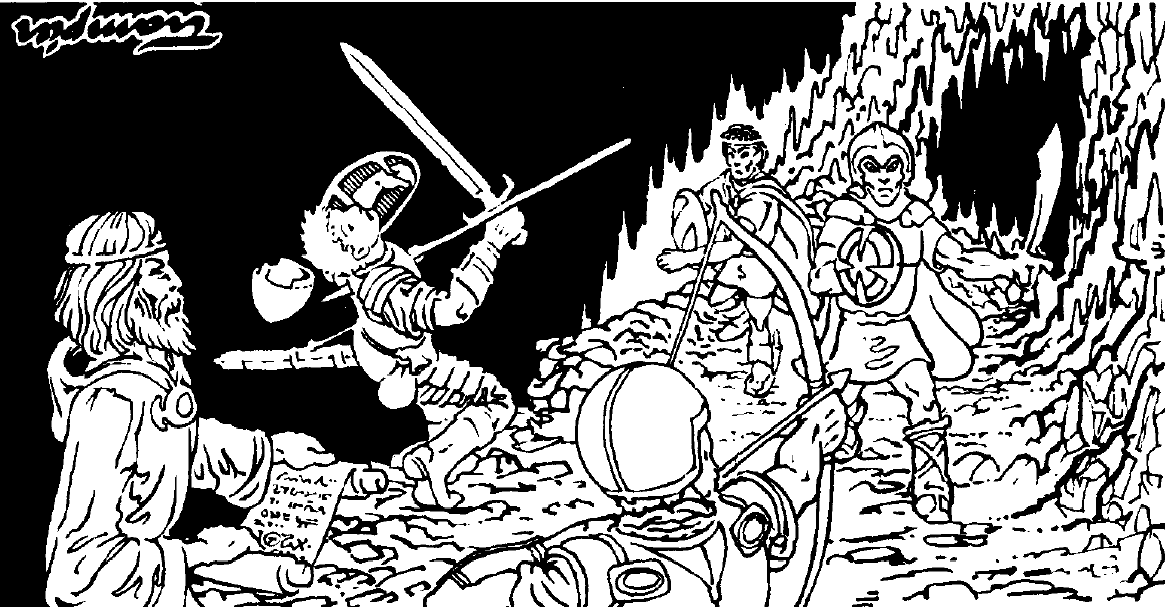
And not just any barbarian, I’m talking about b-movie barbarians. You know, those bare-chested outlaws that littered the cinemas back in the glorious ‘80s. I was watching Deathstalker the other day, and it inspired me to put together a quick mini-game of ‘80s barbarian action.

CHARACTER CREATION

You are a barbarian warrior. Heck, not just a warrior, a freaking barbarian lord! That means you don’t need to worry about races or classes or all that nonsense.

As a cat-like barbarian lord, you have 9 lives (more on that later) and you’re a kick-ass combatant. In combat, which uses a D6, you score a hit as follows:

vs. unarmored foes roll 2-6 on 1d6
vs. leather armor or thick skin roll 3-6 on 1d6
vs. chainmail or thick scales roll 4-6 on 1d6
vs. platemail roll 5-6 on 1d6
vs. magic armor or ethereal foes roll 6 on 1d6

Each hit takes one life from a foe.

Of course, less skilled fighters use different hit scores. The full attack matrix is there to the right.

In the attack matrix, a 6 followed by another number means if the attacker rolls a “6”, they must roll another 1d6 and roll in the additional range to succeed.
Attacking from horseback or in an awkward position or without a weapon drops one’s effective skill level (for each such problem) by one column.

Okay – so that’s combat!

So, how do we distinguish one barbarian from another (other than hair color and style of loincloth) – with the extras.

Equipment
Each barbarian hero can choose two pieces of equipment. Each weapon causes a special effect when the hero rolls a “6” in combat and follows it up with a second “6” on 1d6

  • Axe: Can be used to chop down doors (roll 3-6 on 1d6); in combat, decapitates foes for instant death
  • Bow: Range of 200 yards; in combat, can pin foes to walls
  • Broadsword: In combat, decapitates foes for instant death
  • Chainmail Bikini: Can negate hits on a roll of 4-6 on 1d6; and if you’re a guy, the bikini is also going to get you a few weird looks
  • Chakram: Range of 50 yards; in combat, can decapitate foes for instant death
  • Flying Guillotine: Range 5 yards; in combat can decapitate foes for instant death
  • Francisca: Range 10 yards
  • Helmet: Can negate one hit and is then destroyed; can have wings, horns or a plume
  • Maul: Can be used to smash down doors (roll 2-6 on 1d6); in combat, can knock foes flat on their back
  • Shield: Can negate one hit and is then destroyed
  • Spear: Range 10 yards; in combat impales foes for extra loss of life

Skills
Each barbarian hero can choose one extra skill to possess:

  • Beastspeaker: Can communicate with animals, and can control their actions on a roll of 4-6 on 1d6
  • Bull Strength: Can tote wenches, kegs and other heavy objects on his shoulders; up to 300 pounds
  • Cat-Like Reflexes: Can climb walls and move silently on a roll of 3-6 on 1d6
  • Cleave: Can make a free attack on an opponent within reach after successfully killing another foe
  • Eagle Eyes: Can spot ambushes, traps and secret or concealed doors on a roll of 3-6 on 1d6
  • Fortitude: Can ignore the effects of fatigue, poison or disease on a roll of 3-6 on 1d6
  • Horseman: Can attack from horseback with no penalty
  • Intimidate: Can get information out of foes or cause unskilled combatants to flee him on a roll of 3-6 on 1d6
  • Iron Will: Can ignore the effects of magical control and fear on a roll of 3-6 on 1d6
  • Savage Cunning: Can hide in the wilderness and surprise foes (free attack) on a roll of 3-6 on 1d6
  • Scholarly Mein: Can read ancient inscriptions, disarm traps on a roll of 3-6 on 1d6 and produce 1d6 bombs (range 10 yards) per day if he has the ingredients for gunpowder (watch the gorn episode of Star Trek for the formula)
  • Skullduggery: Can pick pockets and find and disarm traps on a roll of 3-6 on 1d6
  • Whirlwind: Can make multiple attacks against foes within range, reducing his combat skill by one column for each additional foe attacked during the round
  • Woo Women: Can make the ladies knees weak and cause their hearts to flutter on a roll of 3-6 on 1d6


Companions
A good barbarian does not travel alone. The barbarian hero can choose two companions for his adventure from the following list. Each companion can fight by his side and brings other abilities to the table as well.

  • Amazon Warrior: Expert warrior with sword and bow, can intimidate foes; has 6 lives
  • Charming Warrior: Expert warrior with sword and shield, can woo women; has 6 lives
  • Cunning Outlaw: Skilled warrior with sword and bow, capable of skullduggery; has 6 lives
  • Feisty Peasant: Unskilled warrior with club, can carry stuff and use common sense to get out of predicaments on a roll of 4-6 on 1d6; has 3 lives
  • Hedge Wizard: Unskilled warrior with staff, possesses a scholarly mein, can cast simple spells of detection and can counter the spells of other wizards on a roll of 4-6 on 1d6; has 3 lives
  • Holy Man: Skilled warrior with mace and chainmail, can hold spirits and undead at bay on a roll of 3-6 on 1d6; has 3 lives
  • Wily Thief: Skilled warrior with dagger, possesses cat-like reflexes, eagle eyes and skullduggery; has 3 lives
  • Young Barbarian: Skilled warrior with axe, possesses savage cunning and bull strength; has 6 lives

Motivations
With each adventure, a barbarian hero has one of three motivations: Greed (i.e. gold, jewels, etc.), Lust (for a prince or princess, feisty peasant girl, dashing swordsman, etc.) or Revenge. Some adventures might allow more than one such motivation. Whenever the barbarian hero (or a comrade) would be destroyed during the adventure, he or she can play a motivation card and manage an amazing feat that ensures their survival.

ADVENTURES

So, you have your barbarian hero and his retinue. Adventures are simple – come up with a patron, a cause, a villain and his lieutenant and soldiers, a fortress for the villain, dangers along the way, and you’re done.

For evil high priests, wizards and sorcerers, give them whatever spells make sense – usually things like teleportation, gaseous form, fireballs, lightning bolts, mind control, invisibility, etc. To resist a spell, a barbarian hero or hedge wizard needs to roll a 3-6 on 1d6, while others need to roll a 4-6 on 1d6.

For monsters, dig into your game books. A monster has as many lives as it has hit dice, fights like a monster, beast or demon (use your best judgment) and has as many attacks as you think it should have. Give the monsters skills (as above) where necessary. The main thing – don’t overthink it. This is a barbarian b-movie, after all. It’s not the story, it’s the action!

Action X – Still Ruminating on Classes

In a nutshell – With Action X, I’m trying to do with the Modern SRD what Blood & Treasure did with the fantasy SRD. The challenge – the SRD has a lot of history behind it – many editions of D&D with all the wonderful nonsense that goes along with it. The Modern SRD does not and, even worse, it’s just so damn boring and mechanical. Worse yet – it keeps making my writing boring and mechanical.

So – I bring an appeal to all of the geniuses that read this blog – what are the modern archetypes you’d like to see in a fun role-playing game not set in a fantasy milieu. By “modern”, I pretty much mean from Victorian times to today (or beyond into the near hard sci-fi future or even pulp sci-fi future).

I started with numerous classes, then boiled them way down and now I’m left feeling uninspired by them. Now I’m beginning to turn back to my original idea of a dozen classes that really hit the archetypes of modern action/adventure. I can’t hit every archetype of course, and new classes can always be added, but I’d like to get a strong core of fun classes that will spark people’s imaginations.

Some ideas (some of which are advanced classes in the Modern SRD, but which will need some TLC to make them anything more than collections of dry, boring bonuses to dice rolls) and some ideas for inspiration:

Brute (Mr. T) – hate the name; love Amazon, but that only applies to the ladies

Daredevil (Clyde Beatty, Howling Mad Murdock, Allan Quatermain)

Detective (Sherlock Holmes, Philip Marlowe, Jim Rockford, Thomas Magnum)

Gangster (Bonny & Clyde, Tony Montana)

Gunslinger (Lone Ranger, anyone from a John Woo flick)

Hacker (they abound in the news these days)

Martial Artist (Bruce Lee) – the name is so boring, though, but ninja and kung-fu master are too specific

Psion (Prof. X)

Scientist (Professor from Giligan’s Island, Spock) – maybe Brainiac would be a better name

Soldier (Sgt. Rock, Captain America, Hannibal Smith)

Sorcerer (Willow, Dr. Strange)

Spy (James Bond, Mata Hari)

I’ve thought about throwing in some odd balls as well – Cyborg, Mutant, Vampire – stuff like that. Almost a “race as class” concept for modern gaming.

So – any additional ideas out there? Let me know in the comments. Dangit – I want to make a fun modern RPG!

An (Un-) Common Dungeon

A little experiment tonight – I’m going to work up the skeleton of an adventure using the “random file” function at Wikimedia Commons. Now, you can’t do anything with some of these random files, so I’m going to take every single one in turn, but I’ll do my best with most of them to fit them into the scheme of the thing.

STEP ONE – LOCATION
Every good dungeon needs an entrance. My first image is actually a cheat – I’m using the picture of the day, the Temple of the God Wind in a Mayan ruin.

There’s the entrance to our adventure site – a ruined temple. Even though “God Wind” sounds like it has something to do with divine flatulence, we’ll assume we’re talking about a wind deity. Let’s work out some wandering monsters:

1. Wind Priests – half-naked blokes with censors of poisoned gas (sleep gas; they’re immune) and light maces

2. Small Air Elemental

3. Fusillade of poisoned darts (save vs. paralysis)

4. Giant Constrictor (wandered into the place from the jungle)

5. Pirates (exploring the ruin; their ship is anchored off the coast)

6. Albino Apes (just because they have a place in any ruined temple)

STEP TWO – THE BIG BAD GUY
Since I’m thinking more in terms of a short adventure than a mega-dungeon, it’s nice to have some monster or NPC sitting on top of the food chain. Not only is he/she/it the ultimate challenge of the place, knowing their identity in advance let’s you weave their presence throughout the place.

My random file – Barack Obama. I’d love to expand on this, but I like to keep politics out of this site, so I’ll try again. The next file is EZ Tondo – some sort of German store I suppose. The image doesn’t help, but how about an exiled Teutonic Knight who dabbled in black magic and has now taken up residence in the bowels of this pagan temple, adopting the identity of Tondo, Son of the God Wind, and cowing the locals into serving him.

Tondo will be a 4th level fighter and 6th level anti-cleric (dual-classing, dontcha know), and always accompanied by four of the aforementioned wind priests (2 HD each).

STEP THREE – THE MACGUFFIN
Now we need a reason for the adventurers to delve in the place, beyond simple loot. I get “Cathagenian ruins in Tunisia”, which brings Hannibal to mind, of course, and elephants, and thus a figurine of wondrous power, a pretty spiffy relic to delve for.

STEP FOUR – THE FIRST GREAT CHALLENGE
Just within the entrance, we need some wondrous challenge to whet the players’ appetites. I randomly get an image of an altar in a church. Our first great challenge, then, is a trapped altar dedicated to the God Wind. Maybe it looks like a pipe organ. You have to play the proper tune to open the doors into the dungeon, with each mistake summoning a monster or bolt of lightning or gust of razor-wind – something like that. The notes are secreted within a bas-relief of a gaggle of sylphs with open mouths, as though singing or shrieking, the mouths being at different heights and thus corresponding to musical notes. No, the ancient Mayans did not use this sort of musical notation, but since the players probably are not ancient Mayans, the concept works for them.

STEP FIVE – GUARDIAN OF THE FIRST LEVEL
We need a good (or evil) guardian of the first level – a monster or trap who keeps people from getting to the lower level, where the MacGuffin and Big Bad Guy are hiding. I get this …

Honestly, I have no idea. But it does give me some inspiration – I’m picturing a person grabbed by legs and arms and pulled in a most inconvenient way. But how?

Perhaps a well lined with hundreds of manacles embedded in the walls. The way to descend would be to either climb down a rope or climb down using the manacles as hand- and footholds. Naturally, the things are animated, and at some point attempt to clamp down on people’s wrists and ankles (Reflex save to avoid). Maybe they then pull the person, or maybe they just hold them while some winged goblins fly up from the darkness and attack. Either way, it would make for an interesting and challenging combat.

STEP SIX – THE BIG MYSTERY

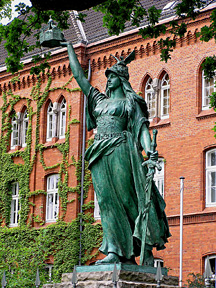
We need a mystery on the lower level to keep the player’s guessing. I now get the image of a statue holding a sword and a torch or oil lamp of some kind. This we’ll place in a circular room at the meeting of four passages. The passages lead to outer portions of the lower level – your basic rooms with monsters and traps and scant treasure. By lighting the statue’s lamp, though, and rotating it so that the light falls on bare walls in the rotunda, it also reveals extra-dimensional passages to four sub-levels, each dangerous. Once one walks through one of these openings, they see a wall behind them, so escaping from the sub-levels will be one of the challenges of the dungeon. One of the sub-levels hides a tiger’s eye gemstone that, when affixed to one of the the statue’s eye sockets (the empty one), animates it. It retains its perch and fights like a devil, but if defeated, the pedestal it stands on fades away, revealing a spiral stair that leads to the inner sanctum of Tondo.

So, six images gives us the framework for a (hopefully) entertaining dungeon. We would now need to draw up the levels and sub-levels and stock the chambers with monsters, traps and treasure. Remember, random isn’t just good in a game, it’s also good for creating a game – random inspirations to set your little grey cells to firing and creating things even you could never have known were lurking in you campaign world.

How to Make a New Class – The Land of Nod Way

I got an email recently asking about whether I used a formula of some sort when creating a new class. I figured the answer might make a good (and easy) post for the blog, so my process is as follows:

1) I read something and think that a particular character would make a good class. I usually look for something from classic fantasy literature, folklore or fairy tales, and a character type which spans a few different sources, even though one in particular might be the original or best known (i.e. there are lots of barbarians in fantasy stories, but Conan is the best known).

It’s quite fun and old school appropriate to base a character class on a particular character from fantasy, including adding in quirks about that character – i.e. the AD&D ranger being able to specifically use crystal balls because Aragorn could use a palantir. If you want to do a “mystic knight” class, go ahead and make it the Luke Skywalker class and include a whining ability – inside jokes like that are integral to the origins of the hobby.

2) I come up with level titles. Seems weird to do that second, but if I can’t come up with eight or nine synonyms for the class, it probably isn’t based on a broad enough concept.

3) I think up one or two specific abilities that not only fit the character, but which set it apart from existing classes. I try not to just make a new class with a mix of abilities from older classes, though sometimes an existing ability is appropriate.

4) I next look for a similar existing class and use it as my base in terms of attack bonus, save bonuses, etc. I throw in the special abilities and then try to figure out how comparable it is to the existing class in terms of power to help me decide which XP chart to use.

And that’s pretty much it. I try to keep in mind that I’m making up a bit of make believe nonsense for a game – i.e. I don’t take the process to seriously. Have fun. Be a little silly.

By the way – Tanner Yea’s Races of Lore now joins his Heroes of Lore as a download on the Blood & Treasure page.

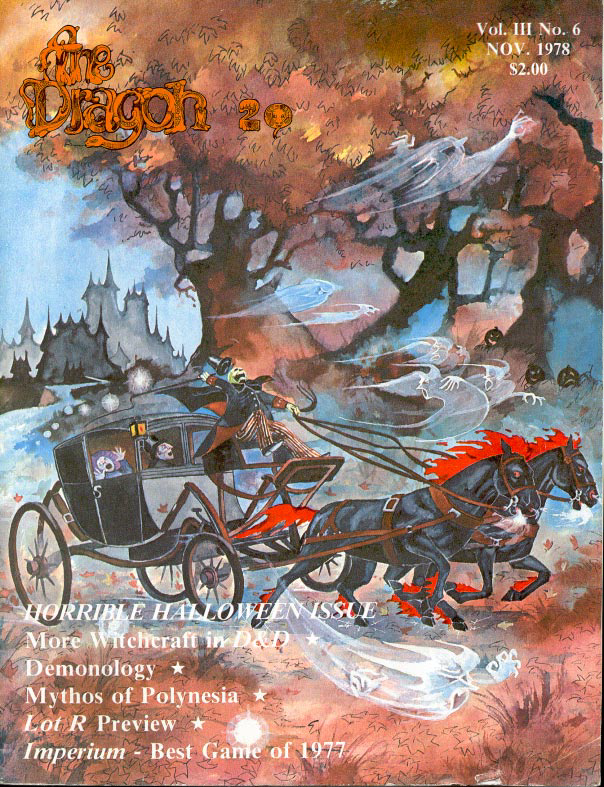
Dragon by Dragon – November 1978 (20)

And so we come to November of 1978, which is notable … for nothing that I’m aware of, other than this magazine. This appears to be their Halloween issue (why November? Kask explains it’s because November is the dreariest month of the year – what with all the football and Thanksgiving? – and thus a good month for horror stories).

Whatever the reason, let’s see what Dragon #20 has to offer.

Designer’s Forum – The Making of a Winner: Imperium – Outstanding Game of 1977 by Marc Miller

Yeah, that Marc Miller. In this article, Miller describes the origins of Imperium. Apparently it began as two games, Imperium being a giant sci-fi game of economics and conquest, and StarFleet, which was on a smaller scale. Ultimately, StarFleet was put on the back burner while Traveler was made. When Lou Zocchi mentioned that the name could get them in trouble with the Star Trek folks, and when they decided Imperium was too big to publish, they decided to take what they had learned making Traveler and apply to StarFleet, which would now be renamed Imperium.

Anywho – the article goes on to describe the design process behind Imperium, and to also provide some rules clarifications and addenda.

I enjoyed this bit …

Whatever happened to that guy?

Distributing Eyes & Amulets in EPT by Mike Crane

One of those great articles that makes perfect sense to people who play the game. The article is just a series of random tables that makes sure “rare” eyes and amulets show up less often than “common” eyes and amulets.

The Mythos of Polynesia in Dungeons & Dragons by Jerome Arkenberg

This article covers everyone from Tangoroa, God of the Ocean, to Pele the Destroyer, to Miru, God of the Underworld. The heroes seem more interesting …

The Polynesian Heroes were born in non-human form, and were brought up by their maternal grandparents, from whom they derived their magic. When in human form, they could transform, stretch, or shrink themselves, fly, take giant strides, and perform great feats of strength.

Maui is, of course, the badass of the crew (and he happens to look like a buffoon with eight heads) – here are some stats for Blood & Treasure.

Maui, Challenger of the Gods: Magic-User 18 and Fighter 15; HP 140; AC 12; ATK 4 slams +7 (1d3+5); MV 30 (Fly 40); F 6 R 9 W 4; XP 4500; Special: Dominate foes with 0 HD or less, 4 attacks per round, spells per day (4/4/4/4/4/4/4/3/3/2); Str 20, Int 18, Wis 18, Con 18, Dex 17, Cha 3.

Wormy

In this episode, Frank and Dudley abscond with one of the demon eggs to spring them on the ogres. It’s amazing how engaging this strip was right from the beginning.

D&D Variant: Another Look at Witches and Witchcraft in D&D by Ronald Pehr

Love the editor’s note:

Editor’s Note: This seems to be a well thought out class-variant. At the very least, it makes an excellent NPC or hireling/acquaintance. For those DM’s bold enough to try it, it provides a very viable character for ladies; be they sisters, girlfriends, lady gamer or others. D&D was one of the first games to appeal to females, and I for one, find it a better game because of that fact.

It manages to be both inclusive and a bit sexist at the same time.

So, what do the ladies get with this witch? It’s actually a nice class, and, I believe, the origin of the later witch class that showed up in Dragon in the 80’s. Witches here are not Satanists, but more nature lovers who use magic to charm and control – I guess what you would call an enchanter in more modern versions of the game – and who can brew potions, narcotics, hallucinogens, etc. Witches get eight levels of spells, many of them new, and they appear to straddle the normal magic-user/cleric divide.

D&D Variant: Demonology Made Easy by Gregory Rihn

This article is all about conjuring demons (and devils). The key here is learning a demon’s name, and the process is simple and clever: You research a demon or devil’s true name the same way you research a spell:

Demon prince, arch-devil = 9th level spell
Type VI, pit fiend = 8th level spell
Type V, ice devil, succubus = 7th level spell
Type IV, horned devil, night hag = 6th level spell
Type III, bone devil = 5th level spell
Type II, barbed devil = 4th level spell
Type I, erinyes, misc. = 3rd level spell

Definitely one of those, “Why the heck didn’t I think of that” moments.

Once you get down to the conjuration, you roll some percentile dice to see if what you call is what you get. Calling a demon prince, for example, has the following chances:

01-50 = Type V demon
51-75 = Type VI demon
76-00 = Demon Prince

High level conjurations require assistants and sacrifices, and there are additional chances for failure for characters below 20th level. Very good article.

GenCon XI Photo Album

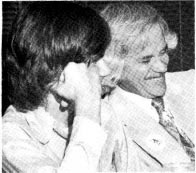
Greg Costikyan of SPI … I believe I recognize the woman as Gygax’s daughter
That Gygax fellow
J Eric Holmes and his son Chris
Jeff Perren
Lou Zocchi and Woody … proving that GenCon’s best days are clearly behind it
Marc Miller
Mike Carr
Tim Kask
Tom Shaw of Avalon Hill

Review: See Africa and Die! or, Mr. Stanley, Meet Dr. Livingstone by Gary Gygax

Gygax reviews Source of the Nile here. Apparently, this is a super long play game. It is pretty extensive review, and it looks like a pretty cool game. Best line of the review:

Be certain to read and KNOW the rules before you attempt to play. The rules are not well organized, nor are they very complete. In fact, in many ways they remind me of those originally written for D&D®.

Gygax also gives some additional ideas for the game.

The Asimov Cluster by William B. Fawcett

This article discusses the problems inherent in recreating scenes from sci-fi novels in games of Traveler. It also provides stats for the planets of the Asimov Cluster from the Foundation Trilogy.

Advert for the drow modules. The drow are going to change quite a bit over the next 30 years.

Preview: The Lord of the Rings by Allen Hammack

This preview is for the Bakshi animated version (which I’ll admit I like, sue me). It mostly gathers together some stills from the movie and a few production notes from Bakshi.

It’s a Good Day to Die by Lyle Fitzgerald

This article compiles death statistics of a D&D campaign in Saskatoon. In two to three years, this campaign racked up 600 deaths of PCs and their advance-able hirelings. Wow! I know the old game was deadly (I’ve played it), but this does seem excessive. The top killers are Miscellaneous Causes (14.6 percent) and goblin races (10.1 percent). Dragons were responsible for 7.5 percent of the kills and giants 5.7 percent – respectable numbers for the big guys. War only caused 6 deaths – I guess one of the four horsemen needs to be replaced by a goblin.

War of the Ring Variant by Allen Hammack

Simple rule change – hide the movement of the fellowship so the bad guys don’t have to pretend they don’t know where they are. Honestly – can’t believe the designers didn’t think of this.

Fineous Fingers

A dragon throws a stupid paladin off a cliff. Nice tactic – fake a subdual.

Demonic Possession in the Dungeon by Chas. Sagui

This article takes the rules to task on the inability of demons to possess victims. In Chas’ rules, only demons of Type IV or higher can possess mortals. Interesting line:

The rule of the thumb is that only those demons that are immune to all but magical weapons and therefore exist upon two planes at once may possess.

One of those, “wait – is that really why, or did he just make that up?” lines.

The basic idea is that the DM let’s the players all know they might be possessed. Everyone rolls a saving throw, but only one character is really the victim. The victim is chosen “randomly” – i.e. first person into a room, last person, etc. A save vs. magic is allowed to avoid the possession.

The possessed dude has his normal AC, but attacks as the possessing demon. They cannot use lawful-aligned magic weapons. The demon can use its normal powers, provided its new body doesn’t preclude it. All damage is taken by the body, not the demon.

There’s more, but you’ll need to read the article.

Not a bad issue, really. The witch and the demon conjuration articles are my favorites. I’d recommend hunting it down.

Maneuvers and Monsters

The magic section is almost completely edited, leaving just the monsters to go before this baby is (almost) ready for publishing. Last week, I finally figured out how I wanted to handle “encounter levels” – i.e. how tough is a fight? Today I thought of another way to handle special maneuvers in combat. Here’s a sample of each – let me know what you think.

[Oh, more previews from the final three circles of Hell and the B&T monster stats are on the way. As soon as I’m finished with B&T and the Rappan Athuk conversions, I’m going to get into 1800 – American Empires. I’m jonesin’ for some Napoleonic fantasy!]

Encounter Levels
First question from the Old Schoolers is, of course, why? The answer has nothing to do with balance (sorta). The real answer is “treasure”. If you’re not using something akin to “treasure types” for the monsters, and I’m not, you need a guide to how tough killing something is to determine the value of its stuff. It also helps dungeon designers, especially the new ones, to determine just how tough a given encounter is. If you’re designing a game for some 5th level characters and you overload it with impossible encounters, you’ve just designed yourself a shitty game. I know the concept of “balance” has been decried of late, and I agree with the sentiment when balance equals “make sure the players win”, but obviously the old school cared about balance as well, if not then there would be no need for racial level limits, more XP to be a magic-user and paladin or the concept of dungeons getting tougher as one descended into them.

The B&T system, in a nutshell is as follows:

A group of 3 to 5 monsters of a given “challenge level” is a challenging encounter for a party of that same average level. In other words, four ogres is a challenging encounter for a 4th level party of adventurers (assuming most parties contain 4 to 6 characters).

Two monsters of a challenge level equal to the average party level +1 is also a challenging encounter, as is one monster of a CL equal to the average party level +2.

Likewise, if you’re throwing lesser monsters at a party, you throw more at them. It goes something like this …

This, of course, begs the question: How do you calculate a monster’s Challenge Level?

I’m glad you asked. A monster with no special abilities has a CL equal to its HD. Thus, ogres, which have 4 HD and no special powers (big and ugly isn’t a power) have a CL of 4. Monsters with various minor powers (yeah, minor and major powers are defined in the rules) have a CL equal to their HD +1. Monsters with major powers have a CL equal to their HD +2. Pretty simple, and so far it has held true in the play tests.

SPECIAL MANEUVERS
I want special maneuvers in the game to be (1) easy to run and (2) worth while. All too often, I see people giving special maneuvers a try and regretting it later – while they were trying to trip the ogre, the ogre was just beating the crap out of them. As the rules usually go, it makes very little sense to do anything but attack. In reality, this is probably the case. Most of the ARMA fights I’ve seen involve wailing on your opponent with a sword rather than jumping around like a Hollywood stunt man. But B&T is, like most fantasy RPG’s, based not on the real middle ages, but rather on pulp fantasy stories and fairy tales, and Conan liked to get tricky.

The current system involved making an attack against a special AC that you had to calculate based on the maneuver. The new one doesn’t bother with that. Instead, it is modeled on the current combat system, with the two-pronged “attack” and “damage” concept. In essence, D&D combat separates combatants in two ways. You have an attack against a set AC. The attack improves as the attacker gains levels, but the AC, in general (monks don’t count here, dang them) does not, other than high level characters often have better equipment.

The “damage” side works the opposite way. The damager’s level doesn’t matter much (again, please ignore the dang monk) other than high level characters maybe having better equipment, but the hit points being damaged do scale with the defender’s level.

In other words, if you have two guys in padded armor with clubs, and one is a 1st level fighter and the other a 12th level fighter, the 12th level fighter has a much better chance of hitting his opponent, though his damage per round is about the same. He also has a much better chance of absorbing his opponent’s hits, even though his Armor Class is about the same.

So – Special Maneuvers. In essence, the attacker needs to hit a set AC based on the maneuver being attempted (i.e. the AC doesn’t improve just because the defender is higher level or has more HD). If the attacker hits, the defender rolls a saving throw to avoid the special effect of the maneuver, so the defender’s skill/power does make a difference. In addition, if the attacker’s attack would have penetrated the defender’s normal AC, he scores some damage (often unarmed attack damage).

Naturally, there are a few provisos and quid pro quos … mostly involving what weapons you can use for some of these maneuvers (that’s what those numbers in brackets in the table above refer to). Hopefully, this makes attempting a special maneuver more attractive and keeps the process pretty simple.

Oh – also – Captain Kirk!

So – special manuevers.

How to Enchant An Item

Here’s a draft for the whole “creating magic items” bit for Blood & Treasure. Still thinking about this, so feel free to make suggestions and such (unless you think it sucks, in which case keep it to yourself as I have a fragile ego and artistic temperament).

The overall idea is that games are always talking about all the cool ingredients that can be used in making magic items, but this one is going to codify it (in a very vague way, of course). It’s also going to attempt to use the system for making these items as a impetus for adventure – i.e. you need a medusa’s tooth for an item, you have to slay it yourself. The other idea is to make sure that magic items are not being created willy nilly and all the time without using several tons of required gold pieces or XP costs to achieve it.

THE BASICS
The game has two systems for “what level do I have to be?” to make magic items, one based on 3rd edition, where as full spellcasters advance in levels they learn to make different types of magic items, and the other drawn from older versions of the game, that require one to be 9th level to make anything. Treasure Keepers can do as they like.

The overall cost to make an item is equal to have the gp value of the item – which can be divided up by the creator between hiring master craftsmen and alchemists, making the item to be enchanted, etc.

The item to be enchanted must be made by a master craftsman under the watchful eye of the magic item’s creator using the best possible materials

Magic weapons, armor, rings and rods must be forged from meteoric iron, mithral or adamantine or, for rings and rods, precious metals

Leather goods must be made from expensive animal hides

Cloth goods must be made from expensive fabrics (silk, velvet, cloth-of-gold, cloth-of-silver, wool from the exceptionally fine sheep, the hair of virgins, etc.)

Wooden goods (wands, staves, etc.) must be carved from rare and expensive woods

Scrolls must be scribed on vellum prepared by a master or chiseled in an expensive stone (malachite, porphyry) using an adamantine chisel

Potions must be brewed in vats made of precious metals with the assistance of an alchemist

MAGICAL ELEMENTS
All magic items are tied to an “equivalent spell” determined by the Treasure Keeper – i.e. what spell is sorta kinda (or exactly) like the magic item being made here. For each level of that spell, the item requires a “magical element”.

Roll d8 for potions and scrolls, d10 for all other magic items.

MAGICAL ELEMENT (Roll d10)
1-2 Herb (must be harvested from a special place or at a special time)
3-4 Mineral (discovered in a dungeon)
5-8 Monster (slain by the magic-user and his comrades)
9 Place
10 Time

HERBS (may be ground, used to make essential oils, smoked, burned as incense or ingested as a tea)
Angelica: Good and lawful spells, abjurations, summoning
Anise: Abjurations and divinations (esp. clairvoyance)
Basil: Strength, fire, evocations, necromancy, command/domination
Bamboo: Dispel magic
Caraway: Air spells, charm spells, movement
Cinnamon: Holy spells, mind-effects, communication spells, healing spells
Cloves: Negative energy protection, silence, dispel magic, charm person, astral projection, ethereal jaunt and other travel spells (teleport, dimension door)
Coriander: Abjurations
Foxglove: Poison, cause wound spells
Frankincense: ???
Galangal: Luck spells, blessings, remove curse
Garlic: Exorcism, protection from undead, healing, weather spells
Ginger: Fire spells, curses, evocations, spells of travel or movement
Ginseng: Restoration
Hellebore: Exorcism
Henbane: Poison, death spells
Holly: Resistance to electricity, magic circles, protection from evil
Horehound: Plant spells, tree spells, hallow
Lavender: Bless, healing, memory spells, sleep, bull’s strength, bear’s endurance, illusions
Lovage: Eagle’s splendor, charm spells
Mace: Transmutations
Mandrake: Evocations, summoning, visions
Marigold: Illusions
Marjoram: Animal spells, necromancy
Mistletoe: Love, druidic spells
Mugwort: Astral and ethereal travel
Mustard: Enchantments, dispel magic
Myrrh: ???
Myrtle: ???
Nutmeg: Dream, nightmare, divination
Onion: Contact other plane, commune
Oregano: Calm emotions, good hope, abjurations
Parsley: Haste
Peppermint: Animals, energy spells (including protection and resistance), healing, necromancy
Pomegranate: Communication with the dead, necromancy
Poppyseed: Sleep, dream, nightmare, confusion, insanity, binding spells, curses
Rosemary: Fear (including resistance to), exorcism, legend lore, alarm, glyphs and other spells that protect items, fox’s cunning, owl’s wisdom, water spells
Saffron: Sun and light spells, divinations, true seeing, detect invisibility, wind spells
Sage: Healing, longevity, protection from scrying
Savory: Animal spells, fey spells
Star Anise: Lawful spells, mark of justice, detect lie, hallow, aid, bless, prayer
Tarragon: Dragon spells, rage, remove fear
Thyme: Fey spells, divinations, necromancy
Turmeric: War and weapon spells, exorcisms, hold spells, mage armor, shield
Wormwood: Illusion

MINERALS
Agate: Plant spells, physical ability boosts, cure spells, abjurations
Amber: Sun and light spells, detect spells
Amethyst: Mind and emotion spells, clairaudience and other hearing spells, AC-enhancing spells, remove curse, break enchantment
Aventurine: Earth spells, open doors, knock, passwall, remove curse
Bloodstone: Remove fear, enhance physical abilities, heroism, mage’s transformation
Carnelian: Abjurations, fire spells, spells of movement (fly, jump, haste)
Chrysoberyl: Spell turning, reflective spells, locate object, spells of awareness
Copper: Remove fear, neutralize or delay poisons, communication spells
Emerald: Charms and enchantments, exorcism, enhance mental abilities and vision
Fluorite: Chaos spells, cure disease
Garnet: Abjurations, heal
Gold: Spells of purification, positive energy spells
Hematite: Mental and psychic spells, time spells
Jade: Water spells, wisdom spells, healing
Jasper: Abjurations, cure disease
Lapis Lazuli: Psychic spells, remove fear, divinations
Malachite: Plant spells, bear’s endurance, transmutations
Moonstone: Confusion, insanity, wish, neutralize poison, sleep, illusions
Obsidian: Protection from energy, detect evil, true seeing
Onyx: Lawful spells, spells of command and control, abjurations, wall spells
Opal: Emotion spells, memory spells, astral projection, ethereal jaunt, dream, nightmare
Platinum: Anti-transmutation
Quartz: Aid, bless, prayer and other such spells, evocations, cold spells
Rhodochrosite: Fire spells, legend lore, calm emotions
Rose Quartz: Atonement, heal, cure disease, resistance to fire and other energies
Ruby: Command spells, growth spells, haste, resistance to fire and other energies
Sapphire: Wind spells, water spells, planar travel, abjurations, creation spells
Silver: Energy spells, sleep, insanity, magic circles and other protections
Sunstone: Sun, light and fire spells, blessings,strength
Tiger Eye: Animal spells, true seeing, divinations, travel spells
Topaz: Blessings, evocations, mineral detection
Tourmaline: Heal spells, mental spells, plant spells
Turquoise: Earth spells

MONSTER
Requires eye, hair, feather, skin, gland, organ, claw, tooth, etc. of a monster (aberration, dragon, fey, giant, magical beast, monstrous humanoid, outsider, undead) or legendary personage (at least 12th level) associated with the spell or power being woven into the item. Monster must have twice the Hit Dice of the equivalent spell to be used.

PLACE
Ruined temple
Ancient palace
Place associated with birth or death of particular god or demigod
Place associated with magical or historic event
Stone circle sanctified by a 15th or higher level druid
Elemental plane or other plane of existence
Atop highest mountain
Fabled or mythic island
Active volcano
Cloud giant’s castle
Storm giant’s undersea palace
Waters of a magic pool or fountain
Bottom of deepest chasm
Within the pounding surf
Waters of a holy river

TIME
Specific phase of the Moon
Specific solstice or equinox
Specific position of stars
Anniversary of magical or historic event
During a storm, earthquake or other cataclysm (natural)
During a meteor shower

Example: Flaming Longword
The Treasure Keeper rules that fireball is the important spell for a flaming longsword. Fireball is a 3rd level spell, so there will be three rolls on the table above. The TK rolls and gets mineral, monster and time. He decides the “mineral” will be carnelian (3,000 gp worth, powdered), the “monster” a salamander’s blood and the “time” during a meteor shower. The magic user must also provide a sword made of meteoric iron, mithral or adamantine. The magic-user will have to use divinations to discover when and where a meteor shower is to occur, and of course he’ll have to liberate a carnelian from a dungeon and slay a salamander. The services of an alchemist are needed to prepare the carnelian powder. While the flaming sword is forged by a master smith (during the meteor shower and under the open sky, of course), the magic-user mingles in the carnelian powder and salamander blood and casts the fireball spell.

Example: Cape of the Mountebank
The magic-user must provide around 5,000 gp worth of materials for this cape, which must be woven of silk or another expensive material, probably with gold or silver thread embroidered in it. It is associated with the dimension door spell, a 4th level spell of movement and travel. Rolling the dice, the TK decides he needs an herb, two minerals and a place. He decides the place will be the tomb of an infamous illusionist – the enchantment, though not the manufacture of the cloak, must occur there. The “herb” is ginger, which must be brewed into an ale and consumed by the magic-user while creating the item. The “minerals” are sapphire and tiger’s eye, which must be powdered and mixed into a dye for the cloak. The cloak will have silver threads embroidered into it to form symbols of power.

Blood & Treasure: An Idea and a Problem

Before I begin this post … The NOD 13 E-Book is back up for sale. I had forgotten to credit an artist, so I needed to bring it down until I could fix the PDF this morning. So – back up for sale, $3.50. Buy it HERE if you’ve a mind to.

Now back to our regularly scheduled post …

How many readers do yard work or putter around in the garden? If not, I highly suggest it, because it gives you time to think and create.

THE IDEA

B&T Ranger by Jon Kaufman

Today I was putting in a veggie garden and while I toiled a thought popped into my head. I want Blood & Treasure to be inclusive of all the editions that fed into the SRD – but that means a Referee who wants to run the game without some material from one or another edition has to put together a list for his players of what material is forbidden. That’s a pain in the butt.

So, working off of ideas I’ve seen floated around by Zak Smith and Jeff Rients and possibly others, I thought I might help those Referees out. Obviously, if a Referee is exluding material based on the theme of his or her campaign, I can’t read their minds and help with that. But, if they want to exclude things based on the edition it showed up in, that I can handle.

The idea is simple. I’m using three categories of material:

Classic: For me, this is the material that showed up in the three original books and material from the “basic” game written by Holmes and expanded by Moldvay, Cook and Mentzer. So, the four basic classes (yes, of course you don’t have to use the thief), the human, elf, dwarf and halfling, the old stand-by spells and the old stand-by monsters.

Advanced: This is the stuff from the original supplements as well as the first edition of AD&D. Material (i.e. classes, races, spells and monsters) that is “advanced” will be marked with a little black diamond next to the name.

Expanded: This is the stuff that showed up in the 2nd and 3rd editions of the game, from feats to sorcerers to tieflings to grey renders. Expanded material will be marked with a little black circle.

So, if a Referee just wants to run a “classic” campaign, he can tell the players to avoid any race, class or spell marked with a diamond or circle.  Likewise, those who want an “advanced” campaign can caution players not to attempt to use materials marked with a circle. Simple and, I think, not too intrusive. Let me know what you think …

THE PROBLEM
Inclusivity is nice, but it poses some problems. For all intents and purposes, I am finished writing Blood & Treasure and it looks like it’s coming in around 300 big fat pages. That’s a sizable book, and not to some peoples’ taste. So …

How about I produce three books?

One will be a 300 page monster with everything in it. This should run in the $30 range.

The other two will be divided into a Player’s Guide with the classes, races, spells and basic rules (combat, skills, saving throws, etc.) and a Referee’s Guide with monsters, treasure and info on creating and running adventures and campaign worlds. These would probably sell in the $15 range.

My only worry here is that somebody could accidentally buy all three and waste some of their hard earned money.

Again, let me know what you think.

The S-word in Blood & Treasure

While I’ve been scrambling to finish NOD 12 by the end of the year, Blood and Treasure and Space Princess have been simmering on the back burner. B and T is about 80% complete – all the monsters, spell and magic items converted, classes written, basic rules finished – and is mostly waiting for some info on high level play (strongholds, wargames, magic research) and a sample delve. Space Princess needs some modifications to the rules (fairly minor) and a formal writing down of the sample delve. They’ll probably both be available in January of 2012.

In the meantime, here’s a look of how non-combat actions can be resolved in the game (i.e. skills, one of the dirtiest words in Old School gaming). Also, a preview of the game’s iconic thief.

HEROIC TASKS

The concept of “heroic tasks” covers everything from climbing a sheer wall to riding a dragon. Brushing one’s teeth or stepping over a puddle do not qualify as heroic tasks, and characters can do these and most things automatically, without rolling any dice. Accomplishing very difficult (or almost impossible) tasks, on the other hand, does require a player take dice in hand and roll to discover his character’s fate.

For each of the heroic tasks described below, the conditions of the task are described as either “easy” or “difficult”. If somebody meets the definition of an easy task, they need not roll dice to see if they succeed. Success is assumed.

For people attempting a difficult task, dice must be rolled, and failure imposes consequences.

The actual dice to be rolled and the number needed for success depends on whether the person attempting the heroic task is unskilled, unskilled but has a knack or skilled.

UNSKILLED: An unskilled person can succeed at a difficult task by rolling 1d20, adding the relevant ability modifier, and trying to equal or beat an “18”. Alternatively, you can simply roll 1d6 and attempt to roll a “1”.

KNACK: An unskilled person with a knack for something (such as an elf’s knack for finding secret doors or a gnome’s knack for listening at doors) can succeed at a difficult task by rolling 1d20, adding the relevant ability modifier, and trying to equal or beat a “15”. Alternatively, you can simply roll 1d6 and attempt to roll a “1” or “2”.

SKILLED: A character skilled at a heroic task improves his chances of success as he or she advances in level. A skilled skill check is made by rolling a saving throw, modifying the 1d20 roll with the appropriate ability score modifier.

The type of saving throw depends on the ability most associated with the heroic task. Saving throws made to accomplish a heroic task are modified by their associated ability score, not the ability scores that normally modify saving throws (see Saving Throws above).

Strength: Fortitude
Dexterity: Reflex
Constitution: Fortitude
Intelligence: Will
Wisdom: Will
Charisma: Will

In some circumstances, a Referee can alter which ability is associated with a heroic task, and therefore which type of saving throw. Such is the power of being a Referee!

MULTIPLE DIFFICULTIES
If a heroic task you are attempting involves more than one difficulty, a -2 penalty per extra difficulty is applied to the dice roll. For example, riding a mount during combat is difficult, and therefore requires a skill check for success. Riding an untamed flying mount that has been frightened during combat involves four different difficulties, and thus imposes a -6 penalty (-2 per difficulty beyond the first) to the skill check to avoid failure.

[Note – just a sample of the more “old school” heroic tasks here – there are more in the game]

BEND BARS (STRENGTH)
Adventurers tend to get themselves into trouble, either by breaking into a monster’s home and stealing its loot or by failing to pay the king’s taxes on said stolen loot. This means that they might end up in the king’s dungeon or maybe on the wrong side of a portcullis with thousands of angry kobolds rushing towards them.

EASY: Bending bars is only easy if the bars are made of a weak metal, like gold, or very rusty iron bars. Using a tool might make bending bars an easy task as well.

DIFFICULT: The following difficulties force a character to attempt an action check when bending bars:
• Bending normal metal bars
• Bending bars one inch or more thick

FAILURE: The bars do not bend.

NOTE: Adamantine bars cannot be bent.

FINDING SECRET DOORS (INTELLIGENCE)
When a wizard wants to hide their treasure for all time, they might put it behind a massive metal door with a dozen locks trapped with acid, or they might put it behind a door that blends into the wall. Of course, they might do both.

SKILLED: Elves have a knack for finding secret doors.

EASY: Finding a secret door is never easy.

DIFFICULT: The following difficulties force a character to attempt an action check to find a secret door:
• Secret door is built to resemble the surface of a wall, floor or ceiling (i.e. all secret doors).
• Secret door is hidden using magic.

FAILURE: The secret door remains a secret.

NOTE: Finding a secret door does not necessarily mean opening a secret door. Many secret doors require special catches to be tripped (a book pulled from a bookshelf or a wall sconce pulled down, for example). Characters who cannot figure out how to open a secret door may have to batter it down (see Battering Doors above).

HIDING (DEXTERITY)
When an adventurer finds themselves hunted in a hostile dungeon or fortress, hiding might come in handy.

SKILLED: Thieves and assassins are skilled at hiding anywhere. Rangers are skilled at hiding in the wilderness. Halflings have a knack for hiding.

EASY: Hiding one’s entire body behind a solid opaque object.

DIFFICULT: The following difficulties force a character to attempt an action check to hide:
• Hiding behind a translucent objects (no, you cannot hide behind a transparent object!)
• Hiding behind an object smaller than you are.
• Hiding behind a non-rigid object, such as curtains.
• Hiding in nothing but shadow (counts as two difficulties)
• Hiding while under observation (requires a distraction)

FAILURE: You are noticed by an observer.

NOTE: If wearing camouflaging clothing (i.e. green in a woodland, black when hiding in shadows) you may receive a +2 bonus to your dice roll.

Alien Critter Generator

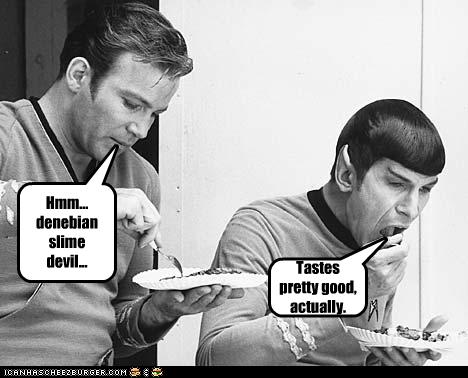
Any viewer of mainstream sci-fi has heard a few alien animal names that consist, usually of three elements. First, is their place of origin. Perhaps a planet orbiting the star Deneb. Then a descriptor – maybe this creature is slimy or dwells in slime. Finally, a noun – perhaps this irascible creature can best be described, like the well-known critter from Tasmania, as a devil. Hence Denebian slime devil. Okay, so how about a random table to do the same and stat the critter out.

Place
1. Venusian
2. Martian
3. Jovian
4. Saturnian
5. Mercurian
6. Plutonian
7. Neptunian
8. Denebian
9. Altairan
10. Cygnian
11. Betelgeusian
12. Polarian
13. Andromedan
14. Cetian
15. Algolian
16. Pleiadeian
17. Rigelian
18. Aldebaran
19. Antarean
20. Arcturan

* Note, if you prefer your beasties to be from distant stars rather than planets, just re-roll if Martian or Venusian, etc comes up. Or make your own table you lazy bugger – what do you want for free? You might also want to alter the critter’s stats based on the conditions of the planet (i.e. high gravity, etc.)

Descriptor
1. OOZE/SLIME: Creature may be covered in slime, granting it DEFENSE +3 vs. grabbing or wrestling attempts. Otherwise, just lives in a slimy environment.
2. ROCK/STONE: Creature may have DEFENSE +2. Otherwise, simply lives in a rocky environment.
3. DEATH: Creature either has a deadly poison bite or +2 hit dice.
4. SHADOW: Creature surprises opponents on a roll of 1-3 on 1d6 in darkness.
5. DUST/DESERT: Creature dwells in the desert, enjoys STRENGTH +1.
6. TREE/FOREST: Creature dwells in woodlands, enjoys DEXTERITY +1.
7. GIANT/GREAT: Creature has double hit dice.
8. CRYSTALLINE: Creature has DEFENSE +2 against all attacks except those from bludgeoning weapons and DEFENSE +5 against ray guns.
9. ICE: Creature suffers half damage from cold attacks.
10. LAUGHING/HISSING: Creature makes a laughing or hissing noise when threatened.
11. SCALED/FEATHERED: Creature is DEFENSE +1.
12. SPECKLED/SPOTTED: Creature has speckled or spotted hide. Heck, you could do stripes as well.
13. ACID: Creature has an acidic bite that inflicts +2 damage.
14. FIRE/STAR: Creature suffers half damage from fire and ray attacks or has ray attacks from eyes (weapon rating +5).
15. FANGED/HORNED: Creature has +1 weapon rating to bite or horn attack and +1 to bite or horn damage.
16. VAPOR/MIST: Creature either surrounded by a weird fog (opponents -1 to hit with SHOOT attacks) or creature dwells in misty area.
17. STINK/MUSK: Opponents must pass a Strength test or suffer -2 penalty to hit this creature in combat.
18. SEA/RIVER: Creature dwells in the sea or rivers and is equipped to swim at its normal speed.
19. CLOUD/SKY: Creature has a flying speed one category faster than its land movement.
20. LEAPING/HOPPING: Creature’s land movement is one category faster.

* Other special abilities could include spitting (poisonous spit, like cobra), long-necked, long-legged (faster movement), dwarf (half normal hit dice – probably meaningless for animals with only one hit dice to begin with), burrowing (gains slow burrow speed) and hypno- (can paralyze with eyes)

Noun
Stats are for Space Princess – you can no doubt find stats for Swords and Wizardry or Dungeons and Dragons if you just snoop around a bit.

1. DEVIL/BADGER: HD 1; DEFENSE 9; FIGHT 5 (claws and bite +0); SHOOT 8; MOVE N; Burrow S; STR 10; DEX 17; MEN 6; KNO 2; DL 2; Special: Flies into rage when damaged (+1 to hit and damage).
2. CRAWLER/CREEPER: HD 1; DEFENSE 8; FIGHT 5 (bite +1); SHOOT 7; MOVE F / Climb F; STR 10; DEX 15; MEN 2; KNO N/A; DL 2; Special: Poisonous bite (1d6 damage).
3. BAT: HD 1; DEFENSE 7; FIGHT 1 (bite +0); SHOOT 7; MOVE S / Fly F; STR 3; DEX 15; MEN 4; KNO 2; DL 1; Special: See in dark with echolocation.
4. DOG: HD 2; DEFENSE 8; FIGHT 7 (bite +1); SHOOT 8; MOVE F; STR 14; DEX 15; MEN 6; KNO 2; DL 2; Special: None.
5. CAT: HD 1; DEFENSE 7; FIGHT 3 (claws and bite +0); SHOOT 7; MOVE N; STR 6; DEX 15; MEN 7; KNO 2; DL 1; Special: None.
6. BIRD: HD 1; DEFENSE 7; FIGHT 3 (talons and bite +0); SHOOT 7; MOVE S / Fly F; STR 6; DEX 15; MEN 6; KNO 2; DL 1; Special: None.
7. HOG/PIG: HD 3; DEFENSE 8; FIGHT 9 (tusks +1); SHOOT 7; MOVE F; STR 16; DEX 10; MEN 4; KNO 2; DL 3; Special: +2 to strength tests to ignore pain.
8. BEETLE: HD 1; DEFENSE 7; FIGHT 5 (bite +2); SHOOT 5; MOVE N; STR 10; DEX 11; MEN 7; KNO N/A; DL 1; Special: None.
9. LION/TIGER: HD 6; DEFENSE 13; FIGHT 16 (claws and bite +2); SHOOT 12; MOVE F; STR 20; DEX 15; MEN 6; KNO 2; DL 7; Special: Pounce (two attacks when it wins initiative).
10. BEAST/ELEPHANT: HD 11; DEFENSE 17; FIGHT 26 (tusks +7 or stomp +5); SHOOT 15; MOVE N; STR 25; DEX 10; MEN 5; KNO 2; DL 12; Special: Trample (all in melee combat must make a dexterity test or suffer 1d6 damage).
11. BEAR: HD 6; DEFENSE 12; FIGHT 19 (claws and bite +3); SHOOT 11; MOVE F; STR 23; DEX 13; MEN 6; KNO 2; DL 7; Special: Creatures hit must make a strength test or be hugged for automatic damage each round until a successful strength test is made.
12. PINCHER/CRAB: HD 1; DEFENSE 7; FIGHT 5 (bite +2); SHOOT 5; MOVE N; STR 10; DEX 11; MEN 7; KNO N/A; DL 1; Special: None.
13. MOLE/RAT: HD 1; DEFENSE 7; FIGHT 2 (bite +0); SHOOT 7; MOVE S / Climb S; STR 4; DEX 15; MEN 2; KNO 2; DL 1; Special: Bite may cause disease.
14. APE: HD 4; DEFENSE 10; FIGHT 12 (claws and bite +2); SHOOT 10; MOVE N; STR 18; DEX 15; MEN 7; KNO 2; DL 4; Special: None.
15. LIZARD/SNAKE: HD 3; DEFENSE 10; FIGHT 10 (bite +1); SHOOT 9; MOVE M; STR 17; DEX 15; MEN 2; KNO 1; DL 3; Special: May be poisonous.
16. ANTELOPE/DEER: HD 2; DEFENSE 10; FIGHT 6 (antlers or horns +1); SHOOT 9; MOVE F; STR 12; DEX 17; MEN 4; KNO 2; DL 2; Special: None.
17. SPIDER: HD 1; DEFENSE 9; FIGHT 4 (bite +0); SHOOT 8; MOVE N / Climb N; STR 8; DEX 17; MEN 2; KNO N/A; DL 2; Special: Poison (2d6 damage).
18. BRUTE/RHINOCEROS: HD 8; DEFENSE 14; FIGHT 22 (horn +5); SHOOT 12; MOVE N; STR 24; DEX 10; MEN 2; KNO 2; DL 9; Special: Charge for double damage.
19. SNAIL/SLUG: HD 2; DEFENSE 4; FIGHT 4 (bite +0); SHOOT 4; MOVE S; STR 6; DEX 6; MEN 2; KNO N/A; DL 2; Special: None.
20. FISH/SHARK: HD 3; DEFENSE 10; FIGHT 8 (bite +1); SHOOT 9; MOVE F; STR 13; DEX 15; MEN 2; KNO 1; DL 4; Special: Blood frenzy (+1 to hit and damage when blood is in the water).

* You might want to swap out toad/frog for fish/shark, maybe throw turtles in somewhere.

Some Examples …

ANTAREAN ICE CREEPER: HD 1; DEFENSE 8; FIGHT 5 (bite +1); SHOOT 7; MOVE F / Climb F; STR 10; DEX 15; MEN 2; KNO N/A; DL 2; Special: Poisonous bite (1d6 damage), half damage from cold attacks. I’m picturing a stark white centipede of great size that hides beneath the snow. It has pockets on it in which it stores bodily fluids sucked from victims. It draws sustenance and heat from the decay of these fluids.

POLARIAN SEA BIRD: HD 1; DEFENSE 7; FIGHT 3 (talons and bite +0); SHOOT 7; MOVE S / Fly F / Swim S; STR 6; DEX 15; MEN 6; KNO 2; DL 1; Special: None. Polarian sea birds resemble Earth penguins except they are as large as dolphins and have coloration and habits reminiscent of killer whales. They have horn-like crests on their heads that allow them to make a low-frequency rumbling that can be heard by other sea birds miles away.

CETIAN HORNED SLUG: HD 2; DEFENSE 4; FIGHT 4 (bite +0, horn +1); SHOOT 4; MOVE S; STR 6; DEX 6; MEN 2; KNO N/A; DL 2; Special: None, horn does +1 damage. These slugs are the size of lions and are covered by a shiny, pink segmented shell. The forward-most shell piece has curved horns that the beast can use to attack.

Image from HERE.