Saving Throws – 2E vs 3E

I’m beginning the process of revising Blood & Treasure for release next year. This is primarily a task of getting in the errata, looking for things I and others might have missed, and refreshing the design. I want to make the books more readable, and thus easier to use. I’m also considering new cover art for the books – commissioned cover art. If you have suggestions for artists you would like to see grace the covers, let me know in the comments.

Revisions are also a good time to examine some premises – are there things that were not wrong, per se, but which could be better. To that end, I was looking at saving throws the other day, and whether B&T saving throws, which are based on the values in 3rd edition, are easier or harder than saving throws in older editions.

I did a quick search online this morning and found the 2nd edition AD&D saving throw tables, so I’m using them for this analysis. I figured that Save vs. Paralyzation, Poison & Death Magic mapped pretty well to Fortitude in B&T. Save vs. Breath Weapon maps pretty well to Reflexes, and Spells to Will. What I didn’t notice until now (it’s been a while since I looked at 2nd edition, and perhaps the values are the same in 1st as well), is that Save vs. Wands, Staves and Rods is just Save vs. Spells, but 1 point easier. I’ll incorporate that into the revised B&T for sure (+1 bonus to save vs. spells cast from wands, staves and rods).

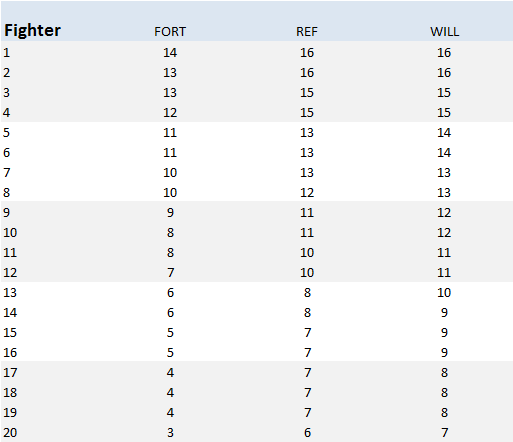
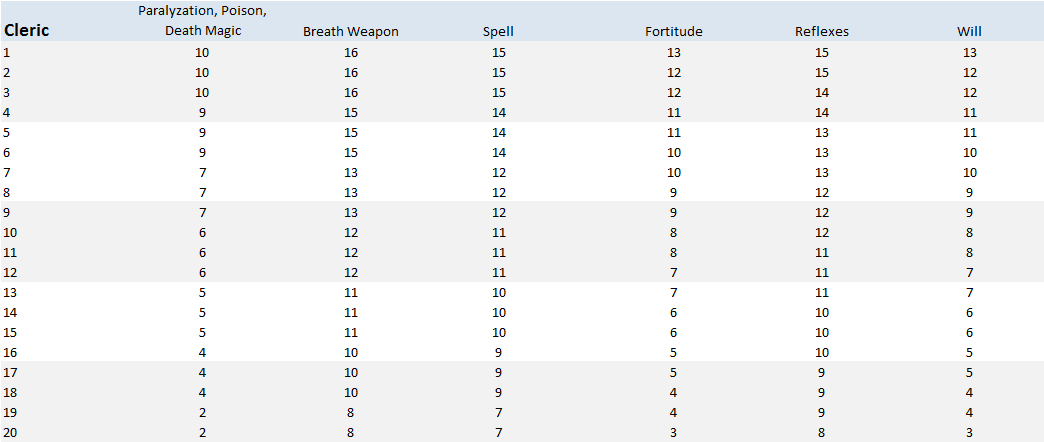
Anyhow – here is how they shaped up:

Clerics (or Priests, in 2E) weren’t that great against spells, which was changed in 3E. People often complained about the clerics being a bit too good in 3E, so perhaps they shouldn’t have made that change. That aside, the other categories end up pretty close at 20th level, but PPDM is much better than FORT for most of the cleric’s career. Perhaps the worse FORT save in 3E makes up for the better WILL save.

The fighters have an easier time of it in 3E at early levels, and a worse time of it at higher levels in terms of REF and WILL saves.

Magic-users are pretty close on PPDM vs. FORT and BW vs. REF. SP/WILL differ somewhat, with a marked improvement in 3E at very high levels.

Thieves in 2E were better vs. PPDM than BW, which was flipped in 3E. Save vs. Spells / WILL is pretty close.

So, between those editions, there were changes to be sure, but the overall ranges from 15 to 8 for poor saving throws and 13 to 3 for good saving throws, are pretty close.

My temptation is to do hybrids of these in the revised B&T, so they’re not quite so formulaic. Something like:

MST3K RPG

Sometimes, a stupid idea pops into my head, and I think it over – how can I do this? Yesterday, an RPG based on Mystery Science Theater 3000 popped into my head. How could you do that? And then it hit me …

… every game of D&D I ever played was MST3K the RPG.

After all, what is MST3K but three guys making fun of a movie. Every game I’ve ever played in is a group of people both playing the game and making a running funny (well, sometimes funny) commentary on the game we were playing. How do we turn “making fun of each other” into a game? Rules!

Rule #1 – The DM is the audience

Rule #2 – When the DM laughs, the player who made it happen earns XP

Smirk … 10 XP

Snicker … 100 XP

Guffaw … 250 XP

Belly Laugh … 500 XP

ROFL … 750 XP

Releases a beverage from mouth or nose … 2,500 XP

Players can also earn 1,000 XP for singing an impromptu song about something in the game and getting applause from at least 60% of the people at the table

Players use the fighter’s XP level advancement table. Players get the following special abilities:

Level 1 … nothing

Level 2 … gets most comfortable seat at the table, if highest level player

Level 3 … can make the lowest level player fetch them a snack or drink, once per session

Level 4 … can add a bit of narrative that benefits his or her character in a small way (once per character life)

Level 5 … can re-roll a failed dice roll (once per character life)

Level 6 … can make the DM re-roll a successful dice roll (once per session)

Level 7 … player is immune to fire (trust me)

Level 8 … can add a bit of narrative that benefits his or her character in a big way (once per character life)

Level 9 … player gets the right to build a stronghold out of couch cushions and pillows and must be referred to as Lord or Lady by the other players

Weird Fantasy

I’m a weird-o (if that’s the correct spelling). I’ve come to this conclusion as “geek culture” has become more prominent, and I came to realize that while my interests have some overlap with geek culture, I’m definitely not part of that culture. Of course, definitions vary, so we won’t linger on that. The point is – I like weird stuff, including weird fiction and weird fantasy. I’m more of a Clark Ashton Smith guy than a J.R.R. Tolkien guy.

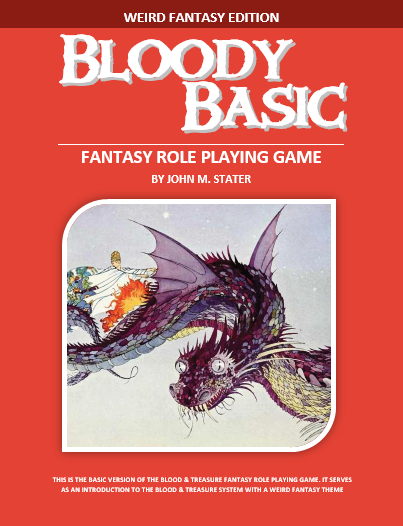
This brings me to my next mini-project. Bloody Basic – Weird Fantasy Edition.

I know, I said I’d probably do a different edition next, but then I was perusing some Aubrey Beardsley art, and that led to Harry Clarke art and then Clark Ashton Smith and the next thing you know I was spit-balling ideas and writing up an outline.

Here’s my intro to the edition:

Weird fantasy is a cornerstone of fantasy role-playing games, influencing the earliest games and lending them their unique flavor. Born from the Romantic Movement and symbolism, weird fantasy was a reaction to the modern world in which the authors lived. Weird fantasy was lush and decadent and yearned for meaning and release. It consisted of simple stories set in ornate worlds, and reveled in obscure, flowery and archaic text. The weird fantasy author and his characters were like tourists drinking in exotic places that existed only in their dreams. It has in its genes both pseudo-historical romances, Orientalism and fairy tales. Not fairy tales fit for children, but fairy tales that were not stripped of their violence or their erotic overtones.

Weird fantasy is steeped in meaning and bereft of it. It is quiet and noisome and ridiculous and sublime … and makes an excellent place for players to explore and indulge their sense of wonder. Weird fantasy characters are decadent and seek escape from the tedium and constrictions of the industrial age. They are errant knights, burglars, wise women, mystery priests and magicians, entering a world of fantasy through their dreams. They are bent on one last grand adventure, one chance to crack open the bones of drudgery and suck out the marrow of life, one final opportunity to live deeply and truly and transform the mundane into the beautiful … are you?

Does this sound right to you? It’s one of those situations where I know what mean, but I don’t know if I’m conveying what I mean.

Races for the edition, at the moment, are humans, elves (with a little soulless fairy twist), grotesques (ugly little buggers) and satyrs. Classes are the hierophant (unarmored clerics that accept taboos to gain access to the spell lists of divine mystery cults), the magic-user, the vagabond (basically the thief with a different name, not unlike the knave of the Mother Goose Edition) and the puissant (a warrior that uses combat feats the way magic-user’s use spells). Sub-classes are the rake (puissant), and the demimonde, odalisque and traveler (vagabond sub-classes).

I’m still working on monsters – trying to get the basics in (after all, we’re still dealing with good, old-fashioned dungeoneering), with some CAS-inspired stuff added in. I don’t want to go the Lovecraft route because I think that it is a little overexposed at the moment, and it tends to dominate. Alignment is replaced by passions, which are dangerous to indulge (one loses wisdom or constitution, as over-indulgence leads characters to madness or physical degredation) but are worth bonus XP when they are indulged. I might switch out the bonus XP for special abilities, though – something more palpable and flavorful that just raw numbers.

I might mess with spell names, treasure and the weapons and armor to use more archaic, ornate language, a la Clark Ashton Smith. I say I might, because I’m not sure if that’s just adding complexity without adding enough flavor to make it worth while.

So, what else? And what public domain art would make for a good cover image? I’d love to hear some ideas from the peanut gallery – make sure this edition is all it could be. Let me know in the comments or on G+, if you would be so kind. Thanks!

The Hierarchy of Materials

Machines are a pain in the butt.

Well, really, they’re a challenge, and challenges are half the reason to design a game.

The challenge in this case is dealing with 100 years of machine technology in a systematic way that allows one decade to flow into the next in a rational way that permits gameplay.

The specific challenge I’ve been playing with is Armor Class. Armor Class and attack rolls and damage rolls work – they’re an abstract way to deal with combat between individuals and they’ve managed to produce fun gameplay for a long time. I don’t want to rock that boat. There are some functional limits, though, that become apparent when you have to allow for a system that runs from “man in loincloth” to modern tank with 12 inches of steel armor.

Functionally, an attack roll involves rolling a d20, which gives you a maximum roll of 20. Characters in the sweet spot of levels are going to bring maybe a +4 or +5 to their attack rolls. High strength or dexterity adds another +3. Side factors throw in a +2 or +4 bonus to hit. The result: You’re not going to get many attack rolls higher than 30. Sure, at high levels, with everything on your side, maybe you roll a 40. But – and this is key – tanks were destroyed by guys with, reasonably, 1 or 2 Hit Dice all the time in World War II. A tank shouldn’t require a “40” attack roll to inflict damage.

So what do we do with that 12″ armor?

Well, damage reduction makes sense. This allows us two mechanisms to govern the ability to damage objects (and hit points lends a hand as well). Now, we don’t need super high Armor Class. We can have manageable Armor Class ratings, supplemented by Damage Reduction that makes sure certain classes of weapons cannot destroy certain objects. A fighting-man shouldn’t be able to sink the Bismark with a revolver, no matter how high his level is.

My first attempt at damage reduction was based on two factors – what is the object’s skin/hull made of, and how thick is it. I came up with some arbitrary values and used them as a place holder. Steel armor, for example, would provide 20 points of damage reduction per inch. Wood would be 5 points. Most other metals 10 points, etc. Simple enough, but maybe not realistic. With damage reduction in play, I needed to deal with the amount of damage inflicted by weapons.

Once again, a system was involved – in simple terms, rating firearms on the energy they were putting into their projectiles and turning these ratings into damage figures. Once again, I had a system that needed to take into account everything from slings to super-cannon, and now I needed it to interact intelligently with damage reduction. Obviously, some of these values were getting pretty big. Tanks were rolling around with 240 points of damage reduction, which meant anti-tank weapons needed to reasonably deal more than 240 points of damage (quite a bit more, actually) to destroy them. How does one roll upwards of 400 points of damage? That could take more than 60 d6, or about 20d20. That’s a lot of dice!

I won’t bore you with the details of the calibrations – and I’m honestly not done with all of them yet – but I did come up with a plan to simplify things.The point of my using damage reduction was to make sure that certain weapons were going to be ineffective on certain machines. In the real world, this isn’t just about how hard you’re hitting something, it’s also about what you’re hitting it with. This gave me the idea of a hierarchy of materials based on the strength of that material (or as near as I could figure it).

With this system, I decided that damage reduction would be 12 points per inch of material, regardless of the material. I chose 12 because it is easy to divide by 2, 3 and 4 (i.e. half-inch, quarter-inch, third-inch).

Using the hierarchy of materials, one compares the material being hit with the material doing the hitting. If they’re on the same “level”, or the hitter is at a lower level than the “hittee”, damage reduction applies as normal. If the hitter is one level higher in the hierarchy, use half the normal damage reduction value. If the hitter is more than one level higher, it ignores the damage reduction entirely. For every level lower, the damage reduction value is increased by 6 per inch.

Here’s the hierarchy I came up with (changes pending):

A. Kevlar
B. Tungsten
C. Steel (Hard, Armor), Titanium Alloy, Uranium (Depleted)
D. Mangalloy, Steel (Medium)
E. Cast Iron, Chainmail, Nickel Alloy, Spider Silk, Stainless Steel, Steel (Soft)
F. Aluminum, Bamboo, Brass, Copper, Fiberglass, Granite, Hard Woods (Ash, Hickory, Maple, Oak, Walnut), Nickel, Titanium, Wrought Iron
G. Bricks (Hard), Glass (Bulletproof), Lead, Limestone, Sandstone, Soft Woods
H. Bricks (Common), Concrete
I. Flesh

Let’s take an inch of steel armor (Class C). It has the following damage reduction values:

6 vs. Class B (tungsten projectiles)
12 vs. Class C (hard steel projectiles)
24 vs. Class E (cast iron, like old cannon balls)
30 vs. Class F (brass and copper, like many non-armor piercing projectiles)
36 vs. Class G (lead projectiles)
48 vs. Class I (Flesh, which sounds ridiculous until you realize you need to deal with things like Kaiju vs. tanks)

If we assume that adamantine is harder than tungsten, then we could say that steel armor has no damage reduction against adamantine. One could make that argument for magic weapons as well if they were using them in their game.

There’s still some work to do with this idea, and I’ll probably alter the hierarchy before I’m finished, but I think this is a simple, workable system that will make that campaign involving Hitler invading Mars as viable as one that just involves a small band of French resistance fighters committing acts of sabotage and espionage during World War II. The main idea is not to build a complex war game that takes every possible contingency into account, but rather to make a system that makes fighting tanks in Grit & Vigor not much more complex than fighting purple worms in Blood & Treasure.

What’s It Worth?

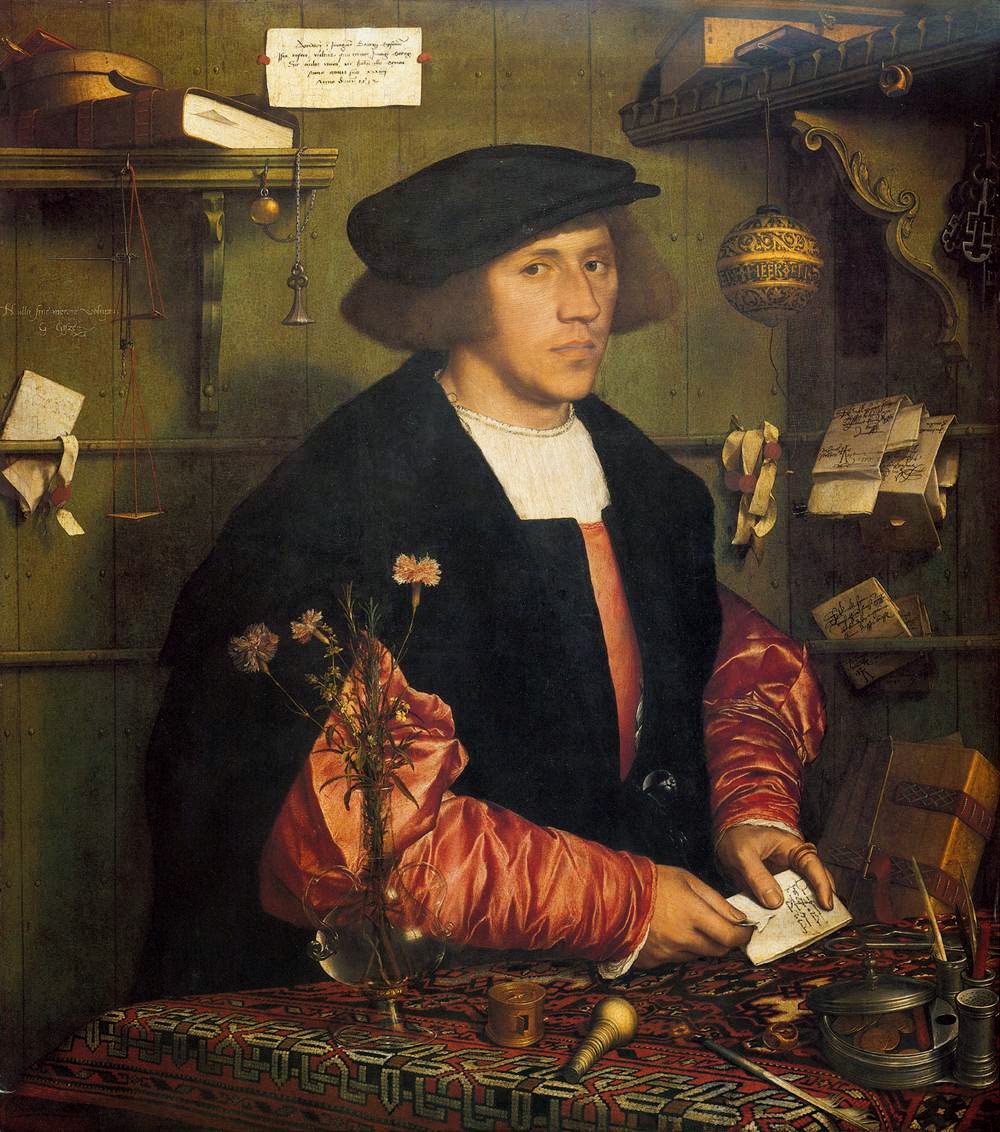
I’ll give you 10 gp, and not a copper more

Despite the wondrous quality of my RPG writing, it hasn’t made me a million dollars yet (just shy by about a million), so I have to have a real job. In my case, I research the commercial real estate market in Las Vegas, and write reports every quarter about how the market is doing. In the process, I often get asked questions about how much something is worth, or hear people complaining that a building sold for less than it was worth. I respond by explaining that nothing is worth more than what somebody else is willing to pay for it at any given moment. That got me thinking about a different way to value treasure.

Currently, when I’m writing a hex crawl, I’ll include treasure hordes with notations like “large ruby worth 5,000 gp”. What if, instead, I merely wrote “large ruby” and let the value be determined by the customer?

The basic idea: Come up with a matrix. The columns represent different classes of customers, the rows different categories of treasure. The data would be a random amount of money that the customer would be willing to pay for the treasure. The GM would roll this to determine the starting bid, and then roll a second dice to determine how high the customer will go. Adventurer and customer (GM) could then work out a final price for the item by haggling.

Classes of Customer

Peasants: These are your average working stiffs – laborers in towns and cities, people who carry things and serve others. They didn’t make much money in the real world – some would figure it at the equivalent of 1 or 2 copper pieces a day – but in the fantasy world, the standard is 1 silver piece per day. Either way, they have expenses, so they can’t afford to spend much on luxuries like treasure. There is a 90% chance they’ll offer goods and/or services instead of coins.

Artisans & Traders: These skilled laborers make a bit more, maybe five times as much as the peasants. This gives them a bit more money for luxuries. Still, if adventurers are going to these guys to sell their treasure, they’re probably a bit hard up. There is a 75% chance they’ll offer goods and/or services instead of coins.

Merchants: The merchants have plenty of money, though their assets probably aren’t liquid (meaning they have lots of stuff – goods, wagons, camels, ships – but not lots of money). Still, they aren’t hurting, and they can drop a few coins on the good things in life. There is a 50% chance they’ll offer goods and/or services instead of coins.

Merchant Princes: These are the big-time merchants, the fellows with royal and noble connections that allow them to own fleets and caravans and manors, etc. They’re going to be a bit more liquid than the common merchants. There is a 35% chance they’ll offer goods and/or services instead of coins.

Aristocracy: The lower end of the titled fellows – the knights and baronets and such. Like the merchants, their wealth is mostly tied up in things – land, animals, armor, weapons – so they’re like uber-barterers. They have a few coins stashed away, but they’re probably more apt to trade things like armor, horses or favors. There is a 65% chance they’ll offer goods and/or services instead of coins.

Nobility: The nobility includes barons, counts, and the like. Lots of land, but, as with the merchant princes, more liquid than the aristocracy. There is a 25% chance they’ll offer goods and/or services instead of coins.

Lesser Royalty: A step up from the nobility – the dukes and bishops. There is a 20% chance they’ll offer goods and/or services instead of coins.

Greater Royalty: Kings, queens, princes and princesses, and archbishops as well. There is a 12% chance they’ll offer goods and/or services instead of coins.

Imperials: Not Chryslers, but actual imperials – emperors, empresses, kings-of-kings, popes, etc. There is a 6% chance they’ll offer goods and/or services instead of coins.

Categories of Treasure
These are the same categories you will find in Blood & Treasure, and adapting them to your favorite game shouldn’t be too taxing on the grey matter.

Fancy Stones – agates, hematite – the stuff you find in shopping malls and tourist traps

Gems – better than stones, not as good as jewels

Jewels – rubies, emeralds, sapphires, diamonds

Common Arts & Trade Goods – armor, weapons, things made out of non-precious metals, common animal skins, rugs, many tapestries, common sorts of books. Assume the price is per ounce where applicable.

Fine Arts & Exotic Goods – lacquered wood, rare spices, items made from precious metals, bejeweled items, the skins of exotic animals, rare books, especially fine paintings and tapestries. Assume the price is per ounce where applicable.

Minor Magic Items – potions, scrolls, magical oddities

Major Magic Items – that stuff you really want to put on your character’s equipment list

The Table

The table above is a simple matrix. Find the category of treasure and the category of customer, and you get their opening bid. Roll a d6 to find out how high they’ll actually go:

1-3: No more than 25% higher, and they might have some conditions
4-5: No more than 50% higher
6: No more than 100% higher

Also, remember that there is a percentage chance that the customer offers to pay with goods and/or services rather than actual money. The value of services rendered is up to you, but most games give some sort of guidance. Favors are tricky – they may not be honored at a later date – but they could come in handy.

Obviously, some interpretation is involved here for the GM in terms of treasure category and customer category, and feel free to apply other factors. In a country where gold or silver is common, objects made from gold and silver might be considered common arts rather than fine arts. Likewise, spices, furs and pelts might be common one place and exotic in another.

The impetus for this table was a painting I posted a few weeks ago when I asked the question “Are Treasure Hordes Too Small?”. The idea here is that you can now provide a fairly large horde without having to predetermine what everything is worth. This system also gives adventurers a reason to make contact with nobles and such, which in turn can lead to further adventures.

The Evils of Drink and Other Intoxicants

From Wikipedia

A little preview of GRIT & VIGOR here for you. When you base a game on manly exploits of the olden days, you have to put some thought into rank drunkenness and other intoxicating past times. How can you run a Victorian-era game without using an opium den as a set piece, and how can you run a game set in the Old West without a drunken brawl in a saloon? You can’t – it’s somewhere in the bylaws I think – and so you need some rules to cover intoxicants and their effect on the human body (specifically, the PC’s bodies and those NPC bodies they’re going to be clashing with).

Why I never thought of writing these rules for Blood & Treasure, I don’t know, but they would work for that game and most other old school games I should suppose. Obviously, the rules are kept simple and abstract – they’re meant to take up a column of the rulebook, not a chapter – but I think they’ll do the job.

INTOXICANTS

Strong men often crave strong drink to dull the pain of living, or to celebrate a hard-fought victory. Of course, alcohol isn’t the only intoxicant a man or his enemies might use. Intoxicants are treated as poisons, and thus require a Fortitude saving throw to resist. They come in three broad varieties: Depressants, stimulants and hallucinogenics.

Intoxicants are also given two levels of efficacy – mild and strong. A strong substance not only has a greater effect than a mild one, and it imposes a -10 penalty to save against it.

The dosage of intoxicants varies widely, so use your best judgment. Mild intoxicants have a duration of 1d6 turns, while strong intoxicants have a duration of 1d6 hours.

If a character already under the effects of a mild intoxicant takes another dose and fails his saving throw, treat him as though he has taken a strong intoxicant.

Each time a character falls prey to the effects of a mild intoxicant, there is a 5% chance they will develop an addiction to that intoxicant (rules for that to follow). Strong intoxicants have a 10% chance per use of causing addiction.

MILD DRUG EFFECT

Depressant: -2 penalty to sensory task checks and balance and tumbling task checks, -2 penalty to AC and to all attack rolls, 10% chance per hour of falling asleep

Stimulant: -2 penalty to all wisdom=based task checks and Will saves and saves vs. sleep effects, +2 bonus to all other saving throws and to attack, -2 penalty to AC

Hallucinogenic: Confusion (there would be a page reference here in the rulebook, but if you’ve played ye old fantasy rpg, you know what confusion does)

STRONG DRUG EFFECT

Depressant: -4 penalty to sensory task checks and balance and tumbling task checks, -4 penalty to AC and to all attack rolls, 10% chance per turn of exhaustion of falling asleep

Stimulant: -4 penalty to all wisdom-based task checks and Will saves and saves vs. sleep effects, +4 bonus to all other saving throws and to attack, -4 penalty to AC, suffers 1d6 points of damage to body per hour of duration, after duration the character is left fatigued for equal duration

Hallucinogenic: Confusion, with a 10% chance that the condition is permanent

Some common intoxicants include the following:

Alcohol: Mild or strong depressantAmphetamine: Strong stimulant
Caffeine: Mild stimulant
Cannabis: Mild depressant and Hallucinogenic
Cocaine: Strong stimulant
Heroine: Strong depressant
LSD: Strong hallucinogenic
Mescaline: Strong hallucinogenic
Morphine: Strong depressant
Mushrooms: Mild or strong hallucinogenic
Nicotine: Mild stimulant
Nitrous: Oxide Mild hallucinogenic
Opium: Strong depressant

The Superman Theory of Interesting Monsters

When Superman was first introduced to the world in the late 1930’s in comic strips and comic books, he really wasn’t so much an adventure character as he was a wish fulfillment character – the ultimate big brother who could beat up anyone the author thought was deserving of it. Superman’s earliest battles were against normal folks who really never had a chance at defeating him – think of it something like a group of 20th level characters wandering into the Caves of Chaos. The point wasn’t to challenge Superman, but to live vicariously through him.

As the character went on, though, things had to change. For one thing, stories like that can become boring. Stories like that are still written, of course, and will be for as long as people daydream about getting everything they have ever dreamed. But there were other forces at work … competition! Superman was soon joined by many other heroes, and not all published by the same company. National Comics needed to keep things fresh!

Yes, I got there before Lex Freaking Luthor!

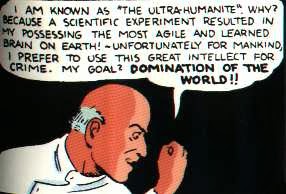
In 1939, the first supervillain appears on the scene – The Ultra-Humanite in Action Comics #13. The Ultra-Humanite represents the “opposite attracts” concept in comic book super-villainy – a physically powerful hero countered by a mentally powerful villain. The point here was simple – Superman can overpower anyone on Earth, but how will he fare against a superior mind? In other words – “how is he going to beat THIS guy?”

It strikes me that this lies at the heart of much of the monster creation in fantasy role playing games, especially during the old school phase when Arneson and Gygax and many others were building the foundation of what was to come. After the initial phase of dragons and balrogs, we begin getting into the weird Gygaxian ecology that includes rust monsters and lurkers above.

The idea was the same as above – the players have discovered tactics that work against bands of orcs and hordes of kobolds and fire-breathing dragons, but how will they defeat a monster against which metal is useless? How will they defeat monsters that drain levels every time they hit, monsters you dare not get close to? How will they defeat monsters who are resistant or even immune to magic spells? The monsters created by this process were weird and goofy and didn’t make the least bit of sense, because they weren’t monsters in the traditional sense, but rather puzzles disguised as monsters.

Okay, smarty pants – now what?

When I invent new monsters that are not based on creatures from myth or folklore (and sometimes even when they are), I try to make sure that that concept lies at the heart of what I’m doing – How do I force players to invent new tactics to overcome this new threat?

I think that what lies at the heart of what makes role playing games fun is the challenge they represent to the player, rather than the character. By forcing players outside of what is familiar, their interest is sparked and the game is more fun, even if at the same time they’re cursing you for your new innovation in killing their character. I think that at the heart of the game lies the basic puzzle of how do I overcome the challenge (monster/trap/riddle) to receive the prize (treasure/kiss/power).

When next you’re designing a new menace, or even if you’re using tried and true monsters, I suggest you put some thought into how this encounter will be different than all the other encounters your players have faced – what is the “gotcha” moment that will force the players to pause, give each other that worried glance, and then get their brains buzzing as they look for a solution. The treasure chest behind the monster is just a token, really – the real prize is the satisfaction of solving the puzzle the monster represents.

ACTION X is dead … Long live GRIT & VIGOR

Cover art by George Bellows

I tried. So help me I tried. But I just couldn’t get into the thing.

The idea was to do to the Modern SRD what I did with the fantasy SRD – i.e. turn it into a modern version of Blood & Treasure. The problem – I just couldn’t find the hook, the energy, the right feel that would make the thing gel. It’s tough to make something good if you don’t love it, you know.

And then the revelation.

I was musing on what kind of RPG Ron Swanson would play. I know – ridiculous – but an hour on a treadmill can send the mind into all sorts of odd places. Of course, the answer is that Ron Swanson wouldn’t play an RPG. He is, however, the closest thing modern America has to a folk hero, and symbolic of a movement by modern men to get in touch with their roots. I needed a subject that I found interesting, fun and inspirational – and by Ron Swanson’s mustache, the manly adventure of yesteryear was going to be it. Surviving in the wilds, steering tall ships, plunging into the mysterious corners of the globe in search of loot, hunkering down in a trench, preparing to dash into the oncoming bullets of the hun! – that was the ticket.

So, Action X is dead, may it rest in peace. I’m replacing it with GRIT & VIGOR – BOLD VENTURES FOR RUGGED FELLOWS. I’ve been writing the crap out of it for the last week, and think I can begin play-testing it on Google + in January and publishing it sometime in the Spring or Summer.

GRIT & VIGOR draws on the literature of Kipling, Conan-Doyle, Conrad, Hemingway, REH, London, Burroughs and their ilk. It’s about larger than life men going on adventures in search of money, power and freedom. Yes, women can play G&V – either as male characters (it is role playing, after all), or by flipping all the pronouns in the book from masculine to feminine – any woman worth her salt will do anything she likes with my game rules – she doesn’t need me to give her permission or molly-coddle her.

A FEW SPECIFICS

Characters, also called “rugged individualists” in G&V, do not belong to a permanent “class”. Special abilities, skills and weapon proficiencies are handled with feats. You get several at first level, many of them are rolled randomly on one of four tables meant to represent your character’s background (you can Go Rogue, Go to School, Go to Work or Go to war), though the referee could allow players to simply choose them if they preferred. All of the feats are given one of four classifications – Mental, Martial, Red-Blooded and Underhanded.

Whichever of those categories the majority of your character’s feats fall into determines your character’s “class” at that level, with their class determining what dice they roll for hit points, and what ability scores they can boost at levels 4, 8, 12, 16, etc. So, at 1st level, a character with mostly Martial feats is classed as a Fighter, and rolls 1d10 for hit points. By level 3, he may have more Red-Blooded feats than any other, so now he’s classed as a Daredevil that rolls d8 for hit points. Other than that, attack bonuses and saving throws are the same for everyone, though they are modified by ability scores and feats.

Combat, saving throws and task checks work as they do in Blood & Treasure, as do hit points, Armor Class, ability scores, etc. Aerial combat and vehicle rules will be included, of course. Psychic powers are included in the game, but are optional. For opponents, the game primarily uses animals and human beings, but a few monsters (vampires, werewolves, morlocks) are included as well for those who want a paranormal or science-fiction element in their game.

The game will also include what I’m calling an Almanac of Adventure. This will be a series of articles covering different time periods and genres that referees (Venture Masters) can use to build their campaigns. One might be “Wild West”, and will provide some tips and information relevant to that era, as well as any additional rules or equipment to run that setting. Another might be “Mystery”, and will discuss running mystery-oriented games. Hopefully you get the idea. There will also be “Steampunk”, “Atomic Super-Science”, “The Jazz Age”, etc.

I’d also like to include an element of taking the manly virtues expounded on in the game and applying them to one’s real life. Maybe XP awards for overcoming real life challenges that players can apply to their characters – a good chance for members of a gaming group to support one another outside the gaming table. Sounds corny, I guess, but I am corny so I don’t give a damn!

That’s the plan, ladies and gents. I’ll let you know when the playtesting is about to begin, in case you’d like to join in.

Getting Down With the Sickness

I don’t think I’ve ever been 100% satisfied with diseases in role playing games, not even with the rules in Blood & Treasure. This post is an attempt to create a system a bit more granular than most. In this system, diseases are not named, but rather are collections of random symptoms, with the number of symptoms and their severity based on the general severity of the disease.

THE BASICS

When struck with a disease, say from the bite of a rat, a prolonged stay in sewers (or a flophouse) or a biological trap, an adventurer must pass a Fortitude saving throw to avoid suffering any ill effects at all. This might represent a case where the contagion is simply not introduced to the character’s system, or it is introduced and the character’s immune system neutralizes it very quickly.

If this Fortitude save fails, the character is infected. First, we need to know the severity of the disease. The Treasure Keeper can either roll dice to determine severity, or base it on the hit dice of the monster that spread it or the level of the dungeon on which it was acquired.

D% (HD or LEVEL): SEVERITY (SYMPTOMS)
01-75 (0-4 HD): Minor Disease (1d3 minor symptoms)
76-90 (5-9 HD): Medium Disease (1d4 minor symptoms, 1d2-1 major symptoms)
91-100 (10+ HD): Major Disease (1d4 minor symptoms, 1d3 major symptoms)

Symptoms begin appearing within 1d4 days.

The Treasure Keeper should now roll 1d4 minus the sufferer’s Constitution bonus. This is the number of days before the sufferer’s immune system has a chance of defeating the disease. It is possible that the disease can be fought off before any symptoms begin to appear.

Each day, a victim of disease can roll a Fortitude saving throw to attempt to throw off one symptom, usually the most severe, but in any event a symptom of the player’s choice. If the player is successful, that symptom is removed.

If the diseased character is active (i.e. not getting plenty of rest), they suffer a -2 penalty on this save.

All characters that spend time around the diseased character have a percentage chance each day to be exposed to disease. This percentage chance is based on the number of type of symptoms, with a 10% chance per minor symptom and a 5% chance per major symptom. Naturally, the non-diseased character is permitted a Fortitude save to avoid actually contracting the disease.

Note: If you want to give a more supernatural feel to diseases, you can rule that any adventurer who dies from a disease and is not burned or buried in consecrated ground rises as an undead with Hit Dice roughly equal to the number of levels they had in life.

MINOR SYMPTOMS (ROLL 3d6)

3. Exhaustion4. Fever, severe
5. Rash, major
6. Dementia
7. Rash, minor
8. Aches
9. Cough
10. Diarrhea
11. Fatigue
12. Fever, low-grade
13. Sickened
14. Stuffy head/runny nose/sneeze
15. Swollen joints, minor
16. Shooting pains
17. Spasms
18. Swollen joints, major

Aches
The character is possessed of aches in the muscles and joints and suffers a -1 penalty to attacks, Armor Class and Reflex saving throws (including task checks).

Cough
Roll 1d4 for severity; this is the chance on 1d6 per hour that your coughing attracts a wandering monster. After any major exertion (running, fighting, climbing more than 10 feet) you are fatigued until resting 10 minutes.

Dementia
The character is unsteady on his feet. When moving at more than half speed or fighting, he must pass a Reflex save each round to avoid falling prone for 1d4 points of damage. Whenever he is forced to concentrate on spell casting, he must pass a Will save to successfully cast the spell. The character suffers a -1 penalty on all Reflex and Will saves (including task checks).

Diarrhea
Not for the faint of heart. You suffer intestinal distress every 1d6 x 10 minutes and need to find a private place to deal with the problem. If you are not drinking a double ration of water, you suffer 1 point of Constitution damage per day due to dehydration.

Exhaustion
An exhausted character moves at one-quarter normal speed, suffers a -1 penalty to saving throws and task checks and her foes enjoy two tactical advantages against her in combat.

Fatigue
Per the normal rules for this condition in Blood & Treasure.

Fever, Low-grade
The character has a low-grade fever and suffers a -1 penalty to Will saving throws (including task checks). He also requires twice the normal daily ration of water. Failure to hydrate properly results in 1 point of Constitution damage each day.

Fever, Severe
The character has a severe fever and suffers a -3 penalty to Will saving throws (including task checks). He requires twice the normal daily ration of water. Failure to hydrate properly results in 1 point of Constitution damage each day. Finally, the fever causes hallucinations. Each hour, the character must pass a Will save or be struck with the equivalent of the confusion spell for 1d6 x 10 minutes.

Rash, Minor
The character suffers from a minor rash over a small portion of her body and suffers a -1 penalty to attacks, Armor Class and Reflex saving throws (including task checks) due to the discomfort. Each day, the character must pass a Fortitude save to avoid scratching and turning the minor rash into a major rash.

Rash, Major
The character suffers from a major rash over a large portion of her body and suffers a -2 penalty to attacks, Armor Class, Reflex saving throws (including task checks) due to the discomfort and a -2 penalty to Charisma-related task checks due to the physical marring. Each day, the character must pass a Fortitude save to avoid scratching and suffering 1 point of Charisma drain for permanent scarring.

Shooting Pains
The character suffers fierce, shooting pains. She suffers a -2 penalty to attacks, Armor Class and Reflex saving throws (including task checks). Whenever she is forced to concentrate on spell casting, she must pass a Will save to successfully cast the spell. The character suffers a -1 penalty on all Reflex and Will saves (including task checks).

Sickened
Per the normal rules for this condition in Blood & Treasure.

Spasms
The character suffers random severe muscle spasms. This translates as a tactical advantage for his foes in combat, a -1 penalty to Reflex saving throws (including task checks) and a requirement to pass a Reflex save each time he is walking on a precarious surface to avoid falling.

Stuffy Head/Runny Nose/Sneeze
You suffer a 1 in 6 chance per hour that your sniffling and nose blowing attracts a wandering monster. Any exposure to copious amounts of dust, pollen, molds and the like force you to pass a Fortitude saving throw or begin a sneezing fit that last 1d4 minutes, delaying the party and attracting a wandering monster on a roll of 1-2 on 1d6.

Swollen Joints, Minor
Minor swelling in the joints reduces movement by 5, grants the sufferer’s foes a tactical advantage in combat and imposes a -1 penalty to Reflex saves (including task checks).

Swollen Joints, Major
Major swelling in the joints reduces movement by 10, grants the sufferer’s foes a tactical advantage in combat and imposes a -3 penalty to Reflex saves (including task checks).

MAJOR SYMPTOMS (Roll 1d6)

1. Blood poisoning
2. Coma
3. Immune system attacked
4. Internal bleeding
5. Muscle damage
6. Nerve damage

Blood Poisoning
The disease is attacking the character’s blood. Each day the character must pass a Fortitude saving throw or suffer 1d6 points of Constitution damage. At 0 Constitution, the character dies.

Coma
The character falls into a deep, comatose slumber. While in a coma, she heals ability score damage at twice the normal rate and enjoys a +1 bonus to save vs. the other symptoms of her disease. After three days, the comatose character can begin making daily Will saving throws to come out of the coma. If three of these Will saves are failed, the coma becomes a permanent condition and can only be removed with a restoration, miracle or wish spell.

Immune System Attacked
The disease attacks the characters immune system, imposing a -2 penalty to all saves vs. disease (including saves against symptoms of disease).

Internal Bleeding
The character is bleeding internally, suffering 1d6 points of hit point damage and 1d6 points of Constitution damage each day that a Fortitude saving throw is failed. At 0 Constitution, the character dies.

Muscle Damage
Each day the character must pass a Fortitude saving throw or suffer 1d6 points of Strength damage. If the character reaches 0 points of Strength, she is paralyzed and dies in 1d6 hours.

Nerve Damage
Each day the character must pass a Fortitude saving throw or suffer 1d6 points of Dexterity damage. If the character is reduced to 0 Dexterity, he is paralyzed and dies in 1d6 hours.

NEW SPELLS

This disease system suggests a few new spells:

SUPPRESS SYMPTOM
Level: Cleric 1, Druid 1, Ranger 1
Range: Touch
Duration: 24 hours

This spell suppresses a single symptom of a disease for 24 hours.

CURE SYMPTOM
Level: Cleric 2, Druid 2, Ranger 2
Range: Touch
Duration: Instantaneous

This spell completely removes one symptom from a diseased character.

VIRULENCE
Level: Cleric 2, Druid 2
Range: Close
Duration: 24 hours

This spell makes all diseases within close range more virulent for 24 hours. All who suffer from these diseases suffer a -1 penalty on all saving throws against the disease, and the chance of exposure to the disease for others is doubled.
B is for Barbarian II: The Improvening

Oh yeah, it’s already time for the second edition of B is for Barbarian! A few things occurred to me since yesterday:

I. COMBAT

I think the combat table would work better if it compared attacker skill to defender skill:

Armor: With this matrix, armor provides an armor save, as follows:

  • Leather Armor/Thick Skin: Avoid losing a life on a roll of 6 on 1d6
  • Chainmail/Thick Scales: Avoid losing a life on a roll of 5-6 on 1d6
  • Platemail: Avoid losing a life on a roll of 4-6 on 1d6
  • Magic Armor: Avoid losing a life on a roll of 3-6 on 1d6

Mounted Combat: It was also pointed out that an attacker on horseback should get a bonus. Let’s turn that around – fighting a mounted attacker while on foot will count as “fighting from an awkward position”, and thus degrade the attack ability of the person on foot.

Reach: One might also consider fighting somebody with better reach, either because they are larger (like a giant) or because they have a longer melee weapon fighting from an awkward position. In this case, when fighting somebody with a longer weapon, your first successful attack can be counted as disarming them rather than taking away one of their lives.

II. Companions

A few additional companions occurred to me:

Eagle/Falcon/Hawk: A bird of prey serves you loyally. It fights as a beast and has 2 lives. It also has Eagle Eyes and can fly, which is pretty sweet.

Panther/Lion/Tiger: This can either be a big cat or a mysterious, dark woman who can turn into a big cat. It fights as a beast and has 5 lives. It has Cat-Like Reflexes and can Intimidate.

Giant: Not a real giant, just a huge warrior played by Richard Kiel or Wilt Chamberlain. Skilled fighter with 7 lives and armed with leather armor and a maul. Can Intimidate.

Ninja: What the heck, it’s the 80’s! The ninja is a skilled fighter with 5 lives armed with a sword and shuriken (treat as chakram). Can fight like a Whirlwind and has Cat-Like Reflexes.

If anything else occurs to me, I’ll release the 3rd edition.