On Magic-Users and Illusionists – Part Two

Here are the rest of the illusionist spells. All of these spells are released as Open Game Content.

Level 5

  1. Dream
  2. False Vision
  3. Mass Suggestion
  4. Nightmare
  5. Persistent Image
  6. Seeming
  7. Shadow Evocation

Dream

Level: 5

Range: Unlimited

Duration: See text

You, or a messenger touched by you, sends a phantasmal message to others in the form of a dream. At the beginning of the spell, you must name the recipient or identify him or her by some title that leaves no doubt as to identity. The messenger then enters a trance, appears in the intended recipient’s dream, and delivers the message. The message can be of any length, and the recipient remembers it perfectly upon waking. The communication is one-way. The recipient cannot ask questions or offer information, nor can the messenger gain any information by observing the dreams of the recipient.

False Vision

Level: 5

Range: Touch

Duration: 1 hour per level

Any scrying spell used to view anything within the area of this spell instead receives a false image, as defined by you at the time of casting. As long as the duration lasts, you can concentrate to change the image as desired. While you aren’t concentrating, the image remains static.

Mass Suggestion

Level: 5

Range: 150 ft

This spell functions like suggestion, except that it affects one creature per level. The same suggestion
applies to all these creatures.

Nightmare

Level: 5

Range: Unlimited

Duration: Instantaneous

You send a hideous and unsettling phantasmal vision to a specific creature that you name or otherwise specifically designate. The nightmare prevents restful sleep and causes 1d10 points of damage. The nightmare leaves the subject unable to regain magic-user spells for the next 24 hours. Dispel evil cast on the subject while you are casting the spell dispels the nightmare and causes you to be stunned for 10 minutes per caster level of the dispel evil.

Persistent Image

Level: 5

Duration: 1 minute per level

This spell functions like phantasmal force, except for the duration. The figment follows a script determined by you and without your having to concentrate on it.

Seeming

Level: 5

Range: 50 ft

Duration: 12 hours

This spell functions like change self, except that you can change the appearance of other people as well. The spell can affect one creature per two levels of the illusionist. Affected creatures resume their normal appearances if slain. Unwilling targets can negate the spell’s effect on them by making a saving throw.

Shadow Evocation

Level: 5

Range: See text

Duration: See text

You use shadows to cast a quasi-real, illusory version of one of the following magic-user spells: Magic Missile, Shocking Grasp, Fireball, Lightning Bolt, Ice Storm, Wall of Fire or Wall of Ice.

Spells that deal damage have normal effects unless an affected creature succeeds on a saving throw. Each disbelieving creature takes only one-fifth damage from the attack. If the disbelieved attack has a special effect other than damage, that effect is one-fifth as strong (if applicable) or only 20% likely to occur. Nondamaging effects have normal effects except against those who disbelieve them. Against disbelievers, they have no effect.

Level 6

  1. Irresistible Dance
  2. Mislead
  3. Permanent Image
  4. Programmed Image
  5. Project Image *
  6. Shadow Walk
  7. Veil

Irresistible Dance

Level: 6

Range: Touch

Duration: 1d4+1 rounds

The subject feels an undeniable urge to dance and begins doing so, complete with foot shuffling and tapping. The spell effect makes it impossible for the subject to do anything other than caper and prance in place. The effect imposes a -2 penalty to Armor Class and a -5 penalty on saving throws and it negates any AC bonus granted by a shield the target holds.

Mislead

Level: 6

Range: 60 ft

Duration: 1 round per level and concentration + 3 rounds (see text)

You become invisible (as greater invisibility) and at the same time an illusory double of you (as phantasmal force) appears. You are then free to go elsewhere while your double moves away. The double moves as you direct it (which requires concentration beginning on the first round after the casting). You can make the double appear superimposed perfectly over your own body so that observers don’t notice an image appearing and you turning invisible. You and the figment can then move in different directions. The double moves at your speed and can talk and gesture as if it were real, but it cannot attack or cast spells, though it can pretend to do so.

The illusory double lasts as long as you concentrate upon it, plus 3 additional rounds. After you cease concentration, the illusory double continues to carry out the same activity until the duration expires. The invisibility
lasts for 1 round per level, regardless of concentration.

Permanent Image

Level: 6

Duration: Permanent

This spell functions like phantasmal force except that the illusion is permanent.

Programmed Image

Level: 6

Duration: Permanent until triggered, then 1 round per level

This spell functions like phantasmal force, except that this spell activates when a specific condition occurs. The event that triggers the illusion can be as general or as specific and detailed as desired but must be based on an audible, tactile, olfactory, or visual trigger. The trigger cannot be based on a quality that is not normally obvious to the senses, such as one’s philosophical or ethical stance.

Shadow Walk

Level: 6

Range: Touch

Duration: 1 hour per level

You and any creature you touch are then transported along a coiling path of shadows to the edge of the Material Plane where it borders the Plane of Shadows. The effect is largely illusory, but the path is quasi-real. You can take more than one creature along with you (subject to your level limit), but all must be touching each other.

In the region of shadow, you move at a rate of 50 miles per hour, moving normally on the borders of the Plane of Shadow but much more rapidly relative to the Material Plane. Thus, you can use this spell to travel rapidly by stepping onto the Plane of Shadow, moving the desired distance, and then stepping back onto the Material Plane.

Veil

Level: 6

Range: 600 ft

Duration: Concentration + 1 hour per level

You instantly change the appearance of the subjects and then maintain that appearance for the spell’s duration. You can make the subjects appear to be anything you wish. The subjects look, feel, and smell just like the creatures the spell makes them resemble. Affected creatures resume their normal appearances if slain. Unwilling targets can negate the spell’s effect on them by making saving throws. Those who interact with the subjects can attempt disbelief saving throws to see through the illusion, but magic resistance doesn’t help.

Level 7

  1. Greater Shadow Conjuration
  2. Mass Invisibility *
  3. Maze *
  4. Simulacrum *

Greater Shadow Conjuration

Level: 7

This spell functions like shadow conjuration, except that it can duplicate any magic-user conjuration or summoning spell of 6th level or lower. The illusory conjurations created deal three-fifths (60%) damage to nonbelievers, and non-damaging effects are 60% likely to work against nonbelievers.

Level 8

  1. Greater Shadow Evocation
  2. Permanency *
  3. Scintillating Pattern
  4. Screen

Scintillating Pattern

Level: 8

Range: 60 ft

Duration: Concentration + 2 rounds

A twisting pattern of discordant, coruscating colors weaves through the air, affecting creatures within it. The spell affects a total number of Hit Dice of creatures equal to your caster level within a 20-ft sphere. The spell affects each subject according to its Hit Dice.

6 HD or less:
Unconscious for 1d4 rounds, then stunned for 1d4 rounds, and then confused
for 1d4 rounds.

7 to 12 HD:
Stunned for 1d4 rounds then confused
for 1d4 rounds.

13 or more HD:
Confused
for 1d4 rounds.

Screen

Level: 8

Range: 60 ft

Duration: 24 hours

This spell combines several elements to create a powerful protection from scrying and direct observation. When casting the spell, you dictate what will and will not be observed in the spell’s area. The illusion created must be stated in general terms. Once the conditions are set, they cannot be changed.

Attempts to scry the area automatically detect the image stated by you with no save allowed. Sight and sound are appropriate to the illusion created. Direct observation may allow a save (as per a normal illusion), if there is cause to disbelieve what is seen. Even entering the area does not cancel the illusion or necessarily allow a save, assuming that hidden beings take care to stay out of the way of those affected by the illusion.

Greater Shadow Evocation

Level: 8

This spell functions like shadow evocation, except that it enables you to create partially real, illusory versions of the following magic-user spells: Cloudkill, Death Spell, Delayed Blast Fireball, Disintegrate, Wall of Iron or Wall of Stone. If recognized as a greater shadow evocation, a damaging spell deals only three-fifths (60%) damage.

Level 9

  1. Prismatic Sphere *
  2. Shades
  3. Weird

Shades

Level: 9

This spell functions like shadow conjuration, except that it mimics magic-user conjuration and summoning spells of 8th level or lower. The illusory conjurations created deal four-fifths (80%) damage to nonbelievers, and non-damaging effects are 80% likely to work against nonbelievers.

Weird

Level: 9

This spell functions like phantasmal killer, except it can affect any number of creatures, no two of which can be more than 30 feet apart. If a subject’s saving throw succeeds, it still takes 3d6 points of damage and is stunned for 1 round. The subject also temporarily loses 1d4 points of strength.
On Magic-Users and Illusionists – Part One

This post is released as Open Game Content.

THE MAGIC-USER

The magic-user is a mysterious figure, a student of arcane powers and spell casting. Usually cloaked in robes woven with mystical symbols, magic-users can be devastating opponents. However, they are usually physically weaker than other adventuring classes, and are untrained in the use of armor and weapons. As magic-users progress in level, they generally become the most powerful of the character classes. Perhaps one day, though, you will rise to such heights of power that you can build a mystically protected tower for your researches, create fabulous magic items, and scribe new formulae for hitherto unknown spells. Such arch-mages can sway the politics of kingdoms, and command respect and fear across the realms.

Prime Attribute: Intelligence, 13+ (+5% experience)

Hit Dice: 1d6-1 (Gains 1 hp/level after 9th level.)

Armor/Shield Permitted: None.

Weapons Permitted: Club, dagger, staff, and darts.

SPELLS (1st): A magic-user casts arcane spells. Each magic-user can cast a limited number of spells from each spell level per day. The table below lists the number of spells per day a magic-user may cast of each spell level. For example, a fifth level magic-user can cast four 1st level spells, two 2nd level spells, and one 3rd level spell. A magic-user must prepare spells before casting them by studying from a spell book. While studying, the magic-user decides which spells to prepare.

The magic-user keeps his spells in a spell book, or grimoire. The number of spells that a magic-user has in his spell book at the beginning of play is up to the Referee, but usually includes read magic, plus three additional spells – one offensive, one defensive and one practical.

Spells Per Day (By Spell Level)

Level Experience

Hit Dice

Attack

Save

Title

1

2

3

4

5

6

1 0

1

+0

15

Adept

1

2 2,500

2

+0

14

Soothsayer

2

3 5,000

3

+0

13

Evocator

2

1

4 10,000

4

+1

12

Mage

3

2

5 20,000

5

+1

11

Spellbinder

4

2

1

6 40,000

6

+2

10

Enchanter

4

2

2

7 65,000

7

+2

9

Marvel

4

3

2

1

8 95,000

8

+3

8

Archimage

4

3

3

2

9 135,000

9

+3

7

Wizard

4

3

3

2

1

10 190,000

+1

+4

6

Wizard

4

4

3

2

2

11 285,000

+2

+5

5

Wizard

4

4

4

3

3

12 385,000

+3

+5

4

Wizard

4

4

4

4

4

1

The Illusionist Sub-Class

The illusionist is a sub-class of magic-user that specializes in illusions. Illusionists are tricksters and charlatans. Illusionists tend to make their homes not in isolated towers but in towns, where there are people on whom they can practice their art. A high-level illusionist might open an emporium or found a traveling wonder show, attracting young apprentices with a yen for trickery. Where magic-users are scholarly, illusionists have an artistic temperament. They are often “bohemians” and may be agents of chaos and freedom, confidence men looking to make a dishonest gold piece, or even philosophers attempting to grasp the true meaning of reality.

Prime Attribute: Intelligence & Charisma, 13+ (+5% experience)

Hit Dice: 1d6-1 (Gains 1 hp/level after 9th level.)

Armor/Shield Permitted: None.

Weapons Permitted: Club, dagger, staff, and darts.

SPELLS (1st): An illusionist casts spells from the illusionist spell list. Each illusionist knows a limited number of spells from each spell level. These spells are learned through practice and invention, and new “spells known” gained via level advancement are gained without study or expense.

Unlike a traditional magic-user, the illusionist does not have to prepare spells each day before casting them. When an illusionist casts a spell from her repertoire, she must pay for it with spell points. A spell costs a number of spell points equal to its level. The chart below shows how many spell points the illusionist has at each level.

SHARP SENSES (1st): An illusionist’s innate ability to perceive the real from the unreal imparts a +1 bonus to all saving throws against illusions.

SILVER TONGUE (1st): Using her natural charisma and a bit of fast talking, the illusionist is a capable manipulator of people. Potential victims of the illusionist’s silver tongue receive a saving throw to see through her. If the saving throw is successful, apply a -2 penalty to reaction rolls with the NPC. If the saving throw fails, apply a +2 bonus to reaction rolls with the NPC.

Spells Known (By Spell Level)

Level Experience

Hit Dice

Attack

Save

SP

Title

1

2

3

4

5

6

1 0

1

+0

15

2

Quacksalver

2

2 2,600

2

+0

14

3

Humbug

2

3 5,200

3

+0

13

5

Prestidigitator

3

1

4 12,000

4

+1

12

9

Mountebank

4

2

5 24,000

5

+1

11

12

Pharisee

5

2

1

6 48,000

6

+2

10

15

Tregatour

5

3

2

7 70,000

7

+2

9

21

Charlatan

5

3

2

1

8 100,000

8

+3

8

28

Virtuoso

5

3

3

2

9 140,000

9

+3

7

33

Illusionist

6

4

3

2

1

10 195,000

+1

+4

6

42

Illusionist

6

4

4

3

2

11 290,000

+2

+5

5

51

Illusionist

6

4

4

3

3

12 400,000

+3

+5

4

66

Illusionist

6

5

5

4

4

1

Illusionist Spell List

* Indicates an existing magic-user spell

Level 1

  1. Change Self
  2. Color Spray
  3. Dancing Lights
  4. Daze
  5. Flare
  6. Ghost Sound
  7. Hideous Laughter
  8. Hypnotism
  9. Prestidigitation
  10. Silent Image
  11. Ventriloquism
  12. Wizard Mark

CHANGE Self

Level: 1

Range: Personal

Duration: 10 minutes per level

You make yourself, including your equipment, look different. You can seem 1 foot shorter or taller, thin, fat, or in between. You cannot change your body type. Otherwise, the extent of the apparent change is up to you.

COLOR SPRAY

Level: 1

Range: 15 ft cone

Duration: Instantaneous

A vivid cone of clashing colors springs forth from your hand. Each creature within the cone is affected according to its Hit Dice. Creatures with 2 HD or less is knocked unconscious for 2d4 rounds, then blinded and stunned for 1d4 rounds and then stunned for 1 round. Creatures with 3 or 4 HD are blinded and stunned for 1d4 rounds, then stunned for 1 round. Creatures with 5 or more HD are stunned for 1 round. Sightless creatures are not affected by color spray.

DANCING LIGHTS

Level: 1

Range: 150 ft

Duration: 1 minute

You create up to four lights that resemble lanterns or torches (and cast that amount of light), or up to four glowing spheres of light (which look like will-o’-wisps), or one faintly glowing, vaguely humanoid shape. The dancing lights
must stay within a 10-foot-radius area in relation to each other but otherwise move as you desire. The lights can move up to 100 feet per round. A light winks out if the distance between you and it exceeds the spell’s range.

DAZE

Level: 1

Range: 30 ft

Duration: 1 round

You cloud the mind of a humanoid creature with 4 or fewer Hit Dice so that it takes no actions for 1 round.

Flare

Level: 1

Range: 30 ft

Duration: Instantaneous

This spell creates a burst of light. If you cause the light to burst directly in front of a single creature, that creature is blinded for 1 minute unless it makes a successful saving throw.

Ghost Sound

Level: 1

Range: 30 ft.

Duration: 1 round per level

Ghost sound
allows you to create a volume of sound that rises, recedes, approaches, or remains at a fixed place. You choose what type of sound ghost sound
creates when casting it and cannot thereafter change the sound’s basic character.

Hideous Laughter

Level: 1

Range: 30 ft

Duration: 1 round per level

This spell afflicts the sentient subject with uncontrollable laughter. The subject can take no actions while laughing, but is not considered helpless. After the spell ends, it can act normally.

Hypnotism

Level: 1

Range: 30 ft.

Duration: 2d4 rounds

Your gestures and droning incantation fascinate nearby creatures, causing them to stop and stare blankly at you. In addition, you can use their rapt attention to make your suggestions and requests seem more plausible. Roll 2d4 to see how many total Hit Dice of creatures you affect. Creatures with fewer HD are affected before creatures with more HD. Only creatures that can see or hear you are affected, but they do not need to understand you to be fascinated.

Prestidigitation

Level: 1

Range: 10 ft

Duration: 1 hour

Prestidigitations are minor tricks that novice spell casters use for practice. Once cast, a prestidigitation
spell enables you to perform simple magical effects for 1 hour. The effects are minor and have severe limitations. A prestidigitation can slowly lift 1 pound of material. It can color, clean, or soil items in a 1-foot cube each round. It can chill, warm, or flavor 1 pound of nonliving material. It cannot deal damage or affect the concentration of spell casters. Prestidigitation
can create small objects, but they look crude and artificial. The materials created by a prestidigitation
spell are extremely fragile, and they cannot be used as tools, weapons, or spell components. Finally, a prestidigitation
lacks the power to duplicate any other spell effects. Any actual change to an object (beyond just moving, cleaning, or soiling it) persists only 1 hour.

Silent Image

Level: 1

Range: 600 ft

Duration: Concentration

This spell creates the visual illusion of an object, creature, or force, as visualized by you. The illusion does not create sound, smell, texture, or temperature. You can move the image within the limits of the size of the effect.

Ventriloquism

Level: 1

Range: 30 ft

Duration: 1 minute per level

You can make your voice (or any sound that you can normally make vocally) seem to issue from someplace else.

WIZARD Mark

Level: 1

Duration: Permanent

This spell allows you to inscribe your personal rune or mark, which can consist of no more than six characters. The writing can be visible or invisible. An arcane mark
spell enables you to etch the rune upon any substance without harm to the material upon which it is placed. If an invisible mark is made, a detect magic
spell causes it to glow and be visible, though not necessarily understandable.

Level 2

  1. Blur
  2. Darkness, 15 ft Radius *
  3. Hypnotic Pattern
  4. Invisibility *
  5. Magic Mouth *
  6. Mirror Image *
  7. Misdirection
  8. Phantasmal Force *
  9. Silence, 15 ft Radius *
  10. Suggestion *

Blur

Level: 2

Range: Touch

Duration: 1 minute per level

The subject’s outline appears blurred, shifting and wavering. This distortion grants the subject a +4 bonus to Armor Class against opponents with sight.

Hypnotic Pattern

Level: 2

Range: 150 ft

Duration: Concentration + 2 rounds

A twisting pattern of subtle, shifting colors weaves through the air, fascinating creatures within it. This spell works like hypnotism, except it lasts for as long as the illusionist concentrates, plus 2 rounds after.

Misdirection

Level: 2

Range: 30 ft

Duration: 1 hour per level

You misdirect the information from divination spells that reveal auras (detect evil, detect magic, discern lies,
and the like). On casting the spell, you choose another object within range. For the duration of the spell, the subject of misdirection
is detected as if it were the other object, with no saving throws allowed.

Level 3

  1. Blink
  2. Detect Invisibility *
  3. Dispel Illusion (as dispel magic, but only works against illusions)
  4. Displacement
  5. Enthrall
  6. Illusory Script
  7. Invisibility, 10 ft Radius *

Blink

Level: 3

Range: Personal

Duration: 1 round per level

You “blink” back and forth between the Material Plane and the Ethereal Plane. You look as though you’re winking in and out of reality very quickly and at random. Physical attacks against you are at a -5 penalty. If the attacker can hit ethereal creatures or see invisible creatures, the “to hit” penalty is reduced to -2. Spells that target you fail to work on you 50% of the time, and spells cast by you have a 20% chance of not working. You take half damage from area attacks and falling, and you gain a +2 bonus to hit in combat.

Displacement

Level: 3

Range: Touch

Duration: 1 round per level

The subject of this spell appears to be about 2 feet away from its true location. The creature benefits from a 50% miss chance on attacks.

Enthrall

Level: 3

Range: 150 ft

Duration: 1 hour or less

If you have the attention of a group of creatures, you can use this spell to hold them spellbound. To cast the spell, you must speak or sing without interruption for 1 round. Thereafter, those affected give you their undivided attention, ignoring their surroundings. They are considered to be friendly while under the effect of the spell. Any potentially affected creature of a race or religion unfriendly to yours gets a +2 bonus on the saving throw.

A creature with 4 or more HD or with a wisdom score of 15 or higher remains aware of its surroundings and remains indifferent. It gains a new saving throw if it witnesses actions that it opposes.

The effect lasts as long as you speak or sing, to a maximum of 1 hour. Those enthralled
by your words take no action while you speak or sing and for 1d3 rounds thereafter while they discuss the topic or performance. Those entering the area during the performance must also successfully save or become enthralled. The speech ends (but the 1d3-round delay still applies) if you lose concentration or do anything other than speak or sing.

If those not enthralled
have unfriendly or hostile attitudes toward you, they can collectively make a saving throw to try to end the spell by jeering and heckling. The heckling ends the spell.

If any member of the audience is attacked or subjected to some other overtly hostile act, the spell ends and the previously enthralled
members become immediately unfriendly toward you. Each creature with 4 or more HD or with a wisdom score of 15 or higher becomes hostile.

Illusory Script

Level: 3

Range: Touch

Duration: One day per level

You write instructions or other information on parchment, paper, or any suitable writing material. The illusory script
appears to be some form of foreign or magical writing. Only the person (or people) designated by you at the time of the casting are able to read the writing; it’s unintelligible to any other character, although an illusionist recognizes it as illusory script.

Any unauthorized creature attempting to read the script triggers a potent illusory effect and must make a saving throw. A successful saving throw means the creature can look away with only a mild sense of disorientation. Failure means the creature is subject to a suggestion implanted in the script by you at the time the illusory script spell was cast. The suggestion lasts only 30 minutes.

Level 4

  1. Confusion *
  2. Greater Invisibility
  3. Hallucinatory Terrain *
  4. Illusory Wall
  5. Phantasmal Killer
  6. Rainbow Pattern
  7. Shadow Conjuration
  8. Zone of Silence

Greater Invisibility

Level: 4

Duration: 1 round per level

This spell functions like invisibility, except that it doesn’t end if the subject attacks.

Illusory Wall

Level: 4

Range: 50 ft

Duration: Permanent

This spell creates the illusion of a wall, floor, ceiling, or similar surface. It appears absolutely real when viewed, but physical objects can pass through it without difficulty.

Phantasmal Killer

Level: 4

Range: 150 ft

Duration: Instantaneous

You create a phantasmal image of the most fearsome creature imaginable to the subject. Only the spell’s subject can see the phantasmal killer. You see only a vague shape. The target first gets a saving throw to recognize the image as unreal. If that fails, the phantasm touches the subject and the subject must succeed on a saving throw or die from fear. Even if the saving throw is successful, the subject takes 3d6 points of damage. If the subject of a phantasmal killer
attack succeeds in disbelieving and is wearing a helm of telepathy or is a psychic with the telepathy power, the beast can be turned upon you. You must then disbelieve it or become subject to its deadly fear attack.

Rainbow Pattern

Level: 4

Range: 150 ft

Duration: Concentration + 1 round per level

A glowing, rainbow-hued pattern of interweaving colors fascinates those within it. Rainbow pattern fascinates a maximum of 24 Hit Dice of creatures. An affected creature that fails its saves is fascinated by the pattern. With a simple gesture, you can make the rainbow pattern move up to 30 feet per round, moving its effective point of origin. All fascinated creatures follow the moving rainbow of light, trying to get or remain within the effect. Fascinated creatures who are restrained and removed from the pattern still try to follow it. If the pattern leads its subjects into a dangerous area each fascinated creature gets a second saving throw. If the view of the lights is completely blocked creatures who can’t see them are no longer affected.

Shadow Conjuration

Level: 4

Range: See text

Duration: See text

You use shadows to shape quasi-real illusions of one or more creatures, objects, or forces. Shadow conjuration can mimic any magic-user conjuration or summoning spell of 3rd level or lower. Shadow conjurations are 20% as strong as the real things, though creatures who believe the shadow conjurations to be real are affected by them at full strength. Any creature that interacts with the conjured object, force, or creature can make a saving throw to recognize its true nature. Spells that deal damage have normal effects unless the affected creature succeeds on a saving throw. Each disbelieving creature takes only 20% damage from the attack. If the disbelieved attack has a special effect other than damage, that effect is only 20% likely to occur.

A shadow creature has one-fifth the hit points of a normal creature of its kind (regardless of whether it’s recognized as shadowy). It deals normal damage and has all normal abilities and weaknesses. Against a creature that recognizes it as a shadow creature, however, the shadow creature’s damage is one-fifth (20%) normal, and all special abilities that do not deal lethal damage are only 20% likely to work. (Roll for each use and each affected character separately.) Furthermore, the shadow creature’s AC bonuses (i.e. points of Armor Class better than 9 [10]).are one-fifth as large.

A creature that succeeds on its save sees the shadow conjurations as transparent images superimposed on vague, shadowy forms.

Zone of Silence

Level: 4

Range: Personal

Duration: 1 hour per level

By casting zone of silence, you manipulate sound waves in your immediate vicinity so that you and those within the spell’s area can converse normally, yet no one outside can hear your voices or any other noises from within. This effect is centered on you and moves with you. Anyone who enters the zone immediately becomes subject to its effects, but those who leave are no longer affected.

On the Beastmen of Nabu – Part Three

Two more beastmen round out the blog series. Click to read Part I and Part II. The final article that will appear in NOD #3 will include cattle people, horse people, monkey people, raven people and swine people.

Aigosy (Goat People)
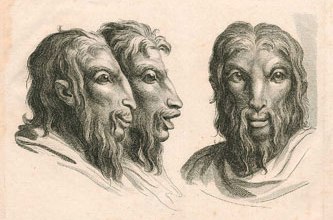
The aigosy are an eccentric race of mystics who dwell in irregularly shaped, or stepped, towers made of sun-dried bricks. Aigosy men always cultivate beards, sometimes small and neat, often curly and tangled, and all aigosy have thick, tangled hair that is usually black. Aigosy are tan to dusky in complexion and have long, flat noses. They traditionally wear felt skullcaps with small felt horns on them, rough tunics, cloaks and leggings and thick leather sandals. Aigosy have little use for jewelry, but do appreciate colored beads, especially glass beads, and often wear strings of them as necklaces and bracelets. Aigosy warriors wear ring mail under their robes and carry shields covered with leather and such weapons as flails, maces and slings. Most aigosy carry a set of pan-pipes.

An aigosy village consists of a dozen or so “towers”, each housing anywhere from three to seven aigosy. Aigosy men and women do not marry, and often do not even live together. Children are raised by the community, with the men cuffing any child that gets out of hand and women, after nursing, doing their best to mother any child within reach. The towers are decorated simply, with the most noticeable articles of furniture being the tall stools and chairs that they prefer. Each aigosy community has a large oven in which they bake their daily bread; flat loaves decorated with seeds in mystic patterns.

The aigosy live by herding goats and sheep and growing a few crops. Rugged and tough, the aigosy have an amazing ability to grow crops in very difficult environments. For this reason, they are considered lucky by many farmers, and should a family of aigosy wish to establish themselves on the fringes of a human settlement, they are usually welcomed (though not too warmly, for they are known to be a bit odd and disruptive).

The aigosy are unflappable, ignoring danger and keeping their cool in just about every situation except being near attractive members of the opposite sex. The truth is, the aigosy are a bit lecherous. They are also eccentric in their speech and manners. They have a cackling laughter that is more unnerving than contagious, and their eyes never seem quite right. They enjoy pondering things over, smoking a clay pipe and, if male, pulling on their beards. When they finally come to a decision, they become a flurry of excited activity.

Racial Characteristics: Aigosy are natural climbers, climbing very difficult surfaces on the roll of 1-2 on 1d6, and rarely failing to climb a surface that provides even small hand and foot holds. They enjoy a +1 bonus on saving throws against spells and effects that affect the mind (i.e. fear, charm, etc). An aigosy’s iron stomach allows them to digest just about anything and makes them more resistant (+2 bonus on saving throws) to poison and disease from ingested articles.

Aigosy Racial Class
The aigosy are often considered to be wild-eyed mystics and, frankly, weirdos. They come by their odd mannerisms honestly, though, for most aigosy are born with what one might call “fairy-sight”. Many aigosy can see spirits and can glimpse the future and past. Besides the racial characteristics mentioned above, a member of th aigosy racial class also gains some spell casting ability and the ability to see spirits.

Prime Requisite: Wisdom (13+ gets +5% bonus to earned experience).
Hit Dice: 1d6 (+2 hit points per level after 9th).
Weapons Permitted: Club, dart, mace, sling, staff.
Armor Permitted: Leather and shields.

Spells: Aigosy can cast divination spells in the same manner that clerics cast spells (i.e. they do not need spellbooks).

Level 1: Comprehend Languages*, Deathwatch*, Detect Evil, Detect Magic, Detect Secret Doors*, Detect Snares & Pits*, Detect Poison*, Detect Undead*, Hide from Undead*, Identify*, True Strike*

Level 2: Augury*, Detect Invisibility, ESP, Find Traps, Locate Object, Speak with Animals, Status*

Level 3: Clairaudience, Clairvoyance, Darkvision, Speak with Dead, Tongues*

Level 4: Detect Scrying*, Discern Lies*, Divination*, Locate Creature*, Speak with Plants, Scrying*, Wizard Eye

Level 5: Commune, Contact Other Plane, Prying Eyes*, Speak with Monsters

Level 6: Analyze Dweomer*, Find the Path, Legend Lore, True Seeing*

* – New spell – see end of article

Spirit Sight: Aigosy are capable of peering into the ethereal plane, and thus have a 1 in 6 chance (increasing by 1 every three levels) of spotting creatures either on the ethereal plane or creatures that are invisible.

Esou (Sheep People)
The esou live in tight-knit communities of 100 to 300 men and women led by a lord and his retainers. Esou communities are herding communities, keeping cattle, sheep and sometimes goats and swine. The esou are skilled at controlling their animals with horns, thus relieving them of the necessity of keeping dogs, which make them nervous. They build their communities on hills, usually constructing a large shell keep. Animals are, as much as possible, kept within the walls of the keep or very near, for the esou tend toward paranoia and are always certain that rustlers are just over the hill waiting to pounce.

Esou have dusky skin and curly blond hair. They wear woolen clothes, including long tunics, leather aprons and sandals. Most esou wear steel skullcaps with a curled ram-horn motif worked into the sides. Warrior equip themselves with ring armor or chainmail, shields and maces that are often tipped with steel heads shaped like a ram’s head. The esou are close-minded and suspicious. It is difficult to work oneself into their confidence, and easy to lose that confidence. Many esou expect visitors seeking hospitality to prove themselves with painful, physical ordeals.

Racial Characteristics: Esou are trained in defensive combat, giving them a base armor class of 8 [11]. They are only surprised on a roll of 1 on 1d8 and sense dangerous traps on a roll of 1 on 1d6.

Esou Racial Class
Esou warriors are experts at defensive combat, and thus very valuable to armies and parties of adventurers. Once an esou adopts a band of adventurers or soldiers, he becomes very protective of them. Esou are always on the lookout for danger, and often drive their comrades crazy with their constant fretting.

Prime Requisite: Constitution (13+ gets +5% bonus to earned experience).
Hit Dice: 1d6+2 (+3 hit points per level after 9th).
Weapons Permitted: Any.
Armor Permitted: Any.

Defensive Stance: When adopting a defensive posture, an esou gains a +1 bonus to hit and damage, a +2 bonus on all saving throws and a +2 bonus to Armor Class. In exchange, he cannot move during combat. A defensive stance lasts for 4 rounds, after which he suffers a -1 penalty to hit and damage for the remainder of the encounter. An esou can adopt his defensive stance a number of times per day equal to his level divided by two, rounding up.

Ignore Damage: At level 6, an esou can ignore 1 point of damage from melee, missile and spell attacks.

Trap Sense: Besides his 1 in 6 chance of noticing traps, an esou who takes levels in this racial class also gains a +1 bonus on saving throws to avoid traps.

NEW SPELLS –

ANALYZE DWEOMER
Level: Magic-User 6
Range: 30 ft.
Duration: 1 round per level

You learn all of the magical functions, effects and triggers on any magic item or any person under the effect of a spell that you look at. The person being analyzed or holding an object being analyzed may make a saving throw to foil your analysis. Casting this spell requires a tiny lens of ruby or sapphire set in a small golden loop, costing approximately 1,500 gp.

AUGURY
Level: Cleric 2
Range: Personal
Duration: Instantaneous

An augury can tell you whether a particular action will bring good or bad results for you in the immediate future. The base chance for receiving a meaningful reply is 70% + 1% per level, to a maximum of 90%; this roll is made secretly. A question may be so straightforward that a successful result is automatic, or so vague as to have no chance of success. If the augury succeeds, you get one of four results: Weal (if the action will probably bring good results), Woe (for bad results), Weal and woe (for both) or Nothing (for actions that don’t have especially good or bad results). If the spell fails, you get the “nothing” result. A cleric who gets the “nothing” result has no way to tell whether it was the consequence of a failed or successful augury. The augury can see into the future only about half an hour, so anything that might happen after that does not affect the result. Thus, the result might not take into account the long-term consequences of a contemplated action. All auguries cast by the same person about the same topic use the same dice result as the first casting.

COMPREHEND LANGUAGES
Level: Cleric, Magic-User 1
Range: Personal
Duration: 10 minutes per level

You can understand the spoken words of creatures or read otherwise incomprehensible written messages. In either case, you must touch the creature or the writing. The spell enables you to understand or read an unknown language, not speak or write it.

DEATHWATCH
Level: Cleric 1
Range: 30 ft.
Duration: 10 minutes per level

You can determine the condition of creatures near death within the spell’s range. You instantly know whether each creature within the area is dead, alive and wounded with 3 or fewer hit points left, alive with 4 or more hit points, undead, or neither alive nor dead (such as a construct).

DETECT POISON
Level: Cleric, Magic-User 1
Range: 30 ft.
Duration: Instantaneous

You determine whether a creature, object, or area has been poisoned or is poisonous.

DETECT SCRYING
Level: Magic-User 4
Range: 40 ft.
Duration: 24 hours

You immediately become aware of any attempt to observe you by means of a scrying spell or effect. The spell’s area radiates from you and moves as you move. You know the location of every magical sensor within the spell’s area. If the scrying attempt originates within the area, you also know its location; otherwise, you and the scrier immediately make opposed caster level checks (1d20 + caster level). If you at least match the scrier’s result, you get a visual image of the scrier and an accurate sense of his or her direction and distance from you.

DETECT SECRET DOORS
Level: Magic-User 1
Range: 60 ft.
Duration: 1 minute per level

You can detect secret doors, compartments, caches, and so forth. Only passages, doors, or openings that have been specifically constructed to escape detection are detected by this spell.

DETECT SNARES & PITS
Level: Druid 1
Range: 60 ft.
Duration: 10 minutes per level

You can detect simple pits, dead falls, and snares as well as mechanical traps constructed of natural materials. The spell does not detect complex traps, including trapdoor traps. The spell detects certain natural hazards, including quicksand, a sinkhole, or unsafe walls of natural rock.

DETECT UNDEAD
Level: Cleric, Magic-User 1
Range: 60 ft.
Duration: 1 minute per level

You can detect the number of undead creatures within range of the spell and their relative strength (i.e. hit dice or challenge level).

DISCERN LIES
Level: Cleric 4
Range: 30 ft.
Duration: 1 round per level

You know if the subject of your scrutiny deliberately and knowingly speaks a lie. The spell does not reveal the truth, uncover unintentional inaccuracies, or necessarily reveal evasions.

DIVINATION
Level: Cleric 4
Range: Personal
Duration: Instantaneous

Similar to augury but more powerful, a divination spell can provide you with a useful piece of advice in reply to a question concerning a specific goal, event, or activity that is to occur within one week. The base chance for a correct divination is 70% + 1% per caster level, to a maximum of 90%.

HIDE FROM UNDEAD
Level: Cleric 1
Range: Touch
Duration: 10 minutes per level

Undead cannot see, hear, or smell the warded creatures. Even extraordinary or supernatural sensory capabilities cannot detect or locate warded creatures. Non-intelligent undead creatures are automatically affected and act as though the warded creatures are not there. An intelligent undead creature gets a single saving throw.

IDENTIFY
Level: Magic-User 1
Range: Touch
Duration: Instantaneous

The spell determines all magic properties of a single magic item, including how to activate those functions (if appropriate), and how many charges are left (if any).

LOCATE CREATURE
Level: Magic-User 4
Duration: 10 minutes per level

This spell functions like locate object, except this spell locates a known or familiar creature.
You slowly turn and sense when you are facing in the direction of the creature to be located, provided it is within range. You also know in which direction the creature is moving, if any.

PRYING EYES
Level: Magic-User 5
Range: One mile
Duration: 1 hour per level

You create a number of semi-tangible, visible magical orbs (called “eyes”) equal to 1d4 + your level. These eyes move out, scout around, and return as you direct them when casting the spell. Each eye can see 120 feet (normal vision only) in all directions. Each eye has 1 hit point and an AC of 18. You give each eye some basic instructions of where to go, and it returns and replays in your mind what it has seen.

SCRYING
Level: Cleric 5, Druid 4, Magic-User 4
Range: See text
Duration: 1 minute per level

You can see and hear some creature, which may be at any distance. If the subject succeeds on a saving throw, the scrying attempt fails. If you have no knowledge of the creature, it gets a +10 bonus to its saving throw. If you have only secondhand knowledge of the creature, it gets a +5 bonus to its saving throw. If you have a picture or likeness of the creature, it suffers a -2 penalty to its saving throw. If you have a possession or garment of the creature, it suffers a -4 penalty to its saving throw. If you have a piece of the creature (body part, fingernail clippings, lock of hair), it suffers a -10 penalty to its saving throw. If the subject is on another plane, it gets a +5 bonus on its saving throw.

If the save fails, you can see and hear the subject and the subject’s immediate surroundings.

STATUS
Level: Cleric 2
Range: Touch
Duration: 1 hour per level

When you need to keep track of comrades who may get separated, status allows you to mentally monitor their relative positions and general condition. You are aware of direction and distance to the creatures and any conditions affecting them. Once the spell has been cast upon the subjects, the distance between them and the caster does not affect the spell as long as they are on the same plane of existence. If a subject leaves the plane, or if it dies, the spell ceases to function for it.

TONGUES
Level: Cleric 4, Magic-User 3
Range: Touch
Duration: 20 minutes per level

This spell grants the creature touched the ability to speak and understand the language of any intelligent creature, whether it is a racial tongue or a regional dialect.

TRUE SEEING
Level: Cleric 5, Druid 7, Magic-User 6
Range: Touch
Duration: 1 minute per level

You confer on the subject the ability to see all things as they actually are. The subject sees through normal and magical darkness, notices secret doors hidden by magic, sees the exact locations of creatures or objects under blur or displacement effects, sees invisible creatures or objects normally, sees through illusions, and sees the true form of polymorphed, changed, or transmuted things. Further, the subject can focus its vision to see into the Ethereal Plane (but not into extradimensional spaces). The range of true seeing conferred is 120 feet. True seeing does not penetrate solid objects. It in no way confers X-ray vision or its equivalent. It does not negate concealment, including that caused by fog and the like. True seeing does not help the viewer see through mundane disguises, spot creatures who are simply hiding, or notice secret doors hidden by mundane means.

TRUE STRIKE
Level: Magic-User 1
Range: Personal
Duration: See text

Your next attack roll (if it is made before the end of the next round) gains a +10 bonus to hit.

On the Beastmen of Nabu – Part Two

Two more beastmen for your enjoyment. Part One, detailing the cat and lion people, is here.

Kawa (Fox People)
The kawa are mostly known as highwaymen and thieves. They wander the River of Death in bands that are like extended families of 10 to 20 individuals, usually under the command (such as it is, for they are a deeply chaotic folk) of the eldest member. The arrival of a band of kawa in a settlement is met with mixed emotions, for while they are known to be thieves, they also bring news and the crafts of their wise women and cunning men to isolated villages.

The kawa are short (4 feet tall, on average) and wiry. They have ruddy skin and platinum blond hair, and eyes they gleam with cunning. They dress in beaded tunics, jaunty leather caps and leather sandals. Belt pouches hold charms and bundles of useful herbs. Kawa warriors carry short, thin swords and long knives, as well as short bows or slings. The kawa are friendly folk, but dishonest and always on the lookout for a sharp deal. They have soprano voices and demoniacal laughs that are deeply unnerving. Kawa often get drunk at night and play tricks, often very cruel ones, on whoever is close at hand.

Racial Characteristics: Kawa are sneaky and cunning. They surprise foes on the roll of 1-2 on 1d6, and because of their acute hearing are only surprised on a roll of 1 on 1d8. Most kawa have a working understanding of herbs and their supernatural and medicinal uses, enough so that their ministrations afford creatures a +1 bonus to save vs. poison and disease. A kawa’s fluid fighting style gives it a +1 bonus to Armor Class.

Ka’wa Racial Class
A ka’wa, despite his reputation, is a useful person to have around on an adventure. Quiet and clever, they make excellent scouts and can help a party of adventurers survive in a hostile wilderness. Moreover, their wandering ways exposes them to useful bits of lore and gossip, including a handful of minor charms. Besides their normal racial abilities, dedicated ka’wa scouts have some minor spellcasting ability and the ability to sneak about and survive in the wilderness.

Prime Requisite: Intelligence (13+ gets +5% bonus to earned experience).
Hit Dice: 1d6+1 (+2 hit points per level after 9th).
Weapons Permitted: Club, dagger, hand axe, javelin, light crossbow, flail, mace, short bow, short sword, sling.
Armor Permitted: Leather and shields.

Herblore: Kawa can spend time each day they spend in the wilderness looking for herbs. There is a 1 in 6 chance each day that they discover a combination of herbs that, with their store of herbal knowledge, can be used to brew a tea that acts as a potion. Roll the type of potion randomly, using the minor potions chart in the core rulebook.

Move Silently: When concentrating and not carrying particularly noisy objects, ka’wa can move about without making any sound. A kawa moving silently and scouting ahead of a party can avoid an encounter entirely if his opponents are surprised.

Perception: A kawa successfully listens at doors and finds secret doors and hidden traps as well as elves (2 in 6 and 4 in 6 chance respectively), and can find pits and traps as well as a dwarf (1 in 6 chance of just noticing, 3 in 6 chance if searching).

Spells: At level 1, 3, 6, 9 and 12, a kawa learns to cast a level 1 magic-user spell. They can cast each spell they know once per day. The kawa’s player can choose to learn a spell known by a magic-using comrade or roll randomly for the spell he learns.

Qamouli (Camel People)
The qamouli are tall, lanky folk often standing over 7 feet in height. They have long arms and a stride that, while loping and ungainly, makes them quite fast. Qamouli have tan skin and curly, golden or reddish hair. They decorate their faces with jewelry, but otherwise dress in simple saffron robes. They cover their misshapen heads, which give them no end of embarrassment, with brightly colored turbans and scarves. Warriors wear ring mail over their robes and carry long spears, sickle-shaped swords (treat as battle axes) and slings. They are obsessive about collecting holy symbols of all kinds of gods and goddesses – major, minor or forgotten, good, evil or otherwise. A qamouli never speaks ill of a divinity, no matter how ancient, unknown or foul.

The qamouli are desert traders. They have thick pads on their feet that protect them scorpion stings and the heat of the desert sands, and so never wear shoes. They roam in bands of 15 to 30 individuals, their long strides and amazing endurance carrying them swiftly across the sands from one village to another.

Racial Characteristics: Qamouli are generally not bothered by heat and cold, though they do suffer normal damage from fire and cold attacks. They need only half as much food and water as normal humans, and are usually (75%) capable of finding food and water in any environment. A qamouli can carry 1.5 times as much weight as a normal human. They have a base movement of 15, but their clumsiness gives them a -1 penalty to Armor Class.

Qamouli Racial Class
Qamouli are natural explorers and adventurers. They like to stay on the move, and always have an eye open for items of value. Besides their racial characteristics, qamouli also know how to protect themselves from wild animals and wicked spirits.

Prime Requisite: Constitution (13+ gets +5% bonus to earned experience).
Hit Dice: 1d6+2 (+3 hit points per level after 9th).
Weapons Permitted: Any.
Armor Permitted: Leather, ring and chainmail and shields.

Desert Songs: The qamouli are especially superstitious, and learn from a young age the secrets of warding away bad luck (+2 bonus to save vs. curses). They also learn ancient songs that keep away dangerous animals and wicked spirits. These songs are sung in a nasally baritone and, in fact, are fairly useful for keeping anything with hearing at bay. In play, these songs act as a cleric’s “turn undead” check, but can be used against normal animals and the undead.

Languages: Qamouli characters are allowed to know 2 bonus languages above and beyond what is allowed by their intelligence score.

On the Beastmen of Nabu – Part One

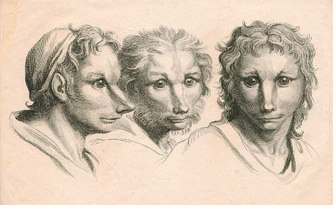
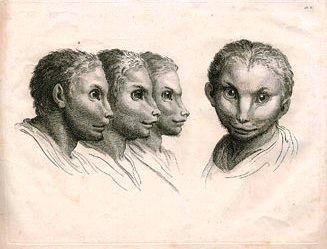
In 1671 AD, a fellow by the name of Charles Le Brun produced a series of illustrations for his treatise on physiognomy – or a study of facial features. Included among these were fanciful illustrations of people with animal characteristics. Approximately 350 years later, a gaming geek is using these illustration to produce this …

The Beastmen of Nabu

Nabu was once a lush savanna cut by a river, the banks of which supported a highly advanced civilization. At the center of this civilization was the city-state of Nabu and its attendant empire that stretched from the jungles of Cush to the rocky hills of the Wyvern Coast. This empire was ruled by successive dynasties of scientist-kings, men and women who, it is said, were as above other humans as humans are above beasts. These kings and queen and their attendants produced wonders for their empire. And then, they apparently went too far. The cataclysm has been attributed to many possible occurrences, though most scholars would place the blame squarely on Nabu’s competition with its rival, Irem, over the verdant hills and forests of Venatia. The two powers, they believe, finally destroyed one another in a final clash of sorcery and science. In the wake of the cataclysm, both lands were turned to waste – wind-swept deserts and buried ruins replacing farmland and city, beastmen and corpses replacing men and women.

The beastmen of Nabu are, for the most part, human beings. Their habits and their faces, however, carry the mark of beasts and keep them separate from other humans, incapable of interbreeding with normal humans and often unwilling to manage their passions sufficiently to fit into to human society. There is no doubt that the beastmen were created by the energies unleashed during the cataclysm, but the process by which this transformation was accomplished is lost to modern theoretic wizardry.

Bubasti (Cat People)

The bubasti are a race of cat-like demi-humans who dwell on the margins of the River of Death. Bubasti appear as short (average 3 feet tall), slight humanoids with dusky skin and glossy, blue-black hair. They have furtive, piercing eyes and are prone to staring. The bubasti are chaotic down to their little souls, and often cruel and malicious. They dress in simple tunics and enjoy decorating themselves (when not on the hunt) with silver trinkets. In fact, bubasti place such a high value on silver that silver coins can be considered to be double in value when trading with the cat people.

The bubasti live in small communities of 10 to 30 individuals. They dwell in the tall reeds that clog the banks of the river. The bubasti construct tiny huts from the reeds. Each little den is separated by several yards from the others, and they are so cunningly camouflaged that it is possible to walk through a bubasti village without ever knowing. Villages are mostly made up of females and young, with a few older males living on the outskirts of the village and claiming it and its inhabitants as their territory. The females put up with this so long as the males keep mostly to themselves and make no attempt to assert political control over the village. Most males belong to no village, instead living the life of wanderers and adventurers.

The cat people mostly make their living as fishermen, but they are also skilled at hunting small birds with weighted nets. Bubasti give most of their religious devotion to the mythic Cat Lord, who the Nabu know as Bast but the cat people call Pasha. In turn, they enjoy Pasha’s special attention and protection, with people hurting a bubasti running a slight (5%) chance of attracting a curse (per the spell).

Racial Characteristics: Bubasti characters enjoy a +1 bonus to make saving throws against breath weapons and triggered traps. They only trip pit traps on a roll of 1 on 1d8, and take only half damage from falling. Bubasti can see in the dark as well as elves and dwarves. Bubasti speak their own language, a dialect of the common tongue of humankind, and the language of felines.

The Bubasti Racial Class

While you can use the bubasti as a race, like elf or halfling, capable of taking levels in the basic classes, you might also want to treat the bubasti as a class of their own. In addition to the racial abilities listed above, members of the bubasti class gain the ability to cast a limited number of spells and the chance to escape certain death.

Prime Requisite: Dexterity (13+ gets +5% bonus to earned experience).

Hit Dice: 1d6+1 (+1 hit points per level after 9th).

Weapons Permitted: Club, dagger, javelin, light crossbow, short bow, short sword, sling.

Armor Permitted: Leather, ring, shields.

Magic Spells (1st): The bubasti are granted access to a small number of spells by their divine patron. The bubasti spell list is described below. Bubasti cast spells as clerics.

Level One: Detect Evil, Detect Magic, Expeditious Retreat#, Feather Fall#, Jump#

Level Two: Detect Invisibility, Dexterity*, Find Traps, Invisibility, Speak with Animals

Level Three: Bestow Curse**, Dimension Door#, Locate Object, Summon Cats***

* As the magic-user spell Strength, but applies instead to dexterity. Bubasti gain 2d4 points of dexterity from this spell.

** The reverse of remove curse.

*** As Monster Summoning I, except the spell summons 2d6 normal cats from the aether. Cats have the following statistics: HD 1d2; AC 5 [14]; Atk 2 claws (1 damage), 1 bite (1 damage); Move 12; Save 17; CL/XP A/5; Special: None.

# New spell – see below.

Evasion (1st): The bubasti can roll with a potentially lethal blow to take less damage from it than she otherwise would. Once per day, when a bubasti would be reduced to 0 or fewer hit points by damage from a weapon or other blow, she can attempt a saving throw. If successful, she takes only half damage from the attack.

Keen Hearing (1st): A bubasti’s hearing is so acute that they are only surprised on a roll of 1 on 1d8.

Light Footed (1st): Bubasti are so quiet when they move that they are capable, when surrounded by equally quiet creatures or alone, of surprising their foes on the roll of 1-2 on 1d6.

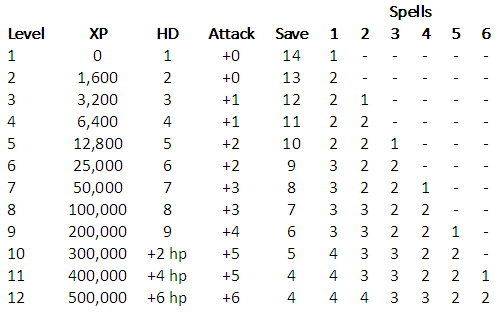
Spells

Level

XP

HD

Attack

Save

1

2

3

1

0

1

+0

14

1

2

1,900

2

+0

13

1

3

3,800

3

+1

12

2

4

7,600

4

+1

11

2

5

15,200

5

+2

10

2

1

6

30,000

6

+2

9

2

1

7

60,000

7

+3

8

3

2

8

120,000

8

+3

7

3

2

9

240,000

9

+4

6

3

2

1

10

360,000

+1 hp

+5

5

3

2

1

11

480,000

+2 hp

+5

4

3

3

2

12

600,000

+3 hp

+6

4

3

3

2

New Spells –

Dimension Door

Level: 3 (bubasti), 4 (magic-user)

Range: 300 feet

Duration: Instantaneous

You instantly transfer yourself from your current location to any other spot within range. You always arrive at exactly the spot desired, whether by simply visualizing the area or by stating direction. You may bring one additional willing man-sized or smaller creature per three caster levels.

Expeditious Retreat

Level: 1

Range: Personal

Duration: 1 minute per level

This spell increases your land speed by +12.

Feather Fall

Level: 1

Range: 30 feet

Duration: Until landing, or 1 round per level

The affected creatures or objects fall so slowly that they take no damage upon landing.

Jump

Level: 1

Range: Touch

Duration: 1 minute per level

The subject of this spell can easily leap 10 feet horizontally or 6 feet vertically.

Belcwn (Lion People)

Unlike their small, furtive kin the bubasti, the lion people, or belcwn, are tall and broad of shoulder. The lion people have tanned, muscular bodies, golden eyes and curly blonde or red hair that is always worn long and loose. Belcwns dress in leather tunics. Warriors wear leather or ring armor and carry heavy flails, hooked swords or pole arms and sometimes shields. They are expert at using their weapons to knock their enemies prone, opening them to a vicious pounce. The male leader of a pride wears a heavy, animal skin cloak and receives visitors sitting on a beautifully carved wooden stool.

The belcwn live in prides, pitching their animal skin tents on grassy meadows near groves of acacia trees. Each pride consists of 6 to 12 female warriors and either a single male or a pair of brothers who rule as titular kings and defenders. While the women work as hunters and gatherers, the kings tutor their children in fighting and in the legends and lore of their people. The males also fill their time working on crafts necessary to the tribe’s survival – mostly weapon making, but also basket weaving and leather working. Males without a pride live as mercenaries and adventurers. Their foul tempers and penchant for violence make them useful to nobles, but poorly regarded by common folk.

The belcwn worship Pasha, the ruler of all felines, as well as deities of war and solar divinities. Males act as priests for their prides, and thus often have the magical abilities of low-level adepts. Many belcwn kings are attended by bubasti viziers.

Racial Characteristics: Belcwns are usually tall and muscular, but are generally not known for their intellects. New belcwn characters receive a +2 bonus to their strength attribute, but a -2 penalty to their intelligence. These modifications cannot take an ability score higher than 18 or lower than 3. Belcwns can see in the dark.

Belcwn Racial Class

Belcwns are roudy, eager warriors who enjoy coming to blows with their enemies. Their ear-shattering battle cries cause enemies to quake in their boots, and their powerful charges often send them scattering. In addition, belcwns possess an innate ability to command normal beasts.

Prime Requisite: Strength (13+ gets +5% bonus to earned experience).

Hit Dice: 1d6+2 (+3 hit points per level after 9th).

Weapons Permitted: Any.

Armor Permitted: Leather, ring, chainmail and shields.

Battle Yell: The belcwn usually enter battle with a terrible, throaty yell, not unlike a lion’s roar. Creatures with fewer hit dice than the belcwn (and no more than 5 hit dice in any event) must pass a saving throw or be struck with fear, suffering a -1 penalty to hit and damage during combat.

Charge: When belcwns charge into a fight, they enjoy a +1 bonus to hit and damage for one round, but suffer a -2 penalty to Armor Class and always lose initiative to troops who have set their spears against a charge. Foes that are damaged by a belcwn’s charge must make a saving throw or be knocked prone.

Command Animals: Belcwns possess a natural aura of command over natural, normal animals (i.e. not mythic animals like unicorns or giant versions of normal animals). Against these creatures, a belcwn can make a “turn undead” roll as a cleric of the belcwn’s level. If successful, the animals fall under the belcwn’s command as the undead fall under the command of an evil cleric, though the duration is only 1 hour.

Level

XP

HD

Attack

Save

1

0

1

+0

16

2

2,000

2

+0

15

3

4,000

3

+1

14

4

8,000

4

+2

13

5

16,000

5

+2

12

6

30,000

6

+3

11

7

60,000

7

+4

10

8

120,000

8

+5

9

9

240,000

9

+6

8

10

360,000

+3 hp

+7

7

11

480,000

+6 hp

+7

6

12

600,000

+9 hp

+8

5


Druid Spells – Level 6 and 7

The following is Open Game Content.

Druid Spell List

Level 6
1. Animal Summoning VI
2. Antilife Shell
3. Find the Path*
4. Fire Seeds
5. Move Earth
6. Spellstaff
7. Stone Tell
8. Wall of Stone **

Level 7
1. Animal Summoning VII
2. Animate Plants
3. Control Weather*
4. Earthquake*
5. Fire Storm
6. Part Water*
7. Sunburst
8. Transmute Metal to Wood
9. Whirlwind
10. Wind Walk*

* As cleric spell of same name
** As magic-user spell of the same name

Animal Summoning VI
Spell Level: Druid, 6th Level
Range: 90 ft.
Duration: 1 round per level

This spell functions like animal summoning I, except that you can summon one 6th-level creature, 1d3 5th-level creatures of the same kind, or 1d4+1 lower-level creatures of the same kind.

1 Bear, Grizzly
2 Crocodile, Giant
3 Leech, Giant (5 HD)
4 Skunk, Giant
5 Snake, Giant, Viper or Cobra
6 Wasp, Giant

Animal Summoning VII
Spell Level: Druid, 7th Level
Range: 90 ft.
Duration: 1 round per level

This spell functions like animal summoning I, except that you can summon one 7th-level creature, 1d3 6th-level creatures of the same kind, or 1d4+1 lower-level creatures of the same kind.

1 Bear, Prehistoric or Polar
2 Hippopotamus
3 Komodo Dragon, Giant
4 Rhinoceros
5 Snake, Giant, Constrictor
6 Tiger
7 Tiger, Sabre-Tooth
8 Wolverine, Giant

Animate Plants
Spell Level: Druid, 7th Level
Range: 60 ft
Duration: 1 round per level

You imbue inanimate plants with mobility and a semblance of life. Each animated plant then attacks whomever or whatever you designate. You may animate one large or smaller plant, or an equivalent number of larger plants, per three caster levels. You can change the designated target or targets as you wish. This spell does not affect plant creatures or nonliving vegetable matter.

Small Plant: HD 1d4, AC 7 [12]; Atk 1 slam (1d2); Move 6; Save 18; CL/XP A/5; Special: None.

Medium Plant: HD 2; AC 4 [15]; Atk 1 slam (1d4); Move 9; Save 16; CL/XP 2/30; Special: None.

Large Plant: HD 4; AC 1 [18]; Atk 1 slam (1d8); Move 12; Save 13; CL/XP 4/120; Special: None.

Antilife Shell
Spell Level: Druid, 6th Level
Range: 10 ft
Duration: 10 minutes per level

You bring into being a mobile, hemispherical field that prevents the entrance of most types of living creatures. The effect does not work against creatures from beyond the Material Plane, the undead or constructed creatures like golems or living statues.

Fire Seeds
Spell Level: Druid, 6th Level
Range: Touch
Duration: 10 minutes per level

This spell turns acorns or holly berries into weapons that detonate on your command. As many as four acorns turn into special weapons that can be hurled as far as 100 feet. A ranged attack roll against an AC 9 [10] is required to strike the intended target. Together, the acorns are capable of dealing 1d6 points of fire damage per caster level, divided up among the acorns as you wish. Each acorn explodes upon striking any hard surface. In addition to its regular fire damage, it deals 1 point of damage per die to creatures within 5 feet of the target and it ignites any combustible materials within 10 feet. A creature within this area that makes a successful saving throw takes only half damage; a creature struck directly is not allowed a saving throw.

You can also turn as many as eight holly berries into special bombs. The holly berries are usually placed by hand, since they are too light to make effective thrown weapons (they can be tossed only 5 feet). If you are within 200 feet and speak a word of command, each berry instantly bursts into flame, causing 1d8 points of fire damage +1 point per caster level to every creature in a 5-foot radius and igniting any combustible materials within 5 feet. A creature in the area that makes a successful saving throw takes only half damage.

Fire Storm
Spell Level: Druid, 7th Level
Range: 150 ft
Duration: Instantaneous

When a fire storm spell is cast, the whole area is shot through with sheets of roaring flame. The raging flames do not harm natural vegetation, ground cover, and any plant creatures in the area that you wish to exclude from damage. Any other creature within the area takes 1d6 points of fire damage per caster level.

Move Earth
Spell Level: Druid, 6th Level
Range: 600 ft
Duration: Instantaneous

Move earth moves dirt (clay, loam, sand), possibly collapsing embankments, moving hillocks, shifting dunes, and so forth. It cannot collapse or move rock formations. For every 150-square feet (up to 10 feet deep), casting takes 10 minutes. The maximum area, 750 feet by 750 feet, takes 4 hours and 10 minutes to move. This spell does not violently break the surface of the ground. Instead, it creates wavelike crests and troughs, with the earth reacting with glacier-like fluidity until the desired result is achieved. Trees, structures, rock formations, and such are mostly unaffected except for changes in elevation and relative topography. The spell cannot be used for tunneling and is generally too slow to trap or bury creatures. Its primary use is for digging or filling moats or for adjusting terrain contours before a battle. This spell has no effect on earth creatures.

Spellstaff
Spell Level: Druid, 6th Level
Range: Touch
Duration: Permanent until discharged

You store one spell that you can normally cast in a wooden quarterstaff. Only one such spell can be stored in a staff at a given time, and you cannot have more than one spellstaff at any given time. You can cast a spell stored within a staff just as though it were among those you had prepared, but it does not count against your normal allotment for a given day.

Stone Tell
Spell Level: Druid, 6th Level
Range: Personal
Duration: 1 minute per level

You gain the ability to speak with stones, which relate to you who or what has touched them as well as revealing what is covered or concealed behind or under them. The stones relate complete descriptions if asked. A stone’s perspective, perception, and knowledge may prevent the stone from providing the details you are looking for. You can speak with natural or worked stone.

Sunburst
Spell Level: Druid, 7th Level
Range: 600 ft
Duration: Instantaneous

Sunburst causes a globe of searing radiance to explode silently from a point you select. All creatures in the globe are blinded and take 6d6 points of damage. A creature to which sunlight is harmful or unnatural takes double damage. A successful saving throw negates the blindness and reduces the damage by half.

An undead creature caught within the globe takes 1d6 points of damage per caster level, or half damage if a saving throw is successful. In addition, the burst results in the destruction of any undead creature specifically harmed by bright light if it fails its save.

The ultraviolet light generated by the spell deals damage to fungi, mold, oozes, and slimes just as if they were undead creatures.

Sunburst dispels any darkness spells of lower than 9th level within its area.

Transmute Metal to Wood
Spell Level: Druid, 7th Level
Range: 600 ft
Duration: Instantaneous

This spell enables you to change all metal objects within its area to wood. Weapons, armor, and other metal objects carried by creatures are affected as well. A magic object made of metal effectively has spell resistance equal to 50% against this spell. Artifacts cannot be transmuted. Weapons converted from metal to wood take a –2 penalty on “to hit” and damage rolls. The armor bonus of any armor converted from metal to wood is reduced by 2. Weapons changed by this spell splinter and break on any natural attack roll of 1 or 2, and armor changed by this spell loses an additional point of armor bonus every time it is struck with a natural attack roll of 19 or 20. Only limited wish, miracle, wish, or similar magic can restore a transmuted object to its metallic state.

Whirlwind
Spell Level: Druid, 7th Level
Range: 600 ft
Duration: 1 round per level

This spell creates a powerful cyclone of raging wind that moves through the air, along the ground, or over water at a speed of 60 feet per round. You can concentrate on controlling the cyclone’s every movement or specify a simple program. Directing the cyclone’s movement or changing its programmed movement is a standard action for you. The cyclone always moves during your turn. If the cyclone exceeds the spell’s range, it moves in a random, uncontrolled fashion for 1d3 rounds and then dissipates. You can’t regain control of the cyclone, even if comes back within range. Any creature that comes in contact with the spell effect must succeed on a saving throw or take 3d6 points of damage. A human-sized or smaller creature that fails its first save must succeed on a second one or be picked up bodily by the cyclone and held suspended in its powerful winds, taking 1d8 points of damage each round with no save allowed. You may direct the cyclone to eject any carried creatures whenever you wish, depositing the hapless souls wherever the cyclone happens to be when they are released.

Done with the druid!

Next post will detail the Gods of Nabu (i.e. Egyptian deities). After that, I begin with my next set of sandbox posts in the lands of Venatia – knights, peasants, thick woods full of fairies and dragons and foreboding mountains filled with giants and ogres.

Druid Spells – Level 4 to 5

The following is Open Game Content.

Druid Spell List

Level 4
1. Air Walk
2. Animal Summoning IV
3. Blight
4. Control Water
5. Cure Serious Wounds*
6. Ice Storm
7. Reincarnation**
8. Scrying

Level 5
1. Animal Growth
2. Animal Summoning V
3. Baleful Polymorph
4. Commune with Nature
5. Insect Plague*
6. Stoneskin
7. Transmute Rock to Mud
8. Wall of Thorns

* As cleric spell
** As magic-user spell

Air Walk
Spell Level: Druid, 4th Level
Range: Touch
Duration: 10 minutes per level

The subject of this spell can tread on air as if walking on solid ground. Moving upward is similar to walking up a hill. The maximum upward or downward angle possible is 45 degrees, at a rate equal to one-half the air walker’s normal movement. A strong wind can push the subject along or hold it back. Should the spell duration expire while the subject is still aloft, the magic fails slowly. The subject floats downward 60 feet per round for 1d6 rounds. If it reaches the ground in that amount of time, it lands safely. If not, it falls the rest of the distance, taking falling damage as normal.

Animal Growth
Spell Level: Druid, 5th Level
Range: 200 feet
Duration: 1 minute per level

A number of animals grow to twice their normal size and eight times their normal weight. This alteration essentially doubles each animal’s Hit Dice and improved its Armor Class by 1. The animal deals +1 damage with its attacks. Its movement remains the same. The enlarged animal can only be harmed by silver or magical weapons and attacks.

Animal Summoning IV
Spell Level: Druid, 4th Level
Range: 60 ft
Duration: 1 round per level

This spell functions like animal summoning I, except that you can summon one 4th-level creature, 1d3 3rd-level creatures of the same kind, or 1d4+1 lower-level creatures of the same kind.

Roll Summoned Animal
1 Ant, Giant Warrior
2 Ape, Gorilla
3 Black Bear
4 Boar, Wild
5 Eagle, Giant
6 Eel, Giant Electric or Giant Moray *
7 Komodo Dragon
8 Leopard
9 Raven, Giant
10 Seahorse, Giant *
11 Stag, Giant
12 Wolverine

Animal Summoning V
Spell Level: Druid, 5th Level
Range: 60 ft.
Duration: 1 round per level

This spell functions like animal summoning I, except that you can summon one 5th-level creature, 1d3 4th-level creatures of the same kind, or 1d4+1 lower-level creatures of the same kind.

Roll Summoned Animal
1 Bat, Giant
2 Hyena, Giant
3 Lamprey, Giant
4 Lion
5 Macaw, Giant
6 Owl, Giant
7 Rock Weasel, Giant
8 Weasel, Giant

Baleful Polymorph
Spell Level: Druid, 5th Level
Range: 50 feet
Duration: Permanent

This spell works like the magic-user spell polymorph, except that the druid changes the subject into a small animal of no more than 1 HD. The new form cannot prove fatal to the creature (i.e. turning someone into a fish in the desert). The subject of the spell gets a saving throw to negate the effect. If the spell succeeds, the subject must make a second saving throw. If this second save fails, the creature loses any spell casting or magical abilities it had and gains the special abilities and Intelligence of its new form in place of its own. Incorporeal or gaseous creatures are immune to being polymorphed, and a shapechanger can revert to its natural form on its next turn.

Blight
Spell Level: Druid, 4th Level
Range: Touch
Duration: Instantaneous

This spell withers a single plant of any size. An affected plant monster takes 1d6 points of damage per druid level and may attempt a saving throw for half damage. A plant that isn’t a creature doesn’t receive a save and immediately withers and dies. This spell has no effect on the soil or surrounding plant life.

Commune with Nature
Spell Level: Druid, 5th Level
Range: Personal
Duration: Instantaneous

You become one with nature, attaining knowledge of the surrounding territory. You instantly gain knowledge of as many as three facts from among the following subjects: the ground or terrain, plants, minerals, bodies of water, people, general animal population, presence of woodland creatures, presence of powerful unnatural creatures, or even the general state of the natural setting.

In outdoor settings, the spell operates in a radius of 1 mile per caster level. In natural underground settings the radius is limited to 100 feet per caster level. The spell does not function where nature has been replaced by construction or settlement, such as in dungeons and towns.

Control Water
Spell Level: Druid, 4th Level
Range: 800 feet
Duration: 10 minutes per level

Depending on the version you choose, the control water spell raises or lowers water.

Lower Water: This causes water or similar liquid to reduce its depth by as much as 2 feet per caster level to a minimum depth of 1 inch. The water is lowered within a squarish depression whose sides are up to caster level x 10 feet long. In extremely large and deep bodies of water, such as a deep ocean, the spell creates a whirlpool that sweeps ships and similar craft downward, putting them at risk and rendering them unable to leave by normal movement for the duration of the spell. When cast on water elementals and other water-based creatures, this spell acts as a slow spell. The spell has no effect on other creatures.

Raise Water: This causes water or similar liquid to rise in height, just as the lower water version causes it to lower. Boats raised in this way slide down the sides of the hump that the spell creates. If the area affected by the spell includes riverbanks, a beach, or other land nearby, the water can spill over onto dry land.

With either version, you may reduce one horizontal dimension by half and double the other horizontal dimension.

Ice Storm
Spell Level: Druid, 4th Level
Range: 800 feet
Duration: 1 round

Great magical hailstones pound down for 1 round, dealing 3d6 points of damage plus 2d6 points of freezing damage to every creature in the area. All land movement within its area is at half speed. At the end of the duration, the hail disappears, leaving no aftereffects other than the damage dealt.

Scrying
Spell Level: Druid, 4th Level
Range: See text
Duration: 1 minute per level

Using a natural pool of water, you can see and hear some creature, which may be at any distance. If the subject succeeds on a saving throw, the scrying attempt simply fails. The difficulty of the save depends on how well you know the subject and what sort of physical connection (if any) you have to that creature. Furthermore, if the subject is on another plane, it gets a +3 bonus on its saving throw.

Knowledge or Connection
None: +5
Secondhand (you have heard of the subject): +3
Firsthand (you have met the subject): +0
Familiar (you know the subject well): –3
Own a likeness or picture: –1
Own a possession or garment: –2
Own a body part, lock of hair, bit of nail, etc.: –5

If the save fails, you can see and hear the subject and the subject’s immediate surroundings. If the subject moves, the sensor follows. The sensor has your full visual acuity, including any magical effects.

If the save succeeds, you can’t attempt to scry on that subject again for at least 24 hours.

Stoneskin
Spell Level: Druid, 5th Level
Range: Touch
Duration: 10 minutes per level

The warded creature gains resistance to blows, cuts, stabs, and slashes. The subject take only one quarter damage from non-magical weapons, and full damage from magical weapons. Once the spell has prevented a total of 5 points of damage per caster level it is discharged.

Transmute Rock to Mud
Spell Level: Druid, 5th Level
Range: 200 ft.
Duration: Permanent (see text)

This spell turns natural, uncut rock of any sort into an equal volume of mud. Magical stone is not affected by the spell. The depth of the mud created cannot exceed 10 feet. A creature stuck in the mud has its movement reduced to 3 and suffers a -2 penalty to hit and to its Armor Class. If cast upon the ceiling of a cavern or tunnel, the ensuing cave-in deals 8d6 points of damage to anyone caught directly beneath the area, or half damage to those who succeed on a saving throw. The mud remains until a successful dispel magic or transmute mud to rock spell restores its substance, but not necessarily its form. Evaporation turns the mud to normal dirt over a period of days.

The reverse of this spell turns mud or quicksand into sandstone. Creatures in the mud are allowed a saving throw to escape before the area is hardened to stone.

Wall of Thorns
Spell Level: Druid, 5th Level
Range: 200 ft.
Duration: 10 minutes per level

This spell creates a barrier of tangled, needle-sharp thorn bushes. The wall covers a number of 10x10x5 foot blocks equal to twice the druid’s level. Any creature moving through a wall of thorns takes damage each round equal to 25 minus the creature’s AC. Forcing one’s way through the thorns requires an open doors check to move 5 feet. One can chop through a foot of the thorns with 10 minutes work. Normal fire has no effect on the thorns, but magic fire burns it away in 10 minutes.

Druid Spells – Level 1 to 3

The following is Open Game Content.

Druid Spell List

Level 1
1. Animal Summoning I
2. Charm Animal
3. Cure Light Wounds*
4. Detect Poison
5. Entangle
6. Produce Flame
7. Shillelagh
8. Speak with Animals*

Level 2
1. Animal Summoning II
2. Animal Trance
3. Barkskin
4. Flame Blade
5. Fog Cloud
6. Gust of Wind
7. Resist Fire
8. Warp Wood

Level 3
1. Animal Summoning III
2. Cure Disease * / Contagion
3. Neutralize Poison * / Poison
4. Plant Growth
5. Speak with Plants *
6. Stone Shape
7. Water Breathing **
8. Wind Wall

* As cleric spell of same name
** As magic-user spell of the same name

Animal Summoning I
Spell Level: Druid, 1st Level
Range: 30 ft.
Duration: 1 round per level

This spell summons a natural creature. It appears where you designate and acts immediately. It attacks your opponents to the best of its ability. If you can communicate with the creature, you can direct it not to attack, to attack particular enemies, or to perform other actions.

1 Baboon
2 Barracuda *
3 Centipede (Swarm)
4 Flying Squirrel, Carnivorous
5 Frog, Giant (Small)
6 Hyena
7 Jackal
8 Rat, Giant

* Roll again if not in an aquatic environment

Animal Summoning II
Spell Level: Druid, 2nd Level
Range: 30 ft.
Duration: 1 round per level

This spell functions like animal summoning I, except that you can summon one 2nd-level creature or 1d3 1st-level creatures of the same kind.

1 Ant, Giant Worker
2 Dolphin *
3 Frog, Giant (Medium)
4 Giant Centipede, Small (Lethal)
5 Leech, Giant
6 Lynx, Giant
7 Snake, Constrictor
8 Snake, Viper
9 Thylacine
10 Wolf

* Roll again if not in an aquatic environment

Animal Summoning III
Spell Level: Druid, 3th Level
Range: 30 ft.
Duration: 1 round per level

This spell functions like animal summoning I, except that you can summon one 3rd-level creature, 1d3 2nd-level creatures of the same kind, or 1d4+1 1st-level creatures of the same kind.

1 Badger, Giant
2 Cattle
3 Crab, Giant
4 Crocodile
5 Goat, Giant
6 Lizard, Giant
7 Ostriches, Giant
8 Ray, Sting *
9 Sea Lion *
10 Shark, Small (3 HD) *
11 Snake, Cobra
12 Toad, Giant

Animal Trance
Spell Level: Druid, 2nd Level
Range: 30 ft.
Duration: Concentration

Your swaying motions and music (or singing, or chanting) compel animals and magical beasts to do nothing but watch you. Only a non-intelligent creatures can be fascinated by this spell. Roll 2d6 to determine the total number of HD worth of creatures that you fascinate. The closest targets are selected first until no more targets within range can be affected.

Barkskin
Spell Level: Druid, 2nd Level
Range: Touch
Duration: 10 minutes per level

The recipient of this spell’s Armor Class improves by 2.

Charm Animal
Spell Level: Druid, 1st Level
Range: 30 ft.
Duration: One day per level

This spell functions like charm person, except that it affects animals instead of people.

Contagion
Spell Level: Druid, 3rd Level
Range: Touch
Duration: Instantaneous

The reverse of cure disease, this spell causes the subject to contract a disease from the table below. The disease strikes immediately. With a successful saving throw, the subject is not infected. If infected, one saving throw is allowed each day to avoid damage. Two successful saving throws in a row are required to overcome the disease completely. If any character has an ability score reduced to 0, it dies. Against monsters, the Referee may rule that the spell causes a -3 penalty to hit, damage and on saving throws, and reduces the monster to half normal movement.

1 Blinding Sickness (1d4 strength damage per day)
2 Cackle Fever (1d6 wisdom damage per day)
3 Filth Fever (1d3 dexterity and 1d3 constitution damage per day)
4 Mindfire (1d4 intelligence damage)
5 Red Ache (1d6 strength damage per day)
6 Shakes (1d8 dexterity damage per day)

Detect Poison
Spell Level: Druid, 1st Level
Range: 30 ft.
Duration: Instantaneous

You determine whether a creature, object, or area has been poisoned or is poisonous. This spell can penetrate doors, but not walls.

Entangle
Spell Level: Druid, 1st Level
Range: 400 ft.
Duration: 1 minute per level

Grasses, weeds, bushes, and trees wrap, twist, and entwine about creatures in the area or those that enter the area, holding them fast and causing them to become entangled. The creature can break free and move half its normal speed by making a saving throw. Each round on your turn, the plants once again attempt to entangle all creatures that have avoided or escaped entanglement.

Flame Blade
Spell Level: Druid, 2nd Level
Range: 0 ft.
Duration: 1 minute per level

A 3-foot-long, blazing beam of red-hot fire springs forth from your hand. You wield this blade-like beam as if it were a long sword (i.e. 1d8 damage). Since the blade is immaterial, it ignores bonuses to Armor Class from armor and shields. A flame blade can ignite combustible materials such as parchment, straw, dry sticks, and cloth. The spell does not function underwater.

Fog Cloud
Spell Level: Druid, 2nd Level
Range: 120 ft.
Duration: 10 minutes per level

A bank of fog billows out from the point you designate. The fog obscures all sight beyond 5 feet. Attacking a creature within 5 feet carries a -4 penalty to hit. Attacking creatures farther away carries a -10 penalty to hit, and the attacker can’t use sight to locate the target). A strong wind disperses the fog in one round. The spell does not function underwater.

Gust of Wind
Spell Level: Druid, 2nd Level
Range: 60 ft.
Duration: 1 round

This spell creates a severe blast of air (approximately 50 mph) that originates from you, affecting all creatures in its path. Very small creatures, like birds and pixies, are knocked down and rolled 30 ft, taking 2d6 points of non-lethal damage. Small creatures, like kobolds and goblins, are knocked prone by the force of the wind. Human-sized creatures are unable to move against the force of the wind. Any creature, regardless of size, takes a –4 penalty on misile attacks in the area of a gust of wind. The force of the gust automatically extinguishes candles, torches, and similar unprotected flames. It causes protected flames, such as those of lanterns, to dance wildly and has a 50% chance to extinguish those lights.

Plant Growth
Spell Level: Druid, 3rd Level
Range: See text
Duration: Instantaneous

Plant growth has different effects depending on the version chosen. Overgrowth causes normal vegetation (grasses, briars, bushes, creepers, thistles, trees, vines) to become thick and overgrown. The plants entwine to form a thicket or jungle that creatures must hack or force a way through. The area must have brush and trees in it for this spell to take effect. At your option, the area can be a 100-foot-radius circle, a 150-foot-radius semicircle, or a 200-foot-radius quarter circle. You may designate places within the area that are not affected.
Enrichment targets plants within a range of one-half mile, raising their potential productivity over the course of the next year to one-third above normal.

This spell has no effect on plant creatures.

Poison
Spell Level: Druid, 3rd Level
Range: Touch
Duration: Instantaneous

Calling upon the venomous powers of natural predators, you infect the subject with a horrible poison by making a successful melee touch attack. The poison deals 1d10 points of damage immediately and another 1d10 points of damage 1 minute later. Each instance of damage can be negated by a saving throw.

Produce Flame
Spell Level: Druid, 1st Level
Range: 0 ft.
Duration: 1 minute per level

Flames as bright as a torch appear in your open hand. The flames harm neither you nor your equipment. In addition to providing illumination, the flames can be hurled or used to touch enemies. You can strike an opponent with a melee attack or missile attack (up to 120 ft), ignoring armor, dealing fire damage equal to 1d6 +1 point per caster level (maximum +5). No sooner do you hurl the flames than a new set appears in your hand. Each attack you make reduces the remaining duration by 1 minute. If an attack reduces the remaining duration to 0 minutes or less, the spell ends after the attack resolves. This spell does not function underwater.

Resist Fire
Spell Level: Druid, 2nd Level
Range: Touch
Duration: 10 minutes per level

This spell grants a creature limited protection from fire. The creatures suffers half damage from fire for the duration of the spell.

Shillelagh
Spell Level: Druid, 1st Level
Range: Touch
Duration: 1 minute per level

Pronounced Shih – Lay – Lee, this spell causes a normal club or staff to become a +1 magical weapon for the duration of the spell.

Stone Shape
Spell Level: Druid, 3rd Level
Range: Touch
Duration: Instantaneous

You can form an existing piece of stone into any shape that suits your purpose. While it’s possible to make crude coffers, doors, and so forth with stone shape, fine detail isn’t possible. There is a 2 in 6 chance that any shape including moving parts simply does not work.

Warp Wood
Spell Level: Druid, 2nd Level
Range: 30 ft.
Duration: Instantaneous

You cause wood to bend and warp, permanently destroying its straightness, form, and strength. A warped door springs open (or becomes stuck). A boat or ship springs a leak. Warped missile weapons are useless. A warped melee weapon is -4 to hit. Alternatively, you can unwarp wood (effectively warping it back to normal) with this spell. A 2nd level druid can warp a single, small item. A level 6th level druid can warp something as large as a door. A 12th level druid can warp something as large as a ship.

Wind Wall
Spell Level: Druid, 3rd Level
Range: 120 ft.
Duration: 1 round per level

An invisible vertical curtain of wind appears. It is 2 feet thick and of considerable strength. It is a roaring blast sufficient to blow away any bird smaller than an eagle, or tear papers and similar materials from unsuspecting hands. Small flying creatures cannot pass through the barrier. Loose materials and cloth garments fly upward when caught in a wind wall. Arrows and bolts are deflected upward and miss, while any other normal missile weapon passing through the wall is -6 to hit. A giant-thrown boulder, a siege engine projectile, and other massive ranged weapons are not affected. Gases, most gaseous breath weapons, and creatures in gaseous form cannot pass through the wall. While the wall must be vertical, you can shape it in any continuous path along the ground that you like. It is possible to create cylindrical or square wind walls to enclose specific points. The wall is 10 ft per level long and 5 ft. per level high.

Levels 4 and 5 tomorrow …

Clerics & Druids

My first attempt at blogging from MSWord – hopefully it comes out okay. This is my take on the cleric and druid. In truth, my only contribution to the cleric is the level titles.

This post is Open Game Content.

THE CLERIC

Clerics are armored priests who serve a patron deity and an alignment ethos (law, good, chaos or evil). Regardless of the details, you are a champion of your faith and moral alignment. You might be a sinister witch-hunter, an exorcist of demons, or a shining knight of the faith. Because most of a cleric’s abilities are oriented toward healing and protecting, clerics tend to play a support role during combat, backing up the front line, but able to stand shoulder to shoulder with the party’s fighting-men if need be, at least for a while. High level clerics often establish fortified temples or monasteries in the wilderness, clearing the area of monsters and attracting followers and soldiers.

Prime Requisite: Wisdom (13+gives +5% experience bonus).

Hit Dice: 1d6+1 (+2 hp per level after 9th).

Armor/Shield Permitted: Any.

Weapons Permitted: Blunt weapons only.

Spells (1st): The spells available are listed on the cleric spell list. A cleric is limited to a certain number of spells of each level per day. A table shows the number of spells per day a character of the class may cast. Clerics prepare spells each day through prayer to their deity, followed by contemplation and study.

Banishing Undead (1st): Clerics can “Turn” the undead, making them flee from the cleric’s holiness (or, in the case of an evil cleric, bringing them to heel as servants and minions). A Referee might decree that a cleric can use this ability against other supernatural creatures hostile to his patron deity or religion.


Spells Per Day (By Spell Level)

Level Experience

Hit Dice

Attack

Save

Title

1

2

3

4

5

6

1 0

1

+0

14

Beadle

2 2,250

2

+0

13

Almoner

1

3 5,000

3

+1

12

Chanter

2

4 9,000

4

+1

11

Friar

2

1

5 18,000

5

+2

10

Prester

2

2

1

6 35,000

6

+2

9

Vidame

2

2

1

1

7 70,000

7

+3

8

Exarch

2

2

2

1

1

8 140,000

8

+3

7

Hierophant

2

2

2

2

2

9 300,000

9

+4

6

Patriarch

3

3

3

2

2

10 425,000

+2

+5

5

Patriarch

3

3

3

3

3

11 650,000

+4

+5

4

Patriarch

4

4

4

3

3

12 900,000

+6

+6

3

Patriarch

4

4

4

4

4

1

The Druid Sub-Class

The druid is a sub-class of cleric who worships a pantheon of nature divinities in place of the cleric’s patron deity and ethos. Because druids worship a wide variety of deities and respect each deity’s place in the greater scheme of things, they are always neutral in alignment. Druids draw energy from the natural world to cast divine spells and gain strange supernatural powers.

Prime Requisites: Intelligence & Wisdom (13+ gives +5% experience bonus).

Hit Dice: 1d6+1 (+2 hp per level after 9th).

Armor/Shields Permitted: Leather armor, shields.

Weapons Permitted: Club, dagger, dart, hand axe, hammers, sling, sickle, spears, swords, and staves.

Spells (1st): The spells available to a druid are listed on the druid spell list (coming soon). A druid is limited to a certain number of spells of each level per day. The druid table shows the number of spells per day a character of the class may cast. Druids prepare spells each day by praying for them.

Secret Language (1st): Druids have a secret language and alphabet used for communicating with one another. They are forbidden from teaching either language or alphabet to any but their brethren. It is this language that the druids use to cast their spells.

Nature Lore (1st): A druid can identify plants and animals with perfect accuracy. This ability is automatically successful when used in the type of environment in which the druid was trained or currently lives. In unfamiliar environments, the druid must succeed at a saving throw to successfully use this ability.

Resist Elements (2nd): At 2nd level, druids gain a +1 bonus to saving throws against fire, water, earth, air, cold and lightning attacks.

Woodland Stride (3rd): At 3rd level, druids gain the ability to move through natural thorns, briers, overgrown areas, and similar terrain at normal speed and without suffering damage or other impairment. When doing so, druids leave no trail in the natural surroundings and cannot be tracked. Areas that are enchanted or magically manipulated to impede motion still affect druids.

Shapechange (6th): At 6th level, druids gain the ability to change into a small or medium-size animal and back again once per day. This ability operates like the spell polymorph. Upon attaining this ability, a druid must choose an animal shape, usually an animal sacred to her religious traditions or patron deity. The selection is permanent, and cannot be changed.

Each time a druid uses this ability, the character regains 1d3 hit points. At 7th and 8th levels, the druid gains a new animal shape. Each shape can be assumed once per day. At 12th level, the druid gains the ability to take the shape of a large (maybe prehistoric) version of one of the previously chosen animal forms. This large form can be assumed once per day, and the druid can decide between the three forms each time this ability is used. When assuming the large version of an animal form, the druid heals 4d6 hit points.

Spells Per Day (By Spell Level)

Level Experience

Hit Dice

Attack

Save

Title

1

2

3

4

5

6

1 0

1

+0

14

Neophyte

2 2,000

2

+0

13

Initiate

1

3 4,250

3

+1

12

Ovate

2

4 8,500

4

+1

11

Soothsayer

2

1

5 17,000

5

+2

10

Magus

2

2

1

6 35,000

6

+2

9

Shaman

2

2

1

1

7 70,000

7

+3

8

Magister

2

2

2

1

1

8 180,000

8

+3

7

Druid

2

2

2

2

2

9 275,000

9

+4

6

Archdruid

3

3

3

2

2

10 400,000

+2

+5

5

Archdruid

3

3

3

3

3

11 525,000

+4

+5

4

Archdruid

4

4

4

3

3

12 650,000

+6

+6

3

Archdruid

4

4

4

4

4

1

Coming Soon – Druid spells

Medieval Woodcut of a Bishop from “Gode Cookery”

Assassins

The assassin is a tough one. I won’t deny that the main reason I used it is nostalgia. That being said, I did my best to make it a useful and hopefully enjoyable class. I think there are two main problems with the assassin class. The first is that the assassin really doesn’t fit well into the “dungeon” environment. Assassins should be plying their trade in the homes of fat merchants or in the castles of the local lord or even in the alleys and side streets of a city-state, but not really in a mythic underworld. I suppose someone might hire an assassin to take out a major power in a mythic underworld (that might make a good fantasy story, in fact), but will they do it over and over again? The whole point of dungeon delving is power, whether via gold pieces, magic items or hidden knowledge. Assassins have their own path to power, and I don’t think it usually goes through dank caverns and trap-laden corridors beneath the earth.

Problem number two is “assassination” boiled down to a single roll of the dice. In C&C it is a death attack – observe for a few rounds, attack, victim saves or dies. How anti-climactic can you get? And what happens when the Ref starts setting groups of assassins on the PC’s? Big damage with a single attack seems to already exist in most systems with the thief’s back stab, so why an assassin?

Despite all of this, I was determined to take a shot at creating an assassin class. The first step was looking for an archetype. If you’re doing a barbarian, you look to Conan. If you’re doing a ranger, you look to Davy Crockett or Aragorn. So who is the archetypal assassin who is a main character in a story? The character that immediately springs to my mind is Bond. James Bond.

In Bond you have a stealthy, deadly (license to kill) errand boy who solves problems. Once you latch on to a spy as an archetype, you also need to look at the history of spies and assassins in the pre-modern eras that fantasy gaming encompasses. You have the Elizabethan spy ring of Sir Francis Walsingham (pictured to the right), the ninjas of feudal Japan, the poisoners of Renaissance Italy, and many others. Taking these influences together, and leaning on previous versions of the assassin in D&D-style games, I came up with this …

What follows is Open Game Content

THE ASSASSIN
The assassin is a sub-class of thief that specializes in stealthy killings for a fee. They are commonly used as spies, and most major city-states have at least one or two spy rings from rival city-states in operation. Like thieves, assassins are useful as scouts. Their skills are not as wide-ranging as thieves, but they are more effective as combatants.

Prime Attribute: Dexterity, 13+ (+5% experience)

Hit Dice: 1d6+1 (Gains 2 hp/level after 9th level.)

Armor/Shield Permitted: Leather and shields.

Weapons Permitted: Any.

Cheat Death (1st): Assassins have an uncanny ability to escape certain doom. Assassins enjoy a +1 bonus to saving throws vs. death. Skilled escape artists, assassins use saving throws to wriggle out of non-magical ropes or chains, and they have a 1 in 6 chance to escape from magical bindings, like magical ropes or chains or spells like hold person or paralysis.

Decipher Script (1st): Assassins can decipher writings by making a successful saving throw. This includes unfamiliar languages, codes and incomplete messages.

Disguise (1st): Assassins train as thespians and masters of disguise. Assassins usually carry some odds and ends (soot, putty, rags for stuffing) that allow them impersonate others. The assassin’s diguises are usually effective on a roll of 1-4 on 1d6, provided the assassin is impersonating a person of the same race and gender. Impersonating another humanoid race lowers his chances by one, and impersonating another gender also lowers his chances by one. Impersonating a monstrous race lowers his chances by two. Even if the disguise is effective, those who know the impersonated person well receive a saving throw to see through the rouse.

Sneak Attack (1st): If an assassin takes an opponent by surprise (i.e. in a surprise round or simply attacking someone in a “non-combat” situation) or by attacking from the shadows, an assassin attacks at a +4 bonus to hit. A successful hit inflicts double normal damage. As the assassin gains experience, the damage inflicted increases. At fifth level, a sneak attack deals triple damage, and at ninth level a sneak attack inflicts quadruple damage.

Stealth (1st): Assassins have the following special abilities: Hiding in shadows, moving silently, climbing sheer surfaces, picking pockets (and other acts of legerdemain) and picking locks (with a set of burglar’s tools, which cost 25 gp). Use of these abilities requires the assassin to succeed at a saving throw (in essence, making a saving throw to avoid failure). Non-assassins have a 1 in 6 chance of successfully performing these abilities.

Hiding in Shadows: Hiding in shadows requires shadows, of course, and is as effective as the invisibility spell, except that the thief cannot move while hiding in shadows.

Moving Silently: This means moving without making any sound at all. A thief moving silently and scouting ahead of a party can avoid an encounter entirely if his opponents are surprised.

Climb Sheer Surfaces: This means surfaces with no, or almost no, hand or toe holds. The Referee might require multiple saving throws for long climbs, and might regard failure as merely “no progress” or actual falling.

Poison (1st): Assassins are well practiced at using poisons, and have no chance of poisoning themselves when applying it weapons or slipping it in food and drink. Assassins can identify poisons on a roll of 1-3 on 1d6 and neutralize most poisons on a roll of 1 on 1d6, provided they have some herbs and other chemical agents on their person (a supply of 10 uses of these items costs 25 gp and can be obtained from most alchemists or herbalists).

Finally, an assassin can use these same herbs and agents to produce poisons of their own. At level 1, assassins know how to brew sleeping draughts and poisons that cause nausea (-2 penalty to all rolls). These simple poisons last one hour, and victims receive a saving throw to avoid the effects. These simple poisons can be applied to an assassin’s weapons as a sticky paste. They cost 50 gp to make and take 1 day to brew a single use.

By level 3, an assassin has learned to make more potent poisons that can either inflict 1d6 points of damage for every three levels an assassin has attained (i.e. 1d6 at level 3, 2d6 at level 6, 3d6 at level 9 and so on) or that cause paralysis for 10 minutes. Again, saving throws are allowed. These poisons can be applied to an assassin’s weapons as a sticky paste. They cost 250 gp to brew and take 1 day to brew a single use.

At level 9, assassins learn how to make a potion of poison that forces imbibers to save or die instantly. This poison cannot be applied to weapons. It costs 1,000 gp to brew and takes 1 day to brew a single use.

Level Experience Hit Dice Attack Save Title
1 0 1 +0 15 Ruffian
2 1,500 2 +0 14 Marauder
3 3,000 3 +1 13 Thugee
4 6,000 4 +1 12 Blackguard
5 12,000 5 +2 11 Cut-Throat
6 25,000 6 +2 10 Hellhound
7 50,000 7 +3 9 Malefactor
8 100,000 8 +3 8 Slayer
9 200,000 9 +4 7 Master Assassin
10 320,000 +2 hp +5 6 Master Assassin
11 440,000 +4 hp +5 5 Master Assassin
12 560,000 +6 hp +6 4 Master Assassin

Well, I’m heading off to Chicago tomorrow for a research conference, so I won’t be updating the blog for a few days. I hope by Thursday or Friday to finish and post my first downloadable “issue” of NOD, collecting most of the April posts. Until then …