Anti-Classes

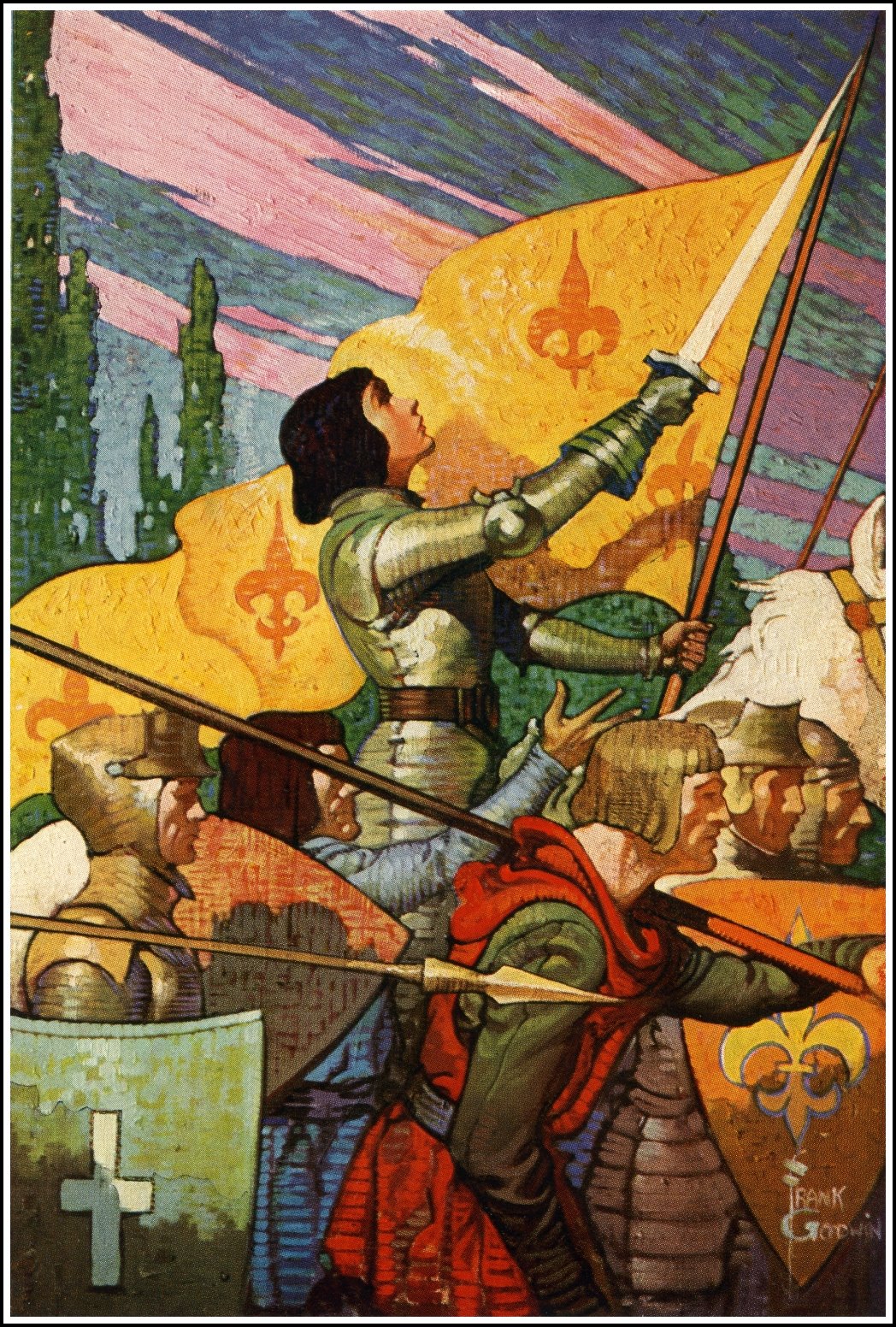
F Schoonover … Nothing to do with the post, just awesome

Those who have delved into the OBBs will recall that the early game had not only clerics, but also anti-clerics. The anti-clerics were, of course, just chaotic clerics who cast the reverse of some of the traditional cleric spells.

Today I started wondering … what about other anti-classes. The cleric’s opposite is based on an opposing alignment. The anti-classes buzzing around in my head, though, are focused on opposing the overall class functions of the other classes to act as an in-game counter to the PC’s.

Anti-Fighters (Harrier): A fighter fights, so an anti-fighter … doesn’t fight? Not much room for a class there. One possibility would be a character that calms tensions and ends fights, but that has more of a magical feel to it, and, frankly, removing combat from the game doesn’t improve the game experience.  To keep our anti-fighter non-magical and to make it fun and interesting, we could instead make the anti-fighter a specialist at countering the tactics and abilities of traditional fighters. When they engage a fighter in combat they slowly improve against that fighter in particular, increasing their AC against them and perhaps forcing the fighter to pass some sort of test or saving through to disengage with them without suffering a free back attack, as many rules allow against combatants that turn and run from a fight. The point of the anti-fighter is to tie up fighters and keep them from doing damage, making them especially potent when accompanied by a large body of 0-level or 1 HD monsters.

Anti-Magic-User (Witch Hunter): This one seems simple. Anti-magic-users cancel out the magical abilities of magic-users. I’m thinking you would use something like the turn undead chart for counter-spelling. In fact, maybe you could extend the concept. Where a cleric destroys or takes control of lesser undead, the anti-magic-user could turn the spell back on the spell caster or block the spell caster from preparing/memorizing the same spell again for a number of days equal to the anti-magic-user’s level. The anti-magic-user should probably have improved saves vs. magic and maybe be able to sniff magic out. Another cool ability would be the ability to drain scrolls, perhaps using that energy to heighten their own magical defenses. Since these dudes wouldn’t have much in the way of fun, active (rather than re-active) abilities, we could ramp up their combat abilities a bit, allowing them to attack as thieves and use the same armor and weapons as thieves.

Anti-Thief (Thief-Taker): The first thing that springs to mind is the classic thief-taker. Where the thing has a set of skills that makes them good at stealing, the anti-thief would have a different set of skills meant to counter them – hide/set traps (find/remove traps), penetrate shadows (hide in shadows), hear footfalls (move silently), silent signals (hear noises), note pilfering (pick pockets) and, well, I can’t think of anything to counter climb walls (nor do I think I need to). I suppose they would also be able to save vs. backstabs, or perhaps their heightened ability to hear the thief creeping up behind them would render back-stabs unlikely. Since their abilities are also focused on defense, one might heighten their combat abilities, perhaps allowing them to attack as a fighter rather than thief, though restricting them to the same equipment as thieves.

So, what do you think? Probably not great as player characters, but they could be interesting as NPCs designed to frustrate the players and force them to switch up their tactics.

I’m picturing a scene where a party busts into an ogre mage’s throne room and finds the ogre mage accompanied by a smattering of goblins (let me at ’em, thinks the party fighters) and four human beings, an anti-cleric, harrier, witch hunter and thief-taker. The party thief attempts to slink into the shadows, but the thief-taker’s eyes follow him unerringly, shouting out his position for the benefit of his comrades in the room. One of the party fighters engages the gibbering goblins, but the other finds himself countered by the harrier, who matches him stroke for stroke. The party magic-user raises his hands to cast magic missile, but finds the spell not only fizzle, but the very knowledge that such a spell exists stricken from his mind! The anti-cleric does his best to match the cleric spell for spell as well.

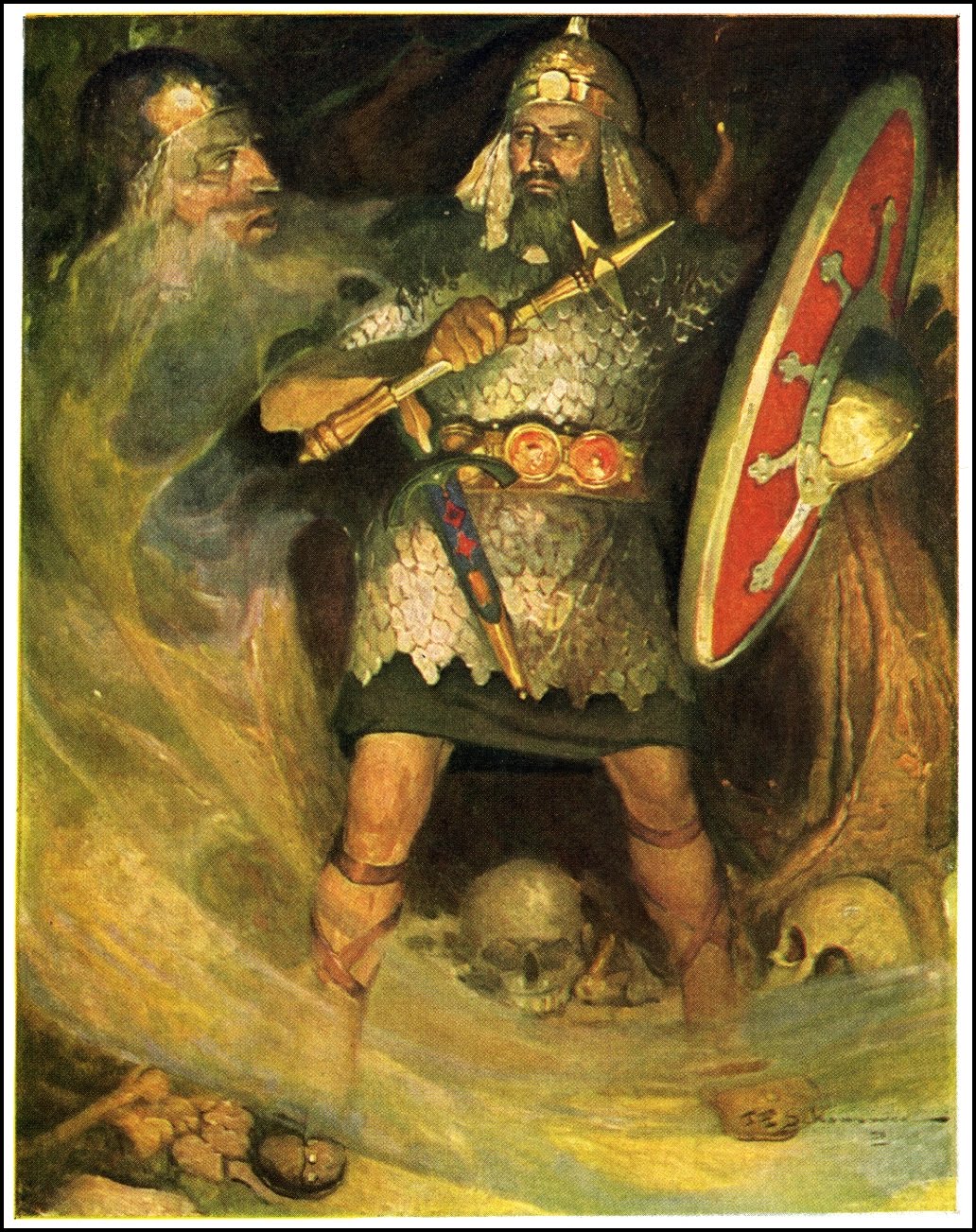
Kinda like this, only more D&D … image found HERE

Woodland Classes I – The Unicorn

A maiden’s best friend, unicorns (and pegasi and other little ponies) are all the craze these days with girls and a few (slightly disturbing) men. We’ve endured many years now of sneering, leather-clad, spiky-shouldered, ridiculously-large-weapon wielding wannabe badasses in dungeons, perhaps it’s time for something sparkly.

Requirements: Wisdom and Charisma 13+, Lawful (Good) in alignment

Hit Dice: d6, +2 per level after 10th

Weapons allowed: None

Armor allowed: Up to chainmail barding

Skills: Find Secret Door, Jump, Listen at Doors, Move Silently, Survival

Advance: As paladin

Attack: As cleric

Saving Throws: As paladin

First level unicorns are medium-sized creatures, with the bodies of goats, heads of horses, snowy-white hair and pearlescent horns growing from their foreheads. They are capable of speaking both Common and Sylvan. They can make one attack each round, either with their alicorn (their horn – yeah, there’s a fancy word for it!) for 1d8 damage, or with their two hooves (as though attacking with two weapons) for 1d4 damage. Unicorns are naturally immune to poison.

A note on climbing: Unicorns, having the legs of goats, are actually quite capable climbers, so long as they have even the smallest ledge (or its equivalent) on which to rest their hooves. For sheer surfaces, unicorns are going to need some help involving ropes and people to pull them.

A 2nd level unicorn’s alicorn strikes as a +1 weapon. This innate magical bonus improves to +2 at 4th level, and +3 at 8th level.

A 3rd level unicorn becomes immune to charm and compulsion-type spells, unless they are cast by a lawful (good) female spellcaster.

A 4th level unicorn gains the innate ability to cast spells with its alicorn. The unicorn prepares and casts spells as a paladin, with each spell being cast from its horn. Spells that require a touch require the unicorn to touch the subject with its horn. The unicorn need not speak to cast these spells, nor otherwise move.

A 5th level unicorn can undertake a quest, guided by a divine vision, to find and gain the service of a chaste, lawful (good) female elven companion. This companion is either a cleric, fighter, magic-user or paladin (roll 1d4) who begins as a 1st level character, but advances one level each time the unicorn advances one level. If the unicorn’s companion dies, it must atone (per the atonement spell) and then wait until gaining another level of unicorn to undertake the quest again.

A 10th level unicorn can establish a serene woodland clearing as its lair. A 12 mile radius circle around the clearing must be cleared of all evil influences before the unicorn can consecrate the clearing. Once consecrated, the unicorn attracts 1d10 creatures to act as guardians of the clearing and associates in its fight for law and good. Roll on the following table to determine these companions.

ROLL D10
1 – Aasimar warrior (2 HD, chainmail, longsword, longbow, 20 arrows)
2 – Brownie
3 – Celestial brown bear
4 – Celestial eagle
5 – Celestial wolf
6 – Druid (1st level; either human, elf or gnome)
7 – Druid (2nd level; either human, elf or gnome)
8 – Dryad
9 – 1d6 pixies
10 – Unicorn

UNICORN SPELLS

First Level: Bless, calm animals, charm person, cure light wounds, detect evil, detect poison, freedom of movement, light, obscuring mist, remove fear, sanctuary, shield of faith, slow poison, virtue

Second Level: Aid, animal messenger, cure moderate wounds, dimension door, lesser restoration, magic circle against evil, neutralize poison, remove paralysis, shield other

Third Level: Charm monster, cure serious wounds, prayer, protection from energy, remove curse, searing light, teleport

Fourth Level: Air walk, cure critical wounds, divine power, holy smite, restoration, teleport without error

The Centurion Class – Go Into Battle With Friends!

Wow – been very busy lately. Sorry for the lack of posts of late, but I’m currently trying to finish writing the NOD Companion, Action X, I’m doing some more freelance stuff for Frog God Games (Tome of Horrors IV!) and I’m putting the finishing touches (editing and layout) to Tanner Yea’s new supplement for Blood & Treasure, Psionics of Lore. It looks like a winner folks.

That being said, I needed to get something posted this week, so …

THE CENTURION

Image from HERE

Fighters might come from many backgrounds, but most adventuring fighters avoid the chaos of the battlefield for the relative simplicity of bashing heads in a dungeon. Centurions, on the other hand, are born and bred for mass combat in the name of king or emperor. They glory in wading into an enemy host with their comrades. When they delve into the lightless depths, they bring friends and know how to make the most of them.

ROLL D8 FOR HIT POINTS (+3 HP PER LEVEL AFTER LEVEL 10)

REQUIREMENTS
Centurions must have a Strength and Charisma of at least 13. They cannot be Chaotic in alignment

ARMOR PERMITTED
Padded, Leather, Studded Leather, Ring, Scale, Chainmail Shirt, Chainmail; All Shields

WEAPONS PERMITTED
Crossbows (All), Dagger, Hand Axe, Javelin, Long Sword, Spear, Short Sword

SKILLS
Bend Bars, Break Down Doors

ADVANCE AS
Fighter

ATTACK AS
Fighter

SAVE AS
Fighter

SPECIAL ABILITIES
Centurions can command double the normal henchmen usually permitted by their Charisma scores, provided those henchmen are men-at-arms armed and armored in the same way as the centurion. Men-at-arms under the command of a centurion gain a +1 bonus to attack, to saving throws and to morale checks. The bonus to morale checks increases to +2 at 4th level, and +3 at 8th level.

When in battle, centurions can lock shields with other centurions, fighter-types and their own men-at-arms. This increases the AC of all involved by +2. While locked, the warriors can still attack with spears, but do so at a -1 penalty to hit. The warriors also gain a +2 bonus to save vs. special maneuvers while in a shield wall.

Centurions are trained as sentries, and thus are only surprised on a roll of 1 on 1d8.

A 3rd level centurion can bestow their shield bonus to AC to any ally within 5 feet, and still attack as normal.

A 6th level centurion learns the skills of an engineer in relation to operating siege weapons.

A 9th level centurion (legatus) can built a fort and design a standard to be flown over his fort and over his person when he is engaged in battle. When he does so, he attracts 1d6 men-at-arms per level, 1d6 first level centurions that wish to train with him and make up his personal guard, and a third level centurion to act as his lieutenant. The centurion’s bonus to his men-at-arms extends to all of his new followers when they share the battlefield with him and they can see his standard.

LVL / TITLE
1 Miles
2 Duplicarius
3 Decanus
4 Cornicularius
5 Optio
6 Centurion
7 Praefectus
8 Tribunus
9+ Legatus

Random Classes – The Download

Image copyright WotC, used w/o permission

Hey folks – quick post today. I wanted to share the link to the groovy little Excel document that Arjen Lissenberg created based on my random class creator idea. Thanks to Arjen for the hard work!

Click HERE for the document. Assuming you have the random value generator thingy operational, you just press F9 to generate class after class (or NPC after NPC, as the case may be).

To prove its immense value, I present three unique NPC’s generated with the sheet.

Sabre LeClerq
Sabre’s base class is rogue. He can wear up to studded leather armor and wield a buckler, and use medium and light melee weapons, light crossbows, short bows and thrown weapons. He has decipher codes and swimming as a class skill, can cast spells as a magic-user up to 3rd level and can turn elementals as a cleric turns undead.

Jasmine X
Jasmine is a scholar who knows how to operate in armor up to a breastplate, and can use bucklers. She can use the same weapons as Sabre, can cast spells as a druid up to 3rd level, can cast spells as a sorcerer, can speak with all living creatures and she has a psychic power.

Rugor the Red
Rugor is also a rogue who can wear up to ring mail. He can use shield and buckler and fight with light melee weapons, light crossbows, short bows and thrown weapons. Rugor has the Great Fortitude feat, has escape bonds as a class skill and knows how to cast a single 1st level ranger spell each day and a single 0-level cleric spell per day.

I can imagine each of these three making for an interesting henchman for a PC.

It Had to Happen: Random Classes

Image found here

How could a game built on a foundation of platonic solids not have random classes? It’s inconceivable (and yes, the word does mean what I think it means).

Now, a completely random class is, on the face of it stupid. I know this. But, let’s think about this. Some people set out in life with a goal, and they stick to it and eventually become what they set out to become. A young Merlin (well, old Merlin I guess – it’s confusing with that guy) decides he wants to be a magic-user, he works hard, gets a few lucky breaks, and eventually makes it to 1st level and heads off into a dungeon.

But some folks play it by ear. They don’t know where their going, and on their way to 1st level, maybe they pick up a wide array of skills. You know, somebody like … Conan the Freaking Barbarian. How many jobs did that kid have? Started out a barbarian in Cimmeria, became a thief, then later a pirate, etc. Guy was all over the place. Thus – random classes.

Here’s the way it works. First roll puts you into a broad category of fighting skills and saving throws – warrior, mage or rogue. This role impacts your additional rolls, which will determine what weapons and armor you can use, and what special abilities and/or skills you managed to pick up. Some of those special skills introduce ability score requirements. If you don’t have a high enough ability score, you have to roll again.

One note: These tables assume you’re using Blood & Treasure. You can probably adapt them to your favorite system.

On to the random nonsense …

ROLL ONE – KNOW YOUR ROLE

Roll D6

1-2. Warrior – advances as Fighter

3-4. Rogue – advances as Thief; rogues add +15% to all future percentile rolls.

5-6. Scholar – advances as Magic-User; scholars add +30% to all future percentile rolls.

ROLL TWO – GIRD YOUR LOINS

Roll D%

ARMOR PERMITTED
01-5. All
6-10. Platemail, banded mail, splint mail, breastplate, chainmail, scale mail, chainmail shirt, studded leather, ring mail, leather armor, padded armor
11-20. Banded mail, splint mail, breastplate, chainmail, scale mail, chainmail shirt, studded leather, ring mail, leather armor, padded armor
21-30. Splint mail, breastplate, chainmail, scale mail, chainmail shirt, studded leather, ring mail, leather armor, padded armor
31-40. Breastplate, chainmail, scale mail, chainmail shirt, studded leather, ring mail, leather armor, padded armor
41-50. Chainmail, scale mail, chainmail shirt, studded leather, ring mail, leather armor, padded armor
51-60. Scale mail, chainmail shirt, studded leather, ring mail, leather armor, padded armor
61-70. Chainmail shirt, studded leather, ring mail, leather armor, padded armor
71-80. Studded leather, ring mail, leather armor, padded armor
81-90. Ring mail, leather armor, padded armor
91-100. Leather armor, padded armor
101-115. Padded armor
116-130. No armor permitted

SHIELD PERMITTED
01-30. All shields
31-50. Shield and buckler
51-80. Buckler
81-130. No shields

ROLL THREE – GRAB A POINTY STICK

Roll D%

01-30. All weapons, melee and ranged
31-80. Medium and light melee weapons, light crossbows, short bows and thrown ranged weapons
81-130. Light melee weapons, light crossbows, short bows and thrown ranged weapons

ROLL FOUR + – GET SPECIAL!

Characters are permitted 1d3+2 rolls on the special abilities table. Abilities that are “as” a character class use the rules for that class’s ability and gain that ability or enhancements to that ability at the same levels as that class does.

Roll D%

1. Smite Chaos (Lawful, Wis 13+)
2. Favored enemy as ranger (Wis 13+)
3. Whirling Frenzy (Dex 13+)
4. Rage as barbarian (Con 13+)
5. Sixth sense as barbarian
6. Weapon specialization as duelist, though you may choose any weapon
7. Add Intelligence bonus to AC (Dex 13+)
8. Spring into combat as duelist (Dex 13+)
9. Riposte as duelist (Dex 13+)
10. Roll with lethal blow as duelist (Dex 13+)
11. Dominate foes as fighter
12. Multiple attacks as fighter
13. Steadfast as defender [fighter variant] (Con 9+)
14. Alertness feat as a class ability
15. Bull Rush feat as a class ability
16. Cleave feat as a class ability
17. Disarm feat as a class ability
18. Dodge feat as a class ability
19. Expertise feat as a class ability
20. Grapple feat as a class ability
21. Great Fortitude feat as a class ability
22. Iron Will feat as a class ability
23. Lightning Reflexes feat as a class ability
24. Power attack feat as a class ability
25. Sunder feat as a class ability
26. Two Weapon Defense feat as a class ability
27. Two Weapon Fighting feat as a class ability
28. Weapon Finesse feat as a class ability
29. Bend Bars as class skill
30. Break Down Doors as class skill
31. Find Secret Doors as class skill
32. Jump as class skill
33. Riding as class skill
34. Survival as class skill
35. Tracking as class skill
36. Swimming as class skill
37. Trickery as class skill
38. Balance as class skill
39. Climb Sheer Surfaces as class skill
40. Escape Bonds as class skill
41. Find Traps as class skill
42. Hide in Shadows as class skill
43. Listen at Doors as class skill
44. Move Silently as class skill
45. Open Locks as class skill
46. Pick Pockets as class skill
47. Remove Traps as class skill
48. Decipher Codes as class skill
49. Legend Lore as bard (Int or Cha 13+)
50. Haggle as a venturer (Cha 13+)
51. Add +1 to reaction rolls (Cha 13+)
52. Get 15 gp per point of Charisma at character creation instead of 10 gp per point of Charisma (Cha 13+)
53. Backstab as thief
54. Use poison as assassin
55. Concoct explosives as anarchist (Int 13+)
56. Paralyze foes as assassin (Dex 13+)
57. Improve AC as monk (Dex 13+)
58. Increased attacks as monk (Dex 13+)
59. Increased unarmed damage as monk (Wis 13+)
60. Increased speed as monk (Con 13+)
61. Deflect arrows as monk (Dex 13+)
62. Damage creatures only harmed by magic as monk (Wis 13+)
63. Slow fall as monk (Dex 13+)
64. Immune to disease (Con 13+)
65. Feign death as monk (Wis 13+)
66. Heal own wounds as monk (Con 13+)
67. Immune to poison (Con 13+)
68. Quivering palm attack as monk (Con 13+, Dex 13+, Wis 13+)
69. Speak with all creatures (Wis 13+)
70. Fascinate as bard (Cha 11+)
71. Suggestion as bard (Cha 13+)
72. Break enchantment as bard (Cha 13+)
73. Detect evil at will as paladin (Wis 13+)
74. Lay on hands as paladin (Wis 13+)
75. Immune to fear (Cha 13+)
76. Summon warhorse as paladin (Cha 13+)
77. Cure disease as paladin (Wis 13+)
78. Resistance to acid (Con 13+)
79. Resistance to cold (Con 13+)
80. Resistance to electricity (Con 13+)
81. Resistance to fire (Con 13+)
82. Resistance to sonic and +2 vs. song-based abilities (Con 11+)
83. Vampire slayer – +2 save vs. undead abilities
84. Dragon slayer – +2 save vs. dragon abilities
85. Turn or rebuke undead as cleric (Lawful or Chaotic, Wis 9+)
86. Turn elementals (Wis 9+)
87. Turn oozes (Wis 9+)
88. Turn dragons (Wis 9+)
89. Rebuke animals (Cha 13+)
90. Move through undergrowth as druid or ranger (Wis 13+)
91. Leave no trail as druid (Wis 13+)
92. +2 save vs. all energy attacks (Con 9+)
93. Change shape as druid (Con 13+, Wis 13+)
94. Protection from evil effect as paladin (Lawful, Wis 13+)
95. Darkvision to a range of 60 feet
96. Gain a psychic power as a psychic (player’s choice)
97. Cast a single 0-level spell 1/day (roll list and actual spell randomly)
98. Cast a single 0-level spell 3/day (roll list and actual spell randomly)
99. Cast a single 1st level spell 1/day (roll list and actual spell randomly)
100. Cast a single 1st level spell 3/day (roll list and actual spell randomly)
101-120. Cast spells, up to level 3*
121-125. Cast spells, up to level 6*
126. Cast spells, up to level 9*
127-129. Cast spells as sorcerer
130. Roll twice on this table, ignoring this roll

* The first time you gain spellcasting abilities, roll randomly to decide which list you use. If you gain the ability to cast higher level spells, use the same list.

1. Assassin (only up to 3rd level)
2-3. Bard (only up to 6th level)
4-9. Cleric
10-12. Druid
13-18. Magic-User
19. Paladin (only up to 3rd level)
20. Ranger (only up to 3rd level)

And there you have it. It could be a fun way to roll up NPC’s – though the short hand of the existing classes is pretty convenient, or a way to throw together a really interesting party for a one night delve into a classic dungeon. Just remember to roll your dice responsibly.

JMS

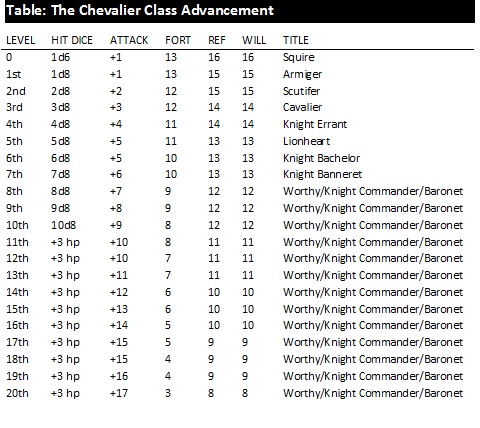
The Chevalier

Whether knights in shining armor or blackguards, chevaliers are the mailed fist of the feudal order, serving their suzerain in war and peace. At the heart of a chevalier’s pride (or arrogance), is his coat of arms, a symbol of his puissance at arms and place in the great chain of being. From a chevalier’s armorial, he draws powers beyond the simple hack and slash of the average fighter.

The chevalier is a sub-class of fighter who gains special abilities from the invocation of his coat of arms, in particular from his the tincture of the field (or main tincture of the field, since some are divided) and from the charge.

Requirements

Strength of 9 or higher and Charisma of 13 or higher. A character that does not have a Charisma of 13 or higher can still enter the chevalier class, but does so as a 0-level character called a squire (see below)

Armor Allowed

Any armor except padded, leather, studded, ring (i.e. scale or better), and bucklers and shields

Weapons Allowed

All weapons

Skills

Riding

XP Requirements

As fighter

Special Abilities

Before we cover the special abilities of a chevalier, we must address the concept of a 0-level chevalier, the squire. Some men are not born as wealthy or well-connected as others, yet they still have the drive to become knights. These poor souls (i.e. folks with low charisma) can still enter the service of a suzerain, holding the rank of “squire”.

A squire earns experience points just as any other character, but can only spend them to increase his or her charisma. One point of charisma can be purchased by the squire for 200 XP. When the squire achieves a charisma of 13, he or she becomes a 1st level chevalier and their experience points are reset to 0.

The first step to becoming a chevalier is to draw up a coat of arms. A perusal of the internet can assist in this, and your Treasure Keeper can make sure you haven’t copied the arms of an existing NPC or PC in the game world. The tincture and charge of a chevalier’s arms determine their special abilities, so read the entire description of the class before designing your arms.

A 1st level chevalier (armiger) can invoke their tincture once per day. The special ability associated with the tincture lasts for one hour. If a chevalier has more than one tincture on his arms (i.e. he has divisions), they must choose which tincture is their “main tincture” at 1st level. At 5th level, the chevalier can invoke their tincture three times per day.

Argent (Silver/White): The chevalier gains use of feat Fast.
Azure (Blue): The chevalier gains the use of the feat Expertise.
Ermine/Vair (Furs): The chevalier gains the use of the feat Alertness.
Gules (Red): The chevalier gains the use of the feat Power Attack.
Or (Gold/Yellow): The chevalier gains the use of the feat Iron Will.
Purpure (Purple): The chevalier gains the use of the feat Great Fortitude.
Sable (Black): The chevalier gains the Trickery skill.
Vert (Green): The chevalier gains the Tracking skill.

A 3rd level chevalier (cavalier) can invoke the charge on his coat of arms to gain a special attack or defense, most of them the equivalent of a spell. A 3rd level chevalier can invoke his charge once per day. A 10th level chevalier can invoke his charge three times per day.

Angel: Cure serious wounds (per the spell)
Arm: Strength (per the spell)
Bear: Chevalier can grapple (as though he has the Improved Grapple feat) for 1d8 points of damage
Bee: Chevalier can summon a giant bee (per summon monster IV)
Boar: Chevalier can continue to fight for 1d6 rounds after reaching 0 hit points, as a boar
Bull: Forceful hand (as the spell, though the attack bonus is only +8)
Castle: Stoneskin (per the spell)
Cross: Holy smite (per the spell)
Deer: Haste (per the spell)
Devil: Inflict serious wounds (per the spell)
Dolphin: Chevalier can swim at a speed of 80, as a dolphin, even when armored
Dragon: The dragon charge on his shield releases a breath weapon in a 15-ft. cone that deals 3d6 points of damage of an energy type associated with the color of the chevalier’s dragon charge
Eagle: Fly (per the spell)
Estoile/Mullet: Psionic blast (per the spell)
Fleur-de-lis: Magic vestment (per the spell)
Fox: Charm monster (per the spell)
Griffin: Magic circle against evil (per the spell)
Harp: Fascinate as a bard of the chevalier’s level
Harpy: Can captivate per the special attack of the harpy
Heart: Immune to fear
Leopard: Invisibility (per the spell)
Lion: Heroism (per the spell)
Mermaid: Water breathing (per the spell), and can swim without penalty in armor
Owl: Dispel magic (per the spell)
Phoenix: Continual flame (per the spell)
Raven: Deeper darkness (per the spell)
Rose: Suggestion (per the spell)
Salamander: Protection from energy (fire) (per the spell)
Serpent: Sticks to snakes (per the spell)
Sphinx: Confusion (per the spell)
Spur: Phantom steed (per the spell)
Sun: Searing light (per the spell)
Sword/Axe: Keen edge on a weapon of the same general type as the charge (per the spell)
Tree: Barkskin (per the spell)
Wolf: Chevalier can summon 1d4 wolves (per summon monster IV)
Wyvern: Poison (per the spell)

A 4th level chevalier (knight errant) can inspire courage in his henchmen and retainers, giving them a +2 bonus to save vs. fear effects as long as they are within the sound of his voice.

An 8th level chevalier (worthy) earns the right to build a castle and either start an order of chivalry (becoming a “knight commander”) or swear fealty to a royal personage (becoming a “baronet”). A chevalier with a castle attracts 1d6 men-at-arms per level, 1d6 first level chevaliers who wish to train under him and one 3rd level chevalier to serve as his castellan. These chevaliers should be generated as characters under control of the player.

The Anarchist Class

In case anyone is unaware, the following class is based on my reading of the first few chapters of The Man Who Was Thursday, a “surreal” little volume by G. K. Chesterton about the fight between the Central Council of Anarchists and the poets who form the New Police Force.

The Anarchist

There are anarchists – the garden variety of folks who talk about toppling governments in the name of ultimate freedom, and back it up with a bomb or two, and there are the true anarchists, who look to a higher form of anarchy that cannot exist within the human (or, in fantasy terms, the humanoid) community. These fellows seek not the toppling of governments, but the toppling of humanity (or humanoidity – weird word, have no idea if it’s correct) itself.

As this would be an unpopular tack to take among the living, the true anarchists face a great deal of opposition, and therefore must organize themselves, ruthlessly and efficiently, to achieve their goals. To this end, there exists a great organization of anarchists governed by a council of seven, each member of this inner council being named for a day of the week. All anarchists seek to rise to this council, but all anarchists must first start on the ground floor, advancing the byzantine aims of the central council in the world. Just as the forces of Law delve underground in search of treasure and magic to fuel their fight against chaos, so chaos must delve to match them.

Requirements

True anarchists are artists and intellectuals; they must have a Int of 11+ and a Cha of 11+

Armor Allowed

Padded (under their expansive black cloaks), no shields

Weapons Allowed

Bomb, dagger, hand crossbow, pistol, sword-cane (treat as rapier)

Skills

Hide in Shadows, Move Silently, Trickery

Advance As

Thief

Special Abilities

Anarchists bring many special abilities to the table in their fight against Law (especially the likes of vigilantes and paladins – yuck!), but among the most important is their ability to concoct explosives. A 1st level anarchist can concoct normal explosives that become more powerful as they advance in level. In addition, they gradually learn to concoct different forms of explosives, per the following table:

LVL / BOMB / COST TO CREATE
1 Grenade (1d6 damage) 10 gp
3 Smoke grenade (per fog cloud spell) 200 gp
5 Grenade (2d6 damage) 50 gp
7 Gas grenade (per stinking cloud spell) 300 gp
9 Grenade (3d6 damage) 100 gp
11 Death Grenade (spews a black fog, per the cloudkill spell) 500 gp
13 Grenade (4d6 damage) 200 gp
15 Incendiary Grenade (per incendiary cloud spell) 800 gp

All of these bombs have a blast radius of 5 feet. An anarchist of higher than 1st level can choose to sacrifice one dice of damage to increase the radius by 10 feet.

Anarchists have their own secret language, in the manner of the thieves’ cant. Called the “black tongue”, it is, more than anything else, a gobbledygook of quotations and dialectics.

With their bombs and their secret tongue, anarchists are sent into the world to work the will of their shadowy masters. To this end, they are given instructions that must be carried out – instructions they will rarely understand, so dark and brilliant are the workings of their president. Before each adventure begins, an anarchist receives a random instruction. If it is carried out, the anarchist earns an additional +10% earned XP. If the anarchist fails at his mission, he loses 10% of his earned XP.

ROLL / MISSION
1 Must befriend and protect the first to third (1d3) NPC he meets
2 Must kill the first to third (1d3) NPC he meets
3 Must pilfer the first to third (1d3) magic item he encounters
4 Must dispose of the first to third (1d3) magic item he encounters (i.e. get rid of it)
5 Must betray (at all costs) a random comrade
6 Must support (at all costs) a random comrade

A 3rd level anarchist is capable of unleashing a raging oratory that works in some ways as a bard’s ability to fascinate sentient creatures with his music. Those within the sound of the anarchist’s voice must pass a Will saving throw or suffer under the effects of the rage spell and vent their spleen upon the nearby symbols and agents of authority. Lawful individuals enjoy a +6 bonus to save vs. this effect, while chaotic creatures suffer a -3 penalty to save against it.

A 5th level anarchist possesses a madman’s sense of purpose and certainty. By taking a swig from their ever-present flask of brandy, they become immune to fear and magical persuasion for 1 round per level.

A 9th level anarchist may build a hideout beneath the streets of a major city, hiding within it a vast armory of weapons and bombs, and attracting to him or her 1d6 rogues per level, 1d6 first level anarchists who wish to learn from the master and a 3rd level anarchist to serve as his or her lieutenant.

Once an anarchist has a hideout, he or she is eligible to be elected to the central council, gaining a random name from Monday to Saturday. Each game month, there is a 1 in 20 chance that a sitting member will die and must be replaced, and the anarchist has a percentage chance equal to his level of being named to the position (with bonuses for any clever campaigning the anarchist does).

A similar chance exists for anarchists already on the council to assuming the presidency of the council and taking the name Sunday.

The Vigilante

The war on chaos cannot be won in the streets alone, for beneath those streets, in hidden places, the lords of chaos lurk and plot the destruction of all that is lawful and good. The vigilante is a warrior against chaos who isn’t afraid to get his hands dirty. He’s not a shining knight, like the paladin, or a beacon of hope like the cleric, but rather a rugged street warrior on par with the thief, but playing for the other side.

The vigilante really doesn’t belong in medieval European fantasy. He is a creature of the lurid penny dreadfuls, dime novels and pulp magazines of the late 19th and early 20th centuries. The Shadow is one of the more famous of these dark avengers, but he is not alone and the stock type survives to this day. Vigilantes are expected to be resourceful, cunning, handy with their fists (and whatever else they can find to bash in their opponent’s head) and sneaky. They employ many of the techniques and skills of their less exotic foes, thieves and assassins, and thus also dress and arm themselves much like these rogues.

ROLL D8 FOR HIT POINTS

REQUIREMENTS
Strength, Dexterity and Intelligence of 13+; Vigilantes must be Lawful (Good)

ARMOR ALLOWED
Padded armor, leather armor, studded leather armor, ring mail, mithral chainmail and bucklers

WEAPONS ALLOWED
Crossbows (any) and all light melee weapons

SKILLS
Balance, climb walls, escape bonds, hide in shadows, jump, listen at doors, move silently, open lock, tracking, trickery

XP ADVANCEMENT
Vigilantes advance as paladins

CLASS ABILITIES
Vigilantes must hide their true identity, lest their value as a crime fighter be negatively affected. While wearing their mask, the vigilante enjoys a +2 bonus to save vs. fear and other mind affects, including mind control. In addition, they can attempt to cause fear (per the spell) in humanoid creatures with no more than half the vigilante’s hit dice. Thus, a 1st level vigilante can cause fear in 0 hit dice creatures, while a 10th level vigilante can cause fear in creatures with 0 to 5 hit dice. If unmasked, the vigilante loses these bonuses and abilities.

Vigilantes have the same need to disable foes quickly that thieves and assassins have, but are often bound by their code of conduct not to kill their victims. A vigilante has the same skill at backstabs as thieves, but any time they would normally kill their target and are employing a bludgeoning weapon, they can instead choose to reduce their victim to 1 hit point and knock them unconscious for 1d6 turns. The victim can attempt a Fortitude saving throw to cut this time in half, but make sure the vigilante is unaware of whether this saving throw is successful or unsuccessful.

Vigilantes are known for their resourcefulness, often having just the piece of equipment they need to beat any situation. As long as a vigilante has at least ten pockets, pouches or sacks (or their equivalent) on their person, they can spend 50 gp to fill them with “miscellaneous gear”. When, during an adventure, a vigilante suddenly needs something that is not on their equipment list other than a weapon, armor, money or magic item, they can attempt a Will saving throw modified by Intelligence to find that item in one of their pouches. If the item costs less than 10 gold pieces, there is no modifier to this saving throw. For every 10 gp of value an item has, this roll is modified by -2. If the roll is successful, the contents of one pouch are now known (i.e. the vigilante can only do this as many times as they have pouches or sacks) and the item is added to the vigilante’s equipment list.

At 6th level, the vigilante can choose an arch-nemesis for themselves. If this is a unique creature (i.e. Gork, the Guildmaster of Assassins in the city of Yorok), the vigilante enjoys a +2 bonus to hit and damage them, a +2 bonus on task checks made to find or defeat them, and a +2 bonus to save vs. their special abilities (if any). Once this unique arch-nemesis is defeated, the vigilante may choose a new arch-nemesis.

The vigilante can, instead of choosing a unique arch-nemesis, choose an entire class of creatures as his arch-enemies. Sample arch-enemies could be goblins, thieves, chaotic magic-users, green dragons or devils. Against his arch-enemies, the vigilante enjoys a +1 bonus to hit and damage them, a +1 bonus on task checks made to find or defeat them, and a +1 bonus to save vs. their special abilities (if any).

A 9th level vigilante can establish a hideout to serve as his secret base of operations within a settlement or in the wilderness near a settlement. This signifies that the settlement is under the vigilante’s protection. The vigilante attracts a 3rd level vigilante to serve as his sidekick and apprentice, and earns one contacts per level within the city-state. Use the following table to determine the general occupation of these contacts.

Contacts are a source of information (and adventures) and have varying amounts of loyalty to the vigilante based on their alignment:

This loyalty is the percentage chance they will cooperate with the vigilante and do special (though not overtly dangerous favors) for the vigilante. Dangerous favors, or resisting torture to protect the vigilante, are made at half normal loyalty.

Holly Jolly Warriors for Your Dungeon

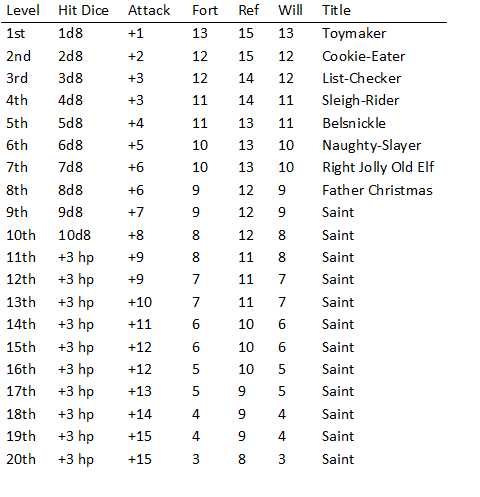
‘Tis the season for being goofy, don’t you know, so I present this long overlooked fantasy archetype for your favorite fantasy game. Check you stocking for dice, roll up a kringle, and go slip the hobgoblins some coal (and cold steel) upside their pointy heads.

KRINGLE

H/T Trey’s Sorcerer’s Skull Blog

Kringles are holy warriors dedicated to generosity to the poor, protection of the weak and punishment of the wicked. They adventure to take their war on naughtiness into dungeons and to acquire enough wealth to one day build a fortified workshop of their own.

ROLL D8 FOR HIT POINTS

REQUIREMENTS
Strength and Wisdom of 13+; Kringle’s must be Lawful or Lawful Good, depending on what alignment scheme you use.

ARMOR ALLOWED
Any armor and shields

WEAPONS ALLOWED
Any bludgeoning weapon

SKILLS
Escape Bonds, Move Silently, Riding

XP ADVANCEMENT
Kringles advance as paladins

CLASS ABILITIES
A kringle can use the know alignment spell at will; he knows just by looking at you whether you’ve been naughty or nice. In addition, they are capable of squeezing through very small openings, as though they were tiny in size.

A 2nd level kringle is capable of using the minor creation spell, though they can only create an item if they have a sack from which to pull it. At 6th level, a kringle can use minor creation three times per day, and major creation one time per day. A 9th level kringle can use minor creation at will, and major creation three times per day.

A 3rd level kringle is immune to fear. Each ally within 10 feet of him gains a +2 bonus on saving throws against fear. In addition, a xxx gains immunity to all diseases, including supernatural and magical diseases.

A 4th level paladin (gallant) gains the ability to turn constructs, as a cleric turns undead, as a cleric three levels lower.

A 5th level kringle can undertake a quest, guided by a divine vision, to find and gain the service of an unusually intelligent, strong, and loyal reindeer to serve her in her crusade against naughtiness. If the kringle’s mount dies, he must atone (per the atonement spell) and then wait until gaining another level of kringle to undertake the quest again.

A 9th level kringle is capable of using time stop once per day. This increases to three times per day at 16th level.

At 9th level, a kringle is permitted to use crystal balls as though they were magic-users. How else could they know when folks are sleeping or when they’re awake?

An 11th level kringle can choose to establish a workshop in the wilderness and gain followers (see High Level Play below). A kringle who becomes a lord or lady attracts 1d6 gnome artisans per level, 1d6 automatons (1st level fighters – toy soldiers, get it?) and one 3rd level kringle to serve as a foreman. The automatons and the kringle should be generated as characters under control of the player.

Fighter Moves – a Feat Hack

Found at Wikipedia

Anyone who regularly reads this blog knows that I like taking existing mechanics from the SRD and playing around with them. Today, while I was working on the NOD Companion (on the illusionist class renamed as the trickster) an idea for messing with combat feats popped into my head. The idea is based on the excellent maneuver concept in the Dragonfist RPG.

Basically, I took each of the combat feats and assigned it a level from 1 to 5 based on how many prerequisite feats it had. I then used the bard spells per day table as a guide for the number of fighter moves a fighter could perform each day of each level. I suppose other fighting classes could use this as well, perhaps as a fighter one level lower.

Fighters should begin the game knowing two moves, and then gain a new move at each level, choosing from any level of moves they have available to them based on their own level. One could also use the spell research rules to allow fighters to invent new moves.

The list of moves follows – note that it’s extremely spare at 4th and 5th levels – I suppose I could do some open content feat research and flesh it out, but for my purposes of exploring the idea and presenting it to folks who might want to use it, this will do.

The rules – well, on his turn, a fighter could perform a move in addition to attacking. Simple as that. If the move is an action – such as cleave – assume it is “instantaneous”. If the move involves a static bonus – such as weapon focus – then it lasts for a number of rounds equal to the fighter’s level. Simple and straight-forward, and thus there are probably all sorts of holes in it. Again, this is an exploration, not a full-blown system.

FIGHTER MOVES

1st level
1. Blind-Fight
2. Combat Expertise
3. Combat Reflexes
4. Dodge
5. Improved Critical
6. Improved Initiative
7. Improved Shield Bash
8. Improved Unarmed Strike
9. Mounted Combat
10. Point Blank Shot
11. Power Shot
12. Quick Shot
13. Rapid Reload
14. Two-Weapon Fighting
15. Weapon Finesse
16. Weapon Focus

2nd level
1. Cleave
2. Deflect Arrows
3. Diehard
4. Far Shot
5. Greater Weapon Focus
6. Improved Bull Rush
7. Improved Disarm
8. Improved Feint
9. Improved Grapple
10. Improved Overrun
11. Improved Sunder
12. Improved Trip
13. Improved Two-Weapon Fighting
14. Mobility
15. Mounted Archery
16. Precise Shot
17. Rapid Shot
18. Ride-By Attack
19. Stunning Fist
20. Trample
21. Two-Weapon Defense
22. Weapon Specialization

3rd level
1. Great Cleave
2. Greater Two-Weapon Fighting
3. Greater Weapon Specialization
4. Improved Precise Shot
5. Manyshot
6. Snatch Arrows
7. Spirited Charge
8. Spring Attack

4th level
1. Shot on the Run

5th level
1. Whirlwind Attack