Armor Up Like a Barbarian

Once upon a time, there was pretty realistic armor floating around in the fantasy realm – the stuff you would expect out of folks who did a little research at the local library. And then the 1980’s arrived on the scene …

In the spirit of ridiculous, barbarian-style armor, I present the following scheme:

Armor is for cowards, and nobody likes or respects a coward – not buxom serving wenches, not grizzled men-at-arms, not squirrely thieves, not fat merchants and certainly not the local lord with a quest that needs fulfilling.

In old school parlance, being unlikable = low charisma.

In a barbarian milieu, armor = cowardice.

The barbarian uses piecemeal armor. Each fledgling barbarian hero can decide, at character creation, to buy as many pieces of armor as they like – well, up to 8 anyways. Each piece costs 25 gp, improves one’s Armor Class by 1 and reduces their charisma score by 1. A barbarian cannot allow their charisma to fall below 3, so starting out with low charisma puts a solid ceiling on how much armor you get to wear as a barbarian. This doesn’t sound fair? By Crom, barbarians don’t whine about life not being fair – go be paladin you lousy #$%#%.

For each piece of armor you order, you roll on the following table – after all, only a real poser would actually go out and buy mismatched, piecemeal armor – barbarians pick it up off the bodies of the slain.


Note: Bits and straps of leather don’t count here – just metal. Leather up all you want.

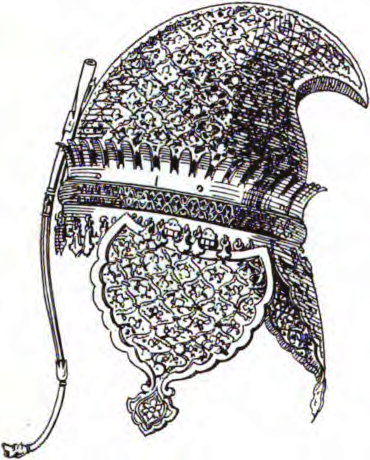
1. Helm (5% chance of wicked horns – if you have horns, you keep your point of charisma)


2. Sabatons (if this is your only piece of armor you lose an extra point of charisma – what kind of dork walks around with nothing but metal shoes)

3. Breastplate or shirt or mail or scales (+2 AC and -2 charisma)

4. Arm (right or left, your choice sport)

5. Leg (right or left, you choice sport)

Always protect yer fightin’ leg!

6. Shield (why does a shield dock your barbarian street cred? Because you should be wielding a honking big two-handed sword or axe, jerkwad)

7. Shoulder guards (if your charisma is still 15 or higher, you can add a cape; otherwise it would just make you look like a stupid poser)

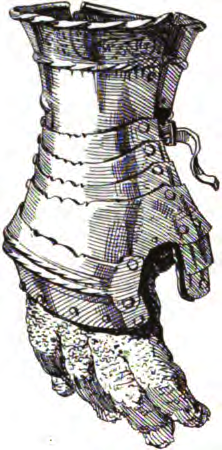
8. Gauntlet (5% chance of being spiked, which grants +1 bonus to damage each time you score a hit in combat)

9. Mail Loincloth (add mail brassiere if female, unless you want to kick it amazon style)

[You can Google “chainmail loincloth” on your own, chief]

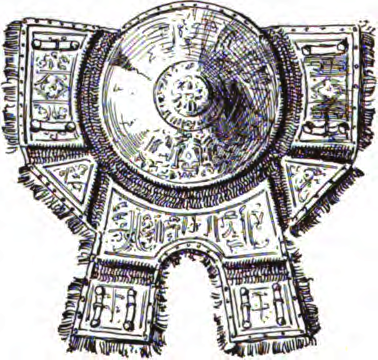
10. Disc Armor (not as dorky as a breastplate, but still shows a lack of self-confidence, which is like a taped up pair of eyeglasses to a barbarian)

You can scrounge other pieces as you adventure, but note – adding a piece still means losing charisma, which means fewer retainers, lower reaction checks and probably some kind of penalty to carousing.

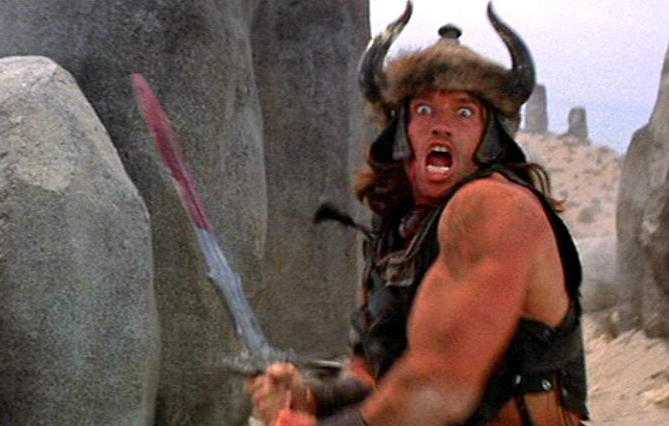
Don’t worry Conan, we can forgive the horned helmet … just not the acting

Let’s Get Grimm … Nursery Rhyme Monsters III

Yeah, I know, this is taking forever. What can I say?

Nixie: Nixies dwell in the rivers and streams of Fairyland, and are more apt to be seductive and cruel than playful and kind. They are aligned with Hearts, and are wicked 75% of the time.

Ogre: Ogres in Fairyland come in two varieties, the traditional man-eating lout who carries a club and takes great delight in frightening people with their fangs, and the spellcasting ogre mages who cultivate a veneer of civilization (though they remain just as thoroughly wicked and hungry for human beings), like the one who appears in Puss-in-Boots. Either way, they conform to the ogre and ogre mage stats in traditional D&D. Ogres are aligned with Clubs (wicked) and ogre mages with Diamonds (wicked).

Pixie: Pixies (or sprites) are the most numerous of the fairy folk. They dwell in meadows and glades and disguise their villages with cunning illusions. Many become attendants of fairy knights.

Rat Swarm: We all remember the tale of the Pied Piper, and thus know that great swarms of rats have a definite place in Fairyland. Many fairy tales were born during the plague years of Europe, and thus rat swarms in Fairyland always carry that disease with their bite.

Rat Swarm: HD 4; AC 5; Atk 1; Dmg 1d6 + save vs. disease; Move 150; Save as Ftr 4

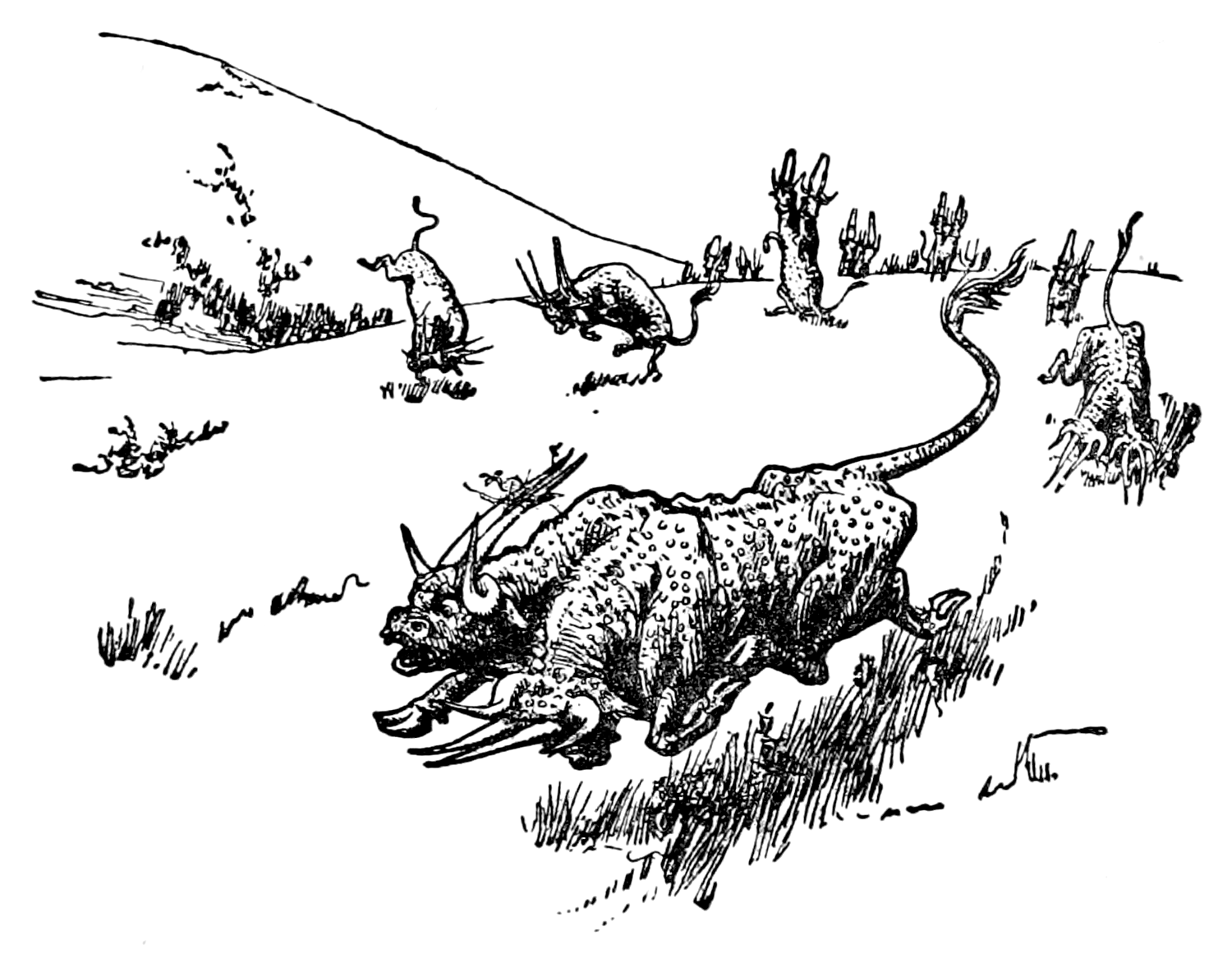
Red Bull: Red bulls are two-headed, fire-breathing bulls that can be treated as chimeras without the wings, sans the dragon and lion bite attacks, but with two butt/gore attacks. They are aligned with Clubs (wicked)

Revenant: Zombies in MG&G are called revenants. They differ from traditional D&D zombies by retaining their intelligence and memories (and alignment), though they are always twisted and wicked in their dealings with the living. It is not uncommon to find them traveling with their coffins upon their backs.

Robber: Robbers are the bandits of MG&G, and conform to the stats for bandits or brigands. They may form small gangs (3d6 individuals) who waylay travelers through woodlands, or they might form larger bodies (up to 40!) who have their lairs in secret caves and attack entire villages for the purpose of plunder.

Roc: The mighty roc makes an appearance now and again in Fairyland, swooping in from balmy seas beyond the mountains of Jinnistan on its way to visit the east wind. They are aligned with nothing and nobody.

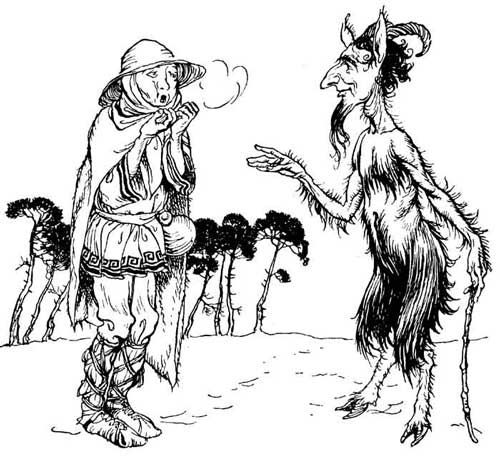
Satyr: Satyrs in MG&G are the same as in D&D, save they are a bit hornier and more frightening. Satyrs are aligned with Hearts, and though not completely wicked, they definitely push the boundaries of polite behavior and have significant difficulties in restraining themselves around females (save vs. spells).

Sorcerer: Sorcerers are men who practice the magical arts, and are thus capable of casting spells as fairy godmothers (roll level on 2d4). Sorcerers may be aligned with any of the factions, but 5 in 6 are thoroughly wicked and corrupt due to their willingness to deal with demons. 1 in 6 sorcerers is a white magician.

Sphinx: Sphinxes are not common in Fairyland, but they do exist. All sphinxes in Fairyland are gynosphinxes, and they are typically aligned with Clubs (wicked), as they enjoy throttling travelers who cannot answer their riddles.

Treant: The treants of Fairyland are pretty similar to those of traditional D&D, save they are usually incapable of moving around. A treant that isn’t talking is only recognized as a treant on a roll of 1 on 1d6 (or 1-3 on 1d6 for dwarves and fairy knights and other fairy folk). Treants do not get on well with woodsmen. Treants are often aligned with Hearts, but some trees are aligned with Clubs.

Troll: Trolls adhere to the same rules as in traditional D&D, with the exception that some of them turn to stone in the light of the sun (either permanently, or only until nightfall). All trolls must save vs. spells or run in terror when they hear the peeling of church bells.

Wicked Witch: Hags in MG&G are known as wicked witches. They are not, of course, old misunderstood women, but evil fairies who seek out the helpless and innocent to consume. Just use the various hag stats in D&D, but give them the ability to cast spells as fairy godmothers. Wicked witches are aligned with Clubs (wicked).

Let’s Get Grimm … Nursery Rhyme Monsters II

Sorry for the delay in getting this baby out – work has been crazy busy for the past couple weeks (in a good way, but tiring nonetheless).

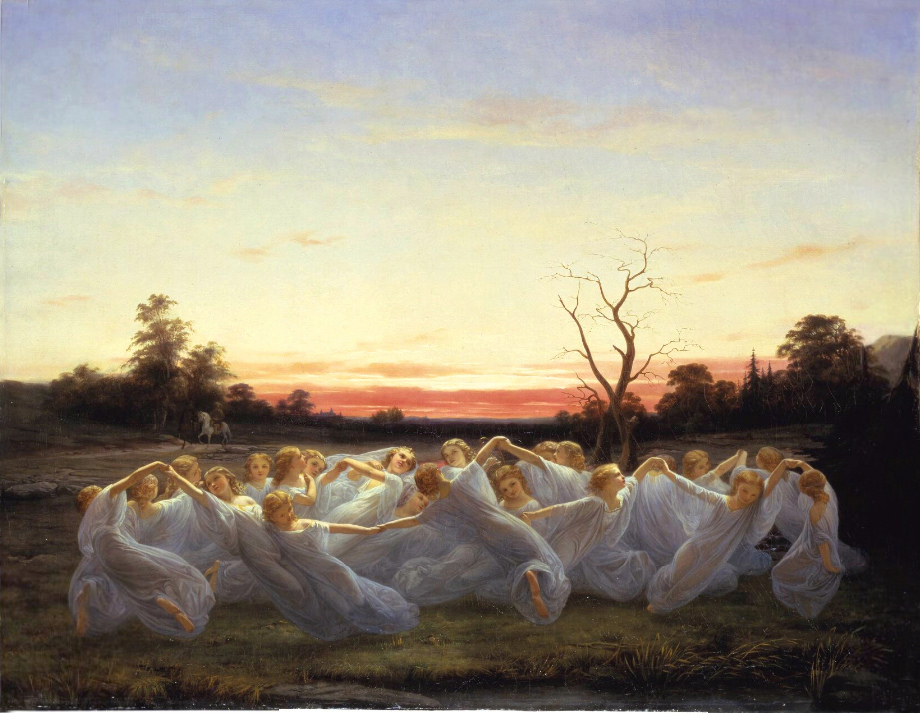
Fairy: Fairy is, of course, a blanket term for all the fair folk (including sprites, brownies, leprechauns, goblins, etc.), but for us, it refers to the beautiful, elfin women of fairy tales. Fairies conform to the stats for nymphs, but gain the ability to fly with gossamer wings, and the ability to cast magic spells as a fairy godmother. Among the more famous of fairies is the Fairy with Turquoise Hair (who serves the court of Hearts), Morgan Le Fey (who serves the court of Spades) and Titania (who serves the court of Diamonds).

Ghost: Ghosts are thick in fairy tales, and can be modeled after the incorporeal undead of D&D, such as the wraith and spectre. They need not be wicked, of course, nor intent on draining energy, though they oft times find mischief irresistible.

Giant Animals: Though not all animals in fairy tales are giant (in fact, few are), giant animals still make excellent monsters in fairy tale games. Naturally, they are all at least dimly intelligent and capable of speech. Giant eagles, goats, owls, snakes and spiders all play their part in a game of Mother Goose & Goblins.

Giants: The most appropriate races of giants for fairy tale gaming are, of course, the infamous cloud giant (sniffer of the blood of Englishmen) and the loutish hill giant. Some fairy tale hill giants can grow exceptionally large (although they are rarely seen), and can, to keep things simple, be referred to as mountain giants (double or triple the size and hit dice of a hill giant, add one dice of damage for double-sized giants and two for triple-sized giants. Cloud giants are not especially brilliant, but they are all magic-users of some renown, but hill and mountain giants are utter dopes.

A variation on the hill giant is the green giant, who has extraordinary intelligence and wondrous powers of illusion. These fellows dress in the manner of knights, and enjoy sending princes on quests.

The ettin, more commonly referred to as a two-headed giant, is also a frequent visitor to Fairyland, as is his cousin, the three-headed giant (+1 HD).

Giants usually serve the court of clubs (evil).

Goblin: Goblins are as thick as flies on the borders of Fairyland, and loom large in many legends. As in D&D, they are ne’er-do-wells who delight in torment and trouble, and generally conform to the normal rules for goblins (or even kobolds). When encountered in their lair, there is a 1 in 20 chance that adventurers will have stumbled upon a goblin market, where fey of all stripes trade wondrous goods and might even trade with the adventurers, if they dare. Goblins either serve the court of clubs (evil) or diamonds (evil).

Griffon: Griffons reside in the mountains of Fairyland, preening their feathers and grooming their tawny fur in the sun. They are creatures of terrible nobility, and are not to be trifled with by inexperienced adventurers. The greatest princes might make them their mounts, if they can be subdued (per the rule for dragons). Griffons serve the court of diamonds, and are always prideful.

Hobyah: Hobyahs are just hobgoblins by another name – and might also be called hobs. They are not always as wicked as their counterparts in D&D, and some serve in the manors of less savory princes as foresters and rat catchers. They have warty hides, bulbous noses and grim expressions. Hobyahs serve the court of spades.

Hydra: The hydra, or three-/five-/or seven-headed dragon as it is more often labeled, appears in a few fairy tales, filling the same basic role as the dragon. Pyrohydras are not uncommon in Fairyland. Hydras, like dragons, serve the court of diamonds (evil).

Leprechaun: Leprechauns are fairy cobblers, and members of the fey proletariat, as it were. As in popular myth, they hide their gold in pots that can only be found by following rainbows, but those who steal a leprechaun treasure will find themselves hunted for all their days by the vengeful fey and their kin. Unfortunately, 1 in 20 pots of gold actually contains brightly dyed foodstuffs. Leprechauns can be found in the AD&D Monster Manual, but might also be modeled after halfling who must grant three wishes to those who catch them. If this be used, allow the leprechaun to roll their initiative on 2d4, and double their movement rate. Leprechauns serve the court of spades.

Merchant: Human merchants loom large in many fairy tales, and can be modeled after the trader of D&D or the merchants of AD&D. They are usually encountered with a wagon of goods, or with a pack mule, and often have a beautiful and innocent daughter they’ve left at home with her stepmother. Merchants can sometimes (1 in 6) speak the language of the fey, as such merchants have had truck with those folk, and know some of their secrets. Merchants serve the court of diamonds.

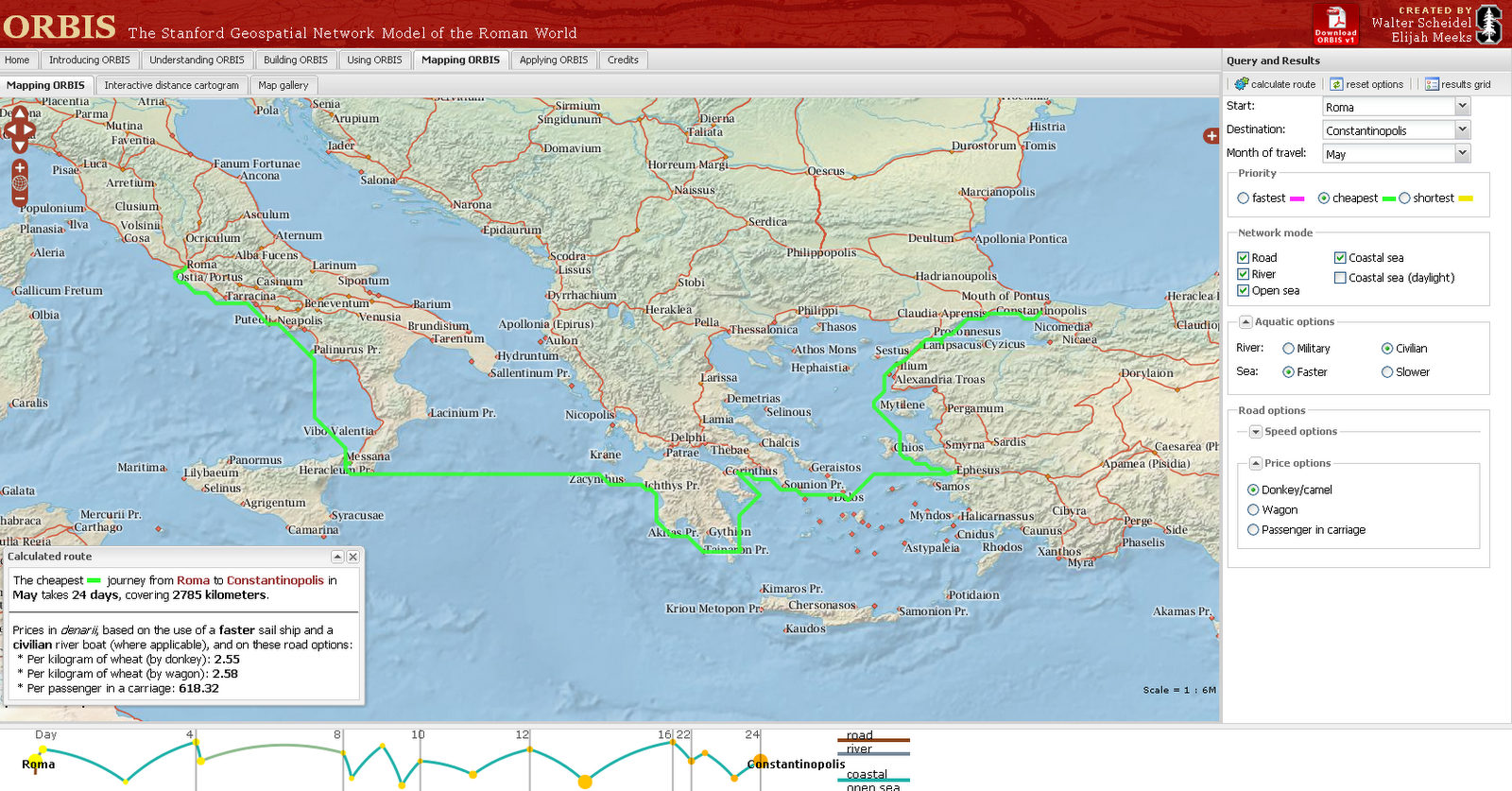
Holy Freaking Crud – Rome, In All It’s Cartographic Glory

Yeah – cheap little post today – have lots of real work (you know, the stuff I get paid for) going on that I need to address. In the meantime, I just stumbled across ORBIS, a mapping site that is trying to bring Imperial Rome into the 21st century.

I can’t help but think this would be a useful thing for folks running campaigns set in the Roman, or even post-Roman era. Hell, if you can’t find a way to use this in almost any fantasy campaign, there’s a really good chance you shouldn’t be running a campaign. If they could just integrate some wandering monster tables, we’d be all set.

I mean – you got travel times, routes, the freaking cost in silver pieces – you can choose donkey travel vs. wagons, military vs. civilian ships, the month of travel, the route, whether you want it cheap or fast. Astounding!

I might chime in later today with another Hell preview, and I’m still working on more monsters for Mother Goose & Goblins. I also hope to produce a small dungeon for it. Oh – and the Pars Fortuna dungeon – I need to work on that as well. Plenty to do!

Let’s Get Grimm … Nursery Rhyme Monsters I

Animals
Just about any animal belongs in a fairy tale world, but some animals are more prominent than others, including bears, foxes, leopards, lions, owls, pussy cats and wolves. Just use the normal stats for these “monsters”.

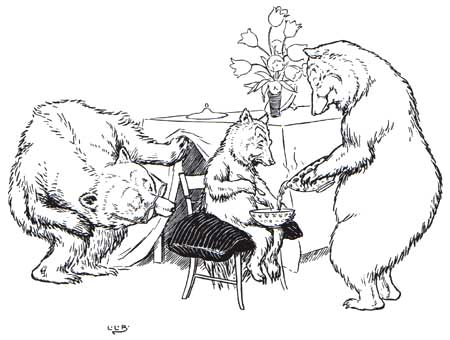
About 1 in 6 animals is a talking animal. Larger talking animals conform to the normal stats, save they are intelligent and can speak. Smaller talking animals (and some of the larger predators) are more anthropomorphized. Pussy cats are clever and often quite magical (spells as a 1st to 4th level magic-user) and have a knack for the fiddle, bears live in comfortable houses and dine on porridge, foxes are able rogues (as a 1st to 4th level thief), etc

Animated Silverwear

When animals aren’t talking in Fairy Tale Land, dishes and spoons are running away with one another.  One can imagine the surprise of a party when it wanders into an “empty” dining room, only to be set upon by the fine china. Also – note that most animated forks, knives and spoons are made of silver.

Animated Silverwear: HD 0 (1d4 hp); AC 5; Atk 1 slap, poke or stab (1 point of damage); Move 120; Save as 0-level human; Aligned with Clubs; Special: None.

Big Bad Wolf
Big Bad Wolves have a bad reputation in Fairy Tale Land, and a well deserved one. They are a particular menace to little pigs and knaves in red cloaks, but are happy to attack anything they think they can make a meal of.

Big Bad Wolf: HD 4; AC 3; Atk 1 bite (1d6); Move 120; Save as Fighter 4; Aligned with Clubs (Evil); Special: Small creatures who are bitten for max damage must make a save vs. death or be swallowed whole.

Billy Goat Gruff

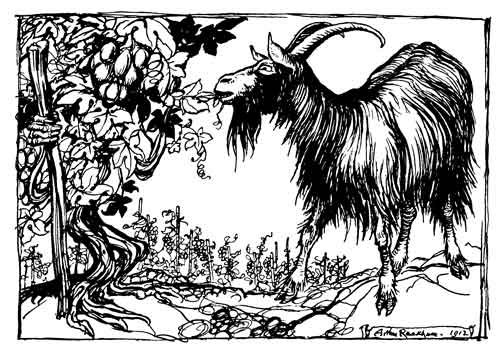
Billy goats gruff are large specimens of intelligent goat. They are neither wicked nor kind; just don’t attempt to bar their way.

Billy Goat Gruff: HD 3; AC 7; Atk 1 gore (2d6); Move 180; Save as Fighter 3; Aligned with Spades; Special: +4 damage on charge.

Bogeyman
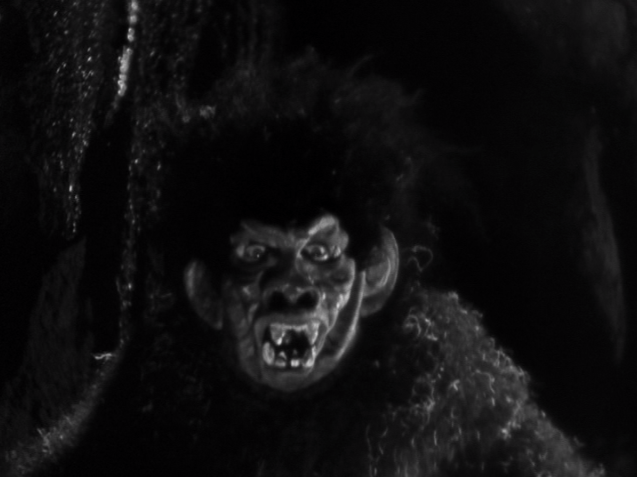
Bogeymen are savage looking humanoids that gather in Bogeyland, but sometimes make incursions into happier places. They often fight with firebrands (1d4 points of damage, save vs. petrification or catch on fire). Bogeymen use the stats for gnolls. Aligned with Clubs (Evil).

Bugaboo
Bugaboos, or bugbears, conform to their normal D&D stats. They look like creepy bears, who lurk in the woods and frighten travelers. Aligned with Clubs (Evil).

Changeling
Changelings are the issue of wicked fairies. When a fairy steals a human child to raise (these children grow up to become fairy knights), they leave a changeling in its place. Changelings are wicked and ill-mannered, and grow up to become spies and assassins. Changelings conform to the stats for doppelgangers. Aligned with Clubs (Evil).

Construct – Gingerbread Man
Gingerbread men are sometimes concocted by wicked witches, and sometimes created accidentally by bakers. They are quick and enjoy taunting others, but sometimes laid low by their over-confidence, and the fact that having a head made of dough doesn’t lend itself to great intelligence.

Gingerbread Man: HD 0 (1d4 hp); AC 4; Atk 1 strike (1d4-1); Move 180; Save as Thief 2; Aligned with Clubs; Special: None.

Construct – Wooden Soldier

Wooden soldiers are built by tinker elves and animated by martial spirits. They look like 6-foot tall soldiers carved of wood and painted in gay colors. Wooden soldiers carry wooden weapons. They are immune to most magic spells, but sticks to snakes cancels their magic immunity for 1d6 rounds. Patrols of wooden soldiers are sometimes led by Nutcracker Princes (8 HD, AC 2, Save as Fighter 8).

Wooden Soldier: HD 2; AC 4; Atk 1 wooden weapon (1d6); Move 120; Save as Fighter 2; Aligned with Spades; Special: Spell immunity, immune to fear and other mind effects.

Devil

Devils are foul creatures from the Netherworld who pop into the Fairy Tale Land to tempt the foolish. They appear either as beautiful temptresses (perhaps with vestigial fangs) or as thin, sophisticated men with red skin, pointed black beards, small horns and a tail that ends with a point. Although they often appear unarmed, a devil can summon a trident to hit or her hand instantly when threatened. They can also unfurl bat wings when they find flight a necessity. Aligned with Spades (Evil).

Devil: HD 6; AC 0; Atk 1 trident (1d8) and tail (1d4 + poison); Move 120 (Fly 240); Save as Cleric 6; Special: Poison tail (save or paralyzed for 4 rounds), teleport (in a puff of sulfurous smoke), only harmed by magic weapons.

Dragon
Dragons in Fairy Tale Land are of the fire breathing variety, though in coloration they are usually green. They have the normal stats for a red dragon, and the normal chance to speak and use magic.

Dwarf, Yellow
The yellow dwarves are cruel tricksters who often fall in love with princesses, doing their utmost to force them into marriage. They are dogged and determined, and never let a slight go unrevenged. Yellow dwarves have sallow skin and stringly, orange-yellow hair. They are usually armed with short swords or hand axes.

Yellow Dwarf: HD 1; AC 6; Atk 1 weapon; Move 90; Save as Dwarf 1; Aligned with Diamonds (Evil); Special: Growth (double in size, fight as 4 HD monster, weapon deals double damage) once per day for 10 rounds or invisibility (once per day).

Mother Goose is my Dungeon Master!

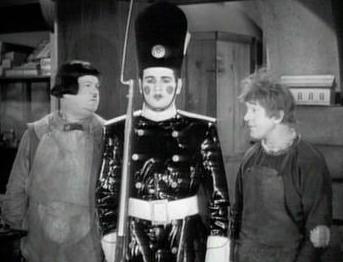
I was watching Babes in Toyland the other day (like you do), mostly because the daughter and I had a hankerin’ for Laurel and Hardy, and while viewing it, a strange thought popped into my head.

“If Mother Goose wrote D&D, little pigs would be a playable race.”

Naturally, one thing led to another …

Mother Goose & Goblins

The basic rules here are B/X D&D (or Labyrinth Lord, if you please). I’m not going to repeat everything in the rules (for now …), so if I don’t mention it, it works like B/X. The concept here is “what if Gygax was inspired more by nursery rhymes and fairy tales than swords & sorcery”. The game is still meant to be about exploration, treasure hunting (with some good deeds thrown in, of course) and fighting monsters, just with a veneer of (slightly tongue-in-cheek) Mother Goose-isms.

CLASSES
MG&G has seven classes, as follows:

PRINCE
The prince works essentially like the fighter – can use any weapon or armor, d8 for hit points, etc. Princes are young, handsome men, and are always the children of one king or another (kings are as copious in fairy tales as grains of sand on a beach).

A prince with a 17 Charisma who has reached at least 4th level can elect to become a Prince Charming. A Prince Charming must serve either the King of Hearts or the King of Diamonds. His kiss can dispel any magical effect, he enjoys a +2 bonus to saving throws against evil magic, and he is bound to fight evil dragons, rescue helpless damsels and give generously to the needy.

JOAN OF ARC RULE: A female character with a Strength of 12 or higher can become a Princess (i.e. a female version of the Prince).

FAIRY GODMOTHER
Fairy Godmothers are always elderly women of an elfin demeanor. They fill the roll of the magic-user and generally follow the rules for that class, save that a fairy godmother knows all the spells (assuming you’re just using the spells in B/X) of a level she learns to cast (much as a cleric), and must possess her magic wand to cast any spell. If a knave is adventuring with a fairy godmother, the fairy godmother must adopt them as a godchild and do their best to teach and protect them.

KNAVE
Knaves are boys and girls of common ancestry (1% chance of being the child of a king and queen who was hidden away with a peasant family to avoid a terrible curse). They fill the role of the thief, with the same skills and abilities, though some skills are renamed slightly for flavor:

Ask/Solve Riddle (replaces find/remove trap)*

Climb Beanstalk (i.e. climb walls)
Hear NoiseHide in Shadows
Creep Quietly
Steal Tarts (i.e. pick pockets)

* Traps do not play a big part in fairy tales and nursery rhymes, but the idea of confusing an opponent with a riddle, or needing to solve a riddle to get past a problem does crop up now and again. Naturally, players can still have their characters look for traps, and can devise ways to get past them without rolling dice; now they can instead roll dice to get past riddles or stun a foolish opponent (for 1d6 rounds) by asking them a real puzzler (the victim gets a saving throw even if the “ask riddle” roll is successful).

Each naughty or wicked act of a knave carries with it a cumulative 1% chance that they will be given a conscience (in the form of a talking cricket or something similar) to attempt to guide them into a more law-abiding and honorable way of life.

CURTAL FRIAR

Curtal Friars are men with tonsured scalps who cultivate a healthy paunch (in order to demonstrate the great abundance of the Lord), wear simple robes (with a mail coat beneath, usually) and wield a club or mace in the name of God Almighty. They are, essentially, clerics in terms of rules, though their ability to “turn undead” works on a slightly different set of monsters (as not all of the B/X monsters appear in fairy tales or nursery rhymes).

Monster
Pixie/Leprechaun (replaces skeletons)
Revenants (i.e. zombies)
Devil (i.e. imp – replaces ghoul)
Changeling (i.e. doppelganger – replaces wight)
Ghost (i.e. wraith)
Troll (replaces mummy)

Naturally, one can play a Nun instead of a Friar, though warrior nuns are generally pretty scarce in fairy tales.

DWARF
One of a group of seven who left his brothers to see the world. Dwarfs conform to the Dwarf class in B/X D&D. Each has a particular physical or personality trait that dominates their character, and for which they are named.

LITTLE PIG
The Little Pig replaces the Halfling in MG&G. Little pigs have a +2 bonus to save vs. fear (“who’s afraid,” they inquire, “by the Big Bad Wolf?”) and a particular skill at building houses and at setting traps (for wolves or others).

FAIRY KNIGHT
The fairy knight (or fairy dame) replaces the Elf class in B/X. They are permitted to wear up to mail, and though beautiful, they have no souls and thus are not to be completely trusted.

ALIGNMENT
Whereas B/X has three alignments, Lawful, Neutral and Chaotic, MG&G has four alignment which correspond with four royal houses in fairy tale land. A character must pledge his or her troth to one of these alignment (though they need not always cleave faithfully to that faction – unless somebody is watching).

Hearts: The character is pledged to the ideal of Love. He or she gets a +1 bonus to hit when defending this ideal (i.e. defending a loved one), but must pass a save vs. magic when confronted with the temptation of Lust.

Diamonds: The character is pledged to the ideals of Truth and Beauty. He or she gets a +1 to hit when defending beauty or seeking out the truth, but must pass a save vs. magic when confronted with the temptations of Envy and Avarice.

Spades: The character is pledged to the ideal of Judgment. He or she gets a +1 bonus to hit when fighting against outlaws and other evils, but must pass a save vs. magic when confronted with the temptation of Vengeance.

Clubs: The character is pledged to the ideal of Mirth and Merriment. He or she gets a +1 bonus when fighting spoil sports and bullies, but must pass a save vs. magic when confronted with the temptation of Cruelty.

Next installment will cover Grimm Tales (i.e. monsters & treasure)

APPENDIX N (A brief version, anyways)

Snow White
Cinderella
Beauty and the Beast
Little Mermaid
Pinnochio
Three Little Pigs
Three Billy Goats Gruff
Hansel & Gretel
Red Riding Hood
Rose RedBlue Beard
Puss in Boots
Gingerbread Man
Rumpestiltskin
Jack and the Beanstalk (Jack the Giant Killer)
Humpty Dumpty
Cat and the Fiddle
Tom Thumb/Thumbellina
Princess and the Pea
Frog Prince
Little Boy Blue
Simple Simon
Pied Piper
Tom Tom the Piper’s Son
Old Woman in a Shoe
Old Mother Hubbard
Old King Cole
Little Jack Horner

Supplement I – Wonderland
Supplement II – Oz

What Would ______ Do? [Random]

Maybe you’re running a game and you’re just not sure how man-at-arms #5 would react to the thief’s bribe. Maybe your a player who wants to mix things up a bit. Maybe you just like stupid random tables …

Whatever you’re doing, roll on this table when you want to ask yourself, “What would _______ do?”

Then do it.

ROLL D20

1. Conan (Roll 1d3; 1 = Pulp Fantasy Conan; 2 = Comic Book Conan; 3 = Movie Conan)
2. Elric
3. Gandalf (Roll 1d6; 1-4 Grey; 5-6 White)
4. Bilbo
5. Grey Mouser
6. Lone Ranger
7. Cugel the Clever
8. Tarzan
9. Odysseus
10. Dejah Thoris
11. Red Sonja
12. The Mighty Thor
13. Prince Valiant
14. Solomon Kane
15. Legolas
16. Batman (Roll 1d8+1 x 10 for which decade’s Batman you’re talking about)
17. Randolph Carter
18. Obi Wan Kenobi
19. James T. Kirk (1 in 6 chance of “Mirror Mirror” Kirk)
20. Fu Manchu

Example: You’re presented with a fortress you need to get into, for the king must be warned of an invading army and his major domo, who controls the guards, is working against him. How do you get into the fortress? Ask yourself, “What would [Roll 1d20; Get 6] the Lone Ranger Do?”

So, you disguise yourself as a kooky old miner and try to bluff your way past the guards. Problem solved!

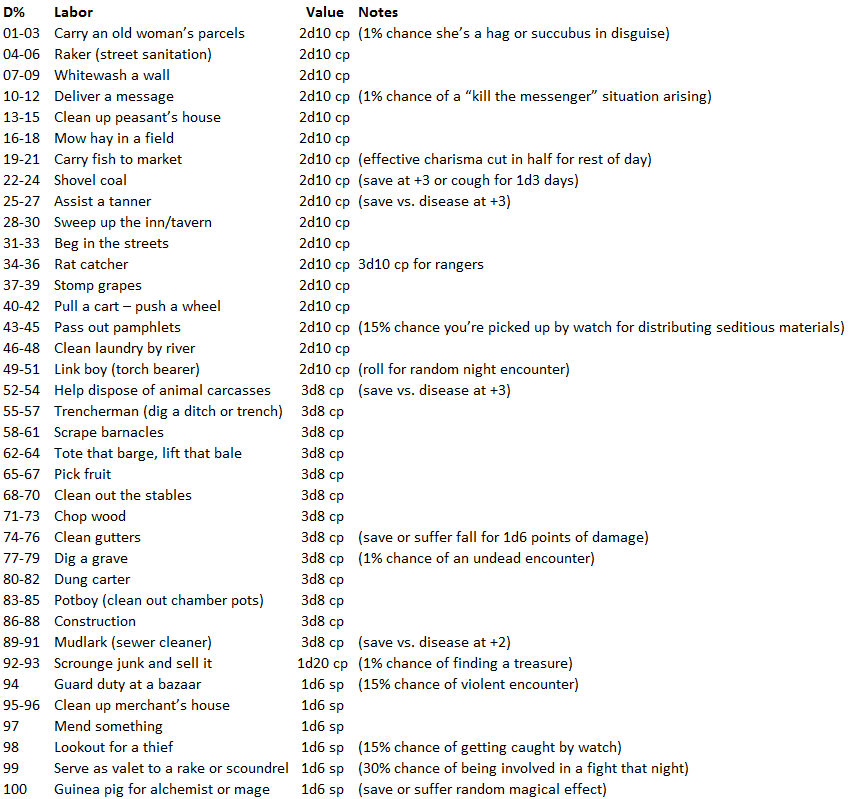
It’s a Dirty Job …

In my Google + Nod game, two characters recently found the need to do some day jobs while the party was resting between dungeon delves. One just didn’t have much coin, and the other decided to take Jeff Rients’ Carousing Table for a spin (and he was a paladin when he did it – the operative word being “was”).

Anyhow, I came up with this table of crappy day jobs, none of which pay much, and some of which carry a little danger.


Hark! What’s That I Hear? [20 Random Dungeon Noises]

20 Things You Might Hear in a Dungeon

1. Dripping water (save or it echoes in your head, draining you of one point of Wisdom/sanity per round until you’ve moved at least 120 feet away, and then 1d6 rounds after)

2. A roaring flood of water (aural illusion created by air flowing through a couple of holes in the wall that create a chill breeze through the area; 1 in 6 chance of encountering a small air elemental)

3. Desperate sobbing (comes from a lead-lined chest in which a female efreeti has recently been imprisoned; the exterior of the chest looks like carnival glass; the lock has been welded shut)

4. Creaking footsteps from above – which makes no sense, because above you is solid rock

5. Creaking footsteps behind you – still doesn’t make sense, but 1 in 6 chance it’s an invisible thief (level 1d4+1) who’s down on his luck and trying to follow the party out

6. Slow hiss (50% chance of a pit of vipers beneath your feet, 50% chance of poison gas flowing into the room or corridor from a ruptured copper pipe that has been struck by a black fletched arrow)

7. Silence (entire corridor has been permanently silenced; 5 in 6 chance of random ambush here by monsters who know about the effect)

8. Clicking (50% chance of monstrous crabs or crabmen, 50% chance of ice cracking beneath the stone tiles of the dungeon – will give way in 1d4+1 rounds sending everything down into a rushing torrent of chilly water)

9. Slapping sound (flag hung over a hole through which flows an updraft from deeper in the dungeon)

10. Electricity (around the corner there is an arc of electricity flowing between two metal plates on either side of the corridor; chance in 12 equal to a character’s armor bonus that (metal armor only) it is drawn to them and deals 1d6 points of damage per round until they are freed)

11. Howling (from an ancient pipe organ enchanted to play on its own – detects as magical – skeletal rats lurk within the pipes, will swarm those who investigate)

12. Snapping of bones (50% chance of trolls eating, 50% chance of goblins breaking up firewood and throwing it in a hearth to feed a small fire elemental)

13. Crackling (50% chance of a fire elemental guarding a room or corridor, 50% chance of a fire burning within the walls – corridor or room is hot and there is a 1 in 6 chance of a roof collapse each turn)

14. Laughter (50% chance of a magic mouth, 50% chance of gnolls reading comic books)

15. Evil Laughter (50% chance of high level wizard torturing a hero, 50% chance of a pack of vampiras mocking a new recruit)

16. Chanting (50% chance of 1d6 lawful acolytes at the bottom of a pit praying for strength, 50% chance of 3d6 chaotic acolytes sacrificing a thief who tried to steal their idol’s good eye)

17. Din of Battle (50% chance of two major dungeon factions locked in battle that swiftly overtakes the party; 50% chance of the noises coming up through a chimney, the battle being a level or two lower)

18. Rumbling (from a primitive elevator located on the other side of the wall – it may not stop on this level)

19. Clanking (50% chance of kobolds mining the dungeon level for building materials, 50% chance of animated chains preparing to strangle curious adventurers)

20. Whispers (50% chance of pygmy goblins in the walls, plotting your doom, 50% chance you have wandered into a stark, black dome that serves as the extra-dimensional brain center for a chaos god – his “brain” is a giant, pulsing mass with the same stats and attacks as a double-strength gibbering mouther)

IMAGE from HERE – Buy one if you take a shine to it

A Fantasy Cosmos

While writing (or, to some degree, copy/pasting from the SRD) Blood & Treasure the other day, I finally came to the section on the planes. I decided, for a sample cosmos (and I do mean sample – there is no official cosmology for Blood & Treasure), to present something like the one I use for NOD. I thought folks might like to see it, but note – it lacks a mention of Hell or the Firmament at the moment.

ONE POSSIBLE COSMOLOGY

This cosmology of planes is inspired by the old Ptolomaic view of the universe, i.e. The Earth at the center of the universe surrounded by “crystalline spheres” containing the different planets and beyond them the Empyrean Heaven of God and the angels. At the center of Earth lies Hell, essentially a plane within a plane.

In this conception, the Ethereal Plane extends beyond Earth to the Moon, but no further. The Astral Plane extends throughout the entire universe, to the borders of the Empyrean Heaven.
All of the planes (i.e. planets) in this cosmology other than the Empyrean Heaven are self-contained spheres. Heaven is infinite.

EARTH AND THE MOON (MATERIAL PLANE)
Earth and the Moon are the Material Plane, the center of the universe. The Moon differs from Earth only in that it is mildly-chaotic. They define what is considered normal. The Material Plane has the following traits:

• Normal gravity.

• Normal Time

• Alterable morphic.

• No Elemental or Energy Traits (specific locations may have these traits, however)

• Mildly neutral-aligned (mildly chaos-aligned for the Moon).

• Normal magic.

THE ETHEREAL PLANE
The Ethereal Plane is coexistent with the Material Plane and the plane of Luna. The Material Plane itself is visible from the Ethereal Plane, but it appears muted and indistinct, its colors blurring into each other and its edges turning fuzzy.

While it is possible to see into the Material Plane from the Ethereal Plane, the Ethereal Plane is usually invisible to those on the Material Plane. Normally, creatures on the Ethereal Plane cannot attack creatures on the Material Plane, and vice versa. A traveler on the Ethereal Plane is invisible, incorporeal, and silent to someone on the Material Plane.

The Ethereal Plane is mostly empty of structures and impediments. However, the plane has its own inhabitants. Some of these are other ethereal travelers, but the ghosts found here pose a particular peril to those who walk the fog.
It has the following traits.

• No gravity.

• Alterable morphic. The plane contains little to alter, however.

• Mildly neutral-aligned.

• Normal magic. Spells function normally on the Ethereal Plane, though they do not cross into the Material Plane. The only exceptions are spells and spell-like abilities that have the force descriptor and abjuration spells that affect ethereal beings. Spellcasters on the Material Plane must have some way to detect foes on the Ethereal Plane before targeting them with force-based spells, of course. While it’s possible to hit ethereal enemies with a force spell cast on the Material Plane, the reverse isn’t possible. No magical attacks cross from the Ethereal Plane to the Material Plane, including force attacks.

PLANE OF SHADOW
The Plane of Shadow is a dimly lit dimension that is both coterminous to and coexistent with the Material Plane. It overlaps the Material Plane much as the Ethereal Plane does, so a planar traveler can use the Plane of Shadow to cover great distances quickly.

The Plane of Shadow is also coterminous to other planes. With the right spell, a character can use the Plane of Shadow to visit other realities.

The Plane of Shadow is a world of black and white; color itself has been bleached from the environment. It is otherwise appears similar to the Material Plane.

Despite the lack of light sources, various plants, animals, and humanoids call the Plane of Shadow home.

The Plane of Shadow is magically morphic, and parts continually flow onto other planes. As a result, creating a precise map of the plane is next to impossible, despite the presence of landmarks.

The Plane of Shadow has the following traits.

• Magically morphic. Certain spells modify the base material of the Plane of Shadow. The utility and power of these spells within the Plane of Shadow make them particularly useful for explorers and natives alike.

• Mildly neutral-aligned.

• Enhanced magic. Spells of shadow are enhanced on the Plane of Shadow. Such spells are cast as though they were prepared with the Maximize Spell feat. Shadow conjuration and shadow evocation spells are 30% as powerful as the conjurations and evocations they mimic (as opposed to 20%). Greater shadow conjuration and greater shadow evocation are 70% as powerful (not 60%), and a shades spell conjures at 90% of the power of the original (not 80%).

• Impeded magic. Spells that use or generate light or fire may fizzle when cast on the Plane of Shadow. Spells that produce light are less effective in general, because all light sources have their ranges halved here. Despite the dark nature of the Plane of Shadow, spells that produce, use, or manipulate darkness are unaffected by the plane.

THE ASTRAL PLANE
The Astral Plane is the space between the planes. When a character moves through an interplanar portal or projects her spirit to a different plane of existence, she travels through the Astral Plane. Spells that allow instantaneous movement across a plane briefly touch the Astral Plane.

The Astral Plane is a great, endless sphere of clear silvery sky, both above and below. Occasional bits of solid matter can be found here, but most of the Astral Plane is an endless, open domain. Both planar travelers and refugees from other planes call the Astral Plane home.

The Astral Plane has the following traits.

• Subjective directional gravity.

• Timeless. Age, hunger, thirst, poison, and natural healing don’t function in the Astral Plane, though they resume functioning when the traveler leaves the Astral Plane.

• Mildly neutral-aligned.

• Enhanced magic. All spells and spell-like abilities used within the Astral Plane may be employed as if they were improved by the Quicken Spell feat. Already quickened spells and spell-like abilities are unaffected, as are spells from magic items. Spells so quickened are still prepared and cast at their unmodified level. As with the Quicken Spell feat, only one quickened spell can be cast per round.

MERCURY (ELEMENTAL PLANE OF EARTH)
Mercury is a solid sphere of rock and metal burrowed through by a multitude if tunnels and caverns. An unwary and unprepared traveler to Mercury may find himself entombed within this vast solidity of material and have his life crushed into nothingness, his powdered remains a warning to any foolish enough to follow.

Despite its solid, unyielding nature, Mercury is varied in its consistency, ranging from soft soil to veins of heavier and more valuable metal.

Mercury has the following traits.

• Earth-dominant.

• Enhanced magic. Spells and spell-like abilities that use, manipulate, or create earth or stone are both empowered and extended (as if the Empower Spell and Extend Spell metamagic feats had been used on them). Spells and spell-like abilities that are already empowered or extended are unaffected by this benefit.

• Impeded magic. Spells and spell-like abilities that use or create air (including spells that summon air elementals or outsiders with the air subtype) are impeded.

VENUS (POSITIVE ENERGY PLANE)
Venus is a lush world of brilliant, almost blinding color and overgrown vegetation and animals. Some area of the plane are so fertile that entering them can actually cause a person to explode with life.

Venus has the following traits.

• Normal gravity.

• Minor positive-dominant. Some regions of the plane have the major positive-dominant trait instead, and those islands may be inhabited by various divinities of fertility and life.

• Enhanced magic. Spells and spell-like abilities that use positive energy, including cure spells, are maximized (as if the Maximize Spell metamagic feat had been used on them). Spells and spell-like abilities that are already maximized are unaffected by this benefit. Class abilities that use positive energy, such as turning and destroying undead, gain a +10 bonus on the roll to determine Hit Dice affected.

• Impeded magic. Spells and spell-like abilities that use negative energy (including inflict spells) are impeded.

MARS (PLANE OF NEUTRALITY)
Mars is an earth-like plane dedicated to neutrality in the war between Law and Chaos. It is a small sphere and taken up by red, sandstone hills, shallow, salty seas, lowlands of red, tuberous plants watered by vast canals and gleaming, ancient cities slowly falling into ruin. The various people of Mars are warriors who glory in combat.

Mars has the following traits.

• Light gravity.

• Strongly neutral-aligned. Lawfuls and chaotic suffer a -2 penalty to reaction checks and to intelligence- and wisdom-based checks.

• Limited magic. The following spells operate normally on Mars: Detect thoughts (ESP), xxx. All other spells fail to operate here.

• Flowing time. Time passes more quickly on Mars than the Material Plane. A year spent on Mars corresponds to a day on the Material Plane.

SUN (ELEMENTAL PLANE OF FIRE)
Everything is alight on the Sun. The ground is nothing more than great, evershifting plates of compressed flame. The air ripples with the heat of continual firestorms, and the most common liquid is magma, not water. The oceans are made of liquid flame, and the mountains ooze with molten lava. Fire survives here without need for fuel or air, but flammables brought onto the plane are consumed readily.

The Sun has the following traits.

• Fire-dominant.

• Enhanced magic. Spells and spell-like abilities with the fire descriptor are both maximized and enlarged (as if the Maximize Spell and Enlarge Spell had been used on them). Spells and spell-like abilities that are already maximized or enlarged are unaffected by this benefit.

• Impeded magic. Spells and spell-like abilities that use or create water (including spells that summon water elementals or outsiders with the water subtype) are impeded.

JUPITER (ELEMENTAL PLANE OF AIR)
Jupiter is a giant spheric plane of air. At the heart of Jupiter there is a core of iron and adamantine, and there are other bits of solid ground and water vapor floating amid the endless, roiling skies of Jupiter.

Jupiter is the home of all manner of airborne creatures. Indeed, flying creatures find themselves at a great advantage on this plane. While travelers without flight can survive easily here, they are at a disadvantage.

Jupiter has the following traits.

• Subjective directional gravity. Inhabitants of the plane determine their own “down” direction. Objects not under the motive force of others do not move.

• Air-dominant.

• Enhanced magic. Spells and spell-like abilities that use, manipulate, or create air are both empowered and enlarged (as if the Empower Spell and Enlarge Spell metamagic feats had been used on them).

• Impeded magic. Spells and spell-like abilities that use or create earth (including spells that summon earth elementals or earth-based outsiders) are impeded.

SATURN (PLANE OF CHAOS)
Saturn is a plane infused with chaos, and therefore quite alien to most folk of the Material Plane. It is covered by all manner of fascinating land-scapes, including ashen plains cut by streams of mercury, swamps of sentient ooze, thickets of mineral plants like sheaves of swords and towering mountains of vapor, all under a greenish-black sky illuminated by the plane’s wondrous rings from which ioun stones are plucked.

Saturn has the following traits:

• Strongly chaos-aligned. Lawfuls suffer a -2 penalty to reaction checks and to intelligence- and wisdom-based checks.

• Wild magic.

NEPTUNE (ELEMENTAL PLANE OF WATER)
Neptune is a sea without a floor or a surface; an entirely fluid sphere lit by a diffuse glow. It is one of the more hospitable of the Inner Planes once a traveler gets past the problem of breathing.

The eternal oceans of this plane vary between ice cold and boiling hot, between saline and fresh. They are perpetually in motion, wracked by currents and tides. The plane’s permanent settlements form around bits of flotsam and jetsam suspended within this endless liquid. These settlements drift on the tides of the plane of Neptune.

Neptune has the following traits.

• Subjective directional gravity. The gravity here works similar to that of the Elemental Plane of Air. But sinking or rising on the Elemental Plane of Water is slower (and less dangerous) than on the Elemental Plane of Air.

• Water-dominant.

• Enhanced magic. Spells and spell-like abilities that use or create water are both extended and enlarged (as if the Extend Spell and Enlarge Spell metamagic feats had been used on them). Spells and spell-like abilities that are already extended or enlarged are unaffected by this benefit.

• Impeded magic. Spells and spell-like abilities with the fire descriptor are impeded.

URANUS (PLANE OF LAW)
Uranus is the opposite of Saturn, a plane of law and perfection. Uranus has the same landscapes as the Material Plane, but they are each perfect and slightly angular, often repetitious, as though made by the will of a single artist. The skies and landscapes of Uranus all carry a metallic hue – warm coppers, brilliant silvers and dazzling golds.
Uranus has the following traits:

• Strongly law-aligned. Chaotics suffer a -2 penalty to reaction checks and to intelligence- and wisdom-based checks.

• Static. Uranus cannot be altered by visitors.

• Timeless. Time does not flow on Uranus.

PLUTO (NEGATIVE ENERGY PLANE)
To an observer, there’s little to see on Pluto. It is a dark, empty place, an eternal pit where a traveler can fall until the plane itself steals away all light and life. Pluto is the most hostile of the planets, and the most uncaring and intolerant of life. Only creatures immune to its life-draining energies can survive there.

Pluto has the following traits.

• Subjective directional gravity.

• Major negative-dominant. Some areas within the plane have only the minor negative-dominant trait, and these islands tend to be inhabited.

• Enhanced magic. Spells and spell-like abilities that use negative energy are maximized. Spells and spell-like abilities that are already maximized are unaffected by this benefit. Class abilities that use negative energy, such as rebuking and controlling undead, gain a +10 bonus on the roll.

• Impeded magic. Spells and spell-like abilities that use positive energy, including cure spells, are impeded. Characters on this plane take a –10 penalty on Fortitude saving throws made to regain lost levels from a life drain attack.