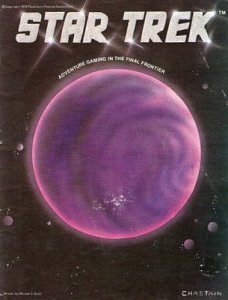
 If I’m going to have a Star Trek campaign, I need some Star Trek rules. Fortunately for me, I discovered a pretty groovy set of rules a few months ago … in fact – the very first set of Star Trek RPG rules, Star Trek – Adventure Gaming in the Final Frontier, by Grenadier in 1978. I reviewed these rules a few posts back (LINK here).
As I said in the review, it’s a very lean set of rules, and in my opinion pretty nifty. The rules are divided into basic rules, which permit you to play the game using the Star Trek characters we all know and love (Kirk, Spock, McCoy, Sulu, Uhura, Scotty, Chekov), and advanced rules that introduce character creation and other enhancements. For my campaign, the rules need just a little bit more.
Who’s in Charge Here?

Commodore Gray and Captain Kirk from Star Trek Continues
One interesting thing “missing” from the game is the idea of rank and command. You get a group of players together, they roll up characters … and so who is the captain. Who is an ensign versus a lieutenant commander?
Here’s my idea for solving this little issue:
First and foremost, each player can decide whether their character is going to be an officer or enlisted crewman, and which division they wish to be in – Command (green shirts*), Sciences (blue shirts) or Operations (red shirts).
At the start of campaign, starting rank is assigned based on the raw ability of the characters. Total each character’s ability scores. The character with the highest total score who is in the command division is given the rank of captain. The new captain is put in command of a scout-class starship of his or her choice.
Using the other character’s total scores, assign them their starting ranks in the following order. Note that whether players choose to be officers or enlisted, there is only one character at the highest rank (commander or chief petty officer), and so on.
- 2nd highest: Commander / Chief Petty Officer
- 3rd highest: Lieutenant Commander / Petty Officer
- 4th highest: Lieutenant Commander / Petty Officer
- 5th highest: Lieutenant / Crewman (1st grade)
- 6th highest: Sub-Lieutenant / Crewman (2nd grade)
- 7th highest, etc.: Ensign / Crewman (3rd grade)
Side Trek – Gold or Green?
According to the William Theiss, who designed those original Star Trek uniforms, the command shirts were indeed avocado green. Apparently, the texture of the fabric and the lighting on set made them look gold. Speaking as someone who is color blind, I honestly could never figure it out. Hell, I only just this year asked my daughter whether Spock had a green cast to his skin or not – when you’re red/green color blind, it’s a tough call. So – command wears avocado green in My Trek.
Advancing in Rank
The Star Trek rules I’m using mention the idea of character advancement, but offer no rules for it. Now that’s what I call old school.
Since a campaign is supposed to represent numerous games with the same characters, it makes sense to allow those characters the chance to advance in rank a bit. Of course, we see very little rank advancement for the characters in the original series – I think Spock goes from lieutenant commander to commander at some point in the series, but poor old Chekov remains an ensign until he got an off-screen promotion to lieutenant. This means, no rank advancement might actually be the way to go, but I know players and what keeps them interested … so here’s my take on the subject.
The simplest way I could have handled character advancement was to introduce levels and experience points of some sort. I decided to try something different. For accomplishments during a mission, a character is awarded a decoration:

For specific acts of heroism, the following commendations may be awarded:

In addition to the commendation to decorate your chest, the newly decorated character may roll once on the following table to receive an upgrade to his or her abilities.
| D6 | Bonus |
| 1-3 | +1 bonus to one skill (tricorder, medikit, psionics, etc) |
| 4-5 | +1 bonus to combat ability |
| 6 | increase one ability score by +1 |
After completing five missions, characters are eligible for an increase in rank. The chance of a promotion is 1 in 20, plus 1 per commendation earned since the last promotion. Thus, a character that has earned two commendations during those five missions has a (1+2) 3 in 20 chance to earn a promotion.
This scheme would mean quicker promotion than was seen in the TV series, but oh well – nothing’s perfect. I suppose, using the show as a guide, we had seven principal characters on 79 missions with one rank promotion … giving characters a 1 in 553 chance of promotion even when saving the universe multiple times. If we assume everyone got a promotion at the end of the series, then we’re down to a 1 in 69 chance.
I’m okay with that, though. I’d like to see the players earn higher rank and better starships as they explore the galaxy. I think it would be fun. I like fun.
A master chief that earns a promotion is offered a commission as a lieutenant commander.
Captains earn better starships instead of rank promotions. New captain command scout ships, and might then be promoted to better ships in the following order: destroyers, light cruisers and then heavy cruisers. Naturally, the captain can take their crew with them to their new ship.
A captain that has earned a heavy cruiser can be promoted to the rank of commodore. A commodore can choose any vessel as their flag ship, or can retire to commanding a starbase. A commodore promoted to admiral is retired from starship command (unless they’re Captain Kirk, of course).
Side Trek – The Medals
Viewers of Star Trek will recognize those medals up there, as I got the names and designs from old Star Trek episodes. Naturally, I just had to make up what name went with what emblem, and since my graphics skills are not super strong, I made the emblems the best I could. I’m sure there are better representations of them out there on the web. I thought it would be fun to have a square on each character sheet colored in with the uniform color of the character’s chosen division, with the sleeve stripes of their rank on the bottom and their collected medals above those stripes – thus I took a stab at drawing the medals.
The corollary to the “captains get better ships instead of higher rank” is that captains that violate Starfleet rules (especially that darn Prime Directive) or who royally screw up missions might be assigned lowlier ships. Using Franz Joseph’s deigns (plus one), the chain of ships would start with the Ptolemy-class transports (which I actually think look pretty cool) and then go through the Hermes-class scout, Saladin-class destroyer, Miranda-class light cruiser, Starship (i.e. Constitution)-class heavy cruiser and finally the Federation-class dreadnought. I would start my players in a Hermes-class scout, leaving the transport available as a punishment.
Next Week – Starship Battles!
 If it is in Star Trek, it is in my campaign. Star Trek is the basis of the whole campaign, but it’s not the entirety of the campaign, and in fact, some of it is not technically in the campaign. My campaign would start in 2265, as Kirk and crew are blasting off for adventure. Heck, the PCs might even beat them to a few adventures in my campaign.
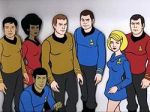 Since the animated adventures shared many key people with Star Trek – and since they’re fun and I love them (and wouldn’t think of running Trek without the Skorr and a 20-ft tall Spock), they’re in My Trek.
 Although there isn’t much material in the planned sequel series to Star Trek that one could use, especially since it would all take place 7 or so years after My Trek starts, the Klingon material from The Kitumba is all valid for my purposes.
 With the “Star Trek feel” in mind, there are some non-Trek works that I think work within the overall scheme. The 1959 TV series Men Into Space, for example, has a very similar feel to Star Trek in terms of its emphasis on exploration, engineering and science. If you haven’t seen it, I urge you to give it a shot.
 In the midst of this, I started getting the Star Trek bug, and found a copy of the first Star Trek RPG, which I reviewed on this blog a while back. This got me to designing a Star Trek campaign (hence, My Trek) that I knew I would probably never play, but wanted to do anyways. And here’s where I discovered my potential burnout. I started having so much fun goofing around with Trek, that I just plain stopped working on my writing. I have an issue of NOD that is written, edited and ready to go … and I’ve just let it sit there for a couple weeks. I could publish it today … but I don’t think I feel like it. The writing and publishing, as much as I enjoyed it, was becoming work, and so messing with Star Trek became not just a vacation, but really more like playing hooky. When writing game materials for myself feels like playing hooky for writing game materials for others, you know you’re heading for burnout.
 While rainbow fantasy has warriors and weapons and swordplay, it also avoids killing (except for robots – you can bash them up and not get in trouble) and doesn’t seem to care much about treasure. In other words – it is far removed from the “kill things and take their stuff” genre of fantasy gaming.







 Land of Nod