The Phoenix

This class originally came about because I was working on some class ideas inspired by the classic elementals – not in terms of “guy who uses fire”, but rather “class inspired by fire’s representation in folklore and mythology”.

Speaking of fire, this is what I came up with:

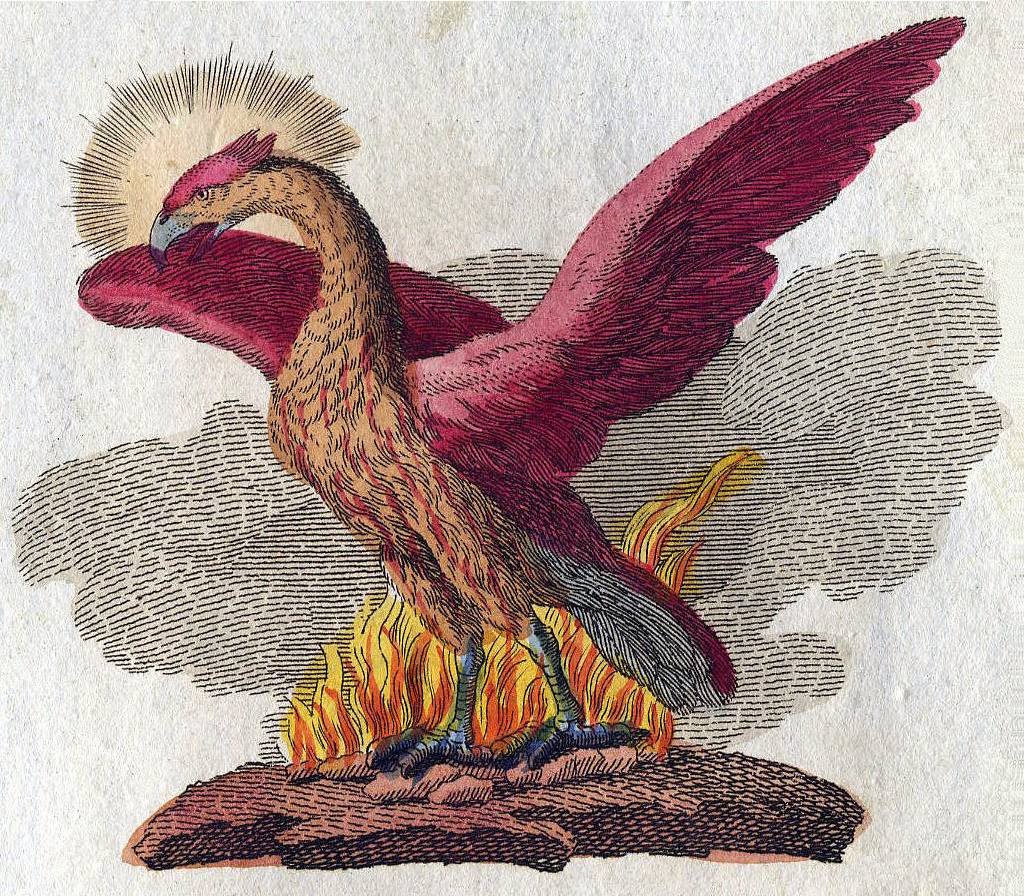
THE PHOENIX

Some humanoids are born with an especially powerful spark of life. These are warrior souls, caught up in the great circle of life. Phoenixes have souls that never stop. When a phoenix dies, he or she immediately reincarnates as a new creature with the same memories and its personality mostly intact. The phoenix can do this many times, though each time stresses their constitution to the max, and each time a phoenix dies may be their last. Of course, it isn’t really the end of the phoenix’s soul – it merely transmigrates elsewhere in the cosmos (i.e. time for the player to roll up a new character) and fights on!

ARMOR – Any armor, including shields

WEAPONS – Any weapon

SKILLS – None

The key ability of a phoenix is his ability to reincarnate upon death, per the druid spell of the same name. When a phoenix is reduced to 0 hit points, its body immediately bursts into a 10-ft. radius of fire which deals 1d6 points of damage per four levels of the phoenix. The phoenix has a chance to direct this flame at a single target; if they can pass a Will saving throw they can direct the fire up to a range of 10 feet per four levels at a single target, who suffers all the damage (Reflex save to halve damage).

Once the fireworks are over, the phoenix emerges from the fire and smoke in a new body rolled randomly on the table below.

D%: REINCARNATED AS …
01. Aasimar
02. Azer
03. Blink Dog
04-07. Bugbear
08. Centaur
09. Crabman
10. Doppelganger
11-13. Dromite
14-19. Dwarf (10% chance of duergar)
20-25. Elf (10% chance of drow)
26-29. Gnoll
30-35. Gnome (10% chance of svirfneblin)
36-39. Goblin (10% chance of blue)
40. Grimlock
41-46. Half-elf
47-52. Half-orc
53. Harpy
54. Hengeyokai
55-58. Hobgoblin
59-64. Human
65. Janni
66-67. Juggernaut
68-71. Kobold
72-76. Lizard man
77. Minotaur
78-82. Neanderthal
83-85. Notac-Ichat (see NOD Companion)
86. Ogre
87-90. Orc
91. Satyr
92-93. Tiefling
94. Troglodyte
95. Unbodied
96-97. Utu (see NOD Companion)
98-00. Xeph

Roll randomly for the gender of the new body.

The phoenix gains all the abilities inherent to his new body (though not equipment, like a satyr’s pipes), but retains his normal hit points (adjusted for losing a level – see below), saving throws, attack bonus, ability scores and ability to speak. The phoenix personality remains largely the same, but is nudged a bit in the direction of its new form. If the phoenix has half or less of the hit dice of his new form, his new form is reduced in size by one size category.

The transformation is not without cost. The phoenix loses one level, and his experience points are reduced to the minimum level for his new level. A first level phoenix can reincarnate. His level remains at first, and his XP are reduced to 0. The phoenix must also pass a Fortitude saving throw or lose 1d3 points of constitution, permanently.

Once the transformation is complete, the phoenix must adjust to their new body. Each round, the phoenix must attempt a Will save. Once they succeed, they gain control over their faculties and can act normally. Until then, they are stunned.

A third level phoenix gains a limited form of regeneration. His natural healing is doubled (i.e. 2 hit points per level per night of rest), and he enjoys a +2 bonus to save vs. poison and disease.

A sixth level phoenix gains access to his soul’s memories. By meditating for one hour, the phoenix gains the use of one feat per three levels (i.e. two feats at sixth level, three a ninth, etc.). The phoenix can only access memories in this way once per day.

A ninth level phoenix can build a fortress-temple dedicated to the Phoenix. The phoenix attracts a body of 1d12+9 men-at-arms, heavy infantry, to serve as his personal bodyguard. In addition, a young 1st level phoenix seeks him out as a master (likely a sidekick from a former life).

Saving Some Gold Pieces (and a Spell)

Boys and girls, if you’ve been waiting to buy some of my print products, you may be in luck. Lulu is running a sale through November 27th ..

And on November 27th, I’m going to throw in some markdowns of my own for the holiday season. You’ll find the link to my storefront on the side over there.

Don’t forget, if you buy a hard cover book, I’ll send you a free PDF of that book.
And now, to keep this post from being nothing but a commercial, I will make up a magic spell …

Wind Tunnel
Level: Cleric 5, Druid 4, Magic-User 5
Range: Centered on caster
Duration: 1 minute

This spell creates a tunnel of powerful winds extending 10 feet per level ahead and behind the spellcaster. The tunnel is large enough for the spellcaster to walk through normally, though it obviously cannot be larger than the chamber or passage which the spellcaster currently occupies. Missile weapons, gases and breath weapons are deflected by the wind tunnel. Creatures outside the tunnel trying to force their way through the tunnel suffer the effects of entering a huge air elemental’s whirlwind. The caster can decide if creatures grabbed by the wind tunnel are carried forward or backward and then deposited on the ground, prone, where the tunnel ends.If the tunnel is not created on solid ground, the spellcaster’s comrades (though not the spellcaster, on whom the spell is centered) might fall into the winds themselves (in other words, it cannot be used to create a bridge across a chasm unless the spellcaster’s comrades want to ride the winds across).

(Essentially, this is a variation on, and enhancement of the wind wall spell).

Elemental Racial Variations

I’ve always enjoyed coming with variations on a theme, or variations on existing things in games. Of late, I’ve thought about doing themed variations on some of the existing races in Blood & Treasure – themes like the elements, or insects or animals.

For my first theme, I choose elemental earth. These races could work well in a specialty campaign, especially one set underground or on the elemental plane of earth, or can be used in an exotic section of an existing campaign world.

I’m not sure how well balanced these races would be, but you know – sometimes it just doesn’t matter. If they look like fun, use them!

COAL GNOMES
Coal gnomes look generally like normal gnomes, save their flesh is composed of a substance not unlike coal. They have pitch black skin and beady eyes that glow like embers. These eyes give them darkvision to a range of 120 feet. Coal gnomes are not immune to fire, but they do have a strange resistance to it.

When a coal gnome is struck by fire, it ignites and smolders. The coal gnome suffers one point of fire damage per round, and no more. While they smolder, they can score +1 point of fire damage with each successful melee attack.

Coal gnomes have the same alterations to their ability scores as normal gnomes, the same knacks and the same ability to multi-class. They do not have any Spellcasting ability.

GRANITE DWARVES
Granite dwarves are stoic and seemingly emotionless; at least, they do not often show emotion. Logical and resolute, they look like dwarves carved from granite.

Granite dwarves have the same ability score modifications as normal dwarves, and the same knacks. Their skin gives them a natural AC of 12, and they have the ability to freeze as do gargoyles, for a maximum of 10 minutes. Granite dwarves have darkvision to a range of 60 feet.

Granite dwarves cannot multi-class, for their minds are too focused.

CRYSTAL ELVES
Crystal elves are as graceful and lithe as normal elves. Their bodies are seemingly composed of living crystal, in various colors and hues. They rarely wear clothing, but do adorn themselves with jewelry and sometimes capes or cloaks.

A crystal elf’s skin reflects and refracts light, depending on the angle at which it is struck. When fighting in moderate illumination, all opponents engaged in melee combat with the crystal elf must pass a Reflex saving throw when they miss the elf in combat by more than 3 points, or be blinded for one round. In strong illumination, creatures locked in melee combat must pass this save each round, and creatures within 20 feet must do so when they miss the elf in ranged combat as above.

The crystal elf’s body gives them a +2 bonus to save vs. rays. They suffer double damage from sonic attacks.

Crystal elves have the normal ability score modifications and knacks, darkvision to a range of 30 feet, and they cannot multi-class.

SANDLINGS
Sandlings look like normal halflings composed of sand. They are quick and curious and have more abrasive personalities than normal halflings.

Sandlings ignore one point of damage per hit from physical damage, but water and wind deals +1 point of damage per dice (or 1 point of damage if the attack doesn’t normally deal damage) to them. They have the same ability score modifications as normal halflings, the same knacks, and they gain a knack at escape attempts.

When a sandling is struck for full damage by a physical blow (minimum 5 points of damage), they split into two tiny versions of themselves, splitting the damage as well. They must also split their equipment when they split, and their hit point total, but each of these twins retains its normal level, ability scores and special abilities. The personalities of each twin can vary, based on the original’s alignment:

THREE TIER ALIGNMENT
Lawful = Lawful and Neutral
Chaotic = Chaotic and Neutral
Neutral = Chaotic and Lawful

NINE TIER ALIGNMENT
Lawful Good = Lawful Neutral and Neutral Good
Lawful Neutral = Lawful Neutral and Neutral
Lawful Evil = Lawful Neutral and Neutral Evil

Neutral Good = Neutral Good and Neutral
Neutral = Lawful Neutral and Chaotic Neutral
Neutral Evil = Neutral Evil and Neutral

Chaotic Good = Chaotic Neutral and Neutral Good
Chaotic Neutral = Chaotic Neutral and Neutral
Chaotic Evil = Chaotic Neutral and Neutral Evil

The twins cannot re-merge until they get a full night’s sleep. If that sleep is interrupted, they split apart and must remain apart until they get another chance at 8 hours of rest.

Odds and Ends (or Monster and Spells to be Precise)

SINOOZE

Large Ooze, Neutral (N), Non-Intelligent; Solitary

HD 8
AC 12
ATK Slam (1d6 + 1d6 acid)
MV see below
SV F10 R11 W11
XP 800 (CL 9)

Sinooze is an ooze that seeks out skeletal remains. It oozes over them and penetrates the bones with microscopic feelers, absorbing and reading the DNA. Using this information, it expands and takes the shape of the creature’s musculature.

The sinooze attacks and moves as the creature whose bones it animated. In addition, the monster deals acid damage when it successfully strikes. This acid damages organic materials and metal, but not stone.

Sinooze are flammable. When struck with fire, it suffers half damage, but is lit on fire. Subsequent successful attacks by the monster deal 1d6 points of fire damage. The monster continues to suffer 1d3 points of fire damage each round while ablaze.

Cold damage forces the ooze to pass a Fortitude saving throw or become thick and sluggish. Its movement is cut in half, and it becomes vulnerable to bludgeoning damage (i.e. takes full instead of half damage).

Special Qualities: Resistance to fire, weapon resistance

Bite of the Wolf
Level: Druid 2
Range: Personal
Duration: 1 hour

The druid’s mouth becomes a wolf’s muzzle. The druid gains a bite attack that deals 1d4 points of damage. Victims of the attack must pass a Reflex save or be tripped and knocked prone.

Coils of the Constrictor
Level: Druid 2
Range: Personal
Duration: 1 hour

The druid’s body becomes sinuous and flexible. On a successful grapple attack, the druid deals 1d4 points of damage and constricts his opponent for 1d4 points of damage per round until the grapple is broken.

Dwarfblood (Transmutation)
Level: Magic-User 1
Range: Personal
Duration: 1 hour

For one hour, the magic-user gains the special racial abilities of a dwarf.

Elfblood (Transmutation)
Level: Magic-User 2
Range: Personal
Duration: 1 hour

For one hour, the magic-user gains the special racial abilities of a elf.

Fangs of the Viper
Level: Druid 3
Range: Personal
Duration: 1 hour

The druid’s mouth becomes fanged. The druid gains a bite attack that deals 1d3 points of damage and injects Poison III into the victim.

Flashing Blade (Transmutation)
Level: Magic-User 1
Area of Effect: One blade
Duration: 1 hour

This spell can be cast on one medium or large blade, which must be touched by the magic-user. For one hour, the blade shines with a bright, blinding light. When the sword is used for an unsuccessful attack, the target of the attack must pass a Reflex save or be blinded until the end of the next round.

Foreboding (Illusion)
Level: Magic-User 2
Range: 30 feet
Area of Effect: One creature
Duration: 6 hours

The target of this spell has terrible feeling of foreboding. While under the effects of the spell, she believes every find trap task check she makes succeeds (i.e. finds a trap), every remove trap task check fails, and all listen at doors task checks result in her hearing weird, threatening noises on the other side of the door.

Gnomeblood (Transmutation)
Level: Magic-User 2
Range: Personal
Duration: 1 hour

For one hour, the magic-user gains the special racial abilities of a gnome.

Horns of the Rhino
Level: Druid 3
Range: Personal
Duration: 1 hour

The druid’s nose and forehead broaden and grow a fierce horn. The druid gains a gore attack that deals 1d8 points of damage. Every gore attack counts as a bull rush attack.

Horseless Carriage (Conjuration)
Level: Magic-User 4
Range: Object touched
Duration: 1 hour

By touching a wagon or similar wheeled conveyance, you imbue with the ability to move on its own. The wagon moves by your command, and in much the same way as a horse would, save that the wagon operates by voice command. For every three levels you possess, the wagon is moved by the equivalent of one horse (i.e. gains one horsepower). A 7th level magic-user could conjure up two horsepower, while a 12th level magic-user could conjure up four horsepower.

Hover (Transmutation)
Level: Magic-User 3
Range: Personal or close
Duration: 1 hour

This spell works like the levitate spell, except that it gives the recipient of the spell the ability to move at a movement rate of 20 forward and backward, and the recipient of the spell only levitates 6 inches above a solid or liquid surface.

Hug of the Bear
Level: Druid 3
Range: Personal
Duration: 1 hour

The druid’s arms become large and furry, and tipped with claws. The druid gains two claw attack each round that deals 1d6 points of damage. If both claw attacks hit a foe, they are automatically grappled.

Monstrous Mein (Transmutation)
Level: Magic-User 3
Range: Personal
Duration: 10 minutes

The magic-user’s creature type changes to monstrous humanoid. The magic-user gains darkvision to a range of 60 feet, is no longer affected by spells that affect humanoids (such as charm person), and gains a +2 bonus on Reflex saving throws. In addition, their visage becomes monstrous, and normal humans and men-at-arms must pass a Will saving throw upon seeing them or become frightened for 1d4 rounds.

Phantom Banker (Transmutation)
Level: Magic-User 2
Range: Close (30 feet)
Duration: Permanent

The magic-user changes one form of currency into the next higher form of currency, thus copper pieces into silver pieces, silver pieces into gold pieces, and gold pieces into platinum pieces. The total value of the coins does not change, thus 100 copper pieces can be changed into 10 silver pieces. Another use of the spell could then turn those 10 silver pieces into a single gold piece.

Polymath (Transmutation)
Level: Magic-User 3
Range: Personal
Duration: 1 hour per level

For the duration of this spell, the magic-user becomes a cleric, fighter or thief of her same level. The magic-user loses all magic-user abilities and restrictions for the duration of the spell, and for this reason they cannot end the spell early – the duration of the effect must be set by them when the cast the spell, up to one hour per level. While in their new class, they gain it’s hit dice (and thus re-roll hit points), saving throws, armor and weapon restrictions, special abilities, etc.

Polymath, Advanced (Transmutation)
Level: Magic-User 5
Range: Personal
Duration: 1 hour per level

As polymath, except the magic-user can become a multi-classed cleric/magic-user, fighter/magic-user or thief/magic-user of one level lower than their magic-user level (follow all normal multi-classing rules), or they can become a bard, ranger, barbarian, druid, assassin, etc. of one level lower than their magic-user level.

Potent Potables (Transmutation)
Level: Magic-User 2
Range: Close (30 feet)
Duration: 1 hour

All liquids within range of the magic-user take on the properties of alcohol for one hour. The liquids still taste the same, and potions still work as advertised, but the imbiber must pass a Fortitude saving throw or become drunk (treat as fatigued, but the player also has to slur their words when the speak and give out a loud, fake hiccup every so often – it’s called verisimilitude dude!)

Pussycat! (Transmutation)
Level: Magic-User 5
Range: Close (30 feet)
Duration: 1 minute

When the magic-user yells “pussycat!”, the most powerful creature (by number of levels or hit dice) is polymorphed into a normal cat for one minute, and it must pass a Will save or be frightened for the duration of the spell.

Quills of the Porcupine
Level: Druid 3
Range: Personal
Duration: 1 hour

The druid grows quills from his back and the back of his head and arms. When they make a successful bull rush attack, they deal an additional 1d6 points of damage, and creatures that miss them in melee combat must pass a Reflex saving throw or suffer 1 point of damage. The druid’s clothing is ruined by this spell, and she cannot cast it while wearing armor.

Sepulchral Power (Transmutation)
Level: Magic-User 5
Range: Personal
Duration: 10 minutes

The magic-user’s creature type changes to undead. The magic-user gains darkvision to a range of 60 feet, is no longer affected by spells that affect humanoids (such as charm person), is immune to illusions and mind-affecting effects, poison, sleep effects, paralysis, disease, stunning attacks, and gains a +2 bonus on Fortitude saving throws. They are still affected by death effects, but are now healed by negative energy and damaged by positive energy. Their appearance becomes gray and decayed, and normal humans and men-at-arms must pass a Will saving throw upon seeing them or become frightened for 1d6 rounds. As undead, they are liable to be turned or rebuked (and thus destroyed or controlled) by clerics and other classes with those abilities.

Spikes (Conjuration)
Level: Magic-User 2, Druid 2
Range: Touch
Duration: 1 hour

Armor touched by the spellcaster gains armor spikes, per the normal rules for armor spikes.

Supernumerary (Divination)
Level: Magic-User 2
Range: Close (30 feet)
Duration: Instantaneous

The magic-user instantly ascertains the exact quantity of one type of item within range, for example all the coins in an area by type.

Telecommunication (Conjuration)
Level: Magic-User 2
Range: Touch
Duration: 1 hour

The magic-user turns two cans, glasses, jars, etc. touched into a “telephone”. The objects are connected by an ethereal “wire” up to 1 mile long, and essentially work as though they were two tin cans connected by a string. There is some danger connected with this spell. When people communicate through it, they send out vibrations into the ethereal plane, and there is a 5% chance per conversation of attracting the attention of a wandering ethereal filcher.

Whitefoot
Level: Druid 2, Ranger 2
Range: Close (30 feet)
Duration: 1 hour

One creature within range leaves white tracks – as though it stepped in white paint – wherever it goes for one hour. This makes tracking a snap under most conditions.
Nodian Grimoire – Four New Spells

Image found HERE

I don’t invent all that many new spells – there are already so many of them, and I find that new ones often go unprepared because they’re a bit too niche – in other words, players don’t know what’s coming, so they tend to prepare the most tried and true spells for their clerics and magic-users.

That being said, a few ideas recently popped into my head, so I figured I would write them up.

ANIMATE ROOM

Level: Cleric 8
Range: Immediate area
Duration: 1 hour

This spell works much as animate object, except that it animates an entire room as a single monster. The room has the statistics of a huge animated object, and can use the objects within it as weapons to attack.

GODLY VISAGE

Level: Cleric 6
Range: Personal
Duration: 1 minute

The cleric takes on the physical form of his or her patron deity for one minute. Their equipment might change its form, but not its properties, magical or mundane (i.e. chainmail may look like +3 platemail, but it still acts like normal chainmail). Followers and enemies of the god or goddess must pass a Will saving throw or be stunned. This state lasts until the “deity” is hit in combat and damaged, or the “deity” or any of the “deity’s” allies attack the stunned creatures.

In addition to looking like their deity, the cleric gains the following special abilities: Suffer half damage from non-magical weapons and attacks, enjoys 5% spell resistance, and gains one special attack associated with their deity. This special attack should be no more powerful than a 3rd level spell, and can be used once.

QUID PRO QUO

Level: Magic-User 6
Range: Personal
Duration: 24 hours

By casting this spell, a magic-user declares a trigger spell, and the spell that will be triggered when that spell is cast in the magic-user’s presence, but not by the magic-user herself. Once this spell is cast, the effect lasts for 24 hours. If during that time any creature casts the trigger spell (hereafter known as the triggerer), instead of the trigger spell’s effect, a different spell is cast, with quid pro quo’s caster as the origin of the spell and the triggerer as the target (if applicable).

THIN AIR

Level: Magic-User 3
Area: One 3-ft. x 3-ft. x 3-ft. cube per level (max 30-ft. cube)
Duration: 1 minute

You rob the air within the area of effect of oxygen. You can move the area of effect while the spell lasts by concentrating on it – this concentration precludes other actions. Creatures within the thin air that engage in strenuous activity (running, climbing, fighting, etc.) must pass a Fortitude saving throw each round or become fatigued. A fatigued creature must continue to attempt Fortitude saving throws to avoid becoming dazed. Dazes creatures must continue to attempt Fortitude saving throws to avoid becoming unconscious. This unconscious state lasts for as long as the creature remains in the thin air, and 1d6 rounds thereafter.

Fight Like a Greek Hero … In the Buff!

A while back, I tossed out the idea of modeling variant samurai in Ruins & Ronin by swapping out access to armor in exchange for extra special abilities.

Today, I was looking at some classical art, wherein all the great heroes fight in the buff. Now, you could swap out the fighter’s normal access to armor with the monk’s ability to improve AC by level if you wanted to run a campaign set in classical Greece – in fact, I would suggest it. But what if you wanted to award fighters (and other character classes that normally have access to very good armor) if they want to throw down their metal suits and fight like Hercules?

My idea would be to grant an XP bonus whenever a warrior goes into battle unarmored. You can actually tie the size of the bonus to the amount of armor the warrior forgoes. This can get tricky at lower levels though, when fighters and clerics cannot necessarily afford better armor. You don’t necessarily want to hand the fighters and clerics a big XP bonus over the thieves and magic-users when they’re opting not to use armor they couldn’t get access to anyways.

Maybe the way to do it is this: If a character that normally has access to any armor decides to wear nothing more than leather armor (nonmagical), they get a +10% bonus to earned XP. If they decide to wear nothing more than padded, they get a +15% bonus. If they go around unarmored, but clothed, they get a +20% bonus. If they go virtually naked, they get a +25% bonus to earned XP.

You can reduce these bonuses for characters with more restrictive armor choices; you might decide that thieves who decide to go around virtually naked earn no more than a +10% bonus to earned XP, since they’re really only forgoing a couple points of AC bonus.

Shields don’t figure into this – the classical heroes often fought with shields. If the armor mentioned above is magical, reduce the XP bonus by 5% per magical plus (so wearing +1 leather armor translates into a +5% bonus to XP).

This could be a fun option for players with fighters who want to challenge common sense, and show off a bit in the process. It could also be a way to model the Xena’s and Red Sonja’s running around in less-than-optimal armor.

You might also give fighters with impressive physiques an additional bonus to reaction checks if they walk around virtually naked – i.e. permit them to add their Strength bonus in place of their Charisma bonus to reaction checks.

The Incarnator

It’s been way too long since the last post, so hopefully this one will make it up. This is admittedly not an “old school” sort of class, but rather more of a “high fantasy” concept.

THE INCARNATOR

The incarnator is a mystic character class that can make the power of the stars incarnate on and within his person. These stellar incarnations appear in many shapes, but are always composed of light of a different color, based upon the star sign being invoked.

Incarnators train in much the same way as monks, psychics, and soulknives. They operate in training houses as tight-knit brotherhoods under the tutelage of a master.

In your campaign, incarnators might be the equivalent of magicians or psychics who specialize in star magic, or they might even have the blood of star gods and goddesses (the Pleiades) running through their veins.

REQUIREMENTS: Wisdom and Charisma 13+

ARMOR ALLOWED: Padded, leather, studded leather, and ring mail

WEAPONS ALLOWED: Club, dagger, dart, light crossbow, light mace, quarterstaff, short sword

SKILLS: Communicate, Decipher Codes, Navigation

CLASS ABILITIES

1. Incarnators call upon the mystic power of the stars, in the form of the twelve signs of the zodiac. Obviously, different fantasy worlds might have different star signs, but the rules here use the traditional zodiac – adjustments may need to be made for other worlds.

Because an incarnator calls upon the zodiac, they must first have their own star sign rolled randomly, with a 12-sided dice, of course.

2. Incarnators are skilled at drawing astrological charts. The action takes one hour, and not only reveals a person’s star sign, but also acts as an augury spell for the person in question.

3. To manifest an incarnation they must make a task check (a Will save) modified by their Wisdom score. Manifesting from one’s own birth sign is at a +2 bonus, from one’s own element at no penalty, from other elements at a -2 penalty, and from an opposing element at a -4 penalty. It is impossible for an incarnator to manifest from his opposing sign.

There are three types of incarnations an incarnator can manifest:

Artifacts are objects of solidified starlight. Manifesting an artifact requires a Will saving throw made with no additional penalty (see above).

Summonings are creatures composed entirely of solidified starlight. A summoning requires a Will saving throw with a penalty equal to the monster’s Hit Dice.

Aspects are internal or external modifications of the body. Aspects require a Will saving throw with a -10 penalty.

An incarnator can attempt a set number of manifestations per day (see table below). These numbers represent attempts, not successes. It’s possible for an incarnator to fail on all their attempted manifestations during a day. An incarnator can attempt the same manifestation multiple times per day if they choose.

Fire signs produce red light, earth green, air white and water blue.

If an incarnator is manifesting three incarnations from the same element, he gains resistance to that element’s related energy (fire, acid, electricity, cold) so long as his incarnations are manifested.

The artifacts, summonings and aspects associated with the signs are as follows:

Weapons: All incarnator weapons, including natural weapons, appear as solidified light of the appropriate color. The weapon acts in all ways as a +1 magic weapon of its type. A 6th level incarnator’s weapons also deal +1d6 points of energy damage based upon its element (i.e. Aries is a fire sign, so a warhammer of Aries deals +1d6 fire damage). A 12th level incarnator’s weapon acts as a +1 brilliant light weapon of its type. Weapons last for one turn (10 minutes). Manifested natural weapons permit an attack by the incarnator in addition to a held weapon.

Armor: Incarnator armor acts as +1 magic armor of its type. A 6th level incarnator’s armor also provides resistance against the appropriate energy (fire for fire signs, acid for earth signs, electricity for air signs and cold for water signs). Armor lasts for one hour.

Potion Bottle: The potion bottle of Aquarius contains a potion that duplicates a single spell of a level equal to the incarnator’s level divided by four, rounding down. Thus, a 1st level incarnator can manifest a potion that duplicates a 0-level spell, a 2nd to 5th level incarnator a first level spell, a 6th to 9th level incarnator a second level spell, and so on. The potion bottle and the liquid starlight is contains last for one turn, though the effects of the spell within have the normal duration.

Scales: The scales of Libra can take a measure of creatures, determining their alignment leanings (chaos vs. law, good vs. evil) and also the wisdom of an action (per the augury spell). The scales manifest for 1 turn.

Monsters: Monsters are energy constructs that fight as their normal type, but enjoy resistance to the energy associated with their sign. They last for 6 rounds.

Split: When a character splits, they become two incarnators of half their normal level and half their current hit points. If one is killed while split, the incarnator absorbs his former half, but suffers one level of energy damage (not drain). A split lasts for one round + one round per level of the incarnator.

Mighty Roar: The mighty roar works as the special ability of the dragonne. While manifesting the mighty roar, the incarnator’s eyes glow red, and a mane of reddish light filaments sprouts from his or her head. The mighty roar ability lasts for one round + one round per level of the incarnator.

Magic Circle: Per the magic circle spell, affecting either good or evil. The magic circle actually appears as a glowing green aura around the incarnator’s body, and lasts for one round + one round per level of the incarnator.

Blinding Beauty: Per the nymph ability, this ability causes the incarnator’s body to glow with luminous, white light. Blinding beauty lasts for one round + one round per level of the incarnator.

Horse Body: The incarnator manifests a centaur like horse body of red light. He gains the movement rate and natural hoof attacks of a centaur.

Steam Body: Per the gaseous form spell, but the incarnator can choose to expand into the equivalent of the fog cloud spell. Lasts for one round + one round per level.

Scales and Gills: The incarnator gains a swim speed of 60 and water breathing (per the spell). Lasts for one round + one round per incarnator level.


I Love Paleontology

I’ve said it before, and I’ll say it again – I love the internet, with the emphasis on “net”. It’s fabulous having so much information so easily accessible, but what’s even better is that you find so many wonderful things you weren’t looking for, and in fact that you never knew existed. For example …

Illustration by Pavel.Riha.CB at the English language Wikipedia, used via Creative Commons Attribution-Share Alike 3.0 Unported license

The Odobenocetops, or Walrus-Faced Whale, or Walrus-Whale for short. Who knew? I’m just waiting for some lucky paleontologist to pull the first owlbear skeleton out of the ground.

So, in honor of this new addition to my brain matter, I present some quick monster stats. Please bear in mind, though, that I’m not going to stat up an inoffensive ancient whale that dined on mollusks. No sir – this is D&D, and that means we need an aquatic bad-ass!

ODOBENOCETOPS (WALRUS-WHALE)
Large animal, Neutral (N), animal intelligence; Pod (1d8)

HD: 8
AC: 18
ATK: Slam (1d6) and tusk (1d10)
MV: 0 (Swim 60)
SV: F8 R8 W14
XP: 800 (CL 9)

The walrus-whale is a sea mammal of the Pliocene era. The walrus-whale has a single long tooth that jutted back from its mouth and can be used as a tool and a weapon.

In combat, a walrus-whale attacks by slamming into opponents and by slashing and spearing with its tooth. Creatures hit by the monster’s tooth attack with a natural roll of ’20’ are punctured if they fail an Armor Saving Throw (i.e. roll 1d20 below one’s armor bonus, including any natural or magical armor bonuses, but excluding dexterity bonuses to AC). A punctured creature suffers 1d4 points of Constitution damage as organs are punctured, and thereafter suffers 1 hit point of bleed damage each round until healed.

Special Qualities: Resistance to cold

Astral Anglers

Saw a picture of ice fishing, and this idea popped into my head.

ASTRAL ANGLER

Large Outsider, Chaotic (NE), Average Intelligence; Solitary

Astral anglers look something like crystaline gulper fish, with massive mouths and long, thick bodies. Their bodies are largely transparent, but the creatures organs are a pulsating pink, and thus can be seen through the monster’s flesh.

HD: 8
AC: 18
ATK: Bite (2d6 + swallow whole)
MV: 40
SV: F8 R9 W9
XP: 800 (CL 9)

Astral anglers appear to exist for the express purpose of eating and swimming. They never speak, and their eyes show not a glimmer of intelligence. In fact, they explorers, slowly mapping the myriad psychic eddies and flows of the Astral Plane, imprinting their knowledge on their gemstone brains.

Mapping an infinite plane is hungry work, of course, which leads to the astral angler’s strategy for hunting. The monster extends a lure into the Material Plane, and when something grabs it, the monster yanks them into the Astral Plane to be swallowed.

SPECIAL ABILITIES
An astral angler opens portals into the Material Plane by opening its mouth and expelling a weird humming sound. This weakens the barrier between planes, creating an invisible portal that can be noticed by some creatures as a ripple in space.

Through this portal, the beast extends something like a tongue. This tongue is long and pink in reality, but it is charged with psionic particles, such that in the Material Plane it appears as something the monster’s prey envisions as their fondest desire. The particles pick up needs and wants that a group has in common, so the tongue appears as the same to thing to all. This is an illusion effect, and can be overcome in the normal way.

When a creature touches the tongue, they stick fast to it unless they pass a Will saving throw. A person stuck to the tongue is suddenly jerked through the invisible portal and into the Astral Plane. The portal remains open for 10 minutes, and others can move through it without difficulty.

The original victim that is jerked in is immediately attacked by the astral angler using its bite attack.

Giants Modified

I love D&D and its tropes, if for no other reason than that they give players a frame of reference that you can shatter by taking the “mundane” and making alterations to it. Take the giants, for example – six varieties that can be modified in wonderful ways to stump those veteran “know-it-alls” that tromp through your campaigns with a copy of the Monster Manual in their brains.

Some of the modifications refer to Blood & Treasure, which is awesome and you should own (and the complete game, e-book, is now on sale at rpgnow.com / drivethrurpg.com – eventually I’ll have all my material up for sale there as pdf’s and hard copies).

GIANT VARIATIONS

(Apply One or More; use a d30 if you’d like)

1. Armored: Giant has a turtle shell, chitin or skin of metal or stone – boost AC accordingly, and add spikes (+2 damage) if you like.

2. Artillerist: Giant carries a cannon or ballista as his personal ranged weapon (just use damage equal to stone throwing damage if you want to keep it simple and just use the weapon for a dash of flavor).

3. Beauteous: The giant is gorgeous, and gains the nymph’s blinding beauty and charm abilities. In terms of giantesses, imagine hill giantesses like junoesque shepherd women, stone giantesses like living, regal sculptures, frost giantesses with cool, calculating beauty, fire giantesses like giant-sized Sophia Lorens, etc.

4. Bellowing Roar/Piercing Scream: The giant has quite a pair of lungs – once per day it can holler/scream/shriek/roar per the dragonne special ability.

5. Bestial: The giant has bestial characteristics (use the hybrid template in B&T). Combine hill giants with giant boars, stone giants with cave bears, frost giants with worgs, fire giants with giant lizards, cloud giants with giant eagles and storm giants with giant rams – or use whatever animals you think are most appropriate (elephants and tigers offer great possibilities).

6. Bigger & Dumber: Why do things get dumber when they get bigger? I’d probably know if I was smaller. For this one, just use the “giant” template in B&T and knock the intelligence down a notch. If the giant should have spell-like abilities, nix them. Huge giants get a trample attack (damage equal to strike damage) and giants that go from huge to huger gain a stomp attack (per the stomp spell).

7. Builder: Giant has the abilities of an NPC engineer, as well as the tools and a giant ox or draft horse to help him work.

8. Breath Weapon: The giant can exhale an appropriate breath weapon in a 20-ft. cone. Frost giants exhale cold (3d6 cold damage), fire giants fire (3d6 fire damage), storm giants and cloud giants spit lightning (4d6 electricity damage) and the rest just blow a gust of wind (per the spell).

9. Centaur: Giant has an animal body (see bestial above), gaining any appropriate attacks (claws, for example) and the trample ability.

10. Chariot: Giant drives a giant chariot drawn by appropriate animals (see bestial above for ideas).

11. Class: Giant has the abilities of a PC class with a level equal to half its hit dice. Hill giants make good barbarians, stone giants rangers (yes, because of Wormy), frost giants bards, fire giants fighters, cloud giants magic-users and storm giants druids – but any will do.

12. Claws: Giant gains 2 claw attacks (2d4 damage for large, 2d6 for huge)

13. Drunk: Giant is drunk 90% of the time. He loses 2 points of AC and suffers a -2 penalty to hit in combat, but ignores half of all physical damage inflicted on him. When he misses in melee combat, he must pass a Reflex save or fall prone – anyone who might be flattened must pass their own Reflex save or suffer 2d6 points of damage.

14. Elemental: The giant is kin to the earth elementals; use the elemental template in B&T.

15. Evil Eye: Giant can curse with its gaze (per bestow curse)

16. Godson/Goddaughter: Giant has the half-fiend or half-celestial template from B&T – mommy or daddy is divine!

17. Hideously Ugly: Giant is so ugly, those who see it must pass a Will save or be frightened.

18. Knightly: Like the giant Russian knights of old, the giant is not only in platemail and carries a giant sword and lance, but also rides upon a warhorse sized for him or her. Giant knights might have the abilities of a chevalier (see NOD Companion) of a level equal to half their hit dice, if the referee so desires. Giant will definitely be more civilized than most of its kin.

19. Magic Resistance: Giant enjoys magic resistance equal to half their Hit Dice x 5%.

20. Man-Eater: Giant gains the swallow whole ability against creatures two sizes (or more) smaller.

21. Pet-Lover: Giant is accompanied by a dragon or magical beast (or dinosaur?) appropriate to his environment.

22. Primitive: Giant is more primitive than its kin; it can wear nothing more than leather armor and carries nothing more than a giant club, but it’s strength gives it a +2 bonus to damage. Note that hill giants aren’t too swift to begin with, so primitive hill giants wear no armor and fight with their fists.

23. Sage: Giant is old and wise, and has the abilities of an NPC sage.

24. Size-Changer: Giant can change size once per day, per the shrink or enlarge spells.

25. Shape-Changer: Giant can polymorph self once per day.

26. Smoker: Giant smokes a large clay pipe, and can exhale the equivalent of a fog cloud once per day. Creatures in the smoke must pass a Fortitude save (vs. poison) or start choking (tactical disadvantage).

27. Sun-Hater: Giant turns to stone in daylight, but regenerates as a troll (though the damage they are vulnerable to might be different than fire and acid).

28. Trickster: Like old Utgard-Loki, the giant has natural illusionist abilities. Allow them to cast spells as an illusionist (specialist magic-user) with a level equal to half their hit dice, and knock their intelligence up a category.

29. Two-Headed: Per the ettin.

30. Tusks or Horns: Giant has a gore attack (2d6 damage for large, 2d8 for huge).

Okay, a few more ideas:

31. Field Marshall: Giant is an exile who has taken up with lesser humanoids, becoming their de factor leader. Scale the humanoids to the giant: Hill giant with kobolds, stone giant with goblins, fire giant with orcs, frost giant with hobgoblins, cloud giant with gnolls and storm giant with bugbears.

32.  Undead: Combine the giant hierarchy with the sentient undead hierarchy, thus barrow giants (hill giant + wight), shadow giants (stone giant + wraith), smoke giants (fire giant + spectre), ice giants (frost giant + mummy – I’m thinking about the ice mummies here), mist giant (cloud giant + vampire) and tomb giant (storm giant + lich).

33. Friendly: Giants can be friendly, of course, but you don’t want to ruin the rep of the traditional giants. So – hybridize them with some of the friendly demi-human species. Combine hill giants with gnomes for forest giants, stone giants with dwarves for rock giants or fire giants with dwarves for iron giants, frost giants with elves for taiga giants, etc.