Eine Kleine Monster Art

One of my artists on Blood & Treasure, Jon Kaufman, has just posted a compilation shot of most of the monsters he illustrated for me on DeviantART. Check it ..

From left to right (vaguely – we’re all geeks here, so I’m sure you can suss it out): Behir, Centaur, Horned Devil, Wight, Mummy, Marilith, Nalfeshnee, Hengeyokai (Fox), Sahuagin, Ghaele, Bat Monster, Locathah, Succubus, Flail Snail, Cockatrice, Shedu and Gnoll.

You can also buy the illustration as a print, if you are so inclined.

In other news, I’ve finished editing the Player’s Tome for Blood & Treasure! I still need to tweak the layout a bit, but the Player’s Tome should be on sale pretty soon. Next step is the larger Treasure Keeper’s Tome. Still, I’m getting there little by little.

Blood and Treasure Pregens

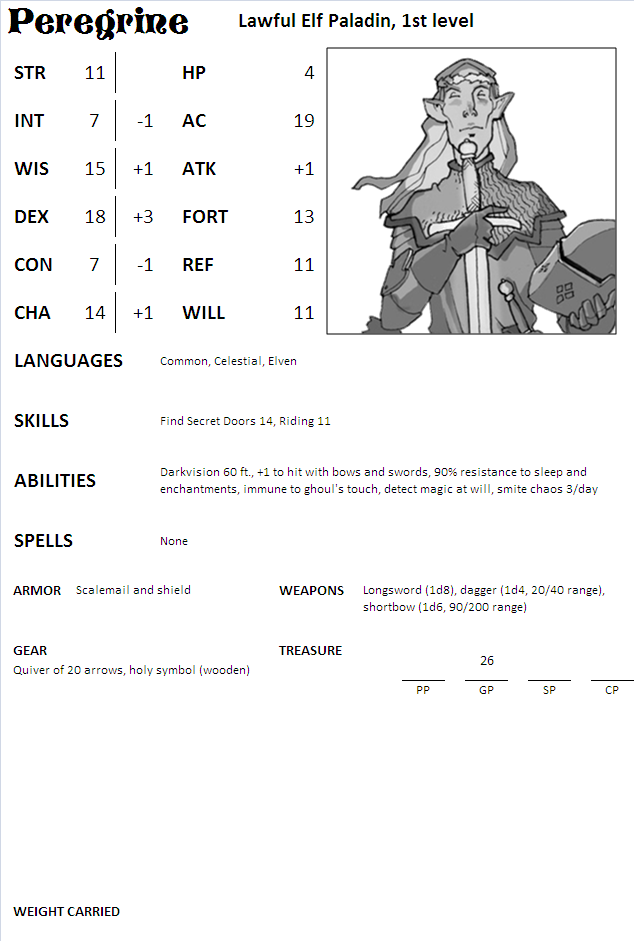
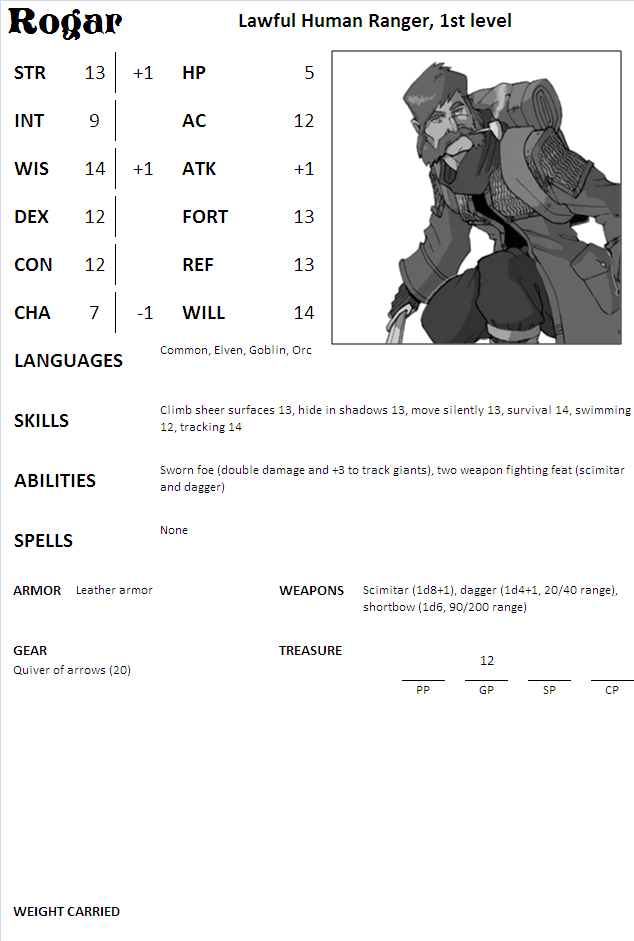
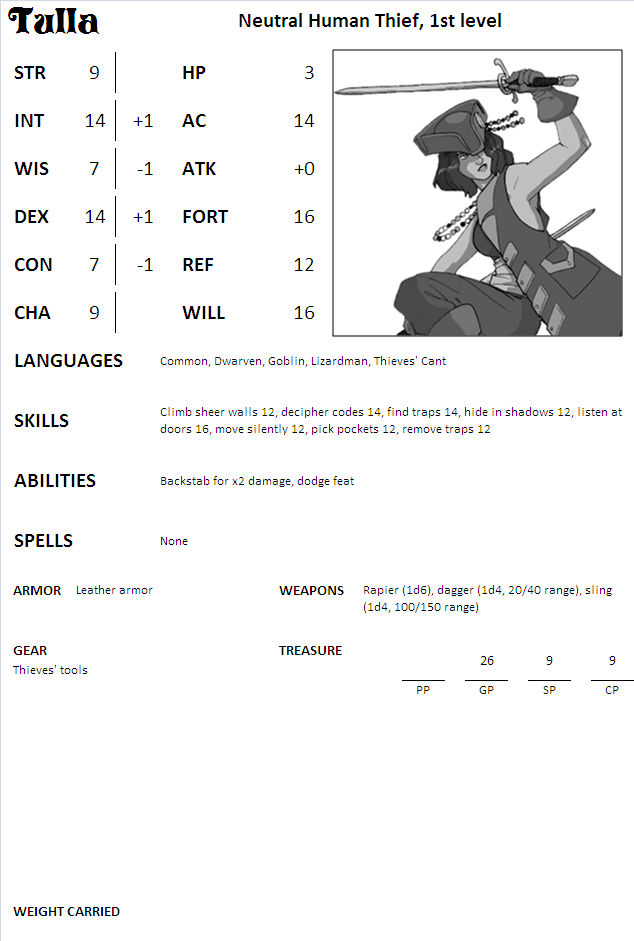
I received an email a week or so ago asking whether there would be an intro adventure for Blood & Treasure as well as some pre-generated characters. Short answer … yes.

I was initially unsure about producing adventures for B&T. My intention was to make a game that could handle most adventures produced for everything from the original edition to Pathfinder (with more GM work on converting 3rd edition and Pathfinder than the classic D&D products). So, if just about every adventure ever written works, more or less, with B&T, why produce more outside of short adventures in issues of NOD? Well, honestly, because someone asked, and because it seemed like a decent freebie download for the game.

That being said, I’m now working on an intro adventure that will play off of the “sample play” bit in the rulebook. Kobolds, exiled bugbears, goblins, fungus, necromancers, etc. Your typical fare.

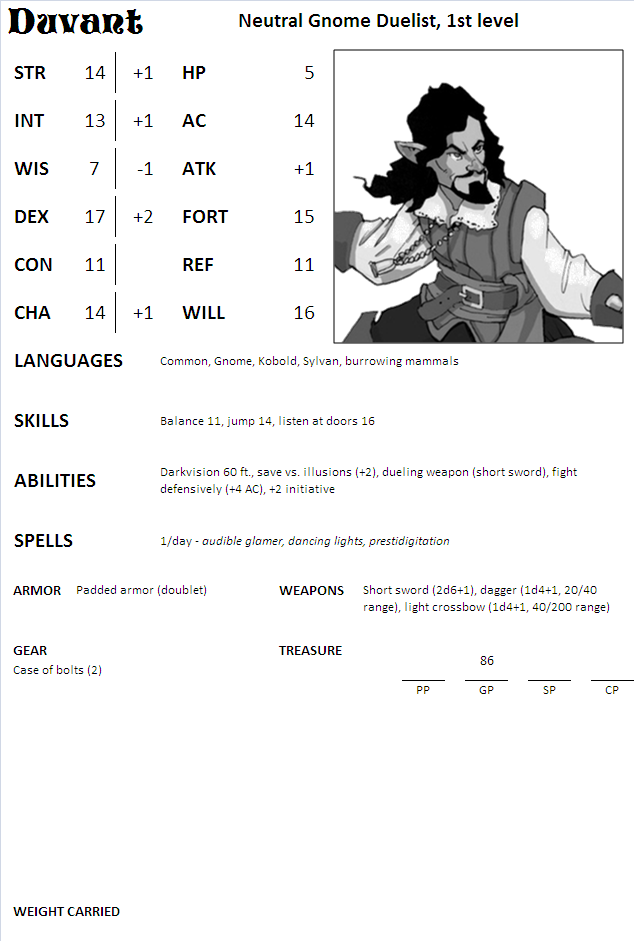
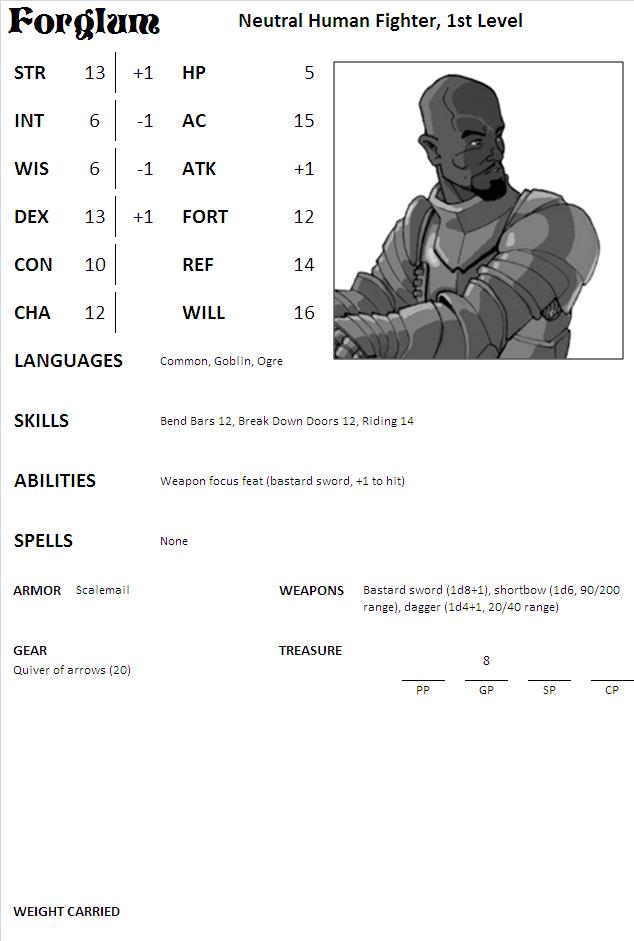
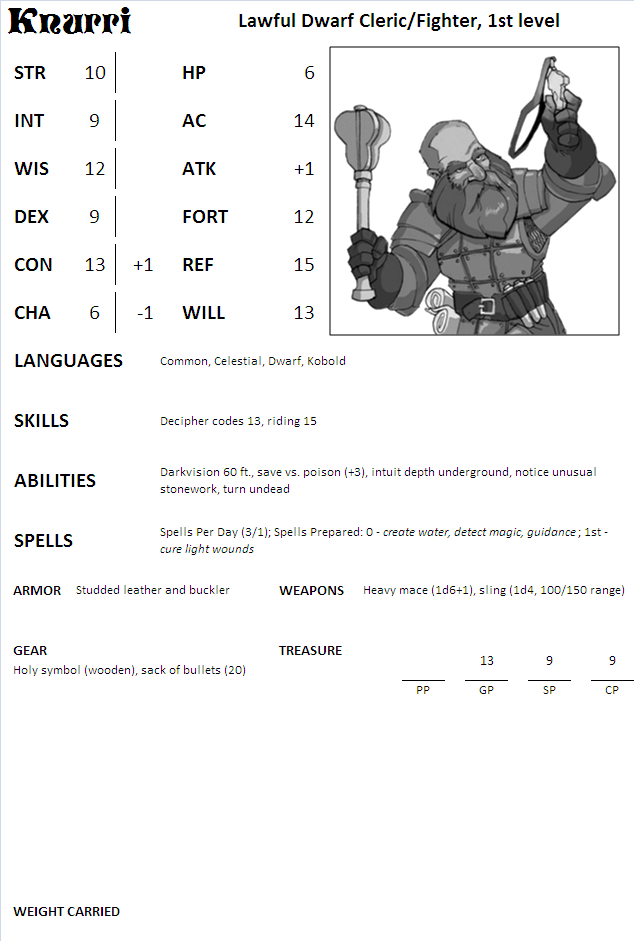
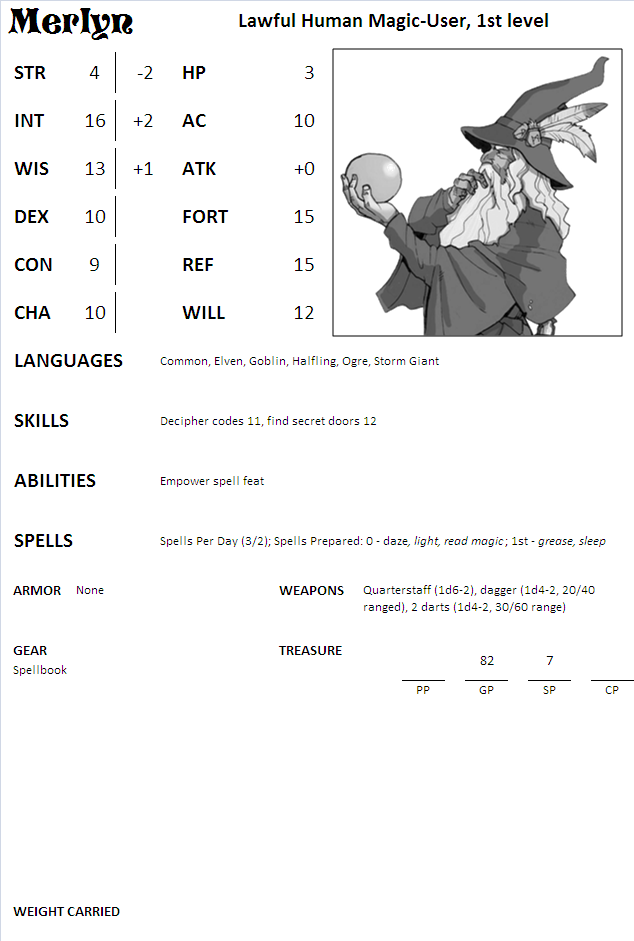
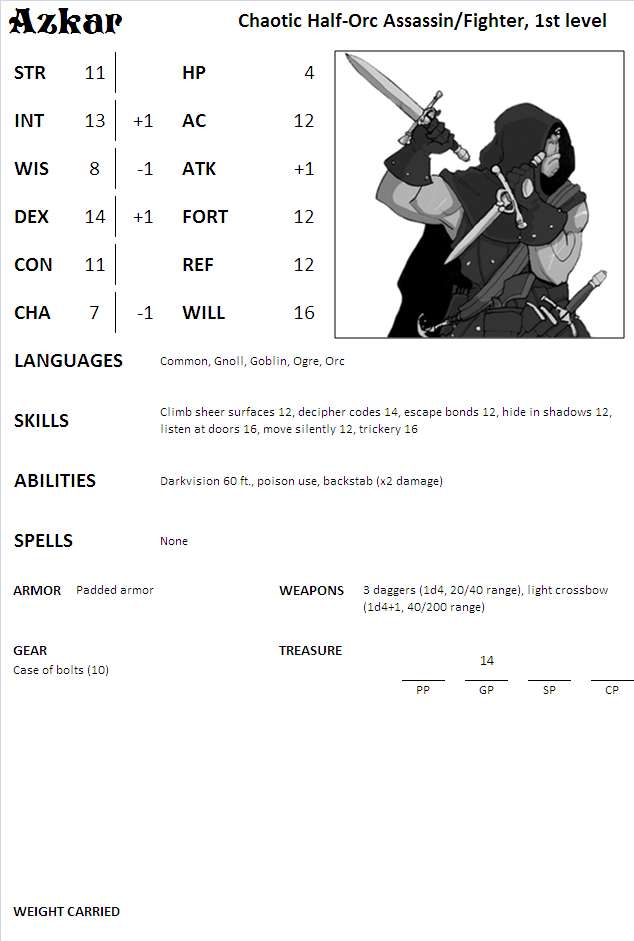
I’m also working on some pre-gen characters (see below) – I know, the equipment doesn’t always match the art … c’est la vie. I only bought weapons, armor and equipment required by the class – the players could spend the rest of the money on adventure supplies (a good time to learn about the importance of logistics!)


Dragon by Dragon – December 1977 (11)

Merry Christmas 1977! I would have been five, having my first Christmas in Las Vegas and opening, well, I have no memory of what I received for Christmas when I was five. I’m sure I was stoked. What were Dragon magazine subscriber’s opening?

First and foremost … best cover yet. A wagon of startled doxies pulled by God-knows-what is accosted by a red-robed dude and his captive troll while the triple-flail-armed driver looks on. Nice! Painted by Elrohir.

Second … an ad for newly released miniatures of the various demons plus Orcus and Demogorgon. The Type VI looks more like “naked guy with wings” than they are typically portrayed, which I think makes him creepier than the “OMG DEMON!” look.

Big announcement from Tim Kask … Dragon is going monthly! Oh, and they’re finally sending checks out to authors and artists! He also announces coming fiction in The Dragon from L. Sprague DeCamp and Andre Norton, as well as fiction from Fritz Leiber in this issue.

Gygax now chimes in with a defense of TSR defending its intellectual property from cheap and crappy imitations and outright theft in the form of reprints of D&D material. He has some nice words for GDW, but seems to be telling everyone else to piss off. He also mentions the coming release of the AD&D Monster Manual and future release of other AD&D material.

Enough announcements and editorials … let’s get to the gaming.

Rob Kuntz presents a system for Brawling (The Easy Way “Out” in D&D) which, at first glance, is way more system than I need. Brawling and grappling are always a problem, it seems, because they offer the chance of knocking someone out or disabling enough to make them an easy kill, thus tons of extra rules. This one compares ability scores of the fighters to get a modifier, and then a dice roll to score “damage” to one of the ability scores. Grappling, for example, involves averaging the dexterity and strength of both combatants and comparing them on a grapple table, then rolling 2d6 to discover how it works. Punching is similar, but determines the amount of damage.

Tony Watson then explains how to stop good old O.G.R.E. (not the monster, the mega-death machine) – basically tips and tricks for the game. I played it once, O.G.R.E. won, and my yen to play O.G.R.E. was satisfied.

In the Design Forum, Thomas Filmore, who opines on the value of role playing in D&D, as opposed to just wargaming. Pretty common blogpost material here, but perhaps a rather new concept back in the day, when many characters did seem to be more about puns and action than deeply invested backgrounds (i.e. the good old days).

Archive Miniatures has an ad for Star Rovers – 25mm miniatures. I dig the names of the figures, all of whom would be at home in a game of Space Princess: Planetary Scout, Funky Robot, Andromeda Annie, Bianca Snow, Doc Crock, Galactic Centaur, Alien Lizards, Walktapus (pre-Runequest?) and Sassanid War Elephant. Wait, Sassanid War Elephant? Why not.

MAR Barker continues answering reader questions in his Seal of the Imperium article.

Next up are some expansions to the Snits game that was featured last issue. Apparently the snits took the world by storm.

The Sorcerer’s Scroll is a new feature, and this first one is written by Rob Kuntz. Here, he mostly goes into the new Monster Manual (with “stupendous art by David Sutherland, David Trampier and Tom Wham”) and the eventual release of ADVANCED DUNGEONS & DRAGONS (I forgot that it was always written in all caps (“Fighters will now take 10-sided dice to determine their hit points and clerics 8-sided, etc.”). He also mentions Judge’s Guild, who continues to “saturate the D&D market with new variants” (and that TSR has undertaken to “make their new rule variant/additions … much more refined and interesting to the hard core D&D player” – I don’t like the sound of that). He has some kind words for Chivalry & Sorcery, but explains that it falls short due to its “smallish” print.

Fritz Leiber is next with Sea Magic. An excerpt:

“On the world of Nehwon and in the land of Simorgya, six days fast sailing south from Rime Isle, two handsome silvery personages conversed intimately yet tensely in a dimly and irregularly lit hall of pillars open overhead to the darkness. Very strange was that illumination — greenish and yellowish by turns, it seemed to come chiefly from grotesquely shaped rugs patching the Stygian floor and lapping the pillars’ bases and also from slowly moving globes and sinuosities that floated about at head height and wove amongst the pillars, softly dimming and brightening like lethargic and plague-stricken giant fireflies.”

Ral Partha’s new releases would make a nice random encounter list:

2. Gremlin War Party (3d6 winged goblins with spears)
3. Dwarf Lord (6th level dwarf fighter with chainmail and battle axe)
4. Satyr (Pan) (1% chance the encounter is with Pan, otherwise 1d6 satyrs)
5. Centaur Archer (1d8 centaurs armed with shortbows)
6. Land Dragon with Captain (treat land dragon as wyvern without wings, captain is 5th level fighter with splintmail, shield and lance)
7. Land Dragon with Lancer (lancer is 1st level fighter with breastplate, lance and shield)
8. Witch (female magic-user level 1d4+2; males must pass Will save or be fascinated with her breasts)
9. Monk (1d6 first level monks armed with staves)
10. Sprite War Band (3d6 sprites with swords led by 3rd level sprite fighter on fey mount)
11. Imp War Party (2d6 flying monkeys with sword or axe, shield and breastplate)
12. Were Bear (1d4)
13. Wing Lord (winged 3rd level fighter with spear and scale mail)
14. Paladin (dismounted) (5th level paladin with war harness (+2 AC), shield, pole axe and HUGE wings on his helmet)
15. Armored Knight (dismounted) (4th level fighter with platemail, shield and halberd)
16. Roomen War Party* (2d6 roomen with shield and spear)
17. Earth Demon (combo of stone giant and earth elemental)
18. Undead War Band (3d6 skeletons armed with swords, scythes and spears)
19. Woman Plunderer (1d6 levels of female barbarians with swords and chainmail)
20. Roll two times on table

* They’re freaking mutant kangaroo warriors!

Roomen (N Medium Humanoid): HD 1+1; AC 13; Atk 1 weapon (1d8) or kick (1d4+1); Move 40; Save F 13, R 15, W 15; XP 50; Special: Bound 60 ft. as charge attack.

James M. Ward now presents Quarterstaff Fighting Rules. This is like a mini-game that could be integrated into a normal game of D&D – somewhat like the jousting rules from Chainmail.

In Tramp’s Wormy, Wormy asks a bunch of dwarves “What wears chainmail and looks like black pudding?” – any guesses?

In Fineous Fingers, the adventurers discover that the evil wizard Kask has forced the local hobbits to try to conquer the city by capturing their princess.

The issue ends with a withering critique of NBC’s The Hobbit, by Rankin-Bass. I know, not the best adaptation, but I dig the design on the wood elves.

Overall, an issue that leaves me of two minds. I’m a big fan of Leiber, so the short story was cool. The EPT and O.G.R.E. stuff is not really aimed at me, so no complaints there. The brawling and quarterstaff fighting are nice mini-games/sub-systems, but probably not things I would include in my regular D&D game. Strangely enough, it’s often the ads that I’m enjoying the most – little snippets of creativity with no rules/stats attached. There’s the suggestion that in 1977, the creative energy of D&D is slipping away from TSR – they have some pretty good modules left in them, of course, but things are becoming more controlled and professional, and that carries with it a price to pay.

Battle of Gaudin’s Ford – Final Rounds

You didn’t think I forgot about the battle, did you? Of course, since today is the 4th of July, I wish I’d pitted Red Coats against Yankees, but I’ll have to settle for halflings and orcs.

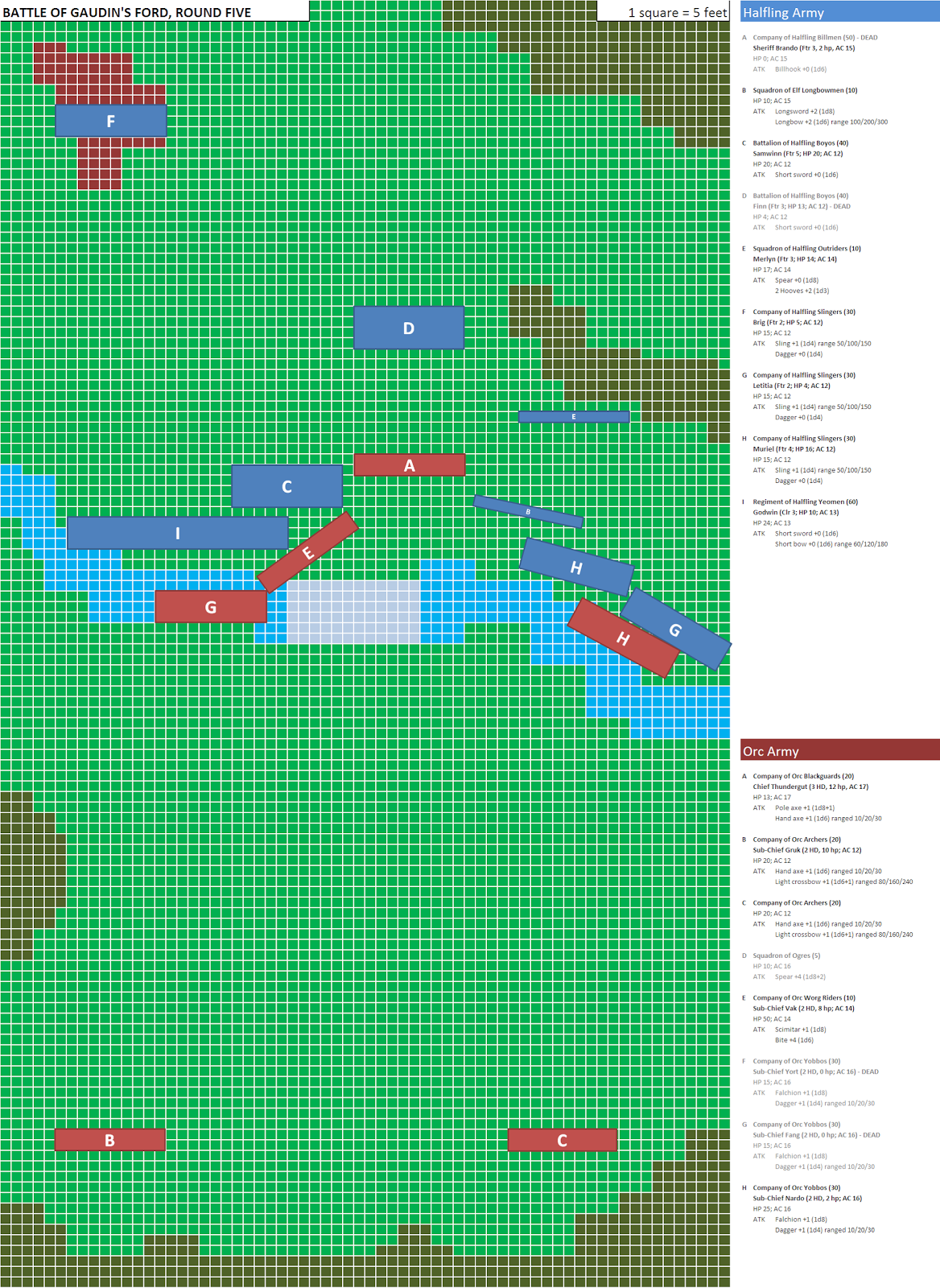
ROUND FIVE

Click to enlarge

The halflings and orcs both find themselves in an interesting predicament with the annihilation of the billmen. The orcs should want to follow it up and charge in … but then they’re surrounded by angry halflings. Likewise, the halflings should want to plug the hole … but then a company of boyos has to take on the orc blackguards all by its lonesome. What to do?

The halflings decide to do the following … the surviving sheriff will retreat back to the safety of Halfling C. Those companies will stay put. The elves would really like to fire their bows at those orcs, but instead they’re going to wheel back a bit. The other halflings are going to hold their ground. All of the halfling’s with missile weapons, except Halfling I and Halfling G, are going to concentrate fire on Orc A. Halfling I is going to fire on Orc G and Halfling G is going to fire on Orc H.

The orcs decide, in true orky fashion, to charge. Orc A is going to charge in to Halfling D – if Halfling B gets in the way, they’ll hack down the elves first. This will, they hope, free up Orc E to slam into the side of Halfling I, along with Orc G. Orc H is going to attack Halfling G. Orc B is going to fire at Halfling F and Orc C at Halfling E.

So, how does it play out?

Missile Phase
Since the last report, I’ve modified the rules a bit to use normal side vs. side initiative which has to be re-rolled for each phase. For this missile phase, the orcs roll a ‘6’ and the halflings a ‘5’.

The orc crossbows let fly their bolts. Orc B scores no damage on Halfling F. Orc C inflicts 7 points of damage on Halfling E, whose leader, Merlyn, rolls his save and suffers no damage.

Orc A suffers 7 points of damage. Thundergut saves and suffers no damage. They’re battered, but they didn’t break! Halfling G scores 2 points of damage on Orc H, and sub-chief Nardo saves, so no damage. Halfling I is pretty ineffective against Orc G, scoring 5 points of damage. On the plus side, this is enough to force a moral check! The orcs, without their leader, fail the check and will begin moving away next round. The worg riders, who have been ordered to attack Halfling I, might be in trouble.

Movement Phase
Orcs roll “1” and Halflings roll “1” – they re-roll initiative and this time the halflings win.
The elves move back, and everyone else holds. The orcs now have two forced moves. The Orc G swims for their own side of the river, while the fleeing ogres in Orc D run off the battlefield. Orc A charges into Halfling D, Orc E wheels into the flank of Halfling I and Orc H rushes up the river bank to attack Halfling G. Plenty of melee combat this round!

Melee Phase
Orcs gain initiative this round, and they’re going to need it with three units already having fled or being in retreat.

Orc E plunges into Halfling I and scores 6 points of damage. Because they’re hitting the far flank, I’m going to rule that Father Godwin doesn’t have to save to avoid damage this round.

Orc A works their magic again … 14 points of damage on Halfling D. Finn, the leader of Halfling D, fails his save and is killed in the onslaught. The halflings now have to roll a morale check – they fail, and turn to flee. Because they’re in melee combat, they expose themselves to pursuit and an extra attack. The orcs score another hit, this one for 2 points of damage, reducing Halfling D’s hit points to 4.

Orc H, scrambling from the river fail to score any damage on Halfling G, who responds by scoring 3 points of damage on the yobbos.

Halfling I now counterattacks Orc E. They fail to score any damage.

No magic this round, so we go to …

Click to enlarge

ROUND SIX
The halflings know they have to destroy Orc A to break the orc army. To that end, Halfling C is going to wheel and attack their flank while Halfling E does the same from the other direction. Halfling B is going to wheel back and wait for an opening. Halfling H is going to join battle with Orc H. Halfling F sling their stones at Orc B. Halfling I is going to maneuver while in melee – essentially, they’re going to change formation this round into a square.

Orc B and C are not going to reload this round, but rather hustle towards the lines. The orc chief needs orcs on the line to hold the bank and claim victory. Orc E and H are going to continue to attack, and Orc A is going to wheel and hit Halfling C in its flank. Clearly, initiative will be important this round.

Missile Phase
No initiative this round, since only the halflings are shooting. Halfling F scores 5 points of damage on Orc B. Sub-chief Gruk fails his save and suffers the same – he’s a tough old bird, though, and keeps on breathing.

Movement Phase
Big initiative roll this round, and the orcs win it! Orc B and C move forward. They might end up being too late to do any good. Orc A wheels and moves into Halfling C’s flank. Orc G makes it out of the water on their way to flee the field.

Meanwhile, Halfling D continues to flee and Halfling E wheels and charges into the rear of Orc A. Halfling B wheels and moves back. Halfling H moves to attack Orc H.

Melee Phase
Orcs lose initiative this time to the halflings. The plucky Halfling C, flanked by the orcs, manages to score 2 points of damage on the blackguards. Halfling E, despite a rear attack and charge, score no damage. The orcs still have 11 hit points, so they don’t have to check morale yet. But the halfling leaders do some damage as well. Samwinn and Merlyn inflicts another 2 hit points of damage on Orc A – now they have to make a morale check and fail badly. This is probably it for the orcs. They immediately flee back for the river ford, and Halfling E pursues (C choose not to), but fails to score any more damage. Thundergut failed his save, and suffered 4 points of damage as well.

Halfling I continues to fight at a disadvantage against Orc E, and scores no damage.
Halfling G and H attack Orc H, combining for 4 points of damage (tough little buggers, those halfling slingers). Sub-chief Nardo fails his save this time, and takes a shiv to the ribs. He’s dead, but I’ve rewritten the rules so that the loss of a leader does not necessitate a morale check.

The orcs (what’s left of them) counterattack. Orc E scores 8 points of damage on Halfling I. They’re one point away from a morale check. Orc H scores 2 points of damage against Halfling G. Muriel fails her save and suffers 2 points of damage. Halfling G is down by at least 50% of their hit points, so they roll a morale check and pass. They stand and fight.

No magic again, so the end of round six!

EPILOGUE
At the end of Round Six, the battlefield is a bit chaotic, but the halflings seem to have the upper hand. Even if Thundergut rallies his blackguards, they’re going to have trouble turning the tide. We’ll give this day to the halflings. I learned quite a bit from this little demonstration, and I’m now ready to apply what I learned to the final mass combat rules in Blood & Treasure.

Dragon by Dragon – October 1977 (10)

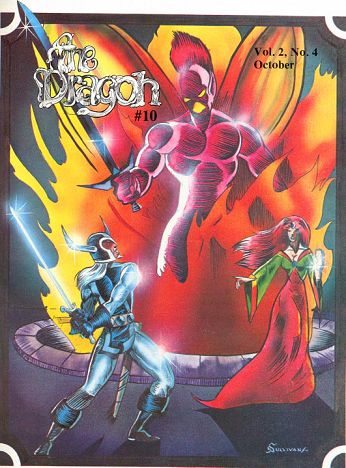
Can you feel the chill in the air – that crisp chill of Autumn? Well, of course not. It’s July in the here and now, and just reading a magazine from October isn’t going to change that unless you have a rather powerful imagination or have been dipping into the pseudo-pharmaceuticals. Let’s see what Gygax & Co. had in store for us 35 years, when the leaves of Lake Geneva were beginning to change*

October 1977 starts off with a firecracker (mixing my seasons again), as Jon Pickens presents D&D Option: Orgies, Inc. The Mule Abides has already brought this article to prominence in the OSR, but I think it’s worth mulling over again.

The article posits the problem of too much wealth in the game. To this end, Pickens decided that treasure should only be translated into XP when it was spent. Since you can only have so many suits of platemail, 10-ft. poles and weeks of iron rations, players need something else for which to spend their gold. Pickens provides the following avenues of expenditure:

1. Sacrifices: Gold given directly to gods or demons; any character can do this
2. Philanthropy: Lawful’s can give gold to charity – but not to hirelings or fellow PC’s, of course
3. Research: This is for magic-users and alchemists.
4. Clan Hoards: Dwarves and other clannish folk can give their money to their clan.
5. Orgies: Fighters (not paladins or rangers), bards, thieves and all chaotics (except monks) can spend their money on wine, women and song

There are, of course, additional guidelines to these expenditures (i.e. how much can be spent in a night or week, etc.), but I love the idea and the restrictions. Even better, he has two appendices to the article – one on gambling and one on the effects of orgies on psionics (and in my opinion, the mere existence of this appendix should make you want to include both orgies and psionics in your next campaign).

Izzat what a female goblin looks like?

Daniel Clifton has the task of following up on Orgies, Inc., and does so with Designing for Unique Wilderness Encounters. It’s a nice little article, containing random tables for determining what the terrain looks like when a few pesky wandering monsters show up in the wilderness. The tables generate the vegetation, slope, etc., but don’t provide any guidance for how this terrain impacts the battle, which is probably a good thing.

Paul Montgomery Crabaugh presents Random Monsters – by which he means monsters generated randomly, not random wandering monsters. Naturally, I need to generate at least one (which I suppose I really should include in Blood & Treasure):

Intelligence: Highly intelligent (I have a budding genius on my hands here!)
Alignment: Chaos
Type: Mammal (which means it might be a ninja)
Speed: 12
Armor Class: 7 (would have been a 6 if it was a reptile; for B&T it’s a 12)
Hit Dice: Level -2 (level being the level of the dungeon … hmm let’s pretend we’re on the 9th level of our dungeon, so 7 HD)
Hit Dice Modifier: +0 (so, 7 HD … odd that I need to roll for the HD and then roll to modify it)
Damage: 1d8

Now I need to roll for special characteristics, which is an odd percentile table. For a 7 HD monster, I’m going to assume it works as follows:

01-39 – none
40-74 – one
75-89 – two
90-100 – three

I roll a “92” (no, really, I swear it) and thus my monster has three special characteristics. I need to roll d24 for these (if you don’t know how to roll d24, I just feel bad for you) and come up with the following:

1. Hostile to clerics
2. Has anti-magic shell
3. Hostile to magic-users

I have a very hostile monster, apparently. But he doesn’t hate cans … he hates spellcasters. This makes his anti-magic shell make pretty good sense (ah, the wisdom of dice!)

I now roll another D% to see if it has “other characteristics”, and a roll of “61” tells me it does not (otherwise, it could have some insect characteristics).

Last batch of rolls determine the physical description:

Size: Medium (6 feet)
Limbs: 2 legs, 3 arms
Exterior: Feathers
Coloring: Spotted white and grey

So, what do we end up with?

ALMESITH
Medium Magical Beast, Chaotic (CE), High Intelligence; Gang (1d4)

Hit Dice: 7
Armor Class: 12 [7 for Swords & Wizardry]
Attacks: 3 claws (1d8)
Move: 30 [12 for Swords & Wizardry]
Saves: F 10, R 10, W 11 [9 for Swords & Wizardry]
XP: 700 (CL 8)

Almesiths are strange beasts that are spawned from the residual energies of powerful spellcasting, living embodiments of nature’s abhorrence of magic. They are most often encountered in the deeper levels of dungeons, and seek out spellcasters for destruction. Almesiths look something like owlbears, and can be mistaken for those sorcerous creations. They differ in size, being no taller than a man, coloration, being covered in dark grey feathers on their arms, legs and backs and softer, white and grey spotted down on their bellies, and in two additional curiosities: They lack mouths, having instead a stirge-like tubular beak that juts 3 feet from their faces, and in that they have a third arm that juts from their chest. Almesiths attack with their large, hooked claws, and generate a natural anti-magic field (as a 7th level caster) in a 60-ft. radius. In combat, they always focus their attacks on spellcasters (clerics, druids, magic-users and sorcerers first, bards second, assassins, paladins and rangers third), ignoring attacks by non-spellcasters even when it threatens to kill them.

In the Design Forum, Richard Gilbert presents Let There Be Method To Your Madness. This is another in the series of “dungeons should usually make some rational sense” articles; the attempt to bring the retro-stupid branch of the RPG world to heel that persists to this day. I think these two camps can best be described as Phoebe vs. Rachel.

Next up is a mini-game … Snit Smashing, in which a Bolotomus waits to smash the Snits that run from the ocean so they can plant their snotch in a Snandergrab. If the Snit player manages to multiply more rapidly than the Bolotomus player can smash them, he or she wins. For the Bolotomus to win, he or she must destroy all of the Snits.

When you’re through smashing snits, you can proceed to P. M. Crabaugh‘s next article, entitled Weights & Measures, Physical Appearance and Why Males are Stronger than Females; in D&D (weird use of a semicolon). If the feminists in the audience are getting their hackles up, they might want to read the article first, they might want to read the article first. The article posits an additional 3d6 stat – Size – which can translate into bonus hit points and a modifier to carrying capacity. Yeah, males get some extra carrying capacity … and females get a +2 bonus to Con and a +1 bonus to Dex, and men get called “thick-fingered clods with facial hair”. The old “trash men to keep the feminists from calling you insensitive names” ploy. A classic.

Beyond the ability modifiers, the article has a mess of random tables for generating a random appearance (did you know males have a 30% chance of having facial hair). I don’t know that I’d use this for generating a PC, but it could be useful for generating general ethnic physical and cultural characteristics, if you want to get away from “these people look like Vikings, and these people look like East Asians and these people look like …” trend in campaigns.

The next article is Gaining a New Experience Level by Tom Holsinger. He explains that what D&D and EPT really need is some sort of dangerous ritual for characters to undertake when they have enough XP to advance in level. To which I reply, “Huh?” Favorite line in the article:

“The sacrifice of humans is generally forbidden in a populated area because too many people get upset.”

The article is actually pretty tongue-in-cheek, and would make for an interesting campaign. Essentially, it creates a sub-game that involves getting the gods’ attention with sacrifices or sacrilege, then assuming the “proper physical and psychic attitude, i.e. complete exhaustion”, which, Holsinger assures us, can only reliably be done by becoming thoroughly inebriated, during which the Emissaries of the Gods, the Great Pink Elephants, come to the character and imbue them with their new Hit Dice and special abilities. The level limits for elves, dwarves and halflings are, he tells us, because they have a harder time getting drunk. It is also why high level characters move out of town and build castles – with more hit points, they have to get super shit-faced to attract the attention of the gods, and that might mean burning things down and causing other massive disruptions to the lives of the common citizenry. This article actually dovetails nicely with Orgies, Inc. and together they could make for one hell of a fun campaign.

Next up, Edward C. Cooper‘s The Tactics of Diplomacy in Stellar Conquest. Honestly, I don’t know the game and so I’m not going to comment on the article.

In Wormy, the eponymous dragon is contemplating stumping some angry dwarves with a riddle. They’re angry because Wormy stole their bowling balls to use on his pool table. Meanwhile, Fineous Fingers is under attack by a whole guild of murderous hobbits.

And that’s it for October 1977. Good issue, I think. I have to run and set up an inflatable pool now, but I have a couple neat ideas in store for next week. Oh, and I finished writing Blood & Treasure yesterday …

Would they be changing in October? I’ve lived in Las Vegas my entire life – Summer temperatures only finally end around the last week of October, and the leaves may not change here until well into December. Basically, I have no idea how seasons are supposed to work.

Perukes of Power [Blood & Treasure]

Don’t know why … don’t ask …

Cadogan of Holding: This wig is grandiose and ridiculous, being woven from two different colors of hair and being quite tall. The wearer can reach into the wig and pull out various items she has stored there, per a bag of holding (I).

Concubine’s Wig: This Egyptian-style wig of perfumed black hair allows female wearers to cast charm person three times per day and charm monster once per day. Charmed men must make additional saves each hour or be overcome by their passions. The wig just makes men look weird.

Diadem Wig: This wig of tightly curled blond hair gives the wearer the ability to cast command three times per day, and improves their charisma by 2 points while worn.

Lousey Wig: This wig of chestnut hair is crawling with nits and lice. Once per day, by shaking it vigorously, the wearer can summon an insect plague, which rises from the wig itself.

Periwig of the Rake: This wig is highly valued by duelists. Examples are either stark white and tied in ponytails, or composed of a heap of black curls. The wig grants the wearer a +2 bonus when using special maneuvers, grants non-duelists the ability to riposte as a 1st level duelist and grants duelists a +2 bonus to hit and damage when riposting.

Wig of Decay: This full, curled whig of auburn hair is cursed, making the wearer break out in open sores and effectively reducing their charisma to 3. While it is worn, the wearer also suffers a -2 penalty to saving throws vs. disease.

Wig of Glowering: This white, powdered magistrate’s wig allows the wearer to cause fear (as the spell), once per day, by scowling.

Wig of Insect Repulsion: These powdered wigs, when fluffed or shifted vigorously, produce a 15-ft. radius cloud of white powder that forces vermin to pass a Will save to enter the cloud, and even then forces them to save vs. poison (Fort) each round they are in the cloud or suffer 1d4 points of damage. The cloud persists for 1d4+2 rounds and can be created once per day.

Wig of Medusa: This wig has long, red locks that hang down to the hips. They can be animated by the wig wearer, making three grapple attacks using the wearer’s attack bonus.

Wig of Sneezing: This powdered wig can, once per day, create a cloud of powder equivalent to powder of sneezing.

(Welcome to those from the Sneeze Fetish Forum! You’ve got to love the way the internet connects everyone to everyone eventually)

Sorry folks – no magical merkins for now …

The Battle of Gaudin’s Ford – Rounds 2 to 4

Today, I continue with the Battle of Gaudin’s Ford. Things begin to get ugly for both sides.

ROUND TWO

The orcs are marching, the halflings are ready … let’s see what happens.

Orders Phase
The halfling commander is now going to order all of his missile troops to concentrate fire on the central company of orc yobbos. Everyone else is going to close ranks (i.e. go into a tight formation) and prepare for the onslaught. The halfling cleric is going to strike, though, this round. If the orcs get close enough, he’s going to unleash his 2nd level spell, sound burst, on them.

The orc commander is going to charge his yobbos at the enemy, even though they’re in a loose formation. He mostly wants them to screen his elite troops. Units G and H are going to plunge into the river and swim for the other side – it will be slow going, but he wants to nail those other halfling units down and keep them from harassing his elite troops. The crossbowmen are going to spend the round reloading their crossbows. The elites are going to march forward and prepare to charge!

Missile Phase
No need for initiative here, as the orcs are reloading this round.

The elves don’t score a hit this round, but the halfling slingers and archers do score some damage – 11 points in all. Yort has to make three saves and fails two, so he’s eliminated as well. That means Unit F has to make a Will save or flee, as they’ve now lost half their original hit points and their commander. The orcs roll a 9 and fail the save, so during the movement phase they will begin fleeing around those elite units.

Movement Phase
Again – no need for initiative, since the orcs are the only one’s moving. Unit F starts off by fleeing.

Melee Phase
No melee yet – next round for sure

Magic Phase
Orc Unit G is close enough, so the halfling cleric throws sound burst. Since it’s an area effect spell, it does normal (i.e. 1d8) damage to that unit, and it must save or be stunned. As it is, the unit suffers 3 points of damage, but is not stunned. Unfortunately, its commander, Fang, fails his save and suffers damage along with the unit – and that kills him. Fortunately for the orcs, the unit does not break (they never like him anyhow).

ROUND THREE

Orders Phase

The halflings are pretty pleased – they’ve eliminated one unit of orcs and a couple orc leaders. Unit I is now going to attack Orc Unit G and try to send them off the board as well. Units H and G are going to attack Orc Unit H. Unit F is going to send their stone sailing over head into Orc Unit D, and the elves are going to make that unit their target as well. With any luck, few halflings will fall this day. The cleric will cast bless on his unit, giving them a +1 bonus to hit and save vs. fear for the remainder of the battle.

The orcs, on the other hand, are having some problems. The orc commander had planned on sending his yobbos against the billmen, to allow his ogres and blackguards to form up in a tight formation before attacking. Now he’s worried that spending a round forming up will cause undo casualties from missile fire. Still, he decides to do it right – Units D, A and E will take a tight formation and charge next round. Meanwhile, Units G and H will begin swimming the river to harass the halflings on the other side. The crossbowmen will pour their shot into Halfling Unit A, to soften them up a bit. Orc Unit F, the one fleeing, has no commander, so they cannot rally – they’re out of the battle.

Missile Phase

Initiative: Halflings (5), Orcs (3)

The halfling player attacks with Unit I first. They score 3 points of damage on the orcs, not enough to cause them to flee. Lousy dice rolls!

The orc commander responds with Unit B, sending his black-fletched bolts into the billmen for 7 points of damage. The halfling commander has to make two saves, and fails one of them. He takes 3 points of damage and has 8 left. Integrating him with a unit might have been a terrible miscalculation in the long run. But the billmen have a bigger problem – they’ve been whittled down to under half their original hit points, which means it’s time for a moral check (i.e. Will save). Fortunately, they ace it with a ‘20’ and will stand and fight – for now.

[Here’s a quick aside. I might remove the moral check when a leader is killed. Leaders improve a unit’s morale checks and enable them to rally if they flee, but a leaderless unit has a weird advantage over them in that they have no leader to lose and force a morale check. I’ll have to think about this.]

The halfling commander is next, so he has Unit B – the elves – send their arrows into the ogres, scoring 4 points of damage. First blood on the ogres!

The second orc crossbow unit now let’s fly at the billmen … and fails to score any damage.
The rest of the halfling units can now go at it. Units G and H have no success against the orcs crossing the river. Unit F, on the hill, scores 1 point of damage against the ogres.

Movement Phase
Again, no need for initiative when the halflings aren’t moving.

The central orc units use the turn to form into a tight formation. They’ll charge next round. The other orc units begin swimming – they can move 10 feet per round swimming. Unit F finally quits the field. No plunder for them.

Melee Phase
Next round, for sure!

Magic Phase
Godwin now casts bless on Unit I.

ROUND FOUR
Time for melee.

Orders Phase

The halflings stick to the script, duplicating their orders from last time. Godwin, the cleric, will cast guidance on himself this round.

The orc crossbowmen are reloading this round. Units G and H are continuing their swim. Unit D, the ogres, is going to crash headlong into the billmen this round. Unit A and E will follow along, charging in the ogres stead if they are eliminated.

Missile Phase
The orcs are reloading again, so it’s all halflings this round.

The elves and hill slingers combine for 5 points of damage, forcing a morale check. The ogres say “screw this!” and are ready to quit the battle. They aren’t getting paid enough for this crap.
Meanwhile, Orc Unit G suffers 2 more points of damage. They’re still standing strong. The halfling slingers fail to do any damage to Orc Unit H.

Movement Phase
First and foremost, the ogres beat it. That leaves it up to the blackguards, who charge into the billmen. The other orcs continue swimming – they’re just about ready to mix it up!

Melee Phase
Finally, we have some melee in this battle.

In melee, both sides exchange blows. Only squadrons within a unit that can attack get to roll the dice. The orcs are using pole axes, so both squadrons (front and back) are able to attack. Likewise for the halflings, who are using bills. Two of the five halfling squadrons can attack. There’s no initiative here – all attacks are treated as simultaneous.

So, the orcs tear into the halflings, and their attack is devastating – 17 points of damage! Chief Thundergut scores 6 points of damage against the halfling sheriff, who makes his saving throws to avoid the rest of the damage – he alone survives, with only 2 hit points. Meanwhile, his troops fail to score any damage on the orcs in return! And Sheriff Brando scores no damage against Thundergut. A devastating blow to the halflings, to be sure.

Magic Phase
Godwin now casts guidance on himself.

ROUND FIVE … This Weekend!

Battle of Gaudin’s Ford – Round One

Time to fight.

(Oh, and I made a mistake on my map yesterday, switching the places of the elf bowmen and halfling cavalry and mislabeling the halfling yeomen – sorry!)

As the rules now stand (yes, covering my @$$), mass combat is handled in the following phases:

1) Orders Phase
2) Missile Phase I
3) Movement Phase
4) Melee Phase
5) Magic Phase

During the orders phase, each commander writes down orders for each unit. These orders cannot be changed because of events on the field.

During each phase, each commander rolls 1d6 to see who moves a unit first, play then proceeding from commander to commander until each unit has moved or attacked during that phase.

So, orders for this phase will be as follows:

Halflings
A, C, D, E – Maintain a loose formation and wait
B – Stand ground and shoot bows at Orc Unit F
F – Stand ground and sling stones at Orc Unit G
G, H – Stand ground and sling stones at Orc Unit H
I – Stand ground and shoot bows at Orc Unit F

Orcs
All orc units are going to maintain a loose formation
All orc units except B and C will move ahead at normal speed, save the worg riders, who will have to match the pace of the units in front of them
Units B and C will target Halfling Unit A with their bows

With orders given, play proceeds with the missile phase

Each commander rolls 1d6 – Thundergut gets a ‘5’, Brando a ‘3’

Each squad of 10 figures makes a single attack, rolling damage if they hit

Thundergut has Unit B fire at Halfling Unit A, rolling a ‘13’ and ‘17’ and scoring 5 points of damage; Brando rolls a ‘18’ for his Reflex save and takes no damage

Brando has Unit B fire at Orc Unit F, rolling a ‘16’ and hitting for 5 points of damage; Sub-chief Yort rolls a 13 for his Reflex save and succeeds, suffering no damage

Thundergut has Unit C fire at Halfling Unit A, rolling an ‘11’ and ‘21’ and scoring 4 points of damage; Brando rolls a ‘25’ for his Reflex save and suffers no damage

Since Thundergut has no more missile attacks planned, it’s all halflings now

Unit F fires at Orc Unit G, rolling an ‘8’, ‘8’ and ‘18’ and scoring 2 points of damage; Sub-chief Fang rolls a ‘12’ on his saving throw and also suffers 2 points of damage

Unit G fires at Orc Unit H, rolling a ‘13’, ‘19’ and ‘17’ and scoring 4 points of damage; Sub-chief Nardo rolls a “1”, “12” and “22” on his Reflex saving throws, failing two and suffering 3 points of damage

Unit H fires at Orc Unit H, rolling a ‘2’, ‘8’ and ‘13’ and scoring no damage

Unit I fires at Orc Unit F, rolling a ’16’, ‘12’, ‘13’, ‘11’, ‘17’ and ‘1’ and scoring 4 points of damage; Sub-chief Yort rolls an ‘18’ and ‘20’ on his Reflex saves and suffers no damage

Movement now commences

Since none of the halfling units are moving this round, the movement all goes to the orcs.

Each square on the map represents 5 feet, and the orcs have a 30 foot movement rate. Thundergut has them move at full running speed towards the enemy, so they move 24 squares forward

No units are in contact, so there is no melee phase. No casters are casting, so there is also no magic phase.

So, at the end of Round One, we’ve seen some minor casualties on the orc side – nothing too dramatic yet, but we’ve only just begun the battle

Click to Enlarge

The Battle of Gaudin’s Ford – Preliminary

Among other things, Blood & Treasure includes some simple rules for mass combat to support the end game of stronghold and army building. While I’ve been playtesting the good old-fashioned dungeoneering and wilderness rules for a while now, I have yet to make sure the mass combat rules actually work. So, to correct this oversight, I’m going to test them LIVE, on this blog. Without further ado …

When spring rolls around, a young orc’s fancy turns to thoughts of plunder. And so it was that the orc chief Thundergut, rousing from a winter’s sleep, decided that it was high time to show those civilized bastards down in the valley what for. To that end, he rallied his troops (it involved lots of screaming and head kicking), convinced a few ogres to join in, and set out for Gaudin’s Ford.

Gaudin’s Ford was a ford across the River Pepp, named for a trapper who once had a trading post in the area. It provided the easiest way for many miles to cross the river and strike into the heart of the civilized area known as the Downs, an area inhabited primarily by a halfling moot called Mottlesby, with elf and human lands beyond.

As the orcs marched, they were spotted by a flock of giant eagles, who sped to the elves to warn them of the impending danger. The elves dispatched immediately a squadron of wayfarers to warn the halflings of Mottlesby and prepare a hasty defense at the ford, while the various elf princes were roused for battle and the humans were given the alarm.

And so it was that the orcs of Chief Thundergut met the halflings of Sheriff Brando at Gaudin’s Ford.

Click to Enlarge

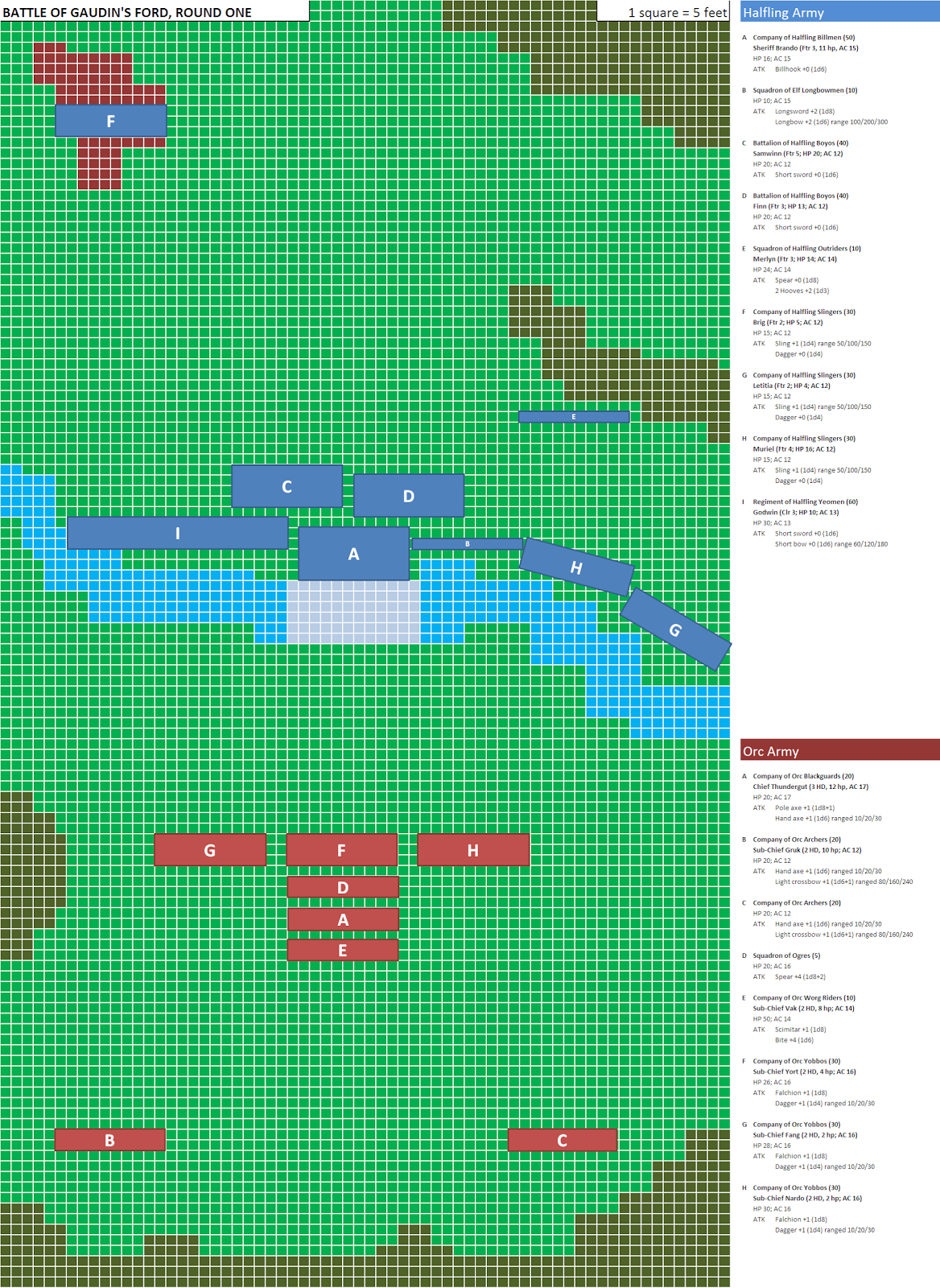
The above is my battle map, whipped up in Excel for ease of use. On the right, you see the display of the forces involved, along with leader types. My plan is to run a few rounds each day and see how things proceed, dropping in a few points about the rules as I go along. Consider today the set-up, with the battle being joined tomorrow.

The orc plan is to push forward, using the yobbos to soak up missile damage and then get out of the way so the ogres and blackguards can attack the lines in waves. The archers will try to engage the enemy missile troops and keep them out of the battle. The worg riders are kept in reserve.

The  halfling plan is to inflict as much damage as possible with missile weapons, and then hope the billmen can whittle the orcs down enough that they won’t overwhelm the yeomen and boyos.

In general, I’m trying to keep this simple and just test the mechanics. The troop types and leaders are drawn from the monster section of B&T and things like hit points were rolled randomly.

Oh – rhe dark green bits are woodlands, the brown blob a hill and the light blue bit is the ford in the river. The rest of the river could be crossed by swimming.