Haunted Armor

I don’t think it’s possible to be a member of my generation without having seen a haunted suit of plate armor at some point in a movie or television show. Even if it was just a cunning ruse by a Scooby Doo villain (who knew so many people tried to use the supernatural to cover up their crimes?), the haunted armor was a well worn trope in my day. These days, it shows up as nothing more than lazy comedy … or, in today’s post, as a way to kill those precious little snowflakes better known as Player Characters.

When a warrior dies with his armor, fighting to the end, his spirit often hesitates to leave its last post. When this happened, the spirit animates the armor and continues doing what it did in life. Haunted armor is a close kin to poltergeists – undead spirits that have opted out of the afterlife for a career in deviltry.

HAUNTED JAZZERAINT
Medium Undead, Chaotic (CE), Average Intelligence; Troop (1d6)

HD: 4
AC: 14
ATK: Strike (1d6) or scales (30’/1d4)
MV: Float 30
SV: F14 R14 W11
XP: 400 (CL 5)

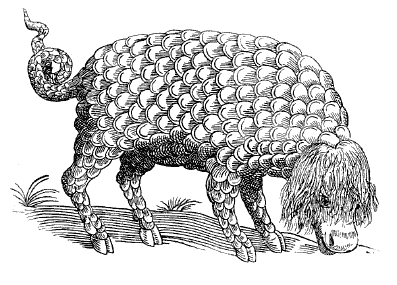
A haunted jazzeraint appears as an empty suit of scale mail, floating about 3 feet above the ground, with a helmet and two burning yellow eyes floating above it. Creatures with one or fewer levels of hit dice and warriors of any level that see a haunted jazzeraint are struck by the plight of the spirit within it, and must pass a Will saving throw or be frightened.

A haunted jazzeraint has no hands, and thus cannot wield weapons. Instead, it attacks by either flailing its arms, or slamming with its helmet (per strike above) or by launching a fusillade of razor-sharp scales from its body. These scales seem to regenerate after being thrown, so the haunted armor has no end of them. Just the same, it can only launch a volley once every 1d4 rounds. When a volley of scales is thrown, the jazzeraint makes a separate ranged attack against all creatures within 30 feet and within a 90-degree arc.

Special Qualities: Weapon resistance (silver or magic), immune to cold, electricity and fire

HAUNTED MAIL
Medium Undead, Chaotic (CE), Average Intelligence; Solitary

HD: 5
AC: 15
ATK: 4 chains (1d6 + constrict + energy damage )
MV: 30
SV: F13 R13 W11
XP: 1250 (CL 7)

Haunted mail appears as a suit of chainmail. Creatures with one or fewer levels of hit dice and warriors of any level that see a haunted jazzeraint are struck by the plight of the spirit within it, and must pass a Will saving throw or be frightened.

Suits of chainmail attack with 20-ft. long chains that hang from the monster’s arms. Creatures struck by these chains may be constricted; if they are, they suffer one level of energy damage each round they are held. A creature that is completely drained becomes a zombie; the chain remains around its neck and the zombie is under the control of the haunted mail.

Special Qualities: Weapon resistance (silver or magic), immune to cold, electricity and fire

HAUNTED O-YOROI
Medium Undead, Chaotic (CE), Average Intelligence; Solitary

HD: 6
AC: 16
ATK: 2 strikes (1d6) or whirlwind (see below)
MV: Float 30
SV: F12 R12 W10
XP: 1500 (CL 8)

A haunted o-yoroi looks like a suit of Japanese samurai armor with a grimacing demon mask. Creatures with one or fewer levels of hit dice and warriors of any level that see a haunted jazzeraint are struck by the plight of the spirit within it, and must pass a Will saving throw or be frightened.

Haunted o-yoroi enter combat with a blood-curdling scream. All in earshot must pass a Will saving throw or be stunned for one round. In combat, they can strike with their arms, and specialize at sundering items (items suffer a -2 penalty to item saving throws to avoid being broken).

Once per combat, a haunted o-yoroi can turn into a veritable whirlwind, striking all foes within 5 feet of it. A separate attack roll must be rolled against each opponent, and each hit suffers normal damage plus one level of energy damage. Any creature reduced to 0 level or hit dice from this attack rise as zombies under the control of the haunted o-yoroi. These zombies have the two attacks of a berserker.

Special Qualities: Weapon resistance (silver or magic), immune to cold, electricity and fire

HAUNTED GOTHIC PLATE
Medium Undead, Chaotic (CE), Average Intelligence; Solitary

HD: 8
AC: 18
ATK: 2 strikes (1d6 + 1d6 fire or cold + energy damage) or by weapon (+ 1d6 fire or cold)
MV: 30
SV: F11 R11 W9
XP: 2000 (CL 10)

Haunted Gothic plate armor looks like the moving armor often seen in movies. It is fully articulated and usually armed with a greatsword, halberd or shield and longsword. If armed with a shield, the haunted armor improves it AC by 2. Creatures with one or fewer levels of hit dice and warriors of any level that see a haunted jazzeraint are struck by the plight of the spirit within it, and must pass a Will saving throw or be frightened.

Haunted gothic plate is either freezing cold or burning hot. All creatures within 10 feet of a chilly suit of armor suffer 1 point of cold damage each round, and must pass a Fortitude saving throw or be slowed, per the slow spell. Creatures within 10 feet of a burning suit of armor suffer 1 point of fire damage each round and must pass a Fortitude saving throw or swoon from the hear (i.e. fatigued).

Foes hit by the armor’s strikes, but not its weapons, suffer one level of energy damage. Creatures brought down to 0 hit dice or levels by the haunted armor rise as zombies with iron-hard hides, and thus an Armor Class of 18.

Special Qualities: Weapon resistance (silver or magic), immune to cold, electricity and fire

Over In a Nonce – Deadly Dueling

I’ve done a similar combat system to this one in the past, so consider this a revision or just forget the last one.

Once again, I’m thinking in terms of a deadly combat system, more realistic perhaps than the traditional hit points/armor class system, and potentially over quickly.

The system is written for Blood & Treasure, but should be easy to adapt. It assumes you are using the combat advantage system in Blood & Treasure. It works as follows:

A. Each character makes an attack roll, add half armor class bonus from natural armor or worn or carried armor (i.e. shields) to this roll

B. Compare the attack rolls – high roll wins the combat round

B1. If a combatant rolls a natural ’20’, their opponent is either killed or, if they are merciful, knocked unconscious or left prone and disarmed (and dishonored)

B2. If a combatant rolls a natural ‘1’, they suffer a catastrophe – roll 1d6

1. Disarmed (must draw another weapon or fight unarmed)
2. Trip or slip (fall prone, Reflex save or lose weapon as well)
3. Backed into corner (opponent gets an advantage, as you cannot maneuver)
4. Face cut (blood in your eyes, opponent gets an advantage)
5. Hand cut (must fight with other hand, giving opponent an advantage unless you are ambidextrous)
6. Roll again (or if anyone has another good idea for a catastrophe, let me know!)

B3. The loser must pass a Fortitude saving throw or is fatigued, suffering the normal penalty to attack rolls, but also extending their fumble range by 1 (i.e. from 1 on 1d20 to 1-2 on 1d20, etc.) A combatant with armor must take a penalty on this save equal to half their armor class bonus.

B4. The winner need only make a Fortitude save vs. fatigue in even rounds of combat. Each round that they win, they increase their critical threat range by 1 (i.e. from 20 on 1d20 to 19-20 on 1d20, etc.)

C. Keep rolling combat rounds until somebody is dead (or unconscious) or surrenders

Multiple Opponents – the outnumbered foe has to roll against each attacker, all of whom derive a combat advantage from the situation, and might have to make multiple saves against fatigue. Only the attacker’s first attack roll counts against a chosen opponent in terms of causing fatigue or death. Unlike with normal rules, heroes sallying forth against multiple foes are probably doomed unless they well out-level them.

Multiple Attacks – Monsters or characters with multiple attacks make those attacks as normal, with each defender making their own attack roll against them, or a defender making multiple rolls against them; as above, only the character’s first attack roll counts towards causing fatigue or death.

Missile Combat – This system doesn’t work for missile weapons, but consider this idea: Make attack rolls against AC as normal. Roll the hit location (you can devise your own table) with that body part being made useless unless the struck character passes a Reflex save. Obviously, hit locations like head, throat or heart would carry with them instant death.

Other Sources of Hit Point Damage: To get rid of hit points, you’d need to deal with things like fire breath or falls. If you like things to be super dangerous, you could always go save or die – or perhaps save vs. being crippled, severely burned (you’d have to determine just what that entails), frostbitten, etc. with a roll of “1” indicating that the attack killed you outright.

Impact of System

A system like this opens some interesting possibilities. High level characters are still hard to kill, but maybe not as hard as before – even a first level character can get lucky against a high level character with a system like this in a way that is essentially impossible using traditional combat. Likewise, first level characters are going to have a tough time surviving, but might actually last many more rounds than they would using the traditional system.

If you try this system out, let me know how it worked.

Grand Curses

First post of 2014!!!

GRAND CURSES

Sometimes a simple spell just is not enough. Sometimes, that damn village that ran you out of town because your barbarian is a half-orc needs to learn what for. Sometimes that pompous duchess who stiffed you after you slayed the local dragon needs to find out you’re not to be messed with. Sometimes, a simple spell is not enough – you need a Grand Curse!

Grand curses are not unlike normal spells in their overall effect, but they strike many more targets than a normal spell. Grand curses spread like plagues. They are cast on a single person and from that person affect all others with which they have contact. In this way, a grand curse can impact virtually every person in a village, town, castle or even kingdom. Grand curses are no more difficult than the normal spells they mimic, but their cost is much higher for the spellcaster.

A spellcaster can turn any spell he or she knows into a grand curse. To do so, they must know the spell the grand curse is to mimic, and they must be willing to sacrifice a pound of their own flesh, metaphorically. Each person affected by a grand curse costs the original spellcaster 10 experience points per level of the mimicked spell. Affected, in this case, means any creature forced to attempt a saving throw versus the spell. If a village of 100 people is affected, for example, by a sleep spell in the form of a grand curse, the spellcaster would lose 4,000 XP. These lost XP can force a spellcaster to lose a level, so when you unleash a grand curse, beware! In addition, the grand curse counts as a spell four levels higher than the spell it mimics.

In all cases, the spellcaster casts the grand curse at one initial victim. This person receives a normal saving throw, but at a -4 penalty. If they pass their saving throw, the grand curse fails. Otherwise, they suffer the effects of the spell with a permanent duration until dispelled with dispel magic spell or remove curse. Each person that sees or has some sort of contact with the victim of the grand curse while they are feeling its effects must succeed at a saving throw themselves or become a victim of the grand curse themselves. The effects of the grand curse affect a victim 1d6 turns (i.e. 10-60 minutes) after they fail their saving throw, so it is possible for the victims to move about quite a bit – all the better to spread the curse.

And before you ask – yes, grand curses must have a negative effect on their victims. No cursing people with cure light wounds!

The following are examples of grand curses.

Beauty’s Sleep
Level: Magic-User 4

This grand curse mimics the sleep spell. Each person that sees a sleeping victim of the spell must pass a Will saving throw or fall to sleep themselves.

Black Mood
Level: Magic-User 8

This grand curse mimics the crushing despair spell. Each person that sees a weeping or otherwise saddened victim of the spell must pass a Will saving throw or fall into despair themselves.

Confusion of Tongues
Level: Magic-User 7

This grand curse mimics the garble spell. Each person that speaks with an addle-brained victim of the spell must pass a Will saving throw or become addle-brained themselves. The garble spell appears in The NOD Companion.

Danse Macabre
Level: Cleric 7

This grand curse mimics the cause disease spell. Each person that comes within 10 feet of a diseased victim of the spell must pass a Will saving throw or fall sick themselves.

Infectious Laughter
Level: Magic-User 6

This grand curse mimics the hideous laughter spell. Each person that hears a laughing victim of the spell must pass a Will saving throw or laugh themselves.

Mass Hysteria
Level: Magic-User 8

This grand curse mimics the confusion spell. Each person that comes within 10 feet of a confused victim of the spell must pass a Will saving throw or become confused themselves.

Plague of Accidents
Level: Magic-User 8

This grand curse mimics the fumble spell. Each person that sees a person drop something must pass a Will saving throw or become clumsy themselves. The fumble spell appears in The NOD Companion.

St Vitus’ Dance
Level: Magic-User 12

This grand curse mimics the irresistible dance spell. Each person that sees a dancing victim of the spell must pass a Will saving throw or dance themselves. Oh, and I know – there are no 12th level spells – but damn this would be cool. Maybe save it for an evil demigod.

History of NOD Part IV

Wow – so I let myself get lax on updating the blog again. In my defense, I’ve been super busy at work (real work, that one that plays for my mansion and gold-plated yacht) and super busy at home (NOD Companion just needs a little editing and layout work, NOD 22 is coming along nicely, Mystery Men! got a small revision and ACTION X has been reborn as GRIT & VIGOR and is also coming along nicely). So, there’s my excuse. Here’s my post …

HISTORY OF HUMANS AND HALFLINGS

With the power of the elves and dwarves broken, the world was left to the humans and their ilk. We now reach a time a scant five thousand years ago.

As the dragons of Mu-Pan slowly retired into secret places, they left their scions in charge of their warring kingdoms. In time, they would be united in an empire that would have to tolerate numerous dynastic changes and revolutions and stand up to the machinations of the weird lords of Tsanjan.

Thule harbored a rogue elven land called Pohiola. This nightmare kingdom would slowly give way to the invasions of the horsemen of the steppe, as they laid the foundations for such kingdoms as Mab, Luhan and Azsor.

Antilia and Hybresail would remain largely wild places, home as they were to the shattered homeland of elves and dwarves, its human and demi-human populations reduced to barbarism.

In the Motherlands and Lemuria, the human populations learned well from their former elven masters, and founded sorcerous empires founded on demon worship. In time, such empires as Irem, Nabu and Kolos would fall in spectacular eldritch fashion. In their ashes, a new empire was born that would rule much of the Motherlands – Nomo. Nomo was founded when a band of elven adventurers led by Prince Partholon left the shores of Antilia in a dozen longships and make their way to the Motherlands. Finding themselves among a tribe of human barbarians, they soon asserted themselves as their masters, founding the city-state of Nomo and eventually extending their control over much of the sub-continent. Under Nomo’s emperors and empresses a 2,000 year empire was begun which would end only with the disappearance of the Emperor during adventures in the mysterious West.

With the emperor’s disappearance, Nomo fell into factional fighting, with each faction supporting its own candidate for emperor. The former tributary kings and queens in the empire also staked their claims on the throne.

Thus it is in today’s land of NOD. City-states built on the ruins of kingdoms built on the ruins of empires, all threatened by encroaching chaos.

RACIAL CLASS VARIANTS
In Blood & Treasure, I introduced the notion of variant classes. These were meant to illustrate the way one might create new classes using old classes as a base, with fairly minor changes.

BARBARIAN VARIANT: HALF-ORC THUG

Half-orcs often grow up on the mean streets, learning to excel not as trained fighters but as street brawlers. These half-orc thugs advance as barbarians, save for as follows: They may only use padded or leather armor and bucklers, they have the following skills: Bend Bars, Break Down Doors, Climb Sheer Surfaces, Gather Rumors, Hide in Shadows, Jump, Move Silently and Pick Pockets.

PALADIN VARIANT: ELVEN GALLANT

Gallants are elven paladins as dedicated to romance and wooing women as they are to righting wrongs and protecting the weak. While most paladins can be a bit stodgy, elven gallants are rather dashing and devil-may-care.

In a three-fold alignment system, gallants must be Lawful. In a nine-fold system, though, they need only be Good. Gallants cast spells from the bard spell list rather than the paladin spell list.

THIEF VARIANT: DWARF PROSPECTOR

As adventurous as dwarves can be, their first loves are always gold, gems and silver. Many, if not most, get their first taste of adventure as prospectors, heading into the hills or depths in search of metals or stones to mine.

Dwarf prospectors have the following skills: Climb Sheer Surfaces, Find Traps, Hide in Shadows, Listen at Doors, Move Silently, Notice Unusual Stonework, Open Locks, Remove Traps and Spelunking. In addition, they can wield picks and hammers.

THIEF VARIANT: GNOME PRANKSTER

Gnomes are innately magical folk, and some learn from a young age to tailor their magical abilities to the profession of thievery. These gnome thieves are noted for their enjoyment of taunting their victims with pranks and riddles, leaving calling cards and boasting of their thefts before they happen.

In place of a gnome’s normal innate spells, a prankster can cast the following spells: Mage hand, open/closer and ventriloquism.

THIEF VARIANT: HALFLING GYPSY

Many of the halflings that people meet are of a breed known as the pikey – wanderers from the east who live a semi-nomadic life among the larger races, making a living telling fortunes, picking pockets, stealing pies (they love pies) and bilking the naive.

Gypsies have the abilities of thieves, save they replace the backstab ability with the bard’s ability to fascinate. Their skills are as follows: Balance, Climb Sheer Surfaces, Escape Bonds, Gather Rumors, Hide in Shadows, Move Silently, Pick Pockets, Train Animals and Trickery.

The Canting Crew

Before we get on with the new class (which may or may not work, but it’s a fun experiment), I want to announce that all my hard copy books are 10% off right now at Lulu.com. Go check ’em out if you’ve been waiting, and keep your eyes open for Lulu.com sales to make the deals even sweeter.

THE CANTING CREW

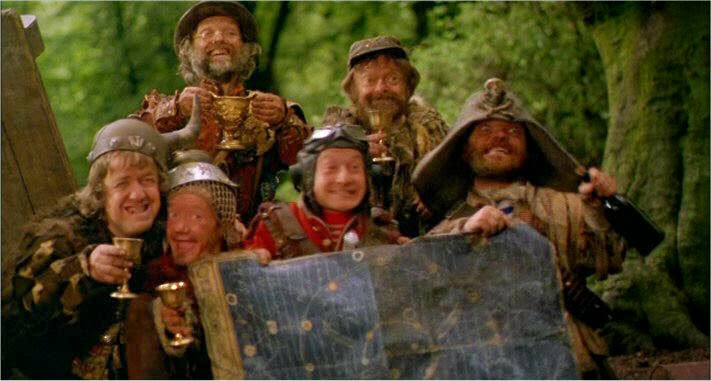
In my quest to create yet another odd character class, I have dreamed up the canting crew. Actually, the inspiration for the class was a small band of robbers cutting a swathe through time after stealing a map of creation. You’ve probably heard of them. Watching Time Bandits made me think of a band of halflings causing trouble, and that made me think of the swarm rules in d20 and one thing led to another and … the canting crew. Obviously, this is not a traditional character class, so it’s not only not for every player, but not for every campaign. Truth be told – I have no idea if this will even work.

REQUIREMENTS
Dexterity 9+, Charisma 13+
Non-lawful, non-good; robber gangs are not necessarily evil, but they are certainly not good
Halfling or gnome (or other small races, if allowed in your games)

ARMOR ALLOWED
Padded and leather armor; no shields

WEAPONS ALLOWED
Club, dagger, dart, hammer, light mace and sling

SKILLS
Hide in Shadows, Move Silently

CLASS ABILITIES

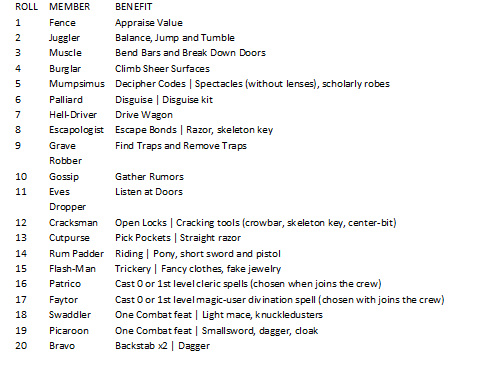
A canting crew starts out as a single rogue, the boss. As the crew gains levels, it also gains members, with each member representing one hit dice, or level, of the crew. Each time a new member is added to the crew, that member should be named, and a dice should be rolled on the following table to get an idea of what that new member brings to the crew.

When a member of the crew brings a competence in a task, that particular member is skilled in that task, and his presence and tutelage makes Gives rest of the members a knack in that task. If a canting crew is divided, this distinction might be important.

The canting crew attacks as a swarm. Attacks against the crew deal damage to the band’s collective hit points. The crew can split up to make attacks, or even choose not to throw all their weight against a single opponent. For however many members of the crew are attacking a single foe (usually no more than eight against a medium-sized creature), treat the attacks as coming from a robber crew of that level. Thus, three robbers attacking a creature attack as a 3rd level crew, i.e. with a +2 attack bonus. The crew, no matter how they are split up, uses saving throw values for their crew’s full level. Any feat taken by the robber crew is assumed to be held by all members of the crew. Feats or abilities that come with individual members are possessed only by that member.

On the downside, robber crews are composed of multiple halflings or gnomes, and each member requires his or her own equipment and rations. This makes running a robber crew a bit expensive, so make sure you don’t pass up a chance for treasure or theft!

Damage against a robber crew must also be addressed. When a robber crew’s hit points are reduced to 0, it is assumed that all of the members have been killed, the boss being the last to fall. For every three points of damage a crew suffers, there is a 10% chance that one member, chosen at random, is killed and must be replaced when the crew next reaches civilization. While the crew is short a member, they are also short that member’s skills or abilities and their help in a fight. When the crew does reach civilization, a new random member is added to the crew.

A 3rd level canting crew learns how to cover one another’s retreats. Members of the crew can retreat at a full run without drawing an attack from their foes.

A 5th level canting crew’s chattering and dodging about has a chance of confusing their opponents. Each round a crew decides to caper instead of actually attacking, their foe must pass a Will saving throw or be stunned for that round. To confuse an opponent, at least three members of the crew must be engaged in combat with that opponent.

A 7th level canting crew learns how to look out for each other. They roll their chance of being surprised on 1d8 instead of 1d6. In addition, when they fight, each member of the canting crew engaged with a single creature over the first member increases the Armor Class of the group fighting that creature by one.

A 9th level canting crew can establish a hideout for themselves, per the thief class. The canting crew does not attract a lieutenant, but they do attract a number of lesser rogues and thieves, with the members of the canting crew each taking on a small gang of their own to tutor and control.

Toxicons

Lately, I’ve been thinking about useful replacements for some of the traditional low-level monsters – the kobold-goblin-orc-hobgoblin-gnoll-bugbear “chain of fiends”. After all, lots of us have played in quite a few of these here dungeons and have faced more than our fair share of these 0 to 3 HD creeps. Something new might be fun. Additionally, that chain of beings may not be as useful for campaigns that are not Tolkien-fantasy based. With that in mind, I offer up these fearsome fellows – The Toxicons!

The Toxicons are for slightly higher than 1st/2nd level parties, owing to the fact that all of them bring poison to the table, and most low-level parties will find poison a very difficult challenge to surmount. They were actually inspired by an episode of Adventure Time, maybe the most inspirational show in history for gonzo role playing.

CREEPERS
Small Humanoid, Chaotic (NE), Low Intelligence; Gang (1d8)

HD 0
AC 13 (leather armor and buckler)
ATK By weapon
MV 20
SV F14 R16 W17
XP 50 (CL 1)

Creepers are gaunt creatures that stand about 3 to 4 feet in height, though their hunched backs make them look shorter. They have dog-like faces, with downward-pointing teeth jutting from their muzzles, brilliant green eyes, greyish skin that looks warty and wrinkled in places, and a single row of bony nodules running from their forehead to the back of their skulls.

Once per day, a creeper can cough up a bluish mist in the face of an opponent. This mist consists of Poison I and forces the adventurer to either hold their breath (treat them as fatigued while holding their breath, which they can do for a number of rounds equal to 3 + their Constitution bonus) or succeed at a Fortitude saving throw to avoid falling asleep.

Creepers generally wear scanty bits of armor, and rarely more than leather. They arm themselves with small weapons and bucklers.

GRAPPLERS
Medium Humanoid, Chaotic (NE), Average Intelligence; Gang (1d6)

HD1
AC 14 (studded leather armor and buckler)
ATK By weapon
MV 30
SV F13 R15 W15
XP 100 (CL 2)

Grapplers are the larger cousins of the creepers. They look like taller creepers, with smaller muzzles, two rows of nodules on their heads, and longer arms that look like a cross between a humanoid arm and a tentacle. Male grapplers have manes of short, brownish fur covering their necks and shoulders.
Grapplers are covered in a thin sheen on contact poison (Poison II). Any creature coming into direct contact with a grappler must pass a Fortitude save to avoid the poison, adding their armor bonus to their saving throw.

CRUSHERS
Medium Humanoid, Chaotic (NE), Low Intelligence; Gang (1d6)*

HD 1+1
AC 16 (chainmail and shield)
ATK By weapon
MV 30
SV F13 R15 W16
XP 100 (CL 2)

Crushers are the largest of the Toxicons, standing a bit taller than a human being. They are rugged and muscular. Their faces have weak chins and down-turned mouths that usually hang open, revealing their sharp teeth. They are hairier than the smaller toxicons, being entirely covered with brownish fur of varying lengths.

Crushers emit a cloud of toxins in a 5-ft radius. Any creature coming into this cloud must hold their breath (see above) or pass a Fortitude save against a weak form of Poison III (1d4 damage). As the shock troops of the Toxicon species, crushers usually wear heavier armor (up to chainmail) and wield heavy bludgeoning weapons and shields.

LORDS

Medium Humanoid, Chaotic (NE), High Intelligence; Gang (1d4)*

HD 2
AC 15 (chainmail and buckler)
ATK By weapon
MV 30
SV F12 R15 W14
XP 200 (CL 3)

The lords of the toxicons are notably smarter than their fellows. They look like grapplers with prominent foreheads and bluish skin and black manes that cover their knobby heads (save for their foreheads) and backs. They are known for the magical powers. Most lords wear chainmail or heavier armor and carry bucklers and piercing weapons (like spears).

Spells: 3/day — poison

Special: Immune to poison

Demigods, the First Adventurers

It would be hard to tell who the first adventurer in literature ever was, but I suppose Gilgamesh might fit the bill. Gilgamesh is the son a human king and the goddess Ninsun, making him a demi-god. In the annals of adventuring, he has good company – Heracles, Achilles, Cuchulainn, Hanuman, Māui, Perseus, Theseus, and many more.

So if demigods can be adventurers in myth and literature, why not in Blood & Treasure?

First things first – we need to define our demigods. If one has some experience in fantasy role playing games, they’ll know that demi-gods are usually depicted as extraordinarily powerful entities. Obviously, characters that powerful would not work well as adventurers, unless one was doing some pretty epic adventuring.

Our demigods are going to be a bit more human (or demi-human), and like other adventurers, are going to become more powerful as they advance in levels. In other words, they’re going to be on par with the other characters – don’t expect them to eclipse the magic-users, thieves and fighters in the party.

REQUIREMENTS
No ability score lower than 10, one ability score higher than 15

ARMOR ALLOWED
Padded, leather, studded leather; bucklers and shields

WEAPONS ALLOWED
Any weapon

SKILLS
Bend Bars, Break Down Doors, Find Secret Doors, Ignore Pain, Jump, Monster Lore

CLASS ABILITIES
At 1st level, a demigod’s player must choose their character’s divine ancestry. Whether a god or goddess, they must choose one of the following domains for their character’s divine parent based on their character’s highest ability score.

  • STR Destruction, Strength, War, Water
  • INT Knowledge, Magic
  • WIS Death, Healing, Sun
  • DEX Air, Fire, Travel
  • CON Animal, Earth, Plant, Protection
  • CHA Love, Luck, Trickery

The demigod gains one power based on his or her parentage, as follows:

  • AIR: Resistance to electricity damage, feather fall at will
  • ANIMAL: Speak with animals at will, charm animal three times per day
  • DEATH: Command undead three times per day
  • DESTRUCTION: Smite opponent once per day (+2 to hit and double damage if you hit)
  • EARTH: Resistance to acid damage, +1 bonus to saving throws while standing on bare earth
  • FIRE: Immune to fire damage
  • HEALING: Laying on of hands ability, per the paladin
  • KNOWLEDGE: Legend lore ability, per the bard
  • LOVE: Charm person once per day, three times per day at 4th level
  • LUCK: Re-roll one saving throw once per day
  • MAGIC: Save vs. magic at +2
  • PLANT: Speak with plants at will, command plants once per day
  • PROTECTION: Barkskin three times per day
  • STRENGTH: Can wield two-handed weapons with one hand
  • SUN: Use light at will, daylight once per day
  • TRAVEL: Haste once per day for one round per level
  • TRICKERY: Trickery as class skill, spell abilities of a gnome
  • WAR: Deals double damage on a charge (if birthed by a war god like Ares) or command double the normal numbers of henchmen (if birthed by a war goddess like Athena)
  • WATER: Resistance to cold damage; cannot sink in water (though can be held under and drowned)

Demigods are supernaturally tough, and gain the Armor Class bonuses as a monk.

Demigods are born to greatness, and are expected to do great things. A 1st level demigod is given an ordained labor by his divine parent. This works as a geas, and requires the demigod to do one of the following by the time he or she reaches 4th level.

  1. Capture a monster* with twice as many Hit Dice (minimum 2 Hit Dice more) as the demigod
  2. Complete a heroic task that would be considered very difficult for the character (the Treasure Keeper has to use his or her best judgment on this one)
  3. Slay a monster* with twice as many Hit Dice (minimum 3 Hit Dice more) as the demigod
  4. Steal a relic (must be worth as many gp as the demigod as XP or be magical)

* Monster in this connotation refers to magical beasts, monstrous humanoids, dragons, prehistoric animals, giants and outsiders

Until the labor is completed, the demigod cannot advance beyond 4th level. A new labor is ordained when the hero reaches 5th level, and must be completed by the time the demigod reaches 8th level. Additional labors must be completed by 12th and 16th level.

  • The first labor completed earns the demigod a one-time use of the restoration spell on him or herself.
  • The second labor completed earns the demigod a one-time use of the raise dead spell on him or herself.
  • The third labor completed earns the demigod a one-time use of the resurrection spell on him or herself.
  • The fourth labor completed earns the demigod the right to ascend into Heaven (or wherever mom or dad are from) when they die.

Demigods are renowned for one of their physical or mental abilities, and this ability grows as their fame grows. A demigod increases his or her highest ability score by one point at 2nd, 4th, 6th, 8th and 10th level.

A 3rd level demigod can make pleas for assistance to his divine parent. Demigods can appeal for 0 to 2nd level spells by passing a Charisma task check with a penalty equal to the level of the spell. At 7th level, the demigod can begin appealing for 3rd to 4th level spells. At 11th level, the demigod can begin appealing for 5th to 6th level spells. Each time an appeal is answered, the demigod must pledge 10% of their earned treasure to the cult of their divine parent (a minimum of 50 gp per spell level).

A 5th level demigod gains magic resistance equal to 1% per level, to a maximum of 10%.

A 9th level demigod may establish a hero cult for themselves. The demigod must construct a temple in his own honor and in the honor of his divine parent. The demigod then attracts 1d6 men-at-arms per level, 1d6 first level clerics or druids and a 4th level cleric or druid to serve as his high priest.


DEMIGOD ADVANCEMENT
LVL
XP
HD
ATK
F
R
W
TITLE
1
0
1d12
+0
13
13
13
Scion
2
2,500
2d12
+1
12
12
12
Exemplar
3
5,000
3d12
+2
12
12
12
Champion
4
10,000
4d12
+3
11
11
11
Hero
5
20,000
5d12
+3
11
11
11
Cynosure
6
40,000
6d12
+4
10
10
10
Archon
7
80,000
7d12
+5
10
10
10
Paragon
8
160,000
8d12
+6
9
9
9
Superhero
9
300,000
9d12
+6
9
9
9
Demigod
10
600,000
10d12
+7
8
8
8
Demigod
11
900,000
+3 hp
+8
8
8
8
Demigod
12
1,100,000
+3 hp
+9
7
7
7
Demigod
13
1,400,000
+3 hp
+9
7
7
7
Demigod
14
1,700,000
+3 hp
+10
6
6
6
Demigod
15
2,000,000
+3 hp
+11
6
6
6
Demigod
16
2,300,000
+3 hp
+12
5
5
5
Demigod
17
2,600,000
+3 hp
+12
5
5
5
Demigod
18
2,900,000
+3 hp
+13
4
4
4
Demigod
19
3,200,000
+3 hp
+14
4
4
4
Demigod
20
3,500,000
+3 hp
+15
3
3
3
Demigod

Establishing a New Dungeon Order with the Masons! [New Class]

Here’s the deal – Freemasonry, whatever you think of it, has some uber-awesome level titles. And level titles, my friend, mean Old School gaming to me. In short – I had no choice but to create this class. I hope it goes without saying that I mean no disrespect to actual Freemasons out there – this is just me having a bit of fun.

Guilds are common among the artisans of NOD, but none have gained such infamy as Fraternity of Stonemasons. Actually many different fraternities organized in lodges, the migratory nature of masonry has led to the formerly autonomous fraternities becoming an international network of lodges, controlled by a Great Lodge, the location and membership of which is a well-kept secret, even from most of the members. Because of the size of this network, and its being spread across many city-states, empires and faiths, there is a vague sense of hostility towards the Fraternity by many rulers and high priests, who question the loyalty of the members.

For their part, the masons are primarily dedicated to their work, traveling from castle to monument to Great Wall to dungeon, cutting and setting stone. The travels of a mason, though, send them through many strange and dangerous lands, making those masons who travel beyond the borders of their home city or town adventurers in their own right. These adventuring masons, or freemasons, make up the elite of the ancient Fraternity, garnering wealth, influence and knowledge for their lodges.

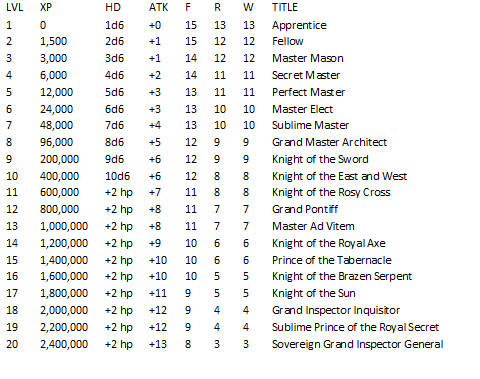
REQUIREMENTS
Intelligence 11+, Strength 9+, Dexterity 13+
Lawful (LG, LN)

ARMOR ALLOWED
Padded armor, leather armor
No shields

WEAPONS ALLOWED
Club, dagger, hammer, handaxe, heavy pick, light crossbow, light mace, light pick, quarterstaff, sap, sling, warhammer

SKILLS
Bend Bars*, Break Down Doors*, Find Secret Doors**, Notice Unusual Stonework***

* Requires mason’s tools; otherwise counts as a knack

** Masons are skilled when looking for secret doors disguised as stone, but only have a knack for finding other secret doors

*** As the dwarf ability, or see New Tasks in this book

CLASS ABILITIES

All masons are capable of cutting stone, earning a wage of 1 silver piece per day for normal masonry and 1 gp a day for ornamental masonry or overseeing up to 10 lower-level masons. Ornamental masonry requires a Reflex task check; naturally, you treat the mason as though he were “skilled” at this task.

In order to earn these wages, the mason must carry a set of mason’s tools. These tools include a pair of wooden compasses, a piece of chalk or charcoal to make marks, chisels of different sizes, a hammer, plumb, a trowel, iron and wooden dowels. These tools are kept in a large canvas or leather bag or backpack, and weigh 20 pounds.

Finally, 1st level masons learn the secret signs, tokens, grips and words of their fraternity. This counts as a secret language, much like the thieves’ cant, that allows masons to identify one another and communicate without others understanding them. Masons can also learn Earth Elemental as one of their starting languages.

A 3rd level mason (master mason) scores double damage against elemental earth creatures and other creatures made entirely or primarily of rock, stone or earth, not including gargoyles, who are just big fakers.

A 6th level mason (master elect) learns the secret rites of the Fraternity, the Rites of Elemental Earth, handed down from the ancient dwarven founders of the Fraternity. These rites permit the mason to cast a small number of spells using the same rules as a magic-user. The mason must carry a special manual filled with his spells, which are recorded in the secret signs of the Fraternity. Other masons can interpret these signs, but must pass a special Decipher Codes check as though they were skilled in the task.

Masons prepare and cast the same number of spells per day as a ranger.

1st level: Elemental weapon (acid only), magic stone, mason mark*, mending**, pass through element**, shatter, soften earth and stone

2nd level: Explosive runes, meld into stone, shockwave***, spike stones, stone shape, summon small earth elemental

3rd level: Move earth, passwall, stoneskin, summon medium earth elemental, transmute mud to rock, transmute rock to mud, wall of stone

4th level: Earthquake, earthwalk, repel stone****, stone of flesh, summon large earth elemental

* As wizard mark

** Affects earth/stone only

*** Mason must strike the ground with a hammer or pick to cast this spell

**** As repel metal or stone, save it only repels stone

In addition, a 6th level mason (master elect) learns to turn elemental earth creatures as a cleric turns undead. The mason turns earth elementals as a cleric five levels lower than his mason level.

A 9th level mason (knight of the sword) earns the right to establish a lodge of the Fraternity in a town or city-state in which no lodge already exists. A mason who becomes a worshipful master attracts 1d6 normal masons (i.e. 0-level artisans) per level, 1d6 first level masons who wish to train under him and one 5th level mason protégé.

A 9th level mason (knight of the sword) also begins to learn to carve powerful runes, as follows:

Knight of the Sword (9th) | Rune of sleep

Knight of the East and West (10th) | Rune of pain

Knight of the Rosy Cross (11th) | Rune of persuasion

Grand Pontiff (12th) | Rune of fear

Master Ad Vitem (13th) | Rune of stunning

Knight of the Royal Axe (14th) | Rune of weakness

Prince of the Tabernacle (15th) | Rune of insanity

Knight of the Brazen Serpent (16th) | Rune of death

Runes work as the symbol spells, but must be carved in stone and are triggered when first looked upon by an intelligent creature. The mason can carve no more than one such rune per day, and can have no more than five runes (of any type) active at any one time.

Upon achieving 12th level (Grand Pontiff), a mason gains command over a Grand Lodge, which simply encompasses all the lodges within a given region (the definition of region here being determined by the Treasure Keeper in regards to his or her own campaign). If there is already a Grand Pontiff in the region, assume that they achieve 13th level and hand down the duties to the new Grand Pontiff. Grand Pontiffs also gain the ability to planeshift into the Elemental Earth Plane (and return to the Material Plane at a time of their choosing) once per day.

Beyond 17th level (knight of the sun), there can be only one mason at each level. A mason cannot rise beyond 17th level without supplanting a higher level mason. This can be done by waiting for them to die (arranging or causing death is not permitted, though of course one can attempt to get away with it if they are bold and stupid enough to forget all those sweet divination spells that can be used to convict them) or challenging them to a contest of masonry. These contests are usually epic in scope, requiring extraordinarily difficult works of masonry that are either decided by a series of task checks, each more difficult than the last, or by judgment from a council of masons that have achieved a minimum of 12th level.

The Grand Inspector Inquisitor (18th) of masonry may issue commands to fellow masons that are the equivalent of a quest spell. The Grand Inspector Inquisitor is the highest level mason whose identity is known to other masons. He knows the identity of the Sublime Prince of the Royal Secret.

The Sublime Prince of the Royal Secret (19th) is capable, once per day, of communing the powers of elemental earth (per the commune with nature or contact higher power spells). He alone knows the identity of the Sovereign Grand Inspector General.

The Sovereign Grand Inspector General (20th) controls the Great Lodge, which consists of all lodges and grand lodges within a single reality. As the leader of all masons, he or she is capable, once per day, of summoning an earth elemental swarm to do his or her bidding.

Edit: Crap – forgot the class advancement table with all the kickass level titles …

Getting Down With the Sickness

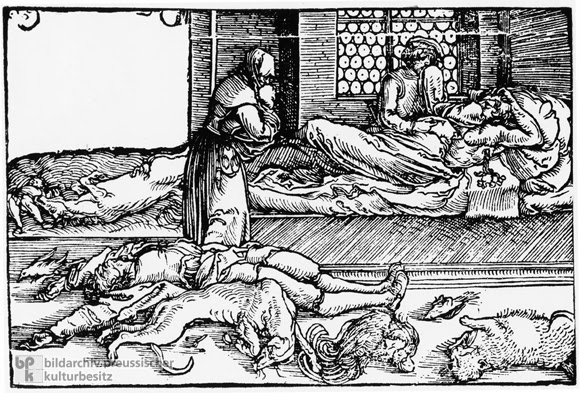
I don’t think I’ve ever been 100% satisfied with diseases in role playing games, not even with the rules in Blood & Treasure. This post is an attempt to create a system a bit more granular than most. In this system, diseases are not named, but rather are collections of random symptoms, with the number of symptoms and their severity based on the general severity of the disease.

THE BASICS

When struck with a disease, say from the bite of a rat, a prolonged stay in sewers (or a flophouse) or a biological trap, an adventurer must pass a Fortitude saving throw to avoid suffering any ill effects at all. This might represent a case where the contagion is simply not introduced to the character’s system, or it is introduced and the character’s immune system neutralizes it very quickly.

If this Fortitude save fails, the character is infected. First, we need to know the severity of the disease. The Treasure Keeper can either roll dice to determine severity, or base it on the hit dice of the monster that spread it or the level of the dungeon on which it was acquired.

D% (HD or LEVEL): SEVERITY (SYMPTOMS)
01-75 (0-4 HD): Minor Disease (1d3 minor symptoms)
76-90 (5-9 HD): Medium Disease (1d4 minor symptoms, 1d2-1 major symptoms)
91-100 (10+ HD): Major Disease (1d4 minor symptoms, 1d3 major symptoms)

Symptoms begin appearing within 1d4 days.

The Treasure Keeper should now roll 1d4 minus the sufferer’s Constitution bonus. This is the number of days before the sufferer’s immune system has a chance of defeating the disease. It is possible that the disease can be fought off before any symptoms begin to appear.

Each day, a victim of disease can roll a Fortitude saving throw to attempt to throw off one symptom, usually the most severe, but in any event a symptom of the player’s choice. If the player is successful, that symptom is removed.

If the diseased character is active (i.e. not getting plenty of rest), they suffer a -2 penalty on this save.

All characters that spend time around the diseased character have a percentage chance each day to be exposed to disease. This percentage chance is based on the number of type of symptoms, with a 10% chance per minor symptom and a 5% chance per major symptom. Naturally, the non-diseased character is permitted a Fortitude save to avoid actually contracting the disease.

Note: If you want to give a more supernatural feel to diseases, you can rule that any adventurer who dies from a disease and is not burned or buried in consecrated ground rises as an undead with Hit Dice roughly equal to the number of levels they had in life.

MINOR SYMPTOMS (ROLL 3d6)

3. Exhaustion4. Fever, severe
5. Rash, major
6. Dementia
7. Rash, minor
8. Aches
9. Cough
10. Diarrhea
11. Fatigue
12. Fever, low-grade
13. Sickened
14. Stuffy head/runny nose/sneeze
15. Swollen joints, minor
16. Shooting pains
17. Spasms
18. Swollen joints, major

Aches
The character is possessed of aches in the muscles and joints and suffers a -1 penalty to attacks, Armor Class and Reflex saving throws (including task checks).

Cough
Roll 1d4 for severity; this is the chance on 1d6 per hour that your coughing attracts a wandering monster. After any major exertion (running, fighting, climbing more than 10 feet) you are fatigued until resting 10 minutes.

Dementia
The character is unsteady on his feet. When moving at more than half speed or fighting, he must pass a Reflex save each round to avoid falling prone for 1d4 points of damage. Whenever he is forced to concentrate on spell casting, he must pass a Will save to successfully cast the spell. The character suffers a -1 penalty on all Reflex and Will saves (including task checks).

Diarrhea
Not for the faint of heart. You suffer intestinal distress every 1d6 x 10 minutes and need to find a private place to deal with the problem. If you are not drinking a double ration of water, you suffer 1 point of Constitution damage per day due to dehydration.

Exhaustion
An exhausted character moves at one-quarter normal speed, suffers a -1 penalty to saving throws and task checks and her foes enjoy two tactical advantages against her in combat.

Fatigue
Per the normal rules for this condition in Blood & Treasure.

Fever, Low-grade
The character has a low-grade fever and suffers a -1 penalty to Will saving throws (including task checks). He also requires twice the normal daily ration of water. Failure to hydrate properly results in 1 point of Constitution damage each day.

Fever, Severe
The character has a severe fever and suffers a -3 penalty to Will saving throws (including task checks). He requires twice the normal daily ration of water. Failure to hydrate properly results in 1 point of Constitution damage each day. Finally, the fever causes hallucinations. Each hour, the character must pass a Will save or be struck with the equivalent of the confusion spell for 1d6 x 10 minutes.

Rash, Minor
The character suffers from a minor rash over a small portion of her body and suffers a -1 penalty to attacks, Armor Class and Reflex saving throws (including task checks) due to the discomfort. Each day, the character must pass a Fortitude save to avoid scratching and turning the minor rash into a major rash.

Rash, Major
The character suffers from a major rash over a large portion of her body and suffers a -2 penalty to attacks, Armor Class, Reflex saving throws (including task checks) due to the discomfort and a -2 penalty to Charisma-related task checks due to the physical marring. Each day, the character must pass a Fortitude save to avoid scratching and suffering 1 point of Charisma drain for permanent scarring.

Shooting Pains
The character suffers fierce, shooting pains. She suffers a -2 penalty to attacks, Armor Class and Reflex saving throws (including task checks). Whenever she is forced to concentrate on spell casting, she must pass a Will save to successfully cast the spell. The character suffers a -1 penalty on all Reflex and Will saves (including task checks).

Sickened
Per the normal rules for this condition in Blood & Treasure.

Spasms
The character suffers random severe muscle spasms. This translates as a tactical advantage for his foes in combat, a -1 penalty to Reflex saving throws (including task checks) and a requirement to pass a Reflex save each time he is walking on a precarious surface to avoid falling.

Stuffy Head/Runny Nose/Sneeze
You suffer a 1 in 6 chance per hour that your sniffling and nose blowing attracts a wandering monster. Any exposure to copious amounts of dust, pollen, molds and the like force you to pass a Fortitude saving throw or begin a sneezing fit that last 1d4 minutes, delaying the party and attracting a wandering monster on a roll of 1-2 on 1d6.

Swollen Joints, Minor
Minor swelling in the joints reduces movement by 5, grants the sufferer’s foes a tactical advantage in combat and imposes a -1 penalty to Reflex saves (including task checks).

Swollen Joints, Major
Major swelling in the joints reduces movement by 10, grants the sufferer’s foes a tactical advantage in combat and imposes a -3 penalty to Reflex saves (including task checks).

MAJOR SYMPTOMS (Roll 1d6)

1. Blood poisoning
2. Coma
3. Immune system attacked
4. Internal bleeding
5. Muscle damage
6. Nerve damage

Blood Poisoning
The disease is attacking the character’s blood. Each day the character must pass a Fortitude saving throw or suffer 1d6 points of Constitution damage. At 0 Constitution, the character dies.

Coma
The character falls into a deep, comatose slumber. While in a coma, she heals ability score damage at twice the normal rate and enjoys a +1 bonus to save vs. the other symptoms of her disease. After three days, the comatose character can begin making daily Will saving throws to come out of the coma. If three of these Will saves are failed, the coma becomes a permanent condition and can only be removed with a restoration, miracle or wish spell.

Immune System Attacked
The disease attacks the characters immune system, imposing a -2 penalty to all saves vs. disease (including saves against symptoms of disease).

Internal Bleeding
The character is bleeding internally, suffering 1d6 points of hit point damage and 1d6 points of Constitution damage each day that a Fortitude saving throw is failed. At 0 Constitution, the character dies.

Muscle Damage
Each day the character must pass a Fortitude saving throw or suffer 1d6 points of Strength damage. If the character reaches 0 points of Strength, she is paralyzed and dies in 1d6 hours.

Nerve Damage
Each day the character must pass a Fortitude saving throw or suffer 1d6 points of Dexterity damage. If the character is reduced to 0 Dexterity, he is paralyzed and dies in 1d6 hours.

NEW SPELLS

This disease system suggests a few new spells:

SUPPRESS SYMPTOM
Level: Cleric 1, Druid 1, Ranger 1
Range: Touch
Duration: 24 hours

This spell suppresses a single symptom of a disease for 24 hours.

CURE SYMPTOM
Level: Cleric 2, Druid 2, Ranger 2
Range: Touch
Duration: Instantaneous

This spell completely removes one symptom from a diseased character.

VIRULENCE
Level: Cleric 2, Druid 2
Range: Close
Duration: 24 hours

This spell makes all diseases within close range more virulent for 24 hours. All who suffer from these diseases suffer a -1 penalty on all saving throws against the disease, and the chance of exposure to the disease for others is doubled.

All the Monsters from A to Z … C!

Continuing the Blood & Treasure monster stats (D is going to be a bear, all those dang demons, devils, dinosaurs and dragons …)

Giant Caecilia, Huge Vermin: HD 6; AC 14; ATK 1 bite (1d8 + swallow whole); MV 20 (Burrow 20); F7 R12 W12; AL Neutral (N); XP 600; Special—Blindsight.

Camel, Large Animal: HD 3; AC 13; ATK 1 bite (1d4); MV 50; F11 R11 W17; AL Neutral (N); XP 150; Special—None.

Carcass Scavenger, Large Magical Beast: HD 3; AC 13; ATK 8 stingers (poison II) and bite (1d6); MV 40 (Climb 40); F11 R12 W17; AL Neutral (N); XP 300; Special—Swallow paralyzed creature.

Cat, Tiny Animal: HD 0; AC 14; ATK 1 claws and bite (1); MV 30 (Climb 20); F16 R13 W19; AL Neutral (N); XP 25; Special—None.

Giant Catfish, Large Animal: HD 8; AC 16; ATK 1 bite (2d8) and 2 fins (1d4 + poison*); MV Swim 30; F11 R12 W18; AL Neutral (N); XP 800; Special—Poison.

Catoblepas, Large Magical Beast: HD 6; AC 12; ATK 1 bite (1d6); MV 30; F9 R10 W15; AL Neutral (N); XP 1500; Special—Paralyzing gaze.

Giant Cave Locust, Small Vermin: HD 2; AC 16; ATK 1 bite (1d2) or slam (1d4) or spit (sickened 3d6 rd); MV 20 (Fly 60); F13 R15 W15; AL Neutral (N); XP 100; Special—Shriek, leap (60’ horizontal, 30’ vertical).

CELESTIAL

Avoral, Large Outsider: HD 16; AC 24 [+2]; ATK 2 claws (2d6) or 2 wings (2d8); MV 40; F4 R5 W4; AL Lawful (NG); XP 4000; Special—Aura of fear 20’, lay on hands 20 hp, immune to electricity and petrification, magic resistance 15%; Spell—Continuous-tongues; At will—aid, blur (self), command, detect invisibility, detect magic, dimension door, dispel magic, gust of wind, hold person, light, magic circle against evil (self), magic missile; 3/day—lightning bolt.

Bralani, Medium Outsider: HD 6; AC 19 [+1]; ATK 1 +1 scimitar (1d8+4) or +1 longbow (1d6+1) or slam (1d6); MV 40 (Fly 100); F10 R9 W9; AL Lawful (CG); XP 1500; Special—Whirlwind form, wind blast (20’/3d6), immune to electricity and petrification, magic resistance 15%; Spell— Continuous—tongues; At will—blur, charm person, gust of wind, mirror image, wind wall; 2/day—lightning bolt, cure serious wounds.

Ghaele, Medium Outsider: HD 10; AC 22 [+2]; ATK 1 +2 greatsword (1d10+5) or 2 light rays (300’/4d6); MV 50 (Fly 150); F8 R7 W7; AL Lawful (CG); XP 2500; Special—Light form, slaying gaze, protective aura 20’, immune to electricity and petrification, magic resistance 25%; Spell—Continuous—tongues; At will—aid, change self, charm monster, color spray, comprehend languages, continual flame, cure light wounds, dancing lights, detect evil, detect invisibility, detect thoughts, dispel magic, hold monster, improved invisibility (self), spectral force, teleport without error (self plus 50 pounds); 1/day—chain lightning, prismatic spray, wall of force. Ghaeles in humanoid form can also cast spells as 14th-level clerics.

Leonal, Medium Outsider: HD 12; AC 23 [+1]; ATK 2 claws (1d8) and bite (1d8); MV 60; F7 R6 W6; AL Lawful (NG); XP 1200; Special—Magical aura, roar (60’cone/holy word), immune to electricity and petrification, magic resistance 30%; Spell—Continuous—speak with animals; At will—detect thoughts, fireball, hold monster, wall of force; 3/day—cure critical wounds, cure disease, neutralize poison; 1/day—heal.


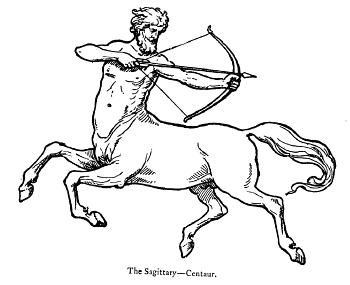
Centaur, Large Monstrous Humanoid: HD 4; AC 14; ATK 2 hooves (1d6) and weapon (1d8); MV 50; F13 R10 W12; AL Neutral (N); XP 200; Special—None.

Giant Centipede, Small Vermin: HD 0; AC 14; ATK 1 bite (1d3 + poison II); MV 30 (Climb 30); F14 R16 W16; AL Neutral (N); XP 50; Special—None.

Chaos Beast, Medium Aberration: HD 8; AC 16; ATK 2 claws (1d4 + corporeal instability); MV 20; F11 R11 W9; AL Chaotic (CN); XP 2000; Special—Instability, immune to transformations, magic resistance 20%.

Cheetah, Medium Animal: HD 3; AC 15; ATK 2 claws (1d2) and bite (1d6); MV 50; F12 R11 W17; AL Neutral (N); XP 300; Special—Trip.

Chimera, Large Magical Beast: HD 9; AC 19; ATK 2 bites (2d10), horns (1d6) and 2 claws (1d6); MV 30 (Fly 50); F8 R9 W12; AL Chaotic (CE); XP 900; Special—Breathe cone of fire (30’/3d6) 3/day.

Choker, Small Aberration: HD 3; AC 17; ATK 2 tentacles (1d4 + constrict); MV 40 (Climb 20); F15 R13 W13; AL Chaotic (CE); XP 300; Special—None.

Chuul, Large Aberration: HD 11; AC 20; ATK 2 pincers (2d6 + constrict); MV 30 (Swim 20); F9 R10 W8; AL Chaotic (CE); XP 1100; Special—Immune to poison.

Cockatrice, Small Magical Beast: HD 5; AC 14; ATK 1 bite (1d4 + petrification); MV 20 (Fly 60); F12 R11 W16; AL Neutral (N); XP 1250; Special—None.

Colossus, Huge Construct: HD 20; AC 20 [+1]; ATK 2 slams (3d6) or thrown object (3d6); MV 40; F3 R5 W8; AL Neutral (N); XP 5000; Special—Cause panic, sickening smell, stomp, immune to magic, negative energy affinity.

Couatl, Large Outsider: HD 9; AC 20; ATK 1 bite (1d4 + poison II) or coils (2d8 + constrict); MV 20 (Fly 60); F8 R8 W8; AL Lawful (LG); XP 2250; Special—Ethereal jaunt, telepathy (90’); Spells- At will—detect evil, detect thoughts, invisibility, plane shift. Couatls can also cast spells as a 9th level sorcerer.

Giant Crab, Medium Animal: HD 3; AC 16; ATK 2 pincers (1d6 + constrict); MV 20 (Swim 10); F12 R12 W17; AL Neutral (N); XP 150; Special—None.

Crabman, Medium Monstrous Humanoid: HD 2; AC 15; ATK 2 pincers (1d4); MV 20 (Swim 20); F15 R12 W12; AL Neutral (N); XP 100; Special—None.

Crabnipede, Medium Magical Beast: HD 4; AC 15; ATK 4 pincers (1d4 + constrict) and bite (1d6 + poison II); MV 20 (Swim 60); F11 R11 W14; AL Neutral (N); XP 400; Special—Immune to mind effects, resistance to cold.

Crawling Claw, Tiny Construct: HD 1; AC 15; ATK 1 claw (1d3 + constrict); MV 20; F18 R15 W15; AL Neutral (N); XP 100; Special—Double damage vs. prone opponents.

Crocodile, Medium Animal: HD 3; AC 19; ATK 1 bite (1d8 + constrict) or tail (2d6); MV 20 (Swim 30); F12 R12 W17; AL Neutral (N); XP 300; Special—None.

Giant Crocodile, Large Animal: HD 7; AC 16; ATK 1 bite (2d8 + constrict) or tail (3d6); MV 20 (Swim 30); F9 R10 W15; AL Neutral (N); XP 700; Special—None.

Crysmal, Small Earth Elemental: HD 6; AC 20; ATK 1 sting (1d3); MV 30 (Burrow 20); F11 R12 W13; AL Neutral (N); XP 600; Special—Immune to fire and cold, resistance to electricity and piercing and slashing weapons.

Crystaline, Medium Earth Elemental: HD 3; AC 16; ATK 1 longsword (1d8); MV 30; F12 R14 W14; AL Neutral (N); XP 300; Special—Blind foes, exploding body, immune to electricity.

Cyclopean, Medium Monstrous Humanoid: HD 2; AC 15 (chain); ATK 1 weapon (1d10); MV 30; F15 R12 W12; AL Neutral (N); XP 100; Special—Peer into future 1/day.

Cyclops, Huge Giant: HD 13; AC 15; ATK 1 slam (3d10) or boulder (3d6); MV 30; F4 R9 W9; AL Chaotic (CE); XP 1300; Special—Poor depth perception.