A Purr-fect Day for a Celebration

Happy belated birthday to Julie Newmar, the one true Catwoman in this guy’s opinion. I’m a day late on her birthday, but I wanted to mention it just the same and, of course, throw in some MM! stats. Those who have followed the blog for a while might remember that Catwoman and Invisible Woman got some MM! stats very early on in the process. Since then, the rules changed quite a bit, so here’s some revamped stats for one of my favorites.

And if you’re going to use her in your Mystery Men! campaign, don’t forget the goons, for crying out loud!

Trivia: Ms. Newmar made her own Catwoman costume.

Also – I’m two days into the Mystery Men! Dark Renaissance campaign that I’m running on Google+. It’s working well so far, with slugfests in Seattle, Chicago and New York and some snooping in Washington DC. Hopefully the players are having as much fun as I am. I’ll probably start some game recaps on the blog in a couple weeks – I want to make sure I don’t reveal anything to players that shouldn’t be revealed, and a two week lag will probably ensure that. If the campaign goes well, I’ll turn it into an adventure for a future issue of NOD.

Taking a Bite out of the Dungeon

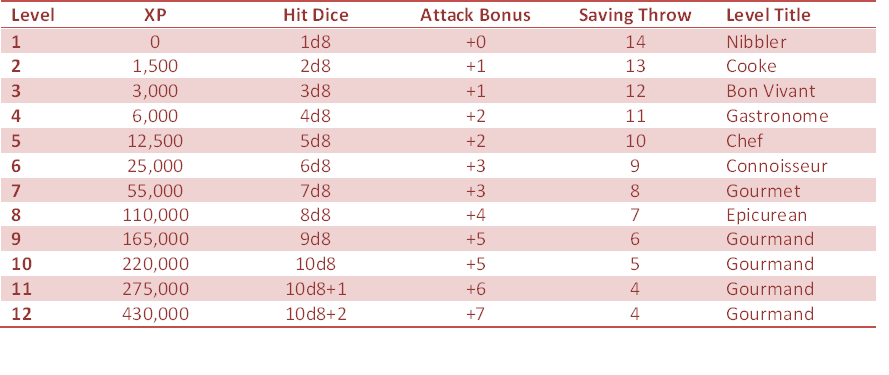
World traveler, bon vivant – the gourmand is both, traipsing across the globe to experience everything it has to offer. Even dungeons cannot escape the curiosity of the gourmand – after all, how are you to know what fresh shrieker or violet fungus tastes like if you don’t crawl into the underworld and harvest it yourself!

The gourmand is a strange class, though there some method to this madness. I got it in my head to produce an article about random fantasy cookery – i.e. random recipe with random ingredients – and then thought that a gourmand might be a good accompaniment to the concept. My inspiration comes from two sources. The first are traveling eaters like Anthony Bourdain and Andrew Zimmern – Zimmern especially for his iron stomach and nearly infinite courage in putting exotic things into his mouth. My second inspiration was the ever-lovin’ blue-eyed Volstagg, heftiest of the warriors three and proof that one can survive the dangers of a fantasy realm without being built like Conan (the Barbarian, not O’Brien).

The Basics 
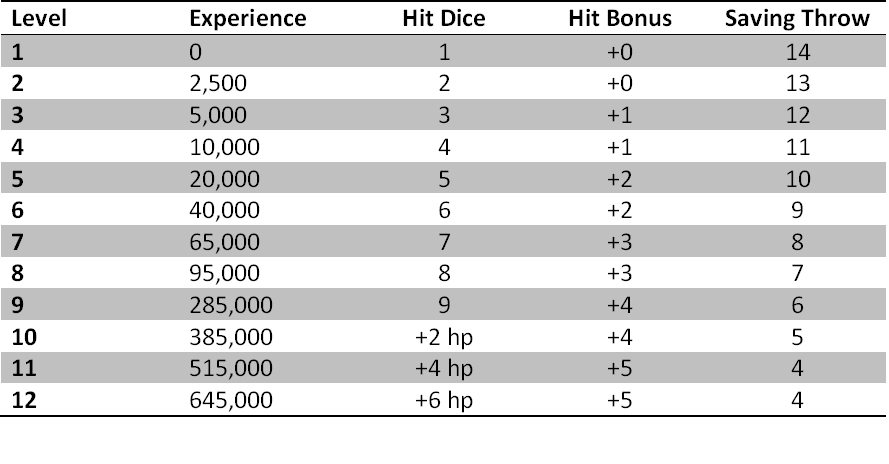
Hit Dice: 1d8 per level, +2 hp per level after 10th.

Prime Requisite: Constitution, +5% bonus to earned XP if 13+. A gourmand needs a strong stomach to tread where their palette takes them.

Armor: Gourmands can wear any armor but plate – it’s too restrictive. They can use shields.

Weapons: Gourmands have traveled all over and gotten into plenty of trouble, so they’re capable of using most weapons. They are barred only from those that take more intense training – swords and bows.

Special Abilities 
Gourmands specialize in eating – in quantity and variety. A gourmand’s goal is to taste everything that is edible and non-poisonous at least once. They aren’t fools or cannibals – they aren’t going to nibble a zombie or give green slime a try – but they are intrigued by owlbear steaks or a tossed salad of assassin vine leaves and treant nuts (okay – that last ingredient doesn’t sound right – but come on – they’re flora, not fauna). Gourmands must have iron stomachs, and their training grants them a +2 bonus on saving throws against poison. Their enhanced search for caloric satisfaction, however, requires them to consume double the normal amount of food for members of their species (i.e. double rations).

Gourmands are driven to try exotic foods. They must consume something new (a new spice, a new meat, a new fruit, etc) once per week or fall into a terrible black mood and suffer a -5% penalty to earned experience. This penalty is cumulative, up to a maximum -20% penalty. Each new food consumed, however, is worth a 100 XP bonus to the gourmand.

Where magic-users keep spellbooks and leech’s leechbooks, gourmands keep cookery books, collecting and inventing all manner of recipes, and recording their culinary experiences. These books must be kept, but they do not offer a gourmand any special abilities or impose on them any special restrictions if lost.

Gourmands are, of course, expert chefs. They can cook almost anything and make it palatable to others, and can take quality ingredients and make dishes so exquisite that they act a balm to body, mind and spirit. A gourmand with a pound of grain (processed, preferably), a pound of meat, a pound of fruit or sweetener (honey, for example), a bottle of spirits (or beer, wine, etc) and a pinch of salt or spice, can prepare a meal for up to six people that can have healing qualities. The gourmand must decide how magnificent his dish will be and then make a percentile roll to see if he succeeds. Failure means he concocts an awful mess with no benefits other than food in the belly and various gastric complaints for the remainder of the night.

Restore Vigor: Restores 1d8 hit points plus one hit point per gourmand level.

Cure What Ails You: Removes any disease afflicting the eater, but does not remove any damage already done by the disease.

Soothe Mind: Frees the eater’s mind from any curse or enchantment.

Revitalize: Restores 3d8 hit points plus one hit point per gourmand level and removes all damage from one ability score.

Restore Spirit: Restores all hit point damage, ability score damage and one lost level.

This fantastic feast can be stretched to feed more than six people, at a -5% penalty to the gourmand’s roll per extra person. Each exotic ingredient added (i.e. owlbear in place of beef) either gives the gourmand a +15% or -5% to his roll. The Referee should determine which (bonus or penalty) with a flip of a coin (or equivalent) without informing the gourmand of the result. The meal takes one hour to prepare and requires basic cooking equipment (pot, pan, knife and fire).

A gourmand’s fame often precedes her, and can be a curse as well as a blessing. Gourmands of first to fourth level never have trouble finding an invitation to dinner in their home town, and have a 1 in 10 chance of an invitation by a local aristocrat. Gourmands of fifth to eighth level enjoy such invitations within their home kingdom or country, gourmands from ninth to tenth level in their home region and gourmands of eleventh to twelfth level throughout the world and gourmands of thirteenth level or higher anywhere in the cosmos.

These invitations come with a price, of course, for the host expects the impress the gourmand and receive a hearty endorsement of their table. The gourmand, however, becomes increasingly picky as they grow older, and their dedication to their art and philosophy require them to render an honest verdict of the sampled fare. A gourmand that has dined must roll 1d20 and beat his own level to find the fare satisfying. Every 100 gp spent on the feast by the host grants a +1 bonus to the roll, up to a maximum bonus of +5. However it goes, the gourmand must give a monologue on the quality and creativity of the prepared feast and then suffer a reaction roll from his host. If he praises the feast, the reaction roll is made at a +3 bonus. If he derides it, the reaction roll is made at a -3 penalty. Naturally, the companions of a gourmand are also invited to these repasts, and they must suffer the same consequences as the gourmand.

The final challenge of the gourmand is one of weight. Each week the gourmand does not spend in vigorous exercise (i.e. fighting monsters or at least running away from them) results in a gain of one pound. Pound gained in excess of what would be considered “standard” or “average” for their species and gender, are treated as weight from equipment and can thus slow them down.

Image by Frans Hals

News from the Land of Nod and a little more Mu-Pan

Busy weekend, but a good one. I finished my fifth Hex Crawl Chronicle The Pirate Coast – and just need to send it along to the good people at Frog God Games. Next up is The Troll Hills, in which I try to incorporate every version of troll I can. If you have an OGL troll you’d like stuck into those very dangerous hills, let me know.

Oh – for that matter – the Tome of Horrors Complete is now available. I have scads of lairs in that tome and did the conversions of the monsters from Tome 1.

I’m about 1 week away from publishing NOD 10. Contents should be …

Mu-Pan – continuation of the hex crawl in NOD 8. I’ve been running excerpts all month.

Polyester Road – this is a mini-game/mini-campaign about truckers hauling goods on post-apocalyptic highways. The technology is mid-1970’s and the mutations not too gonzo.

Monstrous Evolutions – two race/classes for Pars Fortuna in the tradition of beast-people. In this case, the “beasts” are a rust monster and owl bear. Will include an illustration and a mini-adventure.

Chim-Chimera-Cheree – The random chimera generator I posted on this blog with a nice illustration.

The Leech – A fantasy doctor/surgeon class for Swords and Wizardry – think of this class as the medical equivalent of Indiana Jones’ archaeologist.

Phantastes – a few more chapters of the fantasy classic.

Coming up for NOD 11 – A journey into Hell (hex crawl inspired by Dante’s vision of the underworld), Action X (mini-game of special operations teams in the Cold War) and probably something spooky for Halloween – probably a dungeon crawl in a haunted manor.

And now, two encounters – one from Mu-Pan, the other from the Pirate Coast. Enjoy …

0108. The floor of this valley is a chain of shallow lakes linked by channels of sandy, sluggish streams. The lakes are heated geo-thermally, and this has made the valley steamy and verdant. In ages past, great creatures akin to reptiles lived in the valley until they were hunted to extinction by the ancient elves – many an old elven sword has a pommel wrapped in leather cured from their skin and ancient elf lodges often have their strange, massive heads mounted on the walls.
While these massive beasts no longer roam the valley, their spirits do, and are encountered here on a roll of 1-2 on 1d6 (1-4 on 1d6 during a full moon). Use the following table to determine what kind of animal is encountered.
1-3
Ankylosaurus: HD 8; AC 0 [19]; Atk 1 clubbed tail (special); Move 9; Save 8; CL/XP 8/800; Special: None.
4
Brontosaurus: HD 25; AC 6 [13]; Atk 1 stomp (special); Move 9; Save 3; CL/XP 25/5900; Special: None.
5-6
Stegosaurus: HD 15; AC 2 [17]; Atk 1 bite (special), 1 spiked tail (special); Move 9; Save 3; CL/XP 15/2900; Special: None.
7-8
Triceratops: HD 15; AC 0 [19] front, 5 [14] back; Atk 1 gore (special); Move 12; Save 3; CL/XP 15/2900; Special: None.
9-10
Tyrannosaurus: HD 18; AC 4 [15]; Atk 1 bite (special); Move 18; Save 3; CL/XP 19/2400; Special: Chews and tears.
The dinosaur spirits are ethereal, and can thus only be harmed by silver or magical weapons and spells of force or dispelling. Their attacks cause 2d6 points of chilling cold damage and force a victim to save or be drained of one level.
One of the shallow lakes is an illusion, hiding an ivory palace of the ancient elves – one that has been abandoned and forgotten for centuries. The palace is composed of eighty-one cells, each with a vaulted ceiling and connected to four adjacent vaults via a short (5 feet long) passage. These passages are blocked by walls of force, each one a shimmering curtain of one of five colors – cerise, ultramarine, gamboge, myrtle and heliotrope.
The palace has four entrances; each of these entrance cells has only three curtains for force blocking further access to the palace. One of these entrance cells contains a colored tetrahedron of metal, the exact color being determined randomly (see below). In the middle of each cell there is a tripedal stand which fits this tetrahedron. By placing the tetrahedron in the base and tapping it with something metallic, the corresponding colored curtain of force disappears for 1 minute. The colors of the curtains in each cell should be determined randomly with a d10 (1-2 = cerise, 3-4 = ultramarine; 5-6 = gamboge; 7-8 = myrtle; 9-10 = heliotrope), and the color of the tetrahedron changes (using the same random table) when it is brought into a new cell. This makes moving through the strange palace quite a chore, and potentially dangerous as there is a slight chance one will enter a cell and be unable to exit due to the color of the tetrahedron.
Each time a cell is entered, there is a 1 in 1d6 chance of a random monster (CL 3) appearing in the cell. These monsters are given the same random colors as the rooms and tetrahedron, and the color of the creature makes it vulnerable to a single form of attack: Cerise = cold, Ultramarine = fire; Gamboge = silver; Myrtle = steel and Heliotrope = wood. All of these beasts can be harmed by magic missiles. Their bodies disappear after one leaves their cell.
The center cells of the palace are combined into a single large chamber. In the middle of this chamber there is an elf-hewn idol of a four-faced, eight-armed and eight-legged goddess. Each pair of hands holds a golden plate hidden by a pelt of sable. The plates face the curtains of colored force, and these colors determine what secrets are etched on the plates. The plate facing a cerise curtain is attuned to fighters (and rangers and paladins). The plate facing an ultramarine curtain is attuned to clerics (and druids). The plate facing a myrtle curtain is attuned to thieves (and assassins and monks) and the plate facing a gamboge curtain is attuned to magic-users. A plate facing a heliotrope curtain is replaced by a portal into the void, per a sphere of annihilation.
Looking upon a plate not attuned to their class forces a character to save vs. blindess. Looking upon the proper plate grants a magic-user a new spell of their highest spell level (though it must be written into their spellbook), a cleric or druid access to a magic-user spell that can be associated with their deity, a fighter-type a +1 bonus to wield a random weapon and a thief-type a +10% bonus to use one of their skills.
7238. Dinsan: Dinsan is a city of 6,000 people situated atop a plateau that rises 200 feet above the surrounding landscape and looks over the source of the river. The city is quite ancient and the buildings show their age. Although the people are productive, growing sweet, golden barriers (sun berries) and turning them into a very potent liqueur favored by the Ying nobility.
The city is notable for seven grand constructions. The first is a central tower with a single, large wooden gate. This tower is the entrance to the plateau, as it connects with a tunnel that spirals up through the plateau. This tunnel is guarded by albino apes chained to the walls. The roof of the tower is conical and set with six mirrors. As the sun hits these mirrors, it sends a beam of light to strike the face of one of the six statues.
The six statues represent the six founders of the city. Each of the founders is represented by a faction in the city, and while the face of a faction’s founder is illuminated, that faction governs the city absolutely. This makes for rather confused government, though the locals are fairly used to the arrangement and almost take pride in it.
The first faction was founded by Binua, a priestess of Inzana. Her sohei are now commanded by Temang, a muscular woman with a round face and long grey hair. The sohei wear armor lacquered red and brass masks meant to depict Inzana, the sun maiden. The sohei are warlike and easily annoyed, and demand almost constant tribute to their goddess and her sacred monkeys.
The second faction are the samurai descended from the army of Chireng and now ruled by Agchaan. Agchaan is a straight-forward, brash woman with fiery green eyes. Agchaan is big boned and has a small-featured face. She and her samurai rule with wisdom and restraint, following the bushido code zealously.
The third faction are the shugenja of the White Order, a band of moralists who outlaw alcohol, gambling and promiscuous behavior while they are in charge. They are all ascetics who wear simple white loincloths and who anoint their bodies with the oil of stinging herbs. The White Order was founded by Manalch and governed by Haampi, a small man with a thin face and sunken eyes.
The fourth faction are the ninja of Geri, the so-called Jade Prosperity Society. The ninja are a crime syndicate of smugglers and assassins who run protection rackets even when they are not in power. The ninja are ruled by Uncle Take, a secretive man, tall, with a long face, who runs a shop of calligraphers and keeps white mice.
The fifth faction are the wushen of Geran, a monkey hengeyokai who preached the values of laughter and festivities. The city takes on a Mardi-Gras atmosphere while the monkey lords are in power (though not all of them are monkey hengeyokai). The wushen are governed, loosely, by their eldest member, Mudar. Mudar is a willowy men with a heart-shaped face. He and his priests dress in silk tunics and pantaloons, carry staves and wear monkey masks.
The sixth factions are the descendants of the slaves who constructed the city-state and the tunnel through the plateau. They are no longer slaves, and most of the time work on repairing buildings and constructing new buildings. When they are in power, however, they run rampant through the city destroying the work they had done and causing new destruction – though never to the houses of the other factions or the central tower. They are led by the half-ogre Suhaz.
|    Temang, Sohei Lvl 6: HP 20; AC 3 [16]; Save 9 (7 vs death & poisons); CL/XP 7/600; Special: Banish undead, spells (4th). Kabuto, haramaki-do, haidate, masakari, prayer beads.
|    Agchaan, Bujin Lvl 6: HP 6d6+1; AC -1 [20]; Save 11 (10 vs death & poison); CL/XP 6/400; Special: Follow through. O-yoroi, dadao, daikyu.
|    Haampi, Shugenja Lvl 5: HP 19; AC 9 [10]; Save 11 (9 vs magic); CL/XP 4/120; Special: Spells (3rd). Bo staff, spellbook.
|    Uncle Take, Ninja Lvl 7: HP 23; AC 9 [10]; Save 8 (6 vs. death & poison); CL/XP 4/120; Special: Move silently, hide in shadows, climb sheer surfaces, backstab x3, read languages. Bo staff, hankyu.
|    Mudar, Wushen Lvl 5: HP 14; AC 9 [10]; Save 10; CL/XP 5/240; Special: Spells (3rd), turn undead, xxx, xxx. Kama, prayer beads.
|    Suhaz, Half-Ogre: HP 7; AC 9 [10]; Save 16 (15 vs death, 12 vs. poison & disease); CL/XP 1/15; Special: Follow through, ogre’s ferociousness, open door on 1-4 on 1d6.


Image by jurer2, found HERE.
Sunday Grab Bag – Better Late Than Never

Busy day – yard work and family time. Here are a few oddities I found this week …

Golden Age of Weird Department

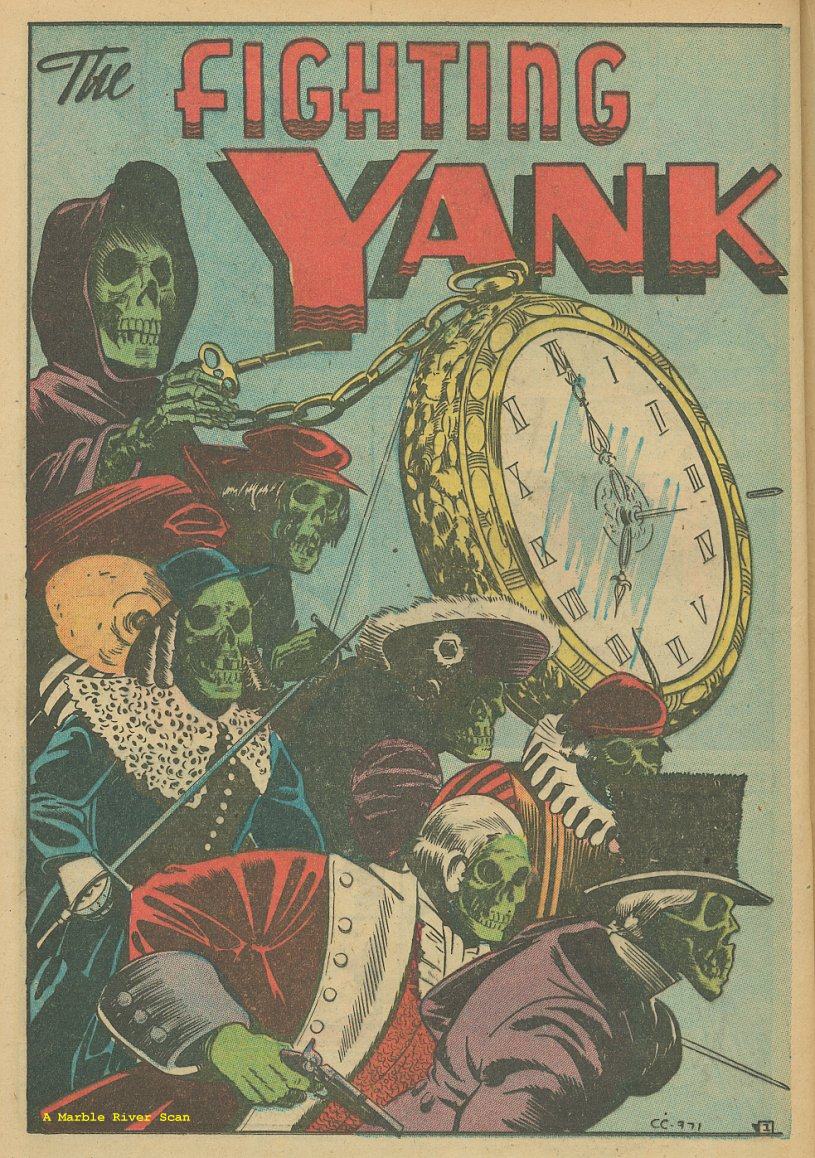
With a splash page like this, how bad could the story be?

Russ Nicholson is Awesome Department

Nothing clever to say here – he just is.

Smoking Airship Department

Yeah, this baby will show up in a Campaign Sketchbook in a future issue of NOD. Dreadnaughts of the Endless Blue maybe. It would be aerial dreadnaughts in the late colonial period – I’d put them in Victorian space, but somebody beat me to that idea.

Looking for Cheap Hits Department

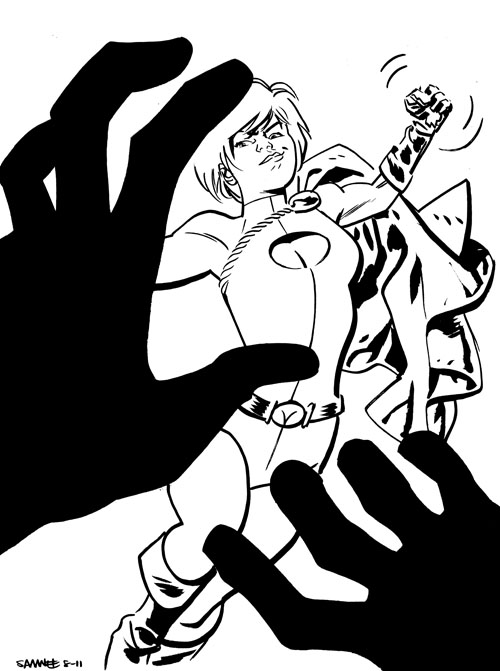
When you’re looking for page views, you can’t go wrong with Power Girl. But honestly – this is one of my favorite depictions of the character ever. Image by Chris Samnee, via Comic Twart, a site you must, if you love your eyeballs and want to give them a treat, follow now!

My Daughter is a Mad Genius Department

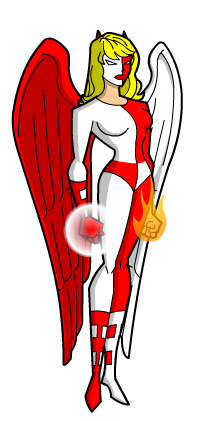
Playing with Fabrica Herois tonight, she created Angel-Devil. Is she a saintly savior or a devilish demon … or BOTH!?! Now we just need to work out some Mystery Men! stats.

The Resistance [Mystery Men!]

Super heroes garbed in the old red, white and blue weren’t the only ones fighting the Nazis in World War II. During the early stages of the war, as the Nazi war machine ran rampant over country after country, a group of super powered freedom fighters already living on European soil came together as the resistance. After the war, they maintained their alliance as the Resistors!

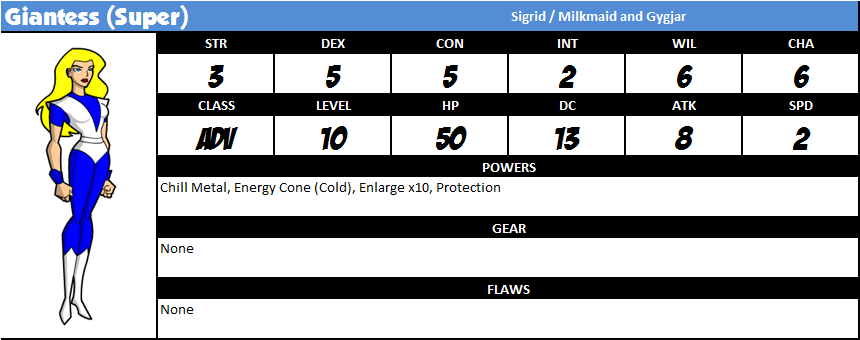
Giantess 
Creator: John M Stater (2011)

Sigrid is literally the daughter of a frost giant, and one of the last of her kind. She was discovered when Reginald Carstairs of the RAF crashed his plane into a secluded valley in Norway. Sigrid lived there alone, tending a farmstead there, and she tended Carstairs’ wounds and nursed him back to health. In the meantime, the Nazis discovered the valley and sent in an assault force to take the prisoner. Sigrid handily defeated the Nazis, but her home was destroyed. Having nothing left to do, and nursing a grudge against the Nazis, Sigrid went back to the UK with Carstairs and became the super hero known as the Giantess.

Lady Satan 
Creator: Unknown (1941)

Lady Satan was the victim of a German bombing on their cruise ship. Her fiance was killed in the attack, so she dedicated herself to destroying the Nazi menace. She primarily operates in Paris.

Marksman 
Creator: Bob Powell and Ed Cronin (1942)

The Marksman is Baron Povalski, a Polish noblemen who masquerades as Major Hurtz of the German army. Spying on the Nazi war machine from inside helps him to thwart their devilish schemes.

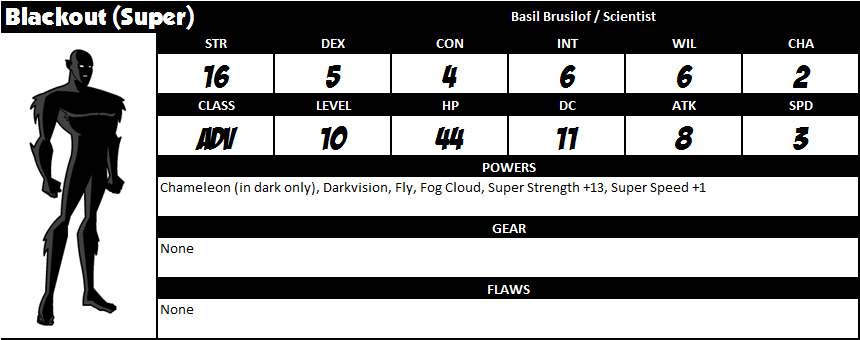
Blackout 
Creator: Don Rico (1941)

Blackout is Yugoslavian scientist Basil Brusilof. While working in his lab in Belgrade, it is bombed by the Germans and in the resulting explosion he becomes infused with a secret gas he was working on. The gas causes his body to grow black hair and the gas gives him a variety of powers.

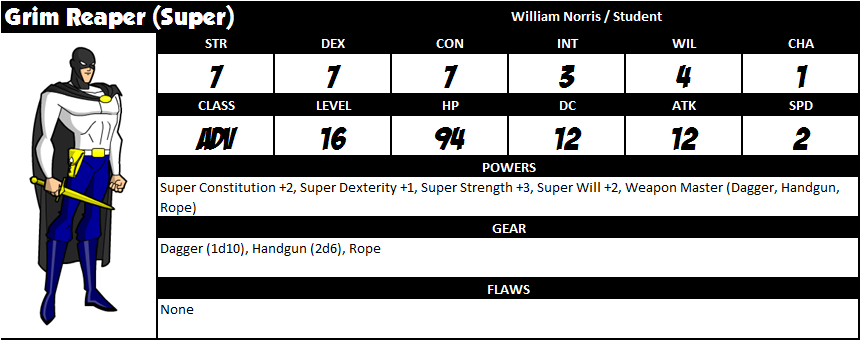
Grim Reaper 
Creator: Richard E Hughes and Al Camy (1944)

The Grim Reaper is William Norris, an American student at the Sorbonne who is captured when Paris is taken. After escaping from a concentration camp, he returns to Paris to fight the Germans as the Grim Reaper.

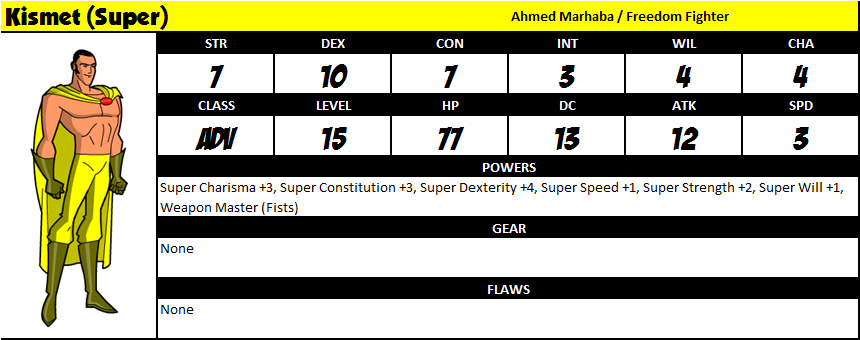
Kismet 
Creator: Omar Tahan (1944)

Kismet is a Muslim who operates in the south of France, combating the infidel Nazis.

Spitfire 
Creator: Malcolm Kildale (1941)

Black Douglas was a privateer in service to Elizabeth I, fighting pirates or sinking galleons as her majesty pleased. Two hundred years ago he is captured and set adrift by his foes, but washes ashore on a small island. On this island he finds a fountain and drinks of it. It turns out the fountain grants him immortality and super powers. It also knocks him out for a couple centuries, until he is rescued by a German u-boat crew. When he discovers they intend to attack his country, he fights back with all the powers at his disposal.

Deviant Friday – Jeremy Mohler Edition

If you’re into RPGs, surely you’ve seen Mohler’s work (JerMohler on DeviantArt). The genres he has worked in are wide reaching (well, in terms of RPGs) and he produces strong line work and often vibrant colors that remind me a bit of Bilibin. Best of all, I think, he breaks the Maxim mold on modern depictions of women in RPGs and comic books.

Here are a few pieces of Mohler’s to enjoy …

ItR Character


The Seven Saxons


Young Queen


Baeg Tobar – Fae – Delledeir


Baeg Tobar – Shuen


Thug


Bird and Woman


Cowboys and Aliens


Pirates 4


Inuit Concepts


Alexander 04


Mutations on the Polyester Road

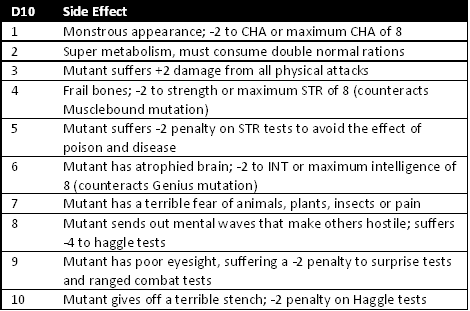
About 99% finished with my Mutant Truckers article for NOD 12. Thought I’d share the mutation tables to give folks an idea about just how mutant-y the game is. In general, Polyester Road doesn’t go as far down the mutant path as Gamma World and Mutant Future. Because it’s a mini-game/setting, I wanted to keep it focused and keep it from being too long. So, there is a small table of mutations – physical and mental, for folks to roll on. Characters can trade one hit dice for one mutation. Each mutation carries with it a 1 in 6 chance of a negative side effect (radioactive scrambled DNA can be dangerous, you know). Referees can use the same process to mutate monsters, bandits and bears (i.e. county mounties) – trade a hit dice for a random mutation. Hopefully, this will keep the mutations from dominating the game, but still allow for some fun variation of the characters.


On a side note – I think the next big hex crawl in NOD will be Hell, based very loosely on Dante’s version, with a little Milton and lots of pulpy/gonzo nonsense thrown in for flavoring. The first hurdle will be mapping Hell – it’s circular and I have no idea how big it should be or what scale would work best. Still, should be an interesting exercise and provide readers with plenty of demonic and diabolical challenges for their game groups. Also gives me an excuse to use that devil cover I premiered a few months back!

Monstrous Evolutions

Today, while thinking of something to do with the blog (and this is one of the best things about having a blog and trying to update it every day – it forces your brain to be productive) I was struck with the idea of evolving fantasy monsters. I mean, we have plenty of beast-people in fantasy games and literature – cat people, dog people, etc. But what about monster? Primates evolve into humans – what might rust monsters evolve into. Since the idea seems to fit with Pars Fortuna, here are a couple such races designed for that game.

Ustte
The ustte are humanoid insects that stand about 4 to 5 feet tall. They have hard, chitinous skin of steel gray, smallish, roundish heads that bear two glossy, black eyes and long, feather-like antennae, wide, slit mouths with long, red tongues (for lapping up corroded metal) and six limbs – two legs, two large arms (like a humans arms) and two smaller, vestigial arms below them. From their abdomen they have long tails that end in “propeller” shaped protrusions.

The ustte dwell wherever there is iron to mine, for though they can corrode most metals and live off of them, iron is their preferred diet. Families consist of a male and multiple females (the species produces roughly three females to one male). Each female is capable of producing a single brood. Broods always consist of four children. These children are given the same name and live with one another as a unit until young adulthood, when they might join with other ustte to form a new family.

Ustte lairs are usually subterranean, though close to the surface. Ustte respect strong physiques and sharp, insightful minds. They compete constantly – in athletic games, tests of skill and craftsmanship and in contests of poetry. Ustte literally wear their “honors on their sleeves” in the form of tracings in gold or silver ink on their chitin. Non-ustte see these fanciful shapes as tattoos, but to an ustte they are a record of their life’s accomplishments and very important.

Racial Abilities
Ustte have thick carapaces that give them a natural Armor Class of 12. Their delicate antennae can detect metals, from iron and copper to gold and platinum, up to 120 feet away, assuming they can conceivably be scented. The touch of their antennae is corrosive to non-precious metals (silver, gold and platinum). Any metal object touched by these antennae (requires a melee attack) has a 1 in 6 chance of being corroded to the point of being useless. Ustte feed on iron and steel, though they can consume other corruptible metals in their place, requiring one pound of metal each day to survive. This makes copper coinage very attractive to ustte adventurers, and some carry the metal as rations.

Class Abilities
Ustte are driven to excel as warriors and artists. Their prime requisite is Charisma. Ustte roll 1d6+2 per level for hit points (+2 per level after 9th). They can wear light and medium armor and use shields and any weapon weighing 3 pounds or less. Ustte are precise warriors, studying the fence as an art and fighting the way a sculptor sculpts. Their passion and drive give them a +2 bonus to save vs. fear effects if already engaged in combat and their ability to draw their opponent into a mistake give them a cumulative +1 bonus to hit and damage every round their foe fails to hit them in melee combat, up to a total of +5. This resets whenever the ustte scores a hit on an opponent. It is for this reason that ustte prefer not to win initiative. This bonus is lost if the ustte is aided in combat by another (i.e. another attacks the same target they are fighting). Whenever an ustte defeats a superior foe in combat, they may apply a new design to their carapace and will always compose a song in their own honor.

Eaoro
The eaoro are a race of tall, bulky humanoids that dwell in farming villages in the midst of wooded regions. They value their privacy; the only eaoro most folk will ever meet are those who must begrudgingly leave their enclaves to trade and those who have suffered exile from their community due to sinful behavior.

Eaoro are sexually dimorphic, the males being much larger than the females. Male eaoro stand about 7 to 8 feet tall, with rather short legs and long, arms. They have narrow shoulders, giving their bodies a distinct “triangular” shape, but are thickly muscled. Females are shorter, averaging 5 to 6 feet in height, and have longer legs and shorter arms. Males are hairier than females, and both sexes have heads covered with feathers rather than hair. Their skin is naturally pale, their eyes large (and telescopic) and they have black, hooked beaks in place of mouths.

Eaoro are vegetarians, though certainly not pacifists. They dwell on farmsteads composed of a central longhouse constructed of stone and logs, maybe one or two outbuildings for storage and a surrounding rampart of earth and stone that stands about 5 feet high. Farmsteads support a family of a bonded male and female, their young (anywhere from three to twelve children) and maybe older relations incapable of surviving on their own. These farmsteads are situated quite near to one another. Eaoro communities are referred to as clusters and usually consist of 20 to 100 farmsteads. Somewhere in the cluster there is a hill cleared of trees that serves as the cluster’s moot.

Eaoro are deeply religious, believing in litany of sins handed down to them from their forebears. When conflicts arise, eaoro must submit themselves to judgment by the moot. Sins are tallied, and judgment always goes to the less sinful eaoro. If this doesn’t cause eaoro to strive for righteousness, it certainly drives them to strive for sneakiness and to pry into the lives of their neighbors, keeping a close “sin count” in case a conflict should arise. Eaoro with too many sins to their names are usually exiled from the community.

While all eaoro are taught magic from a young age, male eaoro tend to be better warriors than mages and females better mages than warriors. For this reason, each is considered separately in terms of class abilities.

Racial Abilities
Eaoro are born farmers – even those who have since been cast out of eaoro society. This gives them a knack for predicting the weather and in all other matters related to the growing of crops and mending of farm implements. They also have a knack for casting cantraps. All eaoro start the game knowing three random cantraps. They can only cast them by making a spell roll and suffer the consequences of failure just like any other spell caster. Their innate strength gives eaoro males a +2 bonus to their strength score and a -2 penalty to their dexterity score at character creation. Females have a bonus and penalty of +1 / -1. These modifications cannot improve a score beyond 18 or lower it below 3. Since most eaoro adventurers are outcasts from their communities and have had to live for an extended time in the wilderness and then on the fringes of society, they have a knack for wilderness survival and pick pocketing.

Eaoro Class – Female
Female eaoro have Intelligence as their prime requisite. They roll 1d6+1 per level for hit points (+2 per level after 9th) and can use light armor, shields and any weapons.

Female eaoro are magicians, and thus can cast magic spells. They have no particular skill at casting a certain kind of spell, being dabblers at the art. They are skilled at picking pockets, palming small objects and at bluffing.

Eaoro Class – Male
Male eaoro have Strength as their prime requisite. They roll 1d6+2 per level for hit points (+2 per level after 9th) and can use light armor, medium armor, shields and any weapons.

Male eaoro are skilled at picking pockets, palming small objects and bluffing. They are known for their ability to present a frightening display when they enter combat, forcing all creatures with 1 hit dice or less to pass a saving throw or flee. Creatures backed into a corner or defending their loved ones will not flee.


Mu-Pan Eastern Encounter XII

Finally finished writing all the Mu-Pan encounters over the weekend! Now I just have to clean up the rough edges, insert some game stats here and there, write the intro stuff (regions, monster encounter tables, etc) and figure out what I want to do (or need to do) about art. I’m about 90% complete with Mutant Truckers as well – finished writing up some monster stats (all re-purposed from the d20 SRD) and just need to write a few more and then drop them into encounter tables. I’ll probably do a play-through in the next few days with some folks on Google + and see if things actually work. In the meantime …

6038. Umborodom’s Abbey: There is an ancient fortress-monastery constructed here of red bricks and tall, peaked roofs of copper. The roof is covered with hundreds of tall, copper spires that attract lightning. The monastery is dedicated to Umborodom, whose hound was the thunder. The monastery is inhabited by 16 low-level sohei and their abbess, Deneg, a temperamental woman with blue-gray eyes and a powerful hatred of the Jade Empress, who quells her lovely storms and keeps her “hounds” hungry.

The “hounds” are three lightning elementals that dwell within a golden matrix that serves as the monastery’s idol. The monastery is surrounded by a village of red brick buildings inhabited by about 150 tin miners. The mines are of ancient vintage, but still producing tin and a few tourmalines and topaz each month. Tourmalines are claimed by the sohei and topaz by the empress.

The sohei of the monastery wear blue armor and carry large, steel-shod mallets.

6111. Ghost Town: These dusty hills are crossed by numerous trails, for the hills once hosted the grand city-state of Ganiz. Ganiz is now a ghost town – literally. Travelers see wisps of people walking through ghostly streets and the outlines of buildings when one squints or looks away from the sun. The buildings and people are more pronounced in the moonlight. The people move slowly and are completely unaware of the living. They are almost certainly not undead, as they are unaffected by turning and cannot be spoken to using the speak with dead spell. Likewise, they do not seem to inhabit the Ethereal Plane, for they still appear as ghostly images in that place and the Astral Plane. Sages do not know what to make of the phenomenon and prefer to ignore it and avoid the hex.