NOD on rpg.net

My daughter googled my name last night, and this review of NOD #1 turned up on rpg.net. Sleeper rated issue #1 a “7”, which isn’t bad since he gave the same rating to the Swords & Wizardry Core Rules, the 1st edition DMG and Vault of the Drow ;).

Anyhow, if you have a hankering to rate the first issue, that would be a good place to do it. Unless you hated it, in which case rating it would be a terrible waste of your time.

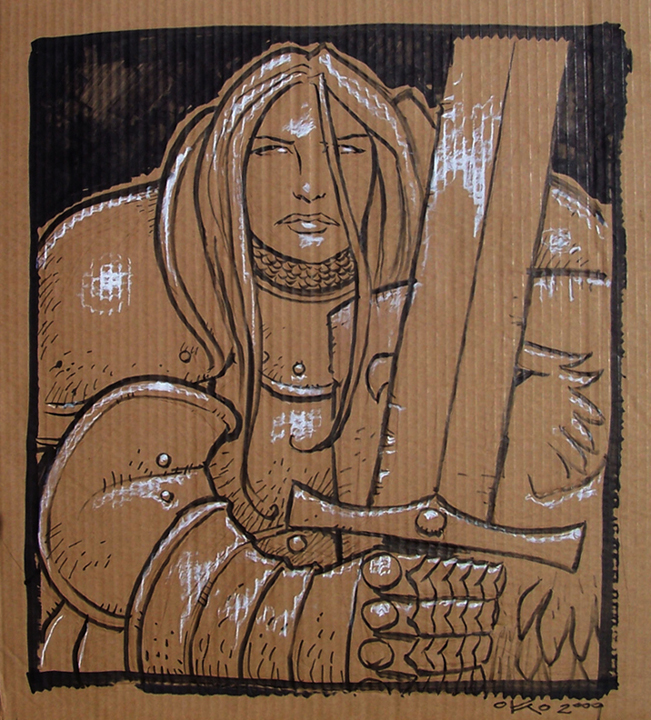
Oh – and why the Darwyn Cooke drawing of Red Sonja? Because Darwyn Cooke + Red Sonja is reason enough.

Medieval Bestiary IV

European folklore holds a candle to none in the breadth and depth of its imagination. Europeans populated not only their own countries with all manner of strange beasts and monsters, but extended their imaginations over the entire globe. While a good many of these creatures have been given game statistics, several have not. Some of these creatures are, to be sure, simple variations on existing monsters – ogres, giants, fairies, spirits, etc. Others are just not threatening or interesting enough to demand statistics. Those monsters of the folklore of France, Germany and the Low Countries, and those of medieval bestiaries and heraldry, that I thought both unique and challenging are presented below.

Part One, Part Two, Part Three

This post is declared Open Game Content.

Ghouls
The nachzehrer, or “afterwords devourer”, is a foul undead creature from German folklore. Usually the risen corpse of a victim of suicide or disease, the nachzehrer consumes dead bodies in the manner of a ghoul. The creature assumes the shape of a large pig after leaving its grave, and initially targets its own family for consumption.

Gnolls
Through one means or another, the gnoll of modern fantasy games has come to be represented as a humanoid with the head of a hyena. In medieval bestiaries, two creatures can be used as variant gnolls. The first is the chromandi, a hairy, savage humanoid with the teeth of dogs. The second is the cynocephalus, Latin for “dog-head”. These dog-headed creatures were long claimed to have hailed from the mountains India. The dog-heads were hunters who communicated with barking and wore animal skins. Although of ancient Greek origin, they persisted into the Middle Ages. Saint Christoper was often depicted as being a cynocephalus, for he was a member of the tribe of Marmaritae, who were believed to be large and to have the heads of dogs. In game terms, Christopher would be a very rare high level lawful gnoll cleric! In the late Middle Ages, there were stories of such people living in Central Asia. King Arthur had a band in his retinue, inhabitants of the mountains of Eidyn, or Edinburgh. The Chinese admiral Hui-Sheng described an island of dog-heads, a “dog kingdom”, to the east of Fusang. Clearly, the gnolls got around in the days when giants still walked the earth.

Gorgad
Gorgades are hairy demi-humans believed to inhabit islands off the Atlantic coast of Africa. First described by Pliny the Elder, they feature in many medieval bestiaries. In Pliny’s description, it seems likely that what he was really describing was an encounter with apes. There is no reason, of course, that the gorgad cannot be portrayed in a fantasy game as a new race of hairy, primitive humanoids. After all, one can only encounter orcs and hobgoblins so many times before they yearn for something new.

Gorgades are primitive humanoids that are covered in shaggy fur. They dwell in large, extended families of 20 to 50 individuals and are usually led by one or several powerful males (2-5 Hit Dice each). Gorgades use primitive weapons, usually clubs and stones. They are known to be fleet of foot.

Gorgad: HD 1+1; AC 7 [12]; Atk 1 weapon (1d8+1); Move 15; Save 17; CL/XP 1/15; Special: None.

Gulon (Jerff, Vielfras)
The gulon appears to be a large, brown, shaggy wolf with the head of a wild cat and the tail of a fox. The gulon kills quickly and then gorges itself on its prey, eating rapidly and until swollen. A frenzied gulon can devour most of a man-sized corpse in three rounds. Once gorged, its movement is reduced to 6, it suffers a -2 penalty to hit, and its Armor Class is reduced by 2 points. A creature devoured by a gulon cannot be raised from the dead or resurrected, but can be brought back to life with a wish.

Gulon: HD 3; AC 3 [16]; Atk 1 bite (2d4); Move 15; Save 14; CL/XP 3/60; Special: Devour corpse.

Humans & Demi-Humans
Pliny the Elder described many strange humanoids who can statistically be represented as bandits or men-at-arms. The hippopodes, or “horse-feet”, were a tribe of humans with equine feet that lived on an island with two other strange tribes. The panotti were humans with ears so large and long that they could cover the creature’s entire body. The other tribe was the oeonae, humans who only ate oats and marsh bird eggs (but not the eggs of the barnacle goose, for that creature does not lay eggs!) The struthopodes are a tribe of humans in which the male has very large feet and the female very tiny feet. The machlyes are a race of hermaphroditic humanoids that look generally like human beings with male and female halves.

Ichneumon (Echinomon)
The ichneumon was believed to be the enemy of dragons. When the creature spotted a dragon, it would cover itself with mud and close its nostrils with its tail in order to surprise the dragon and pounce upon it and swiftly kill it. The name was later used to designate the mongoose, legendary enemy of poisonous snakes. For our purposes, we’ll consider the ichneumon to be a giant mongoose that is incredibly swift (per the haste spell) and immune to dragon breath and poison. Against dragons and other reptiles, the ichneumon enjoys a +2 bonus to hit and damage.

Ichneumon: HD 6; AC 3 [16]; Atk 2 bites (2d4); Move 18; Save 11; CL/XP 8/800; Special: Haste, immune to dragon breath and poison.

Klabautermann
Klabautermann are aquatic gnomes of a kindly disposition who aid fishermen and sailors at sea. These gnomes are expert sailors and musicians. They appear to be small, gnomish sailors in yellow clothes, woollen caps and gripping a sailor’s pipe in its mouth. Unfortunately, a klabautermann is naturally invisible, and will only appear to sailors if their ship is doomed to sink. A klabautermann is skilled at the hornpipe, and can play a tune that grants the sailors of a ship a +2 bonus to hit, damage and on all saving throws.

Klabautermann: HD 1d6; AC 3 [16]; Atk 1 weapon (1d4); Move 9; Save 18; CL/XP 3/60; Special: Invisibility, rousing music, only harmed by silver or magic weapons.

Mandragora
A mandragora is a little doll or figurine in the shape of a beardless man. They are given to magic-users by the nether powers to act as familiars. In terms of game statistics, the mandragora can be considered a homunculus. Its possession allows a magic-user to Contact Other Plane once per week. The mandragora must be fed the blood of an innocent to keep it alive. They are immune to fire, and can actually travel back to their hellish plane of origin by entering a fire.

Matagot (Mandagot)
The matagot is an evil spirit that takes the form of a black cat, rat or fox. Matagots can bring wealth to a person, but in turn condemn their soul to torment after death. If the owner of a matagot gives it the first bite of food and drink at every meal, it is rewarded the next morning with a single gold coin. Each gold coin the person collects condemns his soul to torment for 1 year, thus making it impossible to resurrect or raise that person from the dead until his soul is freed. Moreover, the owner of a matagot suffers a -1 penalty to Armor Class and 1 extra point of damage per damage dice in combat – all the better to hasten his soul’s arrival in Hell.

Matagot: HD 1; AC 6 [13]; Atk 1 bite (1d3); Move 15; Save 17; CL/XP 2/30; Special: Only harmed by silver or magic weapons, misfortune.

Venatia – Saint Stimula

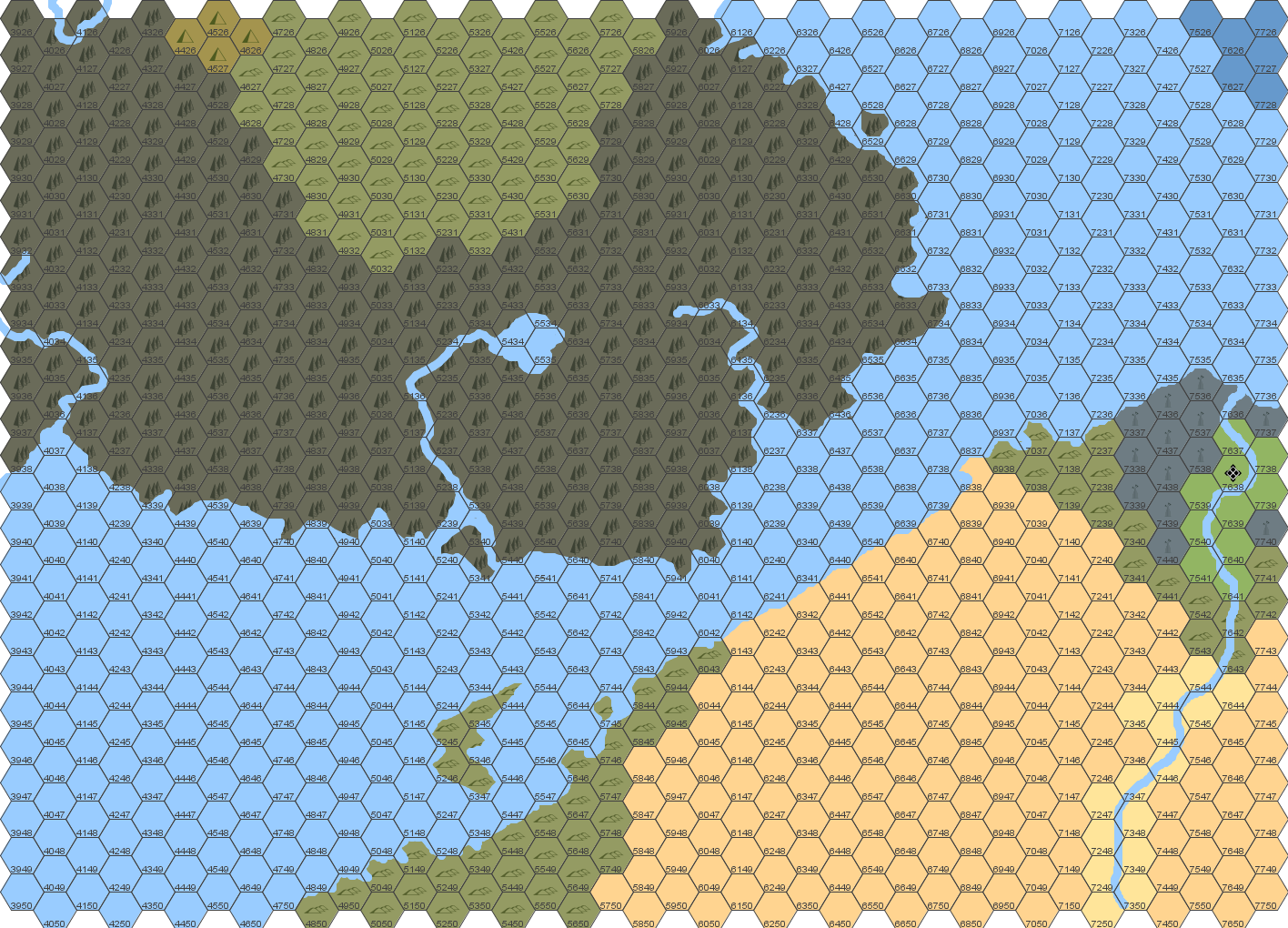
You can find Part One here – oh, and I screwed up the numbering on the map last time around, so it has been fixed. If you downloaded it before, you’ll want to download it again.

May plan is to present six encounters, every other day, until I hit 60 encounters. Then I’ll post the NW map and begin the process all over.

Encounters

3926 Ancient Highway: Remnants of an ancient highway run through this hex. The highway was constructed along a tall ridge, and was in fact constructed by excavating and flattening a portion of the ridge. At one point, several clay drainage pipes penetrate ridge beneath the highway’s surface, allowing water to pass through and form a pleasant stream that continues down the slope before meeting a larger stream. The drainage pipes can be crawled through (or walked through if one is a halfling or gnome), being 200 yards long and eventually ending in a large, pond that fed by a dozen little streams. The pond is lined with tall trees and reeds and home to a menagerie of frogs and fish. In the midst of the stream, surrounded by water lilies, is the battered and toppled statue of a humanoid. Closer inspection reveals it to be a fairy queen. The queen is guarded by a gwurrum (or green fairy mist) that appears at night as a greenish, glowing mist on the surface of the pond. It soon moves through the pipes and into the hills beyond in search of creatures to torment and hurt. If the statue is righted and cleaned, and decorated with garlands of flowers, the statue’s mouth will open, revealing a small, flint arrowhead on the tongue. The arrowhead can be used as an arrow of slaying against fey creatures.

3928 Runic Relic: A 10 ft tall runestone carved from a greenish stone flecked with silver stands atop a grassy knoll. While the base of the hill is clogged with gnarled pine trees, the hill is completely devoid of anything but reddish-green grass. The runestone recounts the deeds of an ancient chieftain of the wose in simple (and often graphic) pictograms reminiscent of the ones used by the ancient lizard kings. The stone is erected atop the chieftain’s burial mound, the crypt chamber lying 15 feet beneath the soil. The crypt can be reached by a low tunnel composed of large stones leaning against one another and buried under the soil. The stone “walls” of the passage and crypt are covered in swirls and stylized skulls. The chieftain’s partially mummified remains lie atop a stone slab made reddish-brown from the spilling of blood (probably sacrifices). Around the slab lie the chieftain’s treasures, mostly obsidian axes and flint spear and arrow heads, but also some simple copper and electrum jewelry (25 gp worth) and a soapstone carving of what appears to be a bear standing on its hind legs (worth 10 gp).

3929 Poisonous Hollow: The landscape here turns into a deep hollow choked with maples, sycamores and ferns and traversed by a deep, moderately fast running rivulet. At many places, the rivulet becomes quite shallow and is easily forded. Many large rocks, some that bear signs of having been shaped into irregular blocks, dot the rivulet. In the center of the hex, the rivulet becomes the lair of a clutch of eight giant, green frogs that are scaled in the fashion of a dragon and that belch plumes of poisonous vapor from their wide mouths almost at random. The largest of the bunch is an actual green dragon that was polymorphed into its present form by a vengeful wizard.

• Draconic Giant Frog: HD 3; AC 5 [14]; Atk 1 bite (1d8); Move 3 (or 100 ft leap); Save 14; CL/XP 4/120; Special: Leap, swallow whole, immune to sleep, breath weapon (3/day, cloud of poisonous gas 30-ft in diameter, 12 damage).

3936 Abbey of St. Stimula: Atop a rocky promontory, the base of which is forested with sycamores and maples, is a large, fortified abbey. The abbey is dedicated to St. Stimula, patron saint of wine and part of the cult of Bacchus.

The abbey is built of gray stone and has gleaming white shutters on the windows. The shutters are engraved with vines and frolicking nymphs and satyrs. The buildings of the abbey have peaked roofs of green copper. The abbey is composed of a large, round tower that houses an armory, hospital and living quarters for abbey officials. It is connected to a two-story L-shaped building that houses the sisters, their winery and a shrine to St. Stimula and Bacchus. A tall wall encloses a courtyard with an iron portcullis. The courtyard houses a medicinal garden, a few young vines, a tall pomegranate tree and a very deep well. Hidden among the surrounding wooded hills are a dozens of vineyards. The vinyards are protected by a band of 12 satyrs that join the sisters in their revels each night.

Mother Isleiza is a 70-year old woman who hails from Lyonesse. Her fifteen sisters hail from the local villages as well as Lyonesse, so there is a mix of olive-skinned and dark-haired women with the long noses and narrow faces common to the coast and the rounder faced, lighter-skinned women of Lyonesse. All wear grey frocks embroidered with round badges that look like a woman’s face that is composed of grape leaves and vines. Isleiza is an ugly woman with a rude, grating personality. Of course, her looks and demeanor soften each night when the satyrs arrive and the drunken revelries begin, but in the daylight hours she is quite formidable. Mother Isleiza, despite her advanced age and seemingly tough exterior, has fallen deeply in love with Baron Torod of [4336]. The Baron and a contingent of villagers visit the abbey every year or so to pay their respects and make sacrifices, as well as to purchase the sister’s excellent wine.

The abbey treasure includes four leopard skins (15 gp each), 20,000 cp, 1,000 ep, 5,000 gp, 100 pp, a large, polished obsidian sphere (worth 95 gp) and an olivine (worth 125 gp). In a vault beneath the tower, accessible only through a secret door with a lock that appears to have a poisoned needle, but in fact channels 4 dice of lightning damage through any metallic object that enters it, is kept a powerful relic, The Hand of Sabazios.

The Hand of Sabazios is cast in bronze and is slightly larger than a human hand. When held above the head, it amplified the holder’s voice and gives his every word the power of a command (per the spell). The bearer of the hand is immune to fear and lightning and can, once per day, summon a celestial charger (treat as a benevolent version of the nightmare) that serves loyally for 1 hour.

• Mother Isleiza, Level 12 Druid: HP 44; AC 7 [12]; Save 4; Special: Druid spells (6th), change into leopard, cobra or bull; Leather armor, gnarled club (does 1d6 damage), leopard skin (45 gp).

• Satyr: HD 5; AC 5 [14]; Atk 1 weapon (1d8); Move 18; Save 12; CL/XP 6/400; Special: 50% magic resistance, pipes, concealment.

• Sister of St. Stimula, Level 2 Druid: HD 2d6+2; AC 7 [12]; Save 13; Special: Druid spells (1st); Leather armor, club, sling.

3942 Wild Herd: A wild, unruly herd of nine hippocampi dwells on a submerged plateau. The creatures are wrangled by a trio of young storm giants on behalf of the nereid in [4041]. The storm giants, Eksen, Hraga and Tyrnach, are members of the family that dwells in [XXX] in the mountains way to the north. The storm giants live in a large cave that overlooks the fields grazed by the hippocampi. They enjoy tests of skill and strength, and will gladly challenge adventurers to compete in games. The storm giants possess 21,000 sp, 2,200 gp, 100 pp, a silver toe ring (large enough to be used as an armband, worth 1,000 gp) and a ceramic aquamanile (worth 230 gp, a memento of home). The hippocampi are all colored bluish-grey, with white manes and silvery scales.

• Young Storm Giant: HD 8+3; AC 2 [17]; Atk 1 weapon (3d6); Move 15; Save 8; CL/XP 9/1100; Special: Throw boulders, control weather (4 in 6 chance of success).

3948 Turtle Shark: These waters, and those nearby, are the hunting ground of a massive turtle shark – possibly the largest specimen of its kind on Nod. The creature is large enough that it can batter the hulls of ships and send them to the bottom.

• Turtle-Shark: HD 9+1; AC 1 [18]; Atk 1 bite (4d6) or 1 slam (3d6); Move 9 (Swim 15); Save 11; CL/XP 11/1700; Special: Shell, capsize, swallow.

Art: Women of Amphiss (1877) by Lawrence Alma-Tadema

Medieval Bestiary – Part Three

European folklore holds a candle to none in the breadth and depth of its imagination. Europeans populated not only their own countries with all manner of strange beasts and monsters, but extended their imaginations over the entire globe. While a good many of these creatures have been given game statistics, several have not. Some of these creatures are, to be sure, simple variations on existing monsters – ogres, giants, fairies, spirits, etc. Others are just not threatening or interesting enough to demand statistics. Those monsters of the folklore of France, Germany and the Low Countries, and those of medieval bestiaries and heraldry, that I thought both unique and challenging are presented below.

Part One, Part Two

This post is declared Open Game Content.

Caleygreyhound
This odd beast of medieval heraldry had the body of an antelope, the head of a wild cat with the antlers of a deer, the forelegs of an eagle and the hind legs and tail of either a lion or ox. The caleygreyhound is a predator with amazing speed; in effect, it is always under the effects of the haste spell. A similar creature is the enfield, with the head of a fox, chest of a greyhound, body of a lion, hindquarters and tail of a wolf and forelegs of an eagle.

Caleygreyhound: HD 3; AC 1 [18]; Atk 2 bite (1d4) and 4 claws (1d3); Move 18; Save 14; CL/XP 5/240; Special: Haste.

Carcolh
The carcolh is one of the folkloric beasts that makes you half-wonder if our medieval ancestors did play fantasy roleplaying games, because it is simply made for them! The carcolh is a giant serpent with a mollusk shell on its back. It is covered in sticky slime. Around its gaping mouth, the creature has dozens of long tentacles – some as long as a mile. The beast dwells in a cave and unfurls its tentacles, extending them well into the countryside. When something approaches too close to a tentacle, it is grabbed and squeezed and pulled back to the creature’s waiting mouth. In game terms, these tentacles might be found anywhere in a dungeon, and in fact 90% of random carcolh encounters are actually with a tentacle. The tentacles surprise creatures on a roll of 1-4 on 1d6. If a tentacle successfully attacks, it wraps around its victim quickly, squeezing for 1d4 points of damage each round and dragging it back 10 feet per round to the creature’s mouth. The tentacles have an Armor Class of 6 [13] and can be severed by inflicting 8 points of damage on them. The bite of the carcolh is +5 to hit a grappled creature, and if the bite attack beats the victim’s Armor Class by more than 4 points, the creature is swallowed whole.

Carcolh: HD 9; AC 4 [15]; Atk 1 or more tentacles (1d4 + grappled) or 1 bite (2d6); Move 9; Save 6; CL/XP 11/1700; Special: Tentacles, swallow whole.

Chichevache
This odd creature began as an unkind joke of Geoffrey Chaucer. The creature is said to resemble an emaciated cow with a human face. Its diet consists entirely of obedient and faithful wives, and the scarcity of such women, according to Chaucer, explains why it is so thin. The word may be a play on the French chichifache (“thin face”). In game terms, the creature can be turned into a fairly disturbing creature. Imagine an emaciated grey cow with a human face (a good start, in terms of being disturbing). Now imagine that this creature is an undead spirit, roaming the countryside looking for lawful females that it might devour their souls. In essence, it becomes a wraith wrapped in a new form.

Chichevache: HD 4; AC 3 [16]; Atk 1 touch (1d6 + level drain); Move 12; Save 13; CL/XP 5/240; Special: Drain 1 level with hit.

Dipsa
The dipsa is a tiny serpent or worm, covered in a mucus membrane and so poisonous that its victims die before they are aware that they were bitten. The dipsa is a perfect creature to have lurking in swamps or dank dungeons, often buried in the soft mud or living in a puddle of water. It gets a single attack that forces its victim to save or die. The creature is so small that it can be killed with a single hit.

Dipsa: HD 1 hp; AC 9 [10]; Atk 1 bite (poison); Move 3; Save 18; CL/XP B/10; Special: Deadly poison.

Dragons
Dragons feature prominently in French folklore. Gargouille was a river dragon that spouted water. It was tamed by Saint Romain and then slaughtered and burned. Gargouille’s head and neck, however, would not burn, and were instead affixed to the cathedral, thus beginning the use of carved gargoyles as water spouts. The Tarasque was a legendary dragon from Provence. It was a dragon with six short legs, like those of a bear, an ox-like body covered by a turtle’s shell, a lion’s head and a tail that ended in a scorpion’s sting. The Tarasque was the offspring of the Biblical Leviathan and the Onachus, a scaly, bison-like beast from Galatia that burned everything it touched. The beast was impervious to the armies thrown against it, but was finally charmed by Saint Martha and led back to a city where it was killed by the people, offering them no resistance. The city was then renamed Tarascon. La Fertre’-Bernard, France, was terrorized by a dragon called Peluda, or “Shaggy Beast”. Peluda is unique enough to deserve its own entry below.

Note: Some fantasy games include rules for subduing dragons. Using these legends as a guide, a Referee might allow lawful or good clerics in his campaign the ability to charm dragons as though attempting to turn undead. If successful, treat the dragon as though it has been subdued.

Drude
The drude is a strange spirit from German folklore. It appears as a hag, and is in fact the evil portion of a virginal or holy woman’s soul. Sometimes, these women voluntarily undergo the Drudenfluch, or drude‘s curse to split their soul in two, and other times it is forced upon them by a demon or witch. The drude is very heavy and is as powerful as an ogre. It has a foot print that looks like a pentacle, and this symbol, called the Drudenfuss, can ward them away as a protection from evil spell. Drudes are capable of assuming gaseous form and seeping into a house through the tiniest cracks. Once inside, they attempt to suffocate their victim by sitting on its chest; in essence, this is handled as a fist attack. If successful, the victim must succeed at a saving throw or be grappled and suffer 1d3 points of constitution damage each round. When the victim is reduced to 0 consitution, the drude possesses them, bringing them back to full health and gaining complete control over them until forced out, which can be done by a cleric’s turn undead attack or with other spells.

Drude: HD 4; AC 5 [14]; Atk 1 fist (1d6); Move 12; Save 13; CL/XP 7/600; Special: Grapple, possession, only harmed by silver or magic weapons.

Forest Cattle
Pliny the Elder placed these cattle in Ethiopia. Forest cattle are twice the size of normal cattle and bright red in color. They are capable of turning their horns in any direction, thus allowing them to make two separate horn attacks each round. Bulls inflict 1d6 points of damage with each horn, while cows inflict only 1d4 points of damage. The forest cattle may be related to the yale of English folklore.

Forest Cattle: HD 6; AC 5 [14]; Atk 2 gores (1d6); Move 18; Save 11; CL/XP 6/400; Special: Can gore two different creatures in the same round.

Ged
Ged was the original word used for the pike. It is derived from the Old Norse gaddr, or “spike”. For our purposes, the ged is a giant pike that lurks in lakes and rivers. Ged are quite sneaky, and surprise on a roll of 1-3 on 1d6.

Ged: HD 4; AC 5 [14]; Atk 1 bite (3d6); Move 0 (Swim 24); Save 13; CL/XP 4/120; Special: Surprise.

On Venatia – Introduction

VENATIA
Venatia is a region of woodlands and hills nestled between the Klarkash Mountains in the west and the Great Yamas in the east. Once dominated by the Nomo Empire, it is now home to several competing city-states – Antigoon, the golden city, Blackpoort, the city of thieves, Lyonesse, the white city and ancient Ibis. Venatia has several sub-regions, including the Dreadful Woods, Forest Perilous*, Golden Coast, Golden Sea, Great Myre*, Harrowing Hills, Reed Sea, Rooky Wood*, Tepid Sea* and a small portion of the Wyvern Hills and Nabu Desert.

* Does not appear on this map – wait for future installments.

Dreadful Forest

The Dreadful Forest is thick and dark, consisting mostly of evergreens (spruce, pine) and brambles. It’s primary inhabitants are the noroob and kobolds – hundreds of small copper and tin mines can be found beneath the forest. Orcs, goblin and ogres prowl the forest as well, and incursions by thugtoads and lizardmen are not uncommon in the forest’s western reaches.

The Dreadful Forest is really the foothills of the Sturmdrang Mountains. It is bordered by the Forest Perilous to the north and the Great Myre to the east. Reptilians figure greatly into the ecology, for the whole forest was once ruled by the Lizard Kings, technologically advanced ancestors of the noroob and lizard-men. Lizardman ruins can still be found in the forest, along with some of their artifacts.

Monster encounters should be diced for twice a day, once in the daylight hours and once at night. There is a 1-2 in 1d6 chance of a monster encounter. The monster encountered can be chosen from the list below or diced for randomly.

ENCOUNTERS
1 Baccae (1d6)
2 Bear – Black (1d6)
3 Beetle – Giant Stag (1d6)
4 Dragon – Green (1d3)
5 Firedrake (1d8)
6 Flying Squirrel – Carnivorous (6d6)
7 Giant – Hill (1d4)
8 Goblin (9d6)
9 Kobold (12d6)
10 Lizard – Giant (2d6)
11 Lizardman (3d6)
12 Noroob (2d6)
13 Ogre (2d6)
14 Orc (6d6)
15 Phycomid (1d6)
16 Pixie (1d6)
17 Pseudo-Dragon (1d8)
18 Thugtoad (3d6)
19 Wolf – Reptilian (3d6)
20 Woodwose (1d3)

KOBOLD – There are hundreds of small kobold mines in the Dreadful Forest. Many mineshafts are long since abandoned, the vein running dry and the miners moving on. For the most part, the kobolds mine copper and tin in the woods, with a few lucky groups finding silver, gold or precious stones. Kobold warriors wear leather armor and wield picks and short bows. For every 12 kobolds there is a 1 HD sergeant, for every 24 a 3 HD lieutenant and if more than 60 kobolds are encountered they are led by a 5 HD captain. For every sergeant in the band there is a 10% chance that they are accompanied by a 2nd to 5th level adept (see NOD #1) or magic-user.

• Kobold: HD 1d4; AC 6 [13]; Atk 1 weapon (1d6); Move 6; Save 18; CL/XP A/5; Special: None.

WOLF, REPTILIAN – An invention of the ancient Lizard Kings, reptilian wolves have the same statistics as normal wolves.

Golden Coast
The Golden Coast consists of a largee range of highlands bording the Golden Sea. The highlands are as rugged as those of the Wyvern Coast to the southwest, but receive more rainfall and thus support more vegetation. The coasts have the thickest woods, including forests of date palms, sycamores and pistachios. The hinterlands have smaller copses of bay laurels, hazels, lindens, maples and spruces. Animal life is also more plentiful on the Golden Coast, with the most common predator being a breed of lanky, golden-furred wolves. The highlands are also pocked with dozens of artesian wells and bubbling springs. They are rich in deposits of gold, copper, tin and zinc.

During the Pandiluvian Age, the highlands of the Golden Coast were little more than small, scrubby islands in the what was then part of the much larger Tepid Sea. Many of the elder races established underwater mining operations in the highlands, traces of which can still be found today in irregularly shaped caverns filled with dark, dank deposits of primordial sea water and the descendants of the bizarre creatures that once inhabited those seas.

As the waters receded, the highlands were settled by the chalkeions, a race of bronze-skinned men. The chalkeions built small settlements that gradually grew into small city-states and there honed the art of war and worshiped such gods as Sabazios, Hecate and Bacchus. At its height, the Nabu Empire conquered the city-states of the bronze men and reduced their numbers to the point that they would no longer be a threat to the empire and its ambitions, and the chalkeions remain few in number to this day. The Nabu left behind a few settlements of humans and beastmen (see Beastmen of Nabu in this issue).

With the fall of the empires of Nabu and Irem, the elf-dominated Empire of Nomo expanded into Venatia, but never really came as far as the Golden Coast. A few adventurers established strongholds in the region, but the land remained wild and in the possession of the remaining chalkeions. In recent times, the exiled dwarfs of the western continent have begun to establish mining operations along the Golden Coast.

Monster encounters should be diced for twice a day, once in the daylight hours and once at night. There is a 1-2 in 1d6 chance of a monster encounter. The monster encountered can be chosen from the list below or diced for randomly.

ENCOUNTERS
1 Aurumvorax (1)
2 Baccae (1d6)
3 Basilisk (1d4)
4 Bear – Black (1d6)
5 Gorgon (1d3)
6 Humanoid (see below)
7 Panthera (1)
8 Ram – Giant (2d6)
9 Roc (1d3)
10 Stymphalian Bird (1d6)
11 Wolf (3d6)
12 Wyvern (1d3)

GIANT SUBTABLE
1 Giant – Bronze (1d3)
2 Giant – Hill (1d3)
3 Gnoll (3d6)
4 Ogre (2d6)

HUMANOID SUBTABLE
1 Beastman – Aigosy (6d6)
2 Beastman – Arcs (2d6)
3 Beastman – Axum (6d6)
4 Beastman – Esou (6d6)
5 Chalkeion (1d6)
6 Centaur (1d6)
7 Dwarf (6d6 or 1d6+3)
8 Human – Bandits (1d6 x 10)
9 Nymph (1d6)
10 Satyr (1d6)

AIGOSY (Goat Men) – A large group of goat people might be a patrol or a caravan moving goods on the backs of allocameli. The warriors wear ring mail under black robes and carry shields, maces and slings. There is one 3 HD sergeant for every six warriors, one 5 HD lieutenant for every 12 and a 7 HD captain if more than 30 are encountered. There is a 10% chance per sergeant of a 2nd to 5th level aigosy (see “Beastmen of Nabu” in this issue).

• Aigosy: HD 1; AC 5 [14]; Atk 1 weapon (1d6); Move 12; Save 17; CL/XP 1/15; Special: Climb, +1 save vs. mind-affecting spells, +2 save vs. disease and poison.

ARC (Bear Men) – Arcs are usually encountered as a single hermit with the abilities of a 5th level fighting-man, monk or arc (see “Beastmen of Nabu” in this issue). The arc will be wearing a simple brown robe tied at the waist with a length of rope and carrying an earthenware jug on his shoulder and a large, gnarled club.

• Arc: HD 5d6+10; AC 7 [12]; Atk 1 club (1d8+1) or 1 grapple (1d6); Move 12; Save 12; CL/XP 5/240; Special: +1 to hit and damage with club, +1 to hit with grapple, deals 1d6 damage per round while grappling, jug with 1d12 doses of cure light wounds.

AXUM (Falcon Men) – The axum wander the hills in hunting parties of 2d6 individuals. The band will be led by a 4th to 6th level axum (see “Beastmen of Nabu” in this issue), fighting-man or ranger (see “Fighting-Men of Nod” in NOD #1 or “On the Fighting-Men of Nod” on the Land of Nod blog). The axum wear leather armor and carry curved long swords and daggers and a bundle of 6 javelins each.

• Axum: HD 3; AC 7 [12]; Atk 1 weapon (1d8); Move 15; Save 14; CL/XP 3/60; Special: +1 to hit with missile weapons.

CHALKEIONS (Bronze Men) – Usually a small party wearing hoplite armor and carrying spears, short swords and short bows. There is a 60% chance they will be mounted on warhorses.

• Chalkeion Hoplite: HD 5; AC 2 [17]; Atk 2 by weapon (1d6); Move 12; Save 12; CL/XP 5/240; Special: None.

DWARFS – Either a patrol of warriors wearing chainmail and carrying shields, axes and light crossbows or a small group of 4 to 9 prospectors. The patrol will have one sergeant for every 6 dwarfs, one lieutenant for every 12 and will be led by a captain if more than 30 dwarfs are encountered. There is a 5% chance per sergeant in the patrol of a dwarf druid.

• Dwarf Warrior: HD 1; AC 4 [15]; Atk 1 weapon (1d8); Move 6; Save 17; CL/XP 1/15; Special: Detect stonework.

• Dwarf Prospector: HD 3; AC 3 [16]; Atk 1 weapon (1d8); Move 6; Save 14; CL/XP 3/60; Special: Detect stonework.

ESOU (Sheep Men) – The paranoid esou are encountered in large, well-armed groups that are either patrolling or on an important errand. The warriors wear chainmail and carry shields and maces. For every 6 esou encountered there is a 3 HD sergeant. For every 12 esou encountered there is a 5 HD lieutenant wearing platemail. If more than 30 esou are encountered, they are lead by a 7 HD captain in platemail. There is a 10% chance they are mounted on giant rams. There is a 5% chance per sergeant that they are accompanied by a 2nd to 5th level cleric of Onuris, a Nabu god of war.

• Esou: HD 1; AC 2 [17]; Atk 1 weapon (1d8); Move 9 (due to armor); Save 17; CL/XP 1/15; Special: Only surprised on 1 on 1d8.

GNOLLS – Gnoll war/hunting parties number 3d6 warriors. For every 6 gnolls there will be one sub-chief and if more than 15 gnolls are encountered there will be a chieftain. The gnolls are wearing leather or ring armor and carrying spears and bundles of javelins. There is a 3% chance per sergeant of a 2nd to 5th level adept (see “Wise Women & Cunning Men” in NOD #1, or “On Wise Women & Cunning Men” on Land of Nod blog).

• Gnoll: HD 2; AC 5 [14]; Atk 1 bite (2d4) or 1 weapon (1d10); Move 9; Save 16; CL/XP 2/30; Special: None.

Golden Sea
The Golden Sea is a deep body of water that connects to the Tepid Sea via the Strait of Sabaz. Despite its depth, the Golden Sea is fairly calm, and much of the outer reaches of the sea is shallow, allowing easy navigation by galleys. The sea got its name for the deposits of gold on its shores and in its shallows.

Monster encounters should be diced for twice a day, once in the daylight hours and once at night. There is a 1-2 in 1d6 chance of a monster encounter. The monster encountered can be chosen from the list below or diced for randomly.

ENCOUNTERS
1 Aspidochelone (1)
2 Harpy (1d6)
3 Humanoid (see below)
4 Nymph (Oceanid) (1d3)
5 Octopus – Giant (1d3)
6 Roc (1d3)
7 Sea Serpent (see below)
8 Shark – Large (1d6)
9 Turtle Shark (1d4)
10 Wyvern (1d3)

HUMANOID SUBTABLE
1 Galleass – Ibisian
2 Galley – Merchant
3 Galley – Pirate
4 Locathah (6d6)
5 Mermaid (3d6)
6 Scrag (2d6)

SEA SERPENT SUBTABLE
1 Briny (1d3)
2 Fanged (1d4)
3 Gilded (1d6)
4 Spitting (1d3)

IBISIAN GALLEASS – The Ibisian navy patrols the Golden Sea in sleek galleasses. The ships are constructed from golden brown hardwoods and have brilliant yellow sails that bear crimson ankhs. The ships are armed with bronze cannon and always have a shipboard magic-user, usually of 3rd to 6th level and sporting an array of spells useful to naval combat. Issue #2 of NOD has rules for naval combat that Referees might find useful.

LOCATHAH (Fish Men) – The locathah are a race of fish men who once dominated the Golden Sea. They have glassy black eyes and flesh reminiscent of a goldfish, with bits of pink and purple on their finger tips, toes and the tips of their arm, leg and back fins. Their numbers are now fewer, thanks mostly to the depredations of the shark-worshiping sahuagin. A locathah patrol will be armed with barbed spears and knives fashioned from obsidian or flint. For every 6 locathah, there will be a sergeant with 4 HD. For every 12 sahuagin, there will be a lieutenant with 6 HD. If more than 30 locathah are encountered, they will be led by a level 8 fighting-man.

• Locathah: HD 2; AC 6 [13]; Atk 1 weapon (1d8); Move 12; Save 16; CL/XP 2/30; Special: None.

MERCHANT GALLEY – A merchant vessel with a single oar deck carrying about 2,000 gp worth of mundane cargo. The galley is crewed by six sailors and twenty rowers. They are commanded by a ship captain and first mate. The sailors are armed with light crossbows and axes, while the rowers can fight with clubs. Leaders wear leather armor and carry scimitars and daggers.

• Sailor/Rower: HD 1; AC 8 [11]; Atk 1 weapon (1d8); Move 12; Save 17; CL/XP 1/15; Special: None.
• First Mate: HD 3; AC 6 [13]; Atk 1 weapon (1d8); Move 12; Save 14; CL/XP 3/60; Special: None.
• Captain: HD 5; AC 4 [15]; Atk 1 weapon (1d8); Move 12; Save 12; CL/XP 5/240; Special: +1 to moral checks, troops +1 to hit.

PIRATE GALLEY – A pirate vessel with two oar decks, the galley is crewed by twelve pirates and thirty rowers. They are commanded by a ship captain and first mate. The pirates are armed with light crossbows and axes, while the rowers can fight with clubs. Pirate leaders wear leather armor and carry scimitars and pistols. There is a 1 in 6 chance of a mage being aboard.

• Pirate: HD 2; AC 7 [12]; Atk 1 weapon (1d8); Move 12; Save 16; CL/XP 3/60; Special: +1 hit and damage in round 1, backstab for double damage.
• First Mate: HD 3; AC 6 [13]; Atk 1 weapon (1d8); Move 12; Save 14; CL/XP 4/120; Special: Backstab for double damage.
• Pirate Captain: HD 5; AC 6 [13]; Atk 1 weapon (1d8); Move 12; Save 12; CL/XP 6/400; Special: Backstab for triple damage; +1 morale; troops +1 to hit
• Pirate Mage: HD 2d6; AC 8 [11]; Atk 1 weapon (1d4); Move 12; Save 16; CL/XP 3/60; Special: Two first level magic-user spells, backstab for double damage.

Harrowing Hills

The Harrowing Hills are a range of craggy hills that ring the river delta, forming a barrier between the Reed Sea and the Nabu Desert. The Nabu side of the highlands are barren, while the Reed Sea-side is more lush, though not as lush as the wetlands themselves. Beyond the river, the hills support, at best, tough grasses and thorny shrubs fit only for goats. In happier, more prosperous times, the hills were the location of dozens of villas owned by the nobility of Nabu. Most of these villas are now lost, but a few remain as villages occupied by the beastmen of Nabu.

Most of the active settlements in the Harrowing Hills are along the canyon through which flows the River of Death. These hillside villas have terraced fields set anywhere from 40 to 60 feet above the level of the river. There are few landing sites on either side of the river, usually massive stone quays backed by sturdy, narrow temples chipped into the walls of the canyon. From these quays, dozens of little trails extend back into the hills, sometimes being constructed as stairs that ascend more than 100 feet before turning into well worn paths. These paths lead, in a twisting, indirect way, to the different villas, and from there into the hinterlands and a few scattered homes of goatherds.

Most folk avoid the hinterlands, especially when the sun is highest, due to the visitations of the Sun Queen, a malevolent fairy queen who claims dominion over the hills. Her beautiful servants appear to travelers and laborers under the noonday sun and relieve from them the burden of life. The western hills are said to be home to an equally unpleasant earth dragon of considerable age. Ibis sends into the hills patrols of clockwork cavaliers in the shape of hawk-headed warriors in gleaming brass scale armor mounted on steeds that resemble brass hippogriffs.

Largest native plant is a bush that grows as a clump of 3-ft long wooden branches covered in what appears to be a downy hair, but is actually tiny little leaves. From the end of these branches there drips a steady stream of sap that eventually forms a tear-shaped amber ball. When a branch is removed from the bush, ball-intact, it can be used as a mace, for the sap is quite hard and heavy and well-attached to the wood. These maces make a distinct whirring noise when swung about. If a hit with one of these maces causes maximum damage, the mace breaks.

Monster encounters should be diced for twice a day, once in the daylight hours and once at night. There is a 1-2 in 1d6 chance of a monster encounter. The monster encountered can be chosen from the list below or diced for randomly.

ROLL ENCOUNTER
1 Bandit (6d6)
2 Beastman (see below)
3 Clockwork Cavalier (1d6)
4 Jackalwere (1d6)
5 Lady Midday (1d6; only in daytime, 1% chance of the Sun Queen and her court)
6 Owl – Giant (1d6)
7 Pixie (1d6)
8 Poltergeist (3d6)
9 Serpent (see below)
10 Skeleton (6d6)

BEASTMAN SUBTABLE
1 Aigosy (Goat People) (7d6)
2 Arc (Bear People) (2d6)
3 Axum (Falcon People) (6d6)
4 Esou (Sheep People) (6d6)
5 Kawa (Fox People) (6d6)
6 Moulaj (Night Raven People) (2d6)
7 Qamouli (Camel People) (3d6)
8 Riri (Swine People) (3d6)

SERPENT SUBTABLE – all serpent encounters are with a single specimen who always gains surprise
1 Cobra
2 Cobra, Giant
3 Giant Spitting Snake
4 Viper

AIGOSY (Goat Men) – The goat people are sometimes found in large bands wandering the hills in search of mystic herbs and woods for use in their divinations, or else hunting down a predator that has recently struck their herds. They are armed in leather armor and carry javelins and spears. There is one 3 HD sergeant per 6, one 5 HD lieutenant per 12 and one 7 HD captain if more than 30 aigosy are encountered. For every sergeant there is a 10% chance of a 2nd to 5th level aigosy (see “Beastmen of Nabu” in this issue) or magic-user with the group.

• Aigosy: HD 1d6; AC 7 [12]; Atk 1 weapon (1d6); Move 12; Save 18 (17 vs. mind effects, 16 vs. poison and disease); CL/XP B/10; Special: None.

ARC (Bear Men) – A small number of arcs live in the Harrowing Hills. They are cave-dwelling hermits, but come together each year in the Spring to feast and play. If more than 1 arc is encountered, it is a sure bet that they are on important businesses. Arcs wear leather armor and carry large clubs and jugs of mead.

• Arc: HD 3+3; AC 7 [12]; Atk 1 weapon (1d6+1); Move 12; Save 14; CL/XP 3/60; Special: +1 to hit when wrestling.

AXUM (Falcon Men) – Axum encounters are either with a small band of exiles looking for a new perch, or with patrols from one of their lonely towers. In either event, they will be on foot and wearing leather armor beneath flowing white robes and tall white turbans, and wielding swords and long bows. There is one 3 HD sergeant per 6, one 5 HD lieutenant per 12 and one 7 HD captain if more than 30 axum are encountered. There is a 1 in 6 chance the captain is a ranger or has levels in the axum class (see “Beastmen of Nabu” in this issue).

• Axum: HD 1; AC 7 [12]; Atk 1 melee weapon (1d8) or 2 missile weapon (1d8); Move 15; Save 17; CL/XP 1/15; Special: None.

BANDITS – This is a band of human bandits preying on the few merchant ships and caravans that travel through the hills. They will be a desperate lot in leather armor and armed with spears and short bows. For every six bandits there will be one sergeant with 3 HD. For every 12 bandits there will be a lieutenant with 5 to 6 Hit Dice. If more than 30 bandits are encountered, they will be led by a captain who is a level 7 or 8 fighting-man. There is a 3% chance per sergeant encountered of a magic-user of 2nd to 5th level, and a 3% chance of a cleric of 2nd to 5th level.

• Bandit: HD 1; AC 7 [12]; Atk 1 weapon (1d8); Move 12; Save 17; CL/XP 1/15; Special: None.

ESOU – The esou of the hills usually inhabit abandoned human villas. They send out many patrols, and these patrols usually react with hostility to strangers. Esou warriors wear chainmail and carry shields, spears, short swords and light crossbows. There is one 3 HD sergeant per 6, one 5 HD lieutenant per 12 and one 7 HD captain if more than 30 esou are encountered. There is a 1 in 6 chance the captain is a fighting-man or has levels in the esou class (see “Beastmen of Nabu” in this issue).

• Esou: HD 1; AC 2 [17]; Atk 1 weapon (1d8); Move 9 (due to armor); Save 17; CL/XP 1/15; Special: Only surprised on 1 on 1d8.

KAWA – A merry band of kawa can be a sight for sore eyes in the Harrowing Hills. Hunters by trade, they have little to steal and thus little to fear from others. Although kawa are initially wary of strangers, they will parlay and after an exchange of gifts will show hospitality. Kawa warriors wear leather armor and carry short bows and short swords. There is one 3 HD sergeant per 6, one 5 HD lieutenant per 12 and one 7 HD captain if more than 30 kawa are encountered. There is a 1 in 6 chance the captain is a ranger or has levels in the kawa class (see “Beastmen of Nabu” in this issue).

• Kawa: HD 1; AC 7 [12]; Atk 1 weapon (1d6); Move 12; Save 17; CL/XP 1/15; Special: Surprise.

MOULAJ – The moulaj are encountered in small bands in search of treasure to loot. They will make every attempt to hide from or avoid adventurers, but may tail them in the hopes of being led to a loot. The moulaj wear black robes over their leather armor and carry daggers, light crossbows and short swords. They are led by a 3rd to 6th level cleric/thief or moulaj (see “Beastmen of Nabu” in this issue).

• Moulaj: HD 1d6; AC 7 [12]; Atk 1 weapon (1d6); Move 12; Save 18 (17 vs. undead); CL/XP 1/15; Special: Cast one level 1 cleric spell per day plus see above.

QAMOULI – Qamouli encounters are always with a band of traders and their families. As a group, they are easy to spot in their yellow robes and tall, crimson turbans, holding their long spears decorated with gleaming holy symbols. The qamouli are among the friendlier races in the hills. Each band is led by a 4th to 7th level venturer (see NOD #2) or qamouli (see “Beastmen of Nabu” in this issue).

• Qamouli: HD 2; AC 7 [12]; Atk 1 weapon (1d8+1); Move 15; Save 16; CL/XP 2/30; Special: See above.

RIRI – Riri treasure hunters comb the hills for hidden shrines and tombs of the ancient Nabu. They are standoffish and encounters with them can quickly turn violent if they fear adventurers are after their treasure. Offerings of intoxicating drink can soften them up, but one must take care not to wait around form them to become drunk, for drunk riri are as dangerous as suspicious riri. The warriors wear ring mail and carry shields and axes. There is one 3 HD sergeant per 6, one 5 HD lieutenant per 12 and one 7 HD captain if more than 30 riri are encountered. There is a 1 in 6 chance the captain is a thief or has levels in the riri class (see “Beastmen of Nabu” in this issue).

• Riri: HD 1+1; AC 4 [15]; Atk 1 weapon (1d8); Move 9; Save 17; CL/XP 2/30; Special: Fight until -5 hit points.

SUN QUEEN – On very rare occaisions, travelers through the hills encounter the Sun Queen and her court. The Sun Queen is a powerful fey accompanied by three Lady Middays and nine golden lions. Encountering the Sun Queen almost always means death. The Sun Queen appears as an 8-ft tall woman with white skin (actually white hot skin) and flaming hair. Her thin, angular body is unclothed.

• Sun Queen: HD 12 (70 hp); AC 2 [17]; Atk 1 slam (1d8 + 1d6 fire); Move 15; Save 3; CL/XP 14/2600; Special: Aura of heat inflicts 3d6 damage within 5 ft, 2d6 damage within 10 ft and 1d6 damage within 30 ft, immune to fire, her aura of heat and touch cause confusion in those who fail a saving throw.

• Lady Midday: HD 4; AC 3 [16]; Atk 1 shears (1d4+2 plus 1d6 fire); Move 12; Save 13; CL/XP 8/800; Special: Burning touch, confusion, dark sensitivity.

• Golden Lion: HD 5+2; AC 4 [15]; Atk 2 claws (1d4), 1 bite (1d8); Move 12; Save 12; CL/XP 6/400; Special: Body gives off tremendous heat, causing 1d6 damage to all within 10 feet, immune to heat and fire, double damage from cold.

Nabu Desert
Click here for information on the Nabu Desert

Reed Sea
The Reed Sea is a vast wetland, the river delta of the River of Death. The delta consists of rich, sandy soil criss-crossed by thousands of smalla and large water courses, all of them choked with papyrus plants. The delta supports a rich variety of plants and animals, including olive, qumquat and silver beech trees, dozens of berry-producing shrubs and such animals as silver foxes, ibis, ducks, eagles, water rats, serpents and a unique variety of leaping cattle called the Nabu Blue that have long horns that sweep back from the head, in the manner of an antelope, narrow faces and bodies and blue-grey coats with white spots on the haunches.

The largest settlement on the Reed Sea is Ibis, an ancient port of Nabu that survived the empire’s downfall largely intact. Since the fall of the empire, Ibis has prospered as both an independent city-state (as it is now) and as a far-flung colony of Nomo. Ibis is surrounded by hundreds of manorial villas and boasts a fine university. As in the days of old, it is ruled by a wizard king, the scion of a long and storied dynasty.

Monster encounters should be diced for twice a day, once in the daylight hours and once at night. There is a 1-3 in 1d6 chance of a monster encounter. The monster encountered can be chosen from the list below or diced for randomly.

ENCOUNTERS
1 Catoblepas (1d4)
2 Clockwork Cavalier (1d6)
3 Cobra (1, always surprises)
4 Crocodile (2d6)
5 Eblis (1d6)
6 Grey Ooze (1d6)
7 Hippopotamus (1d6)
8 Humanoid (see below)
9 Mud-Man (2d6)
10 Rat (see below)
11 Tangleweed (1d6)
12 Vermin (see below)

HUMANOID SUB-TABLE
1 Bandit (6d6)
2 Man-at-Arms (6d6)
3 Qamouli (2d6)
4 Synthoid (3d6)
5 Trader (2d6)
6 Wererat (2d6)

RAT SUB-TABLE
1 Rat – Brain (9d6)
2 Rat – Ethereal (2d6)
3 Rat – Giant (12d6)
4 Rat – Shadow (2d6)
5 Rat – Wizard’s Lab (3d6)
6 Spine Rat (12d6)

VERMIN SUB-TABLE
1 Centipede – Giant, Small (3d6)
2 Crabnipede (1d6)
3 Ear Seeker (12d6)
4 Effluvial Grub (1)
5 Leech – Giant (2d6)
6 Mosquito – Giant (3d6)
7 Rot Grub (12d6)
8 Sorcery Leech (6d6)
9 Spinal Leech (9d6)
10 Throat Leech (9d6)

CLOCKWORK CAVALIER – See Harrowing Hills above.

MEN-AT-ARMS – This represents a patrol from Ibis. Half of the patrol is light infantry wearing leather armor and carrying shields and spears. The other half are archers wearing leather armor and carrying short bows and short swords. Patrols sometimes ride on skiffs, but are usually on foot. For every 6 men-at-arms there is a sergeant-at-arms, for every 12 a 5th level fighting-man and if more than 30 are encountered they are led by a 7th level fighting-man. For every sergeant present there is a 5% chance of a 2nd to 5th level cleric accompanying the patrol.

QAMOULI – See Harrowing Hills above.

TRADER – A band of traders either employs shallow barges to move goods or else is leading a camel caravan.

Wyvern Coast
Click here for information on the Wyvern Coast

Medieval Bestiary – Part Two

European folklore holds a candle to none in the breadth and depth of its imagination. Europeans populated not only their own countries with all manner of strange beasts and monsters, but extended their imaginations over the entire globe. While a good many of these creatures have been given game statistics, several have not. Some of these creatures are, to be sure, simple variations on existing monsters – ogres, giants, fairies, spirits, etc. Others are just not threatening or interesting enough to demand statistics. Those monsters of the folklore of France, Germany and the Low Countries, and those of medieval bestiaries and heraldry, that I thought both unique and challenging are presented below.

Part One

This post is declared Open Game Content.

Barbegazi
A creature from the folklore of the Swiss, the barbegazi resembles a dwarf covered in white fur and sporting a long beard and two enormous feet. They dwell in large, extended families in the highest mountains, traveling through the snow cover using their feet as skis or snowshoes. In the summer months, they doze away in caves and tunnels, not awakening until the first snowfall. The barbegazi are generally kind, warning people of impending avalanches and helping shepherds find lost sheep. They are usually encountered in bands of 6 to 10 individuals traveling from one community to another. These parties are armed with clubs and darts made of ice. They are not slowed by the snow, and can reach high speeds when skiing down hill.

Barbegazi: HD 1; AC 7 [12]; Atk 1 weapon (1d4+1); Move 9; Save 17; CL/XP 1/15; Special: Immune to cold, weapons cause +1 point of cold damage.

Birds
Several strange species of birds are described in medieval bestiaries. Most of them are not fit for a combat encounter, but they make for interesting non-combat encounters, or the goal of quests for magical ingredients.

The avalerion was a bird without a beak and with stumpy, feathered legs. After two avalerion mate and lay a pair of eggs, they drown themselves.

The barnacle goose is another interesting creature of European folklore. It was a small marsh goose that was believed to be born from a piece of driftwood, in much the same way that it was believed that flies were born out of rotting flesh and mice out of grain.

The hercinia was a bird of the Hercynian Forest. Its feathers glowed brightly, illuminating the forest at night.

Bishop Fish
The bishop fish, or sea bishop, is a bipedal fish with a human face and a pointed head that resembles a bishop’s mitre. A couple specimens were said to have been captured in the 16th century. One, while being studied by a group of bishops, plead to be released through gesturing. When the bishops acquiesced, the bishop fish made the sign of the cross before disappearing into the waves.

In game terms, the bishop fish can be treated as a more lawful version of the locathah. Bishop fish communities are led by low- to mid-level clerics of lawful deities. The bishop of a community is served by a bodyguard of 3 to 6 monk-fish. Monk-fish have maximum hit points for a bishop fish and can cast spells as 2nd level clerics. Bishop fish cannot speak out of water, but are capable of making themselves understood to humanoids with hand gestures.

Blemmye (Acephali)
Blemmyes are a race of headless men and women who have their faces in their chests. Pliny the Elder, the champion monster creator of his day, placed them as inhabitants of Nubia, Kush or Ethiopia. Others placed them in India. Sir Walter Raleigh wrote about a tribe of the creatures living in the Caribbean.

The blemmyes are humanoids without heads. They have eyes, mouths and noses in their chests, but are without ears and thus deaf. They live in small bands of 20 to 40 individuals, living by hunting and gathering. They are known to eat sentient humanoids, so one must take care when interacting with them.

Blemmye: HD 1+1; AC 7 [12]; Atk 1 weapon (1d6) or 1 bite (1d4); Move 12; Save 17; CL/XP 1/15; Special: Surprised on 1-2 on 1d6, immune to affects that work through sound.

Bonnacon (Bonasus)
The bonnacon was believed to be a species of bison native to the steppes of Asia. The bonnacon had curled horns and a most unpleasant form of self-defense. When attacked, the creature flees and sprays behind it a cone of acidic dung. Pliny describes the creature as a bull with the mane of a horse and horns curled back in such a manner as to be useless for fighting. The bonnacon’s “cone of dung” is 120 feet long and 50 feet wide at the base. Creatures caught in the shower suffer 1d6 points of damage (or half with a successful saving throw). Creatures hit by the dung suffer an additional point of damage each round thereafter, as it adheres to the skin and can only be removed completely by washing with some form of liquid.

Bonnacon: HD 3; AC 6 [13]; Atk 1 bite (1d3) or 1 kick (1d4); Move 15; Save 14; CL/XP 4/120; Special: Cone of dung.

Bugul Noz
The Bugul Noz, or “Night Shepherd”, is a fairy of Brittany. The last of its kind, it lives a solitary life due to its incredible hideousness. Any creature that views the face of Bugul Noz must pass a saving throw or be affected by its frightening visage. Creatures who fail their saving throw by 10 or more are killed on the spot. Those who fail the saving throw by at least 5 points faint dead away, and remain unconscious for at least an hour. Upon waking, they will discover that their hair has turned snowy white and that their sanity has been ever so shaken. Those who fail the saving throw by less than 5 are merely panicked and flee at top speed in a random direction until they collapse from exhaustion. Should one manage to control themselves, they will discover that the Bugul Noz is a kind and generous creature, and very knowledgeable about its home forest. Attacking so pitiable a creature may draw the ire of the seelie (i.e. holy) fairy court.

Caladrius (Dhalion)
The caladrius was represented in medieval bestiaries as a white bird that would take sickness upon itself, thus curing the sick. The bird would then fly away, dispersing the sickness to others. In game terms, the caladrius seeks out strong individuals and attempts to divest it of whatever disease it is carrying by pecking at them, in the hopes that they are strong enough to withstand the disease that a weaker person could not. The bird will appear in the sky, dive at the humanoid with the highest constitution, and attack until making a hit. At that point, the victim must make a saving throw against the effects of a cause disease spell (the reverse of cure disease). Whether the victim saves or not, the caladrius will flee, looking for another victim. The caladrius’s high Armor Class is due to its speed and savvy.

Caladrius: HD 1d4; AC 3 [16]; Atk 1 beak (1 + disease); Move 9 (Fly 24); Save 18; CL/XP B/10; Special: Cause disease.

Deviant Friday Five – Adam Hughes

I’ve been a lurker at DeviantArt since 2007, always on the lookout for material I could use in the game I was running. In that time, I followed over 360 artists, and have enjoyed drinking my morning caffeine (Diet Dr. Pepper, to be specific) while perusing the latest offerings of these talented folks. So, looking for a nice routine to slip into, I decided I’d start featuring a few pieces of work from my favorite deviants.

This week – Adam Hughes

Yeah, I know – a guy who likes the art of Adam Hughes. Astounding. But look at the technique, for crying out loud. Regardless of the sex appeal, the man can draw. Here’s five from the modern master of comic book pin-up art.

Come on, you’d tramp halfway across Mars for her too …

Batwoman, doing what batpersons do

Everyone’s favorite amazon – and for the record, I’m not a fan of the new costume or the profound lack of imagination behind the entire scheme – looks like DC’s going to have to kill Superman again real soon

Walt Disney’s contribution to the world of pin-up art

I want to believe in chainmail bikinis, I really do.

Medieval Bestiary – Part One

European folklore holds a candle to none in the breadth and depth of its imagination. Europeans populated not only their own countries with all manner of strange beasts and monsters, but extended their imaginations over the entire globe. While a good many of these creatures have been given game statistics, several have not. Some of these creatures are, to be sure, simple variations on existing monsters – ogres, giants, fairies, spirits, etc. Others are just not threatening or interesting enough to demand statistics. Those monsters of the folklore of France, Germany and the Low Countries, and those of medieval bestiaries and heraldry, that I thought both unique and challenging are presented below.

This post is declared Open Game Content! Enjoy.

Abarimon
First described by Pliny the Elder in his Natural History, the abarimon lived in a country, also called Abarimon, in a great valley of Mount Imaus (i.e. the Himalayas). Despite their feet being turned backwards, or perhaps because of it, they were incredibly swift runners. The abarimon were terribly savage, and lived alongside wild animals. The air in the valley of Abarimon is so pure, that once one has become accustomed to it, they cannot leave the valley again without dying.

In game terms, the abarimon are humanoids who have backwards pointing feet. They dwell in mountain valleys and live the life of hunter-gatherers. They are swift runners, and as cunning as any animal. The abarimon speak a simple dialect of grunts and gestures, and place no value on treasure other than weapons.

Abarimon: HD 1; AC 7 [12]; Atk 1 weapon (1d6) or 1 unarmed (1d3); Move 18; Save 17; CL/XP 1/15; Special: None.

Alce (Keythong)
The alce is a wingless griffon, the offspring of a true griffon and a lion. Although lacking the ability to fly, it makes up for this with a coat of spikes, not unlike that of a hedgehog. Because of these spikes and the beast’s vicious disposition, creatures engaged in melee combat with an alce must make a saving throw each round to avoid suffering 1d4 points of damage from the spikes. Alces usually live in highlands bordering mountains inhabited by griffons.

Alce: HD 6; AC 2 [17]; Atk 2 claws (1d4), 1 bite (2d6); Move 12; Save 9; CL/XP 7/600; Special: Spikes.

Allocamelus
The allocamelus is the offspring of an ass and a camel. The allocamelus has the head of an ass and the body of a camel. The creature is used as a pack animal throughout Venatia and the Golden Coast. It is not as tolerant of the desert heat as the camel, but can in most respects be treated as that creature.

Alp (Schrat, Walrider)
In German folklore, the alp is a creature that resembles the incubus (the male version of a succubus) and the vampire. The word “alp” is related to the word “elf”.

The alp is a minor demon that appears as a demonic satyr wearing a hat in a style common to the region. The female version is called a “mara”. In either case, the creature attacks sleeping people, controlling their dreams and trapping them in terrible nightmares. While the victim is unable to rouse himself, the alp sits upon his chest, making it difficult to draw breath. The alp might also attempt to suckle on its victim, male or female, drawing blood if no breast milk is forthcoming. Alps can change themselves into the form of a boar, cat, viper, wolf or a small, white butterfly, and it is in this last guise that it often infiltrates a home. The alp’s hat, or tarnkappe, acts as a cloak of invisibility, though the hat itself always remains visible. Besides being able to use the nightmare spell at will (but only at night), the alp’s gaze can either cause disease or bestow a curse. In either case, a saving throw is allowed to negate the effect.

Alp: HD 5; AC 4 [15]; Atk 1 horn (1d4) and 1 bite (1d3); Move 12; Save 12; CL/XP 7/600; Special: Nightmare, gaze attack, change shape, cap of invisibility, only harmed by silver or magic weapons.

Alphyn
The alphyn’s name means “chaser”. A heraldic creature, it resembles a large wolf with the forelegs of an eagle and the hind legs of a lion. It has a long tail that is invariably knotted in the middle, and a long, flicking tongue like that of a snake. The alphyn is a powerful predator of the forest and highlands. As large as a tiger, it has multiple, vicious attacks and the tracking abilities of a wolf. In combat, an alphyn that hits the same target with both foreclaws gets two additional attacks on that target with its rear claws. Alphyns often run in small packs of 2 to 5 monsters. Their baying can be heard for miles. Up close, it causes fear (saving throw to negate), but even from afar is makes ones hair stand on end. Some hold that the alphyn is the executioner of the fairy court.

Alphyn: HD 6; AC 6 [13]; Atk 2 claws (1d4), 1 bite (1d6); Move 15; Save 11; CL/XP 7/600; Special: Rear claws, immune to fear, can track creatures on a roll of 1-5 on 1d6.

Amphiptere
The amphiptere is a small, legless wyvern. The creature is faster and more flexible than the wyvern and it is also more clever. An amphipteres is capable of folding its wings close to body and hiding in small (for a large creature) spaces and then springing out. This gives it the ability to surprise on a roll of 1-2 on 1d6. The amphiptere retains the wyvern’s stinging tail.

Amphiptere: HD 6; AC 3 [16]; Atk 1 bite (2d6), 1 sting (1d6); Move 9 (Fly 24); Save 11; CL/XP 8/800; Special: Poison sting, flight.

Apes
The callitrix, or cericopithecus, was a monkey with a long beard and wide tail that always gave birth to twins, loving one and hating the other. While this does make it something of a jerk, it doesn’t make for an interesting encounter. If the need arises, use the gorilla’s statistics for a callitrix.

Aspidochelone (Fastitocalon, Jasconius, Pristis)
The aspidochelone, or “asp-turtle” is either a whale or sea turtle or an amalgam of the two, that has grown to such a massive size as to be, in essence, a living island. In game terms, the creature is a massive sea turtle with a craggy shell that can easily be mistaken for a small island. The shell is caked with soil from which grows trees and flow small streams. The aspidochelone is among the largest creatures in creation, its shell having a diameter of approximately 300 feet. Unfortunately, the aspidochelone is a cruel beast. It surfaces and allows desperate sailors to land on its back. After they have tied their ships down and made camp, it suddenly submerges again, plunging them into the ocean and then gobbling them up as they flail about helplessly. A victim of the creature’s bite attack must pass a saving throw or be swallowed whole. Creatures inside the aspidochelon’s stomach suffer 1d6 points of damage each round from the stomach acids and poisonous vapors. From the inside, the creature has an Armor Class of 6 [13]. Escaping into the esophagus requires an open doors roll.

Aspidochelone: HD 20; AC 1 [18]; Atk 1 bite (3d6); Move 3; Save 3; CL/XP 21/4700; Special: Swallow whole.

Inspirational Art – Quirky Fantasy Art

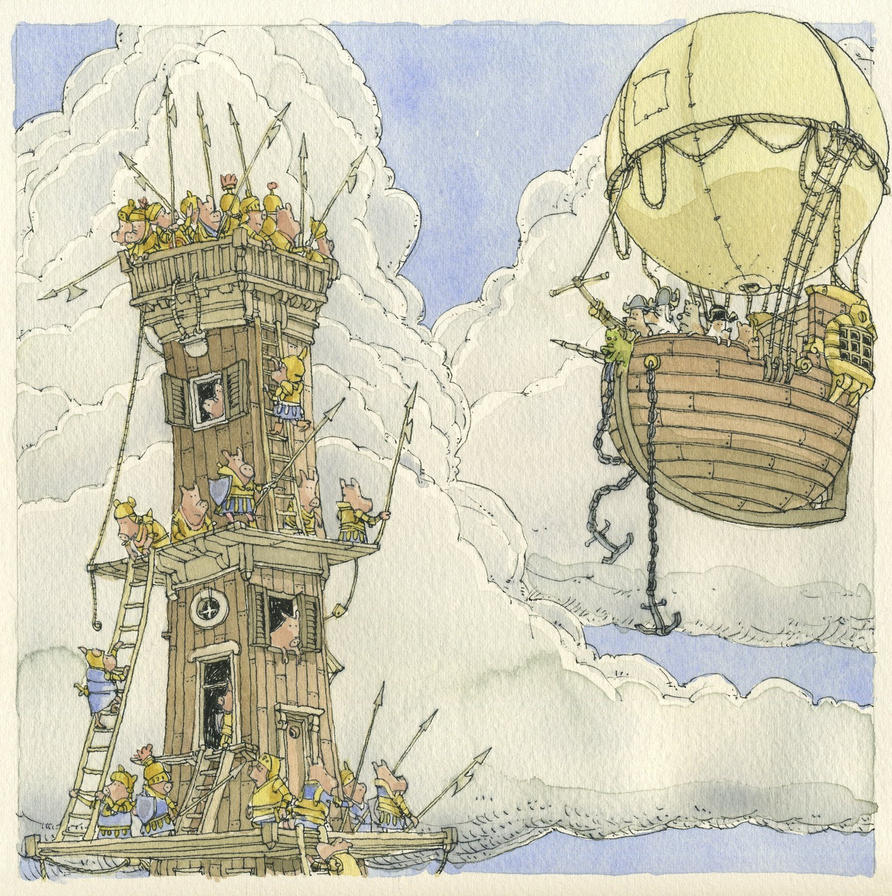
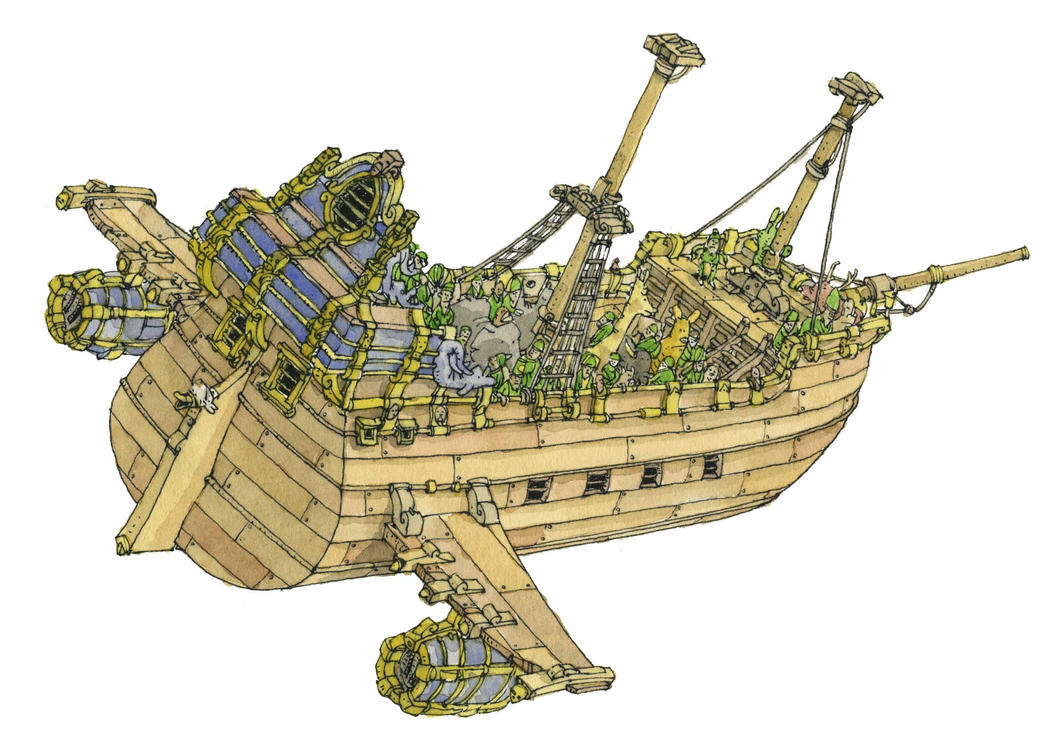
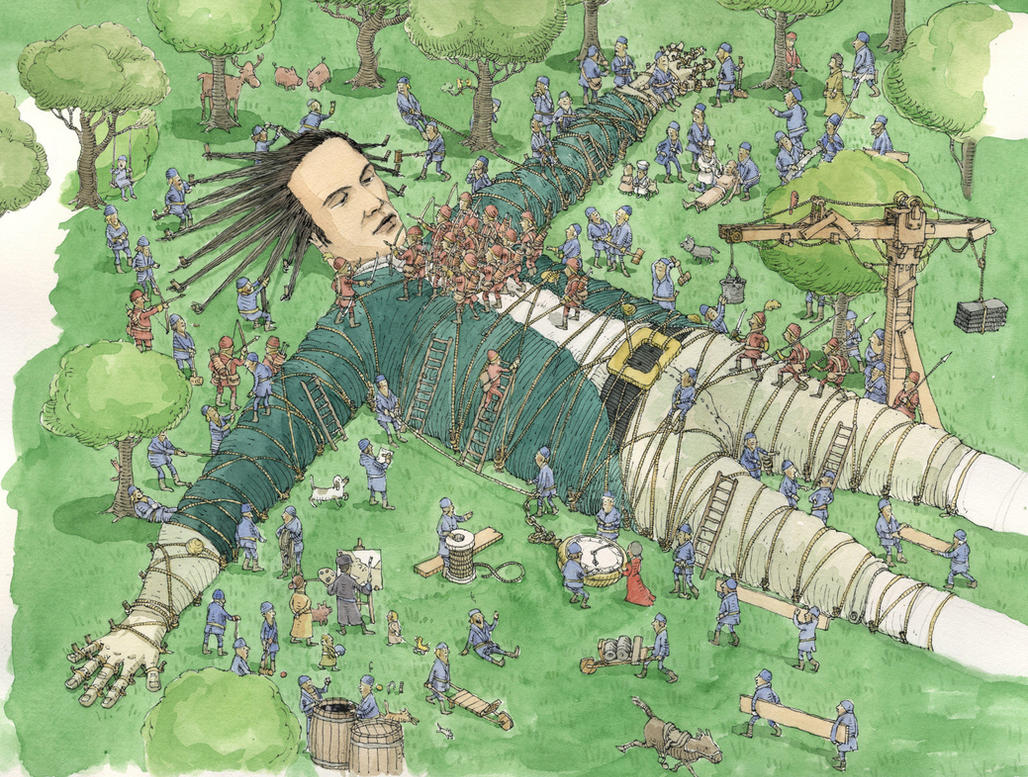
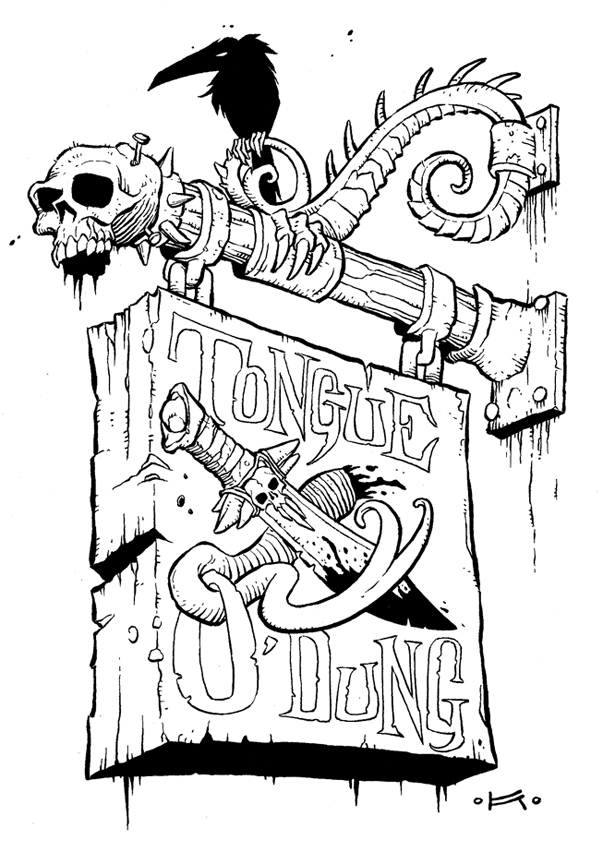
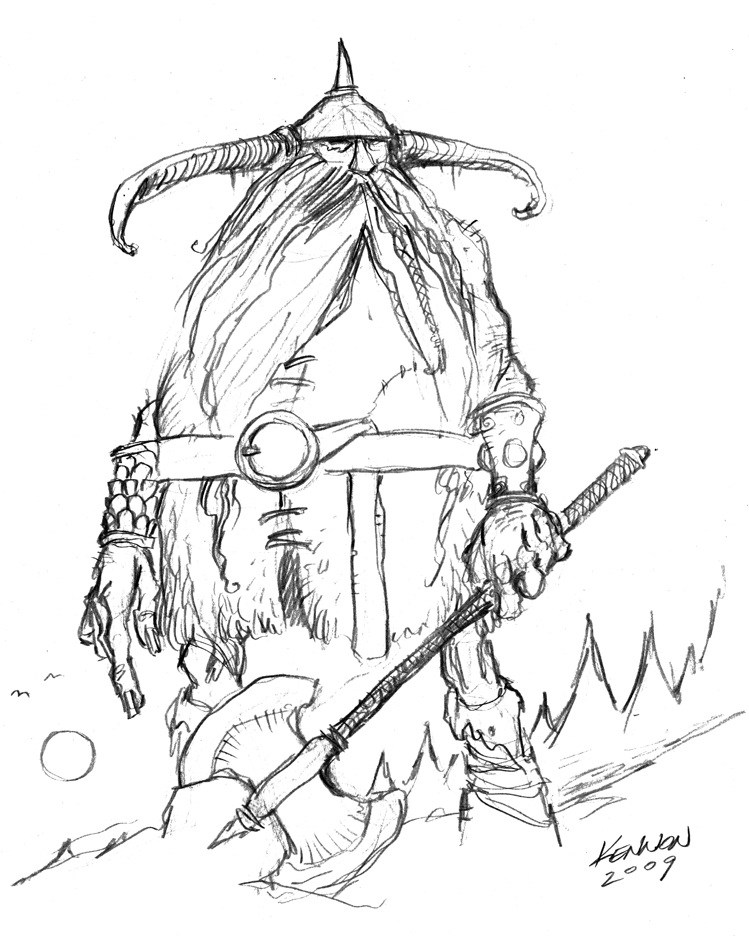
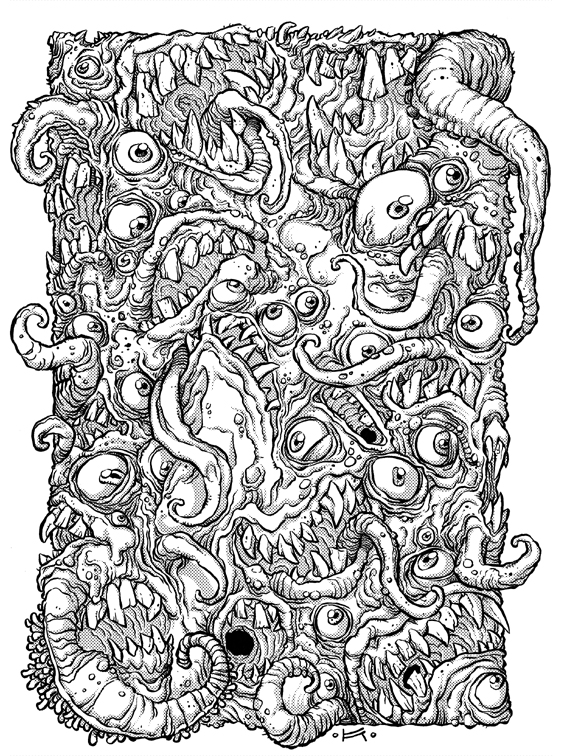
There is a style of quirky, comical art that I really adore. It has a way of putting me in a happy place, full of wonder at the little details and the placement of lines on a page. I would love to see an RPG illustrated in such a style*, but fear I would be in a minority in that respect. Anyways – Mattias Adolfsson and Kennon Jamesare good examples of this kind of artist – very creative and very skilled at hatching their vision on a piece of paper. Here are a few examples of their work …

Matthias Adolfsson

Kennon James

* Wouldn’t it be cool to merge an old school RPG like Swords & Wizardry with the art book concept. Different copies of S&W illustrated entirely by a single artist. So, you would have the Frazetta S&W and the Russ Nicholson S&W and the Arthur Rackham S&W, etc. In the words of Bare Naked Ladies, if I had a million dollars …