Pars Fortuna Preview #3 – More Races

Four more of the strange races in the PARS FORTUNA setting …

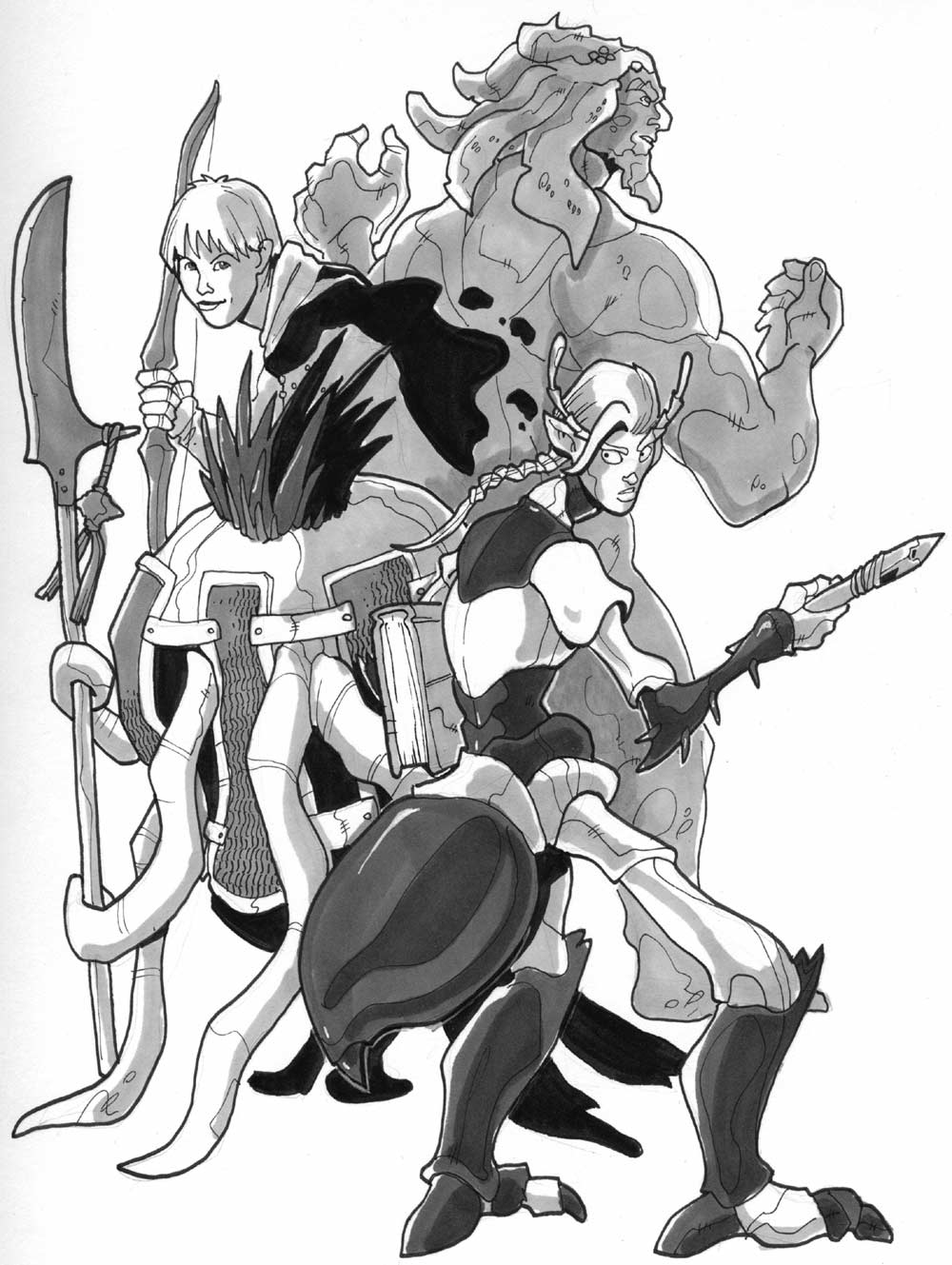
In the back of the pack we have a JAE. The Jae are clumps of walking vegetation that can assume a humanoid form by wrapping themselves around a skeleton of wood or metal. They use their morphic form and a little magic to make themselves appear to be members of other races – or even a person’s close friends or family. In their real form, the so-called kelpies can detach from their skeletons and move about almost like oozes – fitting into tight spaces and such. They are natural charlatans.

Jae are another spell casting race, with the added abilities of impersonating people and crawling around like an ooze when it suits them. They can communicate with plants.

Next to the Jae is a KYSSAI, also known as a ghost. The Kyssai are happy anarchists who view bodies of solid matter as prisons. Kyssai are capable of becoming ethereal for short periods, and are generally sneaky sorts. In the game setting, they are wanderers who pick up all sorts of useful information that a Referee might wish to introduce into game. They are the only race besides the Oraenca (see next preview) who can tolerate the Ilel – mostly for the spectacle.

Kyssai are another skill class, this time working as spies and scouts. They are good at sneaking about and surprising others and their power to become ethereal helps them infiltrate areas and escape with their lives. They are, alas, a bit emotionally stunted and have difficulty forming close relationships.

The bizarre creature that looks like a tentacled potato is an OLVUGAI. The Olvugai are nicknamed the visitors by the other races. They are, in fact, alien visitors to the setting, stranded on the strange world (dimension?) of PARS FORTUNA and dedicated to unraveling its mysteries.

Olvugai are a race of scholarly warriors. They are capable of attacking opponent in front and behind at the same time, and they are capable of becoming invisible for short periods of time. Olvugai have a knack for logical thinking and are skilled as sages.

In the foreground, we have a NIF, or wasp-woman. The Nif are the female counterparts to a mindless race of drones called the Nef. They dwell in hive-cities in the Cinnabar Flats, a desert of poisonous mineral springs. Each Nif belongs to a brood of sisters. The broods serve their queen mother and dote on their over-protective (and sentient) fathers until they get the call to strike out on their own. Nif have honey-colored carapaces marked with black patterns that they share with their brood-sisters.

The Nif are our third magic-using class. Their carapaces make them slightly more durable than the Caledjula and their talents run to elemental spells rather than illusions. Nif are resistant to poisons and acids, have thick carapaces and a knack for chemistry.

Our last preview of the races of PARS FORTUNA will appear next week, and include fire-loving lions, mercantile monkeys, wise antelope-centaurs and creatures with bones of steel.

On the Classic Elements and Their Masters

So, I was pondering doing an elementalist class a couple weeks ago, and today jotted down some ideas. Here’s the class “in progress” – I’d love to know what people think …

Elementalist
Command elemental spirits to perform tasks – the effect is the equivalent of casting spells. An elementalist can attempt to command these spirits a number of time each day equal to his Charisma score divided by 3, rounding down. [maybe at 6th level, this increases to Charisma divided by 2, rounding down?]

Elementalists must own and carry a grimoire of the true names of known spirits – they add to this as they adventure, but not in the manner that magic-users add spells to their spell books

An elementalist is a ritual caster; each day he chooses to focus himself on a particular element and in turn must wear an appropriately colored robe (red, blue, yellow or white) and carry a ritual tool – athame, goblet, censer or wand. Without the robe and the tool, he cannot command elemental spirits.

Elementalists cannot command spirits opposed to their chosen element for the day, but they can command all spirits that are not opposed to them. When commanding elementals spirits that match their daily focus, they receive a +1 bonus to their command checks (see below).

Command checks are the equivalent of a cleric’s ability to turn undead, and use the same table substituting the spell level for the undead’s Hit Dice. Elementalists can also turn elementals opposed to him and command elementals favorable to him. Elements refers to elementals, genies (efreet, djinn, janni), sylphs, salamanders and other creatures composed entirely or mostly of elemental stuff.

The elementalist has four spell lists, each tied to a different element (with a few spells appearing on all four lists). Spells marked with an asterisk (*) are new and described below.

[Maybe his communications with spirits helps him avoid surprise (i.e. surprised on 1 in 1d8 instead of 1 in 1d6), avoid pit traps, find secret doors – essentially, he’s in communication with the landscape/dungeon and maybe gets some forewarning]

Level One
1 Burning Hands (F)
2 Feather Fall (A)
3 Magic Stone (E)
4 Produce Flame (F)
5 Purify Food & Drink (W)
6 Ray of Frost (W)

Level Two
1 Fog Cloud (W)
2 Heat Metal (F)
3 Levitate (A)
4 Pyrotechnics (F)
5 Stinking Cloud (A)
6 Strength (E)

Level Three
1 Fireball (F)
2 Fly (A)
3 Lightning Bolt (A)
4 Protection from Normal Missiles (A)
5 Stone Shape (E)
6 Water Breathing (W)

Level Four
1 Create Water (W)
2 Ice Storm (W)
3 Solid Fog (A)
4 Spike Stones (E)
5 Wall of Fire (F)
6 Wall of Ice (W)

Level Five
1 Cloudkill (A)
2 Cone of Cold (W)
3 Conjure Elemental (U)
4 Passwall (E)
5 Transmute Rock to Mud (E)
6 Wall of Stone (E)

Level Six
1 Find the Path (E)
2 Invisible Stalker (A)
3 Lower Water (W)
4 Move Earth (E)
5 Part Water (W)
6 Stone to Flesh (E)

Level Seven
1 Aerial Servant (A)
2 Control Weather (A)
3 Delayed Blast Fireball (F)
4 Earthquake (E)
5 Reverse Gravity (E)
6 Wind Walk (A)

Level Eight
1 Horrid Wilting (W)
2 Incendiary Cloud (F)
3 Repel Metal or Stone (E)
4 Whirlwind (A)

Level Nine
1 Imprisonment (E)
2 Meteo Swarm (F)

Prime Req: Charisma
Fights As: Magic-User
Hit Dice: Magic-User
Saving Throws: Magic-User
Armor & Weapons: Leather, magic-user weapons

Level Titles
1. Grammarian
2. Reciter
3. Incantator
4. Lector
5. Elementalist
6. Dracunculus
7. Draco
8. Pentalpha
9. Solomon

Thoughts –

1. I might need to invent a few spells to fill in the gaps. I wanted about three spells per level per element up to level 5, and then one or two from 6-9.

2. The big question is the use of the Turn Undead table for casting spells. As written, a 1st level elementalist would be able to make, on average, three or four attempts at casting a spell each day. They could attempt to cast 5th level spells (5% chance of success), 4th level spells (10% cos), 3rd level spells (25% cos), 2nd level spells (40% cos) and 1st level spells (55% cos). Limited number of tries, limited chance of success – but is it too limited? Not limited enough?

A 1st level elementalist that sticks to 1st level spells can, on average, cast about 2 spells per day, so double that of most magic-users. If that elementalist tries to get off a fireball, he only has a 25% chance to do it, and even if he does it, it will only do 1d6 damage. This is probably okay.

At higher levels, the elementalist is still limited to just a few attempts per day, meaning he falls behind the magic-user as a spell caster – fewer spells and less variety. In exchange, I’m giving him leather armor and the ability to turn (and command) elemental creatures – not bad, but maybe not good enough. He might still be worth it if he advances in level faster than the magic-user, but advancing quickly in a crappy character class is little compensation.

So, still some work to be done here. If you have any suggestions, let me know.

On Venatia – Saint Arachne

Six more sites for the Southeast map – two more installments to go before I begin on the Northeast map.

4348 Fish Men: A community of 112 locathah dwell in a submerged castle. They ride giant eels into battle and carry barbed spears or heavy crossbows or tridents and nets. The locathah are known for their paralyzing poisons, which they harvest from the sea urchins that cover their castle. They are led by Lord Kigl’lot and his bodyguard of twelve elite warriors. The castle is further protected by 11 cave eels and a giant jellyfish. The cave eels live in the catacombs that run underneath the castle and hold Kigl’lot’s vault of treasure. The vault contains 6,100 gp and 110 pp.

• Kigl’lot, Locathah Fighting-Fish Lvl 4: HP 24; AC 4 [15]; Save 13; Shagreen armor, poisoned trident, shield.

• Elites, Fighting-Fish Lvl 3: HD 3d6+6; AC 5 [14]; Save 14; Shagreen armor, poisoned trident, shield.

• Locathah: HD 2; AC 6 [13]; Atk 1 weapon (1d8); Move 12; Save 16; CL/XP 2/30; Special: None.

4431 Abbey of St. Arachne: This abbey is dedicated to Arachne, a mortal weaver possessing such magnificent skill at her art that she challenged the goddess Minerva and was eventually punished for her hubris. Nevertheless, she has become a patron saint of weavers and dyers and a minor figure in the cult of Minerva. The hillsides surrounding the abbey are grazed on by sheep with especially fine, strong wool. The nuns of the abbey use this wool to produce spectacular tapestries which are valued throughout the Motherlands and a variety of magical vestments.

The abbey itself is situated on a rocky hill overlooking a valley of rolling hills. The abbey is a shell keep, two stories tall, containing workshops, storage areas (mostly bundles of wool (5 tons, worth 20 gp per ton) and dyes of many colors (100 lb each of yellow, red, blue and green, worth about 5 sp per pound), combs, spindles, etc) living quarters for the nuns and their officers, an armory, and vaults carved into the granite hill where the true treasure of the monastery, dozens of enchanted spiders who do the real weaving of the abbey, are kept.

At the foot of the abbey hill there is a village of 30 thatched longhouses surrounded by a stone wall with a moat and three towers. The village is built against the abbey hill, with the town hall constructed right against the wall and offering access through a secret door to the tunnels and vaults carved into the hill. One can also access the abbey from the village by a system of stairs, some wooden and some carved into the living rock. The villager is defended by five men-at-arms in embroidered +1 tunics carrying shields, spears and light crossbows.

Abbey and village are ruled by Xanah, a small, radiant woman who wears sepia robes covered in magnificent embroidery depicting scenes from the life of St. Arachne (worth 200 gp). Xanah has guileless green eyes and fine, white hair in an elegant chignon. Her order is sworn to a vow of silence, and she will not break this vow. She is assisted by ten nuns. Hidden in the vaults beneath the abbey is her former lover, Brear, who has been turned into a drider and now stalks the dark corridor struck with madness. While Xarah has forsworn her love for him, she still does her best to hide and protect him, despite his occasional attacks on the villagers.

The abbey’s treasure consists of 10,000 cp and 4,100 gp and is kept behind a locked door in the subterranean vaults.

• Xanah, Cleric Level 9: HP 30; AC 1 [18]; Save 6 (5 with cloak); Special: Spells (4th); Platemail, shield, mace, cloak of resistance (+1 to saving throws), holy symbol.

• Brear, Drider: HD 7 (30 hp); AC 3 [16]; Atk 1 weapon (1d8); Move 18; Save 9; CL/XP 9/1100; Special: Spells, magical abilities.

4433 Ancient Donjon: An ancient, crumbling donjon stands atop a hill, overgrown with pine trees that are gradually tearing the place down. An obscured trap door allows access into the dungeon, which currently houses two hungry ghosts.

• Hungry Ghost: HD 1+1; AC 9 [10]; Atk 1 claw (1d4); Move 12; Save 17; CL/XP 3/60; Special: Phantasmal force, invisibility, suffer double damage from cold and fire.

4436 Ancient Computer: An ancient analog computer has been tucked into a small niche in the rocks and hidden by a few pine boughs, now dry as kindling. The computer looks like a large, wooden chest filled with gears and covered with dials on the outside and a crystal sphere on which is etched a map of the world. By turning the dials to match astronomical observations, the sphere turns to show one their location on NOD. Alas, the map is a bit inaccurate, ignoring the existence of the antipodes and misjudging by 1,000 miles the western extent of Antilia. Operating the device requires a check against intelligence, with magic-users modifying their roll by 1 and scientists by 2.

4450 Whirlpool: This hex is almost filled by an enormous whirlpool that will almost certainly drag ships down to be dashed against the rocks. The whirlpool is caused by a glowing sword piercing the sea floor. The short sword, constructed in the ancient Greek style, was placed there by Neptunus for any hero brave and cunning enough to claim it. The sword is a +2 weapon that allows its wielder to breath underwater and swim as swiftly as a dolphin (Move 24). In addition, sea creatures must pass a saving throw to threaten or attack the wielder (unless he attacks first).

4531 Ancient Road: An elevated stone road goes from this hex to [6026], following the curve of the evergreen belt. In hexes [5434] and [5534] is follows along the banks of the lake. The road is of Nomo construction, and was meant to move troops swiftly into the Golden Coast region for an invasion that never took place. Every six miles (i.e. in each hex) there is a statue of Mercurius consisting of a 5-ft tall pillar of porphyry topped by a sculpture of the deity’s head. Where the road is near settlements, it is lined with cenotaphs, tombs and crypts.

Medieval Bestiary – Part Six

European folklore holds a candle to none in the breadth and depth of its imagination. Europeans populated not only their own countries with all manner of strange beasts and monsters, but extended their imaginations over the entire globe. While a good many of these creatures have been given game statistics, several have not. Some of these creatures are, to be sure, simple variations on existing monsters – ogres, giants, fairies, spirits, etc. Others are just not threatening or interesting enough to demand statistics. Those monsters of the folklore of France, Germany and the Low Countries, and those of medieval bestiaries and heraldry, that I thought both unique and challenging are presented below.

Part One, Part Two, Part Three, Part Four, Part Five

This post is declared Open Game Content.

Pegasus, Ethiopian
Medieval bestiaries told of a breed of pegasus from Ethiopia that had two horns. These creatures can be treated as normal pegasi with the addition of a gore attack that deals 1d6 points of damage.

Revenant
The revenant is an animated corpse that has returned from the grave to terrorize the living. The name comes from the French and means “returning”. Revenants are always wicked in life. Creatures struck by a revenant in combat must make a saving throw or be infected with a disease that resembles mummy rot. Revenants regenerate damage in the manner of a troll at the rate of 1 hit point per round. A revenant can only be destroyed completely by cutting off the head, removing the heart, and burning them and the body separately.

Revenant: HD 4; AC 3 [16]; Atk 1 slam (1d6); Move 9; Save 13; CL/XP 6/400; Special: Regeneration, disease.

Snakes
The writers of medieval bestiaries imagined many interesting serpents, many that were probably based on fourth-hand accounts of real animals. The hydros was a viper whose poison caused a person to swell up. In game terms, his poison causes the person to have their movement and dexterity scores cut in half. The hydros’ poison could only be cured with the application of ox dung. There’s a fun quest! The hydrus, on the other hand, was a water serpent of the Nile River. It would swim into the mouth of a crocodile and then down its throat. Once in the stomached, it would eat the poor beast from the inside out. In game terms, it is probably immune, or at least resistant, to acid. The hypnalis was an asp that killed its victims in their sleep. In game terms, perhaps it can cast a sleep spell one or several time per day. The scytale was a snake with such brilliant markings that those gazing on the creature are hypnotized and lulled into inaction. The scytale’s body is so hot that those touching it or touched by it suffer 1d4 points of burning damage. The seps, on the other hand, has venom so acidic that it liquefied its prey; assume normal viper poison plus an additional 2d6 points of acid damage.

Waldgeist (Woodwose)
The German “woodland spirit” is the custodian of the forest. It dwells in woodlands and protects it as well as lawful creatures within the woodland. Waldgeists resemble gnarled old dwarfs with skin like the bark of a tree and hair like a tangle of leaves and twigs. They dwell in the branches of trees and, though mischievous, are not by any means evil. Waldgeists can use the spells bless and bestow curse. They blend in with the foliage, and thus surprise foes on a roll of 1-4 on 1d6. Despite their small size, they are exceptionally strong and dangerous to provoke.

Waldgeist: HD 5; AC 2 [17]; Atk 1 slam (2d4); Move 15; Save 12; CL/XP 6/400; Special: Bless, curse, surprise.

White Ladies (Wise Ladies)
The white ladies of the woods are elven amazons of the ancient and powerful blood. They are tall and beautiful, with white skin and hair like gleaming platinum. They dress in white cloaks and gleaming armor and wield spears tipped with silver and bows with silver-tipped arrows. White women are capable of casting spells as 3rd level clerics, druids or magic-users. They are capable of using the spell Light at will and always radiate an aura of Protection from Evil in a 10 ft radius. They usually appear in bands of 5 to 10 individuals and might be encountered in the company of unicorns. White women have the same immunities as normal elves. They are skilled in herb craft and healing, and under their care a person’s natural healing rate is doubled and he enjoys a +2 bonus to save vs. poison or disease.

White Woman: HD 3; AC 4 [15]; Atk 1 spear (1d8) or 2 arrows (1d6); Move 15; Save 14; CL/XP 4/120; Special: Spells, immunities.

White Worm
The white worm, or Indus worm, was a giant, pale worm that dwelled in the Indus River. It was carnivorous and capable of swallowing a man whole when it scores a natural ‘20’ on a bite attack.

White Worm: HD 7; AC 6 [13]; Atk 1 bite (2d6); Move 9 (Swim 12); Save 9; CL/XP 8/800; Special: Swallow whole.

Wild Man
Wild men are hairy humanoids that dwell in deep woodlands. They are called wilder mann by the Germans and homme sauvage by the French and wodewose by the English. They are associated with gods and goddesses of the wild such as Silvanus and Fauna and with the death god Orcus. In fact, they are known as orkes or lorkes in some parts of Italy.

Wild men run in bands of 20 to 30 individuals. Their entire bodies are covered in a tangled coat of brown hair and the men wear long, unkempt beards. They behave as though mad and fight as savagely as berserkers, gaining a +2 bonus to hit and damage. Despite their savage appearance, wild men are strict vegetarians, eating nuts, berries, roots and leaves.

Wild Man: HD 1+1; AC 7 [12]; Atk 1 weapon or fists (1d4); Move 12; Save 17; CL/XP 1/15; Special: Berserk.

Wraiths
The erlking, or “alder king”, was a pale, gaunt humanoid who rode a black horse and preyed on women. In game terms, it can be treated as a wraith. In truth, the name “erlking” was a mistranslation from the Danish for “elf-king”.

Yale (Centicore, Eale)
The yale is a black, horse-sized goat with the feet of an elephant and the tusks of a boar. It has large horns that it can swivel in any direction, thus allowing it two attack two different targets each round. Yales are immune to paralyzation and poison, thus making them a natural enemy of the catoblepas and basilisk.

Yale: HD 5; AC 6 [13]; Atk 2 gores (1d6); Move 15; Save 12; CL/XP 5/240; Special: Immunities.

On Venatia – Kelp Fortress and Ooze City

Six more sights to entice and delight (at least, that’s the plan).

4240 Sea Serpent: A briny sea serpent hunts along the coast in this hex. Wrecked ships along the bottom contain 10,000 cp, 5,000 ep, 1,000 gp, 100 pp, a silver stud worth 1,050 gp and a porcelain bowl from the Imperial potter of the court of the Jade Empress of Mu-Pan worth 1,250 gp.

• Briny Sea Serpent: HD 8; AC 2 [17]; Atk 1 bite (3d6 + poison); Move 15; Save 8; CL/XP 11/1700; Special: Acid breath, poison.

4246 Kelp Forest: A forest of long, thick strands of kelp covers the floor of this hex and those surrounding it. Living among the seaweed are dryad-like kelpies, playful and beautiful, but ultimately luring people to their doom. Hidden by the strands of kelp is a massive stone head depicting Okeanus, the titanic ruler of the sea. The head radiates powerful magic, but does not seem to actually do anything. If any remotely hostile act is perpetrated on the head, however, it rises from the ground on the body of a stone golem. Inside the stone head is a fist-sized ruby worth 20,000 gp.

• Kelpie: HD 5; AC 2 [17]; Atk 1 grapple; Move 9 (Swim 12); Save 12; CL/XP 6/400; Special: Charm, drown.

• Stone Golem: HD 15 (60hp); AC 5 [14]; Atk 1 fist (3d8); Move 6; Save 3; CL/XP 16/3200; Special: +1 or better magic weapon to hit, immune to most magic.

4250 City of Oozes: A large city that looks like a maze of excavated canyons lies on the bottom of the sea. This city, its name now lost in the mists of time, was once home to a large colony of elder things. It is now home to 10,000 (more or less, they keep merging and splitting) oozes of every imaginable description – gelatinous cubes, black puddings, jellies of every unappetizing color known to man, slithering trackers and protoplasms as yet undiscovered.

The maze-like canyons of the city are lit by softly glowing irradium globes (treat as continual light spells). Hundreds of complexes, small and large, are cut into the walls of the canyons. Some of these complexes contain air pockets, but most do not. The outermost complexes mostly contain simple, though strange, domestic items and tools. Closer to the center of the city there are libraries, laboratories and a few crypts and command posts of the elder things. At the center of the city there is the large citadel now turned into a massive temple of The Faceless Lord tended by a “priesthood” of gibbering mouthers and an elder black pudding, the city’s “king”.

• Elder Black Pudding: HD 20 (103 hp); AC 8 [11]; Atk 3 pseudopods (4d8); Move 6; Save 3; CL/XP 21/4700; Special: Acidic surface, immune to cold, divides when hit by lightning.

4333 Hawktoad Acres: Five hawktoads lair in the treetops in this hex, streaking down from above to attack travelers and snatch any shiny objects (especially holy symbols) and then flee into the woods. If their wattle-and-daub nest can be found (a tricky task indeed), it contains a 135 gp pearl, 3 gp rock crystal, 155 gp rose quartz, a bronze statue of a dancing satyr worth 500 gp and five silver holy symbols worth 30 gp each.

• Hawktoad: HD 2 (9, 7, 7, 6, 4 hp); AC 7 [12]; Atk 2 claws (1d2), tongue (strangles); Move 3 (Fly 12); Save 16; CL/XP 3/60; Special: Strangling tongue (constitution check or fall unconscious).

4336 Magnar: Magnar is a farming village of 500 lanky peasants living in houses thatched from pine branches and needles. The village is surrounded by an earthen rampart set with wooden spikes and has three wooden guard towers. The villagers get their water from a number of quick-flowing streams around the village. The men of Magnar have light, peach skin and hair that ranges from red to blond. The women of Magnar are known for the complex knot patterns they weave into their hair and their large, brown eyes – referred to poetically as “cow eyes”. They have fairly plain faces with button noses. The peasants dress in tunics and hose of white, yellow and green, and they wear green skullcaps made from felt. The 25 men-at-arms of the village wear ring armor and carry long bows and spears. Their two sergeants, Gaela and Svana, wear chainmail hauberks and are similarly armed.

The village is ruled by the Baroness Tatya, a pudgy, friendly woman with a club foot. Tatya is protective of her people and kind to them, but is nevertheless strict about maintaining the feudal hierarchy. Her husband is a lanky wastrel named Fynedo who can pluck a fine tune on the harp but is otherwise useless. She has three children, the eldest being an easy-going young man named Olinus who dresses in blue and has gray-blue eyes and a disarming smile. The middle child is a dumpy little princess named Madie. The youngest, only five, is thin, meek girl called Tariel.

Magnar is a calm, pleasant village on the surface, but most visitors feel a certain unease with the villagers and the ruling family. They seem a bit too calm and detached from the world, as though they are only going through the motions. In late autumn, the villagers hang blue lanterns in the trees and light blue candles in their windows to welcome the spirits of their ancestors, who visit the village on that night in the form of forest animals. These animals are invited into homes and treated as honored guests.

4344 Shark Hunting Ground: Five great white sharks hunt in this hex. They shadow ships moving through in hopes of someone walking the plank.

• Large Shark (8HD): HD 8 (38, 37, 34, 32, 30 hp); AC 6 [13]; Atk 1 bite (1d8+4); Move 0 (swim 24); Save 8; CL/XP 8/800; Special: Feeding frenzy.

Pars Fortuna Preview #2 – Races of Pars Fortuna (with ART!)

A month back I hired Jon Ascher, a gentleman known on DeviantArt as Pachycrocuta, to draw the odd, randomly generated races that populate the world of PARS FORTUNA, and boy did he knock it out of the park. I had him draw the races in groups of 4 (there are 12 total) and have now received the inked drawings and want to share them with everyone, along with some brief descriptions of the races, how they will be presented in the game and where they fit into the rules and setting.

The tall “gentleman” is a BO’AL. The bo’al are a race of hermaphrodites with bluish-green to deep green waxy skin reminiscent of the skin of a dolphin. In the setting, they dwell on a wide prairie bisected by a great river and crisscrossed with hundreds of canals, locks and irrigated fields. Nicknamed the engineers, they are taught from a young age the disciplines of mathematics, physics and architecture. Bo’al respect hard work and personal liberty – they’re happy to come together for a cause, but dislike the concept of kings. They are usually jovial sorts, and intensely curious about how things work.

In game terms, bo’al are one of the “skill” classes – and by this, I mean you tend to have three sorts of classes in class-based games – the fighting classes (good attack bonus, best hit dice, worst saving throws), the magic classes (spells, low attack bonus, low hit points, good saving throws) and the skill classes, which muddle about in the middle. The bo’al get a bonus to detect sloping passages, sliding walls, secret doors and large, room-sized traps (most folk do it on a 1 in 6, they do it on a 2 in 6), as befits their skill in engineering. They also have some skill at disabling traps, setting traps and repairing damaged items. Adding to their usefulness, they can withstand a pretty good amount of damage – they get an extra hit dice at 1st level and can regenerate some damage after each battle. So, the bo’al is a skill class with a nod towards combat.

At the center of the group is an ILEL, nicknamed the imperials. The ilel are a race of clones – copies of a former marshal of the Empire of Vex grown in vats to form a personal guard for the emperor. They have skin the color of burnished gold, hair as black as night, solid black eyes and a well developed sense of megalomania – probably why they now run the empire they were hired to protect. Ilel are accomplished swordsmen, specializing in fighting with broadsword and a wavy-bladed dagger called a kris. They are haughty and arrogant, often treating their comrades as henchmen, and if not for their ability to cut a path of red ruin through their enemies, they wouldn’t be tolerated.

The ilel is a fighting class. They are mobile fighters, so less armor but a boost in initiative. They also have some bonuses when fighting with two weapons (higher bonus to hit and the ability to trade their bonus to hit for a bonus to AC round by round). Because of their commanding attitude (and admitted skill at command) they improve the fighting-ability of their henchmen (no, not the other player characters, even if the ilel treats them like henchmen) and can have one henchman more than their charisma score would normally allow.

Next to the ilel is a CALEDJULA. The caledjula’s claim to fame is their ability to fly without the need of wings. Caledjula have tawny to reddish fur, pupil less white eyes, huge ears and six fingers on each hand. Caledjula are natural tricksters, having an inborn ability to generate illusions. In the game setting, they dwell in the tall mountains that surround Fortuna’s Spire (the literal “tent-pole” dungeon of the setting) in cliff dwellings. They are nicknamed the aeolians.

Caledjula are one of the magic race/classes in the setting, filling the role of a trickster class. All of the spell casters in PARS FORTUNA use the same spell list (126 spells, level 1 to 9), but each magical race gets a small list of spells open only to them – illusions in the case of the caledjula. The caledjula can also work on people’s emotions with their deep, melodic voices (i.e. a bonus to reaction checks) and they have a bat-like radar sense that lets them operate in complete darkness.

Finally, the little scaly bugger is a CAKROL. The cakrol resemble humanoid pangolins. Nicknamed zealots, cakrol are devoutly religious folk who live in little villages on a lush peninsula covered by rain forest. They make their way harvesting tropical crops, carving wooden idols, trading in beautifully crafted sailing barques and doing their best to protect themselves from the evil spirits that infest their homeland. They are a clannish people, and possessed of a fearful anger when they feel their adopted clan / guild / adventuring band is being threatened.

Cakrol are primarily a fighting class – they have the good attack bonuses, the hit points and the ability to use any weapon. They come with their own armor, which can be supplemented. Adding to this, they have some ability to detect and repel evil spirits (not unlike a cleric’s turn undead ability) and the ability to go berserk in combat.

All of the races in PARS FORTUNA will be presented as races separate from classes, and as racial classes (the default for the setting). My hope is that even people not interested in playing a “PARS FORTUNA” are able to find something useful in the book for their own game.

Next Preview – A ghostly adventuress, a walking heap of kelp, something from beyond the stars and a waspy woman …

Medieval Bestiary – Part Five

European folklore holds a candle to none in the breadth and depth of its imagination. Europeans populated not only their own countries with all manner of strange beasts and monsters, but extended their imaginations over the entire globe. While a good many of these creatures have been given game statistics, several have not. Some of these creatures are, to be sure, simple variations on existing monsters – ogres, giants, fairies, spirits, etc. Others are just not threatening or interesting enough to demand statistics. Those monsters of the folklore of France, Germany and the Low Countries, and those of medieval bestiaries and heraldry, that I thought both unique and challenging are presented below.

Part One, Part Two, Part Three, Part Four

This post is declared Open Game Content.

Melusine
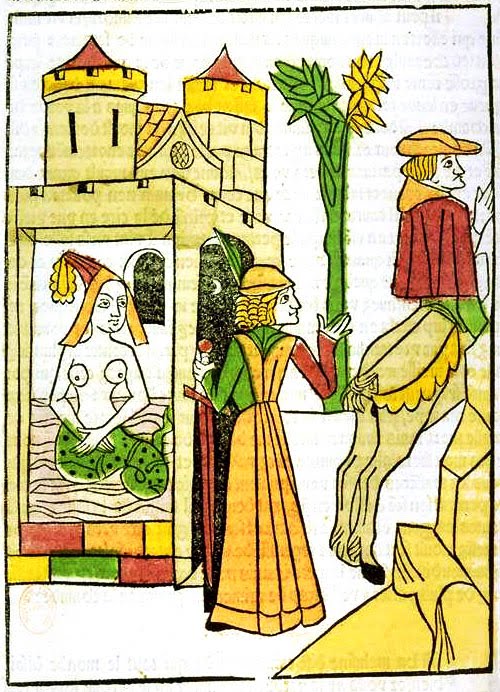
Melusines appear to be exceptionally beautiful young women that, in place of legs, possess two mermaid-like tails. Melusines live in rivers and lakes. They crave the companionship of men, but are easily insulted if not given proper respect. The offspring of unions between humans and melusine are always melusines if female, or future magic-users if male. Melusines are fierce protectors of their children. Melusines can polymorph themselves at will into human females or small bronze dragons. One day per week they must assume their natural form and must submerge themselves in water.

Melusine: HD 2; AC 7 [12]; Atk 1 weapon (1d4); Move 6 (Swim 12); Save 16; CL/XP 4/120; Special: Polymorph.

Monocerus
The monoceros is an animal of the savanna often mistaken for a unicorn. It has the face of a sheep, the body of a stag, the rear feet of a goose, the tail of a dog and a long horn growing from its head. They are expert at spearing fish from rivers with their long horns. Although a monoceros horn has no efficacy against poison, it is worth approximately 20 gp on the open market.

Monoceros: HD 3; AC 5 [14]; Atk 1 gore (1d10); Move 15; Save 14; CL/XP 3/60; Special: None.

Monopod (Sciapod)
The monopodes are dwarves with one leg and a massive foot. They live in sunny highlands and use their foot as an umbrella when they take their afternoon naps. Monopodes are extremely strong (+2 to hit and damage) and they can control animals (as charm monster, but up to 6 animals). Monopods are as skilled at blacksmithing as other dwarves. They wear chainmail hauberks in combat and wield heavy maces and spears. Monopod tribes are led by 3 HD chieftains wearing platemail. The chieftain’s bride is always a druid. The chieftain will be guarded by four 3 HD bodyguards.

Monopod: HD 1; AC 4 [15]; Atk 1 kick (1d8) or 1 weapon (1d6); Move 9; Save 17; CL/XP 1/15; Special: None.

Muscaliet
This odd creature from medieval bestiaries has the body of a hair, the tail of a squirrel and a boar’s tusks. The muscaliet is about the size of a large dog. It’s body gives off a blistering heat that eventually kills the tree in which it builds its nest. Muscaliets are not terribly aggressive, but they do respond violently to threats and attacks. The muscaliet is surrounded by a 10 ft radius of intense heat. Creatures within the heat aura of a muscaliet suffer 1d3 points of damage each round. People in metal armor or wielding metal weapons suffer an additional point of damage each round.

Muscaliet: HD 1; AC 7 [12]; Atk 1 gore (1d4); Move 15; Save 17; CL/XP 2/30; Special: Heat.

Musimon (Tytron)
The musimon is a cross between a goat and sheep, having the feet and body of a goat and the head and wool of a ram. The creature has four horns on its head, two curved like a ram and two straight like a goat. Musimons are incredibly strong and will quickly charge creatures that approach their herd. Their gaze acts as a hold person spell on a single creature or a cause fear spell on up to 10 creatures. In any case, a saving throw is allowed to avoid the effect.

Musimon: HD 4; AC 7 [12]; Atk 1 butt/gore (2d6); Move 12; Save 13; CL/XP 5/240; Special: Gaze attack.

Myrmecoleon
The myrmecoleon has the body of a giant ant and the head of a lion. Because the lion head is only attracted to eating meat and the ant body is designed for digesting grain, the creature is usually in a foul mood. Like giant ants, they inject a poison with their bite attack. The poison does 2d6 points of damage if a saving throw is failed, 1d4 points of damage if the saving throw succeeds.

Myrmecoleon: HD 5; AC 4 [15]; Atk 1 bite (1d8 + poison); Move 18; Save 12; CL/XP 6/400; Special: Poison.

Panthera (Pantere, Love Cervere)
Pantheras are intelligent, supernatural felines with iridescent coats and sweet-smelling breath. Pantheras are roughly the size and shape of a leopard. They spend most of their time sleeping in their caves, but emerge once or twice a week to hunt. Pantheras are lawful creatures that will not attack non-chaotic creatures unless seriously provoked. Panthera females are capable of breeding only once, so the breed is quite rare.

Pantheras have a breath weapon that can be used three times each day. The panthera’s breath is a cloud of perfume that fills a 20 ft radius centered on the panthera. Any creature except dragons that breathes this perfume must make a saving throw or be affected as by a charm monster spell. Dragon, on the other hand, are affected as though by a fear spell. Spells like stinking cloud or a troglodytes maliferous odor are neutralized in a 30 foot radius around a panthera. A panthera’s hide, if reasonably intact, retains this property and thus is quite vauable. If a panthera successfully bites a victim, it gains two additional attacks with its rear claws.

Panthera: HD 7; AC 3 [16]; Atk 2 claw (1d4) and 1 bite (1d6); Move 12; Save 9; CL/XP 8/800; Special: Breath weapon, rear claws.

Parandrus
The parandrus resembled a shaggy ox with cloven hooves and a large rack of antlers. Although unintelligent, the parandrus is capable of changing its color and shape. A parandrus will change its color as a means of camouflage, surprising on a roll of 1-4 on 1d6. In general, a parandrus that surprises will choose to flee, rather than attack. If forced to fight, the creature is capable of changing itself into any natural and supernatural beast. The parandrus can change shape each round and still attack.

Parandrus: HD 4; AC 3 [16]; Atk 1 gore (1d6); Move 12; Save 13; CL/XP 6/400; Special: Change shape.

Peluda
A peluda is a river beast that resembled a giant, green porcupine. Its body is covered by stinger-tipped tentacles that can be made erect like quills. It also has the neck, head and tail of a serpent and the legs and feet of a tortoise. The peluda is capable of attacking with its poisonous stingers. Any creature in melee combat with the beast is subject to 1d3 stinger attacks each round. Each stinger inflicts 1d4 points of damage, or half that if the victim succeeds on a saving throw. The creature can also fire off one stinger each round as a missile attack with a range of 60 feet. A peluda has one of three possible breath weapons. The first is poisonous gas, like that of a green dragon. The second is a fiery breath, like that of a red dragon. The third is a gout of acid, like a black dragon. Each peluda will have one of these breath weapons, which it can use three times per day, inflicting 6d6 points of damage.

Peluda: HD 8; AC 2 [17]; Atk 1 bite (2d6), tentacles (see above); Move 9 (Swim 15); Save 8; CL/XP 11/1700; Special: Breath weapon, poison tentacles, only harmed by magic weapons, magic resistance 15%.

Deviant Friday Five – Adriano Batista Edition

This week’s artist: Adriano Batista, aka Adrianohq

And yes, so far Deviant Friday Five is beginning to look like pin-up girl Friday. In my defense, comic book and fantasy art has always been about 80% pin-up art.

Red Sonja
and don’t let the scale mail bikini distract you from that awesome shield art

Jungle Girl

Jungle Girl again
I found the masks very inspiring when I was writing my faux-African part of NOD (to be published eventually)

Wyrms Book Three
The old tavern scene

Lyrael the Hunter
Cat girls have invaded Western fantasy, and they’re not leaving anytime soon

On Venatia – Ruined Villas and Mysterious Junks

Six more encounters for the Southeast quadrant of Venatia …

3939 Mysterious Junk: A merchant sailing vessel of Mu-Pan design is anchored off the coast and seems perpetually blanketed in fog. The junk is home to Kevote, the commander of a brotherhood of thieves and assassins that operates throughout the Tepid Sea region. The brotherhood engages in smuggling, murder, blackmail and loansharking. Besides the inscrutable Kevote, the ship is home to a dozen low-level thieves and assassins and two lieutenants, Morfinda and Dourne. Morfinda was born in Blackpoort. She has long, black hair, a pale complexion and very dark, brown eyes. Morfinda is cunning and without mercy, and expects to replace Kevote in the very near future when a few of her own plans come to fruition. Dourne, on the other hand, is a native of Tremayne with reddish-blond hair, pale blue eyes and a quick and ready wit. He is also a cowardly killer, very skilled with poisons and “accidents”, but unsteady in a direct confrontation. Both are tied to Kevote via secrets, and both are unaware that Folas, Kevote’s apparent valet, is his true lieutenant. Kevote regards Morfinda and Dourne as nothing more than useful idiots for establishing his empire in the Motherlands. All of Kevote’s operative have a small, black dragon tattooed on their backs at the base of their neck. Kevote’s treasure, kept below decks in steel boxes (puzzle locks, -5 to open, spring-loaded needles with deadly poison), consists of 11,000 sp, 500 ep, 4,500 gp, two rose quartz (worth 500 gp each) and seven fox skins (35 gp each, actually taken from seven kitsune sisters who believed that Kevote was a man they could cheat).

• Kevote, Level 11 Assassin: HP 36; AC 6 [13]; Save 5 (4 vs. death); Special: Sneak attack for x4 damage; Three daggers (one is wavy bladed and coated with deadly poison), five darts, burglars’ tools, leather armor worn under a many-colored silk robe embroidered with a black dragon.

• Morfinda, Level 5 Thief: HP 26; AC 7 [12]; Save 10; Special: Back stab for x3 damage; Two daggers, four darts, burglars’ tools, leather armor, a black cloak with many pockets.

• Dourne, Level 4 Assassin: HP 12; AC 7 [12]; Save 12 (11 vs. death); Special: Sneak attack for x2 damage; Three daggers, five darts (two coated in paralysis poison, three in poison that deals 1d6 damage), leather armor, burglars’ tools, vial of poison.

• Folas, Level 7 Magic-User/Thief: HP 21; AC 9 [10]; Save 8; Special: Spells (4th), back stab for x3 damage; Dagger, three darts.

• Thieves (8): HD 2d6; AC 7 [12]; Atk 1 weapon (1d6); Move 12; Save 13; CL/XP 3/60; Special: Back stab for x2 damage. Carry short swords, daggers, three darts, shield and wear leather armor.

• Assassins (4): HD 2d6; AC 7 [12]; Atk 1 weapon (1d8); Move 12; Save 14 (13 vs. death); CL/XP 3/60; Special: Sneak attack for x2 damage. Carry short long swords, daggers, light crossbows, shield and wear leather armor.

4044 Dragon Ship: The sorcerer Henakhe, bitter exile of Ibis, plies the Golden Sea in an animated dragonship called, Revenge, which looks like a merchant galley with a large figurehead in the shape of a dragon’s head and neck. The ship is crewed by two dozen dragon men and their leader, a warlock called Felia. The Revenge has no home, as yet. It sometimes docks in Cutthroat Cove (see NOD #1, “Wyvern Coast”, hex [3119])), but more often finds small coves along the Golden Coast. Ibisian ships sacked by Henakhe have their crews slaughtered, their heads sent back to the king of Ibis through mysterious means. Henakhe’s treasure consists of 5,200 gp and an aventurine worth 2,000 gp.

• Henakhe, Level 7 Magic-User: HP 22; AC 9 [10]; Save 9; Special: Spells (4th); Grey robes over a black velvet doublet, crimson leggings and long, black velvet slippers that come to a point, grimoire, curved dagger, ebony staff topped with an obsidian jackal’s head (worth 60 gp).

• Felia, Level 4 Fighter/Magic-User: HP 13; AC 9 [10]; Save 12; Special: Spells (2nd), bite attack inflicts 1d4 damage plus 1d4 fire damage; Battle axe, dagger, grimoire.

• Dragon Men: HD 1+1; AC 6 [13]; Atk 1 bite (1d4 + 1d4 fire) or weapon (1d8+1); Move 15; Save 17; CL/XP 3/60; Special: 1 first level magic-user spell, fiery bite. Leather armor, curved long sword, dagger, crossbow.

• Revenge, Dragonship: HD 10; AC 0 [19]; Atk 1 bite (2d8) and 4 slams (1d6); Move 15; Save 5; CL/XP 13/2300; Special: Breath fire (3/day, 30-ft line, 10d6 damage), navigate, double damage from fire, control winds.

4049 Ley Nexus: A nexus of ley lines runs through this hex, culminating a monument constructed on a low sea mount. The monument consists of twelve whale tusks, each 10 ft in length forming a circle. Each tooth has a tiny line of runes carved into it from tip to base, facing the center of the circle. If a druid cuts his forefinger and traces each line of runes, he can activate a teleport spell that will take him up to 90 miles (15 hexes) in any direction, so long as the last tooth touched is in the direction he wishes to go. Others can be taken with the druid, but must be bound to him by some medium (rope, chain, etc).

4127 Pine Ridge: A steep, granite ridge lined with pine trees stands out like a rampart over the surrounding forest. The ridge is the lair of five woodwose, ill-tempered brutes who survey the surrounding woodland for victims on which to release their pent up hostility. The woodwose will attack from the ridge using their spikes when possible. The ridge is roughly 20 feet higher than the woodland floor. It can be climbed with relative ease by rangers, assassins and thieves even during a fight, but under pressure, other characters must make a saving throw midway during their climb to avoid falling for 1d6 damage. The woodwose have collected 10,000 cp, 10,000 ep, 4,500 gp and 20 pp over the centuries, and sometimes leave heaping piles of it in plain sight as bait. Otherwise, it is stored in a dark crevasse atop the ridge.

• Woodwose: HD 9 (44, 42, 42, 39, 33 hp); AC 2 [17]; Atk 2 slams (1d6); Move 12; Save 6; CL/XP 10/1400; Special: Spells, spines, double damage from iron.

4128 Ruined Villa: An ancient villa of the Nabu rests atop a rocky hill. One side of the hill is overgrown with pine trees and brambles, while the other is bare granite that has been carved into a bas-relief of a grape harvest and wine pressing under the gaze of Mut and Min, goddess and god of fertility. The villa is almost completely destroyed, with one two intersecting walls remaining and the rest a pile of masonry overgrown with weeds. One of the surviving walls bears a faded and damaged fresco showing the green-skinned god Osiris holding a goblet and with barrels of grapes at his feet sending ten men bearing jugs of wine away from him toward the setting sun. This is a really a clue directing one to proceed ten paces to the west. At this point, now buried by a couple feet of rubble, there is a secret trap door that leads into a wine cellar. The cellar contains several barrels of what is now vinegar, and a cache of twelve bottles of very fine wine, worth at least 50 gp each. One of these bottles contains a long vial that contains a map showing the location of the tower in [4433].

4138 Sadhnath: Sadhnath is a fishing village built on bluffs overlooking the coast. Beneath the bluff there is a sandy beach and several caves in which the fishermen store their boats. Narrow, precarious steps lead from the village to the beach. The village is protected by a 7 ft tall, 3 ft thick wall of stone with a iron portcullis opening to the stairs and two thick wooden doors to the woodland beyond. A single beacon tower rises near the bluff, giving a commanding view of the sea and woods. Passing very near the village is a stream that pools and then flows underground, eventually spilling into the sea from a submerged cave.

The village consists of a number of stone hovels with gabled, wooden roofs. Over 300 fishermen live in the village with their families. They are outspoken, honest and exceedingly rude, and both men and women make a habit of smoking clay pipes. The largest building in the village, a 3-story tower keep of weathered, pitted stone and warped, wooden shutters is home to Lord Porht, an aging man with heavily creased, olive skin and salt-and-pepper hair. Porht has a well groomed mustachio and beard, and a jutting jawline. He claims the entire coast, from river to river, but hasn’t the ability to back up his claim. His entire “army” consists of fifteen men-at-arms in ring armor with spears and long bows and a brusk, burly sergeant named Jaltyr who wears a long, chainmail hauberk and pot helm and carries a double-headed axe (treat as a pole arm). Lord Pohrt’s treasure consists of 1,200 gp.

The most interesting aspect of the village, however, is its hostel. It is constructed in a large cave about ten feet above the beach. There are two entrances, one through a door facing the sea (itself reachable via warped, wooden stairs), and the other through a long tunnel that crosses the aforementioned subterranean steam before terminating in a circular staircase that leads to a hidden trapdoor on the surface. Either entrance is guarded by a zwunker bouncer (twins named Colleja and Serta). Within the cozy cave there is a taproom serving crabapple cider (the trees grow near the village) and a concoction of fermented goat’s milk flavored with berries and honey, as well as fish stew, boiled eels and large oysters steamed with wild onions and parsnips. The hostel is run by Nidee, a likeable old woman with the mouth of a sailor, and her two sons, the elder March and the younger Linder. The hostel sells space on the floor of the taproom for 1 sp per night, and has two private rooms rented for 3 gp per night. Nidee has about 90 gp to her name.

• Lord Pohrt: HD 4 (16 hp); AC 1 [18] in platemail, otherwise 9 [10]; Atk 1 weapon (1d8); Move 12; Save 13; CL/XP 4/120; Special: Men-at-arms under his command are +1 to initiative. Wears red velvet doublet and striped red and white leggings with black, leather boots with silver buckles. Always carries a long sword and dagger.

• Jaltyr: HD 3 (14 hp); AC 4 [15]; Atk 1 weapon (1d10); Move 12; Save 14; CL/XP 3/60; Special: None. Jaltyr loves Pohrt like a son loves a father, and enjoys a +1 bonus to hit and damage when defending him.

• Colleja & Serta, Zwunkers: HD 2 (8, 7 hp); AC 7 [12]; Atk 1 weapon (1d6); Move 9; Save 16; CL/XP 2/30; Special: Control wind, magic resistance 10% in 10′ radius. Twin sisters, they were wrecked up the coast, losing their comrades and parents, as girls and were given a home by Nidee, who reminds them of their grandmother. They wear leather coats and carry leaden clubs and three darts.

• Nidee: HD 1d6 (4 hp); AC 9 [10]; Atk 1 makeshift weapon (1d4); Move 12; Save 18; CL/XP B/10; Special: None. Usually wears a long peasant’s dress and a dingy apron.

• March & Linder: Same stats as mother, save they have 5 and 4 hit points respectively. They wear peasant’s clothes and carry daggers.
Inspirational Art – Gustaf Tenggren

If you haven’t experienced Gustaf Tenggren before, please make an effort to do so (beyond the few images in this post). As I complete the J10 map of Venatia with its pseudo-Western European vibe, understand that images like those of Tenggren are foremost on my mind. These images come from Illustrateurs, a French blog that makes me feel more sophisticated every time I read it.

Fairies are underused in modern fantasy, in my opinion. There’s no better “big bad guy” than a little bastard who can mind your mind in two

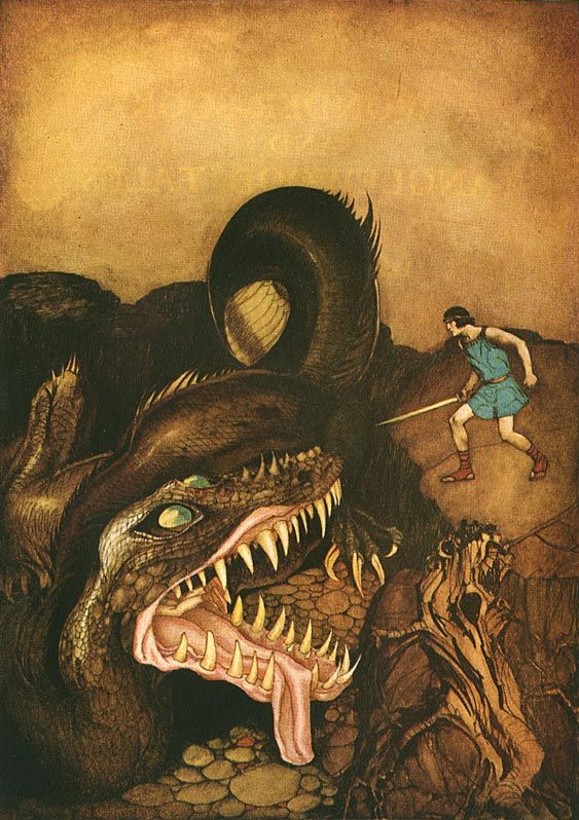
Going after a dragon with an AC of 9 [10] – that’s bravery

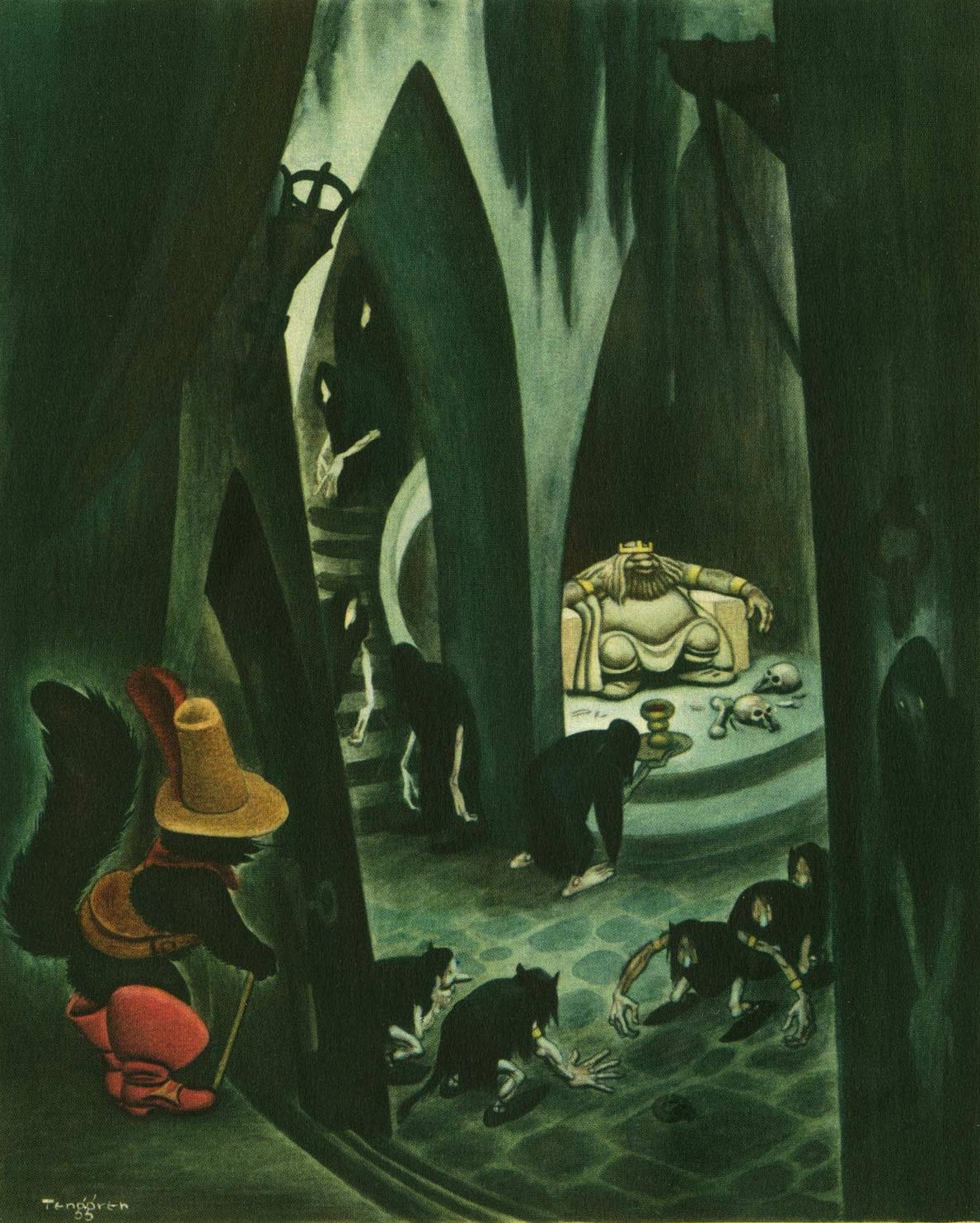
Talking animal (i.e. halfling) in an ogre king’s castle – that could happen in NOD.

Tenggren’s design for the Evil Queen in Snow White.

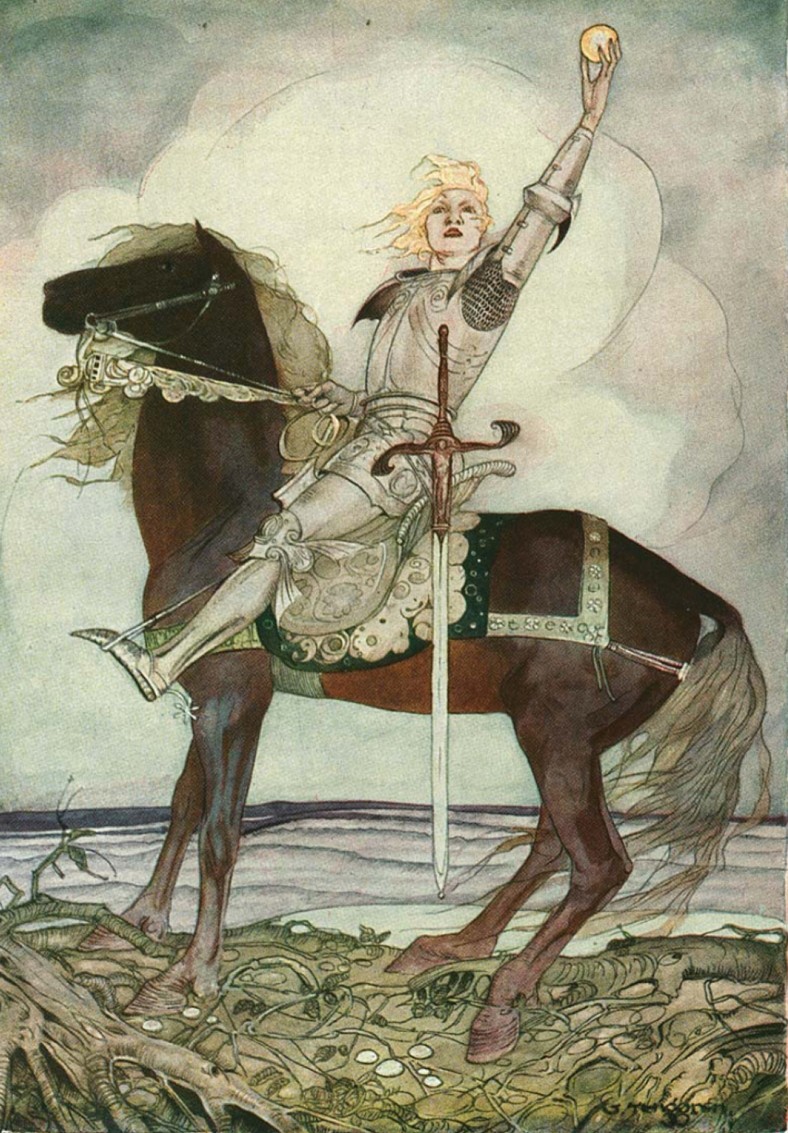
This, my friend, is a paladin.