Action X – Still Ruminating on Classes

In a nutshell – With Action X, I’m trying to do with the Modern SRD what Blood & Treasure did with the fantasy SRD. The challenge – the SRD has a lot of history behind it – many editions of D&D with all the wonderful nonsense that goes along with it. The Modern SRD does not and, even worse, it’s just so damn boring and mechanical. Worse yet – it keeps making my writing boring and mechanical.

So – I bring an appeal to all of the geniuses that read this blog – what are the modern archetypes you’d like to see in a fun role-playing game not set in a fantasy milieu. By “modern”, I pretty much mean from Victorian times to today (or beyond into the near hard sci-fi future or even pulp sci-fi future).

I started with numerous classes, then boiled them way down and now I’m left feeling uninspired by them. Now I’m beginning to turn back to my original idea of a dozen classes that really hit the archetypes of modern action/adventure. I can’t hit every archetype of course, and new classes can always be added, but I’d like to get a strong core of fun classes that will spark people’s imaginations.

Some ideas (some of which are advanced classes in the Modern SRD, but which will need some TLC to make them anything more than collections of dry, boring bonuses to dice rolls) and some ideas for inspiration:

Brute (Mr. T) – hate the name; love Amazon, but that only applies to the ladies

Daredevil (Clyde Beatty, Howling Mad Murdock, Allan Quatermain)

Detective (Sherlock Holmes, Philip Marlowe, Jim Rockford, Thomas Magnum)

Gangster (Bonny & Clyde, Tony Montana)

Gunslinger (Lone Ranger, anyone from a John Woo flick)

Hacker (they abound in the news these days)

Martial Artist (Bruce Lee) – the name is so boring, though, but ninja and kung-fu master are too specific

Psion (Prof. X)

Scientist (Professor from Giligan’s Island, Spock) – maybe Brainiac would be a better name

Soldier (Sgt. Rock, Captain America, Hannibal Smith)

Sorcerer (Willow, Dr. Strange)

Spy (James Bond, Mata Hari)

I’ve thought about throwing in some odd balls as well – Cyborg, Mutant, Vampire – stuff like that. Almost a “race as class” concept for modern gaming.

So – any additional ideas out there? Let me know in the comments. Dangit – I want to make a fun modern RPG!

My Corner

Thought I’d share a picture of a corner of my study (no, I don’t have a man-cave – I’m sick of this trend of making men appear foolish or primitive to boost the fragile egos of modern women – come on ladies, I’d like to think you’re better than that).

I don’t know if it’s geeky enough (and I don’t care – I’ve never been one for sub-cultures), but it’s where I keep my role-playing game nonsense and a few comic book and comic strip collections I enjoy, as well as my grandfather’s chair, a map of the heraldry of Scotland (Scottish, English and Welsh on my mother’s side, German and English on my father’s), a few prints from Jeff Dee’s kickstarters (Morgan Ironwolf became the source of a husband-wife grudge match not seen since the Old Man got his major award), a globe I got for Christmas when I was a wee lad, a coonskin cap from Disneyland and an old sailing ship that used to grace the old Curtis Mathis in my childhood home.

I guess the funny thing is, I rarely work or write in my study these days, preferring to use my laptop out in the family room with, you guessed it, the family. My study is now primarily where I exercise – the treadmill is just to right of the lamp, and I have a pair of dumbbells and a kettle bell just out of sight by the chair.

Okay – back to work. I have quarterly reports to concoct, an issue of NOD to complete and a NOD Companion to work on.

Prepared Spells Without the Preparation

Demonologist by Jon Kaufman, for the NOD Companion

I just had an idea – probably not a new one – and I thought it would be worth a mention.

When I’m writing NOD or Hexcrawls, I usually do not write down the prepared spells for the various spellcasters. There are a few reasons for this, but the top two are (1) it often takes up too much room and (2) it makes some people who run games feel locked in with those spells. Tonight, while writing character stat blocks for the Virgin Woode (progress continues a bit more slowly than I’d like), a notion occurred to me for allowing on-the-fly spell preparation for game masters.

The basic idea is this: The GM picks a spell they want the caster to have. They roll 1d20. If they roll under the caster’s Intelligence score (you can substitute Wisdom for clerics and druids, if you prefer), then it means the caster had the wherewithal to prepare that particular spell for that particular day. Easy as pie.

So – I have a 4th level NPC magic-user with a 14 intelligence. He gets into a scuffle with the player characters and I decide I want him to cast magic missile. I roll the d20, get a 13, and that means he prepared magic missile that day. If he wants to cast it again, I need to roll again to see if he was smart enough to prepare it twice.

Now – you might be saying, “Yes, but what if I have an evil cleric NPC and it turns out she didn’t prepare a basic spell like cure light wounds or inflict light wounds. That’s stupid.”

To get around this, it probably makes sense to scribble down a few spells, especially low level spells, that we don’t have to roll for to check, at least for clerics and druids, who have all the spells at their disposal. For magic-user, it’s arguable that the only spell they certainly have in the spellbooks is read magic.

So – 3 basic spells (using spells from Blood & Treasure – your system may vary) of each of the low levels that we can assume a cleric and druid and magic-user would have prepared:

Cleric (Lawful)
1st level – bless, cure light wounds, protection from evil
2nd level – cure moderate wounds, hold person, silence
3rd level – cure serious wounds, dispel magic, prayer

Cleric (Chaotic)
1st level – cause fear, inflict light wounds, protection from good
2nd level – inflict moderate wounds, hold person, silence
3rd level – animate dead, blindness, dispel magic

Druid
1st level – cure light wounds, entangle, produce flame
2nd level – barkskin, delay poison, resist energy
3rd level – dominate animal, poison, wind wall

Magic-User
1st level – detect magic, read magic, sleep
2nd level – detect thoughts, levitate, web
3rd level – dispel magic, fly, suggestion

Of course, if you don’t want to go through this exercise, it’s always acceptable for the GM to simply decide, on the fly, that the cleric has cure light wounds prepared, and I’m not going to bother rolling for it.

Heroes in Fantasy RPG’s

We’ve given a boost to the underdogs and everymen – ways to make them more interesting and add a little more to the game. What about heroes – those lucky bastards with high ability scores (i.e. everyone in the game by the time we get to AD&D 2nd edition). Why should they get anything good?

First, let’s define heroes beyond the ability scores – and maybe explain those ability scores. In ancient Greece, heroes were the issue of gods and goddesses, whether major or minor, and mortals. Hercules and Achilles are a couple famous heroes. These folks have amazing abilities and ridiculous luck because they are kissed by the divine … but it ain’t all wine and roses.

Being a hero in ancient Greece is like being the child of an Asian tiger mom – the expectations are high. Let’s not mince words – life in the mortal realms sucks and eventually, you die. If you’re a demigod, though, you have the wonderful option of joining ma or pa in heaven and living forever. Getting there, though – that’s the trick. Heroes need glory.

How do you earn glory? Through heroic deeds. Not “four adventurers beat up a kobolds and took his 7 cp” types of deeds, but “one hero takes on dragon alone” sort of stuff. For a deed to fetch a hero glory, it has to be at the envelope of his or her abilities and he or she must risk death in achieving it. If it’s about fighting a monster, it needs to have at least as many hit dice as the hero. If fighting a monster with others, the monster has to have at least as many hit dice as the total party. If fighting a group, the hero must do it alone (perhaps with one allowable henchman) and the opponents, collectively, must have as many Hit Dice as he does. If it is some sort of skill challenge, it needs to have a less than 50% chance of success and, as I mentioned before, be deadly. Fighting a dragon or giant, jumping across a precipice, bathing an otyugh, picking a lock that contains a poison needle – all of these things can be heroic.

What do you get for glory? For every 500 XP earned heroically while 1st level (and every 1,000 XP earned while 2nd level and every 1,500 XP earned while 3rd level – you get the idea), the hero earns what we’ll call a Hero Point (stayed up all night thinking of the name – I’m very proud). Hero points measure your progress towards becoming a true hero:

At 6 Hero Points, you achieve a measure of fame that grants you a +2 bonus on reaction checks.

At 12 Hero Points, you acquire a small cult consisting in its entirety of a 1st level cleric or druid (they are restricted to no higher than 3rd level spells, granted by your divine parent) as a henchman. If he or she dies, a new one is attracted when you earn your next Hero Point, still at 1st level.

At 24 Hero Points, you are granted godhood upon your death. In the meantime, your cleric, if they are at least 5th level, may build a small temple in your honor and attract followers.

But there’s another aspect to being a hero – family troubles. Heroes are related to the gods, and the gods are, frankly, a pain in the ass. Heroes suffer the chance of being cursed by their own parents when the rile up the other gods, usually in two ways:

1) Killing another hero (or monster with divine blood)

2) Defiling another god’s temple

Do these things, and mom or dad have to hear about it and deal with it. They do so with a geas or quest, couple with a curse (i.e. bestow curse or whatever spell works in your system). To relieve the curse, one must complete the geas or quest. Gives heroes something to think about while adventuring and gathering up glory, don’t you think.

The Everyman in RPGs

Last week, I threw out some ideas for dealing with the underdogs – characters with crappy stats – in fantasy games. Today, I want to look at the everyman.

In the mists of time, when 3d6 were used for rolling ability scores and when ability scores really didn’t give much in the way of bonuses, every character was an everyman. By everyman, I mean common, average, ordinary folks. That was part of the beauty of the game, really. Everybody that delved into that dungeon was hopelessly outmatched by the things lurking therein. I think the average human being tends to root for other average human beings, and in this respect there is a similarity between the everyman and the underdog – when you’re a normal guy surrounded by Conans and Merlins, you are, in a sense, an underdog.

I think the concept of an everyman also hinges on the idea of regular folks – the peasantry – versus the aristocracy and nobility. The notion of rustic honor and the value of honest labor and the full-throated enjoyment of life versus the restrained and condescending nature of the nobility.

Okay – enough explanation. What do we do with these folks?

1) Common Sense

Most of us remember the scene in Lord of the Rings – Gandalf the Wise can’t figure out the riddle, but the little hobbit hill lives in a hill does it easily. Common people have common sense (well, maybe not in reality, but in stories), and that common sense gives them the jump on the over-educated. Perhaps, once per day, an everyman can request a special clue or a re-roll when trying to figure out something that a more qualified person has already failed at.

2) Regular Fellers Stick Together

Regular folks have to stick together, and this might suggest a special perk of the everymen. If there is more than one everyman in a party, perhaps they can swap ability points back and forth – one guy drops a couple points of intelligence or takes a saving throw or attack penalty for the next 24 hours so another guy can get a needed boost. Or maybe one everyman can forgo an action and lend it to another.

3) The Sergeant Major

It’s a well known fact that veteran NCO’s run the military in every practical way, with the officers (especially those damned lieutenants) just getting in the way. Well, it’s a well known fact in tons of books and movies, and that’s what we’re interested in here. That everyman might have some hidden depths of practical knowledge that the heroes and underdogs lack. Perhaps a newly created everyman gets three “life events” that are initially kept blank. As he or she adventures, those life events can be filled in, giving them a boost of practical knowledge when its most needed. When the party is surrounded by bugbears, for example, the everyman fighter breaks out with, “Well, in my younger days, I was in a patrol in a very similar situation to this one. One of the henchmen was a cook, and he happened to know that bugbears cannot resist the smell of burning meat – drives them nuts. We made a quick fire and started roasting what meat we had, and in no time, the bugbears were tearing each other apart in their madness for food. Once they were fewer in number, we unbolted the door and slaughtered the lot of them. Could be that the same idea would work for us here.” Things like this are fun in a campaign because they allow players to invent a few bits and pieces for the campaign world, though of course they do need a bit of refereeing to keep them from becoming silver bullets – i.e. saving throws are always permitted, and those berserk bugbears that survive the initial bloodletting might be tougher customers than they might have been normally.

Monsters of the Virgin Woode

I’ve spent a few hours finalizing the new monster stats that will appear in NOD 19 (coming soon – I swear – just give me time). Thought I’d share a few of the beasts from mythic North America. The cultural origin of the monsters appears in parentheses after the monster’s name. Keep in mind, most of these monsters have been fantasy-ized, as is typical for the grand old game (i.e. I already know it isn’t accurate in terms of folklore).`

ALTAMAHA-HA (Georgians)
Large Animal, Neutral (N), Animal Intelligence; School (1d4)
HD 8
AC 14
ATK 1 bite (1d6) and 1 slam (1d8)
MV Swim 50
SV F8 R8 W14
XP 400 (CL 8)

The Altamaha-ha is a giant river creature that looks vaguely like a giant sturgeon with a bony ridge on its back and a snout like a crocodile. The monster is grey in color, with a belly the color of parchment. Mostly harmless, they are curious creatures who are attracted to humanoid activity, and those ridges on their backs have a nasty habit of damaging or capsizing river craft. Boats under which the animal scrapes must pass an item saving throw or spring a leak.

BOO HAG (Gullah)
Medium Monstrous Humanoid, Chaotic (CE), Average Intelligence; Solitary
HD 6
AC 15
ATK 2 claws (1d4) and bite (1d6)
MV 30 (Swim 50)
SV F12 R10 W10
XP 1500 (CL 8)

Boo hags are monstrous women of the swamp. Similar to vampires, they drain the life of their foes by riding them at night while they sleep and stealing their breath. A hag squatting atop a person drains one hit dice or level from them every 10 minutes.

Those victims they kill, they skin, as they have no skin of their own. They use this skin as a disguise when they wish to hunt at night in settled areas. Boo hags are amphibious, and look like skinless, gaunt women with blazing eyes and gnashing, yellow teeth. They can be distracted for 1d10 minutes by brooms, the straws of which they are compelled to stop and count. If attacked while counting straws, the hags flee with their brooms, that they may count the straws at their leisure in a safe place.

Spells: 3/day—gaseous form

FASTACHEE (Seminole)
Small Humanoid, Lawful (NG), Average Intelligence; Clan (1d20)
HD 1
AC 12
ATK 1 weapon
MV 20
SV F14 R15 W15
XP 50 (CL 1)

The fastachee are the dwarves of the hilly portions of the Virgin Woode, exiles from the Bleeding Mountains who settled here long ago. They have reddish-brown skin and black hair, which they wear long, braiding both the hair on their heads and their chins. The fastachee have long since given up on mining, save for the working of flint and granite. They are now mostly farmers, growing corn and raiding medicinal gardens. They enjoy a +2 bonus to save vs. poison and magic. They usually wear buckskin armor and wield tomahawks.

HEADLESS HORSEMAN (Washington Irving)
Large Undead, Chaotic (CE), Average Intelligence; Patrol (1d6)
HD 7
AC 18
ATK 1 sword (1d8 + special) and 2 hooves (1d6) and bite (1d4)
MV 30 (Mounted 50)
SV F12 R12 W10
XP 1750 (CL 9)

Headless horsemen may be encountered alone or in small patrols. The souls of horsemen who have perished in battle and now seek vengeance on the living. They appear as soldiers of various types, always mounted on black horses and always lacking a head. Most carry lanterns, perhaps even jack-o-lanterns, and slashing swords.

Headless horsemen are dangerous opponents. The whinny of their spectral horses and their own shrieks, screams and maniacal laughter cause fear (as the spell) in those with 3 HD or less. They prefer to get their victims running away, that they might swoop in and attempt to decapitate them. Attacks with their swords that roll a natural ‘20’ have a chance at decapitation; the target must pass a Reflex save to avoid this terrible fate. Mounted warriors who are decapitated will rise as headless horsemen themselves in 24 hours, while all others who are decapitated rise as wraiths, none of them under the control of their creator.

Headless horsemen have but a single weakness. They cannot cross running water, like streams or rivers. Make it across a bridge, and they cannot follow, though they may throw their lanterns in a fit of pique.

Note that the headless horsemen’s stats represent the horseman upon his horse – the two are rarely separated. That being said, it is possible to remove a headless horsemen from his steed, though he always gets a Fortitude saving throw to resist, and can, the next round, “teleport” back onto his mount. The two creatures live and die as a team.

Spells: 3/day—ethereal jaunt

Special Qualities: Immune to fear and all mind effects

KANONTSISTÓNTIE (Mohawk)
Large Aberration, Neutral (N), High Intelligence; Solitary
HD 7
AC 18 [+1]
ATK Slam (1d10) or breath weapon
MV Fly 40
SV F11 R12 W9
XP 1750 (CL 9)

Kanontsistóntie are giant, flying heads that appear to be constructed of bronze. They have unmoving faces and apparently sightless eyes, though they see all. Their mouths are agape and one can discern powerful energies within. The ultimate purpose of these entities is unknown and often seems contradictory from day to day. They primarily seek sustenance in the form of grain, lording it over lesser peoples and threatening them with destruction if they fail to pay tribute.

Kanontsistóntie have a breath weapon they can use once every three rounds, and no more than three times per day. The breath weapon is a 60-ft. cone of pure energy that deals 6d6 points of damage. Objects deposited in their mouths linger for a moment, and then disappear in a cascade of colored motes of light. Living creatures so transported into the “belly of the beast” suffer 6d6 points of damage, and, if they live, find themselves suffering 1d6 points of energy damage per day as they are slowly processed and digested by the head.

Special Qualities: Magic resistance 15%, regenerate

SPLINTERCAT (Lumberjack)
Medium Magical Beast, Neutral (N), Animal Intelligence; Solitary
HD 4
AC 14
ATK Bite (1d6) or slam (2d6)
MV 40
SV F11 R10 W17
XP 400 (CL 5)

Splintercats are odd creatures that look like stout mountain lions with broad, flat heads. They so love honey that they charge at trees hosting beehives, smashing into them so hard that the trees are killed; they lose their branches and leaves and are utterly blighted. This rather odd method of feeding leaves them with a terrible headache and in an eternally foul mood.

YEHASURI (Catawba)
Tiny Humanoid, Chaotic (CE), Average Intelligence; Band (2d8)
HD 0
AC 13
ATK By weapon
MV 20
SV F16 R16 W16
XP 25 (CL 0)

Yehasuri are the goblins of the Virgin Woode. They appear as tiny, hairy wildmen armed with spears and darts. They dwell in burrows beneath tree stumps (they enjoy fermented stump water) and issue out at night to hunt for animals and any unfortunate humanoids they might come upon. The smell of tobacco, either tobacco smoke or the juice, drives them away in a panic.

Underdogs in RPG’s

Okay, I said I would hit this yesterday, but then I remembered that I had a review ready to go and I didn’t want to delay. So sue me.

Underdogs – I defined them last time around, but for a refresher, an underdog is a character with ability scores that total 18 to 54, and who must have one ability score no higher than 6. Frankly, these folks shouldn’t be adventuring – OMG no ability bonuses! – but back in the day (when there weren’t ability bonuses, and even when there were), I’m sure many of them did adventure and probably survived about as long as their more generously endowed comrades (read that however you like).

So, what can we do, mechanically, beyond the stats, to make these characters more fun and interesting. I definitely do not want to just make up some bonuses to throw around – i.e. roll ability scores with no bonuses and get some anyways – so what to do? Well, here are a few ideas:

1. All Honor to the Underdog

Underdogs are normally going to follow a strategy of staying out of the way as long as possible. Let the others do most of the work, take a share of the experience and treasure, and live to fight another day. In movies, though, the underdog is usually set up to be the secret hero, striking at just the right moment to win the day. What if, when an underdog applies the final blow to the foe, or the underdog’s player solves the riddle or figures out the trap, the underdog gets all of the experience points for that challenge. This gives the underdog a great reason not to hang back all the time, cheeses off the other players (always good for the GM) and gives a mechanical boon without it really offsetting the underdog’s challenges.

2. The Seeds of a Hero

What if, whenever the above scenario happens, the underdog can forgo the experience (it is divided among the others), and instead increase an ability score. Maybe the underdog isn’t the hapless twit or sniveling weakling he at first appeared. Of course, there are a few provisos and quid pro quos here. The underdog only gets to raise one ability score, ever – if he chooses Strength, he’ll always be raising Strength. Moreover, he can only raise this score to a maximum of 13, and once it has hit 13, he’s no longer an underdog.

3. Root for the Underdog

Instead of (or in addition to?) the above, maybe the other players can lend the underdog a hand – after all, everyone roots for the underdog, right? During play, a player can lend the underdog their own bonuses, losing those bonuses either for the duration of a combat (if they’re in a combat) or for the remainder of the day (if we’re talking about saving throws or skill rolls and such). Naturally, this creates a much different group dynamic than 1 and 2 above.

Well – three ideas for the underdog. I’ll be in the air tomorrow and away from my computer, so no Friday post. But Saturday I’ll ruminate on the Everyman and see what we can do for them. I might also post an old class I invented called … The Everyman. If I can find it, that is.

Cheers!

Knowledge Illuminates – A Review

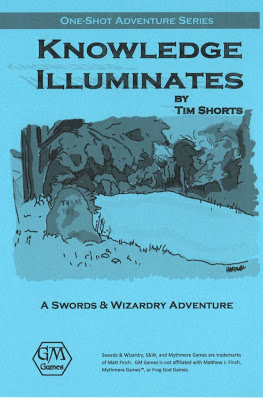
I recently received a copy of Tim Shorts’ new module (yeah, I call them modules) Knowledge Illuminates. Knowledge Illuminates is intended as a one or two session adventure for starting characters (1st level) using the Swords & Wizardry Complete rules. So, what’s it like?

I found it a dandy adventure. It has a wilderness section with interesting encounters and a great map, and an equally enjoyable dungeon component. The encounters made sense, were varied and, best of all, the adventure provides opportunity for moving beyond it. One could even imagine increasing the power of the encounters for a higher level party and using it as the first stage of an adventure that would plunge them into an interesting campaign (I could say more, but I don’t want to dangle any spoilers out there).

Again, the maps are fantastic – clean and easy to read. The art is excellent and provided by Dylan Hartwell of the Digital Orc Blog. The adventure also provides a new undead monster, a new magic item (two, really) and two new spells. It is written with a bit of background in mind, but I think one could easily adapt it to fit their own campaign.

All in all, Knowledge Illuminates definitely gets the Nod seal of approval. Check it out HERE.

Heroes, Everymen and Underdogs – Part 1

I was listening to a pod-cast today that was discussing the Iliad – a story every gamer geek should probably be familiar with – and an idea struck me.

The Iliad is set in the Age of Heroes (yeah, a TSR, AD&D2E-era book), in which the children of the gods, the heroes, were competing for glory and immortality among mortal beings, and bringing the blessings and the curses of the gods with them. What marked these heroes? Well, if nothing else, their incredible ability scores, to put it in D&D terms. Thus, the idea …

In a campaign that ignores “race” – i.e. and all humans campaign – might it not be fun to divide the characters into broad categories based on their rolled ability scores. Now, this makes the most sense to do if you’re rolling 3d6 (either in order or not doesn’t really matter for our purposes). These categories might go as follows:

Ability Score Total / Category

18-54 / Underdog (and must have at least one score of 6 or lower)

55-77 / Everyman (and may not have any score lower than 8 or higher than 13)

78-108 / Hero (and must have one score of 16 or higher)

Now, what special abilities might go along with these categories? More on that tomorrow.

Perpetual Role – A Society to Preserve Pen & Paper Gaming

The good folks at Perpetual Role (well, I assume they’re good folks – if it turns out they’re using me in some complex plot to take over the world, I beg your forgiveness and indulgence for my ill-considered collaboration) are dedicated to preserving pen & paper role playing games, both of the Old School and the New School.

They’re currently running and Indiegogo campaign to fund incorporation for their society as a non-profit, with an aim to holding conventions and, well, I’ll quote from their Indiegogo site:

“Perpetual Role is a new society forming to promote the continued interest in pen-and-paper role-playing games and to encourage independent and innovative new games, while honoring the old. This will take many forms, such as encouraging independent creators of unique and original games; supporting the efforts of other small-scale organizations with a gaming bent; preserving the heritage of the hobby and honoring its creators. And we have plans to start a new gaming convention in the next year, with a particular emphasis on indie games of merit and the old school classics so many of us enjoy.”

If this sounds laudable to you, go check out the CAMPAIGN or maybe hit their BLOG for more information.