Thun’da, King of the Conga/Congo

It’s time for another look into the wonders of old jungle comics with a Thunda story posted at The Comic Book Catacombs (for all your old jungle comic needs, one convenient location on the world wide web).

OK, first and foremost, Thun’da is a dude. Name ends with a vowel, immediately I’m thinking a jungle girl, but no, it’s a jungle boy. Naturally, he has a jungle girl (every Tarzan needs a Jane). This episode is about Jungle Killers (i.e. killers in the jungle, as opposed to people who kill jungles).

I wonder what the berber’s “% in Lare” is?

This scene, killing an elephant with one blast of a gun, does bring up a shortcoming of D&D combat, namely that for a single gun shot to take down an 11 HD elephant, it needs to do about 11 dice of damage (or maybe 6, if we’re allowing for double damage on some sort of critical hit). You could make 10d6 damage elephant guns in D&D, but if you let the monsters have them, the players are going to be pissed.
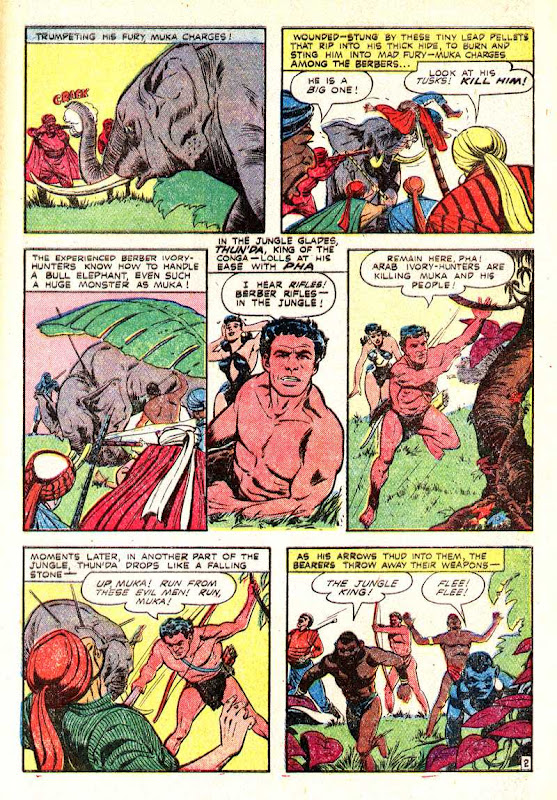
Well, maybe that last elephant just rolled shitty for hit points, because Muka is only annoyed at the little lead pellets, an annoyance he demonstrates by tossing around the Arabs.

What the heck is Pha doing in that middle panel? She’s either distressed at the sound of gunshots or swooning over that dreamy Thun’da, the Frank Sinatra of the Conga.

“Drops like a falling stone” does not really paint Thun’da’s dexterity score in the brightest light.

You know how great it would have been if they misspelled “Flee” in that last panel?

The adventures of Thun’da, Jungle Veterinarian. “That mud will draw out the pain, and introduce a host of bacteria into the wound.”

Meanwhile … Pha Pha Pha Phooom. Thun’da done alright for himself in the jungle. Ain’t it just like a female sidekick, though – you tell them to stay, and they always wander in just in time to be attacked by the one bad guy that got away from you. Sheesh.

Ooo! Ooo! Gold pieces! He said gold pieces! At least we’re dealing with an economy I can understand.

Also … SMATTT? Nice sound effect. Not exactly up to Batman quality.

Hours after days, Thun’da makes his Tracking check and finds the caravan. He then fails his Spot check and is apparently unable to see the guns they’re carrying – those same guns they were carrying on the last page (hours and days ago).

Now Thun’da goes into guerrilla mode – the picture of the impaled dude is actually pretty badass. This brings up a though … how often have your players ever used guerrilla tactics against goblin and orc tribes?

Of course, then Thun’da decides to pick on the African bearers, who are already being whipped and beaten by the Arabs and I lose all respect for the jungle douche.
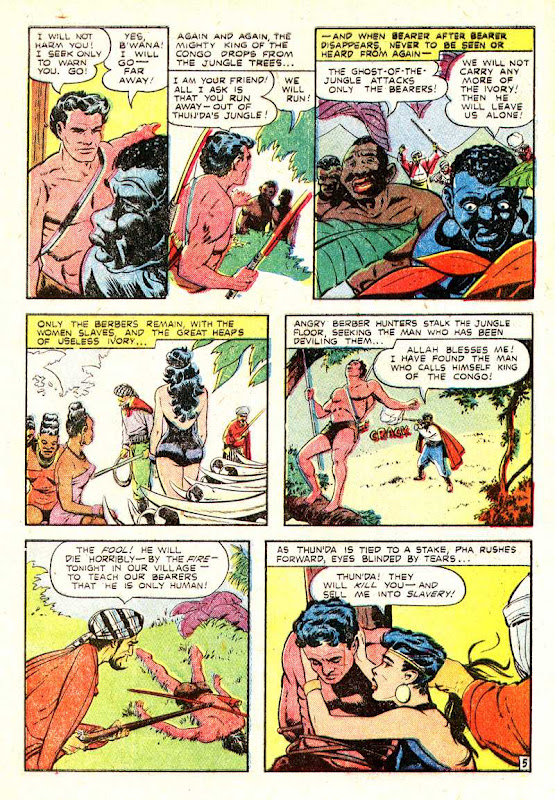
Oh, I take that back. By jumping on his back from a tree, Thun’da only meant to warn him, not hurt him. It’s like the time a warned a friend about the dangers of bricks by throwing one at his head.

So he gets rid of the bearers, leaving the Arabs with useless ivory (not sure why it’s useless … they may have to carry it themselves, but it will still fetch a pretty penny … er, gold piece … in Djibouti.

Oh, and for those who don’t get the geography involved …

These knuckle heads are traveling 4,300 miles to grab ivory and slaves in the Congo (or Conga, depending on the page) and deliver them to the markets of Djibouti. No, the map’s not perfectly accurate, but close enough for government work. Given the terrain involved, this could be a 2 year trip on foot. Methinks the writer was not acquainted with the immensity of Africa.

I like the last panel. Just in case being shot in the head and tied to a post had taken Thun’da mind off the problem at hand, Pha provides some helpful exposition.
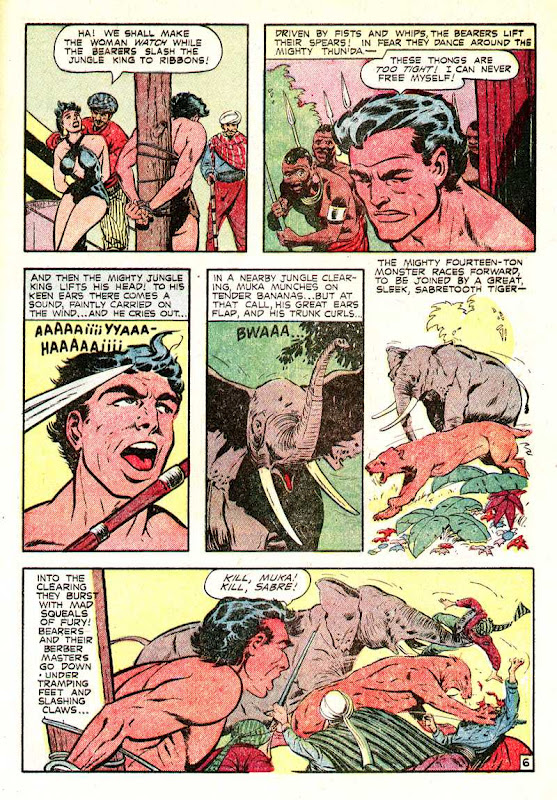
Just when things look their darkest, Thun’da remembers an old trick he learned watching Tarzan movies, and summons his faithful elephant and sabretooth tiger to kill everyone. Which, of course, begs the question … why not summon those two to begin with?

So after saving Muka from the Berbers, he sends Muka to his death against the Berbers. Nice. But it’s not a total loss, as Thun’da finds an alternate route home. You know, for when the jungle is crowded around rush hour. Interesting that the Elephant Graveyard appears to be within sight of the city of Shareen, and yet its existence was a complete surprise to the King of the Congo.

Oh – and love the look on the one guy’s face in the upper right hand panel. Looks like he has a serious noogie coming.

Time for stats!

Thun’da will use have levels in the beastmaster, a variant druid class in Blood & Treasure (yes, I’ll release it pretty soon – give me a break, one guy working on a 400 page RPG book in his spare time). The beastmaster is a druid who loses the shapechange abilities and armor use of a druid, but gains the unarmored AC bonus and speed bonus of a monk and the favored enemy and tracking ability of a ranger. I’m going to be a bit on the brutal side with this guy, given that he’s kind of an ass.

THUN’DA
9th level Beastmaster
Neutral (cause he just ain’t that good)

STR 16 (+2 bonus)
DEX 10 (would have been higher, but the whole “fell like a stone” thing didn’t help him)
CON 16 (+2 bonus)
INT 7 (-1 bonus)
WIS 13 (+1 bonus, and only because he needs it to qualify)
CHA 9

Hit Points: 36 (9d6+18)
Armor Class: 14 (10 + 4 for unarmored AC bonus)
Saving Throws: Fortitude 7, Reflex 12, Will 8

Skills: Survival [8], Tracking [8]

Special Abilities: Druid spells (6/5/4/3/2/1), move through undergrowth (Lvl 2), leaves no trail (Lvl 3), +2 save vs. spells of the fey (Lvl 4), immune to poison (Lvl 9), establish stronghold (Lvl 9; we’ll say his city of Shareen is his stronghold), armor class bonus (+4 at Lvl 9), speed bonus (+20 ft. at Lvl 9), favored enemy (double damage vs. Berbers)

Gear: Short bow, 20 arrows, spear

Henchmen: Sabre (smilodon), Pha (total babe)
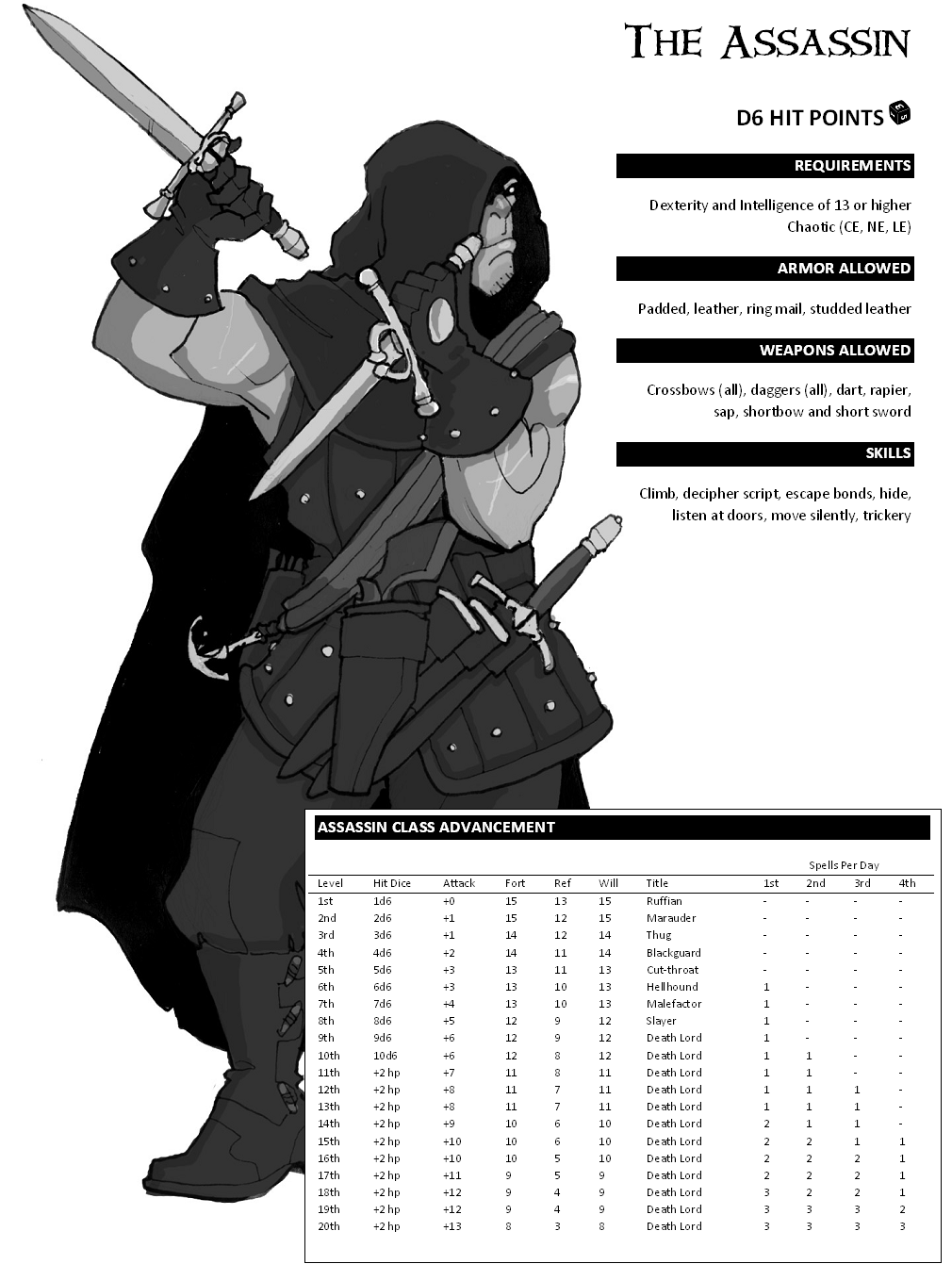
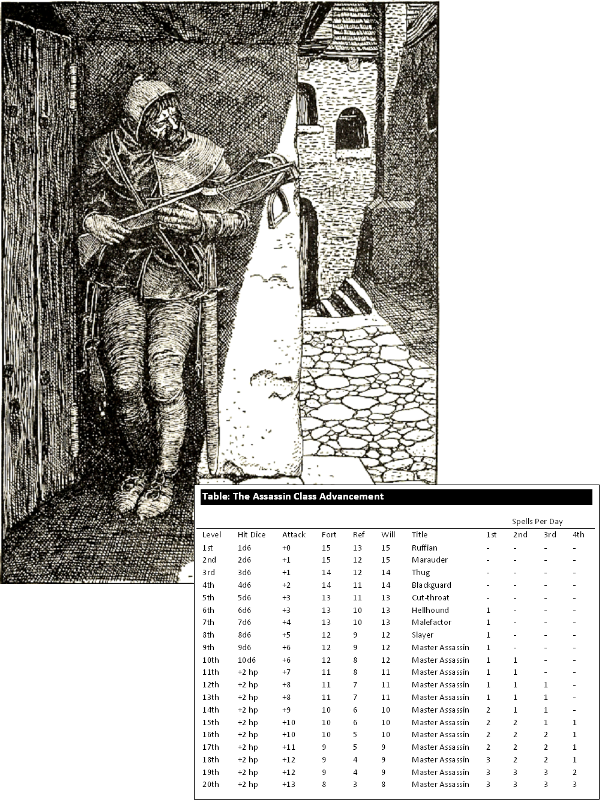
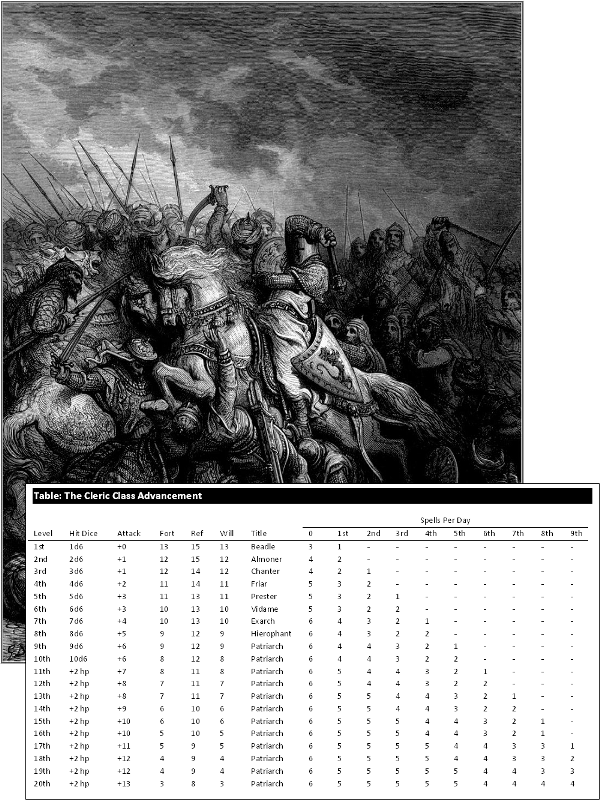
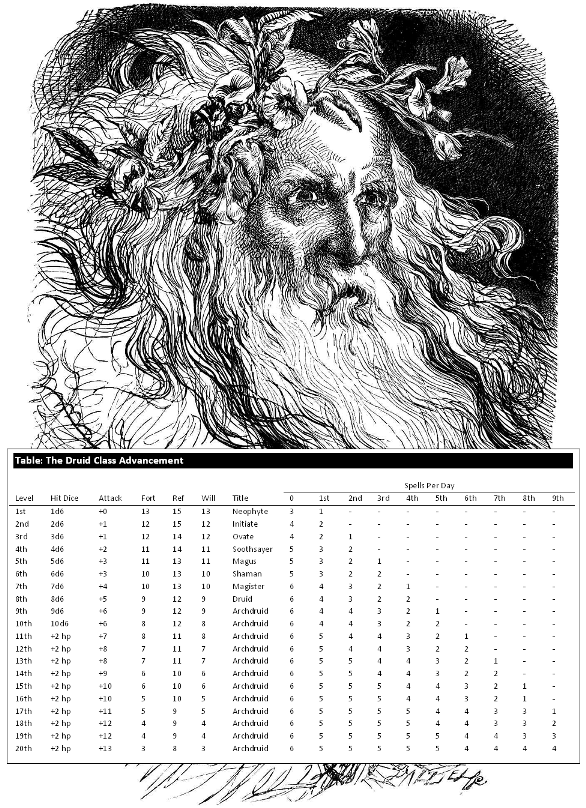
Changing Mind on B&T Layout …

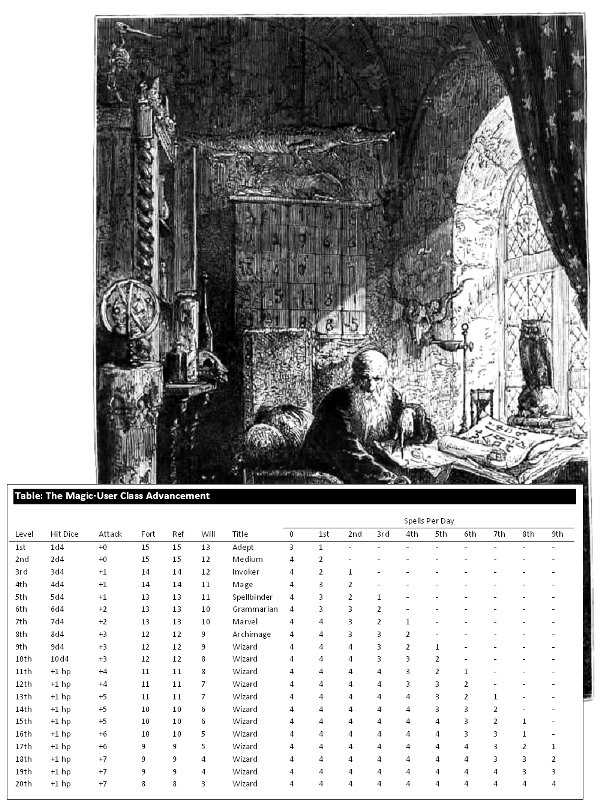
So, a couple days ago I showed off some previews of the class advancement table layout for Blood & Treasure. Then last night, my mind started wandering and … well, what if I did this instead …

The pro here, for me, is that I get to show off Jon Kaufman’s art at the size I had originally intended, plus I throw some class information in for quick reference. I could maybe add on the classes’ special abilities with their associated level in brackets as well.

This way, I don’t have the full page, classic artwork sitting next to the more modern artwork – so less clutter, and I can use those full page bits elsewhere to better effect. By plucking the individual class artwork out of the text, it also makes the text much cleaner and easier on the eyes.

Quantum Rainbow Photon Guns [Space Princess]

Hmmm, a title like “Space Princess Quickie” could bring the wrong kind of traffic.

Anyhow. I just read an article (okay, I read the title) called “Quantum Rainbow Photon Gun Unveiled”. Now, besides the fact that I’m using that for my non-existent band’s name, it also struck me as a great new weapon for Space Princess.

Image found HERE

Quantum Rainbow Photon Gun (DC 25): The quantum rainbow gun fires a blast of multi-colored energy strands in a 15-ft long, 10-ft wide cone. Creatures with 4 or fewer Hit Dice are knocked unconscious for 2d4 rounds, and then are stunned and blinded for 1d4 rounds. Creatures with 5 to 8 HD are blinded and stunned for 1d4 rounds. Creatures with 9 or more hit dice are merely stunned for 1 round. A STR test is allowed to ignore the effects of the blast. The quantum rainbow photon gun has enough power in its battery for 10 blasts.

Great thing about the modern world – I googled “rainbow gun” and found that image in about one second.

Now, making a rainbow gun got me thinking about a rainbow monster of some kind. So, enjoy the Prismal for Space Princess and Blood & Treasure.

PRISMAL: HD 5; DEF 20; FIGHT 11 (fists 1d8); SHOOT 8 (energy blast); MOVE N; STR 6; DEX 3; KNO 2; MEN 7; DL 6; Special: Laser Refraction, Immune to Heat, Cold and Electricity.

Prismals are crystalline beings with a humanoid shape. Their crystal bodies are transparent and translucent and are actual composed of thousands of small crystals bound together with electrical energy. Prismals seem to be born deep underground by an unknown natural process, for they have appeared on many worlds and do not seem intelligent enough to have invented space travel.

Laser Refraction: When struck by a laser or energy attack, the prismal can make a STR test (DC 10). If successful, it absorbs the energy and can fire it the next round from its eyes. If it fails, the blast scores half damage against the prismal and the remainder of the energy is refracted into a rainbow of colors (per the Quantum Rainbow Photon Gun), with each creature within 30 feet (except other prismals) being affected.

PRISMAL
Medium elemental, neutral (N), low intelligence; cluster (1d8)

HD: 5
AC: 20 [-1 for S&W]
ATK: 2 slashes (1d8) or energy blast (see below)
MV: 20
SV: Fort 11, Ref 13, Will 14
XP: 500 (CL 6)

As described above. Whenever a prismal is struck by light (from torches, lanterns, spells, etc.) its body gives off a color spray effect that affects all within 10 feet. If struck by any sort of magical ray, the prismal, if it passes a saving throw, can capture the ray in its helix and then fire it at any target (with the same original range and effects) the next round. Even if it does not save against the ray, it takes only half the normal effect of it.

Special Qualities: Immune to cold, fire and electricity.

Hark! What’s That I Hear? [20 Random Dungeon Noises]

20 Things You Might Hear in a Dungeon

1. Dripping water (save or it echoes in your head, draining you of one point of Wisdom/sanity per round until you’ve moved at least 120 feet away, and then 1d6 rounds after)

2. A roaring flood of water (aural illusion created by air flowing through a couple of holes in the wall that create a chill breeze through the area; 1 in 6 chance of encountering a small air elemental)

3. Desperate sobbing (comes from a lead-lined chest in which a female efreeti has recently been imprisoned; the exterior of the chest looks like carnival glass; the lock has been welded shut)

4. Creaking footsteps from above – which makes no sense, because above you is solid rock

5. Creaking footsteps behind you – still doesn’t make sense, but 1 in 6 chance it’s an invisible thief (level 1d4+1) who’s down on his luck and trying to follow the party out

6. Slow hiss (50% chance of a pit of vipers beneath your feet, 50% chance of poison gas flowing into the room or corridor from a ruptured copper pipe that has been struck by a black fletched arrow)

7. Silence (entire corridor has been permanently silenced; 5 in 6 chance of random ambush here by monsters who know about the effect)

8. Clicking (50% chance of monstrous crabs or crabmen, 50% chance of ice cracking beneath the stone tiles of the dungeon – will give way in 1d4+1 rounds sending everything down into a rushing torrent of chilly water)

9. Slapping sound (flag hung over a hole through which flows an updraft from deeper in the dungeon)

10. Electricity (around the corner there is an arc of electricity flowing between two metal plates on either side of the corridor; chance in 12 equal to a character’s armor bonus that (metal armor only) it is drawn to them and deals 1d6 points of damage per round until they are freed)

11. Howling (from an ancient pipe organ enchanted to play on its own – detects as magical – skeletal rats lurk within the pipes, will swarm those who investigate)

12. Snapping of bones (50% chance of trolls eating, 50% chance of goblins breaking up firewood and throwing it in a hearth to feed a small fire elemental)

13. Crackling (50% chance of a fire elemental guarding a room or corridor, 50% chance of a fire burning within the walls – corridor or room is hot and there is a 1 in 6 chance of a roof collapse each turn)

14. Laughter (50% chance of a magic mouth, 50% chance of gnolls reading comic books)

15. Evil Laughter (50% chance of high level wizard torturing a hero, 50% chance of a pack of vampiras mocking a new recruit)

16. Chanting (50% chance of 1d6 lawful acolytes at the bottom of a pit praying for strength, 50% chance of 3d6 chaotic acolytes sacrificing a thief who tried to steal their idol’s good eye)

17. Din of Battle (50% chance of two major dungeon factions locked in battle that swiftly overtakes the party; 50% chance of the noises coming up through a chimney, the battle being a level or two lower)

18. Rumbling (from a primitive elevator located on the other side of the wall – it may not stop on this level)

19. Clanking (50% chance of kobolds mining the dungeon level for building materials, 50% chance of animated chains preparing to strangle curious adventurers)

20. Whispers (50% chance of pygmy goblins in the walls, plotting your doom, 50% chance you have wandered into a stark, black dome that serves as the extra-dimensional brain center for a chaos god – his “brain” is a giant, pulsing mass with the same stats and attacks as a double-strength gibbering mouther)

IMAGE from HERE – Buy one if you take a shine to it

She-Ra and Fantasy Archetypes for Mystery Men!

Illustration by FeiLong EX at DeviantArt

So I was watching She-Ra this morning …

No, I don’t really know why. It was on Me! TV this morning, and I was eating my breakfast, and … anyhow, when He-Man and all that jazz hit the scene, I was just about too old for it. A friend of mine got all the original He-Man stuff for Hanukkah one year, but I’ll admit it didn’t do much for me. I was never into fantasy stuff as a kid – I was a Star Wars and G.I. Joe man myself. About the only times I ever handled a He-Man figure was when I was playing with my cousins, who were younger. Now that I’m an adult, though, and a fan of gonzo fantasy/sci-fi, I have to admit you can’t go wrong with something as bonkers as He-Man. As I was designing Mystery Men!, I always thought it would be an excellent system for running something like He-Man.

Which brings me back to She-Ra. They were showing what I gathered to be the second episode, since it was the second part of a two-parter and appeared to be introducing the characters. A couple things came to mind.

First, She-Ra was a mega-babe. Yeah, I know, immature. But there it is.

Second, she was a paladin … or at least I saw her “lay on hands” in the episode.

This got me thinking about some of the archetypes in fantasy games other than the fighter, magic-user and thief, and how they might be done in Mystery Men!

First and foremost, you have the cleric. The cleric could be a sorcerer who devotes more XP to his level (thus getting more hit points and a higher attack bonus) and less to his sorcery pool than your typical sorcerer, or he could be an adventurer who takes a few powers related to healing – maybe embedding them in a holy symbol to cut down on the cost. There is no “turn undead” power per se’, but one could use the Fear power and tie is solely to the undead, thus cutting the cost from 10,000 XP to 5,000 XP. If you also embedded it in a holy symbol, you could cut the cost down to 2,500 XP.

That covers the main classes pretty well, which leaves us with the sub-classes.

The assassin could be a thief with the Inflict Wounds power.

Barbarians are just adventurers with the Rage power and maybe Catfall – just look at my previous post on Conan to get the idea.

The bard is probably a sorcerer with a small sorcery pool and the Enthrall and Suggestion powers.

The druid is probably a sorcerer who maybe goes to the trouble of taking Polymorph (self, one animal only) as a power. By and large, you can just use a sorcerer who focuses on druid-y kinds of spells.

The illusionist, and other specialist mages like necromancer, enchanter, etc. is just a sorcerer who picks and chooses his or her spells. No need for special rules.

The monk is really just an adventurer with a few powers – Catfall, Inflict Wounds, etc. – who doesn’t wear armor.

The paladin is an adventurer with the Heal Wounds power, probably embedded in a holy symbol or the paladin’s sword, along with Remove Impairment.

The ranger is actually a tough one. Tracking is just a task check – no need for anything special there. The extra damage against “giant-class humanoids” or the 3rd edition “favored enemy” could be a limited Inflict Wounds, and thus bought at half price. Maybe throw in things like Weapon Master (longbow), Catfall and Speak With Animals, and you’re probably in the right neighborhood.

Anyhow, as I finished my eggs this morning, I decided I should throw together some stats for She-Ra, who is a good example of a character that straddles the “swords & sorcery” and “superhero” genres. Enjoy the Princess of Power, and if you’re in the middle of a game, why not let her show up and kick Wolverine’s ass or something, just for fun …

SHE-RA, Adventurer 9 (Captain of the Guard, Princess of Power)
STR 13 (+6) | DEX 5 (+2) | CON 5 (+2) | INT 3 (+1) | WIL 3 (+1) | CHA 8 (+4)
HP 63 | DC 16 | ATK +7 (+13 melee, +9 ranged) | SPD 2 | XP 13,900

Ability Boosts: Str +10, Dex +2, Con +2, Cha +5

Powers: Heal Wounds (others), Invulnerability I, Speak with Animals, Strike True

Gear: Longsword (Potent Attack, Shield; 1d8+8, can hit ethereal and incorporeal creatures)

Dis, Grand City of Hell – Asteroth and Natijula

Still plugging away. I’m working on “spades” tonight, which I was going to have revolve around violence, but then got my head out of my butt and realized needed to revolve around bureaucracy. How could I have missed that? Anyhow … enjoy some crazy diamonds.

2. Natijula: This block is as hot as an oven, with brick buildings of bright red, with flint roofs and wrought iron accoutrements that give it the appearance of a Hellish New Orleans. The buildings hold bakeries of hellstoker demons producing ashen loaves and deadly delicacies, café’s that serve scalding coffee and bitter tea and every sort of restaurant and tavern. In the streets there are fire pits on which are roasted stench kows and other hellbeasts. These pits are tended by lemures whose flesh drips into the pits, the fire hissing and sending up gouts of steam that become sinister steam mephits. Zombified shades in silk finery walk the streets selling wine from casks on their backs or giant rats on iron skewers.

The gates of Natijula are tall and composed of ivory-colored stone with steep battlements and blue, conical roofs. The battlements and towers that flank the gates of thick, bluish wood, are defended by a company of anti-paladins sans heads. Behind the gates are hidden a giant ballista, cranked by a stone giant in black platemail and armed with a giant halberd.

Natijula, the self-proclaimed Lady of Agony, is an inhumanly tall woman with an hourglass figure. Her head is bald and she has deep-set green eyes. Her body is covered in golden scales and she wears a classic chainmail bikini and many rings on her fingers and toes. Two massive eagle wings sprout from her back, and she has the ability to take the shape of a roc.

Her “palace” is a great courtyard paved with azure stones and filled with long tables where all manner of demons and devils feast, served by emaciated halfling shades weighed down by iron boots. About 1 hour in 6 is filled with a melee between the demons and devils, always over something trivial, but always fought to the death. Natijula has a deep, abiding hatred for all Mephistopholes (they’ve had dealings in the past), and will do everything in her power to oppose him and his servants.

5. Liro: This quarter is reminiscent of Venice, with many canals of water, Stygian black, cutting through the Renaissance-style buildings of glistening, slick black stone with silver highlights and ornaments; the tarnished domes, the thin bell towers with their black, iron bells that, when struck, cast a deafening silence over the quarter (save or deaf) and their crooked piazzas of spongy stone that spurt blood as one walks over them. Floating above the streets are ghostly shades engaged in a never-ending dance and cavorting in the heady fumes dispatched from great, silver braziers that line the streets and produce no light or heat, only a thick, white smoke that stings the nostrils.

Within the canals there float black lotus that attract ill-tempered sprites, and on great burgundy lilly pads there sit black-fleshed hezrous, fat and self-satisfied, eyes drowsy and glazed, thick purple tongues darting about, capturing screaming sprites and sending them to a terrible death in their bellies.

Leather goods are the business of this quarter, leather drawn from every creature imaginable. Some shops sell the prepared hides, while others fashion them into suits of armor (always of the finest quality), scabbards, boots, saddles, cloaks and other goods. Leprechauns handle most of the fancy craftwork, the other goods being imported from other quarters.

The gates of the quarter are located about 20 feet below the surface of these waters – quite a surprise to those who have entered through a normal gate from elsewhere – and are secured by walls of ice one foot thick. Swarms of giant piranha guard the gates, under the seeming command of the hezrou, who make some effort not to displease the mistress of the quarter.

Liro’s palace is set between three of these canals, giving it a triangular shape. It is the most imposing building in the quarter. It is a gracious affair, though much of that grace is robbed of the place by the tempestuous behavior of Liro. Liro is a short, elegant, petite demoness with dark, ruddy skin that is slightly scaled around the hands, feet, shoulders, neck and eyes. Her eyes are teal in color and appear to be looking directly into the eyes of every person within 30 feet of her (even those behind, who see her as facing the other direction). She wears only a cloak of tiny, triangular gold panels and a diadem of gold and pearl. She is surrounded by a pall of the same stinging white smoke that issues forth from the braziers on the streets, though this acts as the death fog spell. Liro is always accompanied by a guard of chittering rubinous xaocs, visitors to Hell who find it entirely too stifling and staid for their tastes.

J. Astaroth: Astaroth is a prince of Hell, and through the markets of his quarter flow spices, narcotics and other such substances sought after by the manors of the demon lords and arch-devils. Astaroth’s quarter is a maze of zigzagging corridors between ziggurats of iron and marble, atop of which pit fiends on thrones of fire roar defiance to the assembled masses of bearded devils who cluster at their feet.

The streets are lined with walls covered with blue tiles and mosaics of serpent people, demonic lions, pit fiends and great battles between devils and demons, all with the bodies of mortals trampled beneath them. Alcoves are set into these walls wherein sit wrinkled, pot-bellied shades wrapped in tattered, dusty azure robes. Before them are spread shallow wicker baskets filled with all manner of herbs, spices and narcotics. Anything you could want, at tremendously high prices, though they will sell almost anything for a drop of a person’s blood. Mangy camels covered with oozing sores, some with leathery bat wings, are led through the dusty streets, laden with goods from the world above, or with the bodies of shades in need of correction and punishment. The everpresent buzz of fly demons can be heard above, the demons swarming over the streets and sometimes swooping down to pluck up a shade, camel or traveler for a quick meal (i.e. 1 in 6 random encounters is with 1d8 fly demons).

The streets are patrolled by scorpion demon magistrates, on the lookout for double dealing and a cut of the proceeds of the shades’ business. They serve Astaroth as his enforcers in his quarter, keeping the spice lords (there are several) under control. Among them are Tizu the hezrou who controls the opium trade, Mosheveti the marilith who controls the supply of saffron and white pepper and Vucarik, the pit fiend who controls the flow of honey. These lords dwell in the ziggurats with their retinues.

The gates of Astaroth’s quarter are numerous, though most of them are false. Finding a gate in this quarter can always be accomplished in 1d3 hours of travel, but only 1 in 4 found gates is genuine. False gates drop people into deep pits lined with burning coal, where they are roasted alive. All of the gates are guarded by twin sirrush and a company of bearded devils armed with mancatchers and heavy crossbows that fire spiked spheres. When these spheres hit a person, they discharge an electrical shock that deals 1d6 points of damage and paralysis for 1d6 rounds (save to negate).

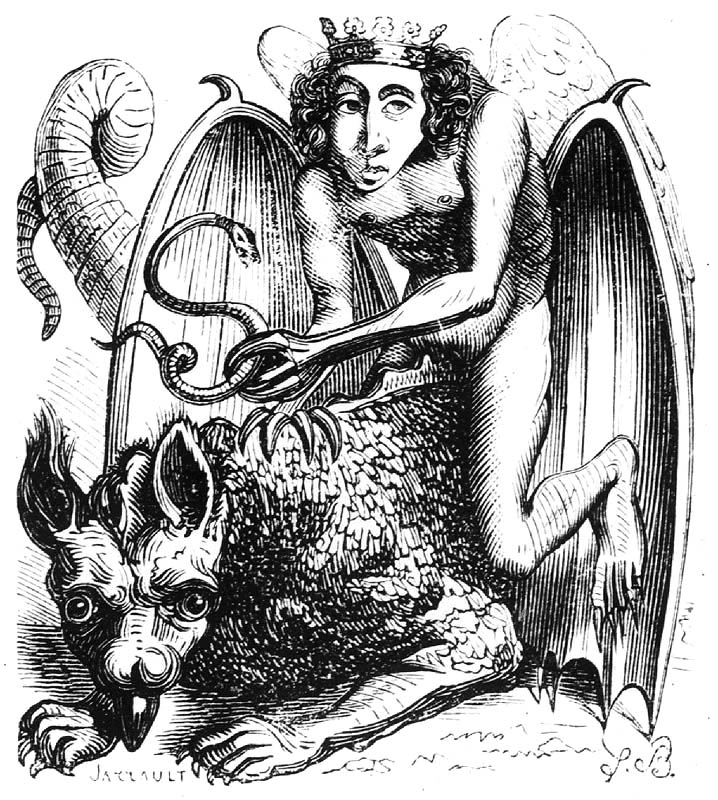
Astaroth dwells in the largest of the quarter’s ziggurats, one surrounded by a moat of mercury (those passing over must pass a saving throw or lose 1d6 points of wisdom and suffer confusion for 10 minutes). Within the ziggurat there is a grand palace of chambers thick with painted columns and deep pools of icy water inhabited by bound water elementals which Astaroth can shape into the form of beautiful women who dance seductively for the arch-devil and his court of pseudo-intellectuals. Astaroth commands three squadrons of inquisitor demons (xxx), five companies of scorpion demons and ten companies of bearded devils. Astaroth is mounted upon a wolf-headed black dragon so ancient it may predate Hell itself.

Hengeyokai for Blood and Treasure

Here’s my take on the much requested hegeyokai for Blood & Treasure. I tried to keep it simple, since they’re a playable race. Let me know what you think.

Hengeyokai

Magical Beast, Alignment Varies, Average Intelligence; Solitary

HD 1
AC 14
ATK Staff (1d6) or dagger (1d4) or by animal type
MV 30
SV F 11, R 11, W 13
XP 100

The hengeyokai are magical beasts that can take human form, usually to play tricks on human beings. They can also take a hybrid form of animal and human, often to good effect when attempting to shock their human victims. Some hengeyokai are rather malevolent, others merely mischievous.

Hengeyokai are usually tiny or small animals in their animal form. When in their animal form, they have the same armor class, movement rate, attacks and damage as that animal form, as well as any special abilities that animal might have. When in hybrid form, they retain the animal form’s attacks, but inflict +1 damage due to their larger size. Hengeyokai can change their shape (i.e. from animal to hybrid, or hybrid to human, or back) three times per day. In animal and hybrid form, hengeyokai have darkvision to a range of 60 feet.

Hengeyolai in hybrid and human form have the following additional abilities, depending on their type:

BAKENEKO (Cat) are usually malevolent creatures. They are immune to poison and can cast dancing lights once per day. Bakeneko with 6 or more hit dice or levels can also cast animate dead, turning corpses into zombies by leaping over them in cat or hybrid form.

INUGAMI (Dog) are loyal and generally lawful in alignment, the protectors of humanity from other hengeyokai. In human form, they typically take the shape of an armored warrior. They can cast cure light wounds once per day, and can cure disease once per week by licking a wound in dog or hybrid form.

JORŌGUMO (Giant Spider): Like the kitsune, the jorōgumo is a temptress, her human form being that of a willowy, elegant woman. They can cast spider climb and web once per day each.

KITSUNE (Fox): Kitsune, or fox maidens, may be the most famous of the hengeyokai. They appear as beautiful women and use their powers to charm and seduce men, using them as bodyguards and servants. Kitsune can charm person once per day and, when they have an instrument, fascinate as a bard with as many levels as the kitsune has Hit Dice. For each additional level or Hit Dice a kitsune gains, they grow an additional tail in their fox form, up to a maximum of nine tails.

MUJINA (Badger): The mujina are not particularly evil, but they do delight in frightening people. They can use the spell change self once per day to give themselves a frightening appearance, and cause fear once per day to frighten those who are not shocked by their appearance. Like badgerd, they are tenacious and ill-tempered when their tricks go awry.

TANUKI (Racoon Dog): Tanuki are pot-bellied tricksters, often drunk and always in good spirits. They can change self once per day, using this ability to make humans feel foolish.

HENGEYOKAI AS CHARACTERS
Hengeyokai characters are whimsical and capricious, and thus suffer a -1 penalty to their starting wisdom score. Bakeneko and jorōgumo gain a +1 bonus to their starting dexterity score, kitsune and tanuki a +1 bonus to their starting charisma and inugami and mujina a +1 bonus to their starting constitution score. They retain the ability to change shape and to cast the spells of their normal type. Hengeyokai cannot take levels as clerics, but can advance as druids. They can multi-class as fighter/sorcerers or sorcerer/thieves.

Thieves, Giants and She-Devils

In the last article in this series, I laid out the basics of using Mystery Men! for a Swords and Sorcery-style campaign, the likes of which you’ve probably read in Conan or Red Sonja comics.

This article continues this with some thoughts on the idea of thieves.

MM! uses three classes. The adventurer is your standard super hero type, with a set array of powers. The sorcerer can have some set powers, but also devotes their XP into a sorcery pool that allows them to use ad hoc powers during a game (i.e. cast spells). The third class, the scientist, puts XP into a science pool that allows them to invent devices (i.e. powers) at the beginning of a game session, making them more flexible than the adventurer, but less flexible than the sorcerer.

By all rights, sneaky thieves should be portrayed as adventurers in an MM!SS game. They probably won’t spend as many XP on boosting their ability scores as the typical barbarian, and therein lies the problem. Since barbarians and thieves are both adventurers, and thieves will probably be higher in level, it is likely that they’ll end up as better warriors than the barbarians. What to do?

How about we introduce a new class called … The Thief!

The thief (or reaver, pirate, tomb robber, assassin … whatever you like) uses the scientist’s hit dice and attack progression, and can put XP in a “thievery pool”. The thievery pool allows them to apply a +1 bonus to any of the traditional thief tasks (pick pockets, open locks, find/remove traps, climb walls, hear noises, move silently, hide in shadows) by spending 500 XP of their thief pool on the roll. Spend 1,000 XP, get a +2 bonus. Spend 3,000 XP, get a +6 bonus.

In addition, thieves can backstab (after successfully hiding in shadows), adding 1d6 to their damage for every 1,000 XP of their thief pool they spend (up to an extra 10d6, or 6d6 if they’re throwing the dagger into someone’s back). Finally, thieves can spend 5,000 XP to avoid certain death (i.e. no save required, automatically avoid a death trap or a killing blow).

RED SONJA
It’s easy to forget that Red Sonja as we know her was an invention of Roy Thomas and, to a lesser extent, Esteban Maroto, rather than one of REH’s creations. With her chainmail (it always looked like scale mail to me) bikini and powers imbued on her by the goddess Scathach, she was a far cry from the 16th century pistol-packin’ mama REH called Red Sonya of Rogatino. It’s almost like the difference between an old school D&D character and a Mystery Men! Sword and Sorcery character. Thus …

RED SONJA, Adventurer 10 (She-Devil, Swordswoman)
STR 7 (+3) | DEX 11 (+5) | CON 5 (+2) | INT 3 (+1) | WIL 7 (+3) | CHA 12 (+6)
HP 73 | DC 23 | ATK +8 (+11 melee, +13 ranged) | SPD 2 | XP 16,330

Ability Boosts: Str +4, Dex +8, Con +2, Will +4, Cha +9

Powers: Catfall, Invulnerability I, Weapon Master (Longsword)

Gear: Longsword (Potent Attack; 1d8+5, can hit ethereal and incorporeal creatures), chainmail bikini, dagger (1d4 +4)

AGAINST THE GIANTS
I’ve decided to send a few of my regular players “Against the Giants” (i.e. through the classic series of AD&D modules of the same name) on Google+ to test out this little experiment in MM! fantasy gaming. Naturally, that means I need to apply some statistics to those giants.

HILL GIANT
LVL 12 (42 hp) | PH 8 (+4) | MN 3 (+2) | DC 20 | SPD 2 | XP 1200
ATK Club (3d8) or fists (2d4) or rock (3d6)

FIRE GIANT
LVL 15 (53 hp) | PH 9 (+5) | MN 4 (+2) | DC 23 | SPD 2 | XP 1800
ATK Greatsword (4d6) or fists (2d4) or flaming rock (3d6 + 2d6 fire)
POW Darkvision, immune to fire, vulnerable to cold

FROST GIANT
LVL 14 (49 hp) | PH 8 (+4) | MN 4 (+2) | DC 21 | SPD 2 | XP 1700
ATK Greataxe (4d6) or fists (2d4) or rock (3d6)
POW Darkvision, immune to cold, vulnerable to fire

OGRE
LVL 4 (14 hp) | PH 5 (+3) | MN 2 (+1) | DC 16 | SPD 2 | XP 700
ATK Club (2d8) or javelin (1d8)
POW Darkvision

TROLL
LVL 6 (21 hp) | PH 7 (+4) | MN 2 (+1) | DC 16 | SPD 2 | XP 1500
ATK Claws (2d6) and bite (1d6)
POW Darkvision, regenerate