Cush – Six-Armed Villagers, Glowing Tubes, Evil Shrines and Galmim

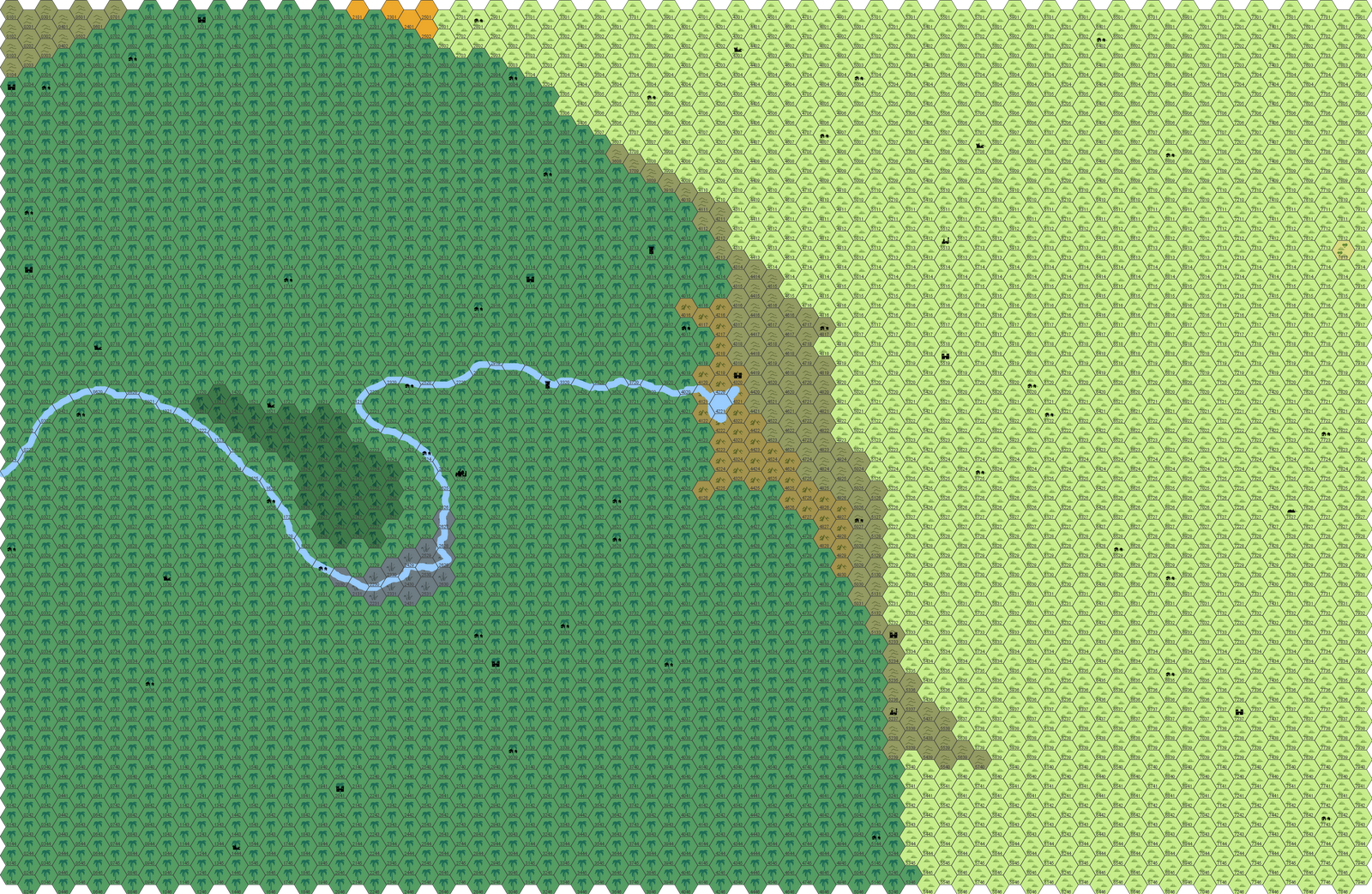
Here are a few early previews of Cush, starting in the west where the trees are as thick as thieves …

01.29: You see a small village (population 90) surrounded by a ditch and wooden palisade by a lazy stream. Within the palisade there are ten buildings constructed from woven branches and thatch. The oviparous humanoids of Obaala are tall, statuesque and have white skin, fair hair, dark eyes and six arms placed evenly around their bodies. Each of their bee-hive shaped houses contains a nest tended by the male of the species. The obaala are matriarchical, with the most aggressive females leading the others. They are known for their sense of humor and their skill at assassination (surprise on a 1-2 on 1d6, double damage from surprise attacks).

The obaala enjoy the services of Zemmu the blacksmith and Yazur the healer. The largest building in the village is a temple dedicated to Gwardaja, their goddess of knowledge. She is served by the priestess Kasbaba who dresses in pale yellow robes that at once clutch at her body desperately and mingle with the breeze.

Gwardaja appears as a tall, obaala female with eyes the clor of roe and a serene expression. She is dressed in a yellow toga hung with amber beards and carries palm fronds in three of her hands and clay pitchers in the others.

OBAALA: N Medium Humanoid; HD 1+1; AC 13; Atk 2 weapons; Move 30; Save F13 R15 W15; XP 100/CL 2; Special: None. Gear: Hand axes (2), beaded armor (+2 AC), shield.

02.14: Lord Galmim is a Zinji adventurer who established a small, walled castle here 12 years ago and instantly set about annoying his neighbors. The castle is built of adobe brick and the walls are topped with sharp wooden spikes. Galmim employs a 50 archers (padded armor, shortbow, short sword) and rules over 44 peasant families who dwell in thatched huts within a log wall about 15 feet all. Galmim’s arms are a yellow doe rampant on a field of purple.

GALMIM: CE Fighter 12; HP 87; AC 19; Atk 3 weapon attacks; Move 30; Save F7 R11 W11; XP 600/CL 12; Special: +1 to hit with spear; Gear: Spear (cold iron tip, painted with spirals of charcoal and red; 1d6+3), light mace (head shaped like a spiked cylinder, haft wrapped in blue crocodile hide; 1d4+4), chainmail, shield, potion of extra healing (thick, ruby colored); Abilities: Str 18, Int 12, Wis 10, Dex 16, Con 16, Cha 15.

03.22: A small shrine of ancient Kolos stands here, choked with jungle vines. Inside there is an idol of Charon, the Stygian boatman. The idol looks like a gaunt figure in black robes. Where the idol’s face should be there is a merely an empty socket that probably once held a large gemstone. The shrine is now inhabited by a family of five pot-bellied ghouls, the largest having been the shrines keeper hundreds of years ago. The ghouls have 3 pp and 70 gp (in the ancient coinage of Kolos) lodged in clear view in the gaps between the stones.

04.20: A tube of metal 4 ft. in diameter sticks 12 ft. out of the ground at a slant. It is rusted and empty. The jungle around the tube is blighted. People touching the tube or spending the night near it must save vs. disease or develop painful blisters on the skin, losing 1 point of dexterity and constitution and glowing for 1d4 days. Glowing adventurers attract monster encounters on a roll of 1-2 on 1d6.

Blood and Treasure Pregens

I received an email a week or so ago asking whether there would be an intro adventure for Blood & Treasure as well as some pre-generated characters. Short answer … yes.

I was initially unsure about producing adventures for B&T. My intention was to make a game that could handle most adventures produced for everything from the original edition to Pathfinder (with more GM work on converting 3rd edition and Pathfinder than the classic D&D products). So, if just about every adventure ever written works, more or less, with B&T, why produce more outside of short adventures in issues of NOD? Well, honestly, because someone asked, and because it seemed like a decent freebie download for the game.

That being said, I’m now working on an intro adventure that will play off of the “sample play” bit in the rulebook. Kobolds, exiled bugbears, goblins, fungus, necromancers, etc. Your typical fare.

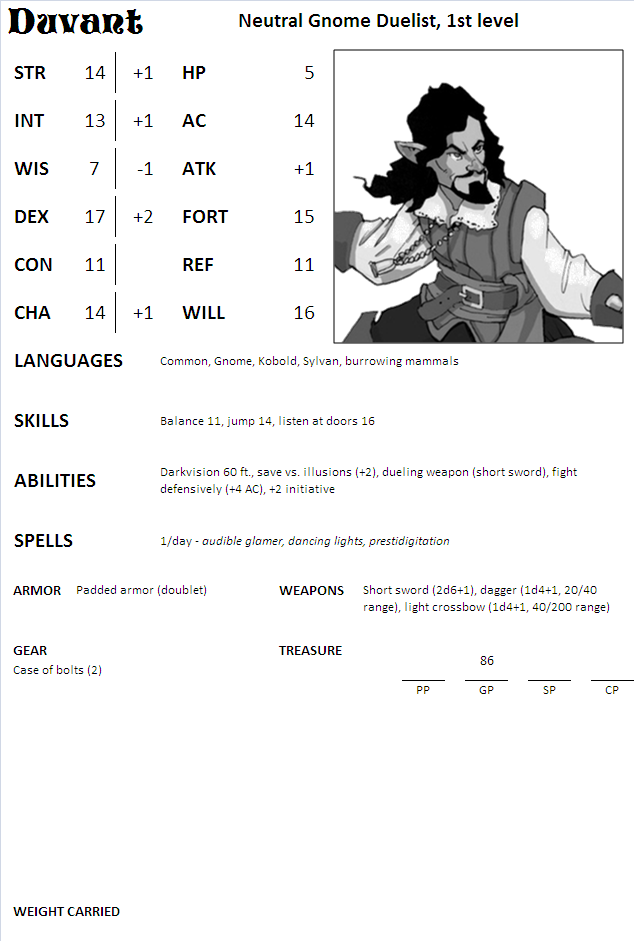
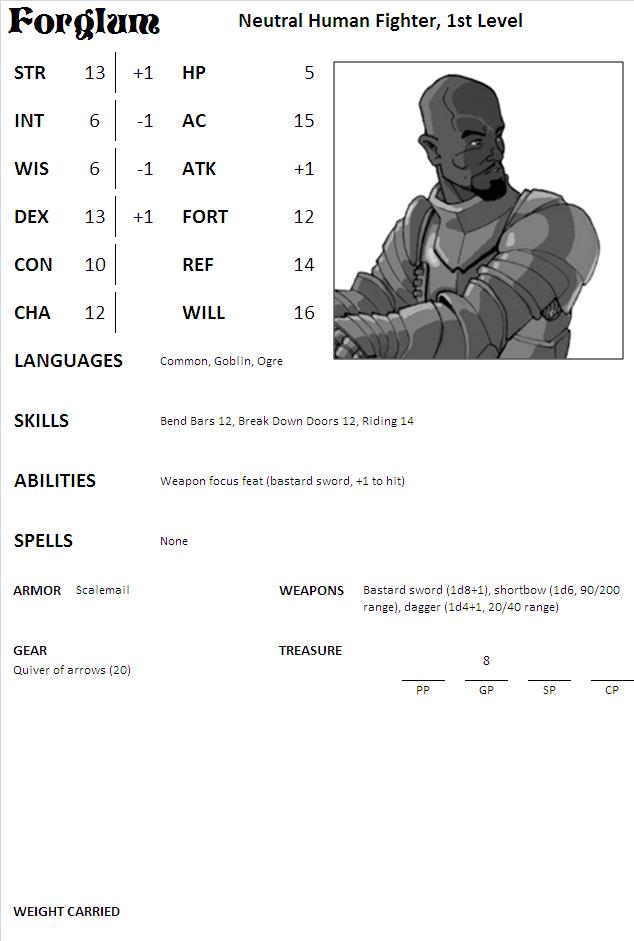
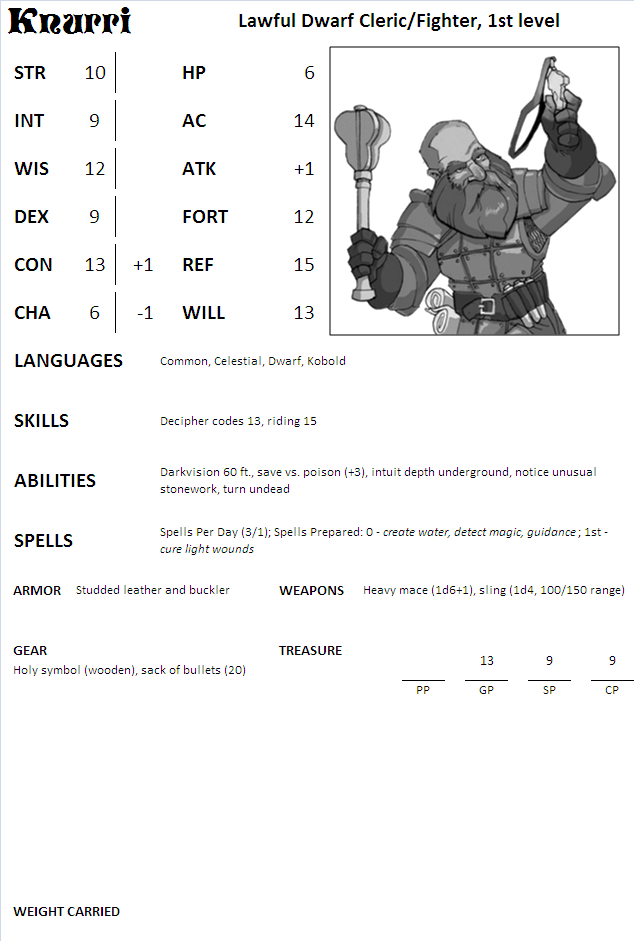
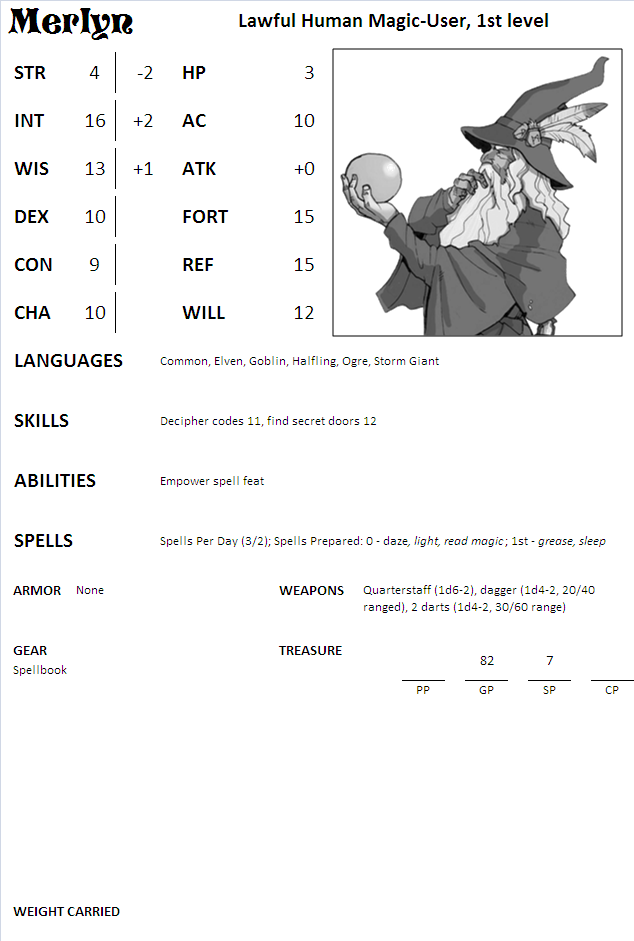
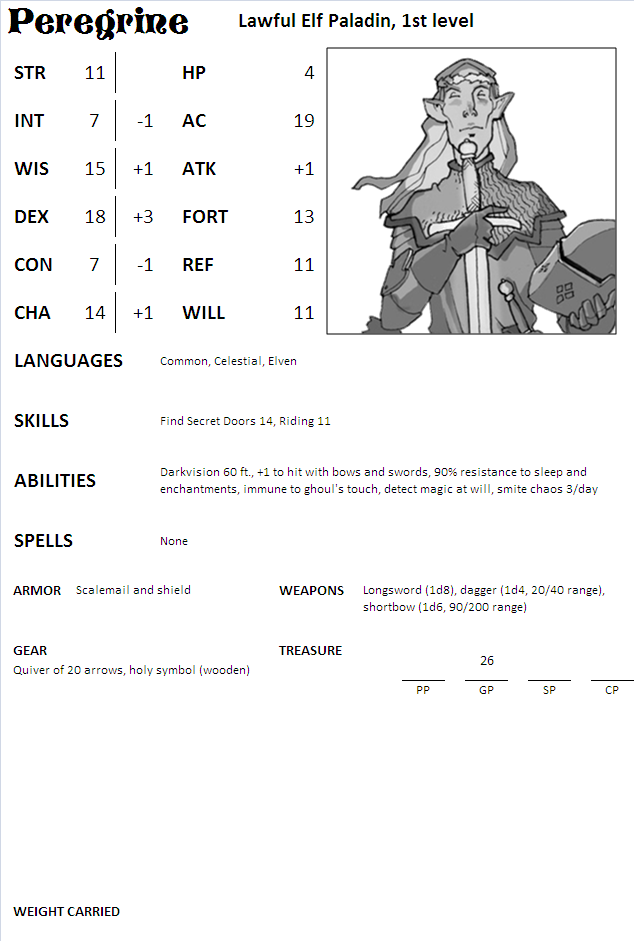
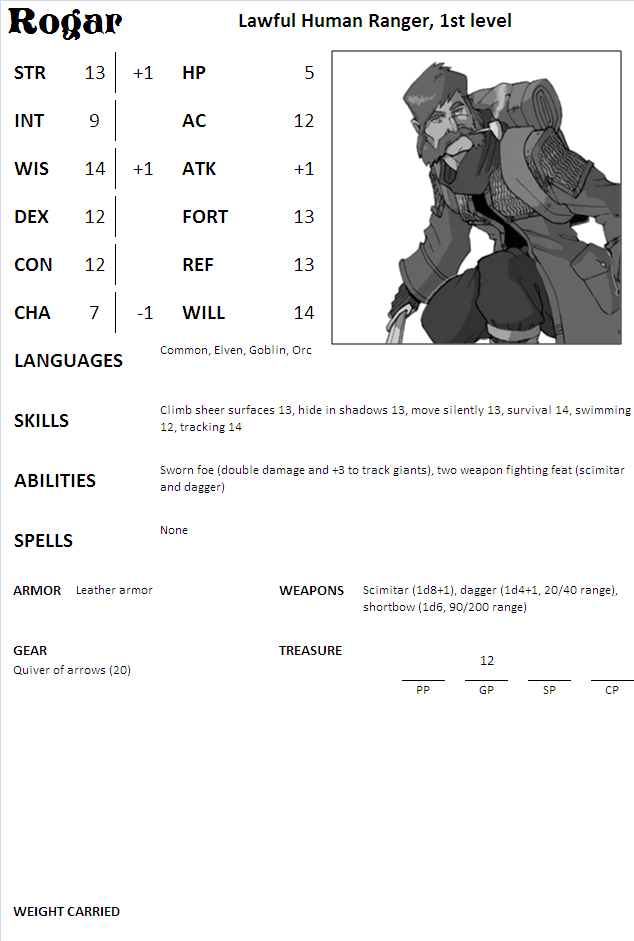
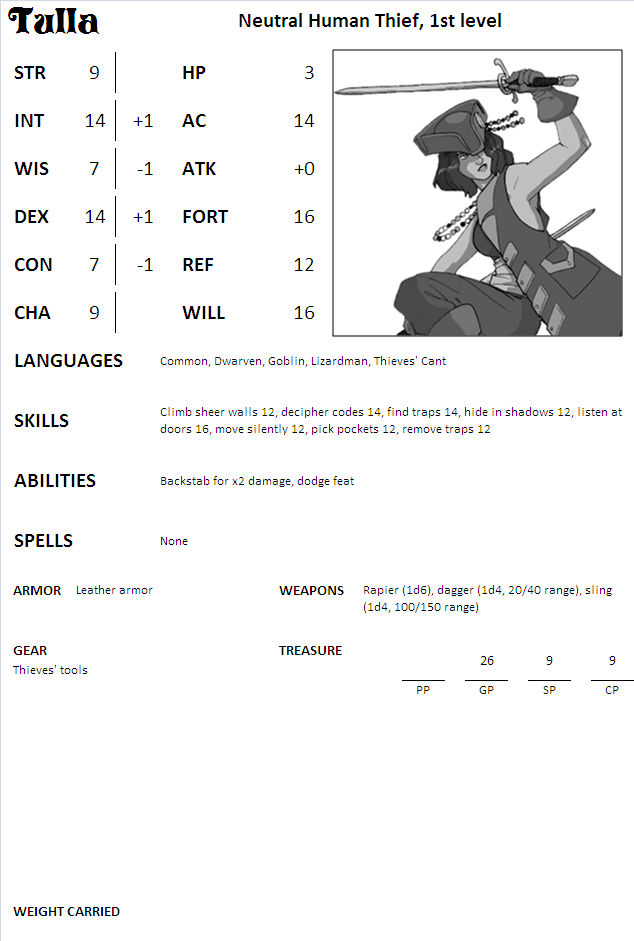
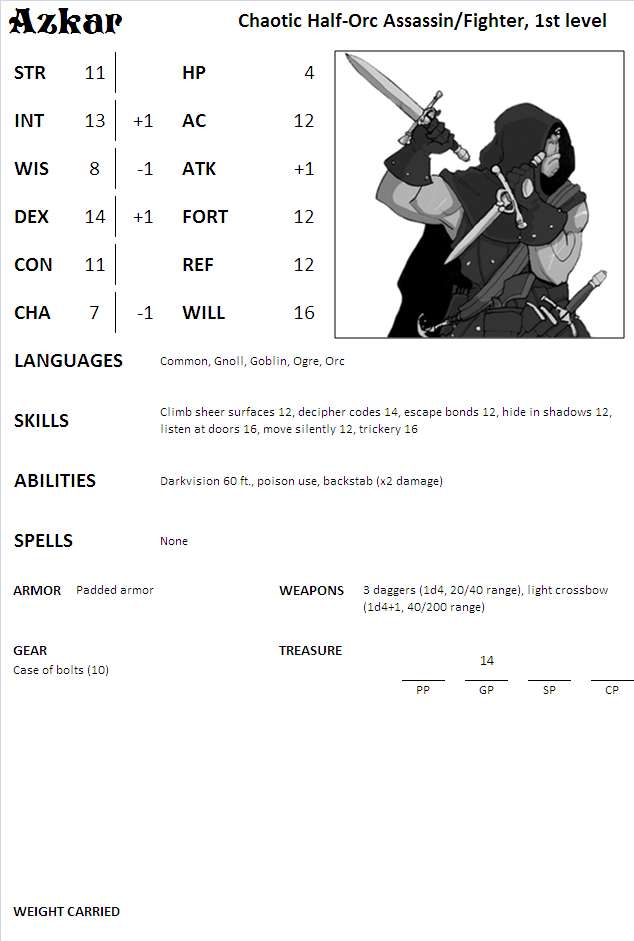
I’m also working on some pre-gen characters (see below) – I know, the equipment doesn’t always match the art … c’est la vie. I only bought weapons, armor and equipment required by the class – the players could spend the rest of the money on adventure supplies (a good time to learn about the importance of logistics!)


Dragon by Dragon – December 1977 (11)

Merry Christmas 1977! I would have been five, having my first Christmas in Las Vegas and opening, well, I have no memory of what I received for Christmas when I was five. I’m sure I was stoked. What were Dragon magazine subscriber’s opening?

First and foremost … best cover yet. A wagon of startled doxies pulled by God-knows-what is accosted by a red-robed dude and his captive troll while the triple-flail-armed driver looks on. Nice! Painted by Elrohir.

Second … an ad for newly released miniatures of the various demons plus Orcus and Demogorgon. The Type VI looks more like “naked guy with wings” than they are typically portrayed, which I think makes him creepier than the “OMG DEMON!” look.

Big announcement from Tim Kask … Dragon is going monthly! Oh, and they’re finally sending checks out to authors and artists! He also announces coming fiction in The Dragon from L. Sprague DeCamp and Andre Norton, as well as fiction from Fritz Leiber in this issue.

Gygax now chimes in with a defense of TSR defending its intellectual property from cheap and crappy imitations and outright theft in the form of reprints of D&D material. He has some nice words for GDW, but seems to be telling everyone else to piss off. He also mentions the coming release of the AD&D Monster Manual and future release of other AD&D material.

Enough announcements and editorials … let’s get to the gaming.

Rob Kuntz presents a system for Brawling (The Easy Way “Out” in D&D) which, at first glance, is way more system than I need. Brawling and grappling are always a problem, it seems, because they offer the chance of knocking someone out or disabling enough to make them an easy kill, thus tons of extra rules. This one compares ability scores of the fighters to get a modifier, and then a dice roll to score “damage” to one of the ability scores. Grappling, for example, involves averaging the dexterity and strength of both combatants and comparing them on a grapple table, then rolling 2d6 to discover how it works. Punching is similar, but determines the amount of damage.

Tony Watson then explains how to stop good old O.G.R.E. (not the monster, the mega-death machine) – basically tips and tricks for the game. I played it once, O.G.R.E. won, and my yen to play O.G.R.E. was satisfied.

In the Design Forum, Thomas Filmore, who opines on the value of role playing in D&D, as opposed to just wargaming. Pretty common blogpost material here, but perhaps a rather new concept back in the day, when many characters did seem to be more about puns and action than deeply invested backgrounds (i.e. the good old days).

Archive Miniatures has an ad for Star Rovers – 25mm miniatures. I dig the names of the figures, all of whom would be at home in a game of Space Princess: Planetary Scout, Funky Robot, Andromeda Annie, Bianca Snow, Doc Crock, Galactic Centaur, Alien Lizards, Walktapus (pre-Runequest?) and Sassanid War Elephant. Wait, Sassanid War Elephant? Why not.

MAR Barker continues answering reader questions in his Seal of the Imperium article.

Next up are some expansions to the Snits game that was featured last issue. Apparently the snits took the world by storm.

The Sorcerer’s Scroll is a new feature, and this first one is written by Rob Kuntz. Here, he mostly goes into the new Monster Manual (with “stupendous art by David Sutherland, David Trampier and Tom Wham”) and the eventual release of ADVANCED DUNGEONS & DRAGONS (I forgot that it was always written in all caps (“Fighters will now take 10-sided dice to determine their hit points and clerics 8-sided, etc.”). He also mentions Judge’s Guild, who continues to “saturate the D&D market with new variants” (and that TSR has undertaken to “make their new rule variant/additions … much more refined and interesting to the hard core D&D player” – I don’t like the sound of that). He has some kind words for Chivalry & Sorcery, but explains that it falls short due to its “smallish” print.

Fritz Leiber is next with Sea Magic. An excerpt:

“On the world of Nehwon and in the land of Simorgya, six days fast sailing south from Rime Isle, two handsome silvery personages conversed intimately yet tensely in a dimly and irregularly lit hall of pillars open overhead to the darkness. Very strange was that illumination — greenish and yellowish by turns, it seemed to come chiefly from grotesquely shaped rugs patching the Stygian floor and lapping the pillars’ bases and also from slowly moving globes and sinuosities that floated about at head height and wove amongst the pillars, softly dimming and brightening like lethargic and plague-stricken giant fireflies.”

Ral Partha’s new releases would make a nice random encounter list:

2. Gremlin War Party (3d6 winged goblins with spears)
3. Dwarf Lord (6th level dwarf fighter with chainmail and battle axe)
4. Satyr (Pan) (1% chance the encounter is with Pan, otherwise 1d6 satyrs)
5. Centaur Archer (1d8 centaurs armed with shortbows)
6. Land Dragon with Captain (treat land dragon as wyvern without wings, captain is 5th level fighter with splintmail, shield and lance)
7. Land Dragon with Lancer (lancer is 1st level fighter with breastplate, lance and shield)
8. Witch (female magic-user level 1d4+2; males must pass Will save or be fascinated with her breasts)
9. Monk (1d6 first level monks armed with staves)
10. Sprite War Band (3d6 sprites with swords led by 3rd level sprite fighter on fey mount)
11. Imp War Party (2d6 flying monkeys with sword or axe, shield and breastplate)
12. Were Bear (1d4)
13. Wing Lord (winged 3rd level fighter with spear and scale mail)
14. Paladin (dismounted) (5th level paladin with war harness (+2 AC), shield, pole axe and HUGE wings on his helmet)
15. Armored Knight (dismounted) (4th level fighter with platemail, shield and halberd)
16. Roomen War Party* (2d6 roomen with shield and spear)
17. Earth Demon (combo of stone giant and earth elemental)
18. Undead War Band (3d6 skeletons armed with swords, scythes and spears)
19. Woman Plunderer (1d6 levels of female barbarians with swords and chainmail)
20. Roll two times on table

* They’re freaking mutant kangaroo warriors!

Roomen (N Medium Humanoid): HD 1+1; AC 13; Atk 1 weapon (1d8) or kick (1d4+1); Move 40; Save F 13, R 15, W 15; XP 50; Special: Bound 60 ft. as charge attack.

James M. Ward now presents Quarterstaff Fighting Rules. This is like a mini-game that could be integrated into a normal game of D&D – somewhat like the jousting rules from Chainmail.

In Tramp’s Wormy, Wormy asks a bunch of dwarves “What wears chainmail and looks like black pudding?” – any guesses?

In Fineous Fingers, the adventurers discover that the evil wizard Kask has forced the local hobbits to try to conquer the city by capturing their princess.

The issue ends with a withering critique of NBC’s The Hobbit, by Rankin-Bass. I know, not the best adaptation, but I dig the design on the wood elves.

Overall, an issue that leaves me of two minds. I’m a big fan of Leiber, so the short story was cool. The EPT and O.G.R.E. stuff is not really aimed at me, so no complaints there. The brawling and quarterstaff fighting are nice mini-games/sub-systems, but probably not things I would include in my regular D&D game. Strangely enough, it’s often the ads that I’m enjoying the most – little snippets of creativity with no rules/stats attached. There’s the suggestion that in 1977, the creative energy of D&D is slipping away from TSR – they have some pretty good modules left in them, of course, but things are becoming more controlled and professional, and that carries with it a price to pay.

Inspiration from Old Cartoons

The beauty of public domain cartoons is that they come from a time when pop culture was bat-shit insane – and I don’t mean the calculated, “trying to damn hard”, imitation insane we get so much of these days.

BALLOON LAND (1935)

Here’s a great demi-plane to introduce your characters to, especially if they need something from the inhabitants that they cannot get by means of violence. And wouldn’t you love to pit them against the Pincushion Man.

CANDY TOWN (1931 or 1933)


Another odd demi-plane to hide behind the next magic mirror in your camapaign.

BIMBO’S INITIATION


This is one of the great weird cartoons ever made. Talk about your mythic underworld!

SUMMERTIME (1935)

I’ve always thought a campaign world where this sort of thing determined the season would be a fun one to challenge players.

THE SUNSHINE MAKERS (1935)

The distilled sunlight potions are excellent, especially if you have a stereotypically dour dwarf in the party.

TO SPRING (1936)

Another in the vein of Summertime, this one with subterranean elves who color the flowers in the springtime.

Cush – Introduction

Okay, I haven’t officially published the last piece of the Hellcrawl (about 1 more week and it’s live), but I’ve already moved on to … Cush! The next hexcrawl project is Cush and Pwenet, pieces of an Africa-themed chunk of Nod. I’m quite excited about this one – probably a good bit of art to commission (which means I’m losing money on this baby), but there isn’t much Africa-themed RPG stuff out there, and it’s a pretty rich vein to mine for adventure. Anyhow – what follows is a quick look at the different geographical regions to be covered and the full Map J12 – the eastern half will be covered in NOD 16, the western half in NOD 18, and NOD 17 will cover the city-state of Ixum. Enjoy!

Click to enlarge – or don’t, it’s up to you

HISTORY
During the Pandiluvian Age, the jungle portions of Map J12 were under water, while the Jamba Highlands constituted a chain of islands the connected to the large archipelago of the modern Wyvern Coast. The savanna of Pwenet was a land of salt marshes and grassland. The so-called elder things built small fortresses in these shallow waters to protect their larger cities in the depths. These fortresses were built with a cyclopean, luminous green stones that were fitted without mortar. Although they were hunted for sport, some mermaids established themselves in sea caves and placid island lagoons.

When the waters receeded, the swampy grasslands became a savanna and the Cush basin became a dismal, tropical swamp. It was here that the lizard men, former servants of the elder things, established themselves in walled city-states, often surrounding the citadels of their former masters. Humans from the highlands were enslaved and put to work building defenses, for the lizard kings were constantly at war with one another, their society on its inevitable march to savagery.

As the waters continued to recede and Cush became a rain forest. The savage lizard men were eventually defeated by the more numerous and clever humans and driven into the coastal swamps or into the underworld. Freed from slavery, the humans established themselves in the homes of their former masters and took up where they left off. But unlike the lizard kings, who spent centuries locked in a stalemate, one human city-state, Kolos, soon brought the others to ruin.

Kolos was ruled by an exiled Atlantean who became fascinated with the alien gods of the lizard men, especially the one they called Mictlantecuhtli. Mictlantecuhtli called out to the Atlantean from the Abyss and bound him to his service with dark, unspeakable pacts. In time, the Atlantean, now known as Kolos, would destroy his city-state in a bid for godhood.

With Kolos fallen and soon swallowed by the jungles, its tributary port, Zinj, assumed the mantle of leadership in the region. But Zinj was tiny compared to the Kolos, and its interest lied in sea trade, not the fetid jungles. Except for a brief period as a subject of the zebra-striped people of the Zebrides, Zinj has remained an independent kingdom for centuries, even briefly lording it over the purple kings of Ophir after they lost their key trade partner in the invoked destruction of the Nabu.

The tribesmen of the savanna land called Pwenet also flourished during the Silver Age. They built villages and towns of adobe and kept massive herds of cattle. They even swept over the Nabu empire and held it for a few decades before decadence and in-fighting aided the Nabu in reclaiming their sovereignty.

GEOGRAPHY
Map J12 is dominated by a hot, steamy jungle in the west and the rolling grasslands of Pwenet in the east. These two regions are divided by the Jamba Highlands, a small mountain range that feeds the Jamba River. The Adze Marsh runs for many miles along the Jamba River.

A powerful necromantic kingdom called Kolos once dominated Cush and made war with the Nabu Empire to the north. While the fall of the Nabu Empire is well documented, the disappearance of Kolos is far more mysterious, and many adventurers have entered the jungles intent on finding that lost city-state and plundering its vaults. To date, none have succeeded in returning to civilization with their lives, let alone any riches.

Map J12 has no city-states of its own. The nearest city-states are Zinj (Map I12) and Ophir (Map J11), both coastal ports. It does have a multitude of villages and supports many sentient cultures, including human tribesmen, pygmys, lizardmen and gnolls.

Adze Marsh & Jamba River
The Adze Marsh, named for one of its more dangerous inhabitants is a vast wetland composed of flat lands, lagoons and copses of trees. The area floods in the Spring, hiding much of the flat land and making the entire swamp a virtual lake.

Cush
The jungle of Cush consists of a gently sloping plain between the Tonaduhna and Jamba Rivers. It is a traditional rain forest. The trees are thick and grow close enough together to blot out the sun. Beneath the canopy live a myriad of insects and reptilian carnivores as well as pygmy deer, elephant, and the dreaded leopard. Cush is valued for its exotic hardwoods (teak, mahogany, ebony and darkwood), orchids and fauna.

AMAZONS: The amazons of Cush are related to their more northern cousins. Like their cousins, they live in a matriarchical society. Unlike their cousins, they allow their menfolk to live in their villages and work as craftsmen, farmers and fishermen. Men and amazons live in separate halves of the village.

The amazons of Cush wear little or no armor, with the heaviest armored warriors (the nobility and their elites) wearing leather armor cured from the hides of mystical beasts (5% chance of dragonhide leather armor). Cushite amazon warriors carry spears, throwing irons and shields.

BERSERKERS: The berserkers of the jungle are cannibals. They appear as normal humans, but with teeth sharpened to points and hungry, feral looks in their eyes. The cannibals of Cush live in small hunting groups of 10 to 20 warriors led by a 3rd to 6th level chief and two 2nd level sub-chiefs. They wear no armor, but 50% of the berserkers carry a shield. Cannibals are armed with nets, battle axes, hand axes or short swords.

GHOULS: The ancient city-state of Kolos fell in a cataclysm of dark sorcery, tainting the surrounding land with necromantic energies. Over the next few months the peasants and knights of Kolos, deprived of their city-state, perished. Those who survived did so on the flesh of their fallen neighbors, and thus became ghouls. These ghouls, known for their dull black skin and pot bellies, still haunt the ruins of the jungle basin. They are extremely aggressive (as they’ve been starving for centuries) and are quite resistant to turning (turn as 4 HD undead). About 1% of ruins contain a ghoul able to summon a vrock demon (25% chance of success).

TRIBESMEN: The tribesmen of Cush know the secret of working iron and mine and smelt surface deposits from sacred out-croppings guarded by traps and summoned cacodaemons. Their witchdoctors are expert brewers of poison, so most warriors go into combat with poisoned darts (poison I) fired from blowguns.

The tribesmen are also privy, it is said, to the location of ancient gold mines secreted deep in the jungle and guarded by forgotten curses and fell magical beasts.

Each tribe consists of 3d10 x 10 warriors and additional non-combatants equal to 5 times the number of warriors. For every ten warriors in the tribe there is one “Big Man” with 1d4 character levels, usually in the fighter class. The tribe is ruled by a 6th to 10th level chief and witchdoctor (usually an adept, but 10% chance of being a 4th to 7th level druid or cleric). The chief is accompanied by 1d6+6 2nd level fighter bodyguards.

All tribesmen have a very fluid fighting style, giving them a base AC of 11. Tribesmen typically wield spears and blowguns, but might also carry hand axes, short swords, daggers and short bows. Leader types might carry battle axes or long swords.

VEGEPYGMIES: These strange plant beings are approximately 3 feet in height with rust-colored skin. They are primitive in nature with a chittering language incompre-hensible to non-plant men. Vegepygmies are usually encountered in small hunting bands. Vegepygmy tribes number from 1d4 x 30.
Vegepygmy warriors usually carry spears and throwing darts covered with a rust-colored mold. The mold deals no extra damage, but does begin to grow on the flesh of those hit by the darts who fail a saving throw. After the first day, the mold begins dealing 1 point of constitution damage each day as it produces enzymes which begin liquifying the host’s body. When the host is reduced to 0 constitution, he is little more than a pile of mush, upon which several “infant” mold men begin to grow. Once the mold begins to grow, it can only be destroyed with fire or a remove disease spell.

Jamba Highlands
The Jamba Highlands are a group of snow-capped mountains and their foothills that rise above the jungle of Cush and the grasslands of Pwenet. The tribesmen believe they are the abode of their gods. This belief is bolstered by the strange, white gorillas that seem to guard the passes that lead through the mountains.

The highlands feature a plethora of simians and avians. Old stories claim that the mountains are rich in precious stones and metals, but they are far enough away from civilization that nobody has made a serious attempt to mine them.

Pwenet Grasslands
Pwenet is a land of rolling hills with scattered copses of aromatic trees and a few rocky outcroppings. Large herds of ruminants travel from watering hole to watering hole while being stalked by giant centaurs, lions and even more fantastic predators. Pwenet is said to hold both a fountain of youth and the source of the River Ish, thus making it a popular destination for explorers.

A few merchant-adventurers from Ibis travel to Pwenet once a year to trade manufactured goods for aromatic resins, ivory, darkwood and wild animals. Otherwise, the region is untouched by the people of Lemuria and the Motherlands.

Though not the most numerous, the giant centaurs of Pwenet are the region’s most prominent folk of the hills. Pwenet is also home to many tribes of gnolls and humans. The largest tribes, human and gnoll both, provide most of the region’s drama as chiefs and witch-doctors jockey for power and recognition.

Oft told tales tell of when the tribes of Pwenet united under Jobo the Great and conquered the cities of Nabu. The people of Pwenet believe that history is a cycle and that they will once again conquer the outside world when a great leader united them.

CENTAURS: The centaurs of Pwenet look like a cross between humans and giraffes rather than humans and horses. Pwenet’s centaurs are larger and stronger than normal centaurs, but also more calm and level-headed. They carry large shields and pikes.

DWARFS: The dwarfs of Pwenet are only distantly related to the dwarfs of Antilia and Thule. They have pitch-black skin and eyes and small beards of wiry, black hair. Like other dwarfs, they dwell under-ground in burrows protected by all manner of traps. The natives of Pwenet call them the utu.

The utu have different abilities than other dwarves. Their eyes allow them to see in the brightest light and blackest darkness, including magical darkness. Their skin is as hard as granite and provides them a natural armor class of 14. Utu characters have a +1 bonus to constitution and a -1 penalty to intelligence. The utu carry shields and swords made of darkwood studded with shards of jade.

Utu dwarves worship Khnum, the divine potter, creator of the universe. Khnum’s clerics are curious about the universe and spend most of their time recording their observations on clay tablets. Where other dwarfs are expert at the forge, the utu are experts working with wood and clay. Their pottery is valued by the people of Ibis.

The utu are learned in the art of conjuring spirits, from whom they obtain most of their knowledge. All non-player character utu clerics can use the spell contact other plane once per month, when the stars are aligned.

Once every century a lucky cleric is able to make contact with Khnum himself to deliver a great prophecy to all the peoples of Pwenet. On these occaisions the dwarves sound their drums and blow long horns made from hollowed darkwood trees to call all the tribes to hear the prophecy. All the great chiefs of Pwenet heed this call and travel to the appointed place with their retinues, sworn by tradition to observe a full week of peace while the ceremonial dances are performed, lineages are recited and finally the prophecy is pronounced. The coming of the current princess of the Quiet Folk, avatar of the great earth mother, was pronounced at the last convocation, and the next prophecy is due to come in the very near future.

Need Battle Maps?

So, a couple days ago, I got an email from the folks at EncounterMaps.com letting me know about a Kickstarter project they have going to make some high quality battle maps. Now, I’m an old schooler, so my battle maps are usually in my head or constructed with such high-quality props as books, dice, bottle caps and pennies, but I looked at the Kickstarter page and must say I’m impressed with the artwork of their cartographer, Jared Blando.

So, for my “new school” readers and those old schoolers who dig nice-looking maps, you might think about throwing some dollars their way.

Battle of Gaudin’s Ford – Final Rounds

You didn’t think I forgot about the battle, did you? Of course, since today is the 4th of July, I wish I’d pitted Red Coats against Yankees, but I’ll have to settle for halflings and orcs.

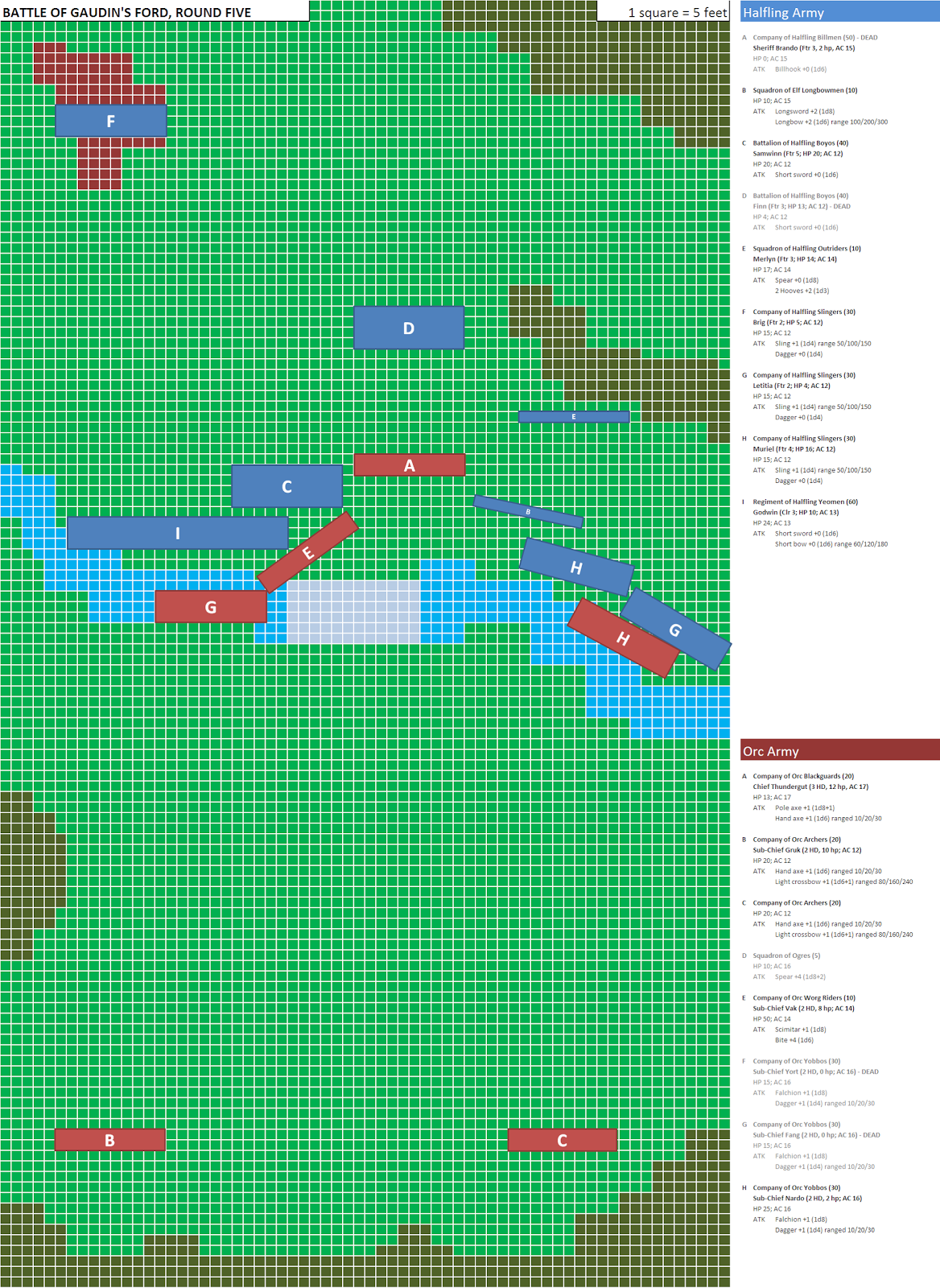
ROUND FIVE

Click to enlarge

The halflings and orcs both find themselves in an interesting predicament with the annihilation of the billmen. The orcs should want to follow it up and charge in … but then they’re surrounded by angry halflings. Likewise, the halflings should want to plug the hole … but then a company of boyos has to take on the orc blackguards all by its lonesome. What to do?

The halflings decide to do the following … the surviving sheriff will retreat back to the safety of Halfling C. Those companies will stay put. The elves would really like to fire their bows at those orcs, but instead they’re going to wheel back a bit. The other halflings are going to hold their ground. All of the halfling’s with missile weapons, except Halfling I and Halfling G, are going to concentrate fire on Orc A. Halfling I is going to fire on Orc G and Halfling G is going to fire on Orc H.

The orcs decide, in true orky fashion, to charge. Orc A is going to charge in to Halfling D – if Halfling B gets in the way, they’ll hack down the elves first. This will, they hope, free up Orc E to slam into the side of Halfling I, along with Orc G. Orc H is going to attack Halfling G. Orc B is going to fire at Halfling F and Orc C at Halfling E.

So, how does it play out?

Missile Phase
Since the last report, I’ve modified the rules a bit to use normal side vs. side initiative which has to be re-rolled for each phase. For this missile phase, the orcs roll a ‘6’ and the halflings a ‘5’.

The orc crossbows let fly their bolts. Orc B scores no damage on Halfling F. Orc C inflicts 7 points of damage on Halfling E, whose leader, Merlyn, rolls his save and suffers no damage.

Orc A suffers 7 points of damage. Thundergut saves and suffers no damage. They’re battered, but they didn’t break! Halfling G scores 2 points of damage on Orc H, and sub-chief Nardo saves, so no damage. Halfling I is pretty ineffective against Orc G, scoring 5 points of damage. On the plus side, this is enough to force a moral check! The orcs, without their leader, fail the check and will begin moving away next round. The worg riders, who have been ordered to attack Halfling I, might be in trouble.

Movement Phase
Orcs roll “1” and Halflings roll “1” – they re-roll initiative and this time the halflings win.
The elves move back, and everyone else holds. The orcs now have two forced moves. The Orc G swims for their own side of the river, while the fleeing ogres in Orc D run off the battlefield. Orc A charges into Halfling D, Orc E wheels into the flank of Halfling I and Orc H rushes up the river bank to attack Halfling G. Plenty of melee combat this round!

Melee Phase
Orcs gain initiative this round, and they’re going to need it with three units already having fled or being in retreat.

Orc E plunges into Halfling I and scores 6 points of damage. Because they’re hitting the far flank, I’m going to rule that Father Godwin doesn’t have to save to avoid damage this round.

Orc A works their magic again … 14 points of damage on Halfling D. Finn, the leader of Halfling D, fails his save and is killed in the onslaught. The halflings now have to roll a morale check – they fail, and turn to flee. Because they’re in melee combat, they expose themselves to pursuit and an extra attack. The orcs score another hit, this one for 2 points of damage, reducing Halfling D’s hit points to 4.

Orc H, scrambling from the river fail to score any damage on Halfling G, who responds by scoring 3 points of damage on the yobbos.

Halfling I now counterattacks Orc E. They fail to score any damage.

No magic this round, so we go to …

Click to enlarge

ROUND SIX
The halflings know they have to destroy Orc A to break the orc army. To that end, Halfling C is going to wheel and attack their flank while Halfling E does the same from the other direction. Halfling B is going to wheel back and wait for an opening. Halfling H is going to join battle with Orc H. Halfling F sling their stones at Orc B. Halfling I is going to maneuver while in melee – essentially, they’re going to change formation this round into a square.

Orc B and C are not going to reload this round, but rather hustle towards the lines. The orc chief needs orcs on the line to hold the bank and claim victory. Orc E and H are going to continue to attack, and Orc A is going to wheel and hit Halfling C in its flank. Clearly, initiative will be important this round.

Missile Phase
No initiative this round, since only the halflings are shooting. Halfling F scores 5 points of damage on Orc B. Sub-chief Gruk fails his save and suffers the same – he’s a tough old bird, though, and keeps on breathing.

Movement Phase
Big initiative roll this round, and the orcs win it! Orc B and C move forward. They might end up being too late to do any good. Orc A wheels and moves into Halfling C’s flank. Orc G makes it out of the water on their way to flee the field.

Meanwhile, Halfling D continues to flee and Halfling E wheels and charges into the rear of Orc A. Halfling B wheels and moves back. Halfling H moves to attack Orc H.

Melee Phase
Orcs lose initiative this time to the halflings. The plucky Halfling C, flanked by the orcs, manages to score 2 points of damage on the blackguards. Halfling E, despite a rear attack and charge, score no damage. The orcs still have 11 hit points, so they don’t have to check morale yet. But the halfling leaders do some damage as well. Samwinn and Merlyn inflicts another 2 hit points of damage on Orc A – now they have to make a morale check and fail badly. This is probably it for the orcs. They immediately flee back for the river ford, and Halfling E pursues (C choose not to), but fails to score any more damage. Thundergut failed his save, and suffered 4 points of damage as well.

Halfling I continues to fight at a disadvantage against Orc E, and scores no damage.
Halfling G and H attack Orc H, combining for 4 points of damage (tough little buggers, those halfling slingers). Sub-chief Nardo fails his save this time, and takes a shiv to the ribs. He’s dead, but I’ve rewritten the rules so that the loss of a leader does not necessitate a morale check.

The orcs (what’s left of them) counterattack. Orc E scores 8 points of damage on Halfling I. They’re one point away from a morale check. Orc H scores 2 points of damage against Halfling G. Muriel fails her save and suffers 2 points of damage. Halfling G is down by at least 50% of their hit points, so they roll a morale check and pass. They stand and fight.

No magic again, so the end of round six!

EPILOGUE
At the end of Round Six, the battlefield is a bit chaotic, but the halflings seem to have the upper hand. Even if Thundergut rallies his blackguards, they’re going to have trouble turning the tide. We’ll give this day to the halflings. I learned quite a bit from this little demonstration, and I’m now ready to apply what I learned to the final mass combat rules in Blood & Treasure.

Blood and Treasure … I’m Kinda Done

Over the weekend I finished writing Blood & Treasure. Yippee!

Up next is the final editing, which I’m beginning now (I also have a few illustrations I’m waiting on – and thanks to Jon Kaufman and Ndege Diamond for their work in this area, and of course Tanner Yea for his editing prowess) and hope to finish in about a week. After that, I create some PDFs and begin selling them while I wait for a hard copy to review – I’m trying to use the thinnest margins possible to keep the overall page count of the books as low as possible, but if the result is hard to read/use, I’ll have to fix the layout.

Anyhow, I though that people who are interested in the project might like to the a quick and dirty version of the table of contents (note: not actual TOC – I can’t really do that until I have something physical to work out the page numbering) for this beast:

I. Getting Started

II. Characters
Ability scores
Races (human, dwarf, elf, gnome, halfling, half-elf, half-orc)
Classes (assassin, barbarian, bard, cleric, druid, duelist, fighter, magic-user, monk, paladin, ranger, sorcerer, thief)
Multi-Classing
Changing Class
Feats (optional rule)
Equipment
Henchmen & Hirelings
– Adepts
Character Details
– Alignment (3-fold and 9-fold)
– Alignment languages
– Personality and description
Strongholds
– Selecting a domain
– Clearing a domain of monsters
– Designing a stronghold
– Establishing your rule (includes random events)

Web spell by Jon Kaufman

III. Magic
Arcane Spells
Divine Spells
Spell-Like Abilities
Arcane Magical Writings
Spellbooks
Spellcasting
Magical Research
Spell Descriptions (627 spells)

IV. Rules of Play
Time
Movement
Encumbrance
Saving Throws
– Item saving throws
Survival
– Starvation and thirst
– Light
– Falling
– Disease
– Poison
Conditions
Heroic Tasks
– Bend Bars
– Break Down Doors
– Balance
– Climb Sheer Surfaces
– Decipher Codes
– Escape Bonds
– Find Secret Doors
– Find Traps
– Hide in Shadows
– Jump
– Listen at Doors
– Move Silently
– Open Locks
– Pick Pockets
– Remove Traps
– Riding
– Survival
– Swimming
– Tracking
– Trickery
– Skill Points (optional rule)
Encounters
Combat
– Initiative
– Combat Actions
o Melee Attacks
o Ranged Attacks
o Hitting in Combat
o Charging
o Fighting Defensively
o Tactical Advantage
o Special Attacks
o Fighting with Two Weapons
o Running Away
o Mounted Combat
o Underwater Combat
o Turning Undead
Damage and Death
– Hit Point Damage
o Alternate Dying Rules
– Ability Score Damage & Drain
– Energy Drain
– Healing
Mass Combat
Naval Combat
Example of Play

V. Adventures
Dungeons
– Mapping
– Dungeon Walls
– Dungeon Floors
– Dungeon Doors
– Dungeon Rooms
– Dungeon Corridors
– Other Dungeon Features
– Cave-Ins
– Slimes, Molds & Fungi
– Traps
– Running Dungeon Adventures
– Random Dungeon Chamber Generator
Wilderness
– Designing a wilderness
– Wilderness encounters
– Wilderness movement
– Wilderness combat
– Wilderness dangers
– Random Wilderness Hex Generator
Civilization & Settlements
– Vistas
– To map or not to map
– Goods for sale
– Rulers
– The long arm of the law
– The dogs of war
– Notable citizens
– Random encounters
– Urban adventure hooks
– Random Settlement Generator
The Planes
– Planar traits
– Elemental and energy traits
– Alignment traits
– Magic
– How planes interact
– One possible cosmology

VI. Monsters
Monster Size
Monster Type
Monster Intelligence
Monster Organization
Other Stats
Special Attacks and Abilities
Making Monsters
– Reskinning
– Modifications
– Creating a new monster
Monster Encounters
Monsters as Characters

Xaoc by Ndege Diamond

Monster Descriptions (538 monsters)
A – Aasimar to Azer (31 monsters)
B – Baboon to Burrawog (35 monsters)
C – Cecilia, Giant to Cyclops (32 monsters)
D – Dark Creeper to Dwarf (79 monsters)
E – Eagle (Hawk) to Eye of the Deep (15 monsters)
F – Flail Snail to Frost Worm (6 monsters)
G – Gargoyle (Kapoacinth) to Grue (41 monsters)
H – Hag, Annis to Hyena (26 monsters)
I – Ice Giant to Iron Cobra (8 monsters)
J – Jackalwere to Juggernaut (3 monsters)
K – Kobold to Krenshar (2 monsters)
L – Lamia to Lynx, Giant (27 monsters)
M – Magmin to Mushroom Man (19 monsters)
N – Naga, Dark to Nymph (15 monsters)
O – Ochre Jelly to Owlbear (9 monsters)
P – Pegasus to Purple Worm (23 monsters)
R – Rakshasa to Rust Monster (16 monsters)
S – Sahuagin to Sylph (50 monsters)
T – Tarrasque to Turtle, Giant (21 monsters)
U – Udoroot to Uvuudaum (5 monsters)
V – Vampire to Violet Fungus (5 monsters)
W – Walking Slime to Wyvern (14 monsters)
X – Xaoc, Achromatic to Xorn (9 monsters)
Y – Yeth Hound to Yrthak (3 monsters)
Z – Zombie (1 monster)
Templates – Beastman template to pseudonatural template (12 templates; 40 sample monsters)

VII. TreasureCoins
Gems
Art Objects
Magic Items
– Using items
– Size and magic items
– Charges, doses and multiple uses
– Creating magic items
– Magic Armor
– Magic Weapons
– Potions and Oils
– Rings
– Rods
– Scrolls
– Staves
– Wands
– Wondrous Items
– Intelligent Items
– Cursed Items
– Artifacts

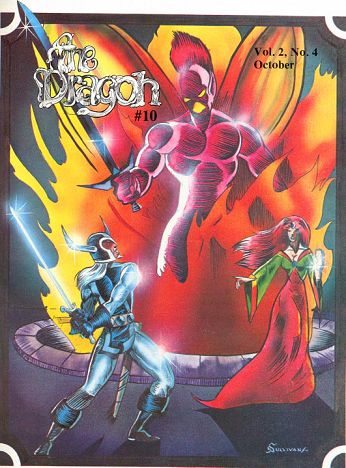
Dragon by Dragon – October 1977 (10)

Can you feel the chill in the air – that crisp chill of Autumn? Well, of course not. It’s July in the here and now, and just reading a magazine from October isn’t going to change that unless you have a rather powerful imagination or have been dipping into the pseudo-pharmaceuticals. Let’s see what Gygax & Co. had in store for us 35 years, when the leaves of Lake Geneva were beginning to change*

October 1977 starts off with a firecracker (mixing my seasons again), as Jon Pickens presents D&D Option: Orgies, Inc. The Mule Abides has already brought this article to prominence in the OSR, but I think it’s worth mulling over again.

The article posits the problem of too much wealth in the game. To this end, Pickens decided that treasure should only be translated into XP when it was spent. Since you can only have so many suits of platemail, 10-ft. poles and weeks of iron rations, players need something else for which to spend their gold. Pickens provides the following avenues of expenditure:

1. Sacrifices: Gold given directly to gods or demons; any character can do this
2. Philanthropy: Lawful’s can give gold to charity – but not to hirelings or fellow PC’s, of course
3. Research: This is for magic-users and alchemists.
4. Clan Hoards: Dwarves and other clannish folk can give their money to their clan.
5. Orgies: Fighters (not paladins or rangers), bards, thieves and all chaotics (except monks) can spend their money on wine, women and song

There are, of course, additional guidelines to these expenditures (i.e. how much can be spent in a night or week, etc.), but I love the idea and the restrictions. Even better, he has two appendices to the article – one on gambling and one on the effects of orgies on psionics (and in my opinion, the mere existence of this appendix should make you want to include both orgies and psionics in your next campaign).

Izzat what a female goblin looks like?

Daniel Clifton has the task of following up on Orgies, Inc., and does so with Designing for Unique Wilderness Encounters. It’s a nice little article, containing random tables for determining what the terrain looks like when a few pesky wandering monsters show up in the wilderness. The tables generate the vegetation, slope, etc., but don’t provide any guidance for how this terrain impacts the battle, which is probably a good thing.

Paul Montgomery Crabaugh presents Random Monsters – by which he means monsters generated randomly, not random wandering monsters. Naturally, I need to generate at least one (which I suppose I really should include in Blood & Treasure):

Intelligence: Highly intelligent (I have a budding genius on my hands here!)
Alignment: Chaos
Type: Mammal (which means it might be a ninja)
Speed: 12
Armor Class: 7 (would have been a 6 if it was a reptile; for B&T it’s a 12)
Hit Dice: Level -2 (level being the level of the dungeon … hmm let’s pretend we’re on the 9th level of our dungeon, so 7 HD)
Hit Dice Modifier: +0 (so, 7 HD … odd that I need to roll for the HD and then roll to modify it)
Damage: 1d8

Now I need to roll for special characteristics, which is an odd percentile table. For a 7 HD monster, I’m going to assume it works as follows:

01-39 – none
40-74 – one
75-89 – two
90-100 – three

I roll a “92” (no, really, I swear it) and thus my monster has three special characteristics. I need to roll d24 for these (if you don’t know how to roll d24, I just feel bad for you) and come up with the following:

1. Hostile to clerics
2. Has anti-magic shell
3. Hostile to magic-users

I have a very hostile monster, apparently. But he doesn’t hate cans … he hates spellcasters. This makes his anti-magic shell make pretty good sense (ah, the wisdom of dice!)

I now roll another D% to see if it has “other characteristics”, and a roll of “61” tells me it does not (otherwise, it could have some insect characteristics).

Last batch of rolls determine the physical description:

Size: Medium (6 feet)
Limbs: 2 legs, 3 arms
Exterior: Feathers
Coloring: Spotted white and grey

So, what do we end up with?

ALMESITH
Medium Magical Beast, Chaotic (CE), High Intelligence; Gang (1d4)

Hit Dice: 7
Armor Class: 12 [7 for Swords & Wizardry]
Attacks: 3 claws (1d8)
Move: 30 [12 for Swords & Wizardry]
Saves: F 10, R 10, W 11 [9 for Swords & Wizardry]
XP: 700 (CL 8)

Almesiths are strange beasts that are spawned from the residual energies of powerful spellcasting, living embodiments of nature’s abhorrence of magic. They are most often encountered in the deeper levels of dungeons, and seek out spellcasters for destruction. Almesiths look something like owlbears, and can be mistaken for those sorcerous creations. They differ in size, being no taller than a man, coloration, being covered in dark grey feathers on their arms, legs and backs and softer, white and grey spotted down on their bellies, and in two additional curiosities: They lack mouths, having instead a stirge-like tubular beak that juts 3 feet from their faces, and in that they have a third arm that juts from their chest. Almesiths attack with their large, hooked claws, and generate a natural anti-magic field (as a 7th level caster) in a 60-ft. radius. In combat, they always focus their attacks on spellcasters (clerics, druids, magic-users and sorcerers first, bards second, assassins, paladins and rangers third), ignoring attacks by non-spellcasters even when it threatens to kill them.

In the Design Forum, Richard Gilbert presents Let There Be Method To Your Madness. This is another in the series of “dungeons should usually make some rational sense” articles; the attempt to bring the retro-stupid branch of the RPG world to heel that persists to this day. I think these two camps can best be described as Phoebe vs. Rachel.

Next up is a mini-game … Snit Smashing, in which a Bolotomus waits to smash the Snits that run from the ocean so they can plant their snotch in a Snandergrab. If the Snit player manages to multiply more rapidly than the Bolotomus player can smash them, he or she wins. For the Bolotomus to win, he or she must destroy all of the Snits.

When you’re through smashing snits, you can proceed to P. M. Crabaugh‘s next article, entitled Weights & Measures, Physical Appearance and Why Males are Stronger than Females; in D&D (weird use of a semicolon). If the feminists in the audience are getting their hackles up, they might want to read the article first, they might want to read the article first. The article posits an additional 3d6 stat – Size – which can translate into bonus hit points and a modifier to carrying capacity. Yeah, males get some extra carrying capacity … and females get a +2 bonus to Con and a +1 bonus to Dex, and men get called “thick-fingered clods with facial hair”. The old “trash men to keep the feminists from calling you insensitive names” ploy. A classic.

Beyond the ability modifiers, the article has a mess of random tables for generating a random appearance (did you know males have a 30% chance of having facial hair). I don’t know that I’d use this for generating a PC, but it could be useful for generating general ethnic physical and cultural characteristics, if you want to get away from “these people look like Vikings, and these people look like East Asians and these people look like …” trend in campaigns.

The next article is Gaining a New Experience Level by Tom Holsinger. He explains that what D&D and EPT really need is some sort of dangerous ritual for characters to undertake when they have enough XP to advance in level. To which I reply, “Huh?” Favorite line in the article:

“The sacrifice of humans is generally forbidden in a populated area because too many people get upset.”

The article is actually pretty tongue-in-cheek, and would make for an interesting campaign. Essentially, it creates a sub-game that involves getting the gods’ attention with sacrifices or sacrilege, then assuming the “proper physical and psychic attitude, i.e. complete exhaustion”, which, Holsinger assures us, can only reliably be done by becoming thoroughly inebriated, during which the Emissaries of the Gods, the Great Pink Elephants, come to the character and imbue them with their new Hit Dice and special abilities. The level limits for elves, dwarves and halflings are, he tells us, because they have a harder time getting drunk. It is also why high level characters move out of town and build castles – with more hit points, they have to get super shit-faced to attract the attention of the gods, and that might mean burning things down and causing other massive disruptions to the lives of the common citizenry. This article actually dovetails nicely with Orgies, Inc. and together they could make for one hell of a fun campaign.

Next up, Edward C. Cooper‘s The Tactics of Diplomacy in Stellar Conquest. Honestly, I don’t know the game and so I’m not going to comment on the article.

In Wormy, the eponymous dragon is contemplating stumping some angry dwarves with a riddle. They’re angry because Wormy stole their bowling balls to use on his pool table. Meanwhile, Fineous Fingers is under attack by a whole guild of murderous hobbits.

And that’s it for October 1977. Good issue, I think. I have to run and set up an inflatable pool now, but I have a couple neat ideas in store for next week. Oh, and I finished writing Blood & Treasure yesterday …

Would they be changing in October? I’ve lived in Las Vegas my entire life – Summer temperatures only finally end around the last week of October, and the leaves may not change here until well into December. Basically, I have no idea how seasons are supposed to work.