Deviant Friday – Laemeur Edition

Happy Veteran’s Day, folks – especially to any genuine veterans reading this blog. Thank You!

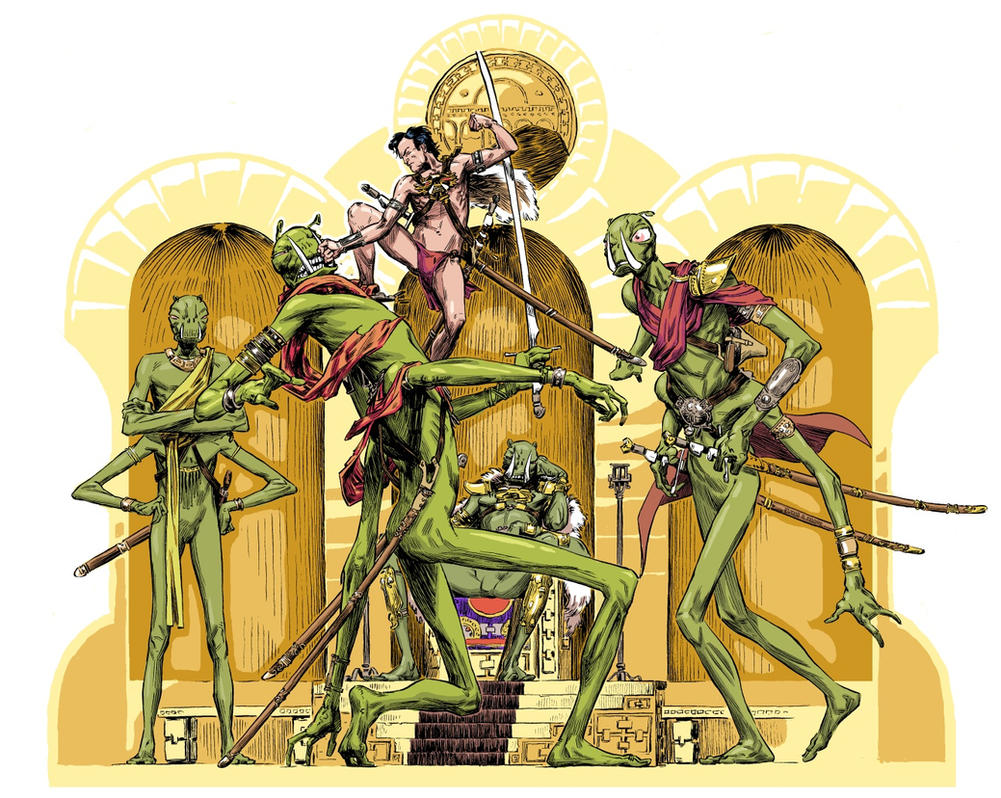
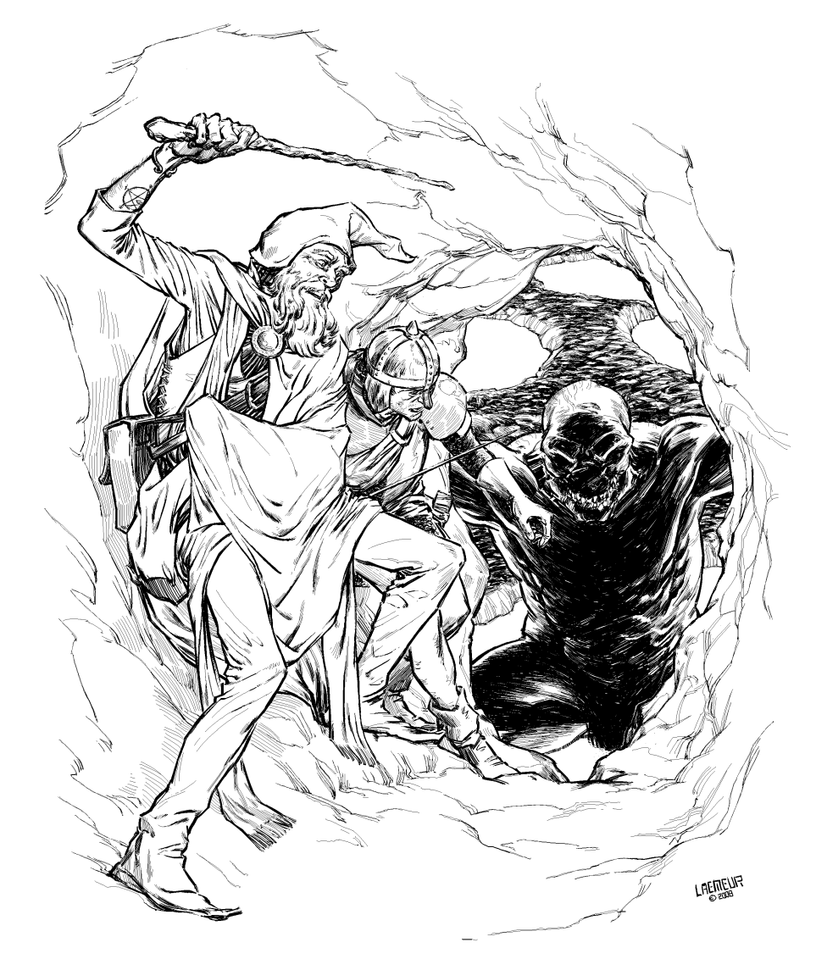
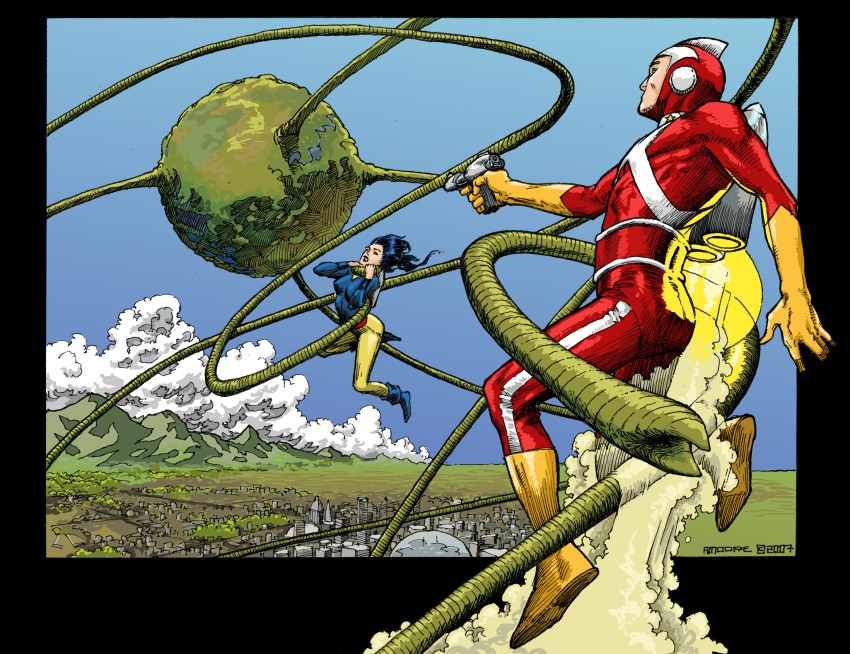
Today’s delve into DeviantArt takes up to Laemeur, a hipster with beautiful line work and lovely colors. Much of his work that would interest gamers concerns ’80s pop culture, but there’s all sorts of goodness on his DeviantArt page. I can’t think of any project – comic book or gaming – that couldn’t benefit from his illustration skills. Go take a look.

BUCK ROGERS, SOLAR SCOUT


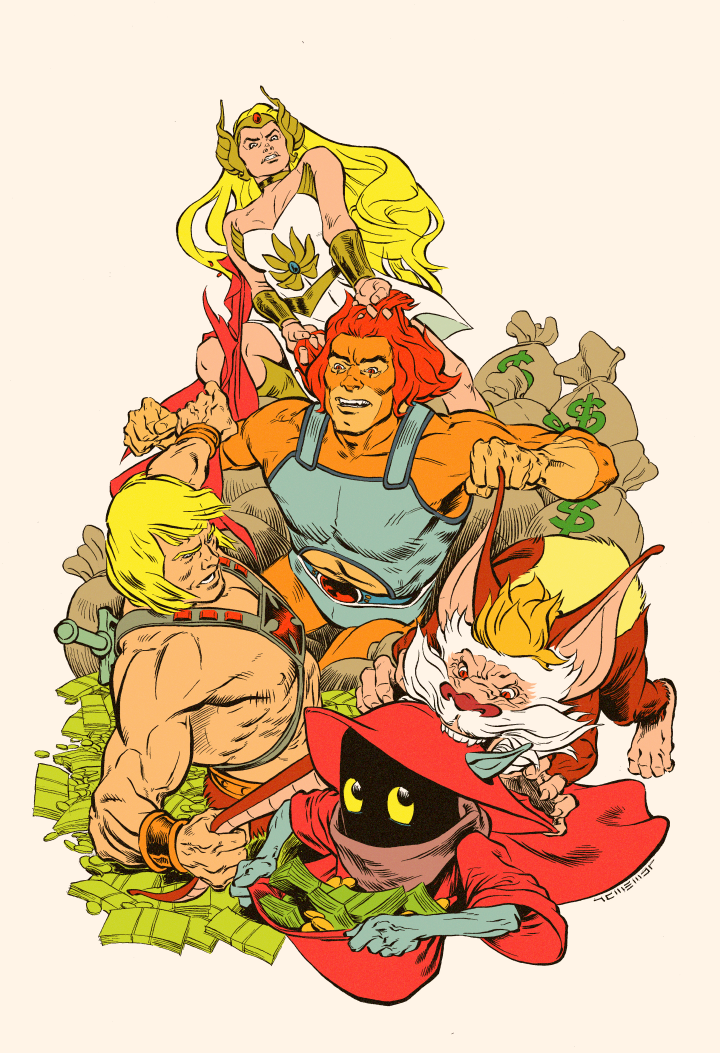
THUNDER POWER RUMBLE


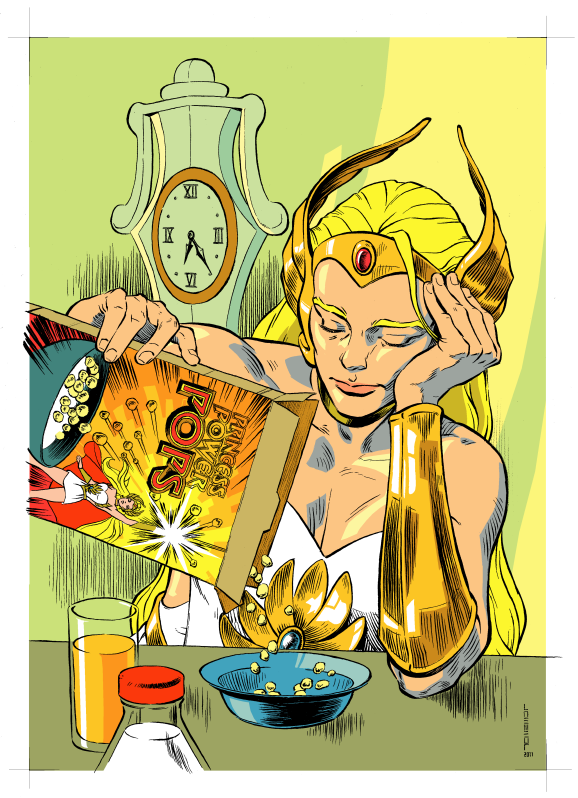
PRINCESS POWER POPS


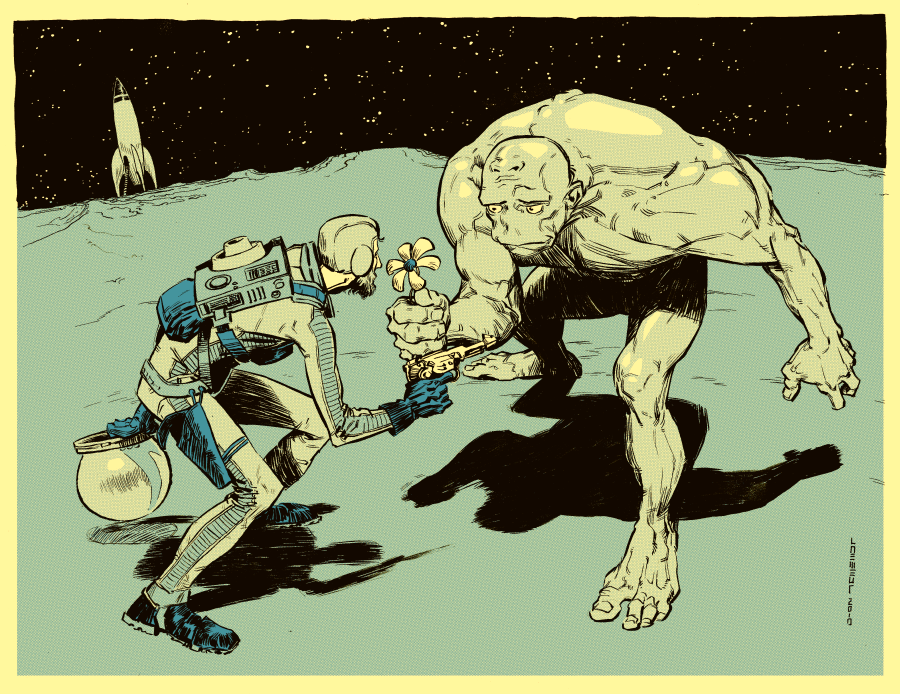
CAP. LAEMEUR ET LA FLEUR


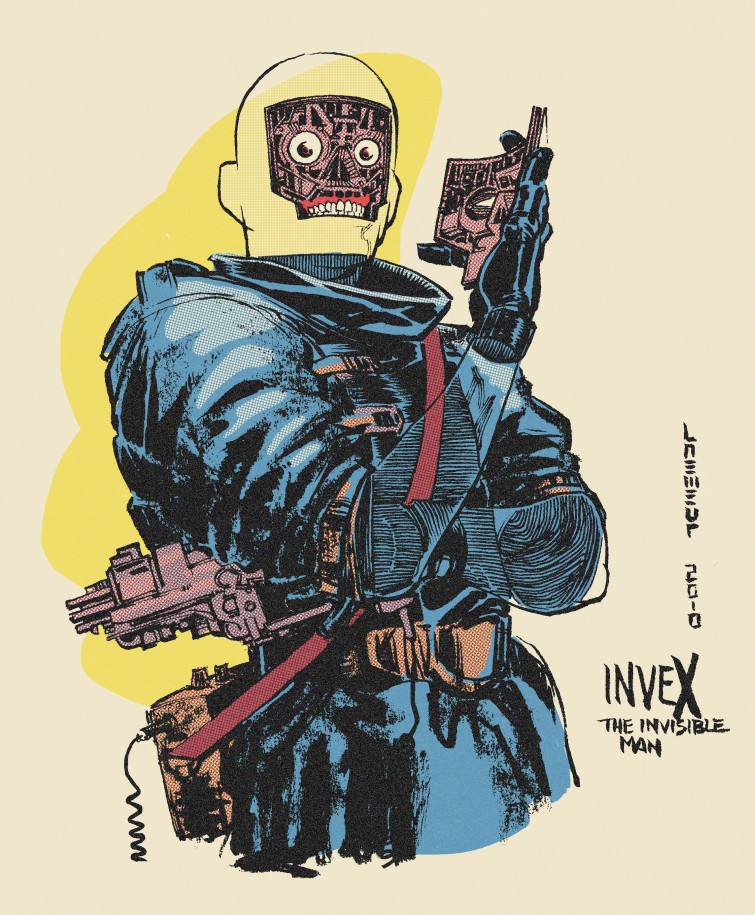
INVEX THE INVISIBLE MAN


AMAZING FRIENDS


EARTH ASTRIDE MARS


TRAPPED


STRANGE ENCOUNTERS


LILLA VS. MAGNUS


MEGA-MONSTERS: The Anaxim

The SRD is a pretty big document, with plenty of neat things to make use of, even for old school gamers. This is one of the reasons I’ve embarked on the Blood and Treasure project – make a system with old school rules that attempts to embrace just about everything the SRD has to offer – thematically, it would be Basic rules with all the Advanced classes, spells and monsters. If you started playing back in the ’80s, you probably know what I’m talking about. Recently, I was perusing some of the epic-level monsters in the SRD and though that any one of them might make a neat center piece to a massive campaign of the kind suggested in Mentzer’s BECMI set of rules. Thus – MEGA-MONSTERS.

The conversion below is for both Blood and Treasure (as it currently stands in my mind) and Swords and Wizardry, with S-n-W stats being behind the slash where necessary.

ANAXIM
Huge Construct, Intelligent, Lawful
Hit Dice: 30
Armor Class: 27 / -8 [27]
Attacks: 2 spinning blades (2d8), 6 projectile spikes (2d8, 120’) and lightning bolt (10d6, 300’) or sonic blast (10d6 + deafness, 60’ cone)
Move: 60 (Fly 200) / 18 (Fly 30)
Saving Throws: F8, R2, W2 / 3
Special: Summon iron golem, +2 or better weapon to hit, regenerate 3 hp/round, resistance to fire and cold (50%), immune to polymorph, petrification and illusions, blindsight (500’), telepathy (1,000’)
Spells: At will – Displacement, ethereal jaunt, greater dispel magic, greater invisibility / Dispel magic, invisibility, etherealness (as the potion)
XP: 38,000 / 39/10,100

Anaxims, or God-Machines, are massive constructs shaped something like beetles and are as large to an iron golem is as an elephant is to a human being. In place of mandibles that have two spinning blades on iron arms and their bodies are studded with six massive spikes that can be launched at enemies up to 120 feet away. They can also emit lightning bolts and sonic blasts. Four times per day, an anaxim can summon an iron golem to fight by its side.

Anaxims might be the product of titans or hordes of lawful creatures like formians. They are created to smash the forces of chaos (in a final, end of Law vs. Chaos way) or guard the secrets of Creation.

Regenesis
The Regenesis campaign pits the adventurers against a secret cult dedicated to re-creating the universe. The current universe, they believe, is tainted by chaos and thus not perfectible. They wish to create an anaxim and set it upon the forces of Law, smashing the machinery of creation and allowing the universe to collapse in on itself and, in their belief system, be recreated from a single, perfect mainspring. Of course, they are insane, but that doesn’t stop them from being dangerous.

BASIC: Basic adventures pit the adventurers against the foot soldiers of the cult. To create their anaxim, the cultists have struck out in search of pure metals and master smiths and engineers, enslaving them. Each individual cell of the cult is responsible for a single part of the finished anaxim, as guided by a group called “The Divine Architects”. Perhaps the ultimate basic adventure would have the adventurers penetrating the slave factory of one cell as they prepare to place their part of the anaxim in the hands of a visiting, extra-planar Architect.

EXPERT: The expert adventurers force the adventurers to strike out into the wilderness to attack other cells of the cult. Perhaps there are three key factories all trying to produce a single part of the anaxim, and at least one must be stopped to slow down the cult’s plan. Golems of various kinds should come into play at these levels, along with conspirators of the cult – sages, magic-users, nobles, etc.

MASTER: The master level adventures involve moving beyond the material plane. The plan of the cult, which is spread across the cosmos (i.e. not only on the adventurer’s home world), has put the Divine Architects (formians) in conflict with the polyhedroids who maintain the mystic gears of the cosmos. A perfect mainspring has been stolen, and the cosmos is grinding to a halt. The adventurers must find the clandestine base where the various parts of the anaxim are being assembled, for it is hidden in a pocket dimension somewhere in creation.

EPIC: The final adventurers involve an assault on the pocket dimension of the true powers behind the cult and the Divine Architects – a band of rebellious titans who seek the cosmos’ destruction for their own purposes, as each believes he can create his own little universe – a multi-verse, one might call it – with he or she taking the role of Creator. The pocket dimension houses a small world (about the size of an asteroid), and deep within this world sits the anaxim, ready to be activated.

A couple notes on Blood and Treasure

For Armor Class conversions (SRD to BnT), I’m using the following formula:

AC 10 to 18 = keep the same
AC 19-20 = 19
AC 21-22 = 20
AC 23-24 = 21
AC 25-26 = 22
AC 27-28 = 23
AC 29-30 = 24
AC 31-32 = 25
AC 33-35 = 26
AC 36-38 = 27
AC 39-41 = 28
AC 42-44 = 29
AC 45+ = 30

Determining XP in Blood and Treasure will (at the moment, I might change my mind) be done as follows:

For monsters with no special combat abilities, XP = HD x 10

For monsters with minor special combat abilities, XP = HD x 100

For monsters with major special combat abilities, XP = HD x 1,000

And no, I haven’t yet figured out what will count as minor and major special abilities. Spells of 0 to 4th level will probably be minor, spells of 5th level or higher are major; resistance to damage (i.e. half damage) will be minor, immunity major; only harmed by silver weapons minor, magic weapons major, etc.

The saving throws are just the number you have to equal or beat on a d20 roll for monsters. Characters would be adding the appropriate ability bonus (constitution to Fortitude saves, dexterity to Reflex saves, wisdom to Will saves). If the save is considered “difficult” – for example, if saving against a creature with 5 HD or levels more than you or because of some extenuating circumstance determined by the Referee, there is a -5 penalty on the saving throw. I’m trying to keep bonuses and penalties to a bare minimum in Blood and Treasure.

I’m going to cap monster Hit Dice and Armor Class at 30. From Kobold to Orcus (or Anaxim), I think a range of 0 to 30 is sufficient. Character levels run from 1 to 20.

Oh, and yeah, I’m still working on Space Princess (art is being produced by Jason Sholtis as we speak, and it rocks! I need to write a sample space fortress …), 1800 – American Empires (holding pattern until Space Princess is finished) and Action X (holding pattern until American Empires is finished – oh, and I think I found a font I like for the title today!). Also almost finished with Hex Crawl Classic 6 (this weekend for sure), still working on NOD 12 and I should dive into Rappan Athuk at some point soon. Busy and happy!

The Dark Demi-Humans [Art]

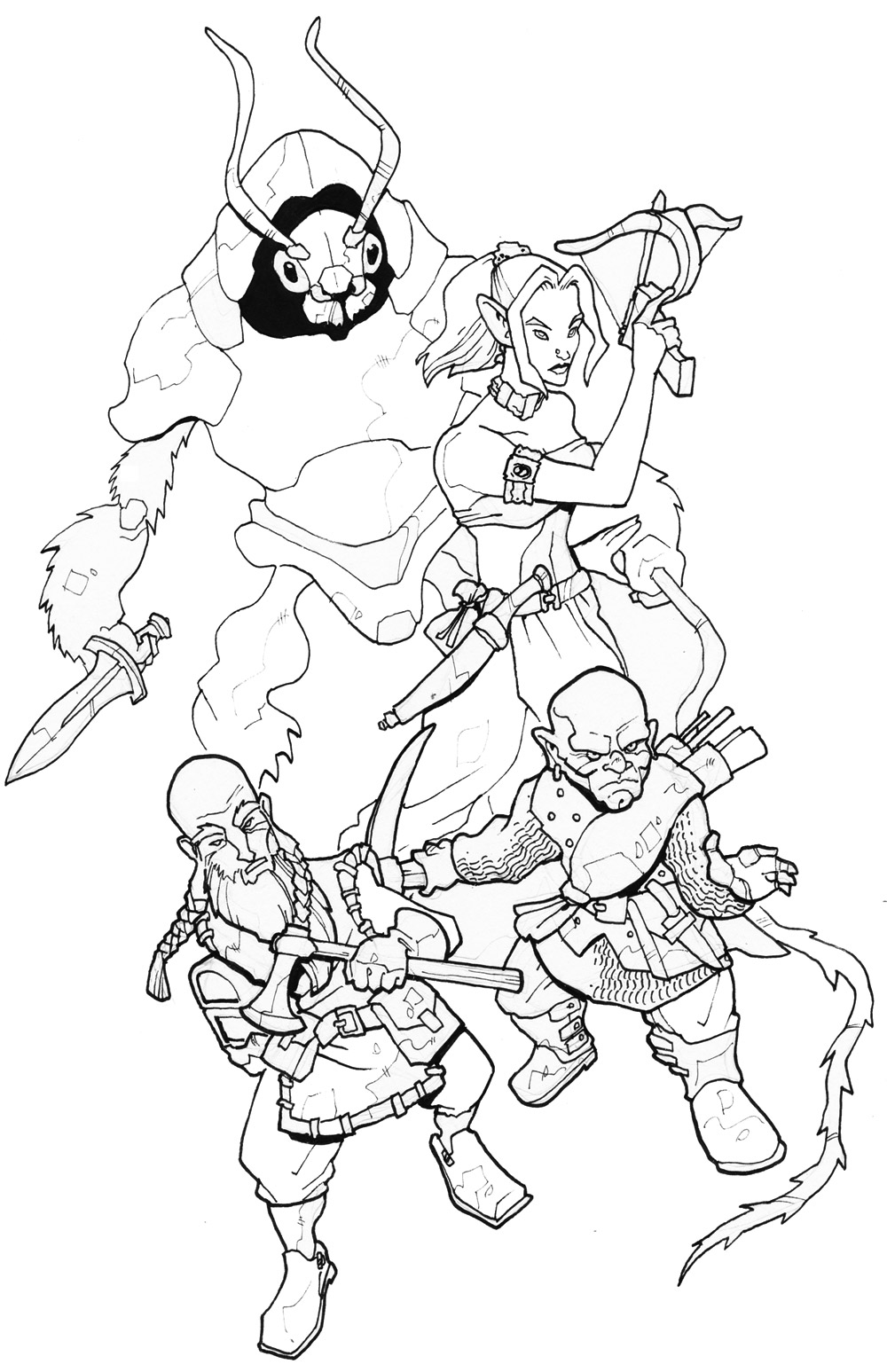
I’m not only working on the second half of the “outer hells” hex crawl for NOD 12, I’m also working on part two of the “Deep Denizens” article. The first part had rules for four humanoid races as PC races – orcs, hobgoblins, bugbears and kobolds. The second part features the drow, duergar, svirfneblin (okay, they’re not dark) and the notac-ichat, an insectoid race I made up for the hex crawl. Here is the depiction of these folk by the great Jon Kaufman (pachycrocuta at DeviantArt).

The first article linked those races with the seven deadly sins – gluttony for orcs, envy for kobolds, wrath for hobgoblins and sloth for bugbears. The three evil races in the next article are also linked – the drow are lustful, the duergar greedy and the notac-ichat prideful. Anyhow – enjoy the art preview – back tomorrow with my first entry in a new series called Mega-Monsters – an attempt to convert some of the epic level monsters in the SRD for Swords and Wizardry, adding an idea at a campaign you could build around that monster.

The Glooms – Mechanical Men, Drow and Worm Food

After taking two days off from writing about Hell (well, a week actually – it was two days between finishing NOD 11 and starting NOD 12), here is the first peek at the southern portion of the Glooms.

2.58 Mechanical Misfits: A little tribe of mechanical men, refugees from the experiments of the Master [4.105], dwell in a ruined kobold fortress. The fortress is carved into the wall and consists of a guarded, fortified entry chamber (locked portcullis, the ledge in front of it is trapped to collapse, sending people 50 feet to the cavern floor). Beyond the entry chamber there are about twenty chambers, mostly small, inhabited by the mechanical men. The mechanical men number 40 individuals built of scrap. Most are about 3 to 4 feet in height. They are sneaky little devils, scavenging far and wide for replacement parts and metal that they can melt down and forge into new parts. They have a working forge and a fine crucible and are open to trade, but find it difficult to resist the temptation presented by adventurers toting metal.

2.106 Troupe: A troupe consisting of five drow overseers and their master, Qodvigo, a drow warrior-mage, and thirteen enslaved ophidian dancing girls. The troupe is gradually picking their way through the ooze-filled tunnel using picturesque wagons painted with phosphorescent paint (skeletons, owls, the words “Master Q’s Traveling Show”) and supported on four spindly legs, like those of an elephant only longer and thinner.

There are three wagons in all, each one carrying three or four ophidians huddled around a coal-burning stove, a driver and a guard. The ophidians wear torqs that have a permanent charm monster effect cast on them and tied to Qodvigo. Qodvigo’s wagon is the largest and contains a separate, raised chamber (about 6 feet long and 4 feet wide) containing his ritual objects and spellbook.

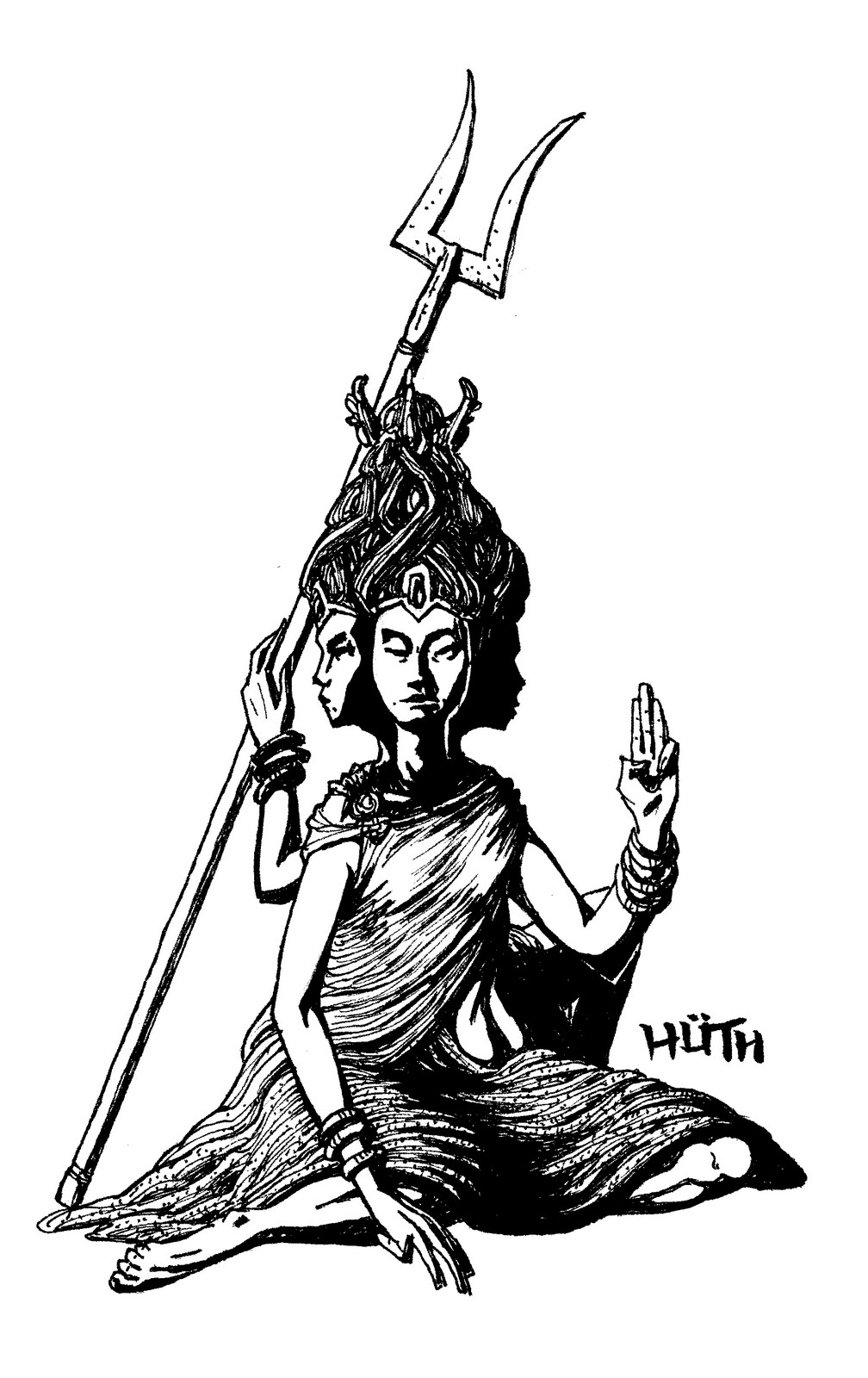
3.66 Worm Food: A tunnel in the wall here features a series of stairs downward leading to a branch of three tunnels. In the nexus there is a brass idol of Tricrucia, the petty goddess of forks in underground tunnels. The three-faced, three-legged, three-armed idol has all three arms pointing down towards the three different passages. One of the passages has an “X” carved above the cave entrance, the second a short series of three white marble steps down and the third the smell of rotting vegetation. The third tunnel is the safe one, the other two containing great lantern worms. At the end of the stinky tunnel there is a small shrine to Tricrucia containing sacred coins (5,100 sp, 710 ep, 5,400 gp) in bronze pots. If any of these are stolen, the thieves suffer a divine curse that keeps them from ever knowing their way under-ground, at least until the treasures are restored.

Image of Tricrucia by Chris Huth from Petty Gods – can’t wait for that release!

Osiris Shall Be Reborn!

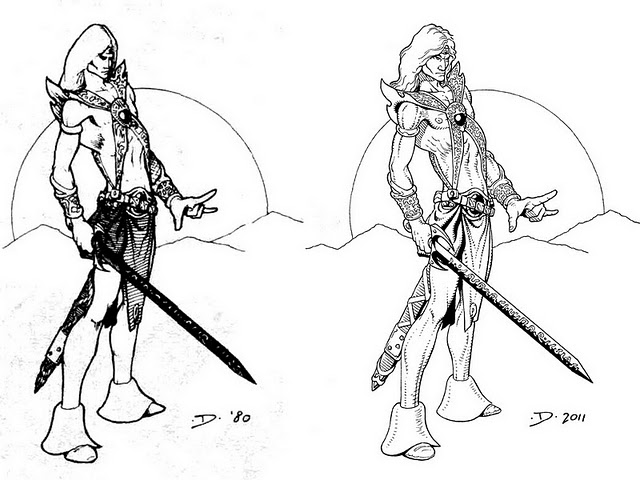
Jeff Dee, who produced by favorite illustration of a halfling ever (the buff little bastard in Moldvay’s Basic) and an image of Thor that could almost turn me into a full-fledged pagan, is undertaking to recreate all of the art he did for TSR, beginning with his illustrations for the Egyptian mythos in Deities and Demigods. Apparently, the originals were thrown into a dumpster at some point (add that dumpster to my list of places to hit when I get a time machine). Here’s an image of his recreated Elric for a sample of what he has in mind …

He project is being done at Kickstarter (where my own Mystery Men! project was born), and I just kicked in $20.

Let get this done ladies and gents!

Notable Nobles – Part the Third

And we roll on with TABLE III

Baron Aglos the Gatekeeper
Aglos commands a sizable fortress that guards a mountain pass into the archduchy. He and his warriors have faced countless hordes of goblins and hobgoblins attempting to push their way into the green lands of the archduchy from the frozen uplands. These years of combat have allowed him to perfect a defensive stance that makes him more difficult to hit than the normal heavily armored warrior. His retinue includes two scribes, four men-at-arms and his two boon fighting companions, Aaron of the Golden Harp (a 5th level bard) and Schultz (a 5th level fighting-man).

AGLOS: HD 9; AC 2 [17]; Atk 1 weapon (1d8); Move 9 (12 out of armor); Save 5; CL/XP 9/1100; Special: Double normal number of followers, defensive stance (+2 AC, +1 hp/HD).

Kenne the Imp, Count of Owaith
Count Kenne is a devotee of the dark cult of Mammon, as befits one of his greedy nature. His devotion to Mammon has won him the ability to cast cause light wounds once per day. Kenne has a retinue that includes five clarks (money counters, mostly), a man-at-arms two sergeants-at-arms.

KENNE: HD 5; AC 2 [17]; Atk 1 weapon (1d8); Move 9 (12 out of armor); Save 12; CL/XP 5/240; Special: Double normal number of followers, treasure as CL 15, cast cause light wounds 1/day.

Archduke Scaton the Handsome
Scaton the Handsome is everything a fairy tale prince should be, except that he is an archduke, of course. He is handsome, charming, well-mannered and brave. Unlike fairy tale princes, he has rarely been outside the walls of his city, Gondwane, but he has cultivated quite a retinue of followers within those walls. This retinue consists of his court champion, Aloysius (a 4th level fighting man) and his comrade, Black Albrect, a rake, his paramour the Baroness Uda, ten scribes (one of whom, Ignatio, is a 5th level assassin sent to spy on the archduchy), three men-at-arms and two sergeants, Duff and Yoder.

SCATON: HD 2; AC 2 [17]; Atk 1 weapon (1d8); Move 9 (12 out of armor); Save 16; CL/XP 2/60; Special: Triple normal number of followers, treasure as CL 20, charisma 16.


Blood & Treasure RPG

You know how hard it is to think up a name for a fantasy game that hasn’t already been taken?

Here’s an idea that popped into my head today. I love the old school games and write for them and will continue to write for them until the cows come home. I am pro-retro in all of its glorious forms, from Castles and Crusades to Basic Fantasy RPG to Labyrinth Lord to Swords and Wizardry and beyond.

But … I don’t hate the modern game introduced in the SRD (System Reference Document). I stopped playing it because there were too damned many rules and modifiers to keep straight – I wanted simplicity – but why can’t I have elf druids and dwarf magic-users and what about gnomes and half-orcs and prismatic sprays and you know, those conditions rules were pretty handy and the three saving throw categories weren’t bad, just different.

Today, I’m driving around town and think – maybe it would be fun to just write a rules-lite version of the SRD that has everything in it – nothing (much) removed because it wasn’t there 20 or 30 years ago or because I don’t personally get much mileage from it. Feats could still be there, but optional (remember my Boons article from NOD 1?) for those who hate feats. I can do skills like I did in Pars Fortuna – as saving throws, with a blanket modifier of maybe -5 for difficult tasks and -10 for super difficult tasks – no skill points and all that guff, and anyone without the skill succeeds on a flat 1 in 6. The diplomacy and intimidate stuff can be optional for people who prefer to leave that up to the players’ skill rather than dice rolls. About the only thing I can imagine leaving out is some of the alignment specific spells (i.e. keep it simple with Law/Good vs. Chaos/Evil instead of nine alignments). Prestige classes – why not? You can jump in at 6th level from certain classes, because dwarven defenders are cool. Yeah – we walk back the power level, because the game was overpowered and tended to make super heroes rather than adventurers. Basically, I don’t want to be the GOD OF THE RULES who issues commandments from on high or gives you his version of the perfect, just the dude who put the rules together in a readable form and sold it to you.

I guess the real theme for Blood & Treasure is lots of options + super simple rules that you can mostly carry around in your head.

No, I don’t know when. But eventually.

What do you think?

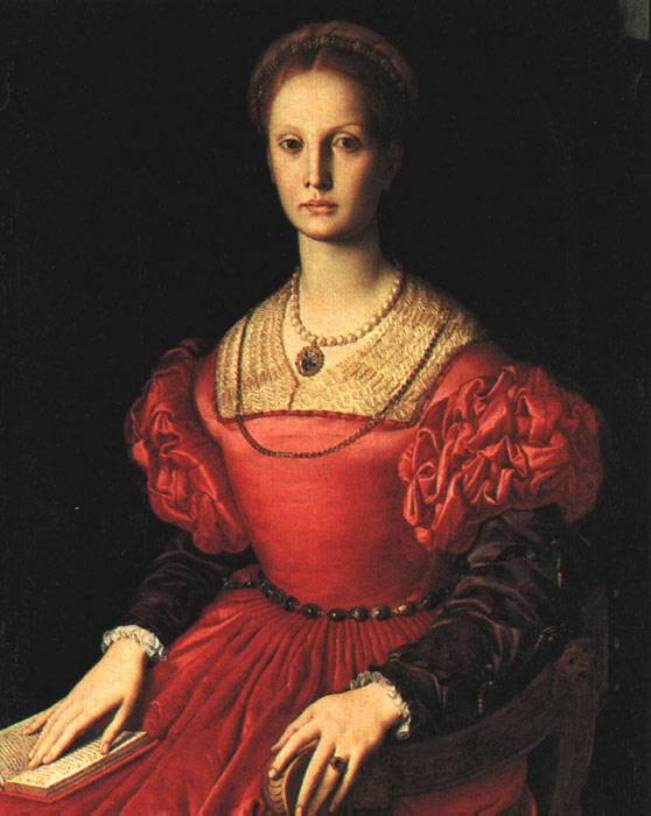
Image from Golden Age Comic Book Stories

Notable Nobles – Part the Second

Here’s another thought regarding the relative power of nobles. The thinking behind makings kings weaker than border barons is generally sound in terms of “earned experience”, which drives the player characters. On the other hand, not all kings are lay-about weenies. Frederick Barbarossa (you can access a scholarly review of his life HERE) and Henry V come to mind, as do Genghis Khan, Julius Caesar, etc. These are the architects of empire, as opposed to the heirs of empire. So – if you’re doing your king or duke or count as an architect of a great kingdom or empire, by all means, use the Borderer stats for him or her.

Now for some more samples, using this table as a source for nicknames.

Marquessa Hiertrude the Bounteous, the Blood Marquessa
The Marquessa Hiertrude is mostly known for her large, loving family – six children by her late husband, the Marquis. It is less known that she is a vampire, turned by a foe of her husband. She has since turned her children into her spawn (save the eldest, Hormand, who is in hiding) and is even now preparing to rally the humanoids she once fought and lead them into the heart of Azura’s kingdom. Her retinue (also vampire spawn) consists of three men-at-arms, two clarks, her court musician Antonio and two sons of the lesser nobility, Anatole and Freder, who were serving as page boys in her husband’s court before she turned them. They are now eternally eleven years old and thoroughly evil.

HIERTRUDE: HD 9 (42 hp); AC 2 [17]; Atk 1 weapon (1d8) or bite (1d10 + level drain); Move 9 (12 out of armor, F18); Save 6; CL/XP 12/2000; Special: Eight followers, vampire powers.

Count Gudolph the Cunning
Gudolph is a cunning man, though only lightly educated. He knows well that his county lies in the path of the Blood Marquessa, and has been recruiting heavily among the priesthood of the kingdom for the last year, giving generous gifts of land to the church in an attempt to shore up his defenses or, at a minimum, convince Hiertrude to march her armies around his land. His retinue consists of two scribes (lay priests), three men-at-arms and three sergeant-at-arms. All of his bodyguards have been trained and armed to deal with vampires.

GUDOLPH: HD 5 (22 hp); AC 2 [17]; Atk 1 weapon (1d8); Move 9 (12 out of armor); Save 12; CL/XP 5/240; Special: Eight followers, treasure as CL 15, intelligence 14.

Queen Azura I, the Calf
The young Azura has recently assumed the throne after the mysterious death of her mother. She is only 16, but head strong and confident. Faced with signs of rebellion on her borders, she is assembling an army to meet it head on, caring little for the council of her advisers. Her retinue includes four lesser nobles, four sergeants-at-arms (one of them her secret lover) and four scribes doing their best to educate the girl-queen while she scurries about barking orders and managing her new kingdom with gusto.

AZURA: HD 2 (14 hp); AC 2 [17]; Atk 1 weapon (1d8); Move 9 (12 out of armor); Save 16; CL/XP 2/60; Special: Triple normal number of followers, treasure as CL 20 intelligence 8, wisdom 6, strength 16, constitution 16.


The Notable Noble – Nicknames and Their Power

Let’s begin by defining nobles. Any character with a crown and a fief or kingdom can be a noble, but we’re looking at them as antagonists or support staff for the player characters, and putting them in the “monster” or NPC category.

The toughest nobles are the border nobles – the guys and dolls on the fringe of the wilderness fighting against humanoids / barbarians / neighbors day in and day out. We’re going to give these folks 9 Hit Dice, making them roughly equal to the name-level characters who might live next door. These folks probably have titles like baron or margrave / markgraf / marquis.

The next toughest are the lesser nobles dwelling within the kingdom’s borders – far enough from the barbarians to not be fighting every day, but close enough that they have to muster maybe once or twice a year to fight a war for their liege. Because they aren’t the upper nobility, they’re more expendable, and might very well have to form up in ranks and charge into battle. We’ll give them 5 HD to reflect their combat training and experience. These folks can be barons, viscounts, counts and maybe dukes.

Dukes, however, are usually part of the greater nobility, along with grand dukes, archdukes (yeah, all the various varieties of duke) and the royals – princes, kings, etc. The greater nobility are politicians more than anything else. They’re trained to fight, but they don’t have to do much fighting. We’ll give the greater nobility 2 HD to show off their training and better living.

This makes nobles pretty plain, really – just men and women with 2, 5 or 9 HD. What makes them noble? Well, power, of course. Some hold more treasure than somebody with their hit dice should hold. We’ll say the greater nobility have treasure as though they were CL 20 monsters, lesser nobility as CL 15 and borderers as CL 9. They also specialize in retinues. Nobles always get twice the number of followers that their charisma (we’ll assume a charisma of 10, but those nicknames we’re going to roll up can change that) would normally allow. Greater nobles have triple the normal number of followers.

Who follows a noble? Roll on the table below for each follower …

Noble Followers (Roll 3d6)
3. Court jester (thief or bard level 1d4+2; re-roll if a second jester comes up)
4. Court musician (bard level 1d4+2; additional musicians are level 1 associates of the first)
5. Rake (5% chance of being a level 1d4+2 assassin; additional rakes are just plain rakes)
6-7. Lesser noble
8-10. Scribe (1% chance of being a level 1d4+2 assassin spy)
11-13. Man-at-arms (platemail, pole arm, sword, maybe crossbow)
14-15. Sergeant-at-arms (platemail, shield, longsword, maybe crossbow)
16. Champion (fighter level 1d4+2; additional champions are level 1 comrades of the first)
17. Court magician (magic-user level 1d4+2; additional court magicians are level 1 apprentices to the first)
18. Chaplain (cleric level 1d4+2; addition chaplains are level 1 assistants to the first)

So, here are our basic noble stat lines:

BORDERER: HD 9; AC 2 [17]; Atk 1 weapon (1d8); Move 9 (12 out of armor); Save 5; CL/XP 9/1100; Special: Double normal number of followers.

LESSER NOBLE: HD 5; AC 2 [17]; Atk 1 weapon (1d8); Move 9 (12 out of armor); Save 12; CL/XP 5/240; Special: Double normal number of followers, treasure as CL 15.

GREATER NOBLE: HD 2; AC 2 [17]; Atk 1 weapon (1d8); Move 9 (12 out of armor); Save 16; CL/XP 2/60; Special: Triple normal number of followers, treasure as CL 20.

Now, about those nicknames.

We’ve all heard them. Charles the Bold, Richard the Lionheart, Pepin the Small. They can describe the person’s appearance, faults, foibles, personality and deeds. So, why not let them make nobles something more than cookie-cutter monsters or NPCs.

What follows are 600 possible nicknames, 99% of them drawn from history. Yeah – the weirdest ones are all real – I added about 5 to give me a solid 600. Most nobles have a single nickname, a few have more than one (see below).

Number of Noble Nicknames (Roll 1d10)
1-8. Roll for one nickname
9. Roll for two nicknames
10. Roll for three nicknames

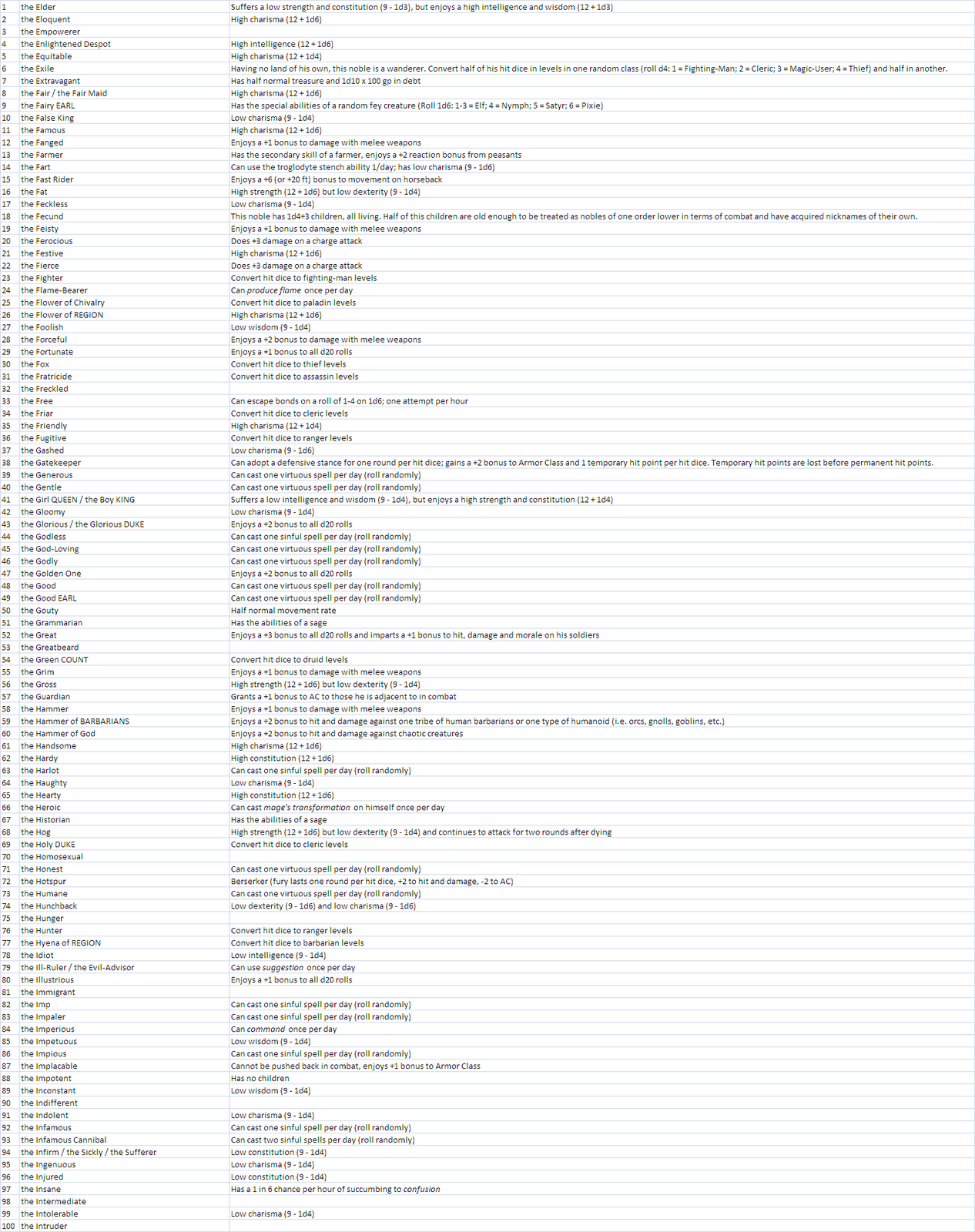
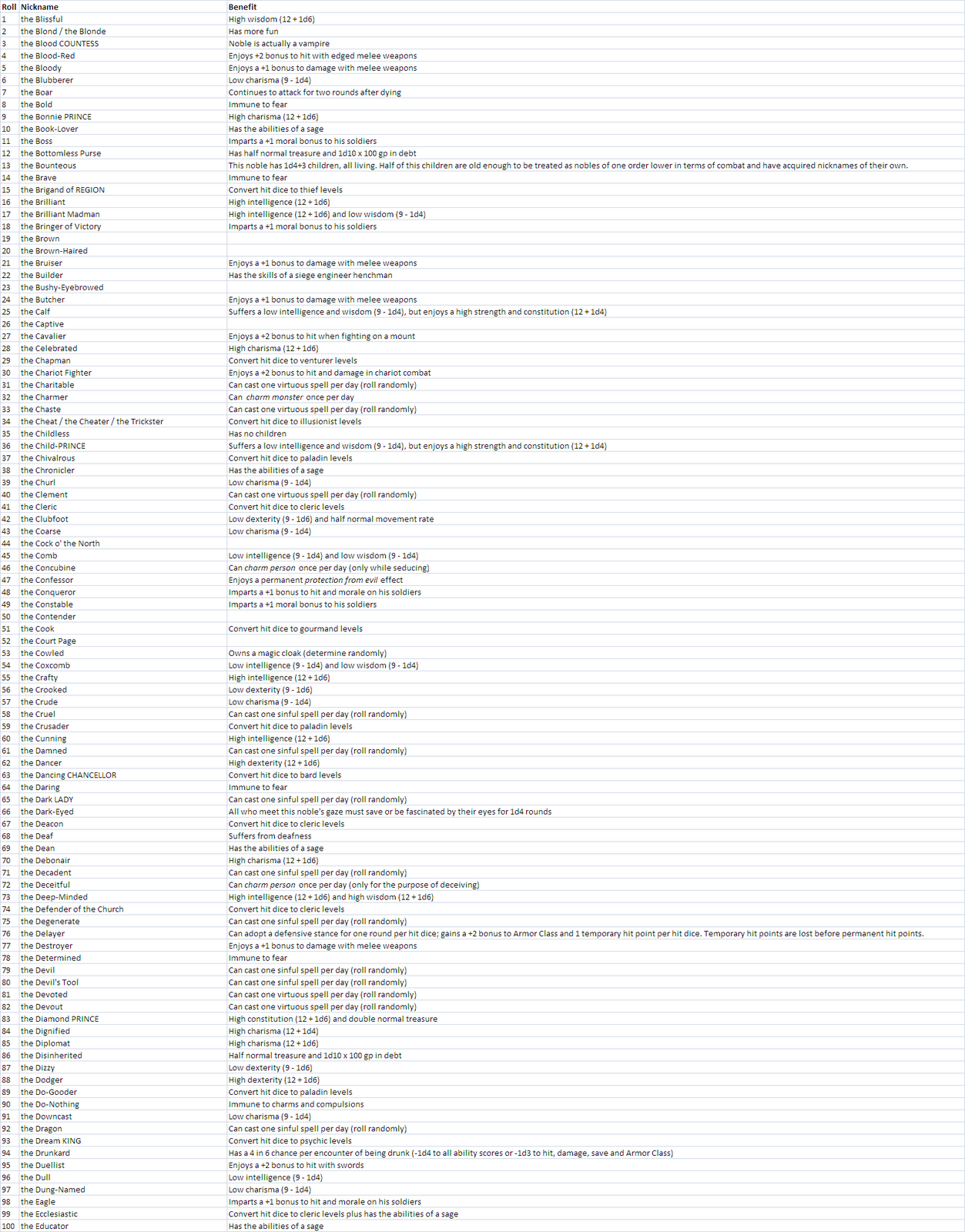
Roll 1d6 to determine which list to use and then 1d100 to determine the nickname. This post has the first list – the other five will follow (hey, this took a while – I need to get more than one blog post out of it).

Since I don’t know which set of rules you’re using, I tried to keep things basic. If your rules don’t give a bonus for high dexterity, then nicknames that give high dexterity should just be treated as descriptive. If a noble gets two nicknames that give him character class levels, then either treat he or she as dual-classed, or re-roll if that doesn’t make sense. Of course, anything that doesn’t make sense, ignore.

Where a title is mentioned (in ALL CAPS), insert the title appropriate to your noble. If your noble is a baron and you roll “Iron DUKE”, just change it to Iron Baron. For REGION, insert the name of a region or kingdom in your campaign world. For BARBARIAN insert the name of a human barbarian tribe or a group of humanoids – i.e. Hammer of the Orcs, Judge of the Scots. References to “virtuous spells” and “sinful” spells we’ll be dealt with later, though most of you can probably figure it out.

If a rolled nickname doesn’t make sense to you, re-roll.

Click the Table to make it full sized.

TABLE I (Roll 1d100)

Sample Nobles (using nicknames from Table I)

Baron Usted the Bald
Being bald doesn’t get Usted much, but as a noble he does get double the normal followers, giving him 8. We roll and find he has the following people in his retinue: For men-at-arms, three scribes (one is a 6th level assassin) and Marcus, the son of the Countess Genevieve, Usted’s liege lady.

USTED: HD 9 (41 hp); AC 2 [17]; Atk 1 battle axe (1d8); Move 9 (12 out of armor); Save 5; CL/XP 9/1100; Special: Eight followers.

Countess Genevieve Hairyfoot
The countess has some halfling blood in her; after all, her mother adored pastries and that halfling gourmand who worked at the castle was often called to visit at odd hours. She now rules a prosperous county in the middle of the kingdom. Her eight followers are Wodwick, a sergeant -at-arms, four men-at-arms, a scribe, the Baroness Salamandra, a childhood friend and Sister Sarah, a 5th level cleric.

GENEVIEVE: HD 5; AC 2 [17]; Atk 1 weapon (1d8); Move 9 (12 out of armor); Save 12; CL/XP 5/240; Special: Halfling racial abilities, eight followers, treasure as CL 15.

King Humphrey the Antichrist
King Humphrey was birthed on a moonless night, the midwife a witch and his mother a sacrifice. A bastard, he was presented to the court by his uncle and, within a decade, had seized the throne and instituted a reign of terror. His followers include five scribes, five men-at-arms and their sergeant-at-arms, Zabbo, and the wicked Viscomte de Gris.

HUMPHREY: HD 2; AC 2 [17]; Atk 1 weapon (1d8); Move 9 (12 out of armor); Save 16; CL/XP 2/60; Special: Twelve followers, treasure as CL 20, spells (1/day – bestow curse, inflict light wounds, protection from good).

FIND PART TWO HERE