Mutations on the Polyester Road

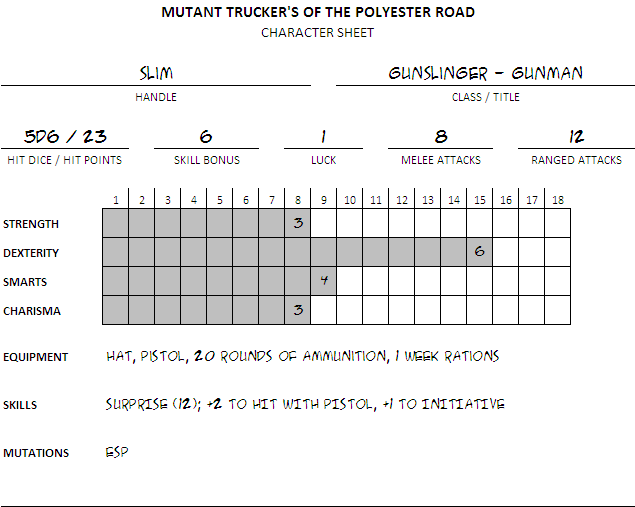
About 99% finished with my Mutant Truckers article for NOD 12. Thought I’d share the mutation tables to give folks an idea about just how mutant-y the game is. In general, Polyester Road doesn’t go as far down the mutant path as Gamma World and Mutant Future. Because it’s a mini-game/setting, I wanted to keep it focused and keep it from being too long. So, there is a small table of mutations – physical and mental, for folks to roll on. Characters can trade one hit dice for one mutation. Each mutation carries with it a 1 in 6 chance of a negative side effect (radioactive scrambled DNA can be dangerous, you know). Referees can use the same process to mutate monsters, bandits and bears (i.e. county mounties) – trade a hit dice for a random mutation. Hopefully, this will keep the mutations from dominating the game, but still allow for some fun variation of the characters.


On a side note – I think the next big hex crawl in NOD will be Hell, based very loosely on Dante’s version, with a little Milton and lots of pulpy/gonzo nonsense thrown in for flavoring. The first hurdle will be mapping Hell – it’s circular and I have no idea how big it should be or what scale would work best. Still, should be an interesting exercise and provide readers with plenty of demonic and diabolical challenges for their game groups. Also gives me an excuse to use that devil cover I premiered a few months back!

Monstrous Evolutions

Today, while thinking of something to do with the blog (and this is one of the best things about having a blog and trying to update it every day – it forces your brain to be productive) I was struck with the idea of evolving fantasy monsters. I mean, we have plenty of beast-people in fantasy games and literature – cat people, dog people, etc. But what about monster? Primates evolve into humans – what might rust monsters evolve into. Since the idea seems to fit with Pars Fortuna, here are a couple such races designed for that game.

Ustte
The ustte are humanoid insects that stand about 4 to 5 feet tall. They have hard, chitinous skin of steel gray, smallish, roundish heads that bear two glossy, black eyes and long, feather-like antennae, wide, slit mouths with long, red tongues (for lapping up corroded metal) and six limbs – two legs, two large arms (like a humans arms) and two smaller, vestigial arms below them. From their abdomen they have long tails that end in “propeller” shaped protrusions.

The ustte dwell wherever there is iron to mine, for though they can corrode most metals and live off of them, iron is their preferred diet. Families consist of a male and multiple females (the species produces roughly three females to one male). Each female is capable of producing a single brood. Broods always consist of four children. These children are given the same name and live with one another as a unit until young adulthood, when they might join with other ustte to form a new family.

Ustte lairs are usually subterranean, though close to the surface. Ustte respect strong physiques and sharp, insightful minds. They compete constantly – in athletic games, tests of skill and craftsmanship and in contests of poetry. Ustte literally wear their “honors on their sleeves” in the form of tracings in gold or silver ink on their chitin. Non-ustte see these fanciful shapes as tattoos, but to an ustte they are a record of their life’s accomplishments and very important.

Racial Abilities
Ustte have thick carapaces that give them a natural Armor Class of 12. Their delicate antennae can detect metals, from iron and copper to gold and platinum, up to 120 feet away, assuming they can conceivably be scented. The touch of their antennae is corrosive to non-precious metals (silver, gold and platinum). Any metal object touched by these antennae (requires a melee attack) has a 1 in 6 chance of being corroded to the point of being useless. Ustte feed on iron and steel, though they can consume other corruptible metals in their place, requiring one pound of metal each day to survive. This makes copper coinage very attractive to ustte adventurers, and some carry the metal as rations.

Class Abilities
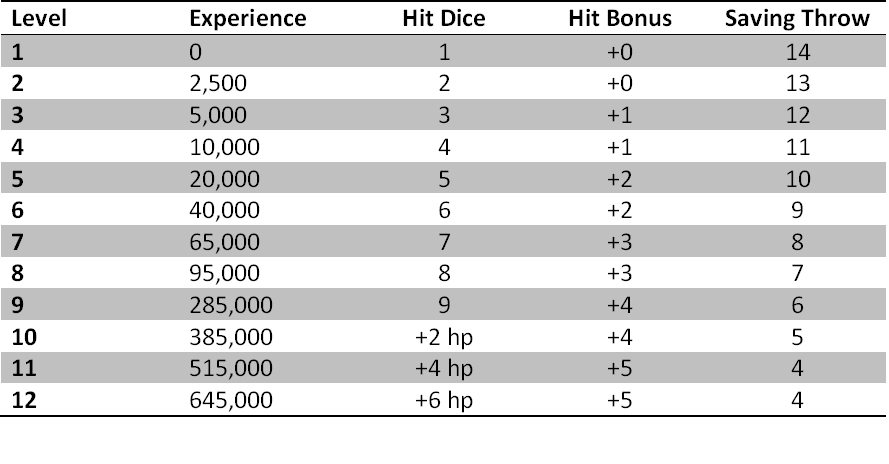
Ustte are driven to excel as warriors and artists. Their prime requisite is Charisma. Ustte roll 1d6+2 per level for hit points (+2 per level after 9th). They can wear light and medium armor and use shields and any weapon weighing 3 pounds or less. Ustte are precise warriors, studying the fence as an art and fighting the way a sculptor sculpts. Their passion and drive give them a +2 bonus to save vs. fear effects if already engaged in combat and their ability to draw their opponent into a mistake give them a cumulative +1 bonus to hit and damage every round their foe fails to hit them in melee combat, up to a total of +5. This resets whenever the ustte scores a hit on an opponent. It is for this reason that ustte prefer not to win initiative. This bonus is lost if the ustte is aided in combat by another (i.e. another attacks the same target they are fighting). Whenever an ustte defeats a superior foe in combat, they may apply a new design to their carapace and will always compose a song in their own honor.
Eaoro
The eaoro are a race of tall, bulky humanoids that dwell in farming villages in the midst of wooded regions. They value their privacy; the only eaoro most folk will ever meet are those who must begrudgingly leave their enclaves to trade and those who have suffered exile from their community due to sinful behavior.

Eaoro are sexually dimorphic, the males being much larger than the females. Male eaoro stand about 7 to 8 feet tall, with rather short legs and long, arms. They have narrow shoulders, giving their bodies a distinct “triangular” shape, but are thickly muscled. Females are shorter, averaging 5 to 6 feet in height, and have longer legs and shorter arms. Males are hairier than females, and both sexes have heads covered with feathers rather than hair. Their skin is naturally pale, their eyes large (and telescopic) and they have black, hooked beaks in place of mouths.

Eaoro are vegetarians, though certainly not pacifists. They dwell on farmsteads composed of a central longhouse constructed of stone and logs, maybe one or two outbuildings for storage and a surrounding rampart of earth and stone that stands about 5 feet high. Farmsteads support a family of a bonded male and female, their young (anywhere from three to twelve children) and maybe older relations incapable of surviving on their own. These farmsteads are situated quite near to one another. Eaoro communities are referred to as clusters and usually consist of 20 to 100 farmsteads. Somewhere in the cluster there is a hill cleared of trees that serves as the cluster’s moot.

Eaoro are deeply religious, believing in litany of sins handed down to them from their forebears. When conflicts arise, eaoro must submit themselves to judgment by the moot. Sins are tallied, and judgment always goes to the less sinful eaoro. If this doesn’t cause eaoro to strive for righteousness, it certainly drives them to strive for sneakiness and to pry into the lives of their neighbors, keeping a close “sin count” in case a conflict should arise. Eaoro with too many sins to their names are usually exiled from the community.

While all eaoro are taught magic from a young age, male eaoro tend to be better warriors than mages and females better mages than warriors. For this reason, each is considered separately in terms of class abilities.

Racial Abilities
Eaoro are born farmers – even those who have since been cast out of eaoro society. This gives them a knack for predicting the weather and in all other matters related to the growing of crops and mending of farm implements. They also have a knack for casting cantraps. All eaoro start the game knowing three random cantraps. They can only cast them by making a spell roll and suffer the consequences of failure just like any other spell caster. Their innate strength gives eaoro males a +2 bonus to their strength score and a -2 penalty to their dexterity score at character creation. Females have a bonus and penalty of +1 / -1. These modifications cannot improve a score beyond 18 or lower it below 3. Since most eaoro adventurers are outcasts from their communities and have had to live for an extended time in the wilderness and then on the fringes of society, they have a knack for wilderness survival and pick pocketing.

Eaoro Class – Female
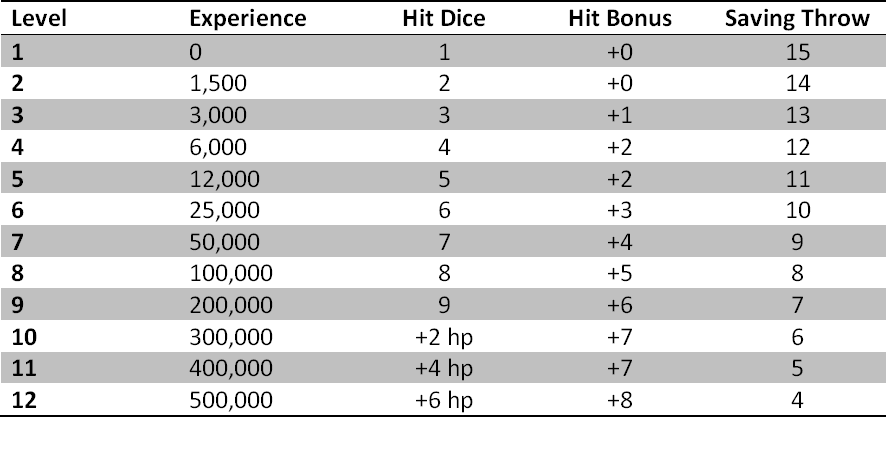
Female eaoro have Intelligence as their prime requisite. They roll 1d6+1 per level for hit points (+2 per level after 9th) and can use light armor, shields and any weapons.

Female eaoro are magicians, and thus can cast magic spells. They have no particular skill at casting a certain kind of spell, being dabblers at the art. They are skilled at picking pockets, palming small objects and at bluffing.

Eaoro Class – Male
Male eaoro have Strength as their prime requisite. They roll 1d6+2 per level for hit points (+2 per level after 9th) and can use light armor, medium armor, shields and any weapons.

Male eaoro are skilled at picking pockets, palming small objects and bluffing. They are known for their ability to present a frightening display when they enter combat, forcing all creatures with 1 hit dice or less to pass a saving throw or flee. Creatures backed into a corner or defending their loved ones will not flee.

 

Mu-Pan Eastern Encounter XII

Finally finished writing all the Mu-Pan encounters over the weekend! Now I just have to clean up the rough edges, insert some game stats here and there, write the intro stuff (regions, monster encounter tables, etc) and figure out what I want to do (or need to do) about art. I’m about 90% complete with Mutant Truckers as well – finished writing up some monster stats (all re-purposed from the d20 SRD) and just need to write a few more and then drop them into encounter tables. I’ll probably do a play-through in the next few days with some folks on Google + and see if things actually work. In the meantime …

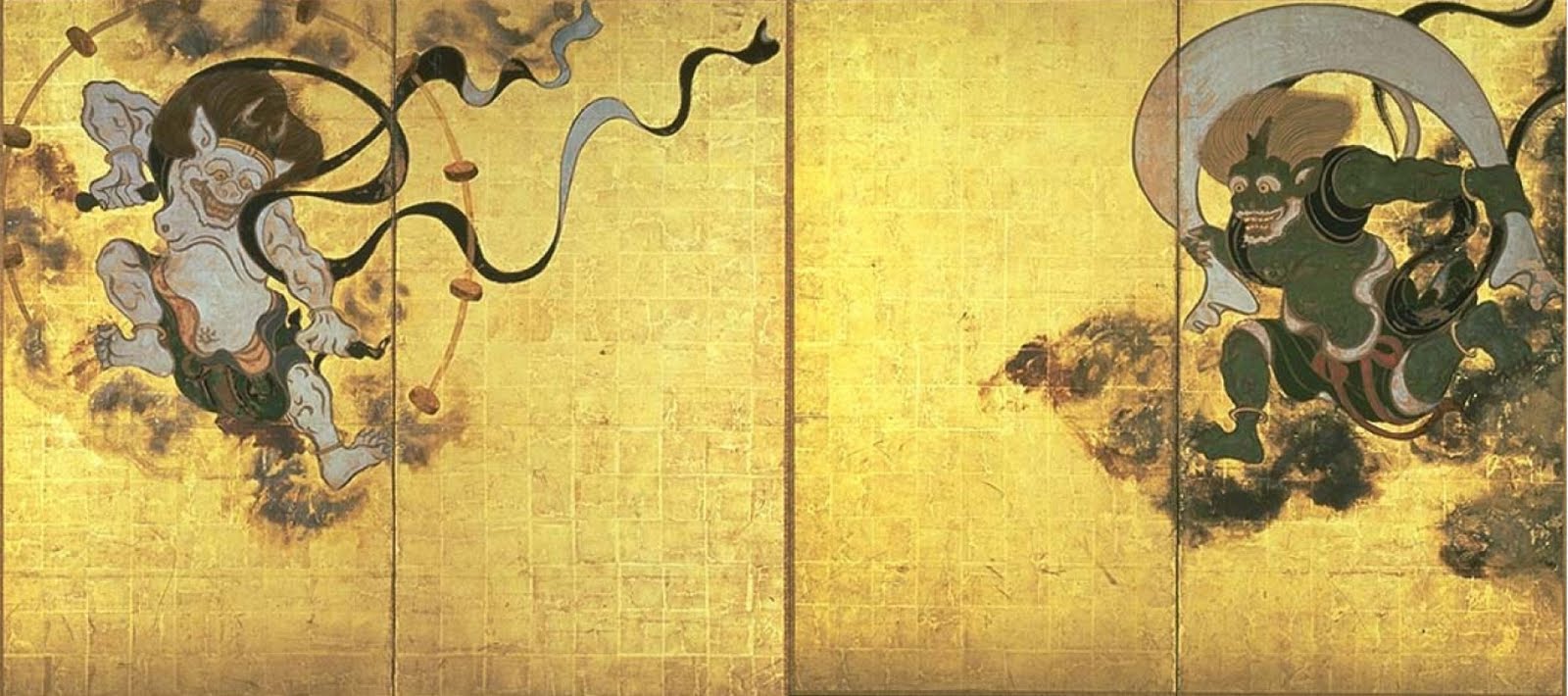
6038. Umborodom’s Abbey: There is an ancient fortress-monastery constructed here of red bricks and tall, peaked roofs of copper. The roof is covered with hundreds of tall, copper spires that attract lightning. The monastery is dedicated to Umborodom, whose hound was the thunder. The monastery is inhabited by 16 low-level sohei and their abbess, Deneg, a temperamental woman with blue-gray eyes and a powerful hatred of the Jade Empress, who quells her lovely storms and keeps her “hounds” hungry.

The “hounds” are three lightning elementals that dwell within a golden matrix that serves as the monastery’s idol. The monastery is surrounded by a village of red brick buildings inhabited by about 150 tin miners. The mines are of ancient vintage, but still producing tin and a few tourmalines and topaz each month. Tourmalines are claimed by the sohei and topaz by the empress.

The sohei of the monastery wear blue armor and carry large, steel-shod mallets.

6111. Ghost Town: These dusty hills are crossed by numerous trails, for the hills once hosted the grand city-state of Ganiz. Ganiz is now a ghost town – literally. Travelers see wisps of people walking through ghostly streets and the outlines of buildings when one squints or looks away from the sun. The buildings and people are more pronounced in the moonlight. The people move slowly and are completely unaware of the living. They are almost certainly not undead, as they are unaffected by turning and cannot be spoken to using the speak with dead spell. Likewise, they do not seem to inhabit the Ethereal Plane, for they still appear as ghostly images in that place and the Astral Plane. Sages do not know what to make of the phenomenon and prefer to ignore it and avoid the hex.

Heroes International [Mystery Men!]

Aztec Prince
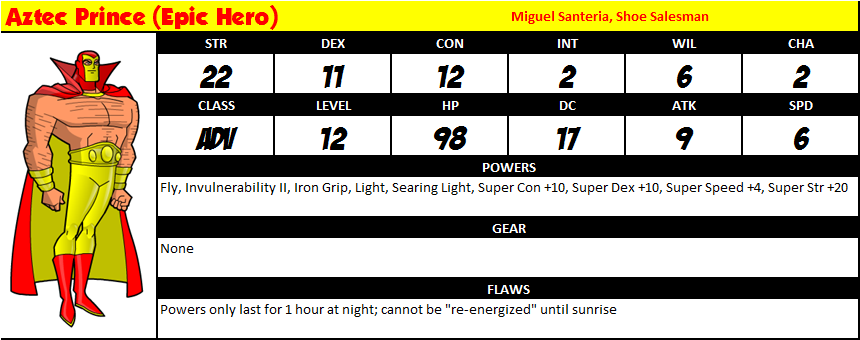
Miguel Santeria was a shoe salesman in Mexico City, and as mild mannered as they come. While he fitted people for shoes and re-stocked the backroom, he dreamed of being a hero. One sunny day he got his chance. Two crooks had just broken into the recently finished Museo Nacional de Antropología and stolen an Aztec calendar made of solid gold. Making their getaway, they ducked into Miguel’s shoe store to cut through to an alley. As the crooks made their way into the backroom with the police hot on their tail, Miguel happened to step around a corner holding a stack of shoes. Colliding with the lead crook, he grabbed hold of the golden calendar to steady himself. The second crook’s gun was drawn, and without thinking he fired at Miguel, striking him in the arm. The force of the impact threw him to the ground, the disc still in his hands. As his blood trickled on the calendar, it activated the magic within. Instantly, the spirits of one thousand Aztec warriors flowed into Miguel, transforming him into the Aztec Prince. The newly born hero quickly dealt with the crooks, delivered them to police and then made his escape. Now, when Miguel hears of trouble, he cries the name of Quetzelcoatl and becomes Aztec Prince, hero of Latin America. His only weakness is the dark – after sunset, his powers can only be invoked for one hour. After that, they fade and cannot be called upon until the rise of the sun.

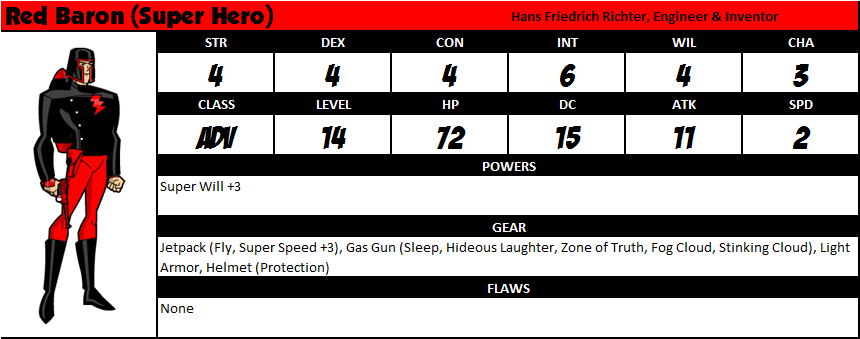
Red Baron
Hans Friedrich Richter was a German scientist and engineer impressed into working for the Nazis during the Second World War. As he neared completion on a rocket pack, he got wind through a friend that the authorities had discovered that his great-grandfather was Jewish and that they were on their way to arrest him. Hans quickly donned his armored flight suit and rocket pack and blasted his way out of his subterranean workshop. He went on to fight the Nazis in Germany and beyond with the Resistors, a band of super-powered Europeans that included the British Spitfire, Norwegian Giantess, Polish Marksman and Hungarian Blackout. After the war he improved his suit and continued to fight crime in Western Europe with the surviving Resistors. There is also speculation in the super-powered community that the Red Baron has started a private detente with Soviette (her NATO codename), a member of the USSR’s Secretariat Seven.

Superhero images built using Fabrica Herois.

Mu-Pan Eastern Encounter XI

Still cranking away – I think I’m about 5 days away from finishing the encounters – then I have to draw some maps, write all the regional/random encounter stuff, etc. Mutant Truckers is looking pretty good as well – these two articles will make up the bulk of NOD 10. Then I just have to figure out what the heck I’m doing with NOD 11 – anyone interested in a hexcrawl set in a pseudo-Dante’s Hell?

5916. House of Clones: At the foot of the mountains there is an old manor built of wood, with domed towers and a peaked roof. The manor has extensive gardens of cherry trees, creeping junipers, roses, chrysanthemums and ponds of goldfish. The manor is home to a secret society of men and women who are clones – created by a shugenja, Jutem, as part of his plan to conquer the empire. The men and women are clones of nobles now largely deceased, aged and replaced by their sons or daughters, or removed from power with the change of imperial control.

The clones are now unable to serve their original purpose, but they are still ambitious and possessed of a desire to rule. They have thus begun the slow task of gathering an army of humanoids from the mountains, their first target being the port of Artuk.

6021. Plateau of Jackals: Much of this hex is taken up by a rugged plateau of rocky outcroppings and long grass. The plateau is surrounded by an abyssal chasm that exhales foul gases (save or suffer 1d6 points of burning damage to the lungs). In the south, there is a single wooden bridge with a 10 foot gap in its center and signs of burning – perhaps the work of a fire breathing dragon.

The plateau is hunted by three packs of jackals. Each pack contains 1d3 x 10 animals. There was once a sprawling village of grass huts in the center of the hex, but those huts have long since been burned to the ground. The village is now a series of shallow graves, many disturbed. Night encounters with ghouls (1d6+1) occur on a roll of 1-3 on 1d6. The ghouls have burrows into the earth, most of them rather small, but some networking into a series of deeper tunnels that smell of the same acrid smoke of the chasm, but without the negative effects.

The ghouls of the plateau number 30 in all. Roll treasure for them randomly as they are encountered – their burrows can also be generated randomly. They go no deeper than 3 levels, and at the bottom level there dwells their chief, an oversized brute called Myan. Myan possesses the great treasure of the plateau, a pair of +1 sode constructed of leather scales dyed black and ornamented with ivory carvings. The sode give the wearer an acid touch (1d6 damage) and likewise cause any weapon they wield in anger to drip with acid, causing an additional 1d6 damage per hit.

Mystery Men! Dark Renaissance Villains

Yeah, I’ve made some villains for the Dark Renaissance campaign this weekend. Some are public domain, some are original.

Now, I’m not guaranteeing all of them will actually be used, but I wanted some options. If nothing else, I have some articles ready for future issues of NOD.

Thought I’d add to this some of the names of the original villains – find them all in the image above and win the admiration and respect of your peers!

Acid Arrow
Blackstar
Black Beard’s Ghost
Blink
British Bombshell
Chaos Hammer
Cloudkill (noticing a pattern to some of these?)
Cobweb
Crusher
Deadhead
Enervate
Grimalkin (formerly known as Faster Pussycat)
Flamestrike
Forcecage
Freak
Glitterdust
Gongthrottle (yeah, love to cross over with my other stuff)
Harletron 3000
King Seth
Manos
Maze
Meat
Pinball King
Powersource
Prism
Psychedelic
Schrodinger
Shatter
Shayna McBain
Shillelagh
Silver Slasher
Sunburst
Super Size
Swamp Billy
Truestrike
Veil
Weevil

Super villain images created using Fabrica Herois.

Mu-Pan Eastern Encounter X

Still cranking away on this hex crawl. About 30 more encounters to write, then the overall description and encounter tables. Getting there …

5140. Fey Samurai: A fairy knight in the trappings of a samurai has made camp here. He has been wandering the land searching for an honest man, for it is the kiss of an honest man that will awaken the Silver Maiden who sleeps beneath the mountains.

5227. Bonnacon Herd: This district is home to a large herd of bonnacon, and a somewhat flighty herd at that. The grassy hills and trees show many signs of burning, and more than a few bonnacon carcasses are evident, victims of “friendly fire”, so to speak. Long-legged buzzards constantly patrol the sky, waiting for accidents. Encounters with the herd, or at least portions of it numbering 2d6 x 20 animals, occur on a roll of 1-4 on 1d6.

Attacks on the bonnacon have a 1% chance of drawing the attention of the bonnacon lord, called Choupi by the Mu-Panese and worshipped as a minor deity of comical rudeness to authorities. Choupi appears as an old man with a large, bloated belly and long, wispy beard. He carries a staff to which is affixed three gourds.

5408. Magic Fountain: There is a limestone cavern here in which drips enchanted waters into a shallow pool stained electric blue. The water of the fountain staves off death, but only barely retards aging – perhaps halving it. At the same time, it links the drinker to the pool. Drinkers who try to leave the pool are affected as though by a geas.

Living under the cavern there is a tribe of troglodytes in service (out of fear) to the shugenja Qorchon, who dwells in the cavern, depending on its waters to keep himself alive. Qorchon is now 120 years old, and his time is growing very short.

Beneath the troglodyte caverns there is lies the body of the demon A’meggologabo imprisoned in ice.

PS – Mutant Truckers is working out pretty well. Should have a preview soon.

PPS – Still gathering players for the Mystery Men! Dark Renaissance campaign on Google +. We have about 12 people who have shown interest and four who have actually produced characters. Should be fun!