Venatia – a Baleful and Beautiful Garden

Quick note – I am finishing up NOD #5 and should have it available by next week. Contents will include a couple dozen vampires drawn from world folklore, Mines & Minerals, the Illusionist class and his spells, Ibis – City of Sorcerers, level 2 of Izrigul’s Palace (continued from last issue) and another chapter or two of Phantastes. Cover image to the right.

1124. The drab moors give way here to a colorful garden of pistachio trees, maples and, in the springtime, brilliant tulips and lilies. A meandering path of crushed stone takes one from the front gates to the little castle within, a tower keep that looks as though it were carved from ivory. The garden is worked by thirty children dressed in tattered clothing, all of them wiry and underfed. The children work in a kitchen garden of over sized cabbages, radishes and eggplants. Secreted in the trees are a six ettercaps, all servants of the mistress of the ivory tower, an annis hag called Urmelia. Urmelia and her minions stage raids on the Emperor’s Way, bringing back slaves who are, using the hag’s special recipe, changed into mere children. Should the hag’s formula be used on a human or halfling, they find themselves reduced in age to 8 or 9 years, their strength score cut in half and their dexterity dropped by 2 points. The hag usually has a dozen doses of the potent potion on hand. In the tower’s donjon Urmelia keeps her sister Yordis, polymorphed into a small child and bound with silver chains that disrupt her ability to use magic.

Treasure: 3,800 ep, 1,090 sp, 820 gp, 10 lb of cocoa worth 100 gp/lb, 7 lb of saffron worth 15 gp/lb.

| Urmelia, Annis Hag: HD 8 (37 hp); AC 1 [18]; Atk 2 claws (2d8), bite (1d8); Move 12; Save 8; CL/XP 10/1400; Special: Hug and rend, polymorph, call mists.

| Ettercaps: HD 5 (31, 27, 23, 19, 16, 14 hp); AC 6 [13]; Atk 2 claws (1d3), bite (1d8 + poison); Move 12; Save 12; CL/XP 6/400; Special: Poison bite.

1131. The woods here hold a forgotten cemetery, overgrown with black willows crowded with white butterflies and pale vines that produce a grape from which one can brew the “wine of ages”. Here, aged ghouls come to lie in the cool grass and dream their dark, lazy dreams. A marble cupola in the center of the graveyard served as a shrine once, but is now the lair of three unpleasant gravebirds, who have used their ability to speak with the dead to learn many secrets, secrets they will divulge for the price of a squealing babe or blushing maiden.

| Gravebirds: HD 2 (15, 13, 7 hp); AC 5 [14]; Atk 1 bite (1d4 + disease) or 2 claws (1d3 + disease); Move 4 (Fly 16); Save 16; CL/XP 3/60; Special: Disease (per mummy rot), speak with dead.

1137. A cave flecked with serpentine snakes its way into the earth, first becoming chilly as one leaves the embrace of the sun, but then becoming hotter and drier with every step until the spelunker emerges into a great vault intersected by streams and rivers of magma that are spanned by natural bridges of basalt. On three of these bridges there are trapezoidal shrines made of serpentine and pierced by a single dark, open entrance. The shrines are approximately 30-ft to a side. The interiors are clad in polished obsidian and hold idols of the ancient ophidians.

The shrine of Yibolokendh, goddess of hunters, who appears as a tall ophidian female wearing armor and trophies of the hunt (primate skulls). The shrine is guarded by six inphidian warriors and overseen by an ophidian seer who speaks of the beginnings of things.

The shrine of Ichasha-Yath, goddess of the deadly chill that terrifies all reptilians. The goddess appears as tall ophidian with icy eyes and chocolate brown scales and carrying a silver dart. It is guarded by six inphidian warriors and overseen by an ophidian seer who speaks of th ends of things. The seer of Ichasha-Yath can summon snowstorms once per day.

The shrine of Labos, god of medicine, who appears as a stately male ophidian, graceful and adorned with long, white hair and purple eyes who carries a map of the ophidian anatomy. It is guarded by six inphidian warriors and overseen by an ophidian seer who speaks of the secrets and lies who can heal the sick and bring the dead back to life – for the right price.

| Ophidian Seer: HD 3; AC 4 [15]; Atk 1 iron staff (1d8), bite (0); Move 12; Save 14; CL/XP 6/400; Special: Reproductive bite, cast magic-user and cleric spells (3rd).

| Inphidian: HD 4; AC 2 [17]; Atk 2 bites (1d4); Move 15; Save 13; CL/XP 6/400; Special: Blinding spray, poison.

1141. On a crystal clear bay there is a large village of swarthy men and women, a sort of lost colony of ancient Nabu called Kademand. The Kademandi mostly deal in the timber trade, shipping wood from the Nybling Hills to Antigoon and Ophir. The village buildings are constructed or marble quarried nearby, with even the most common hovel looking far above its station. The village is surrounded by a 15-ft tall wall of marble, 10-ft thick and studded with 25-ft tall towers. The village is ruled by a nomen (lord) called Thorothi the Sagacious, a learned man of astronomy and ancient history who keeps a small library of scrolls and well worn tomes.

The bay on which the town sits is inhabited by a herd of selkies (fey seal people), and in fact is called Selkie Bay. Thorothi was married to the most beautiful of the selkies, Brece, after using helping the selkies drive away the giant octopus [1149] that once lived just outside the bay, harassing selkies and humans alike. Brece now spends half the year in human form attending her husband, and half the year in seal or selkie form playing in the sea. Both of them are satisfied with this arrangement, and their marriage keeps their people at peace, though it has not yet resulted in an heir for Thorothi.

1149. A giant octopus, called Death’s Gauntlet by the people of the region, dwells here in a vast, undersea cave, brooding at his recent defeat by Thorothi of Kademand [1141]. In his cave he keeps an obsidian shield, too heavy for a human and too small for anything else, worth 200 gp.

| Death’s Gauntlet: HD 10 (50 hp); AC 7 [12]; Atk 8 tentacles (1d4); Move 2 (Swim 10); Save 9; CL/XP 13/2300; Special: Constriction and pinioning.
Mystery Men! Update – The Science Heroes

Well, we’re down to the last week of the patronage project. The project has been funded by 11 awesome patrons, but there’s still room for more if you want to get in on it. Silver Age patronage can be had for $10 and gets you your name in the final book as a Silver Age Patron and a special e-book containing golden age comics and a preview illustration from the final book along with a hand-written note of thanks. Golden Age patronage is $20 and gets you the above, plus your name included in the mini-setting in the game book and you get to vote on which heroes are illustrated for the book. Remember, the final product will be a free, open content PDF and a print-on-demand book sold as cheaply as possible. It will include old school rules for comic book hero adventures – character generation, fighting rules, dozens of super powers and a mini-setting and introductory adventure. The patronage project is to purchase some kick ass artwork.

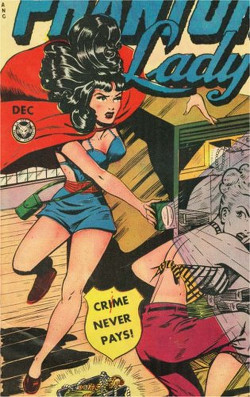
When the time limit is up for the project (Oct 12), I’ll be sending ballots to all Golden Age patrons to vote on which heroes are to be illustrated by Joel Carroll (that’s his work on top of the post). Once the votes are cast and the patronage money drops into my account, I’ll make the official commission and get this ball rolling! When the heroes are drawn, I’ll send out the patronage packages to everybody.

So far, we’ve covered the ubermenschen, elementals, tough guys, patriotic and occult heroes. Today we look at the Science Heroes. Science Heroes are those who get their powers through scientific gadgets and the like.


The King of Darkness is radio engineer Bruce King, who stumbles upon a way to use radio waves to create beams of cold and beams of darkness, as well as an anti-gravity wave for good measure.


The Masked Marvel – identity unknown. Headquarters – glass-domed mountain headquarters. Operatives – ZL, ZR and ZY. Gadgets – zepplin, telepathically-controlled plane, paralyzation ray gun and a televisor that allows him to see everywhere in the world. He can also lift dinosaurs over his head, so he has that to fall back on when he runs out of batteries.


Sandra Knight, daughter of a senator, fights crime with a blacklight ray (no, not for looking at groovy posters) that creates darkness and makes her invisible. And yes, if she gets the nod her name will have to be changed to avoid trademark entanglements.


When Shannon Kane’s chemist husband Harry is killed by agents of a foreign government, she takes his formula for “spider-web glue” and becomes a heroine. She uses bracelets to fire the substance, which is even strong enough to swing on! I can’t imagine why somebody didn’t recycle such a novel idea and make a fortune with it.


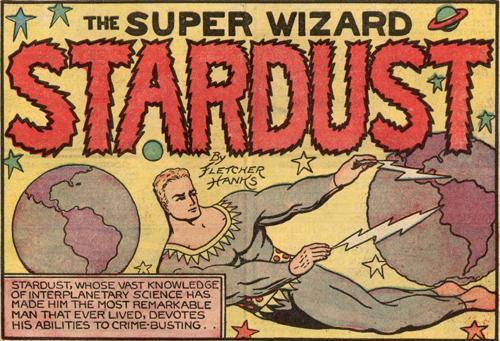
Yes, Fletcher Hanks rears his head once again (see Fantomah of the occult heroes). Stardust the Super Wizard lives on a private star (the air conditioning bills are murder) and travels about fighting crime using “tubular spatial accelerated supersolar light waves” and repulsor and attraction rays. He’s very big in the ray business.

Venatia – the Bell Tower

And another six to whet the appetite.

Part One | Part Two | Part Three | Part Four | Part Five

1006. Luinel is a mid-sized village of about 40 thatched huts surrounded by a picket of pointy sticks and a tangled thicket. The villagers mostly work as woodsmen, but they also keep a few goats, sheep and swine. They are best known, though, for their oxen – powerful beasts with red coats and horns that stretch 4-ft from one tip to the other. These colossal beasts are capable of hauling twice that of normal oxen. The village is governed by a mayor elected by a council of elders and important men and women.

Of particular note is a tall, conical structure in the center of the village. This particular hut is surrounded by a low wall of bright red bricks, with a single opening that is always guarded by an armored man with a masked helm and a stout spear. Inside the hut there is a strange statue, abstract and wretched and hurtful to the eye and soul. The villagers do not allow people to enter the central hut, and when questioned they say only “It is the heart of the village. Can you not hear it beating?” with wide eyes and a look of eerie calm.

While adventurers are welcomed into the village, there is no inn, so they will have to sleep with different families. If they show too much interest in the idol and are of a lawful bent, the families will murder them in their sleep and drag their corpses to the hut, where they will have disappeared by the next morning. The villagers have the abilities of 3rd level assassins when given a mission by their idol. It is said that when a body is given over to “the heart”, that a new red ox appears in the communal pen.

1025. A small family of four hill giants scrapes out a living in the surrounding hills by hunting big game. The cavern holds a towering kiln that the giants use as a hearth for roasting meat. Tucked into the ashes of the kiln there is a sinister magic dagger called the Tooth of Vexus. The Tooth of Vexus is a +2 dagger. Vexus was a potent wizard in these hills some 300 years ago, but not many folks now remember him, primarily because he died in the process of creating a powerful spell to wipe away memories. C’est la vie! Once per day, the holder of the dagger can cast a spell that automatically nullifies saving throws against it.

| Hill Giants: HD 8+2 (42, 40, 36, 30 hp); AC 4 [15]; Atk 1 weapon (2d8); Move 12; Save 8; CL/XP 9/1100; Special: Throw boulders.

1032. There is a bell tower here constructed of dingy, yellow-brown stone. The tower is set on a grassy sward grazed by wild ponies and appears to be abandoned. Careful observers might note that the floor of the bell tower is a spiral of narrow stones. The bell has no rope, but if one manages to ring it, they will cause the spiral floor to turn into a winding spiral stair that leads down to a hexagonal room. Three walls of the room hold a mirror and are painted in a primary color (red, blue or yellow), as opposed to the other walls which are painted black. The mirrors appear to be normal, but if touched prove to have no substance to them. They are, naturally, portals. Each one has a frame of gold set with gems – one with topaz, one with aquamarine and the third with tiger’s eye. Should any of the mirrors be touched, a magic mouth will appear on one wall and say “I shouldn’t do that until you have heard the riddle” in a somber, throaty bass.

At this, a second mouth appears on a different wall and, in a crisp, clear soprano, says, “Choose the picture fair, of fire and light, always bright, small as a snail but containing all there is to see.”

If one answers “The Eye”, a third mouth appears and says, in a soft, quiet voice, “Then what are you waiting for, the master awaits!”

Naturally, the tiger’s eye mirror leads to the under-ground stronghold of Mikelroy the Irregulous, a wizened old sorcerer who specializes in spells of transportation. The aquamarine mirror is one way, and leads to the Land of the Dead. The topaz mirror is also one way, and leads to an alley in Antigoon.

Mikelroy the Irregulous’ home is a round chamber 500-ft in diameter divided by dozens of arches hung with thick, white curtains. Within are living chambers, a library of invisible books (seven volumes, mostly concerning the magic of teleportation, but also a few travelogues of the dimensions) and a laboratory. Several rooms hold bizarre, alien animals in cages – mostly avians of many kinds, including a fairly enraged mi-go in temporal stasis.

Mikelroy has one apprentice, a bestial young woman with a flat nose and flared nostrils, a beetling brow, large, brown eyes, floppy, pointed ears and vestigial horns. Mikelroy will introduce her as Pencella, whom he rescued from a labyrinth.

Mikelroy is a pleasant sort, but distant and overly flashy. He is especially interested in finding a way into the dungeon in [1339].

| Mikelroy, Magic-User Lvl 12: HP 29; AC 9 [10]; Save 5 (3 vs. spells); CL/XP 14/2600; Special: Spells (6th). Silver dagger. Old man with sharp, blue eyes and long, silky hair of grey. He is graceful in build and manner, and wears a flowing white robe that trails several feet behind him and is held aloft by three brass, mechanical crabs.

| Pencella, Beastman Magic-User Lvl 2: HP 2; AC 8 [11]; Save 15 (13 vs. spells); CL/XP 2/30; Special: Spells (1st). Dagger.

1041. A pleasant shoal of white sand stretches almost a mile into the sea here. Though often submerged, at low tide it can be traversed, and one might spot a gleaming statue at its furthest point. The statue is studded with glistening white shells, and appears to be a woman, her arms thrown back, her shoulders forward, her eyes fixed on the horizon. The statue was constructed at some point in time by sea folk, and is an idol of Calypso, a nereid and minor goddess of death. By night, the waters around the idol are thick with enticing asrai.

1105. A wily old kelp dragon, the remains of the honorable Yostifrix, haunts these waters, always on the prowl for a wayward barge of revelers to be overturned and devoured. The dragon’s bed contains three large, rusty chests containing 2,470 sp, 1,200 gp and a large, jagged sard worth 10,000 gp.

| Yostifrix: HD 10 (42 hp); AC 1 [18]; Atk 1 bite (2d6); Move 12; Save 5; CL/XP 14/2600; Special: Breath weapon, level drain, squeeze.

1118. The orc warlord Gorthruk has established a permanent camp here. The camp is built atop a tall, flat hill and consists of a wooden palisade and two tall, wooden watch towers. Gorthruk has worked for the hobgoblins of the Klarkash Mountains in the past, but now has set his sights on conquering Blackpoort. Gorthruk controls 700 orcs and has sent emissaries to the orcs of the central hills to secure an alliance. His warbands patrol the area around this hex constantly, and are encountered on a roll of 1-3 on 1d6.

Treasure: 900 gp, a platinum music box encrusted with gems (5,000 gp, mechanism needs repair) and a gold medallion (1,000 gp).

| Gorthruk: HD 8 (40 hp); AC 4 [15]; Atk 1 battle axe (1d8); Move 9; Save 8; CL/XP 8/800; Special: None. Chainmail hauberk, battle axe, dagger, the Eye of Balor. The Eye of Balor is a pendant worn around Gorthruk’s neck. It allows him to bestow a curse once per day as a 10th level magic-user.

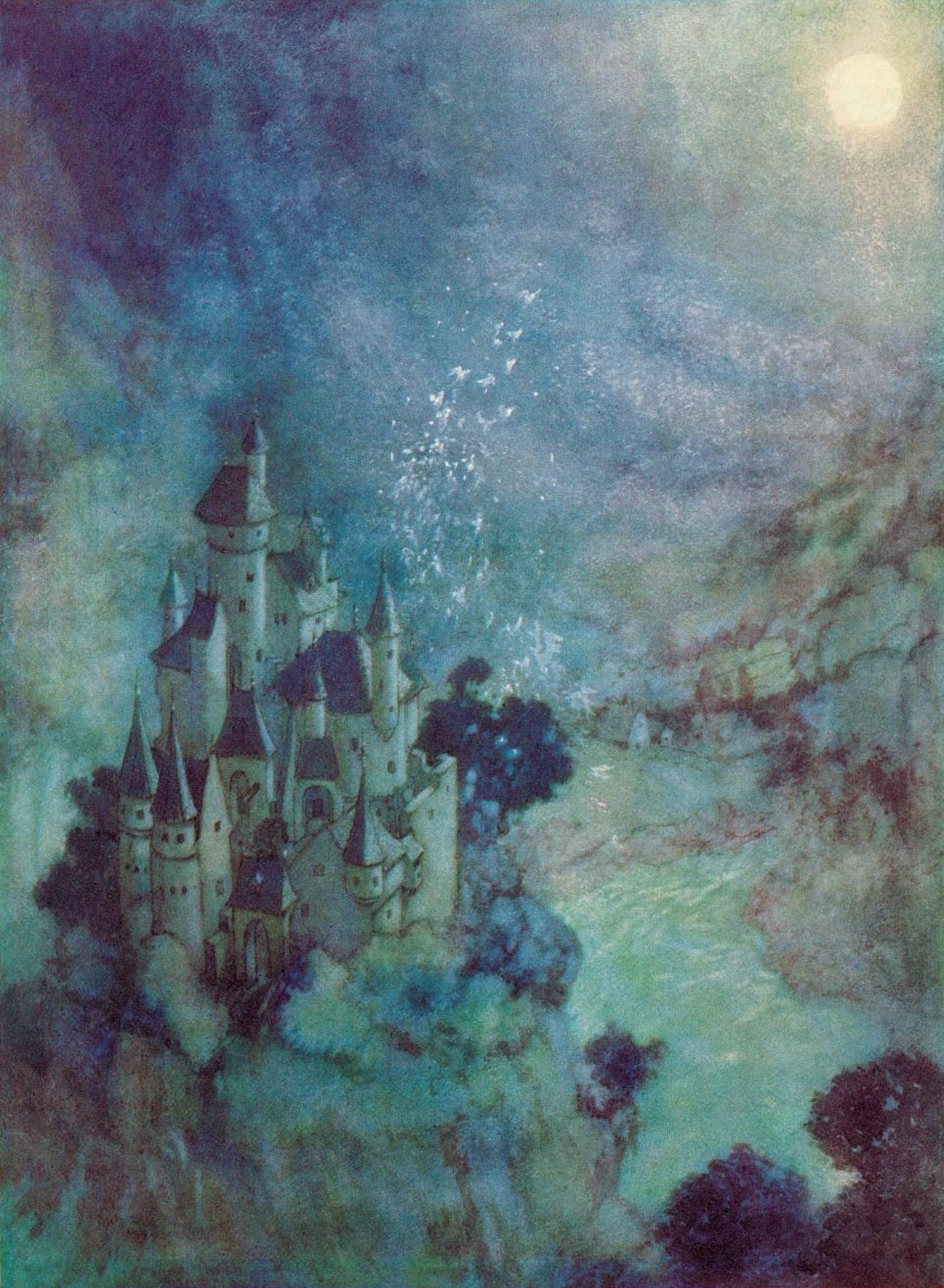
Illustration by Edmund Dulac, via Golden Age Comic Book Stories.

PARS FORTUNA Playtest Time

So, the old band got together last night to do a play test of PARS FORTUNA. It was fun, and generally I was happy with the results. A few take aways:

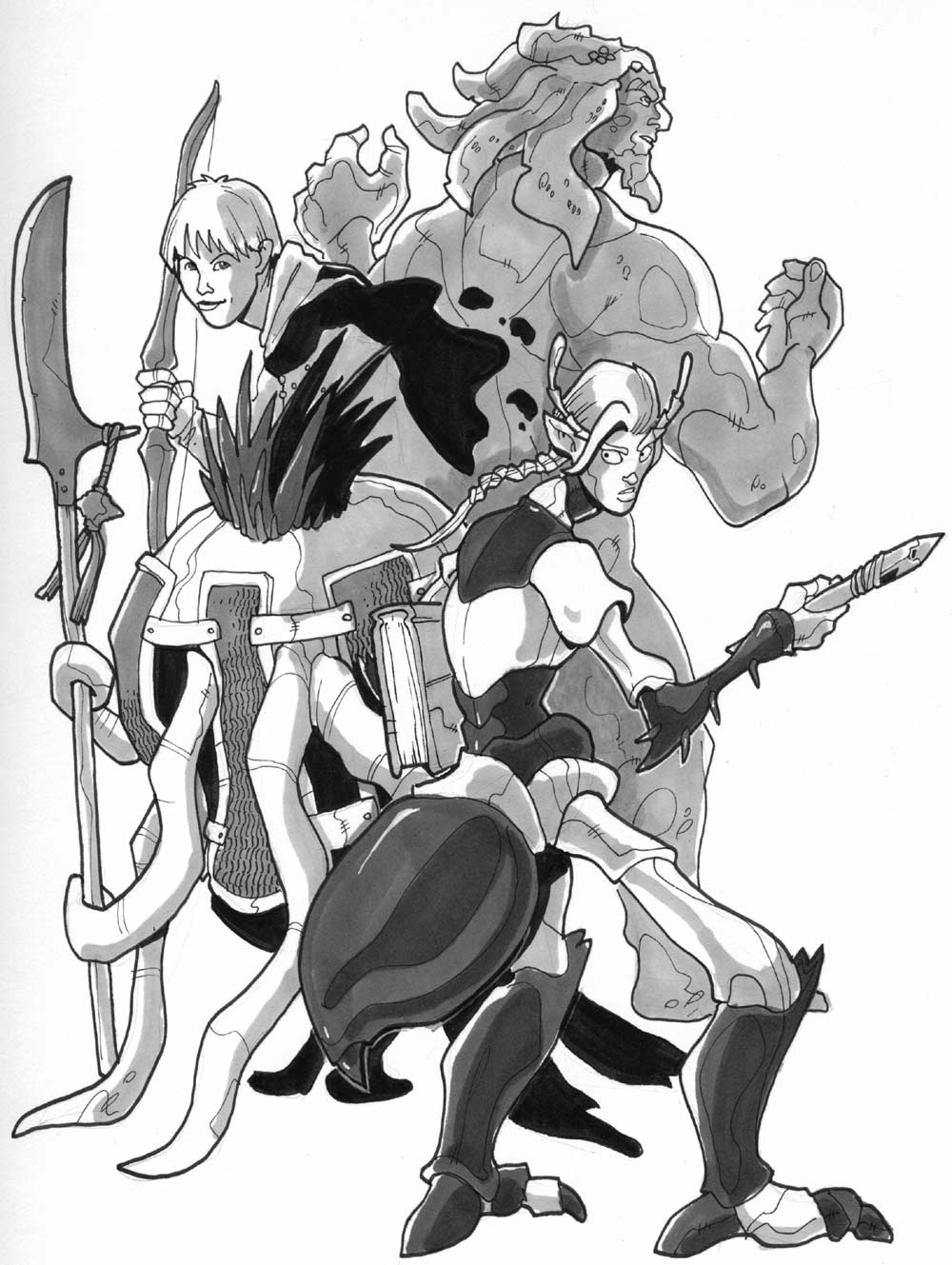
1. The olvugai (the tentacled critter to the right) was the belle of the ball. Dubbed “the potato”, he was the focus of most of the one-liners, i.e. pushing into the middle of a band of nizzertits (the kobolds of Pars Fortuna) so that he could attack to the front and back was termed a “classic potato maneuver”, the olvugai’s heavy armor was described as tin foil, “of the nizzertits show up with sour cream and chives, watch out”, “hand me my angry eyes”, etc.

2. Pars Fortuna is definite old school and my group is not really old school – the lack of combat bonuses for the warriors at first level (or second level) took a few people by surprise, and despite a gentle nudge, henchmen were rejected. Of course, henchmen were sounding better after the first TPK.

3. Oh yeah – I needed to adjust the wandering monster numbers – a large group of wandering nizzertits caused the TPK, and a later band of wandering osks came close to pulling a second. Easy adjustment.

4. The combat system worked very well, and everybody liked it. I was especially pleased with that. The special maneuvers system was also well liked (i.e. declare a special attack, make your roll at -2 to hit, if you hit AC normally, you do damage, if you beat AC by 4 or more, you do your special maneuver).

5. Tweaking the magic system a little, primarily in the random consequences of trying to cast more spells than normally allowed.

So, a few tweaks, but nothing too major. The other happy news is that I finished writing the last 24 magic items today. The game rules are now finished – 12 new race/classes, 100 new monsters, 120 new magic items, 100 converted spells new to Old School gaming and alternate rules for spell casting, combat procedures and weapons and armor. Now I just need to do a bit more editing, write a quick sample dungeon level and small wilderness hexcrawl and do an appendix with some conversion notes for other old school games, and PARS FORTUNA is ready to be published

Mystery Men! Update – The Patriotic Heroes


Really no update on patronage this week. The project is now 109% funded, and any patronage the project attracts now will go to commissioning more art for the game. If you’re interested in being a $10 Silver Age patron or a $20 Golden Age patron, by all means click the link to the right and check it out.

Patriotic heroes are the focus of today’s post. Mystery Men! uses golden age (and public domain) heroes, and it is just about impossible to separate the Golden Age of comic books from World War II. Dozens of costumed heroes and heroines donned the red, white and blue to fight America’s enemies overseas and at home. The patriotic hero that Joel Carroll will illustrate for Mystery Men! will be chosen by Golden Age patrons from the five below.


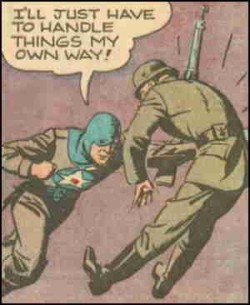
Chase Yale (as opposed to Flee Princeton) was a war correspondent who decided to get into the action by donning the costume of Commando Yank and slapping around Nazis. Commando Yank had no super powers, relying on his fists, knives and guns. I like the low-tech and olive drab vibe of this guy.


Daniel Lyons was another lucky guy who almost died near a reclusive scientist’s laboratory. Nursed back to health by the scientist, Daniel discovers he now has super powers, and decides to use them to fight the Axis. You have to have chutzpah to show up on a battlefield dressed like this guy.


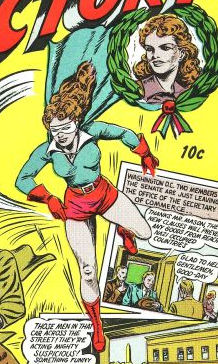
Joan Wayne (she gets points just for the name) is a stenographer in Washington DC who grows disgusted by the political corruption. She decides to fight corrupt politicians as costumed hero in league with the FBI. I know the idea of political corruption in our nation’s capitol sounds crazy, but hey – it was comic books!


Reed suffers from infantile paralysis, and though possessing Herculean strength in his upper body is confined to a wheelchair. Humiliation in front of a woman eventually drives him to build up his legs and become a champion athlete. A rich playboy, he decides to put his new found skills to good use and kick some Nazi butt. Who says sexual frustration never leads to anything positive?


Yankee Doodle Jones is an artifical human created by an unnamed scientist from the body parts of three crippled war heroes (yes, WTF). When Nazi agents kill the scientist in an attempt to steal the formula, Jones and the scientist’s son, dubbed Dandy, go after the agents and then stick around to fight the Axis. Patriotic frankenstein, folks. ‘Nuff said.

Venatia – Raldo’s Head and Terribles Visages

Six more wilderness encounters for you to enjoy. Also – if you’ll peruse the Sept 30 news at Frog God Games, you will see that yours truly has been tasked with writing some hexcrawl modules. The modules are not set in Nod, and are meant to be usable in just about any fantasy campaign. The first module is written, and is now in the process of illumination and editing.

Part One | Part Two | Part Three | Part Four

0603. Here lies the head of Raldo. Raldo’s head measures 8 feet in diameter. It lies in a gully thick with ferns and rotting vegetation and itself is in a state of advanced decay. Despite the presence of dozens of giant centipedes consuming the head and crawling through it, Raldo thinks and speaks and can be consulted as though a sage. Raldo does seem to feel pain, but it doesn’t appear to consume him.

0620. A pack of four dragonnes roams these valleys, preying on the pale, gibbering things that scurry from boulder to boulder and cave to cave. Encounters with them occur on a roll of 1-3 on 1d6.

0628. A terrible image is carved into a mountain here. It depicts a squatting, vaguely humanoid shape. The thing’s head is a mass of tentacles that spread out over the mountain side and its stunted arms end in taloned hands. From beneath the squatting horror, which is at least 100-ft in height, a stream of water rushes out of the side of the mountain to fall into a deep, dark pool. The water has an oily sheen, and smells foul, but is otherwise safe enough to drink. The ground around the pool is often visited, and at night, random encounters with hags occur on a roll of 1-3.

0638. On a pleasant hill overlooking the river valley the gnomes of the hills have constructed a small, stone chapel dedicated to the goddess Minerva in her aspect as the goddess of crafts. The chapel is overseen by a lone priestess, a woman named Kothilda. Kothilda is a woman deformed by disease and abandoned as a child on the coast. Discovered by gnomes, she was raised among them and showed an astounding capacity at their crafts. As she grew to womanhood, they constructed this chapel and dedicated it to the human goddess they believed had blessed the child with her skill at woodworking. She now lives here along, often entertaining the good folk of the forest. The chapel has a single room furnished with an ornate kneeling bench and idol of Minerva that were carved by Kothilda’s own hands, and a simple wooden bowl for donations (she prefers items rather than coins, and people who leave items they have crafted themselves are Blessed by Minerva for 24 hours. Behind the chapel is a gnome-style burrow built on a human scale. This is where Kothilda lives her simple life. It is equipped with a hearth, woven rugs, comfortable chairs and has a small bedroom and a root cellar.

| Kothilda, Cleric Lvl 10: HP 47; AC 9 [10]; Save 6 (4 vs. paralysis and poison); CL/XP 13/2300; Special: Cleric spells (5th), turn undead.

0707. This hex is notable for its large, rolling meadow of tender grass and fragrant blooms. A large fairy circle is evident on the meadow, and it is visited on each full moon by a gaggle (4d6) dancing, fiddling grigs and other fey creatures. In the daytime, it is thick with game and the occasional hunting party of centaurs.

0809. A retired trader from Pfeife has repaired and rebuilt an old stone fort here and turned it into a coaching inn. The inn has a 15-ft tall curtain wall surrounding an oval courtyard with a well. Blending into the wall is a three-story tall round tower topped with crenelations and a tall, conical bell tower. The trader, Androse, lives with his wife and three children on the top floor, beneath the belfry. The second level is a common room for sleeping and the ground floor is a taproom in the day and common room at night. The taproom has two curtained booths which turn into semi-private sleeping berths at night. Androse and his goodwife put out a bountiful spread for their customers, with steaming trays of spiced meats (mutton and game mostly), crocks of soft cheese, wheels of sharp cheddar, round loaves of black bread and fruit cake and leather mugs of pale, sweet ale. Expensive wines are available on request. All of the food is stored in the cellar, which used to hold instruments of torture but now has cages full of wine casks and barrels of flour.

Illustration by Sidney Sime

Deviant Friday – Brohawk Edition

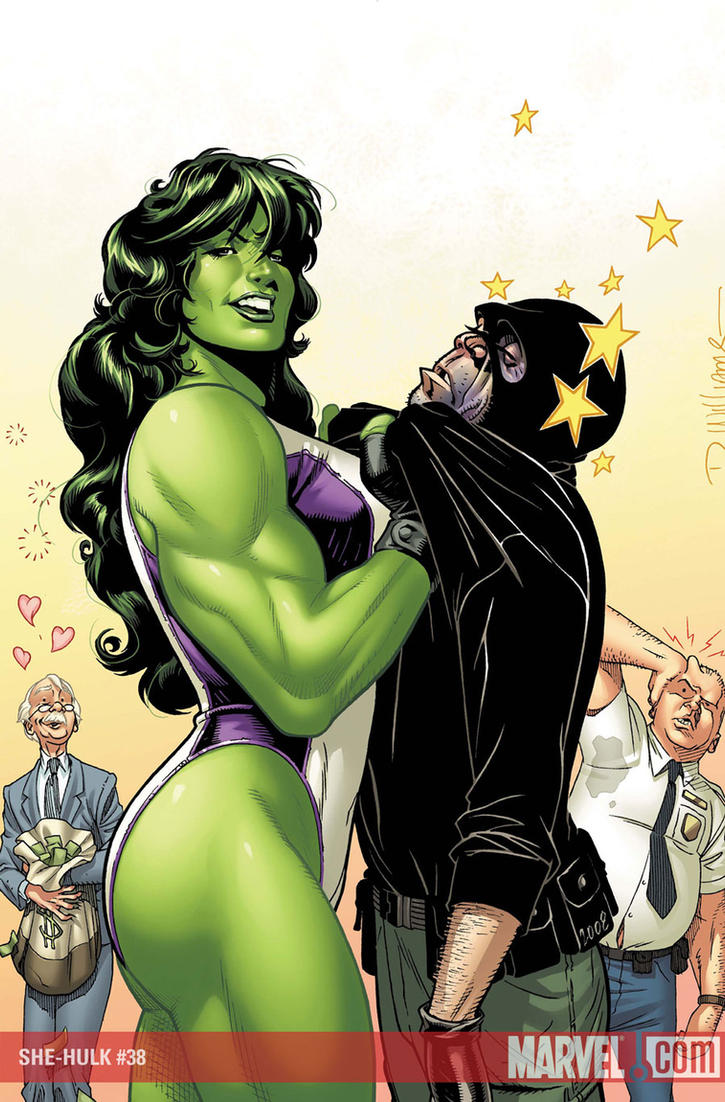
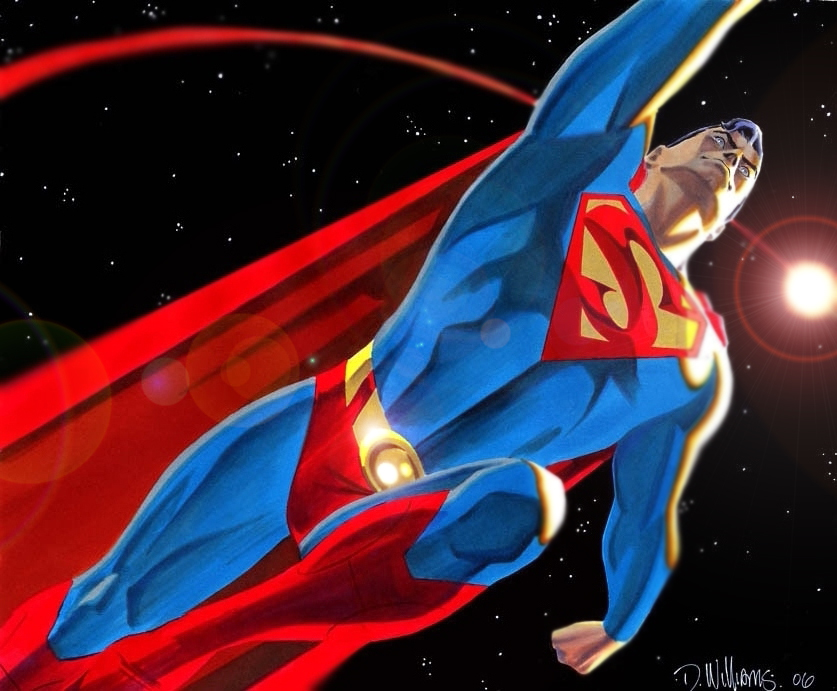
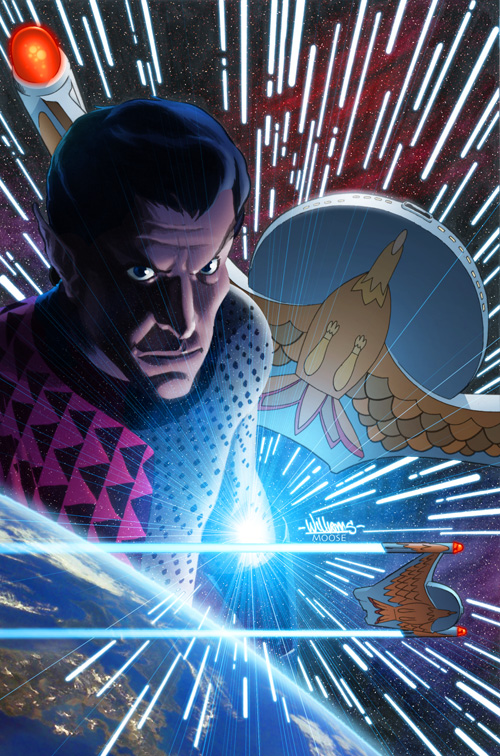
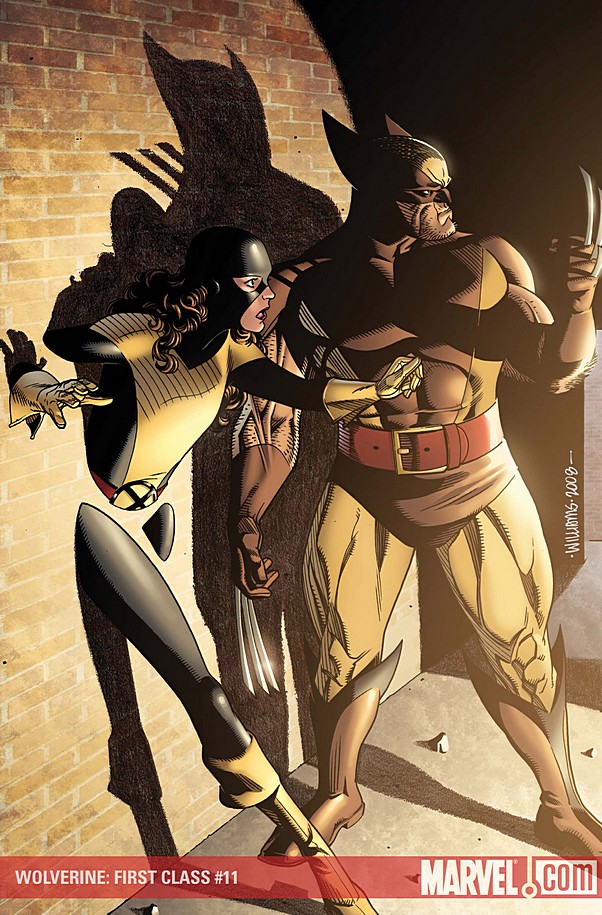
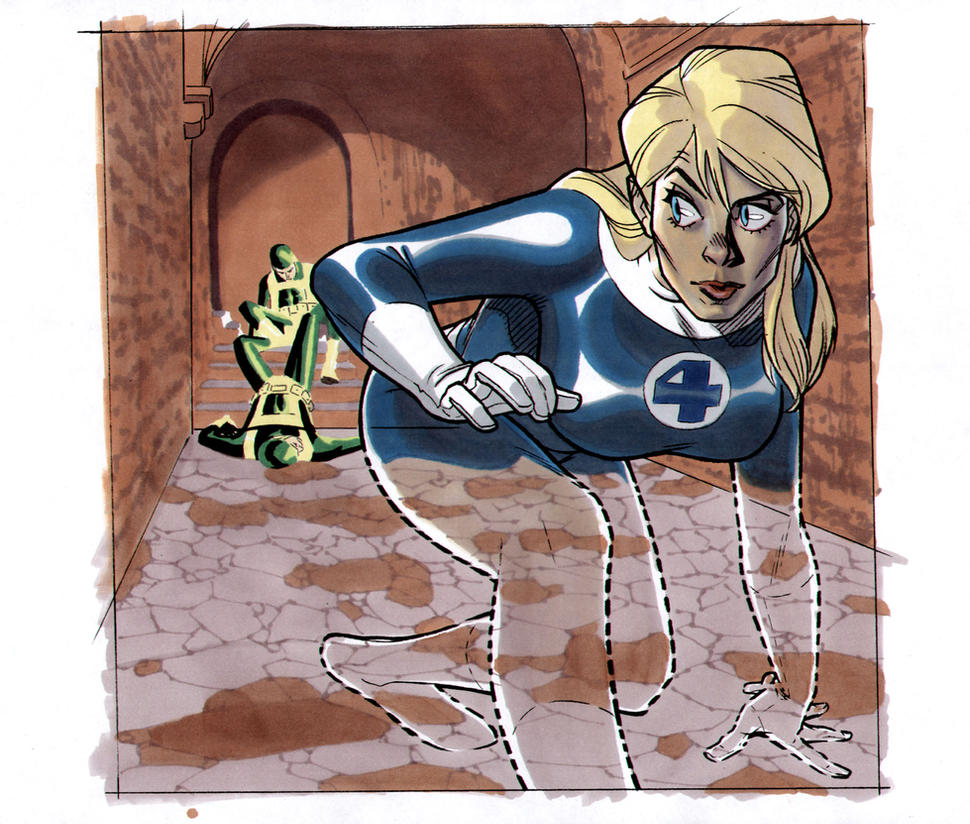
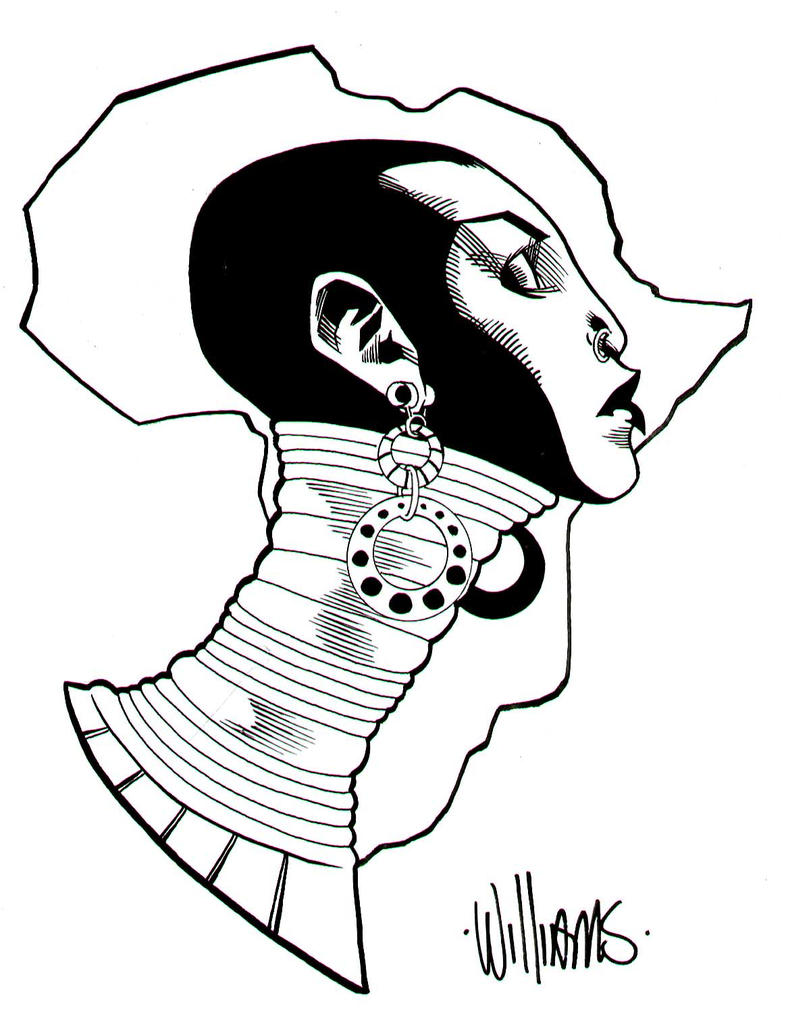
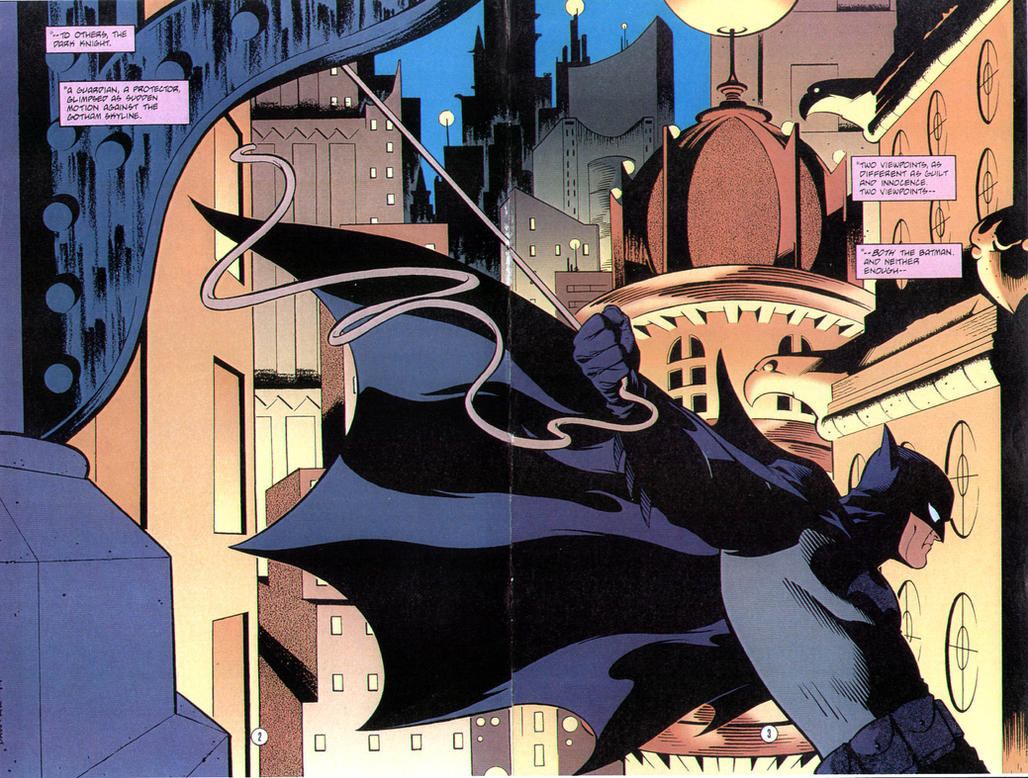
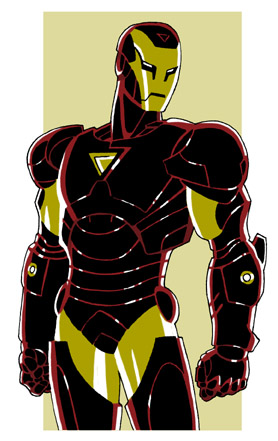
TGI Deviant Friday. Today, a mini-gallery of David Williams, AKA BroHawk. Williams is one of my favorite artists in comicdom – he does great color pieces, great black and whites, with clean lines and an ability to make the heroes equal parts real and fantasy. He is defintely one of the Toth-iest illustrators working in comics today. Enjoy some of my favorite BroHawk pieces.