The Gods of the Golden Sea

The native deities of the Golden Sea region are based on the mythologies of the Eastern Mediterranean, especially the Phrygians, Dacians and Thracians. Almost everything that is known of these entities comes to us from the Greeks and later Romans, and is viewed through their lens. Most of these gods and goddesses were adopted by the Greeks into their own pantheon, usually in positions that were no doubt inferior to the positions they held in the estimation of their native worshipers. Because there were many gaps in the knowledge of these divinities, I did my best to fill them in a suitably pulp-fantasy style.

Besides the deities listed here, several of the deities of the Motherlander pantheon (to be published in the near future) originated in this pantheon, including Bacchus (Dionysus), Hecate and possibly Proserpina (Persephone).

Note: The spells below, and only the spells, are designated Open Game Content.

Kubeleya (Cybele)
Also called Great Mother, Mountain Mother
Deity of Nature, Mountains, Caverns
Wields a staff
Served by earth elementals, fairies of a grim humor
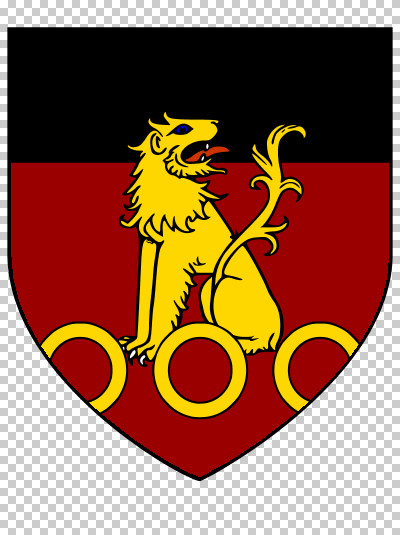
Symbolized by the lion, bees
Aligned with Neutrality
Druids can cast Victory Chant (see below)

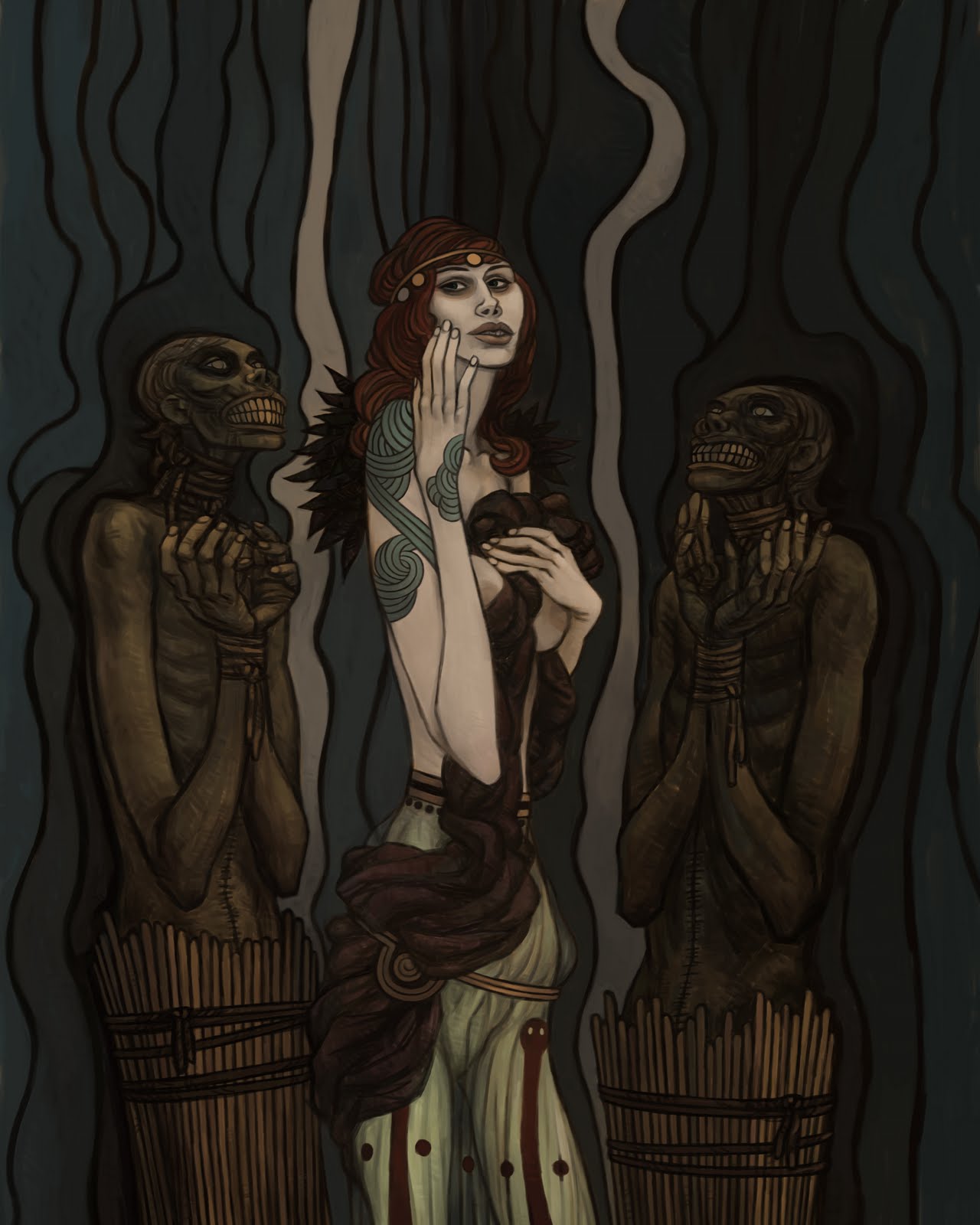
Kubeleya, also called Cybele and Rhea, is the grim goddess of the mountains and mother of the gods. She appears as a stately woman with a dour expression. She wears a long, belted dress, a high, cylindrical headdress called a polos, and a veil covering her entire body. One of her hands rests on an attendant lion while the other holds an instrument that resembles the tambourine. She is often pictured in a lion throne or a lion-drawn chariot.

Kubeleya’s consort is the demigod Attis. Attis has a bizarre origin. The demon Agdistos was a creature that was half man and half woman. It so terrified the gods that they killed it in a suitably bloody manner, and from its castrated male organ grew and almond tree. The remainder of Agdistos became Kubeleya.

One day, Nana, the daughter of the river god Sangarius, picked an almond and laid it on her breast, where it promptly disappeared and impregnated her. Nana abandoned the infant, who was raised by a he-goat in the hills and later adopted by human parents. As an adult, his beauty was godlike and attracted the attention of Kubeleya. Unfortunately, Attis had already been promised to the daughter of the local king. As the wedding songs were being sung, the jilted Kubeleya appeared in all her transcendent power, causing the wedding-goers, including Attis, to go mad and castrate themselves. Attis died, apparently of blood loss, but Kubeleya relented and resurrected him as a pine tree. This occurred on March 25, and is celebrated in the Hilaria festival, an orgiastic ceremony of wild music, drumming, dancing and drinking.

Kubeleya’s priests are called korybantes. They are male eunuchs (self-castrated, like Attis) who worship the Great Goddess in full armor with rhythmic stomping and the clashing of spear on shield.

VICTORY CHANT (Druid Level 2): The druid, by chanting and stomping, gives his allies a +1 bonus to hit and damage for as long as he keeps it up.

Adrasteia (Nemesis, Invidia, Erinys)
Also called Implacable, One from whom there is no escape
Deity of Protection and Righteousness
Wields a long sword and scourge
Served by inevitables (see NOD #3)
Symbolized by a scourge
Aligned with Law
Clerics can cast Unerring Huntress (see below)

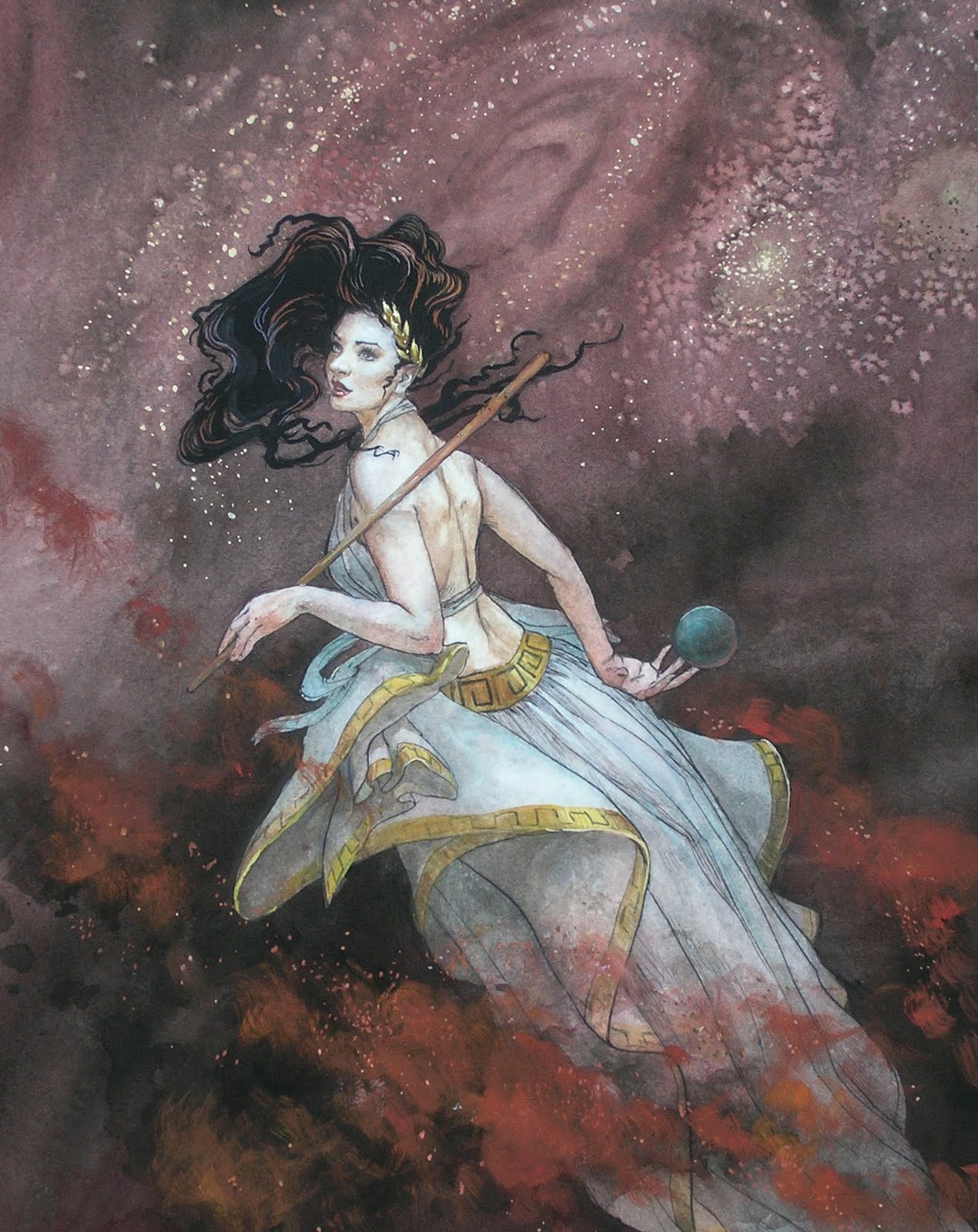
Adrasteia is the goddess of the cosmic sea, dispenser of justice to the wicked and protector of the righteous. In some myths, she is the nursemaid to the infant Jupiter, who grants him a golden ball containing the universe as a toy. In others, she is Nemesis or Invidia, the goddess from which escape is impossible. She appears to her worshipers as a winged maiden with a face unmarred by pity. She might carry the scales of justice, or simply a sword and scourge. Adrasteia is a patron of magistrates and judges, soldiers and gladiators.

UNERRING HUNTRESS (Cleric Level 3): This spell allows the cleric to follow the path of a wanted criminal or blasphemer unerringly for a number of days equal to her level. During this time, she has no need of sleep and feels no hunger. If she has not captured or killed her quarry by the time the spell ends, she collapses into a deep slumber for a full day and cannot be roused.

Kotys (Cottyto, Cottytus)
Deity of the Moon, Caves, Darkness, Lust, Hunting
Wields a spear
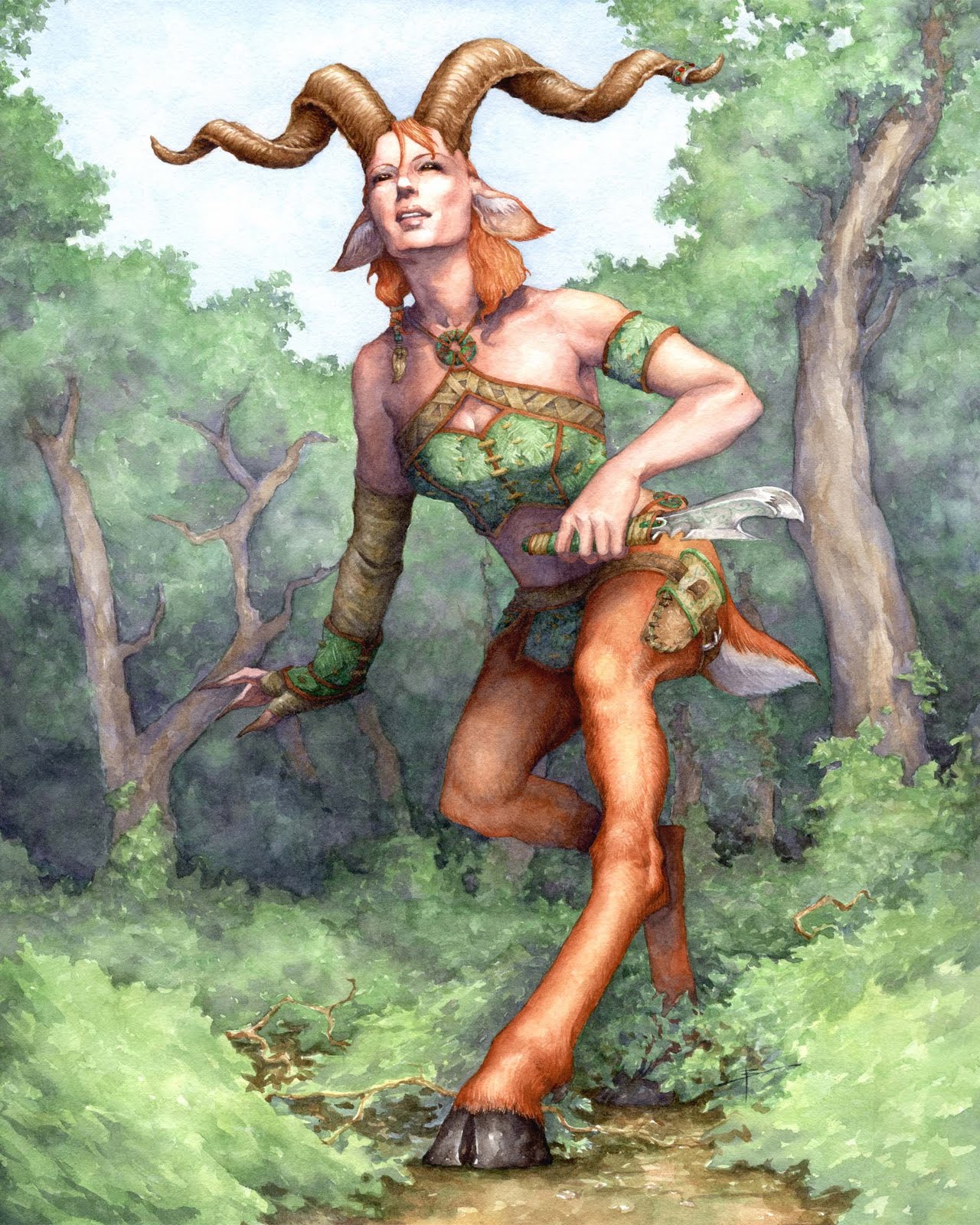
Served by bacchae, demons, satyrs
Symbolized by the full moon
Aligned with Chaos
Clerics can cast Benighted Revelry (see below)

Kotys is a lunar goddess of hunting and wild revels. All of her sacred rituals are conducted at night, preferably by the light of the moon. These rites include raucous midnight orgies accompanied by shrill piping, the clashing of brass cymbals and the thunderous roll of drums, and nighttime relay torch-races on horseback.

Kotys appears as a woman wearing a foxskin cap and short chiton, wrapped in a leopard skin and holding a spear in one hand and a torch in the other. She has a hooded mantle on her shoulders fastened with a brooch and high, leather boots.

Kotys’ priests are called baptai due to the purification ritual they undergo to join the priesthood. They are not unlike the baccae who worship Dionysus / Bacchus.

BENIGHTED REVELRY (Cleric Level 3): This spell affects all sentient creatures within sight of the cleric who fail a saving throw. For the duration of the spell (1d6 rounds per person) they will act in one of three ways:


1 – The person enters a drunken stupor, falling over themselves and finding it impossible to do anything.


2 – The person becomes a raving lunatic, attacking whomever the cleric desires with their teeth and claws. The lunatic attacks twice per round but suffers a 2 point penalty to their Armor Class.


3 – The person acts like a love-starved satyr, attempting to grapple the nearest creature they find even remotely attractive and, well, what they do if successful depends on what kind of game you run.

Men (Lunus)
Also called The Lunar Bull
Deity of the Moon
Wields an axe
Served by nocturnal fey
Symbolized by the crescent moon or an ox skull
Aligned with Neutrality
Druids can rebuke/command lycanthropes as a cleric two levels lower than their druid level

Men is the so-called Lunar Bull, a deity presiding over time and the changing seasons. He appears as a rugged man with crescent horns, like those of a bull, atop his head, and sometimes with the head of a bull in the manner of the minotaur. He wears a Phrygian cap and a belted tunic, and is accompanied by white bulls and white lions.

Sabazios (Karabazmos)
Also called Great God, the Horseman
Deity of Health, Vitality, Abundance, the Underworld
Wields a staff or spear
Served by barghests, demons, wraiths
Symbolized by Hand
Aligned with Chaos
Clerics can cast Ghastly Steed (see below)

Sabazios appears as a black-skinned rider on a white horse. He wears a himation and is depicted carrying a staff of power or a spear. Sabazios is the conqueror of the Lunar Bull and the Solar Dragon, and represents male vitality. Games are held in his honor every five years. Sabazios is believed to by the father of Dionysus. Motherlanders associate him with Pluto.

Sabazios rules the Land of the Dead, emerging with a party of cthonic fey and wraiths to conduct hunts on the nights of the new moon. On these nights, villagers stow away their animals and keep indoors, for all night they hear the baying the barghests and the blowing of spectral horns.

Sabazios’ is the patron of horsemen and his priests are all skilled at riding and mounted combat. They blacken their armor and conduct ritual sacrifices of white bulls and ritual hunts of great beasts like chimeras and manticores. Sabazios is also a psycho-pomp, and thus represents the transmigration of the soul after death. This makes him a patron of magic and magic-users. Such scholarly followers honor sabazios by tattooing their right hands with so many sigils and designs that they are nearly black.

GHASTLY STEED (Cleric Level 2): This spell summons a ghostly white steed with the stats of a warhorse with maximum hit points. The steed is tireless, and serves for a number of hours equal to the cleric’s level divided by three. The cleric can exchange one hour of the spell’s duration for one minute of etherealness, but only while mounted on the steed.

Zalmoxis
Deity of Thunder, Strength, War, Incantation
Wields an axe
Served by berserkers, demons
Symbolized by his axe
Aligned with Chaos
Clerics can cast Thunderstruck (see below)

Zalmoxis appears as a handsome man, unclothed, wielding an axe or lightning bolt. He is a sky father and a deity of masculine power, a god of uncontrollable passions that are often unleashed as violence.

Zalmoxis’ most fervent worshipers believe he is the one true god who accepts their souls after death. Because they do not believe they can ever truly die, they fight as berserkers, gaining two attacks per round and suffering a 2 point penalty to their Armor Class. Zalmoxis is also skilled in the arts of incantation and singing, and thus is worshiped by bards.

Zalmoxis’ clerics wear no armor and only a small amount of clothing. They cultivate a wild, feral appearance and are permitted to wield axes and chopping blades in battle. Because they do not use armor, their Hit Dice are increased to 1d6+2 and +3 hp/level after 9th level.

THUNDERSTRUCK (Cleric Level 2): This enchantment is placed on the cleric’s weapon. The next time it hits in battle, it unleashes a terrific peal of thunder. The victim of the hit must pass a saving throw or be stunned for 1 round. Everyone within 20 feet, including the victim of the hit but excluding the cleric, must pass a saving throw or be deafened for 1d6 minutes.
Meme’s Away! The Fantasy Masterworks List

Via The Silver Key

Bold means I’ve read it, italics means I own it but haven’t read it yet. And yes, I’m ashamed at how many I’ve yet to read.

1 – The Book of the New Sun, Volume 1: Shadow and Claw – Gene Wolfe
2 – Time and the Gods – Lord Dunsany
3 – The Worm Ouroboros – E.R. Eddison
4 – Tales of the Dying Earth – Jack Vance
5 – Little, Big – John Crowley
6 – The Chronicles of Amber – Roger Zelazny
7 – Viriconium – M. John Harrison
8 – The Conan Chronicles, Volume 1: The People of the Black Circle – Robert E. Howard
9 – The Land of Laughs – Jonathan Carroll
10 – The Compleat Enchanter: The Magical Misadventures of Harold Shea – L. Sprague de Camp and Fletcher Pratt
11 – Lud-in-the-Mist – Hope Mirrlees
12 – The Book of the New Sun, Volume 2: Sword and Citadel – Gene Wolfe
13 – Fevre Dream – George R. R. Martin
14 – Beauty – Sheri S. Tepper
15 – The King of Elfland’s Daughter – Lord Dunsany
16 – The Conan Chronicles, Volume 2: The Hour of the Dragon – Robert E. Howard
17 – Elric – Michael Moorcock
18 – The First Book of Lankhmar – Fritz Leiber
19 – Riddle-Master – Patricia A. McKillip
20 – Time and Again – Jack Finney
21 – Mistress of Mistresses – E.R. Eddison
22 – Gloriana or the Unfulfill’d Queen – Michael Moorcock
23 – The Well of the Unicorn – Fletcher Pratt
24 – The Second Book of Lankhmar – Fritz Leiber
25 – Voice of Our Shadow – Jonathan Carroll
26 – The Emperor of Dreams – Clark Ashton Smith
27 – Lyonesse I: Suldrun’s Garden – Jack Vance
28 – Peace – Gene Wolfe
29 – The Dragon Waiting – John M. Ford
30 – Corum: The Prince in the Scarlet Robe – Michael Moorcock
31 – Black Gods and Scarlet Dreams – C.L. Moore
32 – The Broken Sword – Poul Anderson
33 – The House on the Borderland and Other Novels – William Hope Hodgson
34 – The Drawing of the Dark – Tim Powers
35 – Lyonesse II and III: The Green Pearl and Madouc – Jack Vance
36 – The History of Runestaff – Michael Moorcock
37 – A Voyage to Arcturus – David Lindsay
38 – Darker Than You Think – Jack Williamson
39 – The Mabinogion – Evangeline Walton
40 – Three Hearts and Three Lions – Poul Anderson
41 – Grendel – John Gardner [I guess the original doesn’t count]
42 – The Iron Dragon’s Daughter – Michael Swanwick
43 – WAS – Geoff Ryman
44 – Song of Kali – Dan Simmons
45 – Replay – Ken Grimwood
46 – Sea Kings of Mars and Other Worldly Stories – Leigh Brackett
47 – The Anubis Gates – Tim Powers
48 – The Forgotten Beasts of Eld – Patricia A. McKillip
49 – Something Wicked This Way Comes – Ray Bradbury
50 – The Mark of the Beast and Other Fantastical Tales – Rudyard Kipling

I guess I’ll have to get busy. Still – no HPL or CAS, and I have another couple Dunsanys that aren’t on the list.

Organizing My Thoughts on Sandboxes

From issue to issue, I’m trying to improve my sandbox hexcrawl designs. I don’t know if I always succeed, but I’m definitely trying. The first one, the Wyvern Coast, was really just a matter of trying to be original and interesting and, honestly, just seeing if I could put together a product and put it in front of people. With Nabu, I tried to produce some little dungeons to explore – so, less a description of what a place could have, and more an inventory of what the place actually had in it. I see sandboxes as tool-boxes – the writer is supplying readers with ideas that they can use to build fun sessions with their friends. With the next one, I want to take things up a notch, which means spit-balling some ideas.

1. I’ve sketched connections between named NPCs before (X hates Y, Y loves Z), but I think I need to go a bit further on this count. Each named NPC (including the monsters) should have some connection to two or three other NPCs – a history, motivation, emotion, alliance/enmity, relationship, etc – something to drive explorers from one person to the next so that the hex crawl is not only a matter of “what direction do you want to go today” (but, of course, can be exactly “what direction do you want to go today” if that makes the players happy)

2. Some NPCs should hold “pieces to the puzzle” – important rumors, knowledge about a dungeon or another NPC or a lost secret (magic item, spell, way to kill a powerful monster)

3. I should sketch out one big dungeon for each ½ region (i.e. what I publish in a given issue of NOD) and detail the intro level. The big dungeon should probably be well hidden, thus necessitating exploration and interaction for the players to find it. The big dungeon should hold a powerful MacGuffin that ties the region together – maybe an artifact, or a secret, or the catalyst of an important event

4. Each ½ region should also have at least 5 smaller dungeons – a few basic dungeons (for levels 1 to 3), and a few expert dungeons (for levels 4 to 8). What gets turned into a dungeon?

a. A monster lair
b. A tomb or mystic place
c. A stronghold
d. A village
e. A city-state, etc.

One advantage to sticking to this formula is that players will eventually pick up on it, but they won’t necessarily know which stronghold in the region has the dungeon underneath it. This gives them a reason to visit and interact and, hopefully, cause trouble.

5. The dungeons should have connections between them – clues, maps, portals, etc. and should have a connection to the big dungeon

6. I need to do more with the city-states – I’ll always try to detail at least one city-state in each ½ region like I did with Ophir in NOD #2 – Ibis, City of Sorcerers, will be the next. But for the others, I’d like to spread around some interesting, important NPCs that players will probably want to meet, or will want to avoid

a. A master artisan who can craft magical things (nothing too powerful, but useful and maybe vital to the big dungeon)
b. A demon cultist of terrible power
c. A mystic who can tell the future / heal wounds / etc for a price
d. A master rogue/bard/merchant who knows everything and can find anything – again for a price
e. A fierce fighting-man/woman who commands a company of unique mercenaries and can be a great friend or awful rival (or both)
f. A famous inn with important secrets
g. An awesome tavern – the nexus of all adventurers and no-good-niks in the region
h. A monster prince – vampire, ogre mage, etc – something powerful who can drive adventures more than be a simple target for killing and plunder
i. A sage with vital information and his own agenda
j. A valiant noble
k. A villainous noble
l. A monster who is more than it appears and holds a key that cannot easily be claimed with violence (or perhaps a “good” monster that can only provide the key if killed)
m. A demi-god in the flesh – perhaps Hercules is touring the region, or a massive, deified purple worm roosts below a city taking sacrifices from the “innocent” citizens
n. An animal trainer/beast master with wondrous mounts/pets [I’m shaky on this one, but I’m trying to think of the different hirelings that fit into the game and that players might want to visit]
o. A mysterious faction/brotherhood/sisterhood that can be a persistent thorn in the players’ sides

I guess the main thing is that I want to create an environment in which (A) There is a reason to play a game in this region vs. any other region I might invent and (B) the adventurers will have reasons beyond simple wandering to travel hither and yon as they interact with the region. I don’t, however, want to create a narrative that people are bound to follow – rather, I want gentle, passive clues that people can pick up on or ignore, but that nevertheless exist beneath the surface of the sandbox for those who wish to dig into things and occupy the space rather than just visit.

So – any thoughts from the community?

Artwork by Damascus5

Venatia – Bodbertus and Argis

Okay – probably the last preview of Venatia’s eastern half. Today, I’m covering five city-states located in (or near) the Golden Coast. Now, when I create these sandboxes, the first thing I do is randomly generate the contents of the hexes using a huge excel document I created. Based on the terrain of each hex, the excel document randomly fills it with a monster lair, natural feature, village, stronghold or, very rarely, a city. Well, when I generated Venatia, I got five cities in the northeast quadrant of the map, not including Ibis, which I had pre-placed myself – all part of the fun of random tables.

4223 Bodbertus: Bodbertus is a river port city of 5,000 people. The Bodberters, as they are colloquially called, are related to the chalkeions of the Golden Coast. They have reddish brown skin, broad, round faces with brown, grey or blue eyes and thick, straight hair of pale blond to auburn that they wear braided. They tend to be tall, averaging 6 feet in height.

Bodbertus is constructed in the lush valley of the River Vusk, which eventually flows through the Grete Myre and finally empties into the Tepid Sea. The valley is well cultivated and dotted with manorial villages. The economy is based on mining in the mountains. The city-state’s currency is the wose, minted in gold, silver and copper. The patron deity of Bodbertus is Eris, goddess of strife, contention, rivalry and war.

The city itself has an outer wall consisting of thick earthen ramparts topped with wooden spikes and patrolled by groups of 2d6 militiamen in leather armor and carrying bill hooks, short bows and long knives. There is also an inner wall measuring 60 feet tall composed of granite blocks and strong towers. The inner wall has three gates of thick, laminated pine reinforced with iron. The inner wall is patrolled by men-at-arms wearing chainmail and carrying pole axe, short sword and light crossbow (see below).

The buildings within the city are tall and narrow and constructed of white granite with sharply peaked roofs of green copper or tarred pine. Bodbertus is notable for its lush gardens, graceful architecture, expansive markets (there is a corn market, livestock market, metal market, cloth market and gem market), local fencing schools and dozens of eccentric hedgemages. In fact, there are so many mages in Bodbertus that each city guardsman is equipped with three +1 crossbow bolts, and each sergeant of the guard is equipped with three +1 bolts that cause 1d4 points of lightning damage when they hit.

The city streets follow a radial pattern, and are narrow and twisty. The most celebrated construction within the city-state is its museum of ancient treasures, an octagonal building with thick, granite walls. It contains, behind four permanent walls of force, a collection of royal regalia dating to the ancient and warlike Venatian chieftains of the woods, from whom the Countess traces her descent.

Bodbertus is ruled by a triumvirate of elected prefects, one elected by the guilds, one by the peasantry and one by the nobility. All three prefects are quite corrupt. The prefects are under the control of the Ophelia, Countess of Bodbertus, who rules the city-state’s domain and from whom the triumverate and the city’s guilds gained their charters. Ophelia has a measure of storm giant blood in her veins, making her a sorceress of no mean ability.

Bodbertus’ domain is populated by 45,000 people. The nobility consists of 25 baronets. There are also eight ecclesiastical manors. The country is divided into two shires, each patrolled by a sheriff – Jeovald north of the river and Guennock south of the river. The two men despise each other and vye for the hand of the Countess Ophelia. The city watch consists of 50 men-at-arms and the city-state’s standing army consists of 300 militia, 20 knights and 19 sergeants-at-arms.

• Ophelia, Magic-User Lvl 7; HP 24; AC 9 [10]; Save 9; Special: Spells (4th); Crimson robes, golden coronet, thin, twisty pine wand that can cause one subject to dance.

• Guennock, Aristocrat: HD 3 (19 hp); AC 2 [17]; Atk 1 weapon (1d8); Move 12 (9 in armor); Save 14; CL/XP 3/60; Special: Soldiers are +1 to damage; Platemail, battle axe, dagger.

• Jeovald, Aristocrat: HD 3 (9 hp); AC 1 [18]; Atk 1 weapon (1d8); Move 12 (9 in armor); Save 14; CL/XP 3/60; Special: Soldiers are +1 to hit; Platemail, shield, long sword, dagger.

5013 Argis: Argis is a fading city of the chalkeions. The city is constructed on a low rocky plateau with steep sides overlooking the Dinar River, with a system of pulleys and a fortified mule trail linking the city proper to its docks. The city has thick walls of stone, a number of small gates of beaten bronze and tall watch towers manned by expert crossbowmen. Argis is dominated by is ancient citadel and known for the three mighty aqueducts that bring fresh water into the city from the Sturmdrangs. Argis’ patron deity is Kubeleya, the great goddess of the Golden Sea pantheon.

The streets of Argis are narrow and maze-like, and almost impossible for outsiders to navigate what with the propensity of the locals to set up temporary booths and carts to sell their goods. Almost 7,500 chalkeions are packed into Argis’ tall, narrow, tower-like buildings. The buildings of Argis are made of fired red brick with dome-like bronze roofs. The city-state is built around a number of medicinal hot springs, and features a multitude of baths.

Argis is also known for its well-stocked shops (and outrageous prices), medicinal gardens, its brotherhood of druids and rangers that comb the hills for monsters and the fact that almost every surface of every wall and building is covered with mosaics or grotesque terracotta sculpture.

The streets are patrolled by a total of 75 hoplites in archaic armor (treat as chainmail) carrying long spears with black shafts, short swords and crossbows.

Argis has a massive temple dedicated to Kubeleya and her consort, the fertility god Atys. As one of the last cities of the chalkeions, it supports temples to Kotys, goddess of the moon, lust, revelry and the hunt, Sabazios, the cthonic horseman, Zalmoxis, the thunder god worshiped by berserkers, Dionysus (who the Motherlanders call Bacchus), Men, the little god of the moon, and the deities of medicinal springs, Vidasus and Thana.

Argis is surrounded by a domain of 67,500 peasants in 50 manorial villages and mines, mostly goat and sheep herds, but also farmers and miners of gold, copper and silver. The metals trade dominates the economy, and has prompted dozens of foreign merchant companies to construct factories in Argis. Argis has an army of 460 light footmen (mostly spearmen, slingers and archers) and a corps of 30 hoplites in platemail with shield, spear and sword.

Argis is ruled by King Thrasophon and his queen, Hyperne. The royal family also includes princes Phomachus and Hierophius and princesses Thrasoipa, Isaphraste and Lysiela. The king never appears in public without his fire drake-skin cloak (+2 save vs. fire) and his golden scepter and spiky crown.

• Chalkeion Hoplite: HD 5; AC 2 [17]; Atk 2 weapons (1d6); Move 12; Save 12; CL/XP 5/240; Special: None.

• Chalkeion Sergeant: HD 6; AC 2 [17]; Atk 2 weapons (1d6); Move 12; Save 11; CL/XP 6/400; Special: None.

• Princes: HD 7; AC 2 [17]; Atk 2 weapons (1d6); Move 12; Save 9; CL/XP 7/600; Special: None.

• King Thrasophon: HD 11 (59 hp); AC 2 [17]; Atk 2 weapons (1d6); Move 12; Save 4; CL/XP 11/1700; Special: None.

6503 Utya: Utya is a city-state of 12,500 men and women that originated as a military fortress of the ancient Nabu Empire. It is constructed on the banks of the Oeagrus River within view of the blasted remains of an ancient chalkeion citadel.

The people of Utya have coarse, fleecy hair of dark brown and eyes of brown, green or hazel that they highlight with kohl (men and women). They are magnificent physical specimens, standing 6 ½ to 7 ½ feet in height with muscular builds, angular faces and light, creamy skin.

Utya is surrounded by a triple wall of wooden palisades and thick earthworks. It has four stone gatehouses (the River Gate, Mountain Gate, Gate of the Blue Men – see [7502] for more information – and Leopard Gate or Gate of Victory) with steel-reinforced doors operated by stone golems. Within the walls are narrow, stinking, muddy streets and rows of squat, flat-topped buildings constructed of grayish-green brick. The city is built on a grid, but the “suburbs” are less ordered than the city center, which is dominated by a Moon Temple dedicated to Khonsu, the Nabu moon god, and the nomarch’s palace, a vast conglomeration of gardens, brick courtyards and square pavilions. The streets are patrolled by men wearing ring mail and carrying shields, throwing axes and curved short swords.

Utya is known for its many religious idols, which seem to glare at visitors from above every arch and around every corner, as well as its wandering gangs of priests who sing psalms (loudly and badly) for alms. Visitors to Utya usually come for its courtesans, men and women wrapped in gauzy robes of pink or midnight blue and carrying blue lanterns, even in the daytime, or the city’s infamous school of wizardry.

Utya’s economy is based on the fruit trade, with the fields around the city producing an especially tasty golden grape that is turned into a sparkling wine, and the many almond and fig orchards. The economy has been weak of late, but the people have remained cheerful through the hard times.

Utya is ruled by a nomarch (the feudal governors of ancient Nabu) named Haspedth. While the nomarch would have been appointed in the days of the empire, they are now elected by the people, with each hopeful nomarch-to-be minting tin coins in his image and people voting by dropping these coins through the front gates of the palace under the watchful eyes of the high priest of Khonsu, Tebet. The night before each election, the candidates are tested in the arena of combat with light, wooden swords, with the winner of the combat usually chosen nomarch the next day.

7215 Lithr: Lithr is an ancient city of 1,000 stone giants built at the mouth of the Oeagrus River. The city has mammoth walls of granite 150 ft tall and four mighty stone towers, each equipped with a ballista that the stone giant use as a heavy crossbow and dozens of throwing stones. The stone giants of Lithr are tall and angular in body, with pale gray skin and not a sign of body hair. They generally dress in greens and grays, usually in light tunics with sandals and, when the weather turns chilly, cloaks.

The buildings of Lithr are pyramidal stone structures, with wide streets and patrols of 1d3 stone giants (always female) each leading a black bear on a chain. Lithr is known for its lush vines of figs, its orchards of apples and the copious quantities of cider it presses each autumn. The stone giants are peaceful by nature, and welcome traders of the small folk so long as they behave. All small folk are kept at a large inn called the Pudding Pot that is run by Porogan, a swarthy Ibisian with a flair for cookery. The inn’s second story is ringed by a gallery where traders can meet with potential giant trading partners, the arrangement being easier for both small and tall. The stone giants mostly trade via barter, but will accept bars of precious metals and large gems.

Besides their apples and cider, the Lithr are known for their massive ziggurat dedicated to Ymir, the progenitor of all giants, and its corps of rangers, stone giants armed with colossal longbows (1d12 damage) and trained giant hunting owls. The temple is overseen by Wall, who has the abilities of a 6th level druid, and the rangers lead by Peorn, who has the abilities of a 3rd level ranger. Lithr’s queen is the stoic and often cruel Sikn.

7502 Palah: Palah is a city of blue-skinned men and women with golden hair and eyes of the lightest gray and blue-green. The palahi are believed to be colonists from another dimension or world – they aren’t telling – by those sages who have managed to visit them. All palahi have the ability to control people’s minds (per the charm person spell, usable at will).

Palah has a population of 17,500, making it the second largest city in the region after Ibis. The hills and valleys around the city have sewn with salt by the palahi to support their soul source of nourishment, a creeping lavender vine that produces bunches of small, purple crystalline berries that taste of salt and lime. Humans can live on the berries for a few weeks before the very high salt intake begins to take a toll on their health. The many acres of lavender vines are cultivated by over 150,000 peasants, who trill strange songs with their throats while they work, using tame giant snails to pull their plows and fertilize the fields with their trails of slime. Palahiland, as it has been termed by sages, is composed of three districts, each ruled by a zim (roughly equivalent to a count). At the extreme western end of the domain there is a small trading town called Zibbul, where outsiders trade exotic goods for mineral salts and smelted metals.

The city boasts an army of over 1,000 footmen armed with repeating crossbows (3 shots per round) and large cleavers with hooks jutting out from the back of their heads. The army also has 74 knights wearing chainmail and carrying shields, lances and cleavers mounted on what appear to mechanical armadillos.

The city-state itself is constructed on a large, flat island in the midst of a shallow acid lake. A long bridge of spun glass spans the lake, but those crossing the bridge at less than a trot must pass a saving throw or be overcome by the acrid fumes and become nauseous for a few rounds and then die choking on blood. The palahi make a living dredging weird salts and metals from the shores of the lake, the workers wearing respirators and using thick, long-handled glass scoops.

The palahi are cheerful, friendly folk. Their city has smoothly cobbled twisty streets (paved in brilliant azure stones) and spacious, multi-storied buildings built in a rococo style. The streets are patrolled by watchmen in chainmail and shield wielding cleaver, man-catcher (one per team) and longbow, and often assisted by thick, white eyeless worms that they have trained like guard animals. The city has 175 watchmen, each deadly in the extreme with their longbows – in fact, it is the fortunate thief indeed who is placed in the city stocks rather than spitted by a barbed arrow.

Palah is home to numerous little museums in the ground floor of noble homes, each a showcase of the odd collections of its owner. It is governed by King Jespers, a monarch elected by the noble families of Palah. The king, in turn, appoints dozens of nobles to his privy council and to oversee the plantations.

The palahi worship an alien god they call Vinin. Vinin’s idols, which are numerous and placed throughout the city, depict a short palahi man with a graceful build and wearing a pointed, onion-shaped red helm. He carries a thick cutlass in one hand and a skull in the other and is apparently a god of killing placated by the sacrifice of young men, who throw themselves from the glass bridge under the fourth full moon of each year in frenzied adulation.

So, the five city-states of eastern Venatia. Over the next week, I’m going to work on the Gods of the Golden Sea, maybe preview a couple other articles I’ve written, and then get to work on the city-state of Ibis.

[Edit – Wow – many spelling errors. Can you tell I posted this at 11 at night?]