Pars Fortuna Preview #2 – Races of Pars Fortuna (with ART!)

A month back I hired Jon Ascher, a gentleman known on DeviantArt as Pachycrocuta, to draw the odd, randomly generated races that populate the world of PARS FORTUNA, and boy did he knock it out of the park. I had him draw the races in groups of 4 (there are 12 total) and have now received the inked drawings and want to share them with everyone, along with some brief descriptions of the races, how they will be presented in the game and where they fit into the rules and setting.

The tall “gentleman” is a BO’AL. The bo’al are a race of hermaphrodites with bluish-green to deep green waxy skin reminiscent of the skin of a dolphin. In the setting, they dwell on a wide prairie bisected by a great river and crisscrossed with hundreds of canals, locks and irrigated fields. Nicknamed the engineers, they are taught from a young age the disciplines of mathematics, physics and architecture. Bo’al respect hard work and personal liberty – they’re happy to come together for a cause, but dislike the concept of kings. They are usually jovial sorts, and intensely curious about how things work.

In game terms, bo’al are one of the “skill” classes – and by this, I mean you tend to have three sorts of classes in class-based games – the fighting classes (good attack bonus, best hit dice, worst saving throws), the magic classes (spells, low attack bonus, low hit points, good saving throws) and the skill classes, which muddle about in the middle. The bo’al get a bonus to detect sloping passages, sliding walls, secret doors and large, room-sized traps (most folk do it on a 1 in 6, they do it on a 2 in 6), as befits their skill in engineering. They also have some skill at disabling traps, setting traps and repairing damaged items. Adding to their usefulness, they can withstand a pretty good amount of damage – they get an extra hit dice at 1st level and can regenerate some damage after each battle. So, the bo’al is a skill class with a nod towards combat.

At the center of the group is an ILEL, nicknamed the imperials. The ilel are a race of clones – copies of a former marshal of the Empire of Vex grown in vats to form a personal guard for the emperor. They have skin the color of burnished gold, hair as black as night, solid black eyes and a well developed sense of megalomania – probably why they now run the empire they were hired to protect. Ilel are accomplished swordsmen, specializing in fighting with broadsword and a wavy-bladed dagger called a kris. They are haughty and arrogant, often treating their comrades as henchmen, and if not for their ability to cut a path of red ruin through their enemies, they wouldn’t be tolerated.

The ilel is a fighting class. They are mobile fighters, so less armor but a boost in initiative. They also have some bonuses when fighting with two weapons (higher bonus to hit and the ability to trade their bonus to hit for a bonus to AC round by round). Because of their commanding attitude (and admitted skill at command) they improve the fighting-ability of their henchmen (no, not the other player characters, even if the ilel treats them like henchmen) and can have one henchman more than their charisma score would normally allow.

Next to the ilel is a CALEDJULA. The caledjula’s claim to fame is their ability to fly without the need of wings. Caledjula have tawny to reddish fur, pupil less white eyes, huge ears and six fingers on each hand. Caledjula are natural tricksters, having an inborn ability to generate illusions. In the game setting, they dwell in the tall mountains that surround Fortuna’s Spire (the literal “tent-pole” dungeon of the setting) in cliff dwellings. They are nicknamed the aeolians.

Caledjula are one of the magic race/classes in the setting, filling the role of a trickster class. All of the spell casters in PARS FORTUNA use the same spell list (126 spells, level 1 to 9), but each magical race gets a small list of spells open only to them – illusions in the case of the caledjula. The caledjula can also work on people’s emotions with their deep, melodic voices (i.e. a bonus to reaction checks) and they have a bat-like radar sense that lets them operate in complete darkness.

Finally, the little scaly bugger is a CAKROL. The cakrol resemble humanoid pangolins. Nicknamed zealots, cakrol are devoutly religious folk who live in little villages on a lush peninsula covered by rain forest. They make their way harvesting tropical crops, carving wooden idols, trading in beautifully crafted sailing barques and doing their best to protect themselves from the evil spirits that infest their homeland. They are a clannish people, and possessed of a fearful anger when they feel their adopted clan / guild / adventuring band is being threatened.

Cakrol are primarily a fighting class – they have the good attack bonuses, the hit points and the ability to use any weapon. They come with their own armor, which can be supplemented. Adding to this, they have some ability to detect and repel evil spirits (not unlike a cleric’s turn undead ability) and the ability to go berserk in combat.

All of the races in PARS FORTUNA will be presented as races separate from classes, and as racial classes (the default for the setting). My hope is that even people not interested in playing a “PARS FORTUNA” are able to find something useful in the book for their own game.

Next Preview – A ghostly adventuress, a walking heap of kelp, something from beyond the stars and a waspy woman …

Medieval Bestiary – Part Five

European folklore holds a candle to none in the breadth and depth of its imagination. Europeans populated not only their own countries with all manner of strange beasts and monsters, but extended their imaginations over the entire globe. While a good many of these creatures have been given game statistics, several have not. Some of these creatures are, to be sure, simple variations on existing monsters – ogres, giants, fairies, spirits, etc. Others are just not threatening or interesting enough to demand statistics. Those monsters of the folklore of France, Germany and the Low Countries, and those of medieval bestiaries and heraldry, that I thought both unique and challenging are presented below.

Part One, Part Two, Part Three, Part Four

This post is declared Open Game Content.

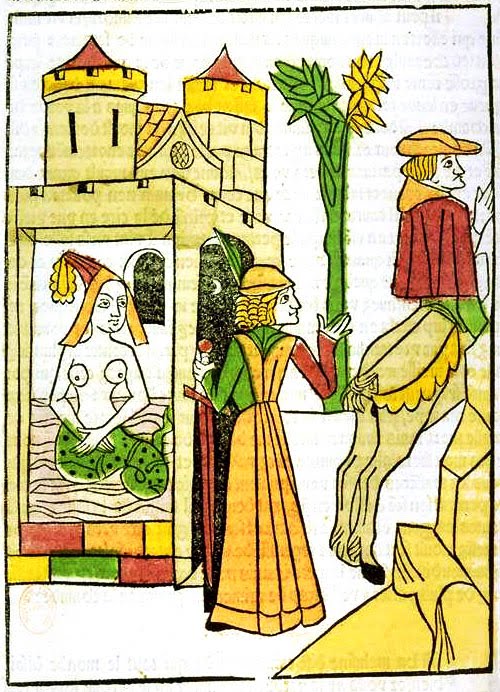
Melusine
Melusines appear to be exceptionally beautiful young women that, in place of legs, possess two mermaid-like tails. Melusines live in rivers and lakes. They crave the companionship of men, but are easily insulted if not given proper respect. The offspring of unions between humans and melusine are always melusines if female, or future magic-users if male. Melusines are fierce protectors of their children. Melusines can polymorph themselves at will into human females or small bronze dragons. One day per week they must assume their natural form and must submerge themselves in water.

Melusine: HD 2; AC 7 [12]; Atk 1 weapon (1d4); Move 6 (Swim 12); Save 16; CL/XP 4/120; Special: Polymorph.

Monocerus
The monoceros is an animal of the savanna often mistaken for a unicorn. It has the face of a sheep, the body of a stag, the rear feet of a goose, the tail of a dog and a long horn growing from its head. They are expert at spearing fish from rivers with their long horns. Although a monoceros horn has no efficacy against poison, it is worth approximately 20 gp on the open market.

Monoceros: HD 3; AC 5 [14]; Atk 1 gore (1d10); Move 15; Save 14; CL/XP 3/60; Special: None.

Monopod (Sciapod)
The monopodes are dwarves with one leg and a massive foot. They live in sunny highlands and use their foot as an umbrella when they take their afternoon naps. Monopodes are extremely strong (+2 to hit and damage) and they can control animals (as charm monster, but up to 6 animals). Monopods are as skilled at blacksmithing as other dwarves. They wear chainmail hauberks in combat and wield heavy maces and spears. Monopod tribes are led by 3 HD chieftains wearing platemail. The chieftain’s bride is always a druid. The chieftain will be guarded by four 3 HD bodyguards.

Monopod: HD 1; AC 4 [15]; Atk 1 kick (1d8) or 1 weapon (1d6); Move 9; Save 17; CL/XP 1/15; Special: None.

Muscaliet
This odd creature from medieval bestiaries has the body of a hair, the tail of a squirrel and a boar’s tusks. The muscaliet is about the size of a large dog. It’s body gives off a blistering heat that eventually kills the tree in which it builds its nest. Muscaliets are not terribly aggressive, but they do respond violently to threats and attacks. The muscaliet is surrounded by a 10 ft radius of intense heat. Creatures within the heat aura of a muscaliet suffer 1d3 points of damage each round. People in metal armor or wielding metal weapons suffer an additional point of damage each round.

Muscaliet: HD 1; AC 7 [12]; Atk 1 gore (1d4); Move 15; Save 17; CL/XP 2/30; Special: Heat.

Musimon (Tytron)
The musimon is a cross between a goat and sheep, having the feet and body of a goat and the head and wool of a ram. The creature has four horns on its head, two curved like a ram and two straight like a goat. Musimons are incredibly strong and will quickly charge creatures that approach their herd. Their gaze acts as a hold person spell on a single creature or a cause fear spell on up to 10 creatures. In any case, a saving throw is allowed to avoid the effect.

Musimon: HD 4; AC 7 [12]; Atk 1 butt/gore (2d6); Move 12; Save 13; CL/XP 5/240; Special: Gaze attack.

Myrmecoleon
The myrmecoleon has the body of a giant ant and the head of a lion. Because the lion head is only attracted to eating meat and the ant body is designed for digesting grain, the creature is usually in a foul mood. Like giant ants, they inject a poison with their bite attack. The poison does 2d6 points of damage if a saving throw is failed, 1d4 points of damage if the saving throw succeeds.

Myrmecoleon: HD 5; AC 4 [15]; Atk 1 bite (1d8 + poison); Move 18; Save 12; CL/XP 6/400; Special: Poison.

Panthera (Pantere, Love Cervere)
Pantheras are intelligent, supernatural felines with iridescent coats and sweet-smelling breath. Pantheras are roughly the size and shape of a leopard. They spend most of their time sleeping in their caves, but emerge once or twice a week to hunt. Pantheras are lawful creatures that will not attack non-chaotic creatures unless seriously provoked. Panthera females are capable of breeding only once, so the breed is quite rare.

Pantheras have a breath weapon that can be used three times each day. The panthera’s breath is a cloud of perfume that fills a 20 ft radius centered on the panthera. Any creature except dragons that breathes this perfume must make a saving throw or be affected as by a charm monster spell. Dragon, on the other hand, are affected as though by a fear spell. Spells like stinking cloud or a troglodytes maliferous odor are neutralized in a 30 foot radius around a panthera. A panthera’s hide, if reasonably intact, retains this property and thus is quite vauable. If a panthera successfully bites a victim, it gains two additional attacks with its rear claws.

Panthera: HD 7; AC 3 [16]; Atk 2 claw (1d4) and 1 bite (1d6); Move 12; Save 9; CL/XP 8/800; Special: Breath weapon, rear claws.

Parandrus
The parandrus resembled a shaggy ox with cloven hooves and a large rack of antlers. Although unintelligent, the parandrus is capable of changing its color and shape. A parandrus will change its color as a means of camouflage, surprising on a roll of 1-4 on 1d6. In general, a parandrus that surprises will choose to flee, rather than attack. If forced to fight, the creature is capable of changing itself into any natural and supernatural beast. The parandrus can change shape each round and still attack.

Parandrus: HD 4; AC 3 [16]; Atk 1 gore (1d6); Move 12; Save 13; CL/XP 6/400; Special: Change shape.

Peluda
A peluda is a river beast that resembled a giant, green porcupine. Its body is covered by stinger-tipped tentacles that can be made erect like quills. It also has the neck, head and tail of a serpent and the legs and feet of a tortoise. The peluda is capable of attacking with its poisonous stingers. Any creature in melee combat with the beast is subject to 1d3 stinger attacks each round. Each stinger inflicts 1d4 points of damage, or half that if the victim succeeds on a saving throw. The creature can also fire off one stinger each round as a missile attack with a range of 60 feet. A peluda has one of three possible breath weapons. The first is poisonous gas, like that of a green dragon. The second is a fiery breath, like that of a red dragon. The third is a gout of acid, like a black dragon. Each peluda will have one of these breath weapons, which it can use three times per day, inflicting 6d6 points of damage.

Peluda: HD 8; AC 2 [17]; Atk 1 bite (2d6), tentacles (see above); Move 9 (Swim 15); Save 8; CL/XP 11/1700; Special: Breath weapon, poison tentacles, only harmed by magic weapons, magic resistance 15%.

Deviant Friday Five – Adriano Batista Edition

This week’s artist: Adriano Batista, aka Adrianohq

And yes, so far Deviant Friday Five is beginning to look like pin-up girl Friday. In my defense, comic book and fantasy art has always been about 80% pin-up art.

Red Sonja
and don’t let the scale mail bikini distract you from that awesome shield art

Jungle Girl

Jungle Girl again
I found the masks very inspiring when I was writing my faux-African part of NOD (to be published eventually)

Wyrms Book Three
The old tavern scene

Lyrael the Hunter
Cat girls have invaded Western fantasy, and they’re not leaving anytime soon

On Venatia – Ruined Villas and Mysterious Junks

Six more encounters for the Southeast quadrant of Venatia …

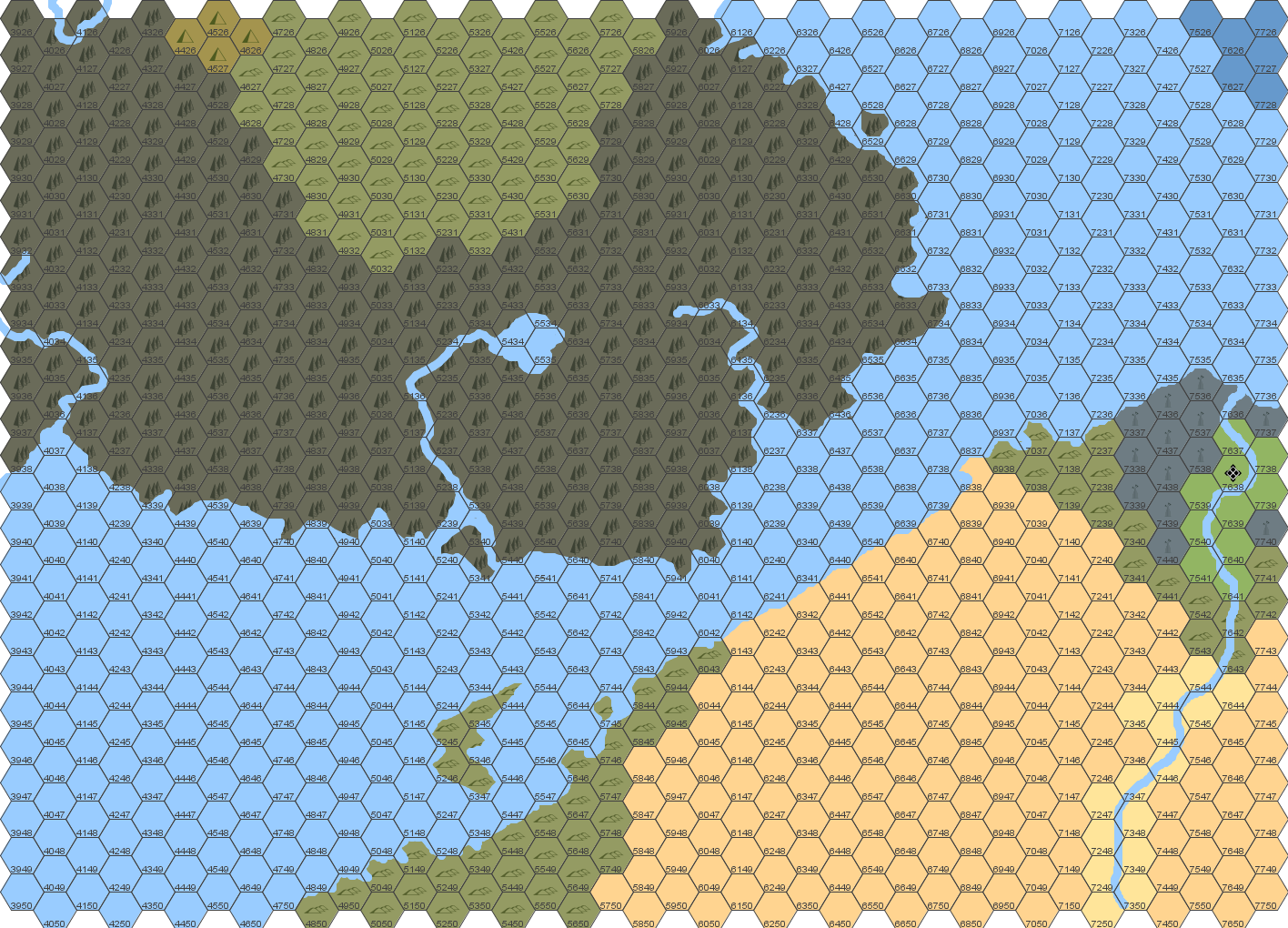
3939 Mysterious Junk: A merchant sailing vessel of Mu-Pan design is anchored off the coast and seems perpetually blanketed in fog. The junk is home to Kevote, the commander of a brotherhood of thieves and assassins that operates throughout the Tepid Sea region. The brotherhood engages in smuggling, murder, blackmail and loansharking. Besides the inscrutable Kevote, the ship is home to a dozen low-level thieves and assassins and two lieutenants, Morfinda and Dourne. Morfinda was born in Blackpoort. She has long, black hair, a pale complexion and very dark, brown eyes. Morfinda is cunning and without mercy, and expects to replace Kevote in the very near future when a few of her own plans come to fruition. Dourne, on the other hand, is a native of Tremayne with reddish-blond hair, pale blue eyes and a quick and ready wit. He is also a cowardly killer, very skilled with poisons and “accidents”, but unsteady in a direct confrontation. Both are tied to Kevote via secrets, and both are unaware that Folas, Kevote’s apparent valet, is his true lieutenant. Kevote regards Morfinda and Dourne as nothing more than useful idiots for establishing his empire in the Motherlands. All of Kevote’s operative have a small, black dragon tattooed on their backs at the base of their neck. Kevote’s treasure, kept below decks in steel boxes (puzzle locks, -5 to open, spring-loaded needles with deadly poison), consists of 11,000 sp, 500 ep, 4,500 gp, two rose quartz (worth 500 gp each) and seven fox skins (35 gp each, actually taken from seven kitsune sisters who believed that Kevote was a man they could cheat).

• Kevote, Level 11 Assassin: HP 36; AC 6 [13]; Save 5 (4 vs. death); Special: Sneak attack for x4 damage; Three daggers (one is wavy bladed and coated with deadly poison), five darts, burglars’ tools, leather armor worn under a many-colored silk robe embroidered with a black dragon.

• Morfinda, Level 5 Thief: HP 26; AC 7 [12]; Save 10; Special: Back stab for x3 damage; Two daggers, four darts, burglars’ tools, leather armor, a black cloak with many pockets.

• Dourne, Level 4 Assassin: HP 12; AC 7 [12]; Save 12 (11 vs. death); Special: Sneak attack for x2 damage; Three daggers, five darts (two coated in paralysis poison, three in poison that deals 1d6 damage), leather armor, burglars’ tools, vial of poison.

• Folas, Level 7 Magic-User/Thief: HP 21; AC 9 [10]; Save 8; Special: Spells (4th), back stab for x3 damage; Dagger, three darts.

• Thieves (8): HD 2d6; AC 7 [12]; Atk 1 weapon (1d6); Move 12; Save 13; CL/XP 3/60; Special: Back stab for x2 damage. Carry short swords, daggers, three darts, shield and wear leather armor.

• Assassins (4): HD 2d6; AC 7 [12]; Atk 1 weapon (1d8); Move 12; Save 14 (13 vs. death); CL/XP 3/60; Special: Sneak attack for x2 damage. Carry short long swords, daggers, light crossbows, shield and wear leather armor.

4044 Dragon Ship: The sorcerer Henakhe, bitter exile of Ibis, plies the Golden Sea in an animated dragonship called, Revenge, which looks like a merchant galley with a large figurehead in the shape of a dragon’s head and neck. The ship is crewed by two dozen dragon men and their leader, a warlock called Felia. The Revenge has no home, as yet. It sometimes docks in Cutthroat Cove (see NOD #1, “Wyvern Coast”, hex [3119])), but more often finds small coves along the Golden Coast. Ibisian ships sacked by Henakhe have their crews slaughtered, their heads sent back to the king of Ibis through mysterious means. Henakhe’s treasure consists of 5,200 gp and an aventurine worth 2,000 gp.

• Henakhe, Level 7 Magic-User: HP 22; AC 9 [10]; Save 9; Special: Spells (4th); Grey robes over a black velvet doublet, crimson leggings and long, black velvet slippers that come to a point, grimoire, curved dagger, ebony staff topped with an obsidian jackal’s head (worth 60 gp).

• Felia, Level 4 Fighter/Magic-User: HP 13; AC 9 [10]; Save 12; Special: Spells (2nd), bite attack inflicts 1d4 damage plus 1d4 fire damage; Battle axe, dagger, grimoire.

• Dragon Men: HD 1+1; AC 6 [13]; Atk 1 bite (1d4 + 1d4 fire) or weapon (1d8+1); Move 15; Save 17; CL/XP 3/60; Special: 1 first level magic-user spell, fiery bite. Leather armor, curved long sword, dagger, crossbow.

• Revenge, Dragonship: HD 10; AC 0 [19]; Atk 1 bite (2d8) and 4 slams (1d6); Move 15; Save 5; CL/XP 13/2300; Special: Breath fire (3/day, 30-ft line, 10d6 damage), navigate, double damage from fire, control winds.

4049 Ley Nexus: A nexus of ley lines runs through this hex, culminating a monument constructed on a low sea mount. The monument consists of twelve whale tusks, each 10 ft in length forming a circle. Each tooth has a tiny line of runes carved into it from tip to base, facing the center of the circle. If a druid cuts his forefinger and traces each line of runes, he can activate a teleport spell that will take him up to 90 miles (15 hexes) in any direction, so long as the last tooth touched is in the direction he wishes to go. Others can be taken with the druid, but must be bound to him by some medium (rope, chain, etc).

4127 Pine Ridge: A steep, granite ridge lined with pine trees stands out like a rampart over the surrounding forest. The ridge is the lair of five woodwose, ill-tempered brutes who survey the surrounding woodland for victims on which to release their pent up hostility. The woodwose will attack from the ridge using their spikes when possible. The ridge is roughly 20 feet higher than the woodland floor. It can be climbed with relative ease by rangers, assassins and thieves even during a fight, but under pressure, other characters must make a saving throw midway during their climb to avoid falling for 1d6 damage. The woodwose have collected 10,000 cp, 10,000 ep, 4,500 gp and 20 pp over the centuries, and sometimes leave heaping piles of it in plain sight as bait. Otherwise, it is stored in a dark crevasse atop the ridge.

• Woodwose: HD 9 (44, 42, 42, 39, 33 hp); AC 2 [17]; Atk 2 slams (1d6); Move 12; Save 6; CL/XP 10/1400; Special: Spells, spines, double damage from iron.

4128 Ruined Villa: An ancient villa of the Nabu rests atop a rocky hill. One side of the hill is overgrown with pine trees and brambles, while the other is bare granite that has been carved into a bas-relief of a grape harvest and wine pressing under the gaze of Mut and Min, goddess and god of fertility. The villa is almost completely destroyed, with one two intersecting walls remaining and the rest a pile of masonry overgrown with weeds. One of the surviving walls bears a faded and damaged fresco showing the green-skinned god Osiris holding a goblet and with barrels of grapes at his feet sending ten men bearing jugs of wine away from him toward the setting sun. This is a really a clue directing one to proceed ten paces to the west. At this point, now buried by a couple feet of rubble, there is a secret trap door that leads into a wine cellar. The cellar contains several barrels of what is now vinegar, and a cache of twelve bottles of very fine wine, worth at least 50 gp each. One of these bottles contains a long vial that contains a map showing the location of the tower in [4433].

4138 Sadhnath: Sadhnath is a fishing village built on bluffs overlooking the coast. Beneath the bluff there is a sandy beach and several caves in which the fishermen store their boats. Narrow, precarious steps lead from the village to the beach. The village is protected by a 7 ft tall, 3 ft thick wall of stone with a iron portcullis opening to the stairs and two thick wooden doors to the woodland beyond. A single beacon tower rises near the bluff, giving a commanding view of the sea and woods. Passing very near the village is a stream that pools and then flows underground, eventually spilling into the sea from a submerged cave.

The village consists of a number of stone hovels with gabled, wooden roofs. Over 300 fishermen live in the village with their families. They are outspoken, honest and exceedingly rude, and both men and women make a habit of smoking clay pipes. The largest building in the village, a 3-story tower keep of weathered, pitted stone and warped, wooden shutters is home to Lord Porht, an aging man with heavily creased, olive skin and salt-and-pepper hair. Porht has a well groomed mustachio and beard, and a jutting jawline. He claims the entire coast, from river to river, but hasn’t the ability to back up his claim. His entire “army” consists of fifteen men-at-arms in ring armor with spears and long bows and a brusk, burly sergeant named Jaltyr who wears a long, chainmail hauberk and pot helm and carries a double-headed axe (treat as a pole arm). Lord Pohrt’s treasure consists of 1,200 gp.

The most interesting aspect of the village, however, is its hostel. It is constructed in a large cave about ten feet above the beach. There are two entrances, one through a door facing the sea (itself reachable via warped, wooden stairs), and the other through a long tunnel that crosses the aforementioned subterranean steam before terminating in a circular staircase that leads to a hidden trapdoor on the surface. Either entrance is guarded by a zwunker bouncer (twins named Colleja and Serta). Within the cozy cave there is a taproom serving crabapple cider (the trees grow near the village) and a concoction of fermented goat’s milk flavored with berries and honey, as well as fish stew, boiled eels and large oysters steamed with wild onions and parsnips. The hostel is run by Nidee, a likeable old woman with the mouth of a sailor, and her two sons, the elder March and the younger Linder. The hostel sells space on the floor of the taproom for 1 sp per night, and has two private rooms rented for 3 gp per night. Nidee has about 90 gp to her name.

• Lord Pohrt: HD 4 (16 hp); AC 1 [18] in platemail, otherwise 9 [10]; Atk 1 weapon (1d8); Move 12; Save 13; CL/XP 4/120; Special: Men-at-arms under his command are +1 to initiative. Wears red velvet doublet and striped red and white leggings with black, leather boots with silver buckles. Always carries a long sword and dagger.

• Jaltyr: HD 3 (14 hp); AC 4 [15]; Atk 1 weapon (1d10); Move 12; Save 14; CL/XP 3/60; Special: None. Jaltyr loves Pohrt like a son loves a father, and enjoys a +1 bonus to hit and damage when defending him.

• Colleja & Serta, Zwunkers: HD 2 (8, 7 hp); AC 7 [12]; Atk 1 weapon (1d6); Move 9; Save 16; CL/XP 2/30; Special: Control wind, magic resistance 10% in 10′ radius. Twin sisters, they were wrecked up the coast, losing their comrades and parents, as girls and were given a home by Nidee, who reminds them of their grandmother. They wear leather coats and carry leaden clubs and three darts.

• Nidee: HD 1d6 (4 hp); AC 9 [10]; Atk 1 makeshift weapon (1d4); Move 12; Save 18; CL/XP B/10; Special: None. Usually wears a long peasant’s dress and a dingy apron.

• March & Linder: Same stats as mother, save they have 5 and 4 hit points respectively. They wear peasant’s clothes and carry daggers.

Inspirational Art – Gustaf Tenggren

If you haven’t experienced Gustaf Tenggren before, please make an effort to do so (beyond the few images in this post). As I complete the J10 map of Venatia with its pseudo-Western European vibe, understand that images like those of Tenggren are foremost on my mind. These images come from Illustrateurs, a French blog that makes me feel more sophisticated every time I read it.

Fairies are underused in modern fantasy, in my opinion. There’s no better “big bad guy” than a little bastard who can mind your mind in two

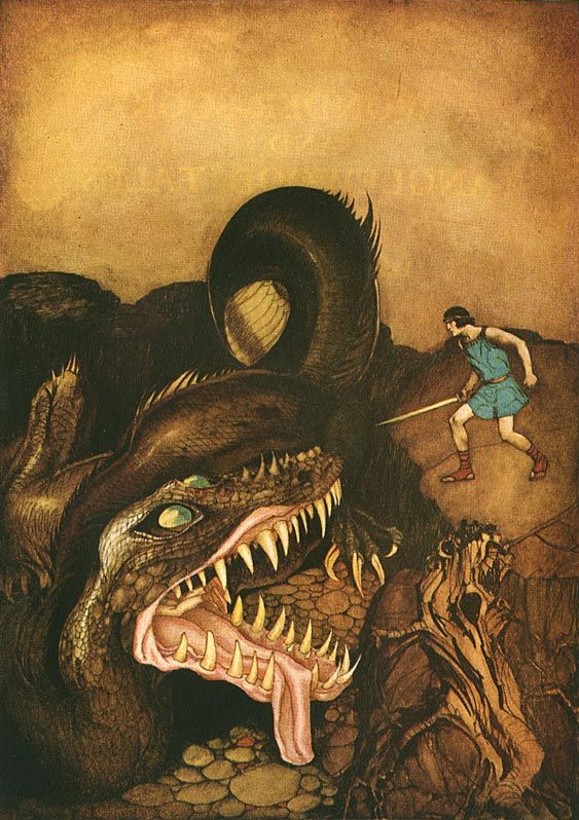
Going after a dragon with an AC of 9 [10] – that’s bravery

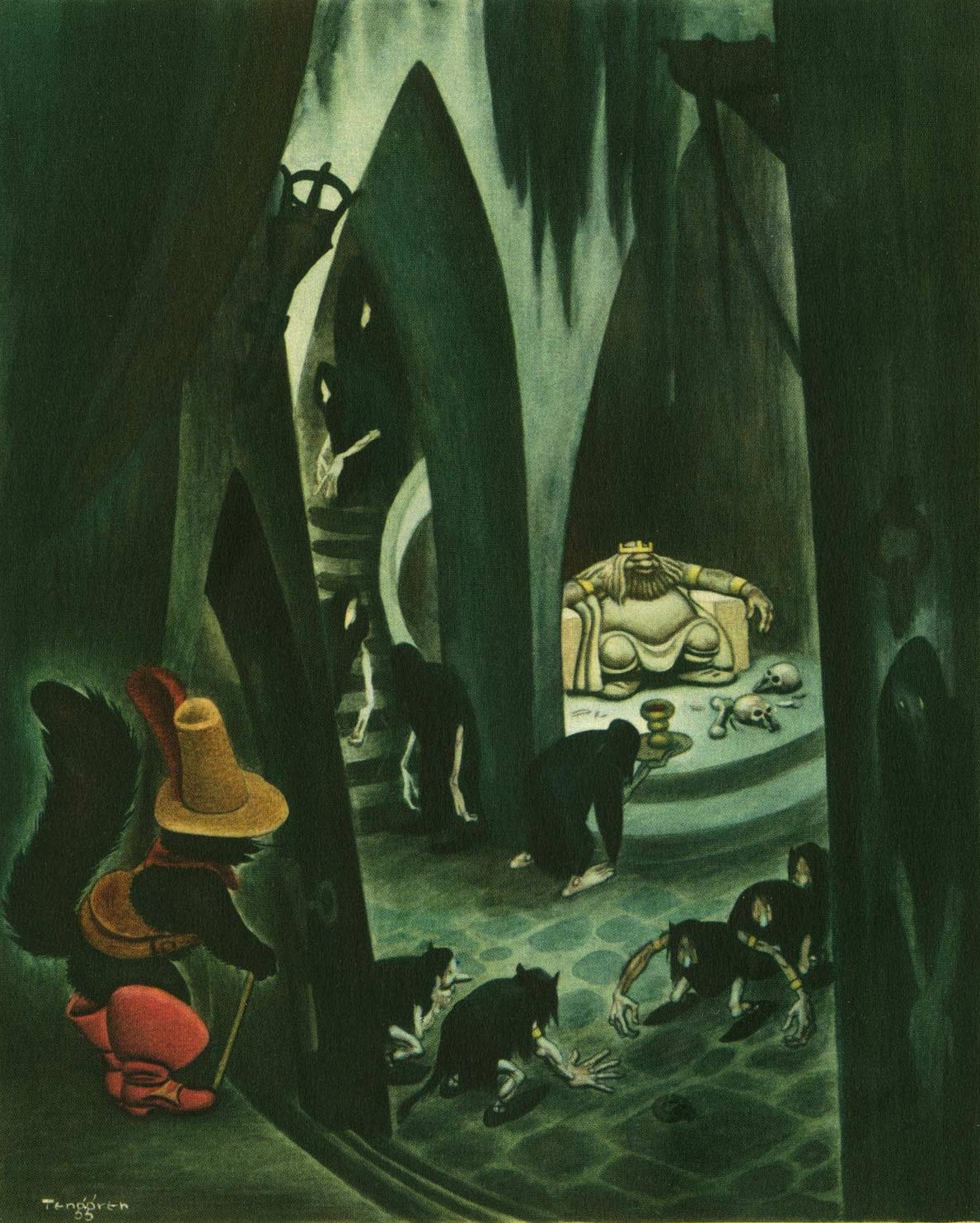
Talking animal (i.e. halfling) in an ogre king’s castle – that could happen in NOD.

Tenggren’s design for the Evil Queen in Snow White.

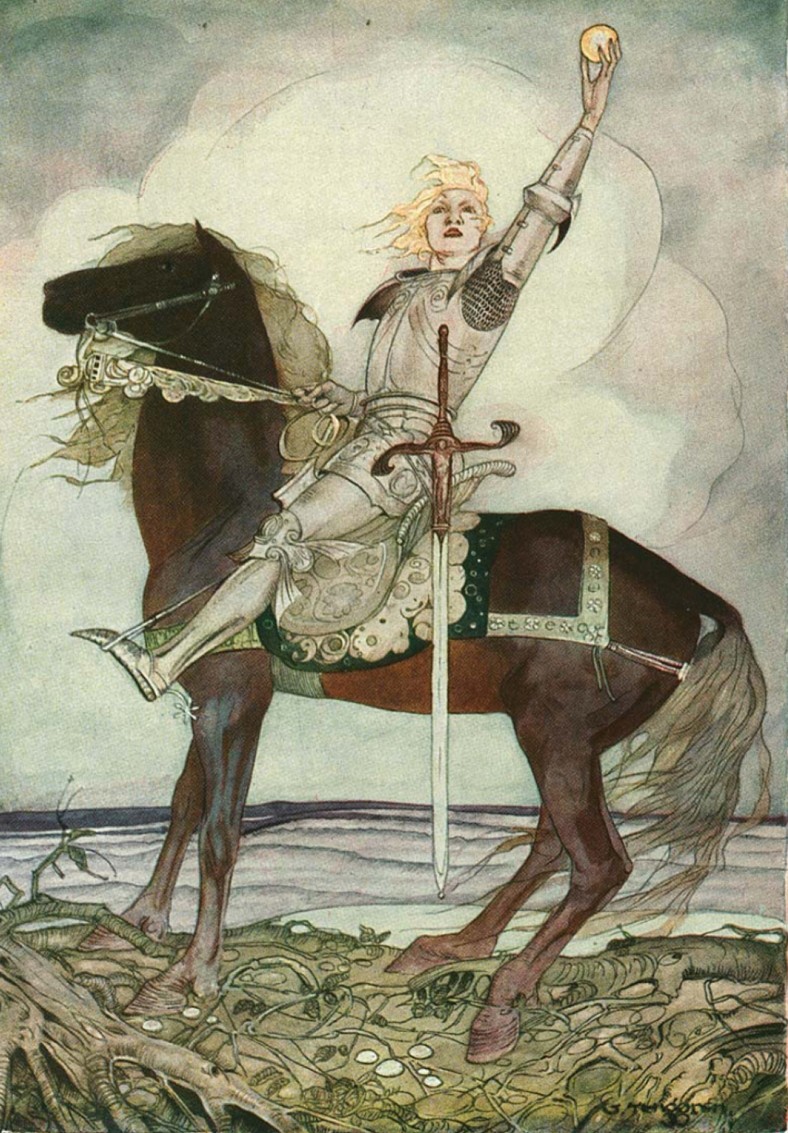
This, my friend, is a paladin.

NOD on rpg.net

My daughter googled my name last night, and this review of NOD #1 turned up on rpg.net. Sleeper rated issue #1 a “7”, which isn’t bad since he gave the same rating to the Swords & Wizardry Core Rules, the 1st edition DMG and Vault of the Drow ;).

Anyhow, if you have a hankering to rate the first issue, that would be a good place to do it. Unless you hated it, in which case rating it would be a terrible waste of your time.

Oh – and why the Darwyn Cooke drawing of Red Sonja? Because Darwyn Cooke + Red Sonja is reason enough.

Medieval Bestiary IV

European folklore holds a candle to none in the breadth and depth of its imagination. Europeans populated not only their own countries with all manner of strange beasts and monsters, but extended their imaginations over the entire globe. While a good many of these creatures have been given game statistics, several have not. Some of these creatures are, to be sure, simple variations on existing monsters – ogres, giants, fairies, spirits, etc. Others are just not threatening or interesting enough to demand statistics. Those monsters of the folklore of France, Germany and the Low Countries, and those of medieval bestiaries and heraldry, that I thought both unique and challenging are presented below.

Part One, Part Two, Part Three

This post is declared Open Game Content.

Ghouls
The nachzehrer, or “afterwords devourer”, is a foul undead creature from German folklore. Usually the risen corpse of a victim of suicide or disease, the nachzehrer consumes dead bodies in the manner of a ghoul. The creature assumes the shape of a large pig after leaving its grave, and initially targets its own family for consumption.

Gnolls
Through one means or another, the gnoll of modern fantasy games has come to be represented as a humanoid with the head of a hyena. In medieval bestiaries, two creatures can be used as variant gnolls. The first is the chromandi, a hairy, savage humanoid with the teeth of dogs. The second is the cynocephalus, Latin for “dog-head”. These dog-headed creatures were long claimed to have hailed from the mountains India. The dog-heads were hunters who communicated with barking and wore animal skins. Although of ancient Greek origin, they persisted into the Middle Ages. Saint Christoper was often depicted as being a cynocephalus, for he was a member of the tribe of Marmaritae, who were believed to be large and to have the heads of dogs. In game terms, Christopher would be a very rare high level lawful gnoll cleric! In the late Middle Ages, there were stories of such people living in Central Asia. King Arthur had a band in his retinue, inhabitants of the mountains of Eidyn, or Edinburgh. The Chinese admiral Hui-Sheng described an island of dog-heads, a “dog kingdom”, to the east of Fusang. Clearly, the gnolls got around in the days when giants still walked the earth.

Gorgad
Gorgades are hairy demi-humans believed to inhabit islands off the Atlantic coast of Africa. First described by Pliny the Elder, they feature in many medieval bestiaries. In Pliny’s description, it seems likely that what he was really describing was an encounter with apes. There is no reason, of course, that the gorgad cannot be portrayed in a fantasy game as a new race of hairy, primitive humanoids. After all, one can only encounter orcs and hobgoblins so many times before they yearn for something new.

Gorgades are primitive humanoids that are covered in shaggy fur. They dwell in large, extended families of 20 to 50 individuals and are usually led by one or several powerful males (2-5 Hit Dice each). Gorgades use primitive weapons, usually clubs and stones. They are known to be fleet of foot.

Gorgad: HD 1+1; AC 7 [12]; Atk 1 weapon (1d8+1); Move 15; Save 17; CL/XP 1/15; Special: None.

Gulon (Jerff, Vielfras)
The gulon appears to be a large, brown, shaggy wolf with the head of a wild cat and the tail of a fox. The gulon kills quickly and then gorges itself on its prey, eating rapidly and until swollen. A frenzied gulon can devour most of a man-sized corpse in three rounds. Once gorged, its movement is reduced to 6, it suffers a -2 penalty to hit, and its Armor Class is reduced by 2 points. A creature devoured by a gulon cannot be raised from the dead or resurrected, but can be brought back to life with a wish.

Gulon: HD 3; AC 3 [16]; Atk 1 bite (2d4); Move 15; Save 14; CL/XP 3/60; Special: Devour corpse.

Humans & Demi-Humans
Pliny the Elder described many strange humanoids who can statistically be represented as bandits or men-at-arms. The hippopodes, or “horse-feet”, were a tribe of humans with equine feet that lived on an island with two other strange tribes. The panotti were humans with ears so large and long that they could cover the creature’s entire body. The other tribe was the oeonae, humans who only ate oats and marsh bird eggs (but not the eggs of the barnacle goose, for that creature does not lay eggs!) The struthopodes are a tribe of humans in which the male has very large feet and the female very tiny feet. The machlyes are a race of hermaphroditic humanoids that look generally like human beings with male and female halves.

Ichneumon (Echinomon)
The ichneumon was believed to be the enemy of dragons. When the creature spotted a dragon, it would cover itself with mud and close its nostrils with its tail in order to surprise the dragon and pounce upon it and swiftly kill it. The name was later used to designate the mongoose, legendary enemy of poisonous snakes. For our purposes, we’ll consider the ichneumon to be a giant mongoose that is incredibly swift (per the haste spell) and immune to dragon breath and poison. Against dragons and other reptiles, the ichneumon enjoys a +2 bonus to hit and damage.

Ichneumon: HD 6; AC 3 [16]; Atk 2 bites (2d4); Move 18; Save 11; CL/XP 8/800; Special: Haste, immune to dragon breath and poison.

Klabautermann
Klabautermann are aquatic gnomes of a kindly disposition who aid fishermen and sailors at sea. These gnomes are expert sailors and musicians. They appear to be small, gnomish sailors in yellow clothes, woollen caps and gripping a sailor’s pipe in its mouth. Unfortunately, a klabautermann is naturally invisible, and will only appear to sailors if their ship is doomed to sink. A klabautermann is skilled at the hornpipe, and can play a tune that grants the sailors of a ship a +2 bonus to hit, damage and on all saving throws.

Klabautermann: HD 1d6; AC 3 [16]; Atk 1 weapon (1d4); Move 9; Save 18; CL/XP 3/60; Special: Invisibility, rousing music, only harmed by silver or magic weapons.

Mandragora
A mandragora is a little doll or figurine in the shape of a beardless man. They are given to magic-users by the nether powers to act as familiars. In terms of game statistics, the mandragora can be considered a homunculus. Its possession allows a magic-user to Contact Other Plane once per week. The mandragora must be fed the blood of an innocent to keep it alive. They are immune to fire, and can actually travel back to their hellish plane of origin by entering a fire.

Matagot (Mandagot)
The matagot is an evil spirit that takes the form of a black cat, rat or fox. Matagots can bring wealth to a person, but in turn condemn their soul to torment after death. If the owner of a matagot gives it the first bite of food and drink at every meal, it is rewarded the next morning with a single gold coin. Each gold coin the person collects condemns his soul to torment for 1 year, thus making it impossible to resurrect or raise that person from the dead until his soul is freed. Moreover, the owner of a matagot suffers a -1 penalty to Armor Class and 1 extra point of damage per damage dice in combat – all the better to hasten his soul’s arrival in Hell.

Matagot: HD 1; AC 6 [13]; Atk 1 bite (1d3); Move 15; Save 17; CL/XP 2/30; Special: Only harmed by silver or magic weapons, misfortune.

Venatia – Saint Stimula

You can find Part One here – oh, and I screwed up the numbering on the map last time around, so it has been fixed. If you downloaded it before, you’ll want to download it again.

May plan is to present six encounters, every other day, until I hit 60 encounters. Then I’ll post the NW map and begin the process all over.

Encounters

3926 Ancient Highway: Remnants of an ancient highway run through this hex. The highway was constructed along a tall ridge, and was in fact constructed by excavating and flattening a portion of the ridge. At one point, several clay drainage pipes penetrate ridge beneath the highway’s surface, allowing water to pass through and form a pleasant stream that continues down the slope before meeting a larger stream. The drainage pipes can be crawled through (or walked through if one is a halfling or gnome), being 200 yards long and eventually ending in a large, pond that fed by a dozen little streams. The pond is lined with tall trees and reeds and home to a menagerie of frogs and fish. In the midst of the stream, surrounded by water lilies, is the battered and toppled statue of a humanoid. Closer inspection reveals it to be a fairy queen. The queen is guarded by a gwurrum (or green fairy mist) that appears at night as a greenish, glowing mist on the surface of the pond. It soon moves through the pipes and into the hills beyond in search of creatures to torment and hurt. If the statue is righted and cleaned, and decorated with garlands of flowers, the statue’s mouth will open, revealing a small, flint arrowhead on the tongue. The arrowhead can be used as an arrow of slaying against fey creatures.

3928 Runic Relic: A 10 ft tall runestone carved from a greenish stone flecked with silver stands atop a grassy knoll. While the base of the hill is clogged with gnarled pine trees, the hill is completely devoid of anything but reddish-green grass. The runestone recounts the deeds of an ancient chieftain of the wose in simple (and often graphic) pictograms reminiscent of the ones used by the ancient lizard kings. The stone is erected atop the chieftain’s burial mound, the crypt chamber lying 15 feet beneath the soil. The crypt can be reached by a low tunnel composed of large stones leaning against one another and buried under the soil. The stone “walls” of the passage and crypt are covered in swirls and stylized skulls. The chieftain’s partially mummified remains lie atop a stone slab made reddish-brown from the spilling of blood (probably sacrifices). Around the slab lie the chieftain’s treasures, mostly obsidian axes and flint spear and arrow heads, but also some simple copper and electrum jewelry (25 gp worth) and a soapstone carving of what appears to be a bear standing on its hind legs (worth 10 gp).

3929 Poisonous Hollow: The landscape here turns into a deep hollow choked with maples, sycamores and ferns and traversed by a deep, moderately fast running rivulet. At many places, the rivulet becomes quite shallow and is easily forded. Many large rocks, some that bear signs of having been shaped into irregular blocks, dot the rivulet. In the center of the hex, the rivulet becomes the lair of a clutch of eight giant, green frogs that are scaled in the fashion of a dragon and that belch plumes of poisonous vapor from their wide mouths almost at random. The largest of the bunch is an actual green dragon that was polymorphed into its present form by a vengeful wizard.

• Draconic Giant Frog: HD 3; AC 5 [14]; Atk 1 bite (1d8); Move 3 (or 100 ft leap); Save 14; CL/XP 4/120; Special: Leap, swallow whole, immune to sleep, breath weapon (3/day, cloud of poisonous gas 30-ft in diameter, 12 damage).

3936 Abbey of St. Stimula: Atop a rocky promontory, the base of which is forested with sycamores and maples, is a large, fortified abbey. The abbey is dedicated to St. Stimula, patron saint of wine and part of the cult of Bacchus.

The abbey is built of gray stone and has gleaming white shutters on the windows. The shutters are engraved with vines and frolicking nymphs and satyrs. The buildings of the abbey have peaked roofs of green copper. The abbey is composed of a large, round tower that houses an armory, hospital and living quarters for abbey officials. It is connected to a two-story L-shaped building that houses the sisters, their winery and a shrine to St. Stimula and Bacchus. A tall wall encloses a courtyard with an iron portcullis. The courtyard houses a medicinal garden, a few young vines, a tall pomegranate tree and a very deep well. Hidden among the surrounding wooded hills are a dozens of vineyards. The vinyards are protected by a band of 12 satyrs that join the sisters in their revels each night.

Mother Isleiza is a 70-year old woman who hails from Lyonesse. Her fifteen sisters hail from the local villages as well as Lyonesse, so there is a mix of olive-skinned and dark-haired women with the long noses and narrow faces common to the coast and the rounder faced, lighter-skinned women of Lyonesse. All wear grey frocks embroidered with round badges that look like a woman’s face that is composed of grape leaves and vines. Isleiza is an ugly woman with a rude, grating personality. Of course, her looks and demeanor soften each night when the satyrs arrive and the drunken revelries begin, but in the daylight hours she is quite formidable. Mother Isleiza, despite her advanced age and seemingly tough exterior, has fallen deeply in love with Baron Torod of [4336]. The Baron and a contingent of villagers visit the abbey every year or so to pay their respects and make sacrifices, as well as to purchase the sister’s excellent wine.

The abbey treasure includes four leopard skins (15 gp each), 20,000 cp, 1,000 ep, 5,000 gp, 100 pp, a large, polished obsidian sphere (worth 95 gp) and an olivine (worth 125 gp). In a vault beneath the tower, accessible only through a secret door with a lock that appears to have a poisoned needle, but in fact channels 4 dice of lightning damage through any metallic object that enters it, is kept a powerful relic, The Hand of Sabazios.

The Hand of Sabazios is cast in bronze and is slightly larger than a human hand. When held above the head, it amplified the holder’s voice and gives his every word the power of a command (per the spell). The bearer of the hand is immune to fear and lightning and can, once per day, summon a celestial charger (treat as a benevolent version of the nightmare) that serves loyally for 1 hour.

• Mother Isleiza, Level 12 Druid: HP 44; AC 7 [12]; Save 4; Special: Druid spells (6th), change into leopard, cobra or bull; Leather armor, gnarled club (does 1d6 damage), leopard skin (45 gp).

• Satyr: HD 5; AC 5 [14]; Atk 1 weapon (1d8); Move 18; Save 12; CL/XP 6/400; Special: 50% magic resistance, pipes, concealment.

• Sister of St. Stimula, Level 2 Druid: HD 2d6+2; AC 7 [12]; Save 13; Special: Druid spells (1st); Leather armor, club, sling.

3942 Wild Herd: A wild, unruly herd of nine hippocampi dwells on a submerged plateau. The creatures are wrangled by a trio of young storm giants on behalf of the nereid in [4041]. The storm giants, Eksen, Hraga and Tyrnach, are members of the family that dwells in [XXX] in the mountains way to the north. The storm giants live in a large cave that overlooks the fields grazed by the hippocampi. They enjoy tests of skill and strength, and will gladly challenge adventurers to compete in games. The storm giants possess 21,000 sp, 2,200 gp, 100 pp, a silver toe ring (large enough to be used as an armband, worth 1,000 gp) and a ceramic aquamanile (worth 230 gp, a memento of home). The hippocampi are all colored bluish-grey, with white manes and silvery scales.

• Young Storm Giant: HD 8+3; AC 2 [17]; Atk 1 weapon (3d6); Move 15; Save 8; CL/XP 9/1100; Special: Throw boulders, control weather (4 in 6 chance of success).

3948 Turtle Shark: These waters, and those nearby, are the hunting ground of a massive turtle shark – possibly the largest specimen of its kind on Nod. The creature is large enough that it can batter the hulls of ships and send them to the bottom.

• Turtle-Shark: HD 9+1; AC 1 [18]; Atk 1 bite (4d6) or 1 slam (3d6); Move 9 (Swim 15); Save 11; CL/XP 11/1700; Special: Shell, capsize, swallow.

Art: Women of Amphiss (1877) by Lawrence Alma-Tadema

Medieval Bestiary – Part Three

European folklore holds a candle to none in the breadth and depth of its imagination. Europeans populated not only their own countries with all manner of strange beasts and monsters, but extended their imaginations over the entire globe. While a good many of these creatures have been given game statistics, several have not. Some of these creatures are, to be sure, simple variations on existing monsters – ogres, giants, fairies, spirits, etc. Others are just not threatening or interesting enough to demand statistics. Those monsters of the folklore of France, Germany and the Low Countries, and those of medieval bestiaries and heraldry, that I thought both unique and challenging are presented below.

Part One, Part Two

This post is declared Open Game Content.

Caleygreyhound
This odd beast of medieval heraldry had the body of an antelope, the head of a wild cat with the antlers of a deer, the forelegs of an eagle and the hind legs and tail of either a lion or ox. The caleygreyhound is a predator with amazing speed; in effect, it is always under the effects of the haste spell. A similar creature is the enfield, with the head of a fox, chest of a greyhound, body of a lion, hindquarters and tail of a wolf and forelegs of an eagle.

Caleygreyhound: HD 3; AC 1 [18]; Atk 2 bite (1d4) and 4 claws (1d3); Move 18; Save 14; CL/XP 5/240; Special: Haste.

Carcolh
The carcolh is one of the folkloric beasts that makes you half-wonder if our medieval ancestors did play fantasy roleplaying games, because it is simply made for them! The carcolh is a giant serpent with a mollusk shell on its back. It is covered in sticky slime. Around its gaping mouth, the creature has dozens of long tentacles – some as long as a mile. The beast dwells in a cave and unfurls its tentacles, extending them well into the countryside. When something approaches too close to a tentacle, it is grabbed and squeezed and pulled back to the creature’s waiting mouth. In game terms, these tentacles might be found anywhere in a dungeon, and in fact 90% of random carcolh encounters are actually with a tentacle. The tentacles surprise creatures on a roll of 1-4 on 1d6. If a tentacle successfully attacks, it wraps around its victim quickly, squeezing for 1d4 points of damage each round and dragging it back 10 feet per round to the creature’s mouth. The tentacles have an Armor Class of 6 [13] and can be severed by inflicting 8 points of damage on them. The bite of the carcolh is +5 to hit a grappled creature, and if the bite attack beats the victim’s Armor Class by more than 4 points, the creature is swallowed whole.

Carcolh: HD 9; AC 4 [15]; Atk 1 or more tentacles (1d4 + grappled) or 1 bite (2d6); Move 9; Save 6; CL/XP 11/1700; Special: Tentacles, swallow whole.

Chichevache
This odd creature began as an unkind joke of Geoffrey Chaucer. The creature is said to resemble an emaciated cow with a human face. Its diet consists entirely of obedient and faithful wives, and the scarcity of such women, according to Chaucer, explains why it is so thin. The word may be a play on the French chichifache (“thin face”). In game terms, the creature can be turned into a fairly disturbing creature. Imagine an emaciated grey cow with a human face (a good start, in terms of being disturbing). Now imagine that this creature is an undead spirit, roaming the countryside looking for lawful females that it might devour their souls. In essence, it becomes a wraith wrapped in a new form.

Chichevache: HD 4; AC 3 [16]; Atk 1 touch (1d6 + level drain); Move 12; Save 13; CL/XP 5/240; Special: Drain 1 level with hit.

Dipsa
The dipsa is a tiny serpent or worm, covered in a mucus membrane and so poisonous that its victims die before they are aware that they were bitten. The dipsa is a perfect creature to have lurking in swamps or dank dungeons, often buried in the soft mud or living in a puddle of water. It gets a single attack that forces its victim to save or die. The creature is so small that it can be killed with a single hit.

Dipsa: HD 1 hp; AC 9 [10]; Atk 1 bite (poison); Move 3; Save 18; CL/XP B/10; Special: Deadly poison.

Dragons
Dragons feature prominently in French folklore. Gargouille was a river dragon that spouted water. It was tamed by Saint Romain and then slaughtered and burned. Gargouille’s head and neck, however, would not burn, and were instead affixed to the cathedral, thus beginning the use of carved gargoyles as water spouts. The Tarasque was a legendary dragon from Provence. It was a dragon with six short legs, like those of a bear, an ox-like body covered by a turtle’s shell, a lion’s head and a tail that ended in a scorpion’s sting. The Tarasque was the offspring of the Biblical Leviathan and the Onachus, a scaly, bison-like beast from Galatia that burned everything it touched. The beast was impervious to the armies thrown against it, but was finally charmed by Saint Martha and led back to a city where it was killed by the people, offering them no resistance. The city was then renamed Tarascon. La Fertre’-Bernard, France, was terrorized by a dragon called Peluda, or “Shaggy Beast”. Peluda is unique enough to deserve its own entry below.

Note: Some fantasy games include rules for subduing dragons. Using these legends as a guide, a Referee might allow lawful or good clerics in his campaign the ability to charm dragons as though attempting to turn undead. If successful, treat the dragon as though it has been subdued.

Drude
The drude is a strange spirit from German folklore. It appears as a hag, and is in fact the evil portion of a virginal or holy woman’s soul. Sometimes, these women voluntarily undergo the Drudenfluch, or drude‘s curse to split their soul in two, and other times it is forced upon them by a demon or witch. The drude is very heavy and is as powerful as an ogre. It has a foot print that looks like a pentacle, and this symbol, called the Drudenfuss, can ward them away as a protection from evil spell. Drudes are capable of assuming gaseous form and seeping into a house through the tiniest cracks. Once inside, they attempt to suffocate their victim by sitting on its chest; in essence, this is handled as a fist attack. If successful, the victim must succeed at a saving throw or be grappled and suffer 1d3 points of constitution damage each round. When the victim is reduced to 0 consitution, the drude possesses them, bringing them back to full health and gaining complete control over them until forced out, which can be done by a cleric’s turn undead attack or with other spells.

Drude: HD 4; AC 5 [14]; Atk 1 fist (1d6); Move 12; Save 13; CL/XP 7/600; Special: Grapple, possession, only harmed by silver or magic weapons.

Forest Cattle
Pliny the Elder placed these cattle in Ethiopia. Forest cattle are twice the size of normal cattle and bright red in color. They are capable of turning their horns in any direction, thus allowing them to make two separate horn attacks each round. Bulls inflict 1d6 points of damage with each horn, while cows inflict only 1d4 points of damage. The forest cattle may be related to the yale of English folklore.

Forest Cattle: HD 6; AC 5 [14]; Atk 2 gores (1d6); Move 18; Save 11; CL/XP 6/400; Special: Can gore two different creatures in the same round.

Ged
Ged was the original word used for the pike. It is derived from the Old Norse gaddr, or “spike”. For our purposes, the ged is a giant pike that lurks in lakes and rivers. Ged are quite sneaky, and surprise on a roll of 1-3 on 1d6.

Ged: HD 4; AC 5 [14]; Atk 1 bite (3d6); Move 0 (Swim 24); Save 13; CL/XP 4/120; Special: Surprise.

On Venatia – Introduction

VENATIA
Venatia is a region of woodlands and hills nestled between the Klarkash Mountains in the west and the Great Yamas in the east. Once dominated by the Nomo Empire, it is now home to several competing city-states – Antigoon, the golden city, Blackpoort, the city of thieves, Lyonesse, the white city and ancient Ibis. Venatia has several sub-regions, including the Dreadful Woods, Forest Perilous*, Golden Coast, Golden Sea, Great Myre*, Harrowing Hills, Reed Sea, Rooky Wood*, Tepid Sea* and a small portion of the Wyvern Hills and Nabu Desert.

* Does not appear on this map – wait for future installments.

Dreadful Forest

The Dreadful Forest is thick and dark, consisting mostly of evergreens (spruce, pine) and brambles. It’s primary inhabitants are the noroob and kobolds – hundreds of small copper and tin mines can be found beneath the forest. Orcs, goblin and ogres prowl the forest as well, and incursions by thugtoads and lizardmen are not uncommon in the forest’s western reaches.

The Dreadful Forest is really the foothills of the Sturmdrang Mountains. It is bordered by the Forest Perilous to the north and the Great Myre to the east. Reptilians figure greatly into the ecology, for the whole forest was once ruled by the Lizard Kings, technologically advanced ancestors of the noroob and lizard-men. Lizardman ruins can still be found in the forest, along with some of their artifacts.

Monster encounters should be diced for twice a day, once in the daylight hours and once at night. There is a 1-2 in 1d6 chance of a monster encounter. The monster encountered can be chosen from the list below or diced for randomly.

ENCOUNTERS
1 Baccae (1d6)
2 Bear – Black (1d6)
3 Beetle – Giant Stag (1d6)
4 Dragon – Green (1d3)
5 Firedrake (1d8)
6 Flying Squirrel – Carnivorous (6d6)
7 Giant – Hill (1d4)
8 Goblin (9d6)
9 Kobold (12d6)
10 Lizard – Giant (2d6)
11 Lizardman (3d6)
12 Noroob (2d6)
13 Ogre (2d6)
14 Orc (6d6)
15 Phycomid (1d6)
16 Pixie (1d6)
17 Pseudo-Dragon (1d8)
18 Thugtoad (3d6)
19 Wolf – Reptilian (3d6)
20 Woodwose (1d3)

KOBOLD – There are hundreds of small kobold mines in the Dreadful Forest. Many mineshafts are long since abandoned, the vein running dry and the miners moving on. For the most part, the kobolds mine copper and tin in the woods, with a few lucky groups finding silver, gold or precious stones. Kobold warriors wear leather armor and wield picks and short bows. For every 12 kobolds there is a 1 HD sergeant, for every 24 a 3 HD lieutenant and if more than 60 kobolds are encountered they are led by a 5 HD captain. For every sergeant in the band there is a 10% chance that they are accompanied by a 2nd to 5th level adept (see NOD #1) or magic-user.

• Kobold: HD 1d4; AC 6 [13]; Atk 1 weapon (1d6); Move 6; Save 18; CL/XP A/5; Special: None.

WOLF, REPTILIAN – An invention of the ancient Lizard Kings, reptilian wolves have the same statistics as normal wolves.

Golden Coast
The Golden Coast consists of a largee range of highlands bording the Golden Sea. The highlands are as rugged as those of the Wyvern Coast to the southwest, but receive more rainfall and thus support more vegetation. The coasts have the thickest woods, including forests of date palms, sycamores and pistachios. The hinterlands have smaller copses of bay laurels, hazels, lindens, maples and spruces. Animal life is also more plentiful on the Golden Coast, with the most common predator being a breed of lanky, golden-furred wolves. The highlands are also pocked with dozens of artesian wells and bubbling springs. They are rich in deposits of gold, copper, tin and zinc.

During the Pandiluvian Age, the highlands of the Golden Coast were little more than small, scrubby islands in the what was then part of the much larger Tepid Sea. Many of the elder races established underwater mining operations in the highlands, traces of which can still be found today in irregularly shaped caverns filled with dark, dank deposits of primordial sea water and the descendants of the bizarre creatures that once inhabited those seas.

As the waters receded, the highlands were settled by the chalkeions, a race of bronze-skinned men. The chalkeions built small settlements that gradually grew into small city-states and there honed the art of war and worshiped such gods as Sabazios, Hecate and Bacchus. At its height, the Nabu Empire conquered the city-states of the bronze men and reduced their numbers to the point that they would no longer be a threat to the empire and its ambitions, and the chalkeions remain few in number to this day. The Nabu left behind a few settlements of humans and beastmen (see Beastmen of Nabu in this issue).

With the fall of the empires of Nabu and Irem, the elf-dominated Empire of Nomo expanded into Venatia, but never really came as far as the Golden Coast. A few adventurers established strongholds in the region, but the land remained wild and in the possession of the remaining chalkeions. In recent times, the exiled dwarfs of the western continent have begun to establish mining operations along the Golden Coast.

Monster encounters should be diced for twice a day, once in the daylight hours and once at night. There is a 1-2 in 1d6 chance of a monster encounter. The monster encountered can be chosen from the list below or diced for randomly.

ENCOUNTERS
1 Aurumvorax (1)
2 Baccae (1d6)
3 Basilisk (1d4)
4 Bear – Black (1d6)
5 Gorgon (1d3)
6 Humanoid (see below)
7 Panthera (1)
8 Ram – Giant (2d6)
9 Roc (1d3)
10 Stymphalian Bird (1d6)
11 Wolf (3d6)
12 Wyvern (1d3)

GIANT SUBTABLE
1 Giant – Bronze (1d3)
2 Giant – Hill (1d3)
3 Gnoll (3d6)
4 Ogre (2d6)

HUMANOID SUBTABLE
1 Beastman – Aigosy (6d6)
2 Beastman – Arcs (2d6)
3 Beastman – Axum (6d6)
4 Beastman – Esou (6d6)
5 Chalkeion (1d6)
6 Centaur (1d6)
7 Dwarf (6d6 or 1d6+3)
8 Human – Bandits (1d6 x 10)
9 Nymph (1d6)
10 Satyr (1d6)

AIGOSY (Goat Men) – A large group of goat people might be a patrol or a caravan moving goods on the backs of allocameli. The warriors wear ring mail under black robes and carry shields, maces and slings. There is one 3 HD sergeant for every six warriors, one 5 HD lieutenant for every 12 and a 7 HD captain if more than 30 are encountered. There is a 10% chance per sergeant of a 2nd to 5th level aigosy (see “Beastmen of Nabu” in this issue).

• Aigosy: HD 1; AC 5 [14]; Atk 1 weapon (1d6); Move 12; Save 17; CL/XP 1/15; Special: Climb, +1 save vs. mind-affecting spells, +2 save vs. disease and poison.

ARC (Bear Men) – Arcs are usually encountered as a single hermit with the abilities of a 5th level fighting-man, monk or arc (see “Beastmen of Nabu” in this issue). The arc will be wearing a simple brown robe tied at the waist with a length of rope and carrying an earthenware jug on his shoulder and a large, gnarled club.

• Arc: HD 5d6+10; AC 7 [12]; Atk 1 club (1d8+1) or 1 grapple (1d6); Move 12; Save 12; CL/XP 5/240; Special: +1 to hit and damage with club, +1 to hit with grapple, deals 1d6 damage per round while grappling, jug with 1d12 doses of cure light wounds.

AXUM (Falcon Men) – The axum wander the hills in hunting parties of 2d6 individuals. The band will be led by a 4th to 6th level axum (see “Beastmen of Nabu” in this issue), fighting-man or ranger (see “Fighting-Men of Nod” in NOD #1 or “On the Fighting-Men of Nod” on the Land of Nod blog). The axum wear leather armor and carry curved long swords and daggers and a bundle of 6 javelins each.

• Axum: HD 3; AC 7 [12]; Atk 1 weapon (1d8); Move 15; Save 14; CL/XP 3/60; Special: +1 to hit with missile weapons.

CHALKEIONS (Bronze Men) – Usually a small party wearing hoplite armor and carrying spears, short swords and short bows. There is a 60% chance they will be mounted on warhorses.

• Chalkeion Hoplite: HD 5; AC 2 [17]; Atk 2 by weapon (1d6); Move 12; Save 12; CL/XP 5/240; Special: None.

DWARFS – Either a patrol of warriors wearing chainmail and carrying shields, axes and light crossbows or a small group of 4 to 9 prospectors. The patrol will have one sergeant for every 6 dwarfs, one lieutenant for every 12 and will be led by a captain if more than 30 dwarfs are encountered. There is a 5% chance per sergeant in the patrol of a dwarf druid.

• Dwarf Warrior: HD 1; AC 4 [15]; Atk 1 weapon (1d8); Move 6; Save 17; CL/XP 1/15; Special: Detect stonework.

• Dwarf Prospector: HD 3; AC 3 [16]; Atk 1 weapon (1d8); Move 6; Save 14; CL/XP 3/60; Special: Detect stonework.

ESOU (Sheep Men) – The paranoid esou are encountered in large, well-armed groups that are either patrolling or on an important errand. The warriors wear chainmail and carry shields and maces. For every 6 esou encountered there is a 3 HD sergeant. For every 12 esou encountered there is a 5 HD lieutenant wearing platemail. If more than 30 esou are encountered, they are lead by a 7 HD captain in platemail. There is a 10% chance they are mounted on giant rams. There is a 5% chance per sergeant that they are accompanied by a 2nd to 5th level cleric of Onuris, a Nabu god of war.

• Esou: HD 1; AC 2 [17]; Atk 1 weapon (1d8); Move 9 (due to armor); Save 17; CL/XP 1/15; Special: Only surprised on 1 on 1d8.

GNOLLS – Gnoll war/hunting parties number 3d6 warriors. For every 6 gnolls there will be one sub-chief and if more than 15 gnolls are encountered there will be a chieftain. The gnolls are wearing leather or ring armor and carrying spears and bundles of javelins. There is a 3% chance per sergeant of a 2nd to 5th level adept (see “Wise Women & Cunning Men” in NOD #1, or “On Wise Women & Cunning Men” on Land of Nod blog).

• Gnoll: HD 2; AC 5 [14]; Atk 1 bite (2d4) or 1 weapon (1d10); Move 9; Save 16; CL/XP 2/30; Special: None.

Golden Sea
The Golden Sea is a deep body of water that connects to the Tepid Sea via the Strait of Sabaz. Despite its depth, the Golden Sea is fairly calm, and much of the outer reaches of the sea is shallow, allowing easy navigation by galleys. The sea got its name for the deposits of gold on its shores and in its shallows.

Monster encounters should be diced for twice a day, once in the daylight hours and once at night. There is a 1-2 in 1d6 chance of a monster encounter. The monster encountered can be chosen from the list below or diced for randomly.

ENCOUNTERS
1 Aspidochelone (1)
2 Harpy (1d6)
3 Humanoid (see below)
4 Nymph (Oceanid) (1d3)
5 Octopus – Giant (1d3)
6 Roc (1d3)
7 Sea Serpent (see below)
8 Shark – Large (1d6)
9 Turtle Shark (1d4)
10 Wyvern (1d3)

HUMANOID SUBTABLE
1 Galleass – Ibisian
2 Galley – Merchant
3 Galley – Pirate
4 Locathah (6d6)
5 Mermaid (3d6)
6 Scrag (2d6)

SEA SERPENT SUBTABLE
1 Briny (1d3)
2 Fanged (1d4)
3 Gilded (1d6)
4 Spitting (1d3)

IBISIAN GALLEASS – The Ibisian navy patrols the Golden Sea in sleek galleasses. The ships are constructed from golden brown hardwoods and have brilliant yellow sails that bear crimson ankhs. The ships are armed with bronze cannon and always have a shipboard magic-user, usually of 3rd to 6th level and sporting an array of spells useful to naval combat. Issue #2 of NOD has rules for naval combat that Referees might find useful.

LOCATHAH (Fish Men) – The locathah are a race of fish men who once dominated the Golden Sea. They have glassy black eyes and flesh reminiscent of a goldfish, with bits of pink and purple on their finger tips, toes and the tips of their arm, leg and back fins. Their numbers are now fewer, thanks mostly to the depredations of the shark-worshiping sahuagin. A locathah patrol will be armed with barbed spears and knives fashioned from obsidian or flint. For every 6 locathah, there will be a sergeant with 4 HD. For every 12 sahuagin, there will be a lieutenant with 6 HD. If more than 30 locathah are encountered, they will be led by a level 8 fighting-man.

• Locathah: HD 2; AC 6 [13]; Atk 1 weapon (1d8); Move 12; Save 16; CL/XP 2/30; Special: None.

MERCHANT GALLEY – A merchant vessel with a single oar deck carrying about 2,000 gp worth of mundane cargo. The galley is crewed by six sailors and twenty rowers. They are commanded by a ship captain and first mate. The sailors are armed with light crossbows and axes, while the rowers can fight with clubs. Leaders wear leather armor and carry scimitars and daggers.

• Sailor/Rower: HD 1; AC 8 [11]; Atk 1 weapon (1d8); Move 12; Save 17; CL/XP 1/15; Special: None.
• First Mate: HD 3; AC 6 [13]; Atk 1 weapon (1d8); Move 12; Save 14; CL/XP 3/60; Special: None.
• Captain: HD 5; AC 4 [15]; Atk 1 weapon (1d8); Move 12; Save 12; CL/XP 5/240; Special: +1 to moral checks, troops +1 to hit.

PIRATE GALLEY – A pirate vessel with two oar decks, the galley is crewed by twelve pirates and thirty rowers. They are commanded by a ship captain and first mate. The pirates are armed with light crossbows and axes, while the rowers can fight with clubs. Pirate leaders wear leather armor and carry scimitars and pistols. There is a 1 in 6 chance of a mage being aboard.

• Pirate: HD 2; AC 7 [12]; Atk 1 weapon (1d8); Move 12; Save 16; CL/XP 3/60; Special: +1 hit and damage in round 1, backstab for double damage.
• First Mate: HD 3; AC 6 [13]; Atk 1 weapon (1d8); Move 12; Save 14; CL/XP 4/120; Special: Backstab for double damage.
• Pirate Captain: HD 5; AC 6 [13]; Atk 1 weapon (1d8); Move 12; Save 12; CL/XP 6/400; Special: Backstab for triple damage; +1 morale; troops +1 to hit
• Pirate Mage: HD 2d6; AC 8 [11]; Atk 1 weapon (1d4); Move 12; Save 16; CL/XP 3/60; Special: Two first level magic-user spells, backstab for double damage.

Harrowing Hills

The Harrowing Hills are a range of craggy hills that ring the river delta, forming a barrier between the Reed Sea and the Nabu Desert. The Nabu side of the highlands are barren, while the Reed Sea-side is more lush, though not as lush as the wetlands themselves. Beyond the river, the hills support, at best, tough grasses and thorny shrubs fit only for goats. In happier, more prosperous times, the hills were the location of dozens of villas owned by the nobility of Nabu. Most of these villas are now lost, but a few remain as villages occupied by the beastmen of Nabu.

Most of the active settlements in the Harrowing Hills are along the canyon through which flows the River of Death. These hillside villas have terraced fields set anywhere from 40 to 60 feet above the level of the river. There are few landing sites on either side of the river, usually massive stone quays backed by sturdy, narrow temples chipped into the walls of the canyon. From these quays, dozens of little trails extend back into the hills, sometimes being constructed as stairs that ascend more than 100 feet before turning into well worn paths. These paths lead, in a twisting, indirect way, to the different villas, and from there into the hinterlands and a few scattered homes of goatherds.

Most folk avoid the hinterlands, especially when the sun is highest, due to the visitations of the Sun Queen, a malevolent fairy queen who claims dominion over the hills. Her beautiful servants appear to travelers and laborers under the noonday sun and relieve from them the burden of life. The western hills are said to be home to an equally unpleasant earth dragon of considerable age. Ibis sends into the hills patrols of clockwork cavaliers in the shape of hawk-headed warriors in gleaming brass scale armor mounted on steeds that resemble brass hippogriffs.

Largest native plant is a bush that grows as a clump of 3-ft long wooden branches covered in what appears to be a downy hair, but is actually tiny little leaves. From the end of these branches there drips a steady stream of sap that eventually forms a tear-shaped amber ball. When a branch is removed from the bush, ball-intact, it can be used as a mace, for the sap is quite hard and heavy and well-attached to the wood. These maces make a distinct whirring noise when swung about. If a hit with one of these maces causes maximum damage, the mace breaks.

Monster encounters should be diced for twice a day, once in the daylight hours and once at night. There is a 1-2 in 1d6 chance of a monster encounter. The monster encountered can be chosen from the list below or diced for randomly.

ROLL ENCOUNTER
1 Bandit (6d6)
2 Beastman (see below)
3 Clockwork Cavalier (1d6)
4 Jackalwere (1d6)
5 Lady Midday (1d6; only in daytime, 1% chance of the Sun Queen and her court)
6 Owl – Giant (1d6)
7 Pixie (1d6)
8 Poltergeist (3d6)
9 Serpent (see below)
10 Skeleton (6d6)

BEASTMAN SUBTABLE
1 Aigosy (Goat People) (7d6)
2 Arc (Bear People) (2d6)
3 Axum (Falcon People) (6d6)
4 Esou (Sheep People) (6d6)
5 Kawa (Fox People) (6d6)
6 Moulaj (Night Raven People) (2d6)
7 Qamouli (Camel People) (3d6)
8 Riri (Swine People) (3d6)

SERPENT SUBTABLE – all serpent encounters are with a single specimen who always gains surprise
1 Cobra
2 Cobra, Giant
3 Giant Spitting Snake
4 Viper

AIGOSY (Goat Men) – The goat people are sometimes found in large bands wandering the hills in search of mystic herbs and woods for use in their divinations, or else hunting down a predator that has recently struck their herds. They are armed in leather armor and carry javelins and spears. There is one 3 HD sergeant per 6, one 5 HD lieutenant per 12 and one 7 HD captain if more than 30 aigosy are encountered. For every sergeant there is a 10% chance of a 2nd to 5th level aigosy (see “Beastmen of Nabu” in this issue) or magic-user with the group.

• Aigosy: HD 1d6; AC 7 [12]; Atk 1 weapon (1d6); Move 12; Save 18 (17 vs. mind effects, 16 vs. poison and disease); CL/XP B/10; Special: None.

ARC (Bear Men) – A small number of arcs live in the Harrowing Hills. They are cave-dwelling hermits, but come together each year in the Spring to feast and play. If more than 1 arc is encountered, it is a sure bet that they are on important businesses. Arcs wear leather armor and carry large clubs and jugs of mead.

• Arc: HD 3+3; AC 7 [12]; Atk 1 weapon (1d6+1); Move 12; Save 14; CL/XP 3/60; Special: +1 to hit when wrestling.

AXUM (Falcon Men) – Axum encounters are either with a small band of exiles looking for a new perch, or with patrols from one of their lonely towers. In either event, they will be on foot and wearing leather armor beneath flowing white robes and tall white turbans, and wielding swords and long bows. There is one 3 HD sergeant per 6, one 5 HD lieutenant per 12 and one 7 HD captain if more than 30 axum are encountered. There is a 1 in 6 chance the captain is a ranger or has levels in the axum class (see “Beastmen of Nabu” in this issue).

• Axum: HD 1; AC 7 [12]; Atk 1 melee weapon (1d8) or 2 missile weapon (1d8); Move 15; Save 17; CL/XP 1/15; Special: None.

BANDITS – This is a band of human bandits preying on the few merchant ships and caravans that travel through the hills. They will be a desperate lot in leather armor and armed with spears and short bows. For every six bandits there will be one sergeant with 3 HD. For every 12 bandits there will be a lieutenant with 5 to 6 Hit Dice. If more than 30 bandits are encountered, they will be led by a captain who is a level 7 or 8 fighting-man. There is a 3% chance per sergeant encountered of a magic-user of 2nd to 5th level, and a 3% chance of a cleric of 2nd to 5th level.

• Bandit: HD 1; AC 7 [12]; Atk 1 weapon (1d8); Move 12; Save 17; CL/XP 1/15; Special: None.

ESOU – The esou of the hills usually inhabit abandoned human villas. They send out many patrols, and these patrols usually react with hostility to strangers. Esou warriors wear chainmail and carry shields, spears, short swords and light crossbows. There is one 3 HD sergeant per 6, one 5 HD lieutenant per 12 and one 7 HD captain if more than 30 esou are encountered. There is a 1 in 6 chance the captain is a fighting-man or has levels in the esou class (see “Beastmen of Nabu” in this issue).

• Esou: HD 1; AC 2 [17]; Atk 1 weapon (1d8); Move 9 (due to armor); Save 17; CL/XP 1/15; Special: Only surprised on 1 on 1d8.

KAWA – A merry band of kawa can be a sight for sore eyes in the Harrowing Hills. Hunters by trade, they have little to steal and thus little to fear from others. Although kawa are initially wary of strangers, they will parlay and after an exchange of gifts will show hospitality. Kawa warriors wear leather armor and carry short bows and short swords. There is one 3 HD sergeant per 6, one 5 HD lieutenant per 12 and one 7 HD captain if more than 30 kawa are encountered. There is a 1 in 6 chance the captain is a ranger or has levels in the kawa class (see “Beastmen of Nabu” in this issue).

• Kawa: HD 1; AC 7 [12]; Atk 1 weapon (1d6); Move 12; Save 17; CL/XP 1/15; Special: Surprise.

MOULAJ – The moulaj are encountered in small bands in search of treasure to loot. They will make every attempt to hide from or avoid adventurers, but may tail them in the hopes of being led to a loot. The moulaj wear black robes over their leather armor and carry daggers, light crossbows and short swords. They are led by a 3rd to 6th level cleric/thief or moulaj (see “Beastmen of Nabu” in this issue).

• Moulaj: HD 1d6; AC 7 [12]; Atk 1 weapon (1d6); Move 12; Save 18 (17 vs. undead); CL/XP 1/15; Special: Cast one level 1 cleric spell per day plus see above.

QAMOULI – Qamouli encounters are always with a band of traders and their families. As a group, they are easy to spot in their yellow robes and tall, crimson turbans, holding their long spears decorated with gleaming holy symbols. The qamouli are among the friendlier races in the hills. Each band is led by a 4th to 7th level venturer (see NOD #2) or qamouli (see “Beastmen of Nabu” in this issue).

• Qamouli: HD 2; AC 7 [12]; Atk 1 weapon (1d8+1); Move 15; Save 16; CL/XP 2/30; Special: See above.

RIRI – Riri treasure hunters comb the hills for hidden shrines and tombs of the ancient Nabu. They are standoffish and encounters with them can quickly turn violent if they fear adventurers are after their treasure. Offerings of intoxicating drink can soften them up, but one must take care not to wait around form them to become drunk, for drunk riri are as dangerous as suspicious riri. The warriors wear ring mail and carry shields and axes. There is one 3 HD sergeant per 6, one 5 HD lieutenant per 12 and one 7 HD captain if more than 30 riri are encountered. There is a 1 in 6 chance the captain is a thief or has levels in the riri class (see “Beastmen of Nabu” in this issue).

• Riri: HD 1+1; AC 4 [15]; Atk 1 weapon (1d8); Move 9; Save 17; CL/XP 2/30; Special: Fight until -5 hit points.

SUN QUEEN – On very rare occaisions, travelers through the hills encounter the Sun Queen and her court. The Sun Queen is a powerful fey accompanied by three Lady Middays and nine golden lions. Encountering the Sun Queen almost always means death. The Sun Queen appears as an 8-ft tall woman with white skin (actually white hot skin) and flaming hair. Her thin, angular body is unclothed.

• Sun Queen: HD 12 (70 hp); AC 2 [17]; Atk 1 slam (1d8 + 1d6 fire); Move 15; Save 3; CL/XP 14/2600; Special: Aura of heat inflicts 3d6 damage within 5 ft, 2d6 damage within 10 ft and 1d6 damage within 30 ft, immune to fire, her aura of heat and touch cause confusion in those who fail a saving throw.

• Lady Midday: HD 4; AC 3 [16]; Atk 1 shears (1d4+2 plus 1d6 fire); Move 12; Save 13; CL/XP 8/800; Special: Burning touch, confusion, dark sensitivity.

• Golden Lion: HD 5+2; AC 4 [15]; Atk 2 claws (1d4), 1 bite (1d8); Move 12; Save 12; CL/XP 6/400; Special: Body gives off tremendous heat, causing 1d6 damage to all within 10 feet, immune to heat and fire, double damage from cold.

Nabu Desert
Click here for information on the Nabu Desert

Reed Sea
The Reed Sea is a vast wetland, the river delta of the River of Death. The delta consists of rich, sandy soil criss-crossed by thousands of smalla and large water courses, all of them choked with papyrus plants. The delta supports a rich variety of plants and animals, including olive, qumquat and silver beech trees, dozens of berry-producing shrubs and such animals as silver foxes, ibis, ducks, eagles, water rats, serpents and a unique variety of leaping cattle called the Nabu Blue that have long horns that sweep back from the head, in the manner of an antelope, narrow faces and bodies and blue-grey coats with white spots on the haunches.

The largest settlement on the Reed Sea is Ibis, an ancient port of Nabu that survived the empire’s downfall largely intact. Since the fall of the empire, Ibis has prospered as both an independent city-state (as it is now) and as a far-flung colony of Nomo. Ibis is surrounded by hundreds of manorial villas and boasts a fine university. As in the days of old, it is ruled by a wizard king, the scion of a long and storied dynasty.

Monster encounters should be diced for twice a day, once in the daylight hours and once at night. There is a 1-3 in 1d6 chance of a monster encounter. The monster encountered can be chosen from the list below or diced for randomly.

ENCOUNTERS
1 Catoblepas (1d4)
2 Clockwork Cavalier (1d6)
3 Cobra (1, always surprises)
4 Crocodile (2d6)
5 Eblis (1d6)
6 Grey Ooze (1d6)
7 Hippopotamus (1d6)
8 Humanoid (see below)
9 Mud-Man (2d6)
10 Rat (see below)
11 Tangleweed (1d6)
12 Vermin (see below)

HUMANOID SUB-TABLE
1 Bandit (6d6)
2 Man-at-Arms (6d6)
3 Qamouli (2d6)
4 Synthoid (3d6)
5 Trader (2d6)
6 Wererat (2d6)

RAT SUB-TABLE
1 Rat – Brain (9d6)
2 Rat – Ethereal (2d6)
3 Rat – Giant (12d6)
4 Rat – Shadow (2d6)
5 Rat – Wizard’s Lab (3d6)
6 Spine Rat (12d6)

VERMIN SUB-TABLE
1 Centipede – Giant, Small (3d6)
2 Crabnipede (1d6)
3 Ear Seeker (12d6)
4 Effluvial Grub (1)
5 Leech – Giant (2d6)
6 Mosquito – Giant (3d6)
7 Rot Grub (12d6)
8 Sorcery Leech (6d6)
9 Spinal Leech (9d6)
10 Throat Leech (9d6)

CLOCKWORK CAVALIER – See Harrowing Hills above.

MEN-AT-ARMS – This represents a patrol from Ibis. Half of the patrol is light infantry wearing leather armor and carrying shields and spears. The other half are archers wearing leather armor and carrying short bows and short swords. Patrols sometimes ride on skiffs, but are usually on foot. For every 6 men-at-arms there is a sergeant-at-arms, for every 12 a 5th level fighting-man and if more than 30 are encountered they are led by a 7th level fighting-man. For every sergeant present there is a 5% chance of a 2nd to 5th level cleric accompanying the patrol.

QAMOULI – See Harrowing Hills above.

TRADER – A band of traders either employs shallow barges to move goods or else is leading a camel caravan.

Wyvern Coast
Click here for information on the Wyvern Coast