This is so D&D it hurts …
Something to think about, the next time you’re designing a mythic underworld.
This is so D&D it hurts …
Something to think about, the next time you’re designing a mythic underworld.
Some illustrations by Frank J. Paul (I think) for Amazing Stories via Golden Age Comic Book Stories. Head to the link to see them large size.
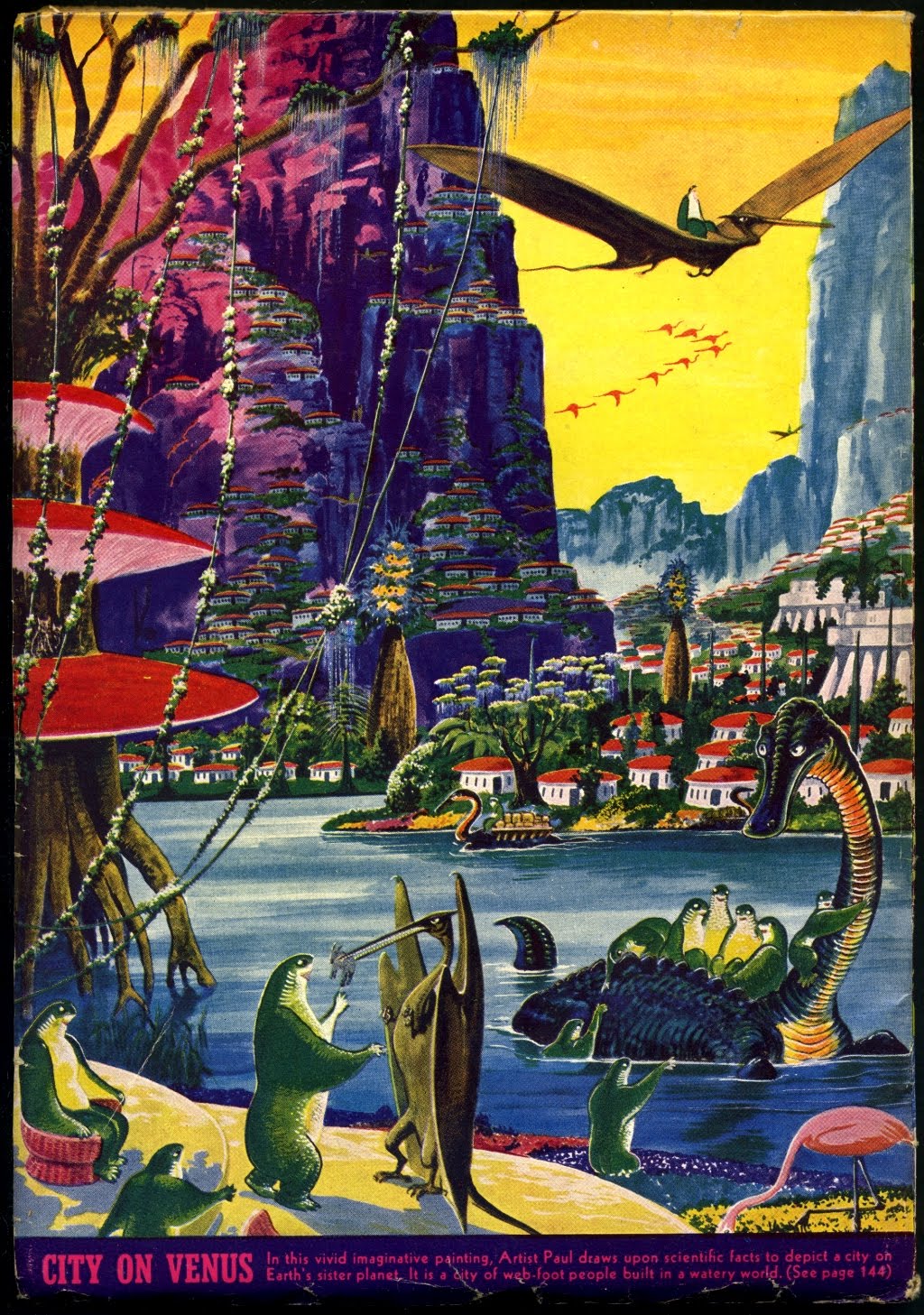


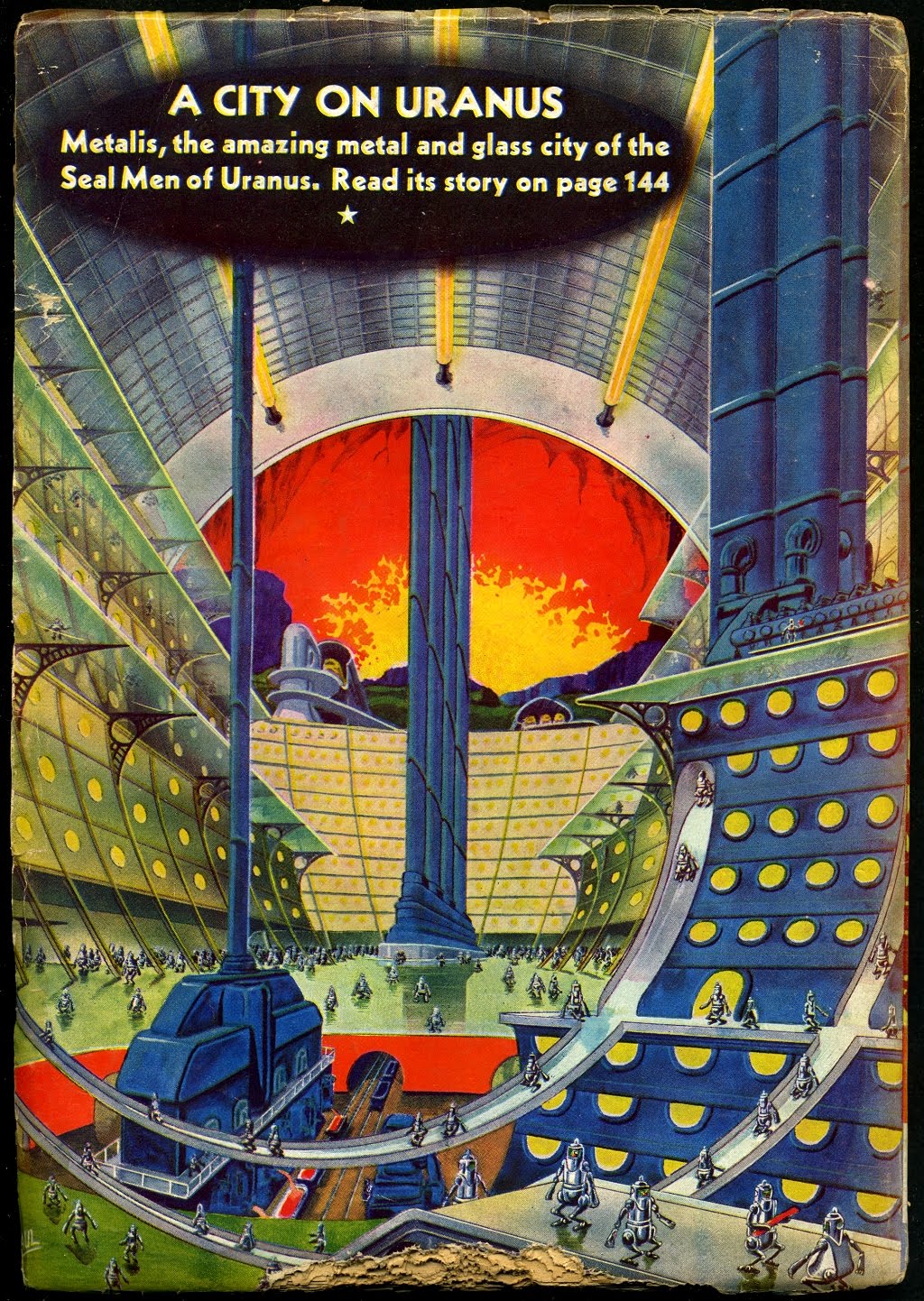
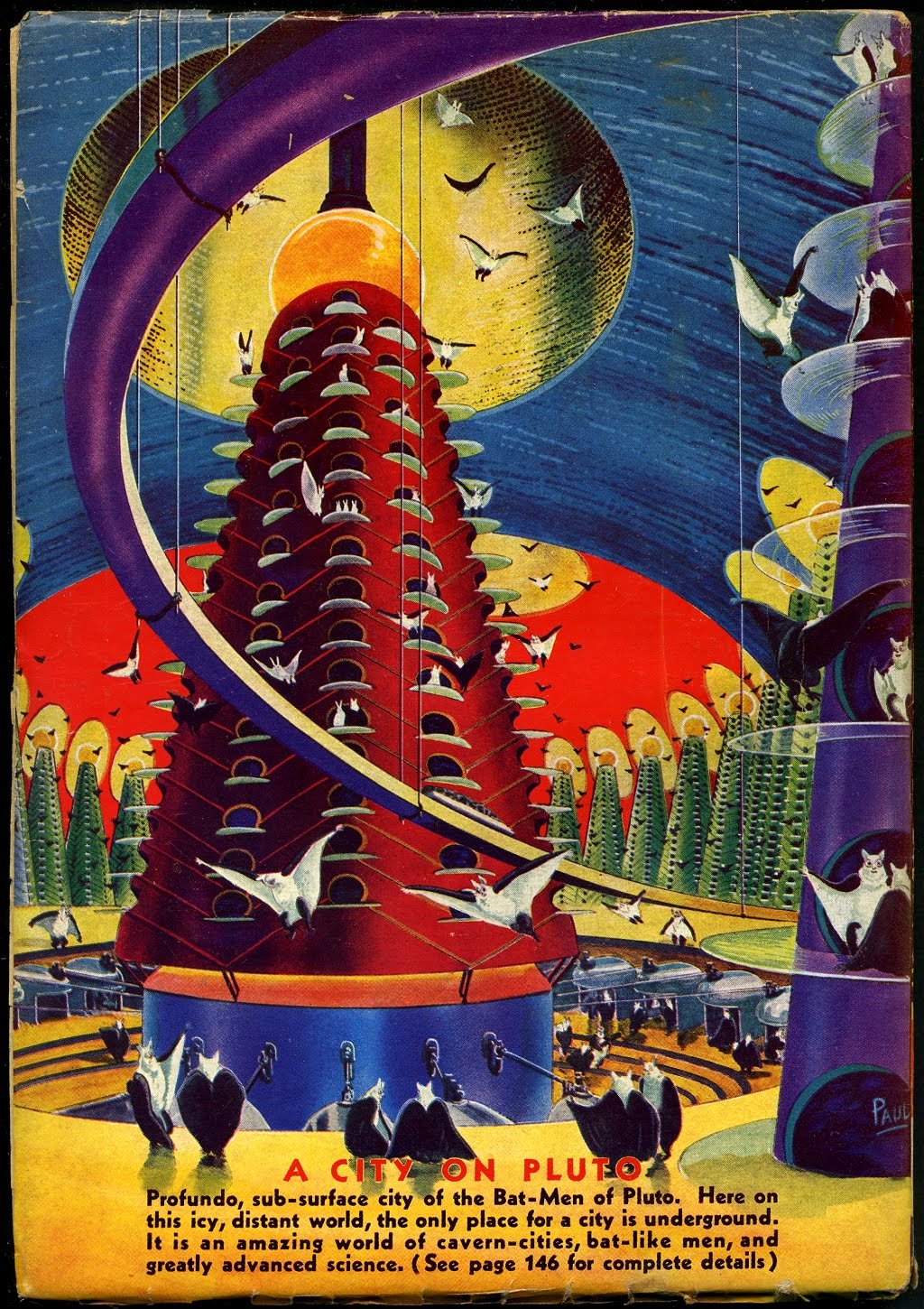
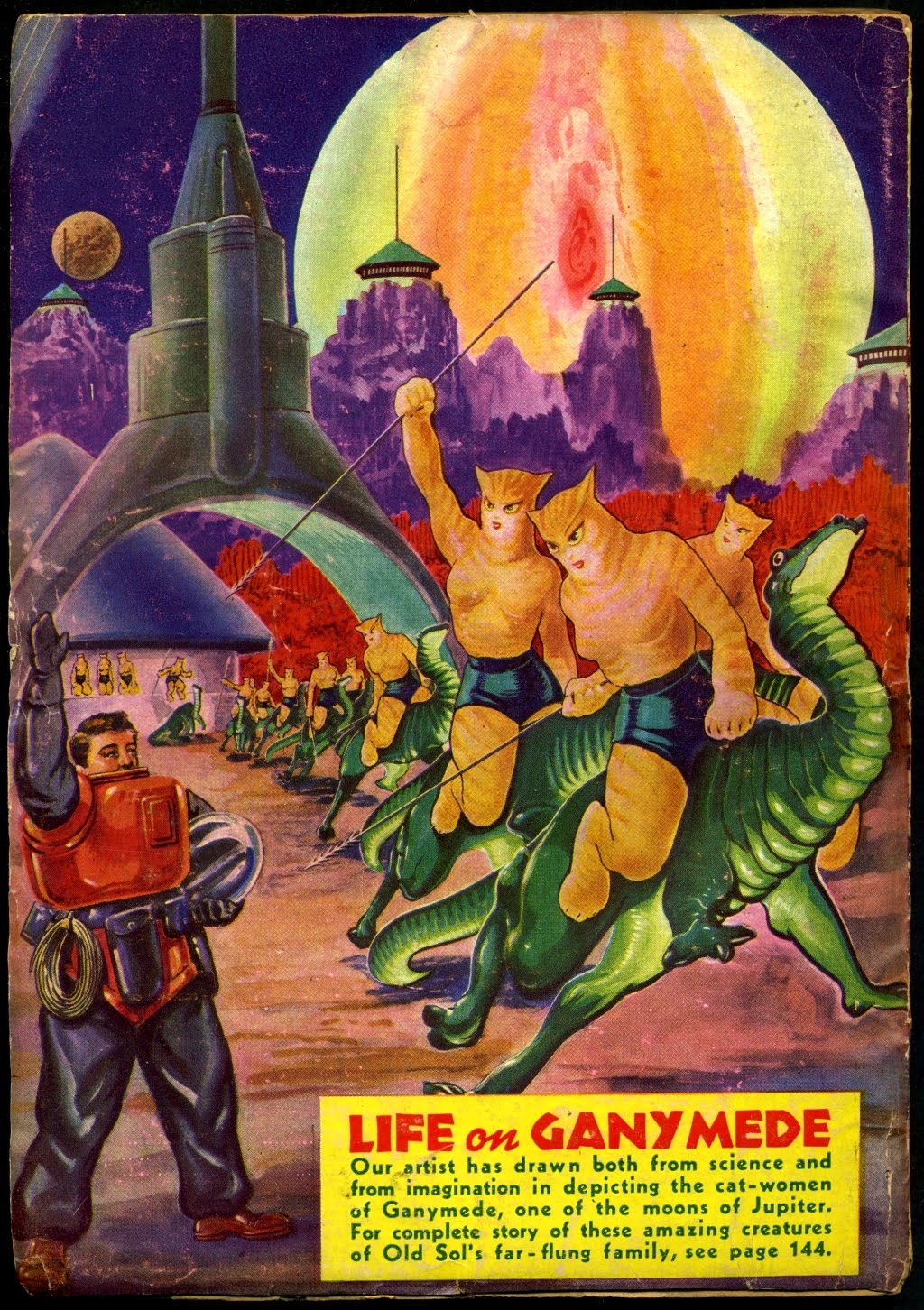
These would make a great foundation for a pulp sci-fi game.
Also – Where does Lucas get all of his great ideas?

Got my copy today of the Savage Swords of Athanor. Brilliant little book! Everything you need to get a campaign started, including a sandbox, races, religion, magic items, monsters, a new class (the rogue, a sort of minor magic-user). The design is excellent – easy to read, well organized, clear and concise. A real inspiration, and well worth the price! My compliments to Doug Easterly for a job well done.
I noticed my last Venatia post had three “ancients” in it – man I need a thesaurus …
4545 Cursed Pirates: A herd of six hippocampi dwell in these waters. They are all that remains of a crew of pirates who were polymorphed by Horrges, the sea hag in [5045]
4633 Yawning Chasm: A chasm splits this hex in two from north to south. The chasm is 100 feet deep, and the keen eyes of an elf might spot numerous piles of bleached bones in the bottom of the chasm. A rope bridge crosses the chasm, but is actually a rope golem in disguise. The golem was placed here by a long dead wizard to guard the approach to his tower, now located on Saturnis after a particularly powerful teleportation spell went awry.
• Rope Golem: HD 6+1 (26 hp); AC 4 [15]; Atk 2 slams (1d8); Move 12; Save 11; CL/XP 10/1400; Special: Magic immunity, reduces damage from hits by 3, slashing, strangle, suffers double damage from fire.
4748 Sea Hags: A covey of three sea hags has set up shop in a sea cave located deep beneath the waves. While they do eat human and demi-human flesh, and find wrecks at sea the height of hilarity, they are actually less violent and evil than their kin and are willing to cast spells in exchange for favors. The hags are named Cacia, Morgis and Sthorah. Their treasure, kept in a casket holding brine zombie named Xavier, consists of 10,000 cp, 10,000 sp, 500 ep, 100 gp, a porcelain chamber pot worth 105 gp and a moss agate worth 175 gp.
• Sea Hag: HD 3 (18, 14, 10 hp); AC 6[13]; Atk 1 bite (1d4); Move 6 (Swim 18); Save 14; CL/XP 5/240; Special: Death gaze, weakness gaze.
• Xavier the Zombie: HD 4 (18 hp); AC 6 [13]; Atk 1 cutlass or 1 slam (1d6); Move 12 (Swim 12); Save 13; CL/XP 4/120; Special: Half damage from fire.
4850 Root Cellar: Under a few inches of soil there is a wooden trapdoor that covers an old root cellar. Travelers through the hex have a 1% chance of stumbling upon it. Inside the cellar there are jars of picked radishes that either cause horrible stomach pains (1d6 damage and disabled for 1d3 days) or give one the ability to breath fire (2d6 damage, 10’ cone) three times over the course of 24 hours. When adventurers eat the radishes, have them roll a saving throw to decide the outcome, with a -2 penalty for every jar consumed over the course of a week.
5136 Deadly Dam: Two giant death watch beetles have felled a number of trees, creating a dam that partially blocks navigation on the river. The valley has become swampy as a result, and the giant mosquitos have already moved in, with 1d6 of the creatures encountered on a roll of 1 on 1d6, made every hour adventurers spend here. The beetles lair inside their dam under a cover of leaves, waiting for a band of adventurers to check things out. One has a dented bronze helm in its stomach that, when worn on the head and the command word “Azkabat” is uttered, covers the wearer in a bronze chitin that resembles the exoskeleton of an insect, complete with bulging eyes of amber glass that allow one to see in the dark. The armor counts as platemail.
• Death Watch Beetle: HD 9 (39, 37 hp); AC 2 [17]; Atk 1 bite (3d4); Move 15; Save 6; CL/XP 10/1400; Special: Vibrations – save (4d6 damage) or die.
• Giant Mosquito: HD 1; AC 4 [15]; Atk 1 touch (attach); Move 12 (Fly 21); Save 17; CL/XP 2/30; Special: Drain blood (1d4 constitution per round).
5332 Halls of the Titans: A yawning cave opens in the side of a hill. The cave has a sharp drop, almost 200 feet, to a cavern filled with strands of glowing fungus (act as assassin vines). Set in one wall of the cavern is a large set of double doors. The doors are composed of titanium and ensorcelled to absorb light, making them very difficult to find. They are also wizard locked. Beyond the doors lies an extensive underworld carved out by the ancient titans and their mortal slaves to house their fabulous treasures. The underworld is haunted by a number of criosphinxes, each considering itself the lord of the dungeon. One level has a vast subterranean prairie of grey grass grazed on by a menagerie of elemental beasts. Another is composed of a massive mechanical puzzle consisting of the very chambers and tunnels, all movable by massive wenches (or winches, if the idea of giant women frightens you) and haunted by a tribe of kobolds armed with hammers, wrenches and oilcans, as well as mechanical assassin beetles, mercury oozes and a creeping patch of rust that not only feeds on armor and weapons, but on one’s very blood. While in the underworld, it is important to avoid doors that appear overly friendly.
I was thinking yesterday about the PARS FORTUNA stuff – mostly developing the race/classes and the idea of knacks and skills hit me. Nothing ground breaking, but they go like this …
TASKS, KNACKS & SKILLS
When playing a game of PARS FORTUNA, there is no limit to what your character can try to do. Please note that trying to do something and actually doing it are two different things. Many tasks a character attempts are easily accomplished and do not require you to dice for the results. In simple terms, if the average person could do it, your character can do it.
However, some tasks require above-average physical or mental abilities, or years of training to have a chance of succeeding – breaking down a bolted door, deciphering a lost language or climbing a sheer wall, for example. When a player wishes his character to attempt a task such as this, this game assumes that they have a 1 in 6 chance of success – in other words, the player throws 1d6 and, if they roll a “1”, they succeed. This translates into a slim (17%) chance of success, so Referee’s should only use this mechanic if the task the character wishes to undertake has a high probability of failure.
A high ability score (15+) in a relevant ability can extend this chance by +1 (to 1-2 on 1d6) if the Referee permits it. Referees might want to give other bonuses based on the situation and any clever ideas a player might have for improving his chances.
Some races have a knack for certain tasks, usually because of their physical or mental make-up. If a racial description notes a “knack”, for something, that race accomplishes it on a roll of 1-2 on 1d6. Oraenca, for example, are stout and solidly built, and have a knack for busting down doors.
Some classes put a portion of their training into mastering certain tasks – the Kyssai, for example, train to move about silently. When presented with a task encompassed by one of their skills, a character’s success or failure is determined by rolling a saving throw. In this way, the character becomes more likely to succeed at that task as he rises in levels. For example, to successfully sneak past some tower guards, a 1st level Kyssai must roll a 15-20 on 1d20 (i.e. a 30% chance of success), while a 10th level Kyssai would have to roll a 6-20 (a 75% chance of success).
To sum up, any character has a 1 in 6 chance of succeeding at a difficult task. Characters with a knack for something have a 2 in 6 chance of success. Characters who are skilled at a task roll a saving throw to determine success or failure.
—
I’d love to know what people think of this basic system for non-combat task resolution.
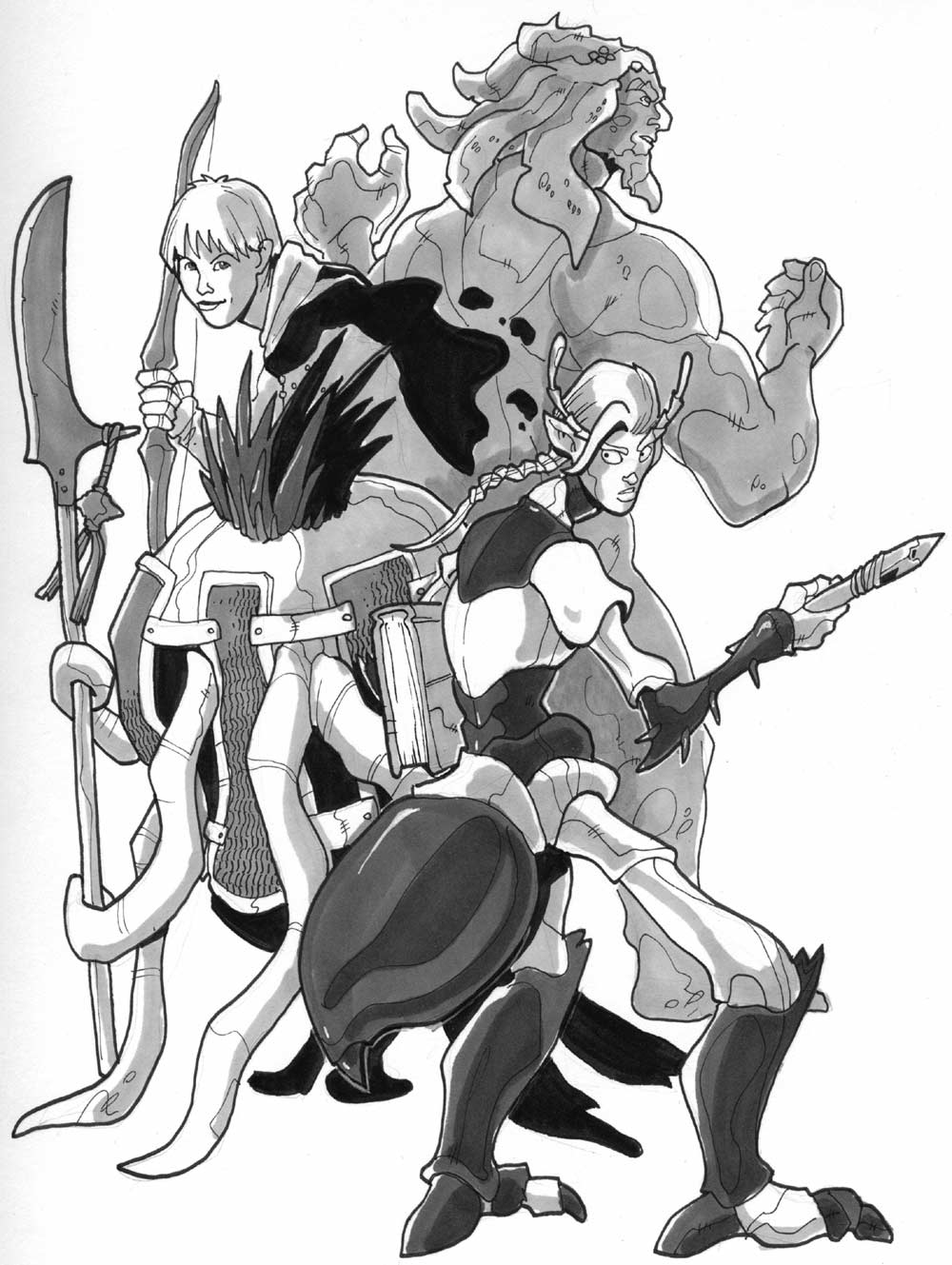
Four more of the strange races in the PARS FORTUNA setting …
In the back of the pack we have a JAE. The Jae are clumps of walking vegetation that can assume a humanoid form by wrapping themselves around a skeleton of wood or metal. They use their morphic form and a little magic to make themselves appear to be members of other races – or even a person’s close friends or family. In their real form, the so-called kelpies can detach from their skeletons and move about almost like oozes – fitting into tight spaces and such. They are natural charlatans.
Jae are another spell casting race, with the added abilities of impersonating people and crawling around like an ooze when it suits them. They can communicate with plants.
Next to the Jae is a KYSSAI, also known as a ghost. The Kyssai are happy anarchists who view bodies of solid matter as prisons. Kyssai are capable of becoming ethereal for short periods, and are generally sneaky sorts. In the game setting, they are wanderers who pick up all sorts of useful information that a Referee might wish to introduce into game. They are the only race besides the Oraenca (see next preview) who can tolerate the Ilel – mostly for the spectacle.
Kyssai are another skill class, this time working as spies and scouts. They are good at sneaking about and surprising others and their power to become ethereal helps them infiltrate areas and escape with their lives. They are, alas, a bit emotionally stunted and have difficulty forming close relationships.
The bizarre creature that looks like a tentacled potato is an OLVUGAI. The Olvugai are nicknamed the visitors by the other races. They are, in fact, alien visitors to the setting, stranded on the strange world (dimension?) of PARS FORTUNA and dedicated to unraveling its mysteries.
Olvugai are a race of scholarly warriors. They are capable of attacking opponent in front and behind at the same time, and they are capable of becoming invisible for short periods of time. Olvugai have a knack for logical thinking and are skilled as sages.
In the foreground, we have a NIF, or wasp-woman. The Nif are the female counterparts to a mindless race of drones called the Nef. They dwell in hive-cities in the Cinnabar Flats, a desert of poisonous mineral springs. Each Nif belongs to a brood of sisters. The broods serve their queen mother and dote on their over-protective (and sentient) fathers until they get the call to strike out on their own. Nif have honey-colored carapaces marked with black patterns that they share with their brood-sisters.
The Nif are our third magic-using class. Their carapaces make them slightly more durable than the Caledjula and their talents run to elemental spells rather than illusions. Nif are resistant to poisons and acids, have thick carapaces and a knack for chemistry.
—
Our last preview of the races of PARS FORTUNA will appear next week, and include fire-loving lions, mercantile monkeys, wise antelope-centaurs and creatures with bones of steel.
So, I was pondering doing an elementalist class a couple weeks ago, and today jotted down some ideas. Here’s the class “in progress” – I’d love to know what people think …
—
Elementalist
Command elemental spirits to perform tasks – the effect is the equivalent of casting spells. An elementalist can attempt to command these spirits a number of time each day equal to his Charisma score divided by 3, rounding down. [maybe at 6th level, this increases to Charisma divided by 2, rounding down?]
Elementalists must own and carry a grimoire of the true names of known spirits – they add to this as they adventure, but not in the manner that magic-users add spells to their spell books
An elementalist is a ritual caster; each day he chooses to focus himself on a particular element and in turn must wear an appropriately colored robe (red, blue, yellow or white) and carry a ritual tool – athame, goblet, censer or wand. Without the robe and the tool, he cannot command elemental spirits.
Elementalists cannot command spirits opposed to their chosen element for the day, but they can command all spirits that are not opposed to them. When commanding elementals spirits that match their daily focus, they receive a +1 bonus to their command checks (see below).
Command checks are the equivalent of a cleric’s ability to turn undead, and use the same table substituting the spell level for the undead’s Hit Dice. Elementalists can also turn elementals opposed to him and command elementals favorable to him. Elements refers to elementals, genies (efreet, djinn, janni), sylphs, salamanders and other creatures composed entirely or mostly of elemental stuff.
The elementalist has four spell lists, each tied to a different element (with a few spells appearing on all four lists). Spells marked with an asterisk (*) are new and described below.
[Maybe his communications with spirits helps him avoid surprise (i.e. surprised on 1 in 1d8 instead of 1 in 1d6), avoid pit traps, find secret doors – essentially, he’s in communication with the landscape/dungeon and maybe gets some forewarning]
Level One
1 Burning Hands (F)
2 Feather Fall (A)
3 Magic Stone (E)
4 Produce Flame (F)
5 Purify Food & Drink 
6 Ray of Frost
Level Two
1 Fog Cloud
2 Heat Metal (F)
3 Levitate (A)
4 Pyrotechnics (F)
5 Stinking Cloud (A)
6 Strength (E)
Level Three
1 Fireball (F)
2 Fly (A)
3 Lightning Bolt (A)
4 Protection from Normal Missiles (A)
5 Stone Shape (E)
6 Water Breathing
Level Four
1 Create Water
2 Ice Storm
3 Solid Fog (A)
4 Spike Stones (E)
5 Wall of Fire (F)
6 Wall of Ice
Level Five
1 Cloudkill (A)
2 Cone of Cold
3 Conjure Elemental (U)
4 Passwall (E)
5 Transmute Rock to Mud (E)
6 Wall of Stone (E)
Level Six
1 Find the Path (E)
2 Invisible Stalker (A)
3 Lower Water
4 Move Earth (E)
5 Part Water
6 Stone to Flesh (E)
Level Seven
1 Aerial Servant (A)
2 Control Weather (A)
3 Delayed Blast Fireball (F)
4 Earthquake (E)
5 Reverse Gravity (E)
6 Wind Walk (A)
Level Eight
1 Horrid Wilting
2 Incendiary Cloud (F)
3 Repel Metal or Stone (E)
4 Whirlwind (A)
Level Nine
1 Imprisonment (E)
2 Meteo Swarm (F)
Prime Req: Charisma
Fights As: Magic-User
Hit Dice: Magic-User
Saving Throws: Magic-User
Armor & Weapons: Leather, magic-user weapons
Level Titles
1. Grammarian
2. Reciter
3. Incantator
4. Lector
5. Elementalist
6. Dracunculus
7. Draco
8. Pentalpha
9. Solomon
—
Thoughts –
1. I might need to invent a few spells to fill in the gaps. I wanted about three spells per level per element up to level 5, and then one or two from 6-9.
2. The big question is the use of the Turn Undead table for casting spells. As written, a 1st level elementalist would be able to make, on average, three or four attempts at casting a spell each day. They could attempt to cast 5th level spells (5% chance of success), 4th level spells (10% cos), 3rd level spells (25% cos), 2nd level spells (40% cos) and 1st level spells (55% cos). Limited number of tries, limited chance of success – but is it too limited? Not limited enough?
A 1st level elementalist that sticks to 1st level spells can, on average, cast about 2 spells per day, so double that of most magic-users. If that elementalist tries to get off a fireball, he only has a 25% chance to do it, and even if he does it, it will only do 1d6 damage. This is probably okay.
At higher levels, the elementalist is still limited to just a few attempts per day, meaning he falls behind the magic-user as a spell caster – fewer spells and less variety. In exchange, I’m giving him leather armor and the ability to turn (and command) elemental creatures – not bad, but maybe not good enough. He might still be worth it if he advances in level faster than the magic-user, but advancing quickly in a crappy character class is little compensation.
So, still some work to be done here. If you have any suggestions, let me know.
 Six more sites for the Southeast map – two more installments to go before I begin on the Northeast map.
4348 Fish Men: A community of 112 locathah dwell in a submerged castle. They ride giant eels into battle and carry barbed spears or heavy crossbows or tridents and nets. The locathah are known for their paralyzing poisons, which they harvest from the sea urchins that cover their castle. They are led by Lord Kigl’lot and his bodyguard of twelve elite warriors. The castle is further protected by 11 cave eels and a giant jellyfish. The cave eels live in the catacombs that run underneath the castle and hold Kigl’lot’s vault of treasure. The vault contains 6,100 gp and 110 pp.
• Kigl’lot, Locathah Fighting-Fish Lvl 4: HP 24; AC 4 [15]; Save 13; Shagreen armor, poisoned trident, shield.
• Elites, Fighting-Fish Lvl 3: HD 3d6+6; AC 5 [14]; Save 14; Shagreen armor, poisoned trident, shield.
• Locathah: HD 2; AC 6 [13]; Atk 1 weapon (1d8); Move 12; Save 16; CL/XP 2/30; Special: None.
4431 Abbey of St. Arachne: This abbey is dedicated to Arachne, a mortal weaver possessing such magnificent skill at her art that she challenged the goddess Minerva and was eventually punished for her hubris. Nevertheless, she has become a patron saint of weavers and dyers and a minor figure in the cult of Minerva. The hillsides surrounding the abbey are grazed on by sheep with especially fine, strong wool. The nuns of the abbey use this wool to produce spectacular tapestries which are valued throughout the Motherlands and a variety of magical vestments.
The abbey itself is situated on a rocky hill overlooking a valley of rolling hills. The abbey is a shell keep, two stories tall, containing workshops, storage areas (mostly bundles of wool (5 tons, worth 20 gp per ton) and dyes of many colors (100 lb each of yellow, red, blue and green, worth about 5 sp per pound), combs, spindles, etc) living quarters for the nuns and their officers, an armory, and vaults carved into the granite hill where the true treasure of the monastery, dozens of enchanted spiders who do the real weaving of the abbey, are kept.
At the foot of the abbey hill there is a village of 30 thatched longhouses surrounded by a stone wall with a moat and three towers. The village is built against the abbey hill, with the town hall constructed right against the wall and offering access through a secret door to the tunnels and vaults carved into the hill. One can also access the abbey from the village by a system of stairs, some wooden and some carved into the living rock. The villager is defended by five men-at-arms in embroidered +1 tunics carrying shields, spears and light crossbows.
Abbey and village are ruled by Xanah, a small, radiant woman who wears sepia robes covered in magnificent embroidery depicting scenes from the life of St. Arachne (worth 200 gp). Xanah has guileless green eyes and fine, white hair in an elegant chignon. Her order is sworn to a vow of silence, and she will not break this vow. She is assisted by ten nuns. Hidden in the vaults beneath the abbey is her former lover, Brear, who has been turned into a drider and now stalks the dark corridor struck with madness. While Xarah has forsworn her love for him, she still does her best to hide and protect him, despite his occasional attacks on the villagers.
The abbey’s treasure consists of 10,000 cp and 4,100 gp and is kept behind a locked door in the subterranean vaults.
• Xanah, Cleric Level 9: HP 30; AC 1 [18]; Save 6 (5 with cloak); Special: Spells (4th); Platemail, shield, mace, cloak of resistance (+1 to saving throws), holy symbol.
• Brear, Drider: HD 7 (30 hp); AC 3 [16]; Atk 1 weapon (1d8); Move 18; Save 9; CL/XP 9/1100; Special: Spells, magical abilities.
4433 Ancient Donjon: An ancient, crumbling donjon stands atop a hill, overgrown with pine trees that are gradually tearing the place down. An obscured trap door allows access into the dungeon, which currently houses two hungry ghosts.
• Hungry Ghost: HD 1+1; AC 9 [10]; Atk 1 claw (1d4); Move 12; Save 17; CL/XP 3/60; Special: Phantasmal force, invisibility, suffer double damage from cold and fire.
4436 Ancient Computer: An ancient analog computer has been tucked into a small niche in the rocks and hidden by a few pine boughs, now dry as kindling. The computer looks like a large, wooden chest filled with gears and covered with dials on the outside and a crystal sphere on which is etched a map of the world. By turning the dials to match astronomical observations, the sphere turns to show one their location on NOD. Alas, the map is a bit inaccurate, ignoring the existence of the antipodes and misjudging by 1,000 miles the western extent of Antilia. Operating the device requires a check against intelligence, with magic-users modifying their roll by 1 and scientists by 2.
4450 Whirlpool: This hex is almost filled by an enormous whirlpool that will almost certainly drag ships down to be dashed against the rocks. The whirlpool is caused by a glowing sword piercing the sea floor. The short sword, constructed in the ancient Greek style, was placed there by Neptunus for any hero brave and cunning enough to claim it. The sword is a +2 weapon that allows its wielder to breath underwater and swim as swiftly as a dolphin (Move 24). In addition, sea creatures must pass a saving throw to threaten or attack the wielder (unless he attacks first).
4531 Ancient Road: An elevated stone road goes from this hex to [6026], following the curve of the evergreen belt. In hexes [5434] and [5534] is follows along the banks of the lake. The road is of Nomo construction, and was meant to move troops swiftly into the Golden Coast region for an invasion that never took place. Every six miles (i.e. in each hex) there is a statue of Mercurius consisting of a 5-ft tall pillar of porphyry topped by a sculpture of the deity’s head. Where the road is near settlements, it is lined with cenotaphs, tombs and crypts.

European folklore holds a candle to none in the breadth and depth of its imagination. Europeans populated not only their own countries with all manner of strange beasts and monsters, but extended their imaginations over the entire globe. While a good many of these creatures have been given game statistics, several have not. Some of these creatures are, to be sure, simple variations on existing monsters – ogres, giants, fairies, spirits, etc. Others are just not threatening or interesting enough to demand statistics. Those monsters of the folklore of France, Germany and the Low Countries, and those of medieval bestiaries and heraldry, that I thought both unique and challenging are presented below.
Part One, Part Two, Part Three, Part Four, Part Five
This post is declared Open Game Content.
Pegasus, Ethiopian
Medieval bestiaries told of a breed of pegasus from Ethiopia that had two horns. These creatures can be treated as normal pegasi with the addition of a gore attack that deals 1d6 points of damage.
Revenant
The revenant is an animated corpse that has returned from the grave to terrorize the living. The name comes from the French and means “returning”. Revenants are always wicked in life. Creatures struck by a revenant in combat must make a saving throw or be infected with a disease that resembles mummy rot. Revenants regenerate damage in the manner of a troll at the rate of 1 hit point per round. A revenant can only be destroyed completely by cutting off the head, removing the heart, and burning them and the body separately.
Revenant: HD 4; AC 3 [16]; Atk 1 slam (1d6); Move 9; Save 13; CL/XP 6/400; Special: Regeneration, disease.
Snakes
The writers of medieval bestiaries imagined many interesting serpents, many that were probably based on fourth-hand accounts of real animals. The hydros was a viper whose poison caused a person to swell up. In game terms, his poison causes the person to have their movement and dexterity scores cut in half. The hydros’ poison could only be cured with the application of ox dung. There’s a fun quest! The hydrus, on the other hand, was a water serpent of the Nile River. It would swim into the mouth of a crocodile and then down its throat. Once in the stomached, it would eat the poor beast from the inside out. In game terms, it is probably immune, or at least resistant, to acid. The hypnalis was an asp that killed its victims in their sleep. In game terms, perhaps it can cast a sleep spell one or several time per day. The scytale was a snake with such brilliant markings that those gazing on the creature are hypnotized and lulled into inaction. The scytale’s body is so hot that those touching it or touched by it suffer 1d4 points of burning damage. The seps, on the other hand, has venom so acidic that it liquefied its prey; assume normal viper poison plus an additional 2d6 points of acid damage.
Waldgeist (Woodwose)
The German “woodland spirit” is the custodian of the forest. It dwells in woodlands and protects it as well as lawful creatures within the woodland. Waldgeists resemble gnarled old dwarfs with skin like the bark of a tree and hair like a tangle of leaves and twigs. They dwell in the branches of trees and, though mischievous, are not by any means evil. Waldgeists can use the spells bless and bestow curse. They blend in with the foliage, and thus surprise foes on a roll of 1-4 on 1d6. Despite their small size, they are exceptionally strong and dangerous to provoke.
Waldgeist: HD 5; AC 2 [17]; Atk 1 slam (2d4); Move 15; Save 12; CL/XP 6/400; Special: Bless, curse, surprise.
White Ladies (Wise Ladies)
The white ladies of the woods are elven amazons of the ancient and powerful blood. They are tall and beautiful, with white skin and hair like gleaming platinum. They dress in white cloaks and gleaming armor and wield spears tipped with silver and bows with silver-tipped arrows. White women are capable of casting spells as 3rd level clerics, druids or magic-users. They are capable of using the spell Light at will and always radiate an aura of Protection from Evil in a 10 ft radius. They usually appear in bands of 5 to 10 individuals and might be encountered in the company of unicorns. White women have the same immunities as normal elves. They are skilled in herb craft and healing, and under their care a person’s natural healing rate is doubled and he enjoys a +2 bonus to save vs. poison or disease.
White Woman: HD 3; AC 4 [15]; Atk 1 spear (1d8) or 2 arrows (1d6); Move 15; Save 14; CL/XP 4/120; Special: Spells, immunities.
White Worm
The white worm, or Indus worm, was a giant, pale worm that dwelled in the Indus River. It was carnivorous and capable of swallowing a man whole when it scores a natural ‘20’ on a bite attack.
White Worm: HD 7; AC 6 [13]; Atk 1 bite (2d6); Move 9 (Swim 12); Save 9; CL/XP 8/800; Special: Swallow whole.
Wild Man
Wild men are hairy humanoids that dwell in deep woodlands. They are called wilder mann by the Germans and homme sauvage by the French and wodewose by the English. They are associated with gods and goddesses of the wild such as Silvanus and Fauna and with the death god Orcus. In fact, they are known as orkes or lorkes in some parts of Italy.
Wild men run in bands of 20 to 30 individuals. Their entire bodies are covered in a tangled coat of brown hair and the men wear long, unkempt beards. They behave as though mad and fight as savagely as berserkers, gaining a +2 bonus to hit and damage. Despite their savage appearance, wild men are strict vegetarians, eating nuts, berries, roots and leaves.
Wild Man: HD 1+1; AC 7 [12]; Atk 1 weapon or fists (1d4); Move 12; Save 17; CL/XP 1/15; Special: Berserk.
Wraiths
The erlking, or “alder king”, was a pale, gaunt humanoid who rode a black horse and preyed on women. In game terms, it can be treated as a wraith. In truth, the name “erlking” was a mistranslation from the Danish for “elf-king”.
Yale (Centicore, Eale)
The yale is a black, horse-sized goat with the feet of an elephant and the tusks of a boar. It has large horns that it can swivel in any direction, thus allowing it two attack two different targets each round. Yales are immune to paralyzation and poison, thus making them a natural enemy of the catoblepas and basilisk.
Yale: HD 5; AC 6 [13]; Atk 2 gores (1d6); Move 15; Save 12; CL/XP 5/240; Special: Immunities.
Six more sights to entice and delight (at least, that’s the plan).
4240 Sea Serpent: A briny sea serpent hunts along the coast in this hex. Wrecked ships along the bottom contain 10,000 cp, 5,000 ep, 1,000 gp, 100 pp, a silver stud worth 1,050 gp and a porcelain bowl from the Imperial potter of the court of the Jade Empress of Mu-Pan worth 1,250 gp.
• Briny Sea Serpent: HD 8; AC 2 [17]; Atk 1 bite (3d6 + poison); Move 15; Save 8; CL/XP 11/1700; Special: Acid breath, poison.
4246 Kelp Forest: A forest of long, thick strands of kelp covers the floor of this hex and those surrounding it. Living among the seaweed are dryad-like kelpies, playful and beautiful, but ultimately luring people to their doom. Hidden by the strands of kelp is a massive stone head depicting Okeanus, the titanic ruler of the sea. The head radiates powerful magic, but does not seem to actually do anything. If any remotely hostile act is perpetrated on the head, however, it rises from the ground on the body of a stone golem. Inside the stone head is a fist-sized ruby worth 20,000 gp.
• Kelpie: HD 5; AC 2 [17]; Atk 1 grapple; Move 9 (Swim 12); Save 12; CL/XP 6/400; Special: Charm, drown.
• Stone Golem: HD 15 (60hp); AC 5 [14]; Atk 1 fist (3d8); Move 6; Save 3; CL/XP 16/3200; Special: +1 or better magic weapon to hit, immune to most magic.
4250 City of Oozes: A large city that looks like a maze of excavated canyons lies on the bottom of the sea. This city, its name now lost in the mists of time, was once home to a large colony of elder things. It is now home to 10,000 (more or less, they keep merging and splitting) oozes of every imaginable description – gelatinous cubes, black puddings, jellies of every unappetizing color known to man, slithering trackers and protoplasms as yet undiscovered.
The maze-like canyons of the city are lit by softly glowing irradium globes (treat as continual light spells). Hundreds of complexes, small and large, are cut into the walls of the canyons. Some of these complexes contain air pockets, but most do not. The outermost complexes mostly contain simple, though strange, domestic items and tools. Closer to the center of the city there are libraries, laboratories and a few crypts and command posts of the elder things. At the center of the city there is the large citadel now turned into a massive temple of The Faceless Lord tended by a “priesthood” of gibbering mouthers and an elder black pudding, the city’s “king”.
• Elder Black Pudding: HD 20 (103 hp); AC 8 [11]; Atk 3 pseudopods (4d8); Move 6; Save 3; CL/XP 21/4700; Special: Acidic surface, immune to cold, divides when hit by lightning.
4333 Hawktoad Acres: Five hawktoads lair in the treetops in this hex, streaking down from above to attack travelers and snatch any shiny objects (especially holy symbols) and then flee into the woods. If their wattle-and-daub nest can be found (a tricky task indeed), it contains a 135 gp pearl, 3 gp rock crystal, 155 gp rose quartz, a bronze statue of a dancing satyr worth 500 gp and five silver holy symbols worth 30 gp each.
• Hawktoad: HD 2 (9, 7, 7, 6, 4 hp); AC 7 [12]; Atk 2 claws (1d2), tongue (strangles); Move 3 (Fly 12); Save 16; CL/XP 3/60; Special: Strangling tongue (constitution check or fall unconscious).
4336 Magnar: Magnar is a farming village of 500 lanky peasants living in houses thatched from pine branches and needles. The village is surrounded by an earthen rampart set with wooden spikes and has three wooden guard towers. The villagers get their water from a number of quick-flowing streams around the village. The men of Magnar have light, peach skin and hair that ranges from red to blond. The women of Magnar are known for the complex knot patterns they weave into their hair and their large, brown eyes – referred to poetically as “cow eyes”. They have fairly plain faces with button noses. The peasants dress in tunics and hose of white, yellow and green, and they wear green skullcaps made from felt. The 25 men-at-arms of the village wear ring armor and carry long bows and spears. Their two sergeants, Gaela and Svana, wear chainmail hauberks and are similarly armed.
The village is ruled by the Baroness Tatya, a pudgy, friendly woman with a club foot. Tatya is protective of her people and kind to them, but is nevertheless strict about maintaining the feudal hierarchy. Her husband is a lanky wastrel named Fynedo who can pluck a fine tune on the harp but is otherwise useless. She has three children, the eldest being an easy-going young man named Olinus who dresses in blue and has gray-blue eyes and a disarming smile. The middle child is a dumpy little princess named Madie. The youngest, only five, is thin, meek girl called Tariel.
Magnar is a calm, pleasant village on the surface, but most visitors feel a certain unease with the villagers and the ruling family. They seem a bit too calm and detached from the world, as though they are only going through the motions. In late autumn, the villagers hang blue lanterns in the trees and light blue candles in their windows to welcome the spirits of their ancestors, who visit the village on that night in the form of forest animals. These animals are invited into homes and treated as honored guests.
4344 Shark Hunting Ground: Five great white sharks hunt in this hex. They shadow ships moving through in hopes of someone walking the plank.
• Large Shark (8HD): HD 8 (38, 37, 34, 32, 30 hp); AC 6 [13]; Atk 1 bite (1d8+4); Move 0 (swim 24); Save 8; CL/XP 8/800; Special: Feeding frenzy.
 Land of Nod