Monsters, Museums and Magic Carpet Burns


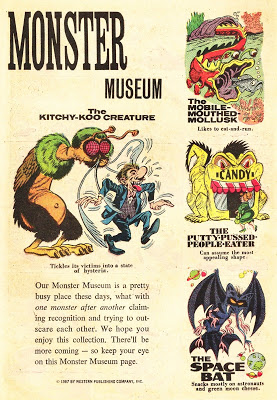
Saw this at Magic Carpet Burn (scroll down to see picture in question). It’s too bad that monsters in fantasy games need to be engines of destruction, because the Kitchy-Koo Creature would be a great way to disturb the hell out of a bunch of PCs. Maybe just make it completely immune to attack and let it follow the PCs around, tickling when things get boring and only leaving when they feed it some sugar.

Ah, what the hey …

The kitchy-koo creature materializes behind a party of adventurers and begins to tickle the rear-most member of the group. Tickled adventurers will begin to laugh loudly (possibly attracting wandering monsters) and will find it difficult (saving throw) to do anything else. If attacked, the creature will seemingly disappear only to reappear later to repeat its bizarre “attack”. The creature can be bought off with honey and nothing else. If communicated with, it is capable of using its clairaudience and clairvoyance abilities to see beyond doors and otherwise aid adventurers. Such help is only rendered in exchange for honey. Kitchy-koo creatures seem to inhabit specific dungeons, though their true home is somewhere between dimensions. Once attacked or communicated with, it will continue to appear at random intervals to harass a party of adventurers.

Kitchy-Koo Creature: HD 4, AC 5 [14], Atk 4 tongues (see below), Move 12, Save 13, CL/XP 5/240; Special: Tickle, dematerialize, clairaudience, clairvoyance.

The space bat isn’t bad either, for those forays into the Astral Plane.

Wyvern Coast – The Tepid Sea

This post will cover the Northwest quadrant of map J11, giving some information the geographies involved and random encounters. My next post will highlight some of the encounter areas. This post is not open content.

J11-WyvernCoast-NE

Tepid Sea
The Tepid Sea is a warm, shallow sea known for its sea turtles and the depredations of corsairs from the Wyvern Coast and filibusters from Brigantia. Storms are rare on the Tepid Sea, and most of the water is clear enough that one can see the sea floor. The eastern shores of the Tepid Sea are home to mollusks that produce a rare (and thus expensive) purple dye that remains in favor throughout the Motherlands. The “Purple Kings” of the Wyvern Coast built their fortunes upon the trade in this dye.

Random Encounters
3 Turtle, Giant Sea (1d4)
4 Nymph (1d6)
5 Sea Cat (1d6)
6 Crocodile, Giant (1d6)
7 Mermaid (2d6) and Merrow (1d6)
8 Crab, Giant (2d6)
9 Dolphin (3d6)
10 Shark, Small (2d6)
11 Merchant Galley (80%) or Merchant Cog (20%)
12 Aquatic Humanoids (see table below)
13 Eel, Giant Electric (2d6)
14 Pirate Galley (see below)
15 Aquatic Troll (1d6)
16 Sea Hag (1d3) and Merrow (1d6)
17 Ray, Giant Manta (1d4)
18 Tusked Whale (1d4)

Random Humanoid Encounters
1-2 Crabmen (2d6)
3 Oktomon (3d6)
4 Sahuagin (2d6)
5 Triton (2d6)
6 Undine (3d6)

Random Battlefield Terrain
1-3 Sandy Ground – half movement
4-7 Rocky Ground – chance to lose footing at top speed
8-9 Kelp Forest – half movement, obscuring cover
10 Chasm – chance of falling

Merchant Galley: A merchant vessel with a single oar deck carrying about 2,000 gp worth of mundane cargo. The galley is crewed by six sailors and twenty rowers. They are commanded by a ship captain and first mate. The sailors are armed with light crossbows and axes, while the rowers can fight with clubs. Leaders wear leather armor and carry scimitars and daggers.

• Sailor/Rower: HD 1; AC 8 [11]; Atk 1 weapon (1d8); Move 12; Save 17; CL/XP 1/15; Special: None.
• First Mate: HD 3; AC 6 [13]; Atk 1 weapon (1d8); Move 12; Save 14; CL/XP 3/60; Special: None.
• Captain: HD 5; AC 4 [15]; Atk 1 weapon (1d8); Move 12; Save 12; CL/XP 5/240; Special: +1 to moral checks, troops +1 to hit.

Merchant Cog: A merchant cog is used for long voyages, and thus carries a more exotic cargo – rare woods, exotic armor and weapons, silk, spices, etc. Assume 5,000 gp worth of cargo. The cog is manned by twelve sailors. They are commanded by a ship captain and first mate. There is a 2 in 6 chance of a priest aboard and a 1 in 6 chance of a mage. The sailors are armed with light crossbows and axes, while the leaders wear leather armor and carry broad swords and pistols.

Oktomon: The oktomon fulfill a roll in the submarine ecology of the Tepid Sea like that of the Vikings. They are plunderers, especially of the surface world, but also traders and explorers. They typically lair in low-ceilinged caves that other species find difficult to negotiate, and they stock those cave lairs with an astounding array of traps. When encountered away from their lairs, the okotomons are either seeking plunder or trade. In either event, they are equipped with serrated spears, one or two gaff hooks, nets (primarily used for carrying items, but also useful in a fight) and round, polished shields. If more than twelve oktomons are encountered, they will be led by a captain.

• Oktomon: HD 3; AC 5 [14]; Atk 4 weapons (1d6); Move 12 (Swim 18); Save 14; CL/XP 4/120; Special: None.
• Captain: HD 6; AC 5 [14]; Atk 1 weapon (1d8); Move 12 (Swim 18); Save 11; CL/XP 6/400; Special: None.

Pirate Galley: A pirate vessel with two oar decks, the galley is crewed by twelve pirates and thirty rowers. They are commanded by a ship captain and first mate. The pirates are armed with light crossbows and axes, while the rowers can fight with clubs. Pirate leaders wear leather armor and carry scimitars and pistols. There is a 1 in 6 chance of a mage being aboard.

• Pirate: HD 2; AC 7 [12]; Atk 1 weapon (1d8); Move 12; Save 16; CL/XP 3/60; Special: +1 hit and damage in round 1, backstab for double damage.
• First Mate: HD 3; AC 6 [13]; Atk 1 weapon (1d8); Move 12; Save 14; CL/XP 4/120; Special: Backstab for double damage.
• Pirate Captain: HD 5; AC 6 [13]; Atk 1 weapon (1d8); Move 12; Save 12; CL/XP 6/400; Special: Backstab for triple damage; +1 morale; troops +1 to hit
• Pirate Mage: HD 2d6; AC 8 [11]; Atk 1 weapon (1d4); Move 12; Save 16; CL/XP 3/60; Special: Two first level magic-user spells, backstab for double damage.

Sahuagin: Sahuagins are aggressive, territorial fish-men. They are matriarchal and are ruled by priestesses. A sahuagin settlement will consist of a basalt ziggurat topped by a temple to their shark deity, Omoo. Within the ziggurat are the living quarters of the priest-queen, her attendants, her consorts and other minor nobles. The ziggurat is surrounded by dozens of stone huts and slave quarters. Sahuagin encountered away from their settlements are always on the hunt for meat, plunder or slaves. A sahuagin war party is always led by a noble. If more than 8 sahuagin are encountered, they will also be accompanied by a priestess riding atop a shark. Sahuagin are equipped with obsidian axes and nets.

• Sahuagin: HD 2+1; AC 5 [14]; Atk 1 weapon (1d8); Move 12 (Swim 18); Save 16; CL/XP 2/30; Special: None.
• Noble: HD 4+1; AC 5 [14]; Atk 1 weapon (2d6); Move 12 (Swim 18); Save 13; CL/XP 4/120; Special: None.
• Priestess: HD 3+1; AC 5 [14]; Atk 1 weapon (1d8); Move 12 (Swim 18); Save 14; CL/XP 4/120; Special: Cleric spells (2 x 1st level), banish undead.
• Small Shark: HD 4; AC 6[13]; Atk 1 bite (1d4+1); Move 0 (Swim 24); Save 13; CL/XP 4/120; Special: Feeding frenzy.

Triton: Tritons live in coral towers decorated with riches taken from sunken ships. Bands of tritons encountered at sea are equipped with shields, tridents and daggers and always ride hippocampi. Tritons are always led by a knight. If more than eight tritons are encountered, they are also accompanied by a priest.

• Triton: HD 3; AC 5[14]; Atk 1 trident (1d8+1); Move 1 (Swim 18); Save 14; CL/XP 4/120; Special: Magic resistance 90%.
• Knight: HD 6; AC 5[14]; Atk 1 trident (1d8+2); Move 1 (Swim 18); Save 11; CL/XP 7/600; Special: Magic resistance 90%.
• Priest: HD 4; AC 5[14]; Atk 1 trident (1d8+1); Move 1 (Swim 18); Save 13; CL/XP 6/400; Special: Magic resistance 90%, cleric spells (2 x 1st level, 1 x 2nd level).
• Hippocampus: HD 4; AC 5[14]; Atk 1 bite 1d4); Move (Swim 24); Save 13; CL/XP 4/120; Special: None.

Undine: Undines are aquatic relatives of the elves. Unsullied by the blood of mortals, the undine are taller than their surface cousins, with pale, gaunt skin, silvery hair, long, webbed fingers and toes and large, violet eyes. They live in exquisite keeps constructed from white stone and decorated with banners made of linked, multi-colored scales. Most undines use giant seahorses as mounts, and keep small hunting squids and swift barracuda for use in their hunts. Undines encountered away from their home will usually be on a hunt, and the party will include no more than one hunting squid or barracuda per three undines. If more than twelve undines are encountered they are led by a warlock. Undines are equipped with scale armor, tridents and daggers and are usually mounted on giant seahorses.

• Undine: HD 2+1; AC 5 [14]; Atk 1 weapon (1d8); Move 12 (Swim 15); Save 16; CL/XP 2/30; Special: Telepathic communication with humanoids and aquatic creatures.
• Warlock: HD 5; AC 5 [14]; Atk 1 weapon (1d8+1); Move 12 (Swim 15); Save 12; CL/XP 7/600; Special: Magic-user spells (3/2/1), telepathic communication with humanoids and aquatic creatures.
• Barracuda: HD 1; AC 6[13]; Atk 1 bite (1d8); Move (swim 24); Save 17; CL/XP 1/15; Special: None.
• Giant Seahorse: HD 4; AC 7[12]; Atk 1 bite (1d6); Move 0 (Swim 24); Save 13; CL/XP 4/120; Special: None.

Wyvern Coast
The Wyvern Coast is a range of sun-baked badlands between the Nabu Desert and the Tepid Sea. Its shoreline hosts a multitude of caves and coves that provide hiding places for the pirates that roam the Tepid Sea. The hills provide little of value other than volcanic glass and some fancy stones. The only city-state on the Wyvern Coast is Ophir, infamous for its bazaars, slave market and assassin’s guild. Ophir was once the main seat of power for the ancient Purple Kings that ruled the coast.

Random Encounters
3 Cyclops (1d4)
4 Lamia (1d4)
5 Scorpion, Giant (1d4)
6 Insectaur (1d6)
7 Eagle, Giant (2d6)
8 Pirates (3d6) and First Mate (see below)
9 Dragon Man (2d6) and Warlock (see below)
10 Lion (2d6)
11 Lizard, Giant (2d6)
12 Tick, Giant (2d6)
13 Igniguana (1d6) or Shocker Lizard (2d6)
14 Slavers (6d6), Slave Master and x 10 slaves
15 Wyvern (1d4)
16 Leucrota (1d6)
17 Basilisk (1d4)
18 Shedu (1d4)

Random Battlefield Terrain
1 Meadow – no penalties
2-5 Gentle Slope – slight chance to lose footing
6-9 Steep Slope – chance to lose footing, higher ground bonus
10 Cliff – chance of falling

Dragon Men: The dragon men of the Wyvern Coast live in settlements composed of bronze domes surrounded by gardens of colored stones and succulents. Dragon men wear no armor. They arm themselves with two-handed axes and longbows. Dragon men encountered outside their settlements are led by warlocks.

• Dragon Man: HD 1+1; AC 6 [13]; Atk 1 bite (1d4 + 1d4) or 1 weapon (1d8); Move 15; Save 17; CL/XP 3/60; Special: Spell (1 level 1), bite.
• Warlock: HD 5; AC 6 [13]; Atk 1 bite (2d4) or 1 weapon (1d8+1); Move 15; Save 12; CL/XP 7/600; Special: Magic-user spells (3/2/1).

Pirates: The pirates of the coast are found in secluded coves, licking their wounds and preparing for their next venture. They sometimes have established camps protected by earthworks that they share with camp followers – traders, craftsmen and wenches. Other times they simply hide their galley and head for a high cave that gives them a good view of the sea. Groups encountered away from this lair are usually on hunting expeditions and armed with crossbows and axes.

If fewer than fifteen pirates are encountered they are led by a first mate. If more than fifteen pirates are in a group they are led by a captain. The first mate and captain will be armed with a broad sword, musket and three pistols.

• Pirate: HD 2; AC 7 [12]; Atk 1 weapon (1d8); Move 12; Save 16; CL/XP 3/60; Special: +1 hit and damage in first round of combat, backstab for double damage.
• First Mate: HD 3; AC 6 [13]; Atk 1 weapon (1d8); Move 12; Save 14; CL/XP 4/120; Special: Backstab for double damage.
• Pirate Captain: HD 5; AC 6 [13]; Atk 1 weapon (1d8); Move 12; Save 12; CL/XP 6/400; Special: Backstab for triple damage; +1 morale; troops +1 to hit.

Slavers: A band of slavers is probably moving their victims to a mine or to their secret lair within the hills. There will be ten slaves for every slaver encountered. Slavers are equipped with leather armor, whip, light crossbow, club and man-catcher. Slave masters are equipped with leather armor, whip, short sword and light crossbow.

• Slaver: HD 1; AC 7 [12]; Atk 1 weapon (1d8); Move 12; Save 17; CL/XP 2/30; Special: Backstab for double damage, man-catchers.
• Slave Master: HD 5; AC 6 [13]; Atk 1 weapon (1d8); Move 12; Save 12; CL/XP 6/400; Special: Backstab for triple damage.
The Fighting-Men of Nod

What follows is the fighting-man class I used for my last campaign. Nothing ground-breaking here, but I do include some original level titles that I’m pretty happy with. The following content is declared open game content.

THE FIGHTING-MAN
You are a warrior, trained in battle and in the use of armor and weapons. Whatever type of fighting-man you choose to play, you will probably end up on the front lines of your adventuring party, going toe-to-toe with dragons, goblins, and evil cultists, hacking your way through them and taking the brunt of their attacks. The fighting-man character is best equipped of all the character classes to dish out damage and absorb it, too. Clerics heal, and magic-users cast spells, but the down-and-dirty hack and slash work is up to you. You’re going to serve as the party’s sword and shield, protecting the weaker party members and taking down the enemies before you. Perhaps one day they will tell legends of your battle prowess, and followers will flock to your castle stronghold where you revel in your fame, riches, and newly earned nobility. Fail, of course, and you’ll die, just another forgotten warrior in a dangerous world.

  • Prime Requisite: Strength, 13+ (+5% experience)
  • Hit Dice: 1d10/level (Gains 4 hp/level after 10th.)
  • Armor/Shield Permitted: Any.
  • Weapons Permitted: Any.

Against creatures with one hit dice, a fighting-man makes one attack per level each round.

Fighting-men may choose one weapon with which to specialize. Once a specialized weapon is chosen, it cannot be changed. For fighters between 1st and 6th level, this specialization imparts a +1 bonus to hit and a +1 bonus to damage using that weapon. At 7th level the bonuses increase to +2 to hit and +2 to damage.

At 10th level, a fighting-man can make two attacks per combat round against creatures with 2 or more Hit Dice.

Level Experience Hit Dice Attack Save Title
1 0 1 +1 18 Yeoman
2 2,000 2 +2 17 Warrior
3 4,000 3 +3 16 Champion
4 8,500 4 +4 15 Duelist
5 17,000 5 +5 14 Swashbuckler
6 34,000 6 +6 13 Grognard
7 68,000 7 +7 12 Freelance
8 136,000 8 +8 11 Hero
9 272,000 9 +9 10 Warlord
10 500,000 10 +10 9 Warlord
11 750,000 +4 hp
+11 8 Warlord
12 1,000,000 +8 hp
+12 7 Warlord

Note on Saving Throws: I should explain that in my hybrid game saving throws were modified by ability score bonuses/penalties. Thus, I would tell a player to make a “strength saving throw”, requiring them to modify their roll with their character’s strength bonus or penalty.

S&W Format
Hit Dice: 1d6+2 per level, +3 hit points per level after level 9

Level Experience Hit Dice Attack Save Title
1 0 1 +0 16 Yeoman
2 2,000 2 +0 15 Warrior
3 4,000 3 +1 14 Champion
4 8,000 4 +2 13 Duelist
5 16,000 5 +2 12 Swashbuckler
6 30,000 6 +3 11 Grognard
7 60,000 7 +4 10 Freelance
8 120,000 8 +5 9 Hero
9 240,000 9 +6 8 Warlord
10 360,000 +3 hp
+7 7 Warlord
11 480,000 +6 hp
+7 6 Warlord
12 600,000 +9 hp
+8 5 Warlord

Beastmen, Centaurs and Mechanical Men

Denis Beauvais Bridge of Sorrows

These are the three “new races” I worked up for my Land of Nod campaign. The centaur owes its creation to Denis Beauvais‘ excellent painting Bridge of Sorrows (he could do the covers for my fantasy rules any day). Looking at that centaur knight, how can you not want to play one? The beastman was a replacement for the half-orc, and was intended as a simple way to introduce all sorts of bestial humanoids into the game as playable races. The mechanical man is a nod to pulp sci-fi and stories of Hephaestus’ automatons in Greek myth, as well as the venerable tin woodsman of Oz fame. The following content is declared open game content.

BEASTMAN
Beastman is not a race per se’, but rather a category of bestial humanoids. This category can include such humanoids as gnolls, orcs and hobgoblins or crossbreeds between such humanoids and humans. The most common “beastmen” in Nod are the half-orcs.

Half-orc characters are usually crossbred from human stock, and can almost pass for human. As they are often the product of rape, half-orcs frequently have a rough childhood. Their orc blood puts them at a disadvantage with most people, as orcs are known for their violent and criminal tendencies.

Half-orcs average from six to seven feet in height, and they are usually built like gorillas. Their skin often has a pink, grey or green cast to it. Half-orcs often have one of the following facial features: turned up nose, pointed ears, thick eyebrows, a heavy forehead, vestigal tusks and/or pointed teeth. Half-orc hair is coarse and unruly, and usually black, dark brown or dark red. Half-orc eyes are almost always brown, brownish green or greyish green.

Half-orcs usually speak the common tongue of men and often (60%) the language of orcs. It is not uncommon for them to learn the language of dwarves, goblins, ogres and giants. Players of half-orcs may wish to affect a deep, gutteral, grunting accent to their speech when communicating as their character.

  • Beastmen enjoy a +1 bonus to strength and constitution at character creation, but suffer a -2 penalty to charisma. These modifications cannot take an ability score above 18 or below 3.
  • Beastmen can see up to 60 feet in the dark. Their sense of smell is as refined as a wolf’s.
  • A beastman’s thick skin or fur coat improves its Armor Class by 1.
  • Beastmen enjoy a +2 bonus to save vs. disease.

CENTAUR
A centaur has the head, arms and torso of a human or elf and the lower body of a pony or ass. Centaurs dwell in meadows and glades surrounded by thick woodlands. They are known for their lack of temper and their fondness for women, war and song.

Centaurs are usually eight to nine feet tall from hoof to head. Even though their equine bodies are smaller than normal horses, they are still quite heavy and find it difficult to scale sheer surfaces without help from others. A centaur’s equine body may have any pattern common to normal horses, and the hair on their heads often follows suit. Centaurs usually have nut brown skin.

Centaurs speak their own language and often (50%) the language of elves. They occaisionally speak the common tongue of men. Many centaurs learn the languages of gnomes, goblins, halflings, kobolds and orcs. Because of their size, centaurs have booming voices. Players of centaurs may want to use a Greek accent when speaking as their characters.

  • Centaurs enjoy a +1 bonus to strength and constitution at character creation, but suffer a -2 penalty to wisdom. These modifications cannot take an ability score above 18 or below 3.
  • Centaurs can carry 150% more than most characters. In addition, their movement is adjusted by +6.
  • Because they are quadripeds, a centaur’s AC vs. grapple and overbearing attacks is increased by +2.
  • In combat, centaurs can choose to attack with their weapon or make two hoof attacks that deal 1d6 damage.
  • A centaurs body shape makes them unsuitable for playing monks. Centaur rangers, thieves and assassins do not gain those class’s ability to climb walls. Centaurs favor the barbarian and bard classes and have a +5% bonus to earned XP in those classes.
  • Centaur armor costs twice as much as normal humanoid armor.

MECHANICAL MAN
Mechanical men are intelligent, artificial lifeforms created by ancient peoples (elves, fish men, ophidians), wizards and Vulcanus, god of the forge. They are as sentient as any living creature, and can “procreate” by building children and endowing them with a portion of their own souls.

Mechanical men are humanoid creatures composed of tin, wood, bronze, porcelain, ivory, steel or other such materials. The actual form of a mechanical man is highly variable. Mechanical fighting-men often have suits of armor attached to their bodies, while thieves may streamline their bodies to make fitting into small places easier.

Mechanical men usually speak the common tongue of men and the language of their creators.

  • Mechanical men are immune to poison and disease. They do not need to eat or breath, although they can benefit from imbibing a magical potion. Spells that heal damage to living bodies are only half as effective on mechanical men.
  • Mechanical men have 50% resistance to lightning damage.
  • A mechanical man has a natural Armor Class of 7 [12]. His unarmed strikes do 1d3 damage.

Wyvern Coast – Introduction

The first map grid I’m going to detail on this blog is J11, which contains the Wyvern Coast and the Nabu Desert. This first post will give an overview of the area.

J11-WyvernCoast-Small

Map J11 – History
During the Pandiluvian Age, what is now the Nabu Desert and Pwenet savanna was a shallow sea and the Wyvern Coast was a series of rocky islands. The elder things and fish men built their cities in this shallow sea, leaving the rocky islands to wyverns, chimera and a few primitive men.

When the waters receded, they left a great grassland dotted with trees and a range of highlands and mountains along the sea. The elder things and fish men retreated with the sea, with the ancient lizard kings and their human slaves filling the void. For centuries the lizard kings fought over the savanna and left the coast to monsters and primitive hill tribes. Finally, human slaves overthrew their reptilian masters and established themselves in the city-states they once built and labored in as slaves.

In the northern reaches of the savanna, the humans established a sorcerous empire under the command of a mysterious king called Nabu, who ruled from a city-state called Per-Nabu. The Nabu Empire made war against their neighbors and established colonies and tributary states along the Wyvern Coast, into the barbarian-infested woodlands of Venatia to the north, and into Pwenet, the southern reaches of the grasslands. Eventually, they came into contact with the rival empires of Kolos in the jungles of Cush and Irem far away in the west. These ancient superpowers clashed at sea and on the land, and eventually summoned up powers well beyond their control. Kolos became a lost city, its people scattered through the jungles. Irem and Nabu, on the other hand, were blasted by the gods (or so it is said), their domains becoming wastelands.

In the aftermath of the cataclysm that struck Nabu, its colonies either became independent city-states in their own right, or simply melted into the wilderness. Nabu’s northern forts in Venatia were overcome by the barbarians and destroyed, not to be colonized again until the great expansion of the Nomo Empire. Nabu’s port of Ibis on the Golden Sea became a powerful city-state and remains one to this day. The tributary ports on the Wyvern Coast rose to prominence for a short time, their rulers being called the “Purple Kings” due to the dies that help make their fortune. Nabu itself is now known as the City of Death on the aptly named River of Death, its vast treasures and terrible knowledge waiting to be discovered by courageous adventurers.

Geography
Map J11 is mostly hot and arid, with the coast, grasslands and high mountains being slightly more pleasant than the sun-baked hills and desert sands. The four geographic regions represented on the map are the Nabu Desert, the Pwenet Grasslands, the Tepid Sea and the Wyvern Hills.

The Wyvern Hills were once controlled by a dynasty that is now referred to as the “Purple Kings”. At the height of their power, these kings established many colonies on the Tepid Sea. In their later years they fell under the dominance of the Nabu Empire. When that empire was destroyed and its grasslands scorched, most of the Purple City-States were abandoned and fell into ruin. Only Ophir, the greatest of them, exists to this day.

The people of the coast and hills are a bronze-skinned mixture of Motherlander and Lemurian. The grasslands are home to pure-blooded, swarthy Lemurians.

Each day and night the Referee should dice for the chance of a dangerous encounter. Generally, there is a 1 in 6 chance of such an encounter, or a 1 in 8 chance if a ranger is present. There is an equal chance of becoming lost.

In the next couple of days I will show the northeast quadrant of Map J11, describe the Tepid Sea and Wyvern Coast, provide some random encounter tables and describe some major set encounters.

Boons and Character Customization

As I mentioned in previous entries, my most recent game began using the 3rd edition rules for D-n-D. Gradually, we switched over to Castles & Crusades, as I wanted a more simple system of rules that would allow me to spend less time calculating Difficulty Classes and more time coming up with interesting things for the players to discover. I watched with interest when Basic Fantasy Role-Playing, Labyrinth Lord and OSRIC appeared on the scene, and then really fell in love with Swords & Wizardry. The rules my group used took bits and pieces from all of these games (spell research rules from Basic Fantasy Role-Playing, saving throws from Swords & Wizardry with a nod to the prime attribute concept in Castles & Crusades, the classes from Castles & Crusades, many of the spells in OSRIC, etc). In the end, the players were using a house-ruled version of Castles & Crusades, and I was using a house-ruled version of Swords & Wizardry.

There was one thing in 3rd edition D-n-D that I did like, at least in theory, and that was feats. I thought that feats could be a very clever way for players to construct the archetype they wanted to play without the need for creating dozens of new classes. Unfortunately, feats ultimately became a revenue source for WOTC; there were too many feats, too many sub-rules concerning those feats, and too many feat chains. I think that the feat chains were especially troublesome. After all, if a player goes to the trouble of making his character the greatest acrobat he can possibly be, the Referee kinda feels guilty if he doesn’t design adventures that allow the player to show off his acrobatic skills.

Just the same, I eventually decided that I liked giving the players some tools to tweak their characters. To this end, I adapted some of the d20 feats into what I called boons. The following content is declared open game content.

BOONS
As characters advance in level, they pick up specialized skills and abilities called boons. Boons are small bonuses that help to make characters unique. Players may choose a boon for their character at 3rd, 6th, 9th and 12th level. Unless otherwise noted, a boon cannot be chosen more than once. The boons a character may possess are as follows:

AGILE: You have a 2 in 6 chance to avoid falling into pits and a 2 in 6 chance to escape from simple bonds (i.e. ropes).

ATTRIBUTE BONUS: You may increase one of your attributes (i.e. Strength, Intelligence, etc) by +1. You can choose this boon and apply it to the same attribute more than once. You cannot increase an attribute beyond 18.

CLEAVE: When you drop an opponent to 0 or fewer hit points in melee combat, you may make a second attack with the same weapon at the end of the combat round against another creature within range of your weapon.

CLIMB WALLS: You can climb walls on a roll of 1 to 2 on 1d6.

DELAY POISON: You can delay (but not neutralize) poison on a roll of 1 to 2 on 1d6.

DODGE: You improve your Armor Class by 1. You lose this bonus when surprised or otherwise unable to move.

EMPOWER SPELL: You can cast one spell per day with all of its variables increased by 150%.

ENLARGE SPELL: You can double the range of one spell per day.

EXPERTISE: You can accept a -2 penalty to your attack rolls and gain a +2 bonus to your Armor Class.

EXTEND SPELL: You can cast one spell per day with a double duration.

FAST MOVEMENT: You improve your unencumbered movement rate by 3.

GREAT FORTITUDE: You gain a +1 bonus to saving throws against poison and disease.

HEAR NOISE: You can hear noises on a roll of 1 to 2 on 1d6 (or 1 to 3 on 1d6 if a nonhuman).

IMPROVED BANISHMENT: You gain a +1 bonus on rolls made to banish the undead.

IMPROVED DISARM: You gain a +1 bonus to make disarm attacks.

IMPROVED GRAPPLE: You gain a +1 bonus to make grapple attacks.

IMPROVED OVERBEARING: You gain a +1 bonus to make overbearing attacks.

IMPROVED PUMMELING: Your pummeling attacks deal 1d3 damage instead of 1d2 damage.

IMPROVED SUNDER: You gain a +1 bonus to make sundering attacks.

IRON WILL: You gain a +1 bonus to saving throws vs. magic.

LEADERSHIP: The morale of your henchmen improved by 2.

LEGENDS AND LORE: You can recall ancient legends and obscure lore on the roll of 1 on 1d6.

LIGHTNING REFLEXES: You gain a +1 bonus to saving throws against breath weapons and death rays.

MAGICAL APTITUDE: You learn to cast one first level magic-user or illusionist spell per day. Magic-users and illusionists may not choose this boon. You may choose this boon more than once, applying it to a different spell each time. To use these spells, you must keep a spellbook and memorize your spell or spells each day. Your referee may restrict which spells you can learn with this boon, and the armor class restrictions faced by magic-users and illusionists apply.

MOUNTED COMBAT: You can make attacks atop a mount without the usual penalty. When fighting atop a warhorse, you can direct the mount’s attacks and still make your own.

MOVE SILENTLY: You can move without making a sound on a roll of 1 to 2 on 1d6.

NEW SPELL: If you are a magic-user or illusionist, you can add an additional spell (of a level you can cast) to your spellbook.

PICK LOCK: You can pick locks on a roll of 1 to 2 on 1d6. You must have burglary tools to use this ability.

PICK POCKETS: You can pick pockets on a roll of 1 to 2 on 1d6.

POINT BLANK SHOT: You gain a +1 bonus to hit with missile weapons when your target is no more than 30 feet away.

POWER ATTACK: You can accept a -2 penalty to your melee attack rolls and gain a +1 bonus to melee damage.

SILENT SPELL: You can cast one spell per day without needing to vocalize it.

SKILL FOCUS: You gain a +1 bonus to saving throws when using a chosen skill associated with your class (such as thievery or woodcraft).

STILL SPELL: You can cast one spell per day without needing to move your hands.

SURVIVAL: You can hunt well enough to feed 6 people on a roll of 1 to 2 on 1d6.

TWO-WEAPON DEFENSE: When wielding two weapons you can forgo making an additional attack and instead improve your Armor Class by 1 as though you were using a shield.

TWO-WEAPON FIGHTING: Your penalties to attack with two weapons are reduced to -1 (primary) and -2 (off-hand). Normal penalties are -2 (primary) and -4 (off-hand).

TOUGHNESS: You gain 3 hit points.

WEAPON FINESSE: When wielding a dagger, hand axe, light hammer, light mace, short sword, sickle or whip you can use your dexterity bonus in place of your strength bonus when making attack rolls.

WEAPON FOCUS: You gain a +1 bonus to hit with a weapon usable by your class. Fighting-men cannot mix this boon with their weapon specialization ability.

WEAPON PROFICIENCY: You learn to use a weapon normally not usable by members of your class.

WIDEN SPELL: Once per day, you can double the coverage of a spell you cast.

My Great Big Setting

Generally, I like to keep things simple. My personal rule for campaign design is: Create nothing you don’t absolutely need to create. If you’re not running a game in which adventurers are going to engage in deep, political intrigues at court, then don’t bother designing a political system and the political power players of the aforementioned court. You’re wasting time that could be spent designing something your players are going to see / hear / touch / smell / taste / fight, etc. After all, most Referees have lives outside of the game – full time jobs, families, etc. When I have time to create things for the game, I want to get the most bang for my buck.

This is the reason I went from running a 3rd edition D&D game to running a Castles & Crusades / Swords & Wizardry hybrid. Less time spent on rules and number crunching, and more time to describe lost temples, majestic city-states and dank orc lairs.

When it came to designing my campaign world, I started off in the vein of classic Greyhawk. I drew a map of the continents, penciled in the national borders, threw in some settlements (thank you Medieval Demographics Made Easy), grabbed the coolest heraldry that I could find, and wound up with a nice little encyclopedia of facts and figures that never came into play once my player’s boots hit the ground. In short, I forgot that I was designing a game setting, and got caught up in the fun (for me) of designing a world. So, it was time to retool. Gone were the nation states and in came a few islands of human civilization surrounded by a vast, chaotic wilderness. Gone were the Encyclopedia Britannica maps and in came the hex maps. Gone was a vast world with dozens of regions, and in came a small, tightly focused … well, not so fast.

One of the things I like best about this planet we live on is the diversity. Paging through an atlas, you might see things like “United States of America” and “China”, but get beneath the surface of those black lines crisscrossing the globe and you’ll find thousands of unique cultures. The internet, especially sites like Google and Wikipedia make it possible for an average person to discover, on a daily basis, peoples, places and things of which I had never heard. When you consider how different many modern societies are from our own, the mind boggles at how different societies were a thousand years ago from our own. The world is incredibly rich, and with my love of exploring it, I was going to need way more than a single region for my fantasy campaign. Imagine the possibilities. If you’ve decided that a band of adventurers in something approximating medieval England need the quills of a manticore for whatever mystical nonsense they’ve involved themselves in, how cool is it that they have to travel half-way across the globe, to India, to get them. Because India is the only place on earth where manticores can be found. When I first let my players glimpse my partially completed atlas, there was an immediate interest in visiting the places on the map, places like Amazonia, the Klarkash Mountains and the Plains of the Emu Riders. That was the campaign I was going for; adventurers getting outside the bounds of stuffy civilization and seeing what was over the next hill, and knowing that Amazonia in Hybresail and the Forest Perilous in the Motherlands are going to be dramatically different places – different cultures, different sights and sounds and smells and different monsters. So, when it came to making my world, I simplified everything but the map. For the map, I went big.

NOD

What you see here is the product of a ridiculous number of hours spent filling in hexes. Every square on that map represents a map measuring 75×45 hexes (give or take – the further north or south you go, the more those maps are stretched out). Initially, I used a free hex mapping software, and the finished regions on this map were done with that software. Recently, I bought the pro license for Hexographer, designed my own hex graphics, and began the process of re-drawing those regions.

Nod is arbitrarily divided into six “continents”. On the east coast of Mother Ocean are the Motherlands, my fantasy Europe. To the South is Lemuria, a mash-up of African in the north and India and Southeast Asia in the south. To the east of the Motherlands and Lemuria lies the Mu-Pan Empire, my fantasy China. North of that is Ultima Thule, the continent of prehistoric giant mammals and barbarians in fur swim-wear. On the west side of Mother Ocean we find Antilia in the north and Hybresail to the south. Beneath the surface of Nod are several underworld vaults inspired by pulp fiction, with the deepest vault holding something akin to Dante’s Hell. Beyond Nod there is Astral space and a Copernican system of planets to explore. And maybe someday, some adventurer will get all the way to the Firmament and try to drill through to whatever lies beyond.